THE HOLOCAUSTAlba Chocán Alexandre1º Grado en HistoriaInglésUniversidad de CantabriaCurso 2010-2011
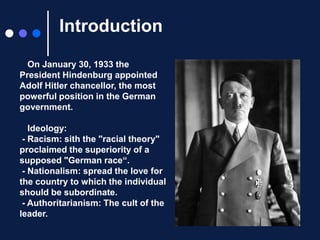
Introduction● On January 30, 1933 the President Hindenburg appointed Adolf Hitler chancellor, the most powerful position in the German government.●Ideology: - Racism: siththe "racial theory" proclaimedthesuperiority of a supposed "Germanrace“. - Nationalism: spread theloveforthe country towhichthe individual shouldbesubordinate. - Authoritarianism: Thecult of the leader.
The Holocaust● “Holocaust" is a word of Greek origin meaning "sacrifice by fire“.● Persecutionand murder of approximately six million Jews by the Nazi regime.● The Nazis believed that Germans were "racially superior“.● German authorities targeted other groups because of their perceived "racial inferiority": Gypsies, Poles, Russians, and other groups were persecuted on political, ideological, and behavioral grounds, among them Communists, Socialists, Jehovah's Witnesses and homosexuals.
Victims● In 1933, the Jewish population of Europe stood at over nine million.● By 1945, the Germans and their collaborators killed nearly 2/3 European Jews as part of the "Final Solution“.● Other victims: - 200,000 Gypsies.- 200,000 mentally or physically disabled patients, were murdered in the Euthanasia Program.
Children:More thanonemillionchildrenweremurderedunder Nazi rule in Germany and Europe.
In theghettos, manydiedfromlack of food, clothing and housing.
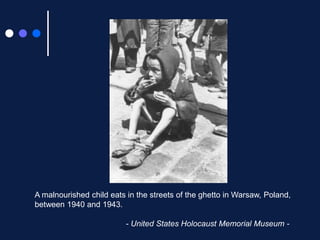
Forced labor, gas chambers and medicalexperiments.A malnourished child eats in the streets of the ghetto in Warsaw, Poland, between 1940 and 1943.- United States Holocaust Memorial Museum -
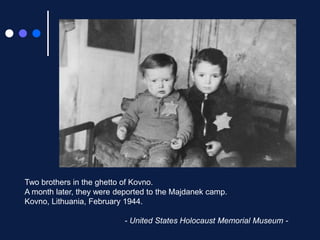
Two brothers in the ghetto of Kovno. A month later, they were deported to the Majdanek camp. Kovno, Lithuania, February 1944.                                              - United States Holocaust Memorial Museum -
Women:Both Jewish and non-Jews women, were subjected to a single strong persecution.
Ravensbrueck, the largest camp established for women.
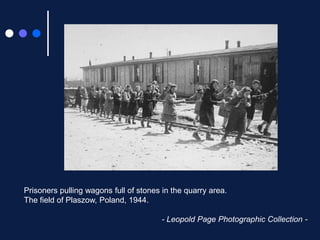
Unethical human experiments, harassment and rape.

The holocaust

  • 1.
    THE HOLOCAUSTAlba ChocánAlexandre1º Grado en HistoriaInglésUniversidad de CantabriaCurso 2010-2011
  • 2.
    Introduction● On January30, 1933 the President Hindenburg appointed Adolf Hitler chancellor, the most powerful position in the German government.●Ideology: - Racism: siththe "racial theory" proclaimedthesuperiority of a supposed "Germanrace“. - Nationalism: spread theloveforthe country towhichthe individual shouldbesubordinate. - Authoritarianism: Thecult of the leader.
  • 3.
    The Holocaust● “Holocaust"is a word of Greek origin meaning "sacrifice by fire“.● Persecutionand murder of approximately six million Jews by the Nazi regime.● The Nazis believed that Germans were "racially superior“.● German authorities targeted other groups because of their perceived "racial inferiority": Gypsies, Poles, Russians, and other groups were persecuted on political, ideological, and behavioral grounds, among them Communists, Socialists, Jehovah's Witnesses and homosexuals.
  • 4.
    Victims● In 1933,the Jewish population of Europe stood at over nine million.● By 1945, the Germans and their collaborators killed nearly 2/3 European Jews as part of the "Final Solution“.● Other victims: - 200,000 Gypsies.- 200,000 mentally or physically disabled patients, were murdered in the Euthanasia Program.
  • 5.
  • 6.
    In theghettos, manydiedfromlackof food, clothing and housing.
  • 7.
    Forced labor, gaschambers and medicalexperiments.A malnourished child eats in the streets of the ghetto in Warsaw, Poland, between 1940 and 1943.- United States Holocaust Memorial Museum -
  • 8.
    Two brothers inthe ghetto of Kovno. A month later, they were deported to the Majdanek camp. Kovno, Lithuania, February 1944. - United States Holocaust Memorial Museum -
  • 9.
    Women:Both Jewish andnon-Jews women, were subjected to a single strong persecution.
  • 10.
    Ravensbrueck, the largestcamp established for women.
  • 11.
    Unethical human experiments,harassment and rape.