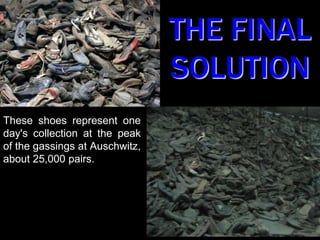
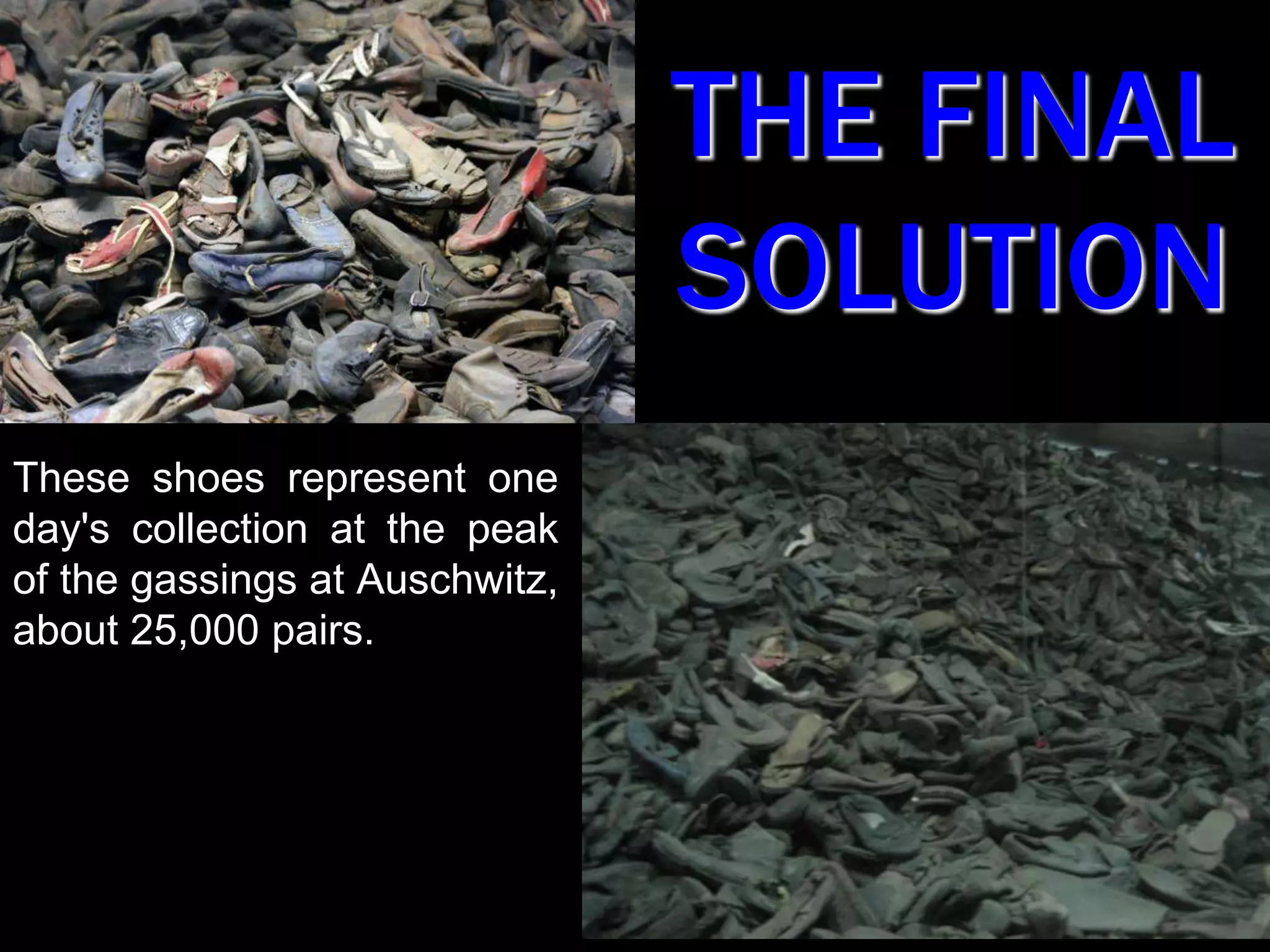

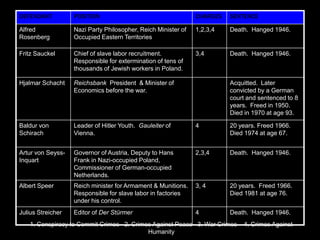

THE FINALSOLUTIONThese shoes represent one day's collection at the peak of the gassings at Auschwitz, about 25,000 pairs.
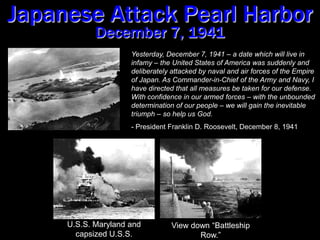
Japanese Attack Pearl HarborDecember 7, 1941Yesterday, December 7, 1941 – a date which will live in infamy – the United States of America was suddenly and deliberately attacked by naval and air forces of the Empire of Japan. As Commander-in-Chief of the Army and Navy, I have directed that all measures be taken for our defense.  With confidence in our armed forces – with the unbounded determination of our people – we will gain the inevitable triumph – so help us God.- President Franklin D. Roosevelt, December 8, 1941U.S.S. Maryland and capsized U.S.S. Oklahoma.View down “Battleship Row.”
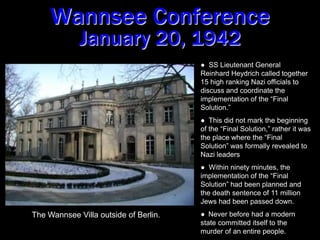
Wannsee ConferenceJanuary 20, 1942  SS Lieutenant General Reinhard Heydrich called together 15 high ranking Nazi officials to discuss and coordinate the implementation of the “Final Solution.”
  This did not mark the beginning of the “Final Solution,” rather it was the place where the “Final Solution” was formally revealed to Nazi leaders
  Within ninety minutes, the implementation of the “Final Solution” had been planned and the death sentence of 11 million Jews had been passed down.
Never before had a modern state committed itself to the murder of an entire people.The Wannsee Villa outside of Berlin.
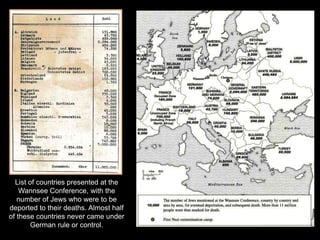
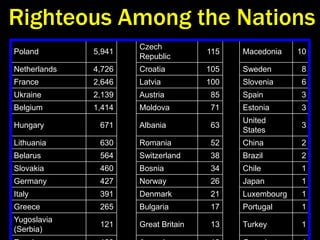
List of countries presented at the Wannsee Conference, with the number of Jews who were to be deported to their deaths. Almost half of these countries never came under German rule or control.
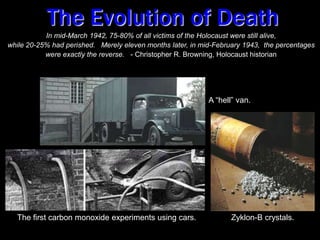
The Evolution of DeathIn mid-March 1942, 75-80% of all victims of the Holocaust were still alive,                                               while 20-25% had perished.   Merely eleven months later, in mid-February 1943,  the percentages were exactly the reverse.   - Christopher R. Browning, Holocaust historian A “hell” van.The first carbon monoxide experiments using cars.Zyklon-B crystals.
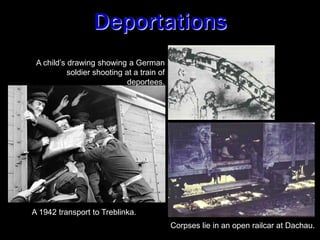
DeportationsA child’s drawing showing a German soldier shooting at a train of deportees.A 1942 transport to Treblinka.Corpses lie in an open railcar at Dachau.
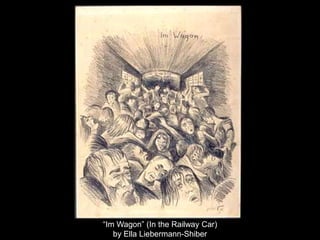
“Im Wagon” (In the Railway Car) by Ella Liebermann-Shiber
Written in Pencil                           in a Sealed Railway Carhere in this carloadi am evewith abel my sonif you see my other soncain son of man …tell him I
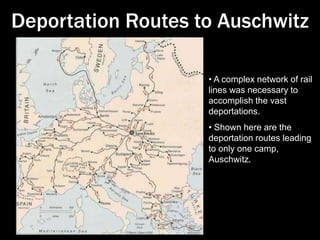
Deportation Routes to Auschwitz A complex network of rail lines was necessary to accomplish the vast deportations.
 Shown here are the deportation routes leading to only one camp, Auschwitz.The CampsConcentration camp: camp in which people are detained, often in harsh conditions and w/o legal norms of arrest and imprisonment
20,000Nazi established camps 1933-1945!
Purposes: labor camps, POW camps, transit camps, extermination camps.
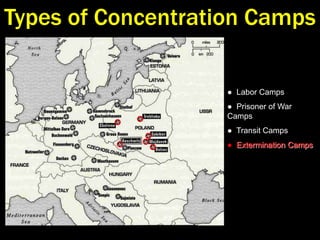
Only 6 extermination/death camps, all in PolandTypes of Concentration Camps  Labor Camps
  Prisoner of War Camps
  Transit Camps
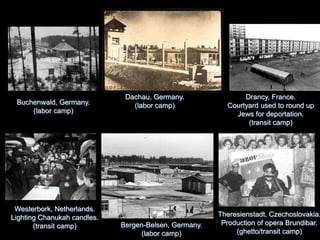
Extermination CampsDachau, Germany.  (labor camp)Drancy, France.                        Courtyard used to round up Jews for deportation.      (transit camp) Buchenwald, Germany.  (labor camp) Westerbork, Netherlands.           Lighting Chanukah candles.  (transit camp)Theresienstadt, Czechoslovakia. Production of opera Brundibar.  (ghetto/transit camp)Bergen-Belsen, Germany.  (labor camp)
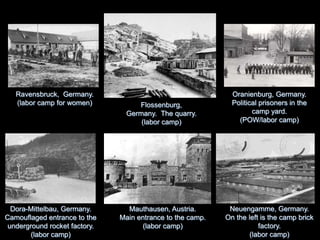
Ravensbruck,  Germany.  (labor camp for women)             Oranienburg, Germany.              Political prisoners in the camp yard.            (POW/labor camp)Flossenburg, Germany.  The quarry.            (labor camp)Neuengamme, Germany.                         On the left is the camp brick factory.                                   (labor camp)Mauthausen, Austria.                                    Main entrance to the camp.  (labor camp)Dora-Mittelbau, Germany.             Camouflaged entrance to the underground rocket factory.        (labor camp)
Extermination CampsBy winter 1941, 1.5 million Jews dead but 11 million Jews targeted for annihilation at Wannsee Conference.Using Germany‘s scientists, businessmen, engineers and officials, the Nazis built a modern and efficient way to eliminate the Jews: elaborate train system; 1 m.+ people to operate and maintain. 1942-1944 ghettos were liquidated; “Resettlement” to Labor/ Extermination Camps in the East. In USSR, Einsatzgruppenkilled Jews on the spot; no need for extermination camps. In Western Europe, no closed ghettos and Jews integrated into society. Send Jews by 3rd class rail to a transit camp and from there to the east.
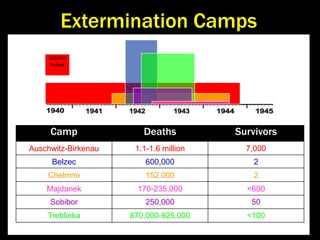
Extermination Camps~ 50% of Jewish victims gassed w/ Diesel exhaust; as many as killed by Zyklon-B
Hitler never visited death camp; Himmler did, gassing made him ill
Operation Reinhard camps: Belzec, Sobibor and Treblinka –for killing Jews in the General Government, run by OdiloGlobocnik
Other three camps – Auschwitz, Chelmno, and Majdanek – for killing the rest of Europe’s Jews
June 6, 1944: D-day. By then, majority of Holocaust victims already deadExtermination Camps100,000Victims
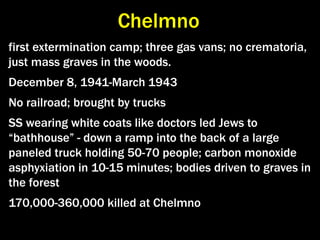
Chelmnofirst extermination camp; three gas vans; no crematoria, just mass graves in the woods. December 8, 1941-March 1943 No railroad; brought by trucksSS wearing white coats like doctors led Jews to “bathhouse” - down a ramp into the back of a large paneled truck holding 50-70 people; carbon monoxide asphyxiation in 10-15 minutes; bodies driven to graves in the forest170,000-360,000 killed at Chelmno
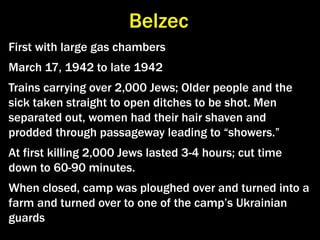
BelzecFirst with large gas chambersMarch 17, 1942 to late 1942Trains carrying over 2,000 Jews; Older people and the sick taken straight to open ditches to be shot. Men separated out, women had their hair shaven and prodded through passageway leading to “showers.” At first killing 2,000 Jews lasted 3-4 hours; cut time down to 60-90 minutes. When closed, camp was ploughed over and turned into a farm and turned over to one of the camp’s Ukrainian guards
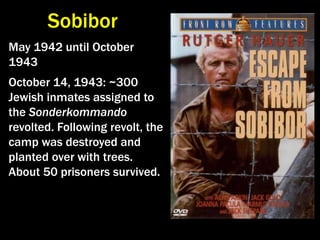
SobiborMay 1942 until October 1943 October 14, 1943: ~300 Jewish inmates assigned to the Sonderkommandorevolted. Following revolt, the camp was destroyed and planted over with trees. About 50 prisoners survived.
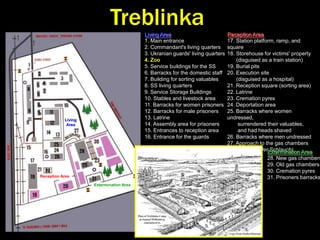
TreblinkaLiving Area1. Main entrance 2. Commandant's living quarters 3. Ukranian guards' living quarters 4. Zoo 5. Service buildings for the SS 6. Barracks for the domestic staff 7. Building for sorting valuables 8. SS living quarters 9. Service Storage Buildings 10. Stables and livestock area 11. Barracks for women prisoners 12. Barracks for male prisoners 13. Latrine 14. Assembly area for prisoners 15. Entrances to reception area16. Entrance for the guardsReception Area17. Station platform, ramp, and square 18. Storehouse for victims' property       (disguised as a train station) 19. Burial pits 20. Execution site       (disguised as a hospital) 21. Reception square (sorting area) 22. Latrine 23. Cremation pyres 24. Deportation area 25. Barracks where women undressed,        surrendered their valuables,       and had heads shaved 26. Barracks where men undressed 27. Approach to the gas chambers(the tube, der Schlauch)Living AreaExtermination Area28. New gas chambers 29. Old gas chambers 30. Cremation pyres 31. Prisoners barracksReception AreaExtermination Area
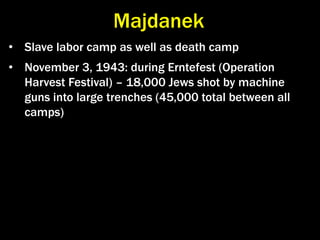
MajdanekSlave labor camp as well as death camp
November 3, 1943: during Erntefest(Operation Harvest Festival) – 18,000 Jews shot by machine guns into large trenches (45,000 total between all camps)AuschwitzAt Auschwitz, not only did man die, but the image of man died.  - Elie Wiesel
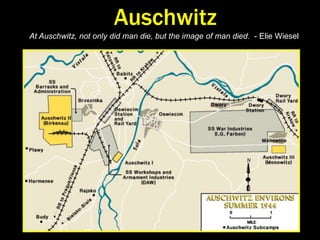
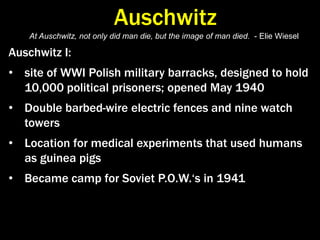
AuschwitzAt Auschwitz, not only did man die, but the image of man died.  - Elie WieselAuschwitz I:site of WWI Polish military barracks, designed to hold 10,000 political prisoners; opened May 1940
Double barbed-wire electric fences and nine watch towers
Location for medical experiments that used humans as guinea pigs
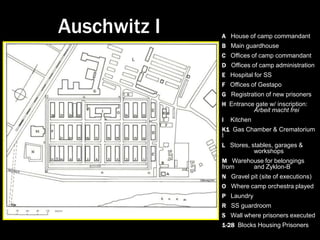
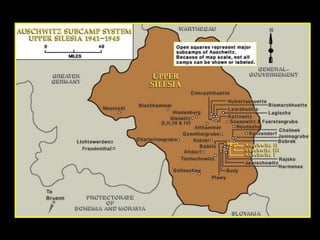
Became camp for Soviet P.O.W.‘s in 1941 Auschwitz IA   House of camp commandantB   Main guardhouseC   Offices of camp commandantD   Offices of camp administrationE   Hospital for SSF   Offices of GestapoG   Registration of new prisonersH  Entrance gate w/ inscription:       	Arbeit macht freiI    KitchenK1  Gas Chamber & Crematorium IL   Stores, stables, garages & 	workshopsM   Warehouse for belongings from 	and Zyklon-BN   Gravel pit (site of executions)O   Where camp orchestra playedP   LaundryR   SS guardroomS   Wall where prisoners executed1-28  Blocks Housing Prisoners
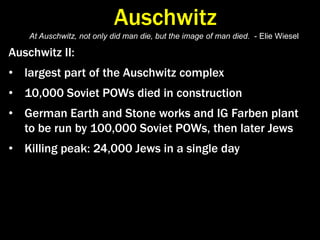
AuschwitzAt Auschwitz, not only did man die, but the image of man died.  - Elie WieselAuschwitz II:largest part of the Auschwitz complex
10,000 Soviet POWs died in construction
German Earth and Stone works and IGFarben plant to be run by 100,000 Soviet POWs, then later Jews
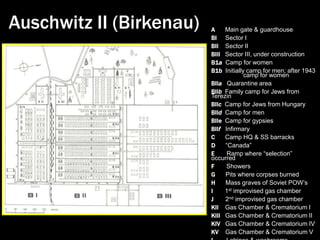
Killing peak: 24,000 Jews in a single dayAuschwitz II (Birkenau)A      Main gate & guardhouseBI     Sector IBII    Sector IIBIII   Sector III, under constructionB1aCamp for womenB1b  Initially camp for men; after 1943 	camp for womenBIIaQuarantine areaBIIbFamily camp for Jews from TerezinBIIcCamp for Jews from HungaryBIIdCamp for menBIIe  Camp for gypsiesBIIf   InfirmaryC      Camp HQ & SS barracksD      “Canada”E       Ramp where “selection” occurredF       ShowersG      Pits where corpses burnedH      Mass graves of Soviet POW’sI       1st improvised gas chamberJ       2nd improvised gas chamberKII    Gas Chamber & Crematorium IKIII   Gas Chamber & Crematorium IIKIV   Gas Chamber & Crematorium IVKV    Gas Chamber & Crematorium VL       Latrines & washrooms
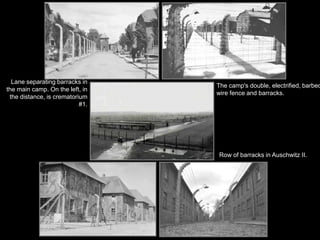
Lane separating barracks in the main camp. On the left, in the distance, is crematorium #1. The camp's double, electrified, barbed wire fence and barracks. Row of barracks in Auschwitz II.
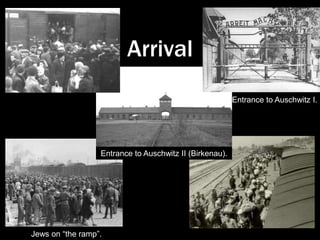
ArrivalEntrance to Auschwitz I.Entrance to Auschwitz II (Birkenau). Jews on “the ramp”.
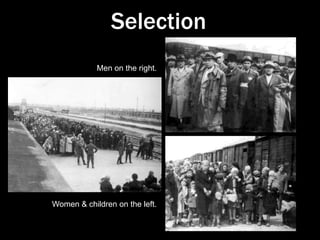
SelectionMen on the right.Women & children on the left.
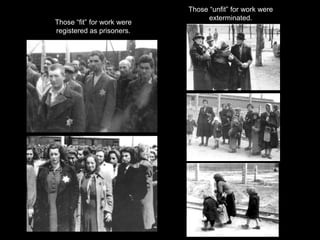
Those “unfit” for work were exterminated.Those “fit” for work were registered as prisoners.
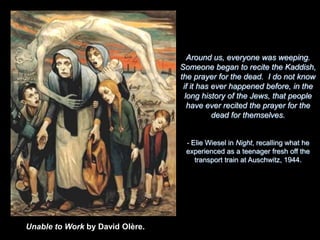
Around us, everyone was weeping.  Someone began to recite the Kaddish, the prayer for the dead.  I do not know if it has ever happened before, in the long history of the Jews, that people have ever recited the prayer for the dead for themselves.- Elie Wiesel in Night, recalling what he experienced as a teenager fresh off the transport train at Auschwitz, 1944.Unable to Work by David Olère.
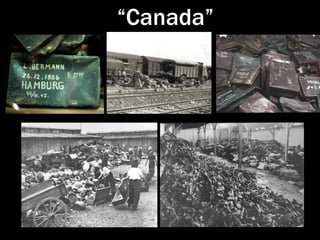
“Canada”
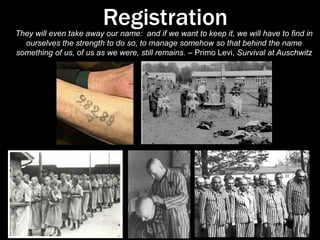
RegistrationThey will even take away our name:  and if we want to keep it, we will have to find in ourselves the strength to do so, to manage somehow so that behind the name something of us, of us as we were, still remains. – Primo Levi, Survival at Auschwitz
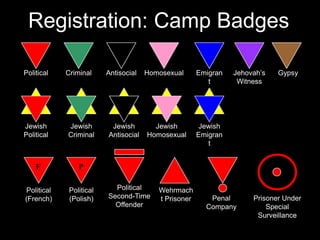
Registration: Camp BadgesPoliticalCriminalAntisocialHomosexualEmigrantJehovah’s WitnessGypsyJewish PoliticalJewish CriminalJewish AntisocialJewish HomosexualJewish EmigrantFPPolitical Second-Time OffenderPolitical (French)Wehrmacht PrisonerPolitical (Polish)Penal CompanyPrisoner Under Special Surveillance
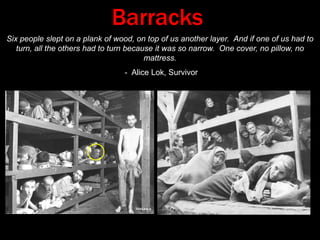
BarracksSix people slept on a plank of wood, on top of us another layer.  And if one of us had to turn, all the others had to turn because it was so narrow.  One cover, no pillow, no mattress.-  Alice Lok, Survivor
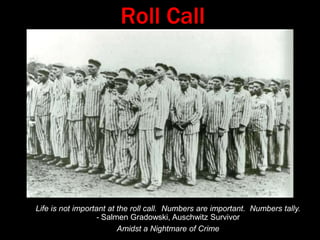
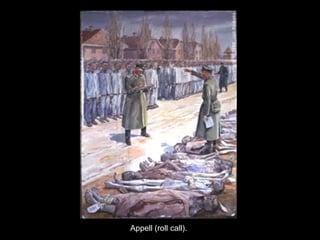
Roll CallLife is not important at the roll call.  Numbers are important.  Numbers tally.       - Salmen Gradowski, Auschwitz SurvivorAmidst a Nightmare of Crime
Appell (roll call).
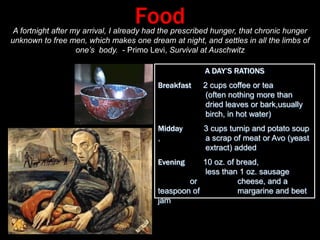
FoodA fortnight after my arrival, I already had the prescribed hunger, that chronic hunger unknown to free men, which makes one dream at night, and settles in all the limbs of one’s  body.  - Primo Levi, Survival at AuschwitzA DAY’S RATIONSBreakfast      2 cups coffee or tea		       (often nothing more than                             	       dried leaves or bark,usually                             	       birch, in hot water)Midday	       3 cups turnip and potato soup , 	       a scrap of meat or Avo (yeast 	       extract) addedEvening	      10 oz. of bread,                       	       less than 1 oz. sausage 	or 	       cheese, and a teaspoon of 	       margarine and beet jam
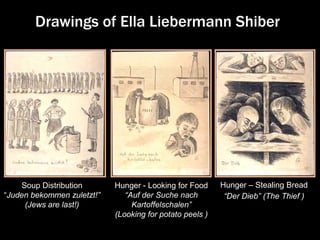
Drawings of Ella Liebermann ShiberHunger - Looking for Food      “Auf der Suche nach Kartoffelschalen”             (Looking for potato peels )Soup Distribution           “Juden bekommen zuletzt!” (Jews are last!)Hunger – Stealing Bread“Der Dieb” (The Thief )
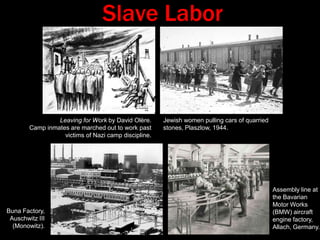
Slave LaborJewish women pulling cars of quarried stones, Plaszlow, 1944. Leaving for Work by David Olère.                  Camp inmates are marched out to work past victims of Nazi camp discipline. Assembly line at the Bavarian Motor Works (BMW) aircraft engine factory, Allach, Germany. Buna Factory,                                Auschwitz III (Monowitz).
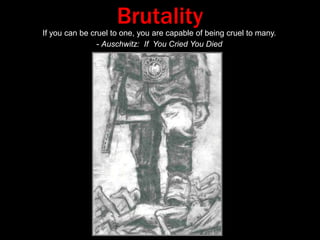
BrutalityIf you can be cruel to one, you are capable of being cruel to many.- Auschwitz:  If  You Cried You Died
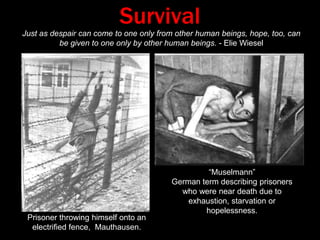
SurvivalJust as despair can come to one only from other human beings, hope, too, can be given to one only by other human beings. - Elie Wiesel“Muselmann”                          German term describing prisoners who were near death due to exhaustion, starvation or hopelessness. Prisoner throwing himself onto an electrified fence,  Mauthausen.
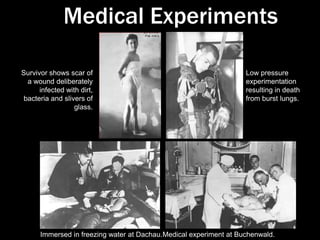
Medical ExperimentsLow pressure experimentation resulting in death from burst lungs.Survivor shows scar of a wound deliberately infected with dirt, bacteria and slivers of glass.Medical experiment at Buchenwald. Immersed in freezing water at Dachau.
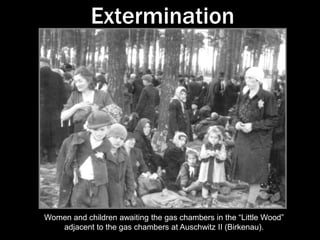
ExterminationWomen and children awaiting the gas chambers in the “Little Wood” adjacent to the gas chambers at Auschwitz II (Birkenau).
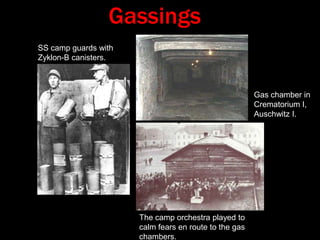
GassingsSS camp guards with Zyklon-B canisters.Gas chamber in Crematorium I, Auschwitz I. The camp orchestra played to calm fears en route to the gas chambers.
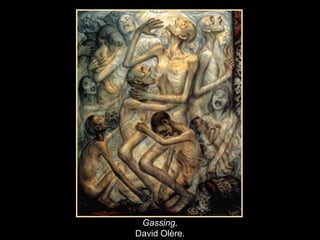
GassingsGassing,                                       David Olère.
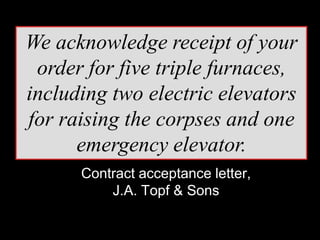
We acknowledge receipt of your order for five triple furnaces, including two electric elevators for raising the corpses and one emergency elevator. Contract acceptance letter,                          J.A. Topf & Sons
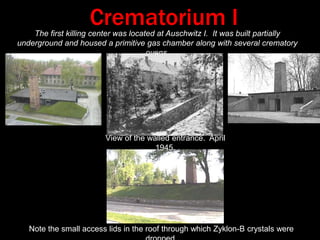
Crematorium IThe first killing center was located at Auschwitz I.  It was built partially underground and housed a primitive gas chamber along with several crematory ovens. View of the walled entrance.  April 1945.Note the small access lids in the roof through which Zyklon-B crystals were dropped.
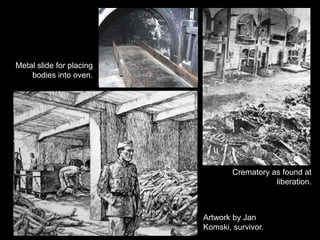
Metal slide for placing bodies into oven. Crematory as found at liberation.Artwork by Jan Komski, survivor.
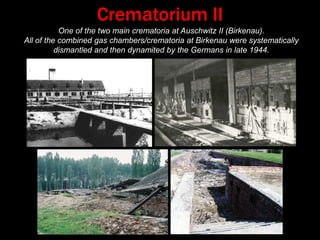
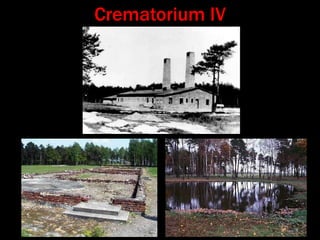
Crematorium IIOne of the two main crematoria at Auschwitz II (Birkenau).                                      All of the combined gas chambers/crematoria at Birkenau were systematically dismantled and then dynamited by the Germans in late 1944. Crematorium-IV. One of two 'crematoria in the woods', this and Crematoria-V are located in a field of birch trees (Birkenau means 'place with Birch trees') and out of view from the main barracks area.
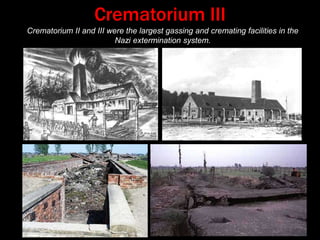
Crematorium IIICrematorium II and III were the largest gassing and cremating facilities in the Nazi extermination system.
Crematorium IV
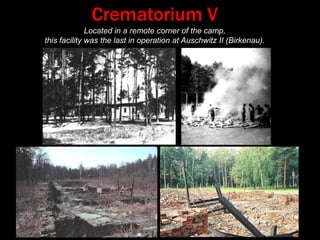
Crematorium VLocated in a remote corner of the camp,                                                                        this facility was the last in operation at Auschwitz II (Birkenau).
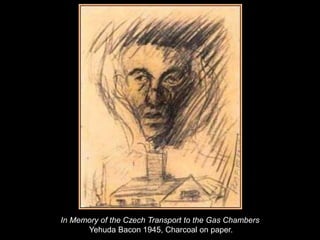
In Memory of the Czech Transport to the Gas Chambers Yehuda Bacon 1945, Charcoal on paper.
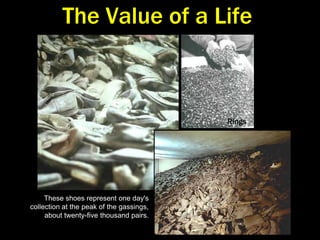
The Value of a LifeRingsThese shoes represent one day's collection at the peak of the gassings, about twenty-five thousand pairs.
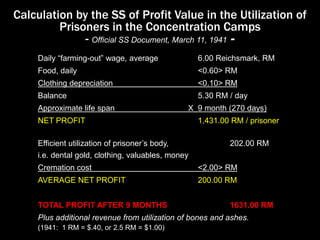
Calculation by the SS of Profit Value in the Utilization of Prisoners in the Concentration Camps                                    - Official SS Document, March 11, 1941 -Daily “farming-out” wage, average		6.00 Reichsmark, RMFood, daily				<0.60> RMClothing depreciation			<0.10> RMBalance					5.30 RM / dayApproximate life span		          X	9 month (270 days)NET PROFIT				1,431.00 RM / prisonerEfficient utilization of prisoner’s body,		202.00 RMi.e. dental gold, clothing, valuables, moneyCremation cost				<2.00> RMAVERAGE NET PROFIT			200.00 RMTOTAL PROFIT AFTER 9 MONTHS		1631.00 RMPlus additional revenue from utilization of bones and ashes.(1941:  1 RM = $.40, or 2.5 RM = $1.00)
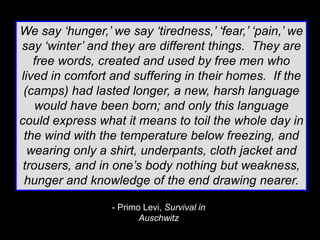
We say ‘hunger,’ we say ‘tiredness,’ ‘fear,’ ‘pain,’ we say ‘winter’ and they are different things.  They are free words, created and used by free men who lived in comfort and suffering in their homes.  If the (camps) had lasted longer, a new, harsh language would have been born; and only this language could express what it means to toil the whole day in the wind with the temperature below freezing, and wearing only a shirt, underpants, cloth jacket and trousers, and in one’s body nothing but weakness, hunger and knowledge of the end drawing nearer.- Primo Levi, Survival in Auschwitz
Resistance
Obstacles to ResistanceSuperior armed power of the Germans.German tactic of “collective responsibility.”Secrecy and deception of deportations.Family ties and responsibilities.Absence of a non-Jewish population willing to help.
Jewish ResistanceTo smuggle a loaf of bread – was to resist.To teach in secret – was to resist.To cry out in warning and shatter illusions – was to resist.To rescue a Torah Scroll – was to resist.To forge documents – was to resist.To smuggle people across borders – was to resist.To chronicle events and conceal the records – was to resist.To hold out a helping hand to the needy – was to resist.To contact those under siege and smuggle weapons – was to resist.To fight with weapons in streets, mountains, and forests – was to resist.To rebel in death camps – was to resist.To rise up in ghettos, among the crumbling walls, in the most desperate revolt 	– was to resist.Taken from a wall on resistance at the Ghetto Fighters House.
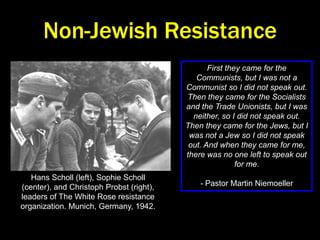
Non-Jewish ResistanceFirst they came for the Communists, but I was not a Communist so I did not speak out.Then they came for the Socialists and the Trade Unionists, but I was neither, so I did not speak out.Then they came for the Jews, but I was not a Jew so I did not speak out. And when they came for me, there was no one left to speak out for me. - Pastor Martin NiemoellerHans Scholl (left), Sophie Scholl (center), and Christoph Probst (right), leaders of The White Rose resistance organization. Munich, Germany, 1942.
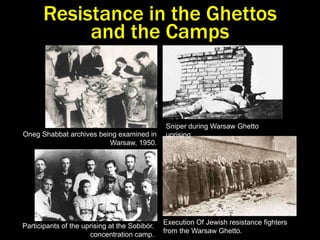
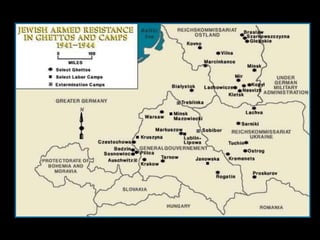
Resistance in the Ghettos and the CampsSniper during Warsaw Ghetto uprising.Oneg Shabbat archives being examined in Warsaw, 1950.Execution Of Jewish resistance fighters from the Warsaw Ghetto.Participants of the uprising at the Sobibór. concentration camp.
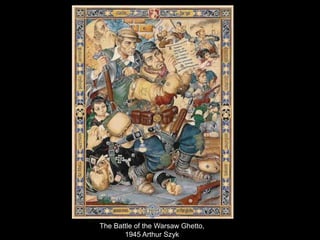
The Battle of the Warsaw Ghetto, 1945 Arthur Szyk
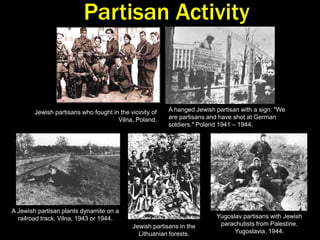
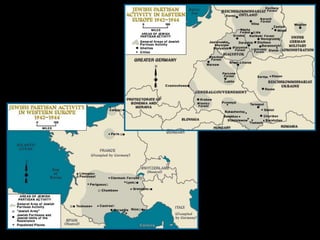
Partisan ActivityA hanged Jewish partisan with a sign: "We are partisans and have shot at German soldiers." Poland 1941 – 1944. Jewish partisans who fought in the vicinity of Vilna, Poland.A Jewish partisan plants dynamite on a railroad track. Vilna, 1943 or 1944.Yugoslav partisans with Jewish parachutists from Palestine. Yugoslavia, 1944. Jewish partisans in the Lithuanian forests.
The Final Stages of the War
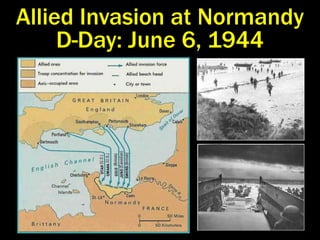
Allied Invasion at Normandy  D-Day: June 6, 1944
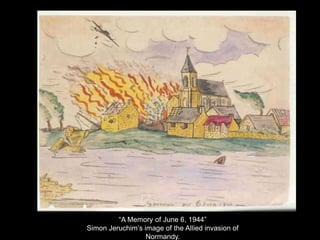
“A Memory of June 6, 1944”Simon Jeruchim’s image of the Allied invasion of Normandy.
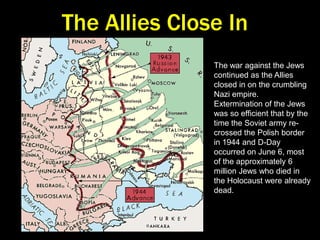
The Allies Close InThe war against the Jews continued as the Allies closed in on the crumbling Nazi empire.  Extermination of the Jews was so efficient that by the time the Soviet army re-crossed the Polish border in 1944 and D-Day occurred on June 6, most of the approximately 6 million Jews who died in the Holocaust were already dead.
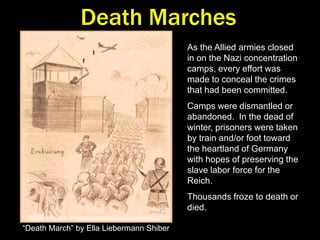
Death MarchesAs the Allied armies closed in on the Nazi concentration camps, every effort was made to conceal the crimes that had been committed.Camps were dismantled or abandoned.  In the dead of winter, prisoners were taken by train and/or foot toward the heartland of Germany with hopes of preserving the slave labor force for the Reich.Thousands froze to death or died.“Death March” by Ella Liebermann Shiber
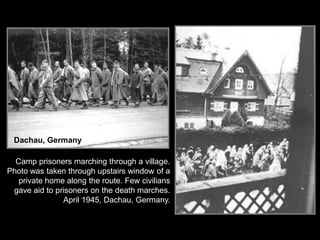
Dachau, Germany Camp prisoners marching through a village. Photo was taken through upstairs window of a private home along the route. Few civilians gave aid to prisoners on the death marches.                                                                   April 1945, Dachau, Germany.
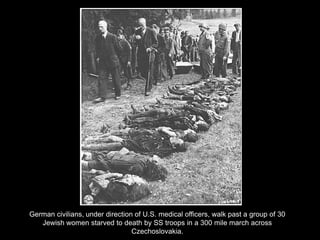
German civilians, under direction of U.S. medical officers, walk past a group of 30 Jewish women starved to death by SS troops in a 300 mile march across Czechoslovakia.
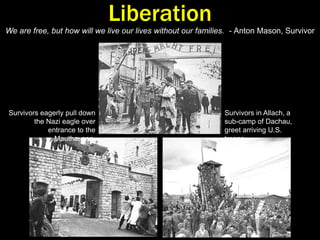
LiberationWe are free, but how will we live our lives without our families.  - Anton Mason, SurvivorSurvivors in Allach, a sub-camp of Dachau, greet arriving U.S. troops. Survivors eagerly pull down the Nazi eagle over entrance to the Mauthausen.
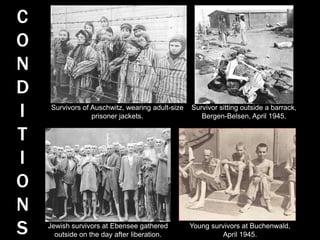
CONDITIONSSurvivor sitting outside a barrack, Bergen-Belsen, April 1945.Survivors of Auschwitz, wearing adult-size prisoner jackets.Jewish survivors at Ebensee gathered outside on the day after liberation.Young survivors at Buchenwald,April 1945.
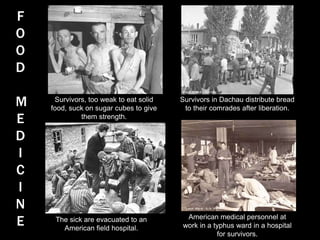
FOOD ♦MEDICINESurvivors in Dachau distribute bread to their comrades after liberation. Survivors, too weak to eat solid food, suck on sugar cubes to give them strength.American medical personnel at work in a typhus ward in a hospital for survivors. The sick are evacuated to an American field hospital.
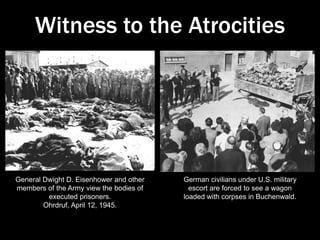
Witness to the AtrocitiesGeneral Dwight D. Eisenhower and other members of the Army view the bodies of executed prisoners.                                          Ohrdruf, April 12, 1945. German civilians under U.S. military escort are forced to see a wagon loaded with corpses in Buchenwald.
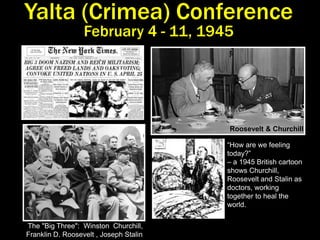
Yalta (Crimea) Conference February 4 - 11, 1945Roosevelt & Churchill“How are we feeling today?” – a 1945 British cartoon shows Churchill,Roosevelt and Stalin as doctors, working together to heal the world.    The "Big Three":  Winston  Churchill,             Franklin D. Roosevelt , Joseph Stalin 
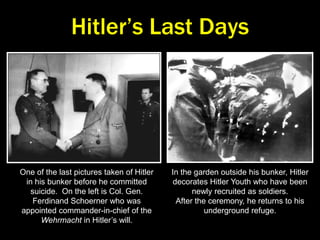
Hitler’s Last DaysOne of the last pictures taken of Hitler in his bunker before he committed suicide.  On the left is Col. Gen. Ferdinand Schoerner who was appointed commander-in-chief of the Wehrmacht in Hitler’s will.In the garden outside his bunker, Hitler decorates Hitler Youth who have been newly recruited as soldiers.                 After the ceremony, he returns to his underground refuge.
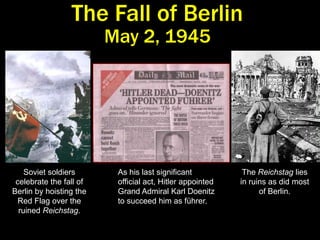
The Fall of BerlinMay 2, 1945The Reichstag lies in ruins as did most of Berlin.Soviet soldiers celebrate the fall of Berlin by hoisting the Red Flag over the ruined Reichstag.  As his last significant official act, Hitler appointed Grand Admiral Karl Doenitz to succeed him as führer.
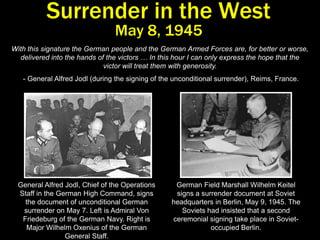
Surrender in the WestMay 8, 1945With this signature the German people and the German Armed Forces are, for better or worse, delivered into the hands of the victors … In this hour I can only express the hope that the victor will treat them with generosity. - General Alfred Jodl (during the signing of the unconditional surrender), Reims, France. Move to last days??????????General Alfred Jodl, Chief of the Operations Staff in the German High Command, signs the document of unconditional German surrender on May 7. Left is Admiral Von Friedeburg of the German Navy. Right is Major Wilhelm Oxenius of the German General Staff. German Field Marshall Wilhelm Keitel signs a surrender document at Soviet headquarters in Berlin, May 9, 1945. The Soviets had insisted that a second ceremonial signing take place in Soviet-occupied Berlin.
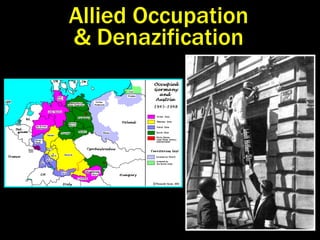
Allied Occupation        & Denazification
The Aftermath
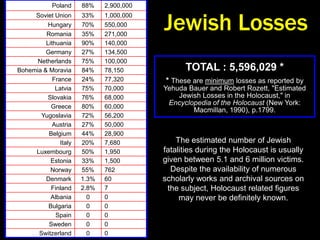
Jewish LossesTOTAL :5,596,029 **These are minimum losses as reported by Yehuda Bauer and Robert Rozett, "Estimated Jewish Losses in the Holocaust," in Encyclopedia of the Holocaust (New York: Macmillan, 1990), p.1799. The estimated number of Jewish fatalities during the Holocaust is usually given between 5.1 and 6 million victims.     Despite the availability of numerous scholarly works and archival sources on the subject, Holocaust related figures may never be definitely known.
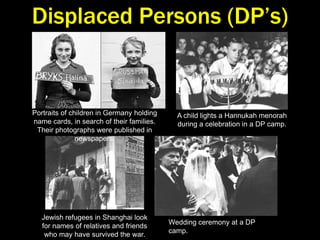
Displaced Persons (DP’s)Portraits of children in Germany holding name cards, in search of their families.  Their photographs were published in newspapers. A child lights a Hannukah menorah during a celebration in a DP camp. Jewish refugees in Shanghai look for names of relatives and friends who may have survived the war. Wedding ceremony at a DP camp.
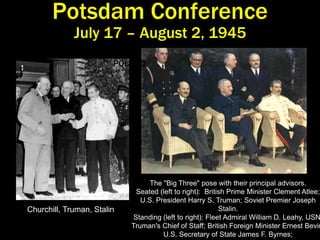
Potsdam ConferenceJuly 17 – August 2, 1945POLANDThe "Big Three" pose with their principal advisors.                Seated (left to right):  British Prime Minister Clement Atlee;     U.S. President Harry S. Truman; Soviet Premier Joseph Stalin.Standing (left to right): Fleet Admiral William D. Leahy, USN, Truman's Chief of Staff; British Foreign Minister Ernest Bevin; U.S. Secretary of State James F. Byrnes;                                              Soviet Foreign Minister Vyacheslav Molotov. Churchill, Truman, Stalin
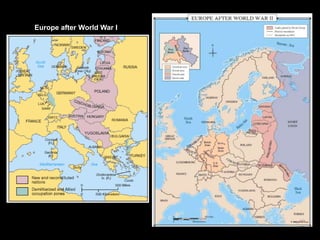
Europe after World War I
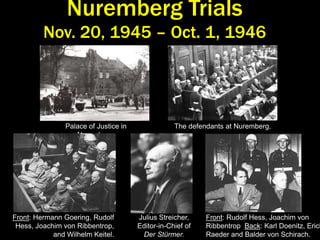
Nuremberg TrialsNov. 20, 1945 – Oct. 1, 1946The defendants at Nuremberg. Palace of Justice in Nuremberg. Julius Streicher,    Editor-in-Chief of      Der Stürmer.Front: Hermann Goering, Rudolf Hess, Joachim von Ribbentrop, and Wilhelm Keitel.Front: Rudolf Hess, Joachim von Ribbentrop  Back: Karl Doenitz, Erich Raeder and Balder von Schirach.
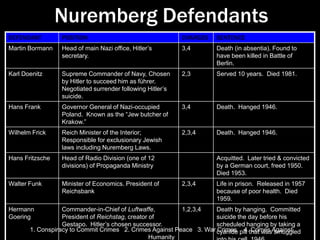
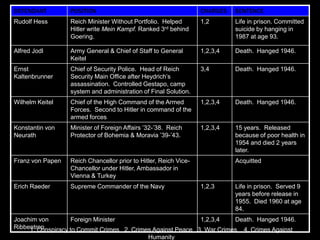
Nuremberg Defendants1. Conspiracy to Commit Crimes   2. Crimes Against Peace   3. War Crimes    4. Crimes Against Humanity
1. Conspiracy to Commit Crimes   2. Crimes Against Peace   3. War Crimes    4. Crimes Against Humanity
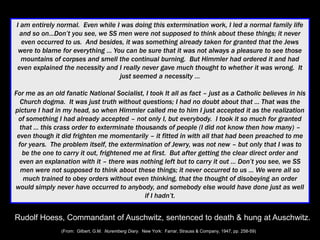
I am entirely normal.  Even while I was doing this extermination work, I led a normal family life and so on…Don’t you see, we SS men were not supposed to think about these things; it never even occurred to us.  And besides, it was something already taken for granted that the Jews were to blame for everything … You can be sure that it was not always a pleasure to see those mountains of corpses and smell the continual burning.  But Himmler had ordered it and had even explained the necessity and I really never gave much thought to whether it was wrong.  It just seemed a necessity …For me as an old fanatic National Socialist, I took It all as fact – just as a Catholic believes in his Church dogma.  It was just truth without questions; I had no doubt about that … That was the picture I had in my head, so when Himmler called me to him I just accepted it as the realization of something I had already accepted – not only I, but everybody.  I took it so much for granted that … this crass order to exterminate thousands of people (I did not know then how many) – even though it did frighten me momentarily – it fitted in with all that had been preached to me for years.  The problem itself, the extermination of Jewry, was not new – but only that I was to be the one to carry it out, frightened me at first.  But after getting the clear direct order and even an explanation with it – there was nothing left but to carry it out … Don’t you see, we SS men were not supposed to think about these things; it never occurred to us … We were all so much trained to obey orders without even thinking, that the thought of disobeying an order would simply never have occurred to anybody, and somebody else would have done just as well if I hadn’t.Rudolf Hoess, Commandant of Auschwitz, sentenced to death & hung at Auschwitz.(From:  Gilbert, G.M.  Nuremberg Diary.  New York: Farrar, Strauss & Company, 1947, pp. 258-59)
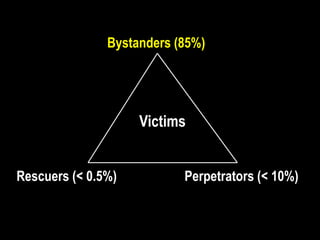
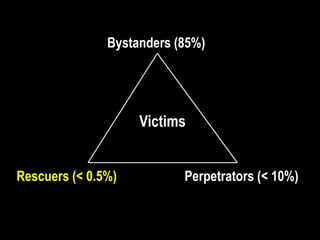
Bystanders (85%)VictimsPerpetrators (< 10%)Rescuers (< 0.5%)
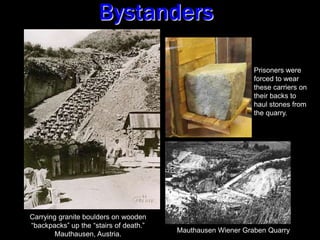
BystandersPrisoners were forced to wear these carriers on their backs to haul stones from the quarry. Carrying granite boulders on wooden “backpacks” up the “stairs of death.”  Mauthausen, Austria.Mauthausen Wiener Graben Quarry
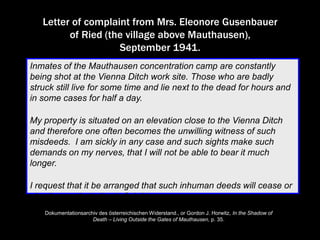
Letter of complaint from Mrs. Eleonore Gusenbauer                of Ried (the village above Mauthausen),                                September 1941.Inmates of the Mauthausen concentration camp are constantly being shot at the Vienna Ditch work site. Those who are badly struck still live for some time and lie next to the dead for hours and in some cases for half a day.My property is situated on an elevation close to the Vienna Ditch and therefore one often becomes the unwilling witness of such misdeeds.  I am sickly in any case and such sights make such demands on my nerves, that I will not be able to bear it much longer.I request that it be arranged that such inhuman deeds will cease or else be conducted out of sight.Dokumentationsarchiv des österreichischen Widerstand., or Gordon J. Horwitz, In the Shadow of Death – Living Outside the Gates of Mauthausen, p. 35.
Bystanders (85%)VictimsPerpetrators (< 10%)Rescuers (< 0.5%)
Rescue
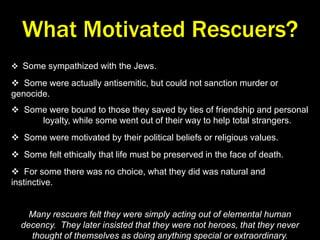
What Motivated Rescuers?Some sympathized with the Jews.
  Some were actually antisemitic, but could not sanction murder or genocide.
  Some were bound to those they saved by ties of friendship and personal 	loyalty, while some went out of their way to help total strangers.
  Some were motivated by their political beliefs or religious values.
  Some felt ethically that life must be preserved in the face of death.
  For some there was no choice, what they did was natural and instinctive.Many rescuers felt they were simply acting out of elemental human decency.  They later insisted that they were not heroes, that they never thought of themselves as doing anything special or extraordinary.
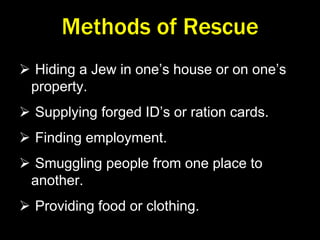
Methods of Rescue Hiding a Jew in one’s house or on one’s property.
 Supplying forged ID’s or ration cards.
 Finding employment.
 Smuggling people from one place to another.
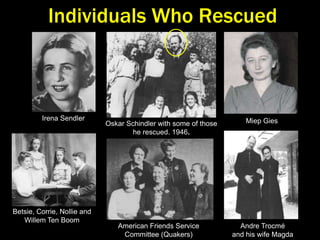
 Providing food or clothing.Individuals Who RescuedIrena Sendler Miep GiesOskar Schindler with some of those he rescued. 1946. Betsie, Corrie, Nollie and Willem Ten BoomAndre Trocmé                       and his wife MagdaAmerican Friends Service Committee (Quakers)
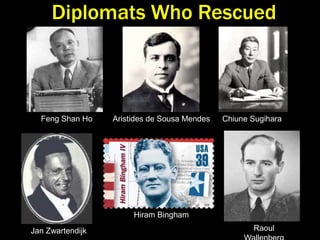
Diplomats Who RescuedAristides de Sousa MendesChiune SugiharaFeng Shan HoHiram BinghamRaoul WallenbergJan Zwartendijk
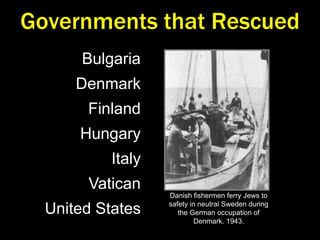
Governments that RescuedBulgariaDenmarkFinlandHungaryItalyVaticanUnited StatesDanish fishermen ferry Jews to safety in neutral Sweden during the German occupation of Denmark. 1943.
Righteous Among the Nations
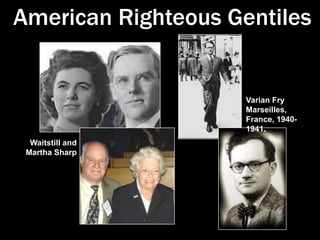
American Righteous GentilesVarian Fry                     Marseilles, France, 1940-1941. Waitstill and Martha Sharp
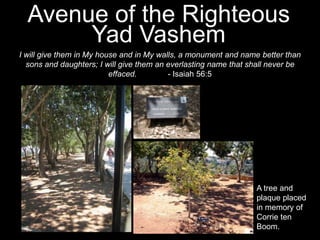
Avenue of the Righteous  Yad VashemI will give them in My house and in My walls, a monument and name better than sons and daughters; I will give them an everlasting name that shall never be effaced.              - Isaiah 56:5A tree and plaque placed in memory of Corrie ten Boom.
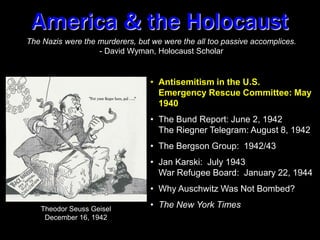
America & the HolocaustThe Nazis were the murderers, but we were the all too passive accomplices.              - David Wyman, Holocaust ScholarAntisemitism in the U.S.                                      Emergency Rescue Committee: May 1940
The Bund Report: June 2, 1942                     The Riegner Telegram: August 8, 1942

The final solution

  • 1.
    THE FINALSOLUTIONThese shoesrepresent one day's collection at the peak of the gassings at Auschwitz, about 25,000 pairs.
  • 2.
    Japanese Attack PearlHarborDecember 7, 1941Yesterday, December 7, 1941 – a date which will live in infamy – the United States of America was suddenly and deliberately attacked by naval and air forces of the Empire of Japan. As Commander-in-Chief of the Army and Navy, I have directed that all measures be taken for our defense. With confidence in our armed forces – with the unbounded determination of our people – we will gain the inevitable triumph – so help us God.- President Franklin D. Roosevelt, December 8, 1941U.S.S. Maryland and capsized U.S.S. Oklahoma.View down “Battleship Row.”
  • 3.
    Wannsee ConferenceJanuary 20,1942 SS Lieutenant General Reinhard Heydrich called together 15 high ranking Nazi officials to discuss and coordinate the implementation of the “Final Solution.”
  • 4.
    Thisdid not mark the beginning of the “Final Solution,” rather it was the place where the “Final Solution” was formally revealed to Nazi leaders
  • 5.
    Withinninety minutes, the implementation of the “Final Solution” had been planned and the death sentence of 11 million Jews had been passed down.
  • 6.
    Never before hada modern state committed itself to the murder of an entire people.The Wannsee Villa outside of Berlin.
  • 7.
    List of countriespresented at the Wannsee Conference, with the number of Jews who were to be deported to their deaths. Almost half of these countries never came under German rule or control.
  • 8.
    The Evolution ofDeathIn mid-March 1942, 75-80% of all victims of the Holocaust were still alive, while 20-25% had perished. Merely eleven months later, in mid-February 1943, the percentages were exactly the reverse. - Christopher R. Browning, Holocaust historian A “hell” van.The first carbon monoxide experiments using cars.Zyklon-B crystals.
  • 9.
    DeportationsA child’s drawingshowing a German soldier shooting at a train of deportees.A 1942 transport to Treblinka.Corpses lie in an open railcar at Dachau.
  • 10.
    “Im Wagon” (Inthe Railway Car) by Ella Liebermann-Shiber
  • 11.
    Written in Pencil in a Sealed Railway Carhere in this carloadi am evewith abel my sonif you see my other soncain son of man …tell him I
  • 12.
    Deportation Routes toAuschwitz A complex network of rail lines was necessary to accomplish the vast deportations.
  • 13.
    Shown hereare the deportation routes leading to only one camp, Auschwitz.The CampsConcentration camp: camp in which people are detained, often in harsh conditions and w/o legal norms of arrest and imprisonment
  • 14.
  • 15.
    Purposes: labor camps,POW camps, transit camps, extermination camps.
  • 16.
    Only 6 extermination/deathcamps, all in PolandTypes of Concentration Camps Labor Camps
  • 17.
    Prisonerof War Camps
  • 18.
  • 19.
    Extermination CampsDachau, Germany. (labor camp)Drancy, France. Courtyard used to round up Jews for deportation. (transit camp) Buchenwald, Germany. (labor camp) Westerbork, Netherlands. Lighting Chanukah candles. (transit camp)Theresienstadt, Czechoslovakia. Production of opera Brundibar. (ghetto/transit camp)Bergen-Belsen, Germany. (labor camp)
  • 20.
    Ravensbruck, Germany. (labor camp for women) Oranienburg, Germany. Political prisoners in the camp yard. (POW/labor camp)Flossenburg, Germany. The quarry. (labor camp)Neuengamme, Germany. On the left is the camp brick factory. (labor camp)Mauthausen, Austria. Main entrance to the camp. (labor camp)Dora-Mittelbau, Germany. Camouflaged entrance to the underground rocket factory. (labor camp)
  • 21.
    Extermination CampsBy winter1941, 1.5 million Jews dead but 11 million Jews targeted for annihilation at Wannsee Conference.Using Germany‘s scientists, businessmen, engineers and officials, the Nazis built a modern and efficient way to eliminate the Jews: elaborate train system; 1 m.+ people to operate and maintain. 1942-1944 ghettos were liquidated; “Resettlement” to Labor/ Extermination Camps in the East. In USSR, Einsatzgruppenkilled Jews on the spot; no need for extermination camps. In Western Europe, no closed ghettos and Jews integrated into society. Send Jews by 3rd class rail to a transit camp and from there to the east.
  • 22.
    Extermination Camps~ 50%of Jewish victims gassed w/ Diesel exhaust; as many as killed by Zyklon-B
  • 23.
    Hitler never visiteddeath camp; Himmler did, gassing made him ill
  • 24.
    Operation Reinhard camps:Belzec, Sobibor and Treblinka –for killing Jews in the General Government, run by OdiloGlobocnik
  • 25.
    Other three camps– Auschwitz, Chelmno, and Majdanek – for killing the rest of Europe’s Jews
  • 26.
    June 6, 1944:D-day. By then, majority of Holocaust victims already deadExtermination Camps100,000Victims
  • 27.
    Chelmnofirst extermination camp;three gas vans; no crematoria, just mass graves in the woods. December 8, 1941-March 1943 No railroad; brought by trucksSS wearing white coats like doctors led Jews to “bathhouse” - down a ramp into the back of a large paneled truck holding 50-70 people; carbon monoxide asphyxiation in 10-15 minutes; bodies driven to graves in the forest170,000-360,000 killed at Chelmno
  • 28.
    BelzecFirst with largegas chambersMarch 17, 1942 to late 1942Trains carrying over 2,000 Jews; Older people and the sick taken straight to open ditches to be shot. Men separated out, women had their hair shaven and prodded through passageway leading to “showers.” At first killing 2,000 Jews lasted 3-4 hours; cut time down to 60-90 minutes. When closed, camp was ploughed over and turned into a farm and turned over to one of the camp’s Ukrainian guards
  • 29.
    SobiborMay 1942 untilOctober 1943 October 14, 1943: ~300 Jewish inmates assigned to the Sonderkommandorevolted. Following revolt, the camp was destroyed and planted over with trees. About 50 prisoners survived.
  • 30.
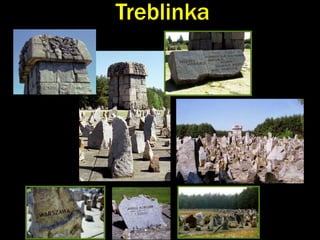
    TreblinkaLiving Area1. Mainentrance 2. Commandant's living quarters 3. Ukranian guards' living quarters 4. Zoo 5. Service buildings for the SS 6. Barracks for the domestic staff 7. Building for sorting valuables 8. SS living quarters 9. Service Storage Buildings 10. Stables and livestock area 11. Barracks for women prisoners 12. Barracks for male prisoners 13. Latrine 14. Assembly area for prisoners 15. Entrances to reception area16. Entrance for the guardsReception Area17. Station platform, ramp, and square 18. Storehouse for victims' property (disguised as a train station) 19. Burial pits 20. Execution site (disguised as a hospital) 21. Reception square (sorting area) 22. Latrine 23. Cremation pyres 24. Deportation area 25. Barracks where women undressed, surrendered their valuables, and had heads shaved 26. Barracks where men undressed 27. Approach to the gas chambers(the tube, der Schlauch)Living AreaExtermination Area28. New gas chambers 29. Old gas chambers 30. Cremation pyres 31. Prisoners barracksReception AreaExtermination Area
  • 31.
    MajdanekSlave labor campas well as death camp
  • 32.
    November 3, 1943:during Erntefest(Operation Harvest Festival) – 18,000 Jews shot by machine guns into large trenches (45,000 total between all camps)AuschwitzAt Auschwitz, not only did man die, but the image of man died. - Elie Wiesel
  • 33.
    AuschwitzAt Auschwitz, notonly did man die, but the image of man died. - Elie WieselAuschwitz I:site of WWI Polish military barracks, designed to hold 10,000 political prisoners; opened May 1940
  • 34.
    Double barbed-wire electricfences and nine watch towers
  • 35.
    Location for medicalexperiments that used humans as guinea pigs
  • 36.
    Became camp forSoviet P.O.W.‘s in 1941 Auschwitz IA House of camp commandantB Main guardhouseC Offices of camp commandantD Offices of camp administrationE Hospital for SSF Offices of GestapoG Registration of new prisonersH Entrance gate w/ inscription: Arbeit macht freiI KitchenK1 Gas Chamber & Crematorium IL Stores, stables, garages & workshopsM Warehouse for belongings from and Zyklon-BN Gravel pit (site of executions)O Where camp orchestra playedP LaundryR SS guardroomS Wall where prisoners executed1-28 Blocks Housing Prisoners
  • 37.
    AuschwitzAt Auschwitz, notonly did man die, but the image of man died. - Elie WieselAuschwitz II:largest part of the Auschwitz complex
  • 38.
    10,000 Soviet POWsdied in construction
  • 39.
    German Earth andStone works and IGFarben plant to be run by 100,000 Soviet POWs, then later Jews
  • 40.
    Killing peak: 24,000Jews in a single dayAuschwitz II (Birkenau)A Main gate & guardhouseBI Sector IBII Sector IIBIII Sector III, under constructionB1aCamp for womenB1b Initially camp for men; after 1943 camp for womenBIIaQuarantine areaBIIbFamily camp for Jews from TerezinBIIcCamp for Jews from HungaryBIIdCamp for menBIIe Camp for gypsiesBIIf InfirmaryC Camp HQ & SS barracksD “Canada”E Ramp where “selection” occurredF ShowersG Pits where corpses burnedH Mass graves of Soviet POW’sI 1st improvised gas chamberJ 2nd improvised gas chamberKII Gas Chamber & Crematorium IKIII Gas Chamber & Crematorium IIKIV Gas Chamber & Crematorium IVKV Gas Chamber & Crematorium VL Latrines & washrooms
  • 41.
    Lane separating barracksin the main camp. On the left, in the distance, is crematorium #1. The camp's double, electrified, barbed wire fence and barracks. Row of barracks in Auschwitz II.
  • 43.
    ArrivalEntrance to AuschwitzI.Entrance to Auschwitz II (Birkenau). Jews on “the ramp”.
  • 44.
    SelectionMen on theright.Women & children on the left.
  • 45.
    Those “unfit” forwork were exterminated.Those “fit” for work were registered as prisoners.
  • 46.
    Around us, everyonewas weeping. Someone began to recite the Kaddish, the prayer for the dead. I do not know if it has ever happened before, in the long history of the Jews, that people have ever recited the prayer for the dead for themselves.- Elie Wiesel in Night, recalling what he experienced as a teenager fresh off the transport train at Auschwitz, 1944.Unable to Work by David Olère.
  • 47.
  • 48.
    RegistrationThey will eventake away our name: and if we want to keep it, we will have to find in ourselves the strength to do so, to manage somehow so that behind the name something of us, of us as we were, still remains. – Primo Levi, Survival at Auschwitz
  • 49.
    Registration: Camp BadgesPoliticalCriminalAntisocialHomosexualEmigrantJehovah’sWitnessGypsyJewish PoliticalJewish CriminalJewish AntisocialJewish HomosexualJewish EmigrantFPPolitical Second-Time OffenderPolitical (French)Wehrmacht PrisonerPolitical (Polish)Penal CompanyPrisoner Under Special Surveillance
  • 50.
    BarracksSix people slepton a plank of wood, on top of us another layer. And if one of us had to turn, all the others had to turn because it was so narrow. One cover, no pillow, no mattress.- Alice Lok, Survivor
  • 51.
    Roll CallLife isnot important at the roll call. Numbers are important. Numbers tally. - Salmen Gradowski, Auschwitz SurvivorAmidst a Nightmare of Crime
  • 52.
  • 53.
    FoodA fortnight aftermy arrival, I already had the prescribed hunger, that chronic hunger unknown to free men, which makes one dream at night, and settles in all the limbs of one’s body. - Primo Levi, Survival at AuschwitzA DAY’S RATIONSBreakfast 2 cups coffee or tea (often nothing more than dried leaves or bark,usually birch, in hot water)Midday 3 cups turnip and potato soup , a scrap of meat or Avo (yeast extract) addedEvening 10 oz. of bread, less than 1 oz. sausage or cheese, and a teaspoon of margarine and beet jam
  • 54.
    Drawings of EllaLiebermann ShiberHunger - Looking for Food “Auf der Suche nach Kartoffelschalen” (Looking for potato peels )Soup Distribution “Juden bekommen zuletzt!” (Jews are last!)Hunger – Stealing Bread“Der Dieb” (The Thief )
  • 55.
    Slave LaborJewish womenpulling cars of quarried stones, Plaszlow, 1944. Leaving for Work by David Olère. Camp inmates are marched out to work past victims of Nazi camp discipline. Assembly line at the Bavarian Motor Works (BMW) aircraft engine factory, Allach, Germany. Buna Factory, Auschwitz III (Monowitz).
  • 56.
    BrutalityIf you canbe cruel to one, you are capable of being cruel to many.- Auschwitz: If You Cried You Died
  • 57.
    SurvivalJust as despaircan come to one only from other human beings, hope, too, can be given to one only by other human beings. - Elie Wiesel“Muselmann” German term describing prisoners who were near death due to exhaustion, starvation or hopelessness. Prisoner throwing himself onto an electrified fence, Mauthausen.
  • 58.
    Medical ExperimentsLow pressureexperimentation resulting in death from burst lungs.Survivor shows scar of a wound deliberately infected with dirt, bacteria and slivers of glass.Medical experiment at Buchenwald. Immersed in freezing water at Dachau.
  • 59.
    ExterminationWomen and childrenawaiting the gas chambers in the “Little Wood” adjacent to the gas chambers at Auschwitz II (Birkenau).
  • 60.
    GassingsSS camp guardswith Zyklon-B canisters.Gas chamber in Crematorium I, Auschwitz I. The camp orchestra played to calm fears en route to the gas chambers.
  • 61.
    GassingsGassing, David Olère.
  • 62.
    We acknowledge receiptof your order for five triple furnaces, including two electric elevators for raising the corpses and one emergency elevator. Contract acceptance letter, J.A. Topf & Sons
  • 63.
    Crematorium IThe firstkilling center was located at Auschwitz I. It was built partially underground and housed a primitive gas chamber along with several crematory ovens. View of the walled entrance. April 1945.Note the small access lids in the roof through which Zyklon-B crystals were dropped.
  • 64.
    Metal slide forplacing bodies into oven. Crematory as found at liberation.Artwork by Jan Komski, survivor.
  • 65.
    Crematorium IIOne ofthe two main crematoria at Auschwitz II (Birkenau). All of the combined gas chambers/crematoria at Birkenau were systematically dismantled and then dynamited by the Germans in late 1944. Crematorium-IV. One of two 'crematoria in the woods', this and Crematoria-V are located in a field of birch trees (Birkenau means 'place with Birch trees') and out of view from the main barracks area.
  • 66.
    Crematorium IIICrematorium IIand III were the largest gassing and cremating facilities in the Nazi extermination system.
  • 67.
  • 68.
    Crematorium VLocated ina remote corner of the camp, this facility was the last in operation at Auschwitz II (Birkenau).
  • 69.
    In Memory ofthe Czech Transport to the Gas Chambers Yehuda Bacon 1945, Charcoal on paper.
  • 70.
    The Value ofa LifeRingsThese shoes represent one day's collection at the peak of the gassings, about twenty-five thousand pairs.
  • 71.
    Calculation by theSS of Profit Value in the Utilization of Prisoners in the Concentration Camps - Official SS Document, March 11, 1941 -Daily “farming-out” wage, average 6.00 Reichsmark, RMFood, daily <0.60> RMClothing depreciation <0.10> RMBalance 5.30 RM / dayApproximate life span X 9 month (270 days)NET PROFIT 1,431.00 RM / prisonerEfficient utilization of prisoner’s body, 202.00 RMi.e. dental gold, clothing, valuables, moneyCremation cost <2.00> RMAVERAGE NET PROFIT 200.00 RMTOTAL PROFIT AFTER 9 MONTHS 1631.00 RMPlus additional revenue from utilization of bones and ashes.(1941: 1 RM = $.40, or 2.5 RM = $1.00)
  • 72.
    We say ‘hunger,’we say ‘tiredness,’ ‘fear,’ ‘pain,’ we say ‘winter’ and they are different things. They are free words, created and used by free men who lived in comfort and suffering in their homes. If the (camps) had lasted longer, a new, harsh language would have been born; and only this language could express what it means to toil the whole day in the wind with the temperature below freezing, and wearing only a shirt, underpants, cloth jacket and trousers, and in one’s body nothing but weakness, hunger and knowledge of the end drawing nearer.- Primo Levi, Survival in Auschwitz
  • 73.
  • 74.
    Obstacles to ResistanceSuperiorarmed power of the Germans.German tactic of “collective responsibility.”Secrecy and deception of deportations.Family ties and responsibilities.Absence of a non-Jewish population willing to help.
  • 75.
    Jewish ResistanceTo smugglea loaf of bread – was to resist.To teach in secret – was to resist.To cry out in warning and shatter illusions – was to resist.To rescue a Torah Scroll – was to resist.To forge documents – was to resist.To smuggle people across borders – was to resist.To chronicle events and conceal the records – was to resist.To hold out a helping hand to the needy – was to resist.To contact those under siege and smuggle weapons – was to resist.To fight with weapons in streets, mountains, and forests – was to resist.To rebel in death camps – was to resist.To rise up in ghettos, among the crumbling walls, in the most desperate revolt – was to resist.Taken from a wall on resistance at the Ghetto Fighters House.
  • 76.
    Non-Jewish ResistanceFirst theycame for the Communists, but I was not a Communist so I did not speak out.Then they came for the Socialists and the Trade Unionists, but I was neither, so I did not speak out.Then they came for the Jews, but I was not a Jew so I did not speak out. And when they came for me, there was no one left to speak out for me. - Pastor Martin NiemoellerHans Scholl (left), Sophie Scholl (center), and Christoph Probst (right), leaders of The White Rose resistance organization. Munich, Germany, 1942.
  • 77.
    Resistance in theGhettos and the CampsSniper during Warsaw Ghetto uprising.Oneg Shabbat archives being examined in Warsaw, 1950.Execution Of Jewish resistance fighters from the Warsaw Ghetto.Participants of the uprising at the Sobibór. concentration camp.
  • 79.
    The Battle ofthe Warsaw Ghetto, 1945 Arthur Szyk
  • 80.
    Partisan ActivityA hangedJewish partisan with a sign: "We are partisans and have shot at German soldiers." Poland 1941 – 1944. Jewish partisans who fought in the vicinity of Vilna, Poland.A Jewish partisan plants dynamite on a railroad track. Vilna, 1943 or 1944.Yugoslav partisans with Jewish parachutists from Palestine. Yugoslavia, 1944. Jewish partisans in the Lithuanian forests.
  • 82.
  • 83.
    Allied Invasion atNormandy D-Day: June 6, 1944
  • 84.
    “A Memory ofJune 6, 1944”Simon Jeruchim’s image of the Allied invasion of Normandy.
  • 85.
    The Allies CloseInThe war against the Jews continued as the Allies closed in on the crumbling Nazi empire. Extermination of the Jews was so efficient that by the time the Soviet army re-crossed the Polish border in 1944 and D-Day occurred on June 6, most of the approximately 6 million Jews who died in the Holocaust were already dead.
  • 87.
    Death MarchesAs theAllied armies closed in on the Nazi concentration camps, every effort was made to conceal the crimes that had been committed.Camps were dismantled or abandoned. In the dead of winter, prisoners were taken by train and/or foot toward the heartland of Germany with hopes of preserving the slave labor force for the Reich.Thousands froze to death or died.“Death March” by Ella Liebermann Shiber
  • 88.
    Dachau, Germany Campprisoners marching through a village. Photo was taken through upstairs window of a private home along the route. Few civilians gave aid to prisoners on the death marches. April 1945, Dachau, Germany.
  • 89.
    German civilians, underdirection of U.S. medical officers, walk past a group of 30 Jewish women starved to death by SS troops in a 300 mile march across Czechoslovakia.
  • 90.
    LiberationWe are free,but how will we live our lives without our families. - Anton Mason, SurvivorSurvivors in Allach, a sub-camp of Dachau, greet arriving U.S. troops. Survivors eagerly pull down the Nazi eagle over entrance to the Mauthausen.
  • 91.
    CONDITIONSSurvivor sitting outsidea barrack, Bergen-Belsen, April 1945.Survivors of Auschwitz, wearing adult-size prisoner jackets.Jewish survivors at Ebensee gathered outside on the day after liberation.Young survivors at Buchenwald,April 1945.
  • 92.
    FOOD ♦MEDICINESurvivors inDachau distribute bread to their comrades after liberation. Survivors, too weak to eat solid food, suck on sugar cubes to give them strength.American medical personnel at work in a typhus ward in a hospital for survivors. The sick are evacuated to an American field hospital.
  • 93.
    Witness to theAtrocitiesGeneral Dwight D. Eisenhower and other members of the Army view the bodies of executed prisoners. Ohrdruf, April 12, 1945. German civilians under U.S. military escort are forced to see a wagon loaded with corpses in Buchenwald.
  • 94.
    Yalta (Crimea) ConferenceFebruary 4 - 11, 1945Roosevelt & Churchill“How are we feeling today?” – a 1945 British cartoon shows Churchill,Roosevelt and Stalin as doctors, working together to heal the world.    The "Big Three": Winston Churchill, Franklin D. Roosevelt , Joseph Stalin 
  • 95.
    Hitler’s Last DaysOneof the last pictures taken of Hitler in his bunker before he committed suicide. On the left is Col. Gen. Ferdinand Schoerner who was appointed commander-in-chief of the Wehrmacht in Hitler’s will.In the garden outside his bunker, Hitler decorates Hitler Youth who have been newly recruited as soldiers. After the ceremony, he returns to his underground refuge.
  • 96.
    The Fall ofBerlinMay 2, 1945The Reichstag lies in ruins as did most of Berlin.Soviet soldiers celebrate the fall of Berlin by hoisting the Red Flag over the ruined Reichstag. As his last significant official act, Hitler appointed Grand Admiral Karl Doenitz to succeed him as führer.
  • 97.
    Surrender in theWestMay 8, 1945With this signature the German people and the German Armed Forces are, for better or worse, delivered into the hands of the victors … In this hour I can only express the hope that the victor will treat them with generosity. - General Alfred Jodl (during the signing of the unconditional surrender), Reims, France. Move to last days??????????General Alfred Jodl, Chief of the Operations Staff in the German High Command, signs the document of unconditional German surrender on May 7. Left is Admiral Von Friedeburg of the German Navy. Right is Major Wilhelm Oxenius of the German General Staff. German Field Marshall Wilhelm Keitel signs a surrender document at Soviet headquarters in Berlin, May 9, 1945. The Soviets had insisted that a second ceremonial signing take place in Soviet-occupied Berlin.
  • 98.
    Allied Occupation & Denazification
  • 99.
  • 100.
    Jewish LossesTOTAL :5,596,029**These are minimum losses as reported by Yehuda Bauer and Robert Rozett, "Estimated Jewish Losses in the Holocaust," in Encyclopedia of the Holocaust (New York: Macmillan, 1990), p.1799. The estimated number of Jewish fatalities during the Holocaust is usually given between 5.1 and 6 million victims. Despite the availability of numerous scholarly works and archival sources on the subject, Holocaust related figures may never be definitely known.
  • 101.
    Displaced Persons (DP’s)Portraitsof children in Germany holding name cards, in search of their families. Their photographs were published in newspapers. A child lights a Hannukah menorah during a celebration in a DP camp. Jewish refugees in Shanghai look for names of relatives and friends who may have survived the war. Wedding ceremony at a DP camp.
  • 102.
    Potsdam ConferenceJuly 17– August 2, 1945POLANDThe "Big Three" pose with their principal advisors. Seated (left to right): British Prime Minister Clement Atlee; U.S. President Harry S. Truman; Soviet Premier Joseph Stalin.Standing (left to right): Fleet Admiral William D. Leahy, USN, Truman's Chief of Staff; British Foreign Minister Ernest Bevin; U.S. Secretary of State James F. Byrnes; Soviet Foreign Minister Vyacheslav Molotov. Churchill, Truman, Stalin
  • 103.
  • 104.
    Nuremberg TrialsNov. 20,1945 – Oct. 1, 1946The defendants at Nuremberg. Palace of Justice in Nuremberg. Julius Streicher, Editor-in-Chief of Der Stürmer.Front: Hermann Goering, Rudolf Hess, Joachim von Ribbentrop, and Wilhelm Keitel.Front: Rudolf Hess, Joachim von Ribbentrop Back: Karl Doenitz, Erich Raeder and Balder von Schirach.
  • 105.
    Nuremberg Defendants1. Conspiracyto Commit Crimes 2. Crimes Against Peace 3. War Crimes 4. Crimes Against Humanity
  • 106.
    1. Conspiracy toCommit Crimes 2. Crimes Against Peace 3. War Crimes 4. Crimes Against Humanity
  • 107.
    1. Conspiracy toCommit Crimes 2. Crimes Against Peace 3. War Crimes 4. Crimes Against Humanity
  • 108.
    I am entirelynormal. Even while I was doing this extermination work, I led a normal family life and so on…Don’t you see, we SS men were not supposed to think about these things; it never even occurred to us. And besides, it was something already taken for granted that the Jews were to blame for everything … You can be sure that it was not always a pleasure to see those mountains of corpses and smell the continual burning. But Himmler had ordered it and had even explained the necessity and I really never gave much thought to whether it was wrong. It just seemed a necessity …For me as an old fanatic National Socialist, I took It all as fact – just as a Catholic believes in his Church dogma. It was just truth without questions; I had no doubt about that … That was the picture I had in my head, so when Himmler called me to him I just accepted it as the realization of something I had already accepted – not only I, but everybody. I took it so much for granted that … this crass order to exterminate thousands of people (I did not know then how many) – even though it did frighten me momentarily – it fitted in with all that had been preached to me for years. The problem itself, the extermination of Jewry, was not new – but only that I was to be the one to carry it out, frightened me at first. But after getting the clear direct order and even an explanation with it – there was nothing left but to carry it out … Don’t you see, we SS men were not supposed to think about these things; it never occurred to us … We were all so much trained to obey orders without even thinking, that the thought of disobeying an order would simply never have occurred to anybody, and somebody else would have done just as well if I hadn’t.Rudolf Hoess, Commandant of Auschwitz, sentenced to death & hung at Auschwitz.(From: Gilbert, G.M. Nuremberg Diary. New York: Farrar, Strauss & Company, 1947, pp. 258-59)
  • 109.
  • 110.
    BystandersPrisoners were forcedto wear these carriers on their backs to haul stones from the quarry. Carrying granite boulders on wooden “backpacks” up the “stairs of death.” Mauthausen, Austria.Mauthausen Wiener Graben Quarry
  • 111.
    Letter of complaintfrom Mrs. Eleonore Gusenbauer of Ried (the village above Mauthausen), September 1941.Inmates of the Mauthausen concentration camp are constantly being shot at the Vienna Ditch work site. Those who are badly struck still live for some time and lie next to the dead for hours and in some cases for half a day.My property is situated on an elevation close to the Vienna Ditch and therefore one often becomes the unwilling witness of such misdeeds. I am sickly in any case and such sights make such demands on my nerves, that I will not be able to bear it much longer.I request that it be arranged that such inhuman deeds will cease or else be conducted out of sight.Dokumentationsarchiv des österreichischen Widerstand., or Gordon J. Horwitz, In the Shadow of Death – Living Outside the Gates of Mauthausen, p. 35.
  • 112.
  • 113.
  • 114.
    What Motivated Rescuers?Somesympathized with the Jews.
  • 115.
    Somewere actually antisemitic, but could not sanction murder or genocide.
  • 116.
    Somewere bound to those they saved by ties of friendship and personal loyalty, while some went out of their way to help total strangers.
  • 117.
    Somewere motivated by their political beliefs or religious values.
  • 118.
    Somefelt ethically that life must be preserved in the face of death.
  • 119.
    Forsome there was no choice, what they did was natural and instinctive.Many rescuers felt they were simply acting out of elemental human decency. They later insisted that they were not heroes, that they never thought of themselves as doing anything special or extraordinary.
  • 120.
    Methods of RescueHiding a Jew in one’s house or on one’s property.
  • 121.
    Supplying forgedID’s or ration cards.
  • 122.
  • 123.
    Smuggling peoplefrom one place to another.
  • 124.
    Providing foodor clothing.Individuals Who RescuedIrena Sendler Miep GiesOskar Schindler with some of those he rescued. 1946. Betsie, Corrie, Nollie and Willem Ten BoomAndre Trocmé and his wife MagdaAmerican Friends Service Committee (Quakers)
  • 125.
    Diplomats Who RescuedAristidesde Sousa MendesChiune SugiharaFeng Shan HoHiram BinghamRaoul WallenbergJan Zwartendijk
  • 126.
    Governments that RescuedBulgariaDenmarkFinlandHungaryItalyVaticanUnitedStatesDanish fishermen ferry Jews to safety in neutral Sweden during the German occupation of Denmark. 1943.
  • 127.
  • 128.
    American Righteous GentilesVarianFry Marseilles, France, 1940-1941. Waitstill and Martha Sharp
  • 129.
    Avenue of theRighteous Yad VashemI will give them in My house and in My walls, a monument and name better than sons and daughters; I will give them an everlasting name that shall never be effaced. - Isaiah 56:5A tree and plaque placed in memory of Corrie ten Boom.
  • 130.
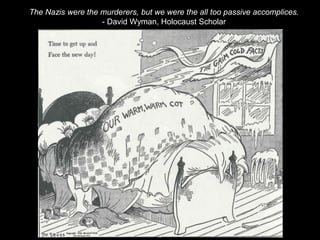
    America & theHolocaustThe Nazis were the murderers, but we were the all too passive accomplices. - David Wyman, Holocaust ScholarAntisemitism in the U.S. Emergency Rescue Committee: May 1940
  • 131.
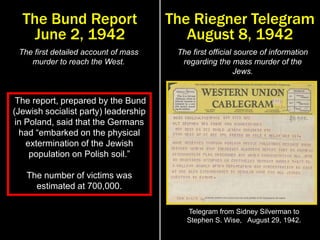
    The Bund Report:June 2, 1942 The Riegner Telegram: August 8, 1942
  • 132.
  • 133.
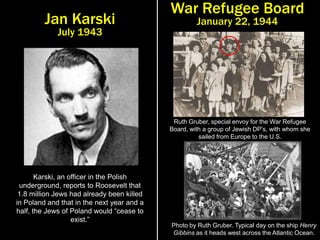
    Jan Karski: July 1943 War Refugee Board: January 22, 1944
  • 134.
  • 135.
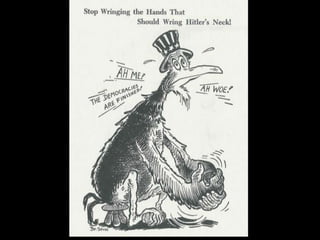
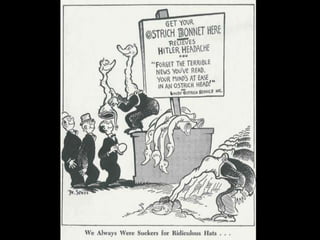
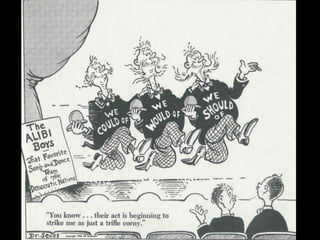
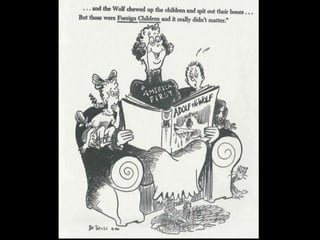
    The New YorkTimesTheodor Seuss Geisel December 16, 1942
  • 136.
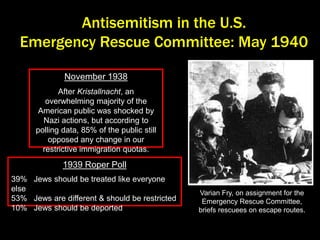
    Antisemitism in theU.S. Emergency Rescue Committee: May 1940November 1938After Kristallnacht, an overwhelming majority of the American public was shocked by Nazi actions, but according to polling data, 85% of the public still opposed any change in our restrictive immigration quotas.1939 Roper Poll39% Jews should be treated like everyone else53% Jews are different & should be restricted10% Jews should be deportedVarian Fry, on assignment for the Emergency Rescue Committee, briefs rescuees on escape routes.
  • 137.
  • 138.
    The Nazis werethe murderers, but we were the all too passive accomplices. - David Wyman, Holocaust Scholar
  • 139.
    The Riegner Telegram August 8, 1942The Bund Report June 2, 1942The first official source of information regarding the mass murder of the Jews.The first detailed account of mass murder to reach the West. The report, prepared by the Bund (Jewish socialist party) leadership in Poland, said that the Germans had “embarked on the physical extermination of the Jewish population on Polish soil.” The number of victims was estimated at 700,000.Telegram from Sidney Silverman to Stephen S. Wise, August 29, 1942.
  • 141.
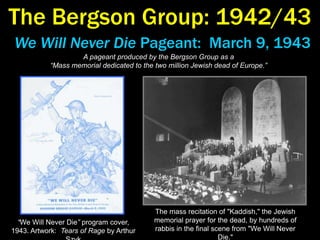
    The Bergson Group:1942/43We Will Never Die Pageant: March 9, 1943A pageant produced by the Bergson Group as a “Mass memorial dedicated to the two million Jewish dead of Europe.”The mass recitation of "Kaddish," the Jewish memorial prayer for the dead, by hundreds of rabbis in the final scene from "We Will Never Die." “We Will Never Die” program cover, 1943. Artwork: Tears of Rage by Arthur Szyk
  • 143.
    War Refugee Board January 22, 1944Jan Karski July 1943Ruth Gruber, special envoy for the War Refugee Board, with a group of Jewish DP’s, with whom she sailed from Europe to the U.S. Karski, an officer in the Polish underground, reports to Roosevelt that 1.8 million Jews had already been killed in Poland and that in the next year and a half, the Jews of Poland would “cease to exist.”Photo by Ruth Gruber. Typical day on the ship Henry Gibbins as it heads west across the Atlantic Ocean.
  • 145.
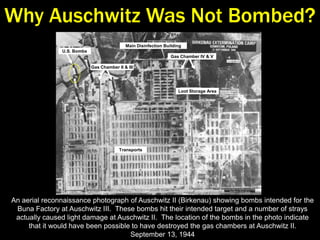
    Why Auschwitz WasNot Bombed?Main Disinfection BuildingU.S. BombsGas Chamber IV & VGas Chamber II & IIILoot Storage AreaTransportsAn aerial reconnaissance photograph of Auschwitz II (Birkenau) showing bombs intended for the Buna Factory at Auschwitz III. These bombs hit their intended target and a number of strays actually caused light damage at Auschwitz II. The location of the bombs in the photo indicate that it would have been possible to have destroyed the gas chambers at Auschwitz II. September 13, 1944
  • 147.
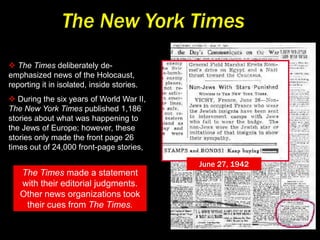
    The New YorkTimes The Times deliberately de-emphasized news of the Holocaust, reporting it in isolated, inside stories.
  • 148.
    During thesix years of World War II, The New York Times published 1,186 stories about what was happening to the Jews of Europe; however, these stories only made thefront page 26 times out of 24,000 front-page stories,June 27, 1942The Times made a statement with their editorial judgments. Other news organizations took their cues from The Times.
  • 149.
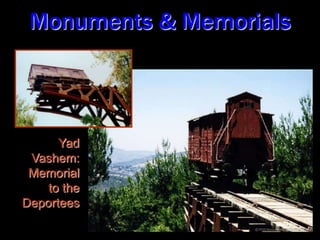
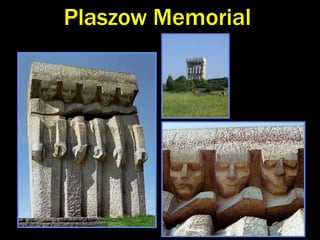
    Monuments & MemorialsYadVashem: Memorial to the Deportees
  • 150.
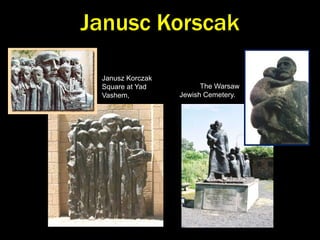
    Janusc KorscakJanusz KorczakSquare at Yad Vashem, The Warsaw Jewish Cemetery.  
  • 151.
  • 152.
  • 153.
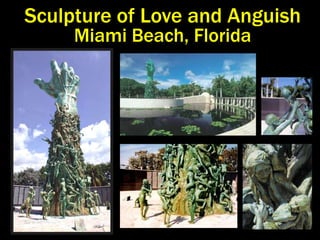
    Sculpture of Loveand Anguish Miami Beach, Florida
  • 154.
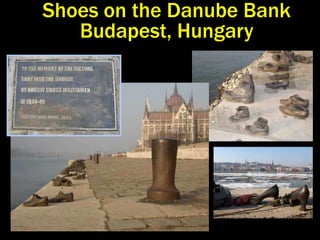
    Shoes on theDanube Bank Budapest, Hungary
  • 155.
  • 156.
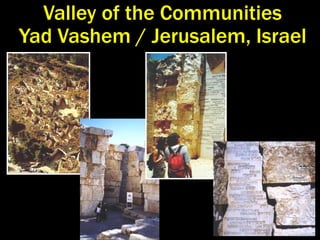
    Valley of theCommunities Yad Vashem / Jerusalem, Israel
  • 157.
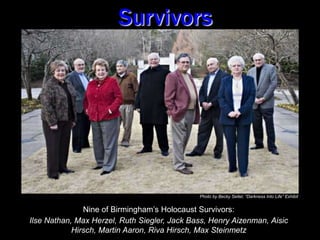
    SurvivorsPhoto by BeckySeitel, “Darkness Into Life” ExhibitNine of Birmingham’s Holocaust Survivors:Ilse Nathan, Max Herzel, Ruth Siegler, Jack Bass, Henry Aizenman, Aisic Hirsch, Martin Aaron, Riva Hirsch, Max Steinmetz
  • 158.
  • 159.
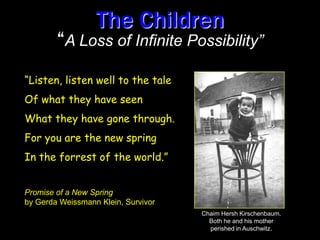
    The Children “A Loss of Infinite Possibility”“Listen, listen well to the taleOf what they have seenWhat they have gone through.For you are the new springIn the forrest of the world.”Promise of a New Spring by Gerda Weissmann Klein, SurvivorChaim Hersh Kirschenbaum. Both he and his mother perished in Auschwitz.