Electronic Health Records

        Katie Seeler
• Katie Seeler
Seeler, Katie
      Acute Presentationitis
      4/14/86 Female
      Hospitalization: 1 day


                 Clonazepam


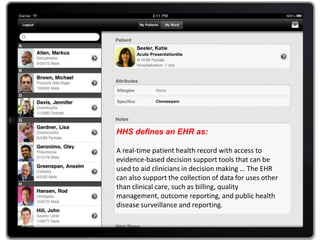
HHS defines an EHR as:

A real-time patient health record with access to
evidence-based decision support tools that can be
used to aid clinicians in decision making … The EHR
can also support the collection of data for uses other
than clinical care, such as billing, quality
management, outcome reporting, and public health
disease surveillance and reporting.
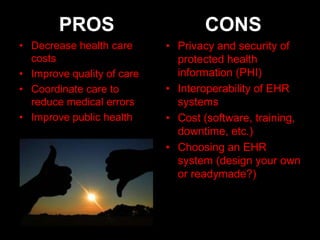
PROS                       CONS
• Decrease health care      • Privacy and security of
  costs                       protected health
• Improve quality of care     information (PHI)
• Coordinate care to        • Interoperability of EHR
  reduce medical errors       systems
• Improve public health     • Cost (software, training,
                              downtime, etc.)
                            • Choosing an EHR
                              system (design your own
                              or readymade?)
Seeler, Katie
   Acute Presentationitis
   4/14/86 Female
   Hospitalization: 1 day


              Clonazepam


Legislation and EHRs:

• HIPAA (1996)
• Executive Order 13335 (2004)
• HITECH/ARRA (2009)
HIPAA (1996)
   • Main objective when enacted: to “improve
     portability and continuity of health insurance
     coverage in the group and individual
     markets.”1
   • Several “rules”
             – Administrative Simplification Rules
             – Privacy Rule (2000)
             – Security Rule (2003)

1 Health   Insurance Portability and Accountability Act of 1996, H.R. 3103, 104th Cong., 2nd sess.
E.O. 13335 (2004)
   • Created position of National Health
     Information Technology Coordinator who
     would oversee development of a nationwide
     interoperable health information technology
     infrastructure
   • Currently known as Office of the National
     Coordinator for Health Information
     Technology (ONC)

2 President, Executive
                    Order, “Incentives for the Use of Health Information Technology and Establishing the Position of the National Health
Information Technology Coordinator,” Federal Register 69, no. 84: (April 2004).
E.O. 13335 (2004)
   • Primary goals:
           – improve health care quality,
           – reduce medical errors,
           – decrease health care costs resulting from
             inefficiency, medical errors, inappropriate care,
             and incomplete information,
           – while ensuring the security of personally
             identifiable health information.

2 President, Executive
                    Order, “Incentives for the Use of Health Information Technology and Establishing the Position of the National Health
Information Technology Coordinator,” Federal Register 69, no. 84: (April 2004).
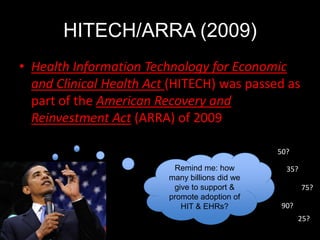
HITECH/ARRA (2009)
• Health Information Technology for Economic
  and Clinical Health Act (HITECH) was passed as
  part of the American Recovery and
  Reinvestment Act (ARRA) of 2009

                                                50?

                          Remind me: how          35?
                         many billions did we
                          give to support &             75?
                         promote adoption of
                            HIT & EHRs?          90?
                                                       25?
HITECH/ARRA (2009)
• Provisions
  – widen the scope of privacy and security
    protections offered under HIPAA
  – increase potential liability for non-compliance
  – provides more enforcement
  – amends Title XXX of the Public Health Service Act
    by adding various opportunities to advance health
    information technology
Seeler, Katie
    Acute Presentationitis
    4/14/86 Female
    Hospitalization: 1 day


               Clonazepam


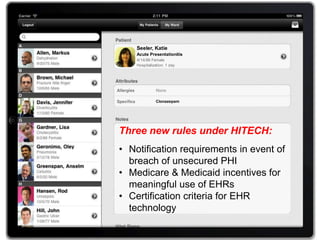
Three new rules under HITECH:
• Notification requirements in event of
  breach of unsecured PHI
• Medicare & Medicaid incentives for
  meaningful use of EHRs
• Certification criteria for EHR
  technology
Notification Requirements
• HITECH established the first national data
  security breach notification law by requiring
  covered entities to notify individuals whose
  unsecured PHI has been disclosed as a
  result of a privacy or security breach.

• In certain cases, the covered entity must also
  notify the Secretary of HHS and the general
  public.
Medicare Financial Incentives
    •     Incentive payments for eligible professionals, eligible hospitals, and CAHs
          that demonstrate meaningful use of certified EHR technology.
           – Participation can begin as early as 2011.
           – Eligible professionals can receive up to $44,000 over five years. There's
               an additional incentive for eligible professionals who provide services in
               a Health Professional Shortage Area (HSPA).
           – To get the maximum incentive payment, Medicare eligible professionals
               must begin participation by 2012.
           – Incentive payments for eligible hospitals and CAHs may begin as early
               as 2011 and are based on a number of factors, beginning with a $2
               million base payment.
    •     Important! For 2015 and later, Medicare eligible professionals, eligible
          hospitals, and CAHs that do not successfully demonstrate meaningful use
          will have a payment adjustment in their Medicare reimbursement (1-2% per
          year)3

3 President, Executive
                    Order, “Incentives for the Use of Health Information Technology and Establishing the Position of the National Health
Information Technology Coordinator,” Federal Register 69, no. 84: (April 2004).
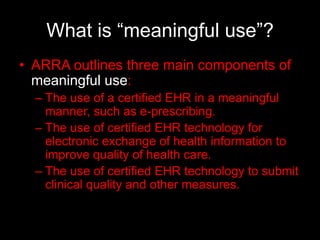
What is “meaningful use”?
• ARRA outlines three main components of
  meaningful use:
  – The use of a certified EHR in a meaningful
    manner, such as e-prescribing.
  – The use of certified EHR technology for
    electronic exchange of health information to
    improve quality of health care.
  – The use of certified EHR technology to submit
    clinical quality and other measures.
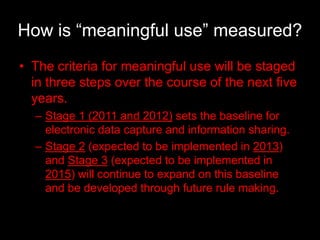
How is “meaningful use” measured?
• The criteria for meaningful use will be staged
  in three steps over the course of the next five
  years.
  – Stage 1 (2011 and 2012) sets the baseline for
    electronic data capture and information sharing.
  – Stage 2 (expected to be implemented in 2013)
    and Stage 3 (expected to be implemented in
    2015) will continue to expand on this baseline
    and be developed through future rule making.
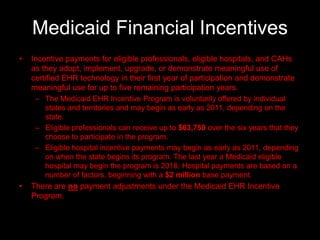
Medicaid Financial Incentives
•   Incentive payments for eligible professionals, eligible hospitals, and CAHs
    as they adopt, implement, upgrade, or demonstrate meaningful use of
    certified EHR technology in their first year of participation and demonstrate
    meaningful use for up to five remaining participation years.
     – The Medicaid EHR Incentive Program is voluntarily offered by individual
       states and territories and may begin as early as 2011, depending on the
       state.
     – Eligible professionals can receive up to $63,750 over the six years that they
       choose to participate in the program.
     – Eligible hospital incentive payments may begin as early as 2011, depending
       on when the state begins its program. The last year a Medicaid eligible
       hospital may begin the program is 2016. Hospital payments are based on a
       number of factors, beginning with a $2 million base payment.
•   There are no payment adjustments under the Medicaid EHR Incentive
    Program.
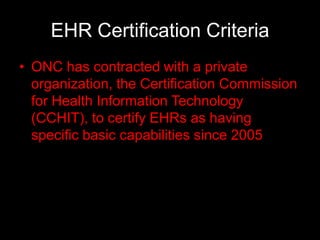
EHR Certification Criteria
• ONC has contracted with a private
  organization, the Certification Commission
  for Health Information Technology
  (CCHIT), to certify EHRs as having
  specific basic capabilities since 2005
EHR Certification Criteria
• Many of the EHRs currently certified are
  difficult to use and are not designed to
  meet ARRA's goals of improving quality
  and efficiency in the healthcare system
• Providers must use certified EHR systems
  in order to receive incentive payments
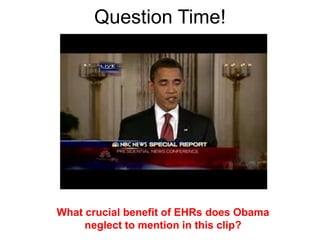
Question Time!


What crucial benefit of EHRs does Obama
     neglect to mention in this clip?
More Questions
• What are some long-term public health
  benefits of EHRs?

• What do you think is the biggest challenge
  to implementing a federal infrastructure for
  EHRs?
Another Question
• Given our current economic climate (debt
  ceiling, partisan bickering and stalemate
  over budget, etc.), do you think the
  government should be providing financial
  incentives to adopt EHRs? Does our
  aging population influence this
  consideration?


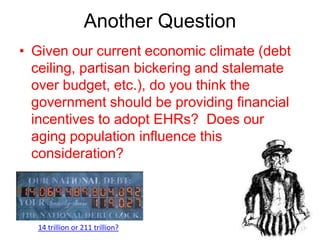
  14 trillion or 211 trillion?
A Couple More
• Even with financial incentives, do you think it’s
  feasible for every healthcare provider be required
  to use EHRs? Should nonadopters be penalized?


• Do you think the
  federal government
  (and individual EHR
  providers) have
  done enough to
  ensure the privacy
  and security of PHI?
One last question!
• Do you think the timeframe for full-scale,
  nationwide implementation of EHRs is realistic?

HLTH606 Facilitated Discussion - EHR (Oct 2011)

  • 1.
  • 2.
  • 3.
    Seeler, Katie Acute Presentationitis 4/14/86 Female Hospitalization: 1 day Clonazepam HHS defines an EHR as: A real-time patient health record with access to evidence-based decision support tools that can be used to aid clinicians in decision making … The EHR can also support the collection of data for uses other than clinical care, such as billing, quality management, outcome reporting, and public health disease surveillance and reporting.
  • 4.
    PROS CONS • Decrease health care • Privacy and security of costs protected health • Improve quality of care information (PHI) • Coordinate care to • Interoperability of EHR reduce medical errors systems • Improve public health • Cost (software, training, downtime, etc.) • Choosing an EHR system (design your own or readymade?)
  • 5.
    Seeler, Katie Acute Presentationitis 4/14/86 Female Hospitalization: 1 day Clonazepam Legislation and EHRs: • HIPAA (1996) • Executive Order 13335 (2004) • HITECH/ARRA (2009)
  • 6.
    HIPAA (1996) • Main objective when enacted: to “improve portability and continuity of health insurance coverage in the group and individual markets.”1 • Several “rules” – Administrative Simplification Rules – Privacy Rule (2000) – Security Rule (2003) 1 Health Insurance Portability and Accountability Act of 1996, H.R. 3103, 104th Cong., 2nd sess.
  • 7.
    E.O. 13335 (2004) • Created position of National Health Information Technology Coordinator who would oversee development of a nationwide interoperable health information technology infrastructure • Currently known as Office of the National Coordinator for Health Information Technology (ONC) 2 President, Executive Order, “Incentives for the Use of Health Information Technology and Establishing the Position of the National Health Information Technology Coordinator,” Federal Register 69, no. 84: (April 2004).
  • 8.
    E.O. 13335 (2004) • Primary goals: – improve health care quality, – reduce medical errors, – decrease health care costs resulting from inefficiency, medical errors, inappropriate care, and incomplete information, – while ensuring the security of personally identifiable health information. 2 President, Executive Order, “Incentives for the Use of Health Information Technology and Establishing the Position of the National Health Information Technology Coordinator,” Federal Register 69, no. 84: (April 2004).
  • 9.
    HITECH/ARRA (2009) • HealthInformation Technology for Economic and Clinical Health Act (HITECH) was passed as part of the American Recovery and Reinvestment Act (ARRA) of 2009 50? Remind me: how 35? many billions did we give to support & 75? promote adoption of HIT & EHRs? 90? 25?
  • 10.
    HITECH/ARRA (2009) • Provisions – widen the scope of privacy and security protections offered under HIPAA – increase potential liability for non-compliance – provides more enforcement – amends Title XXX of the Public Health Service Act by adding various opportunities to advance health information technology
  • 11.
    Seeler, Katie Acute Presentationitis 4/14/86 Female Hospitalization: 1 day Clonazepam Three new rules under HITECH: • Notification requirements in event of breach of unsecured PHI • Medicare & Medicaid incentives for meaningful use of EHRs • Certification criteria for EHR technology
  • 12.
    Notification Requirements • HITECHestablished the first national data security breach notification law by requiring covered entities to notify individuals whose unsecured PHI has been disclosed as a result of a privacy or security breach. • In certain cases, the covered entity must also notify the Secretary of HHS and the general public.
  • 13.
    Medicare Financial Incentives • Incentive payments for eligible professionals, eligible hospitals, and CAHs that demonstrate meaningful use of certified EHR technology. – Participation can begin as early as 2011. – Eligible professionals can receive up to $44,000 over five years. There's an additional incentive for eligible professionals who provide services in a Health Professional Shortage Area (HSPA). – To get the maximum incentive payment, Medicare eligible professionals must begin participation by 2012. – Incentive payments for eligible hospitals and CAHs may begin as early as 2011 and are based on a number of factors, beginning with a $2 million base payment. • Important! For 2015 and later, Medicare eligible professionals, eligible hospitals, and CAHs that do not successfully demonstrate meaningful use will have a payment adjustment in their Medicare reimbursement (1-2% per year)3 3 President, Executive Order, “Incentives for the Use of Health Information Technology and Establishing the Position of the National Health Information Technology Coordinator,” Federal Register 69, no. 84: (April 2004).
  • 14.
    What is “meaningfuluse”? • ARRA outlines three main components of meaningful use: – The use of a certified EHR in a meaningful manner, such as e-prescribing. – The use of certified EHR technology for electronic exchange of health information to improve quality of health care. – The use of certified EHR technology to submit clinical quality and other measures.
  • 15.
    How is “meaningfuluse” measured? • The criteria for meaningful use will be staged in three steps over the course of the next five years. – Stage 1 (2011 and 2012) sets the baseline for electronic data capture and information sharing. – Stage 2 (expected to be implemented in 2013) and Stage 3 (expected to be implemented in 2015) will continue to expand on this baseline and be developed through future rule making.
  • 16.
    Medicaid Financial Incentives • Incentive payments for eligible professionals, eligible hospitals, and CAHs as they adopt, implement, upgrade, or demonstrate meaningful use of certified EHR technology in their first year of participation and demonstrate meaningful use for up to five remaining participation years. – The Medicaid EHR Incentive Program is voluntarily offered by individual states and territories and may begin as early as 2011, depending on the state. – Eligible professionals can receive up to $63,750 over the six years that they choose to participate in the program. – Eligible hospital incentive payments may begin as early as 2011, depending on when the state begins its program. The last year a Medicaid eligible hospital may begin the program is 2016. Hospital payments are based on a number of factors, beginning with a $2 million base payment. • There are no payment adjustments under the Medicaid EHR Incentive Program.
  • 17.
    EHR Certification Criteria •ONC has contracted with a private organization, the Certification Commission for Health Information Technology (CCHIT), to certify EHRs as having specific basic capabilities since 2005
  • 18.
    EHR Certification Criteria •Many of the EHRs currently certified are difficult to use and are not designed to meet ARRA's goals of improving quality and efficiency in the healthcare system • Providers must use certified EHR systems in order to receive incentive payments
  • 19.
    Question Time! What crucialbenefit of EHRs does Obama neglect to mention in this clip?
  • 20.
    More Questions • Whatare some long-term public health benefits of EHRs? • What do you think is the biggest challenge to implementing a federal infrastructure for EHRs?
  • 21.
    Another Question • Givenour current economic climate (debt ceiling, partisan bickering and stalemate over budget, etc.), do you think the government should be providing financial incentives to adopt EHRs? Does our aging population influence this consideration? 14 trillion or 211 trillion?
  • 22.
    A Couple More •Even with financial incentives, do you think it’s feasible for every healthcare provider be required to use EHRs? Should nonadopters be penalized? • Do you think the federal government (and individual EHR providers) have done enough to ensure the privacy and security of PHI?
  • 23.
    One last question! •Do you think the timeframe for full-scale, nationwide implementation of EHRs is realistic?