Policy Related to 
Health Information Systems: 
A U.S. Case Study 
Nawanan Theera-Ampornpunt, M.D., Ph.D. 
Department of Community Medicine 
Faculty of Medicine Ramathibodi Hospital 
October 19, 2014 
SlideShare.net/Nawanan nawanan.the@mahidol.ac.th 
Except where referred 
to or copied from 
other works
Outline 
• Electronic Health Records & Health IT 
• U.S. eHealth Policy 
• HITECH Act & “Meaningful Use” of EHRs 
• Lessons for Thailand
Electronic Health Records 
& Health IT
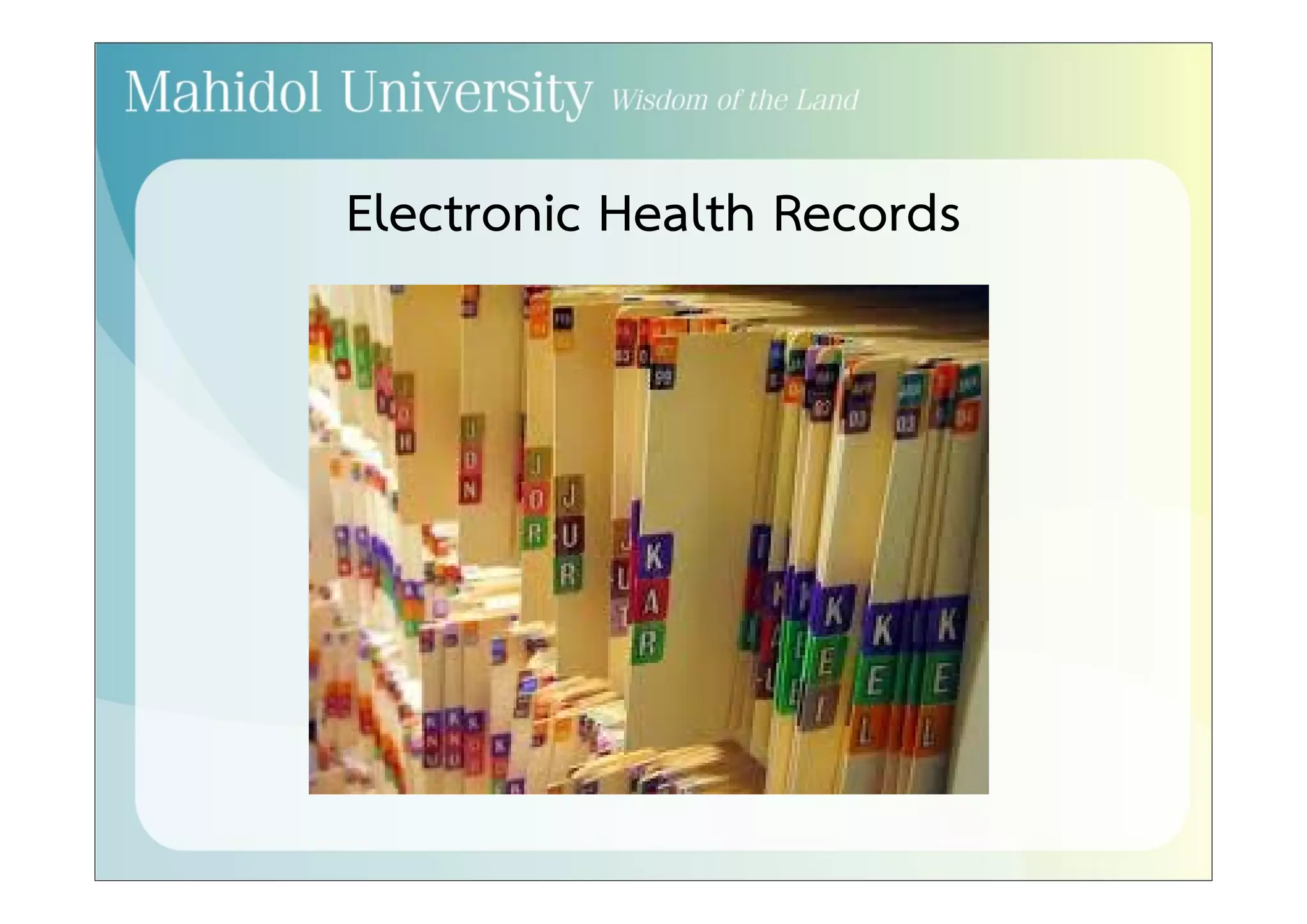
Electronic Health Records
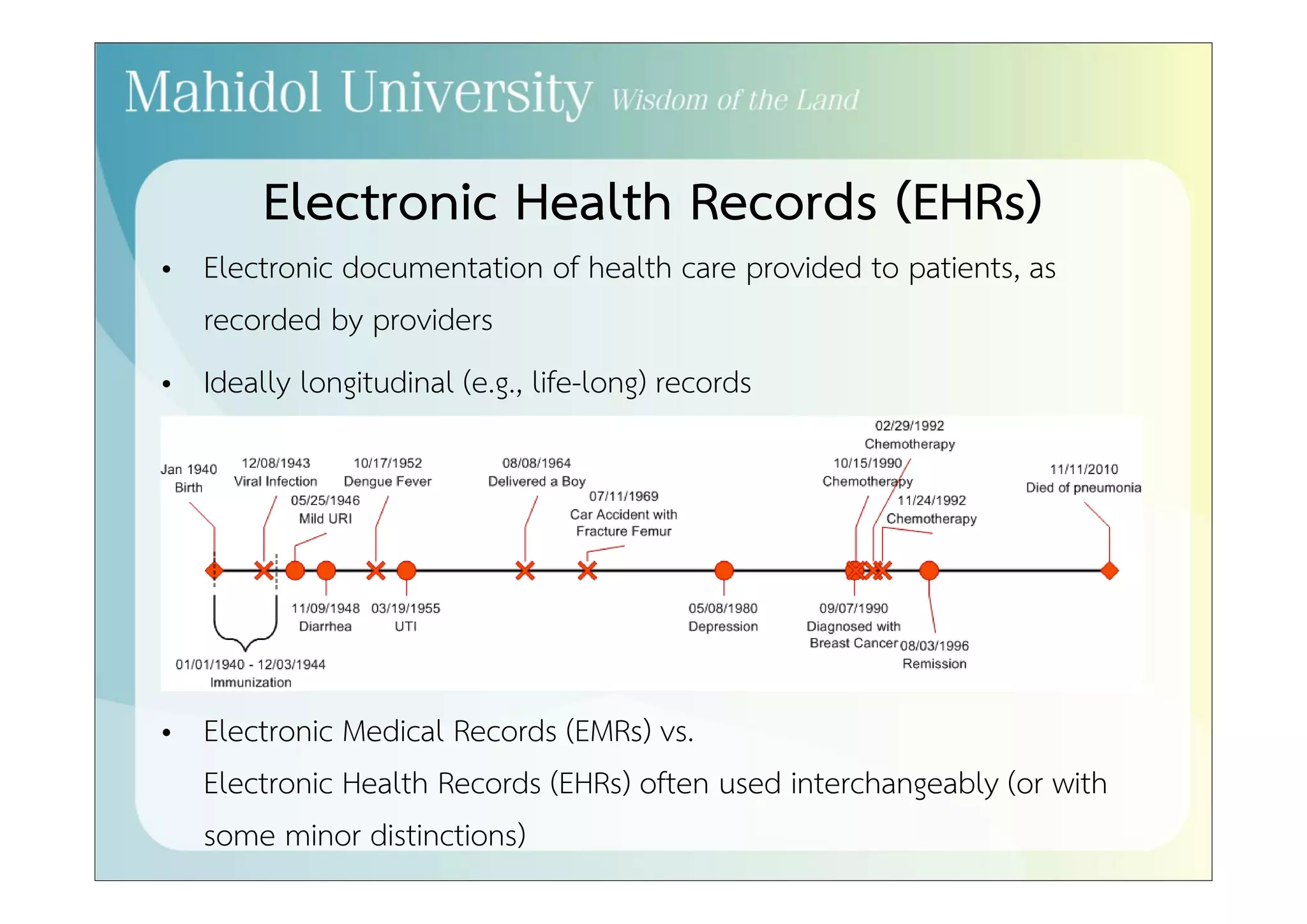
Electronic Health Records (EHRs) 
• Electronic documentation of health care provided to patients, as 
recorded by providers 
• Ideally longitudinal (e.g., life-long) records 
• Electronic Medical Records (EMRs) vs. 
Electronic Health Records (EHRs) often used interchangeably (or with 
some minor distinctions)
• Are they just electronic documentation? 
Diag-nosis 
History 
& PE 
Treat-ments 
• Or do they have some other values? 
... 
EHR Systems
Some Benefits of EHRs 
• Ubiquitous availability (anytime, anywhere, everyone who is authorized) 
• Multiple concurrent uses 
• The end of “Where the heck is the patient’s record?!?” 
• Ability to control & enforce access security 
• Structured data entry possible 
• Data presentation that is easier to understand (e.g. graphs) 
• Efficiency in data entry? (but sometimes it slows users down!) 
• Process improvement (business process reengineering/redesign, quality 
improvement) 
• No doctor’s handwriting!!!!!
Benefits of Health Information Technology 
• Literature suggests improvement in health care through 
– Guideline adherence (Shiffman et al, 1999;Chaudhry et al, 2006) 
– Better documentation (Shiffman et al, 1999) 
– Practitioner decision making or process of care 
(Balas et al, 1996;Kaushal et al, 2003;Garg et al, 2005) 
– Medication safety (Kaushal et al, 2003;Chaudhry et al, 2006;van Rosse et al, 2009) 
– Patient surveillance & monitoring (Chaudhry et al, 2006) 
– Patient education/reminder (Balas et al, 1996) 
– Cost savings and better financial performance 
(Parente & Dunbar, 2001;Chaudhry et al, 2006;Amarasingham et al, 2009;Borzekowski, 2009)
Functions that Should be Part of EHR Systems 
• Computerized Medication Order Entry (IOM, 2003; Blumenthal et al, 2006) 
• Computerized Laboratory Order Entry (IOM, 2003) 
• Computerized Laboratory Results (IOM, 2003) 
• Physician Notes (IOM, 2003) 
• Patient Demographics (Blumenthal et al, 2006) 
• Problem Lists (Blumenthal et al, 2006) 
• Medication Lists (Blumenthal et al, 2006) 
• Discharge Summaries (Blumenthal et al, 2006) 
• Diagnostic Test Results (Blumenthal et al, 2006) 
• Radiologic Reports (Blumenthal et al, 2006)
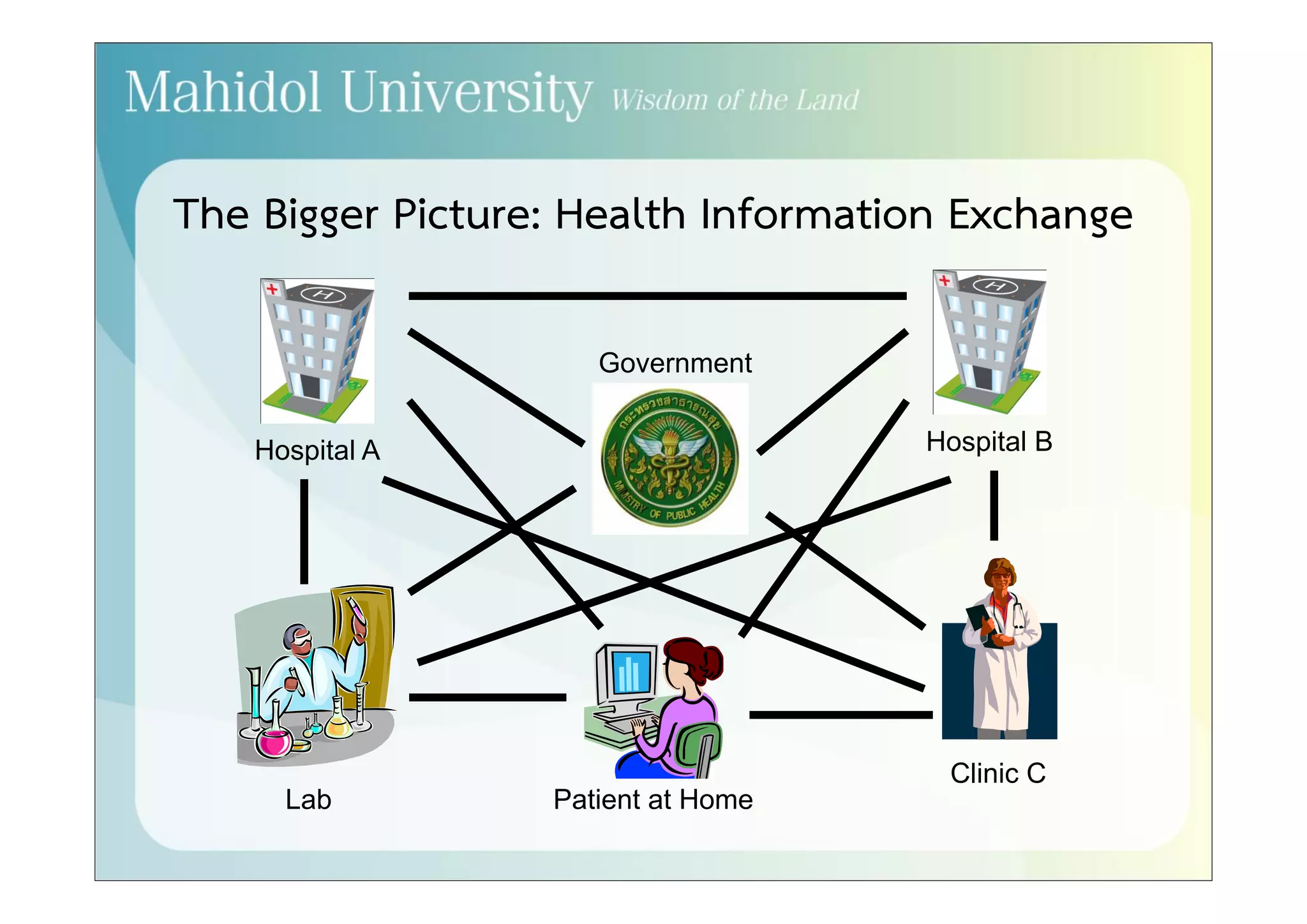
The Bigger Picture: Health Information Exchange 
Hospital A Hospital B 
Clinic C 
Government 
Lab Patient at Home
Common Denominator 
• Health Information Technology 
• Electronic Health Records 
• Health Information Exchange
Ultimate Goal = Health 
• Don’t implement technology just for technology’s sake. 
(Yasnoff et al, 2001 and many others) 
• “Don’t make use of excellent technology. 
Make excellent use of technology.” 
(Tangwongsan, Supachai. Personal communication, 2005.)
U.S. eHealth Policy
U.S. Public Policy Related to eHealth 
1991: IOM’s CPR Report published 
1996: HIPAA enacted 
2000-2001: IOM’s To Err Is Human & 
Crossing the Quality Chasm published 
2004: George W. Bush’s Executive Order 
establishing ONCHIT (ONC) 
2009-2010: ARRA/HITECH Act & 
“Meaningful Use” regulations
Landmark IOM Reports 
(IOM, 2000) (IOM, 2001) (IOM, 2011)
Patient Safety 
• To Err is Human (IOM, 2000) reported that: 
– 44,000 to 98,000 people die in U.S. hospitals each year 
as a result of preventable medical mistakes 
– Mistakes cost U.S. hospitals $17 billion to $29 billion 
yearly 
– Individual errors are not the main problem 
– Faulty systems, processes, and other conditions lead to 
preventable errors 
Health IT Workforce Curriculum Version 
3.0/Spring 2012 Introduction to Healthcare and Public Health in the US: Regulating Healthcare - Lecture d
Landmark IOM Reports: Summary 
• Humans are not perfect and are bound to make 
errors 
• Highlight problems in U.S. health care system 
that systematically contributes to medical errors 
and poor quality 
• Recommends reform 
• Health IT plays a role in improving patient 
safety
Political Support Behind Health IT 
“...We will make wider use of electronic records and other 
health information technology, to help control costs and reduce 
dangerous medical errors.” 
Source: Wikisource.org Image Source: Wikipedia.org 
President George W. Bush 
Sixth State of the Union Address 
January 31, 2006 
?
U.S. Adoption of Health IT 
Ambulatory (Hsiao et al, 2009) Hospitals (Jha et al, 2009) 
Basic EHRs w/ notes 7.6% 
Comprehensive EHRs 1.5% 
CPOE 17% 
• U.S. lags behind other Western countries 
(Schoen et al, 2006;Jha et al, 2008) 
• Money and misalignment of benefits is the biggest reason
American Recovery & Reinvestment Act (ARRA) 
• Economic Stimulus Legislation 
• Contains HITECH Act (Health Information Technology for 
Economic and Clinical Health Act) 
• ~ 20 billion dollars for Health IT investments 
Goals: 
1. Boost economy (economic health) 
2. Widespread adoption of Health IT (clinical health) 
Quality Patient Safety Costs
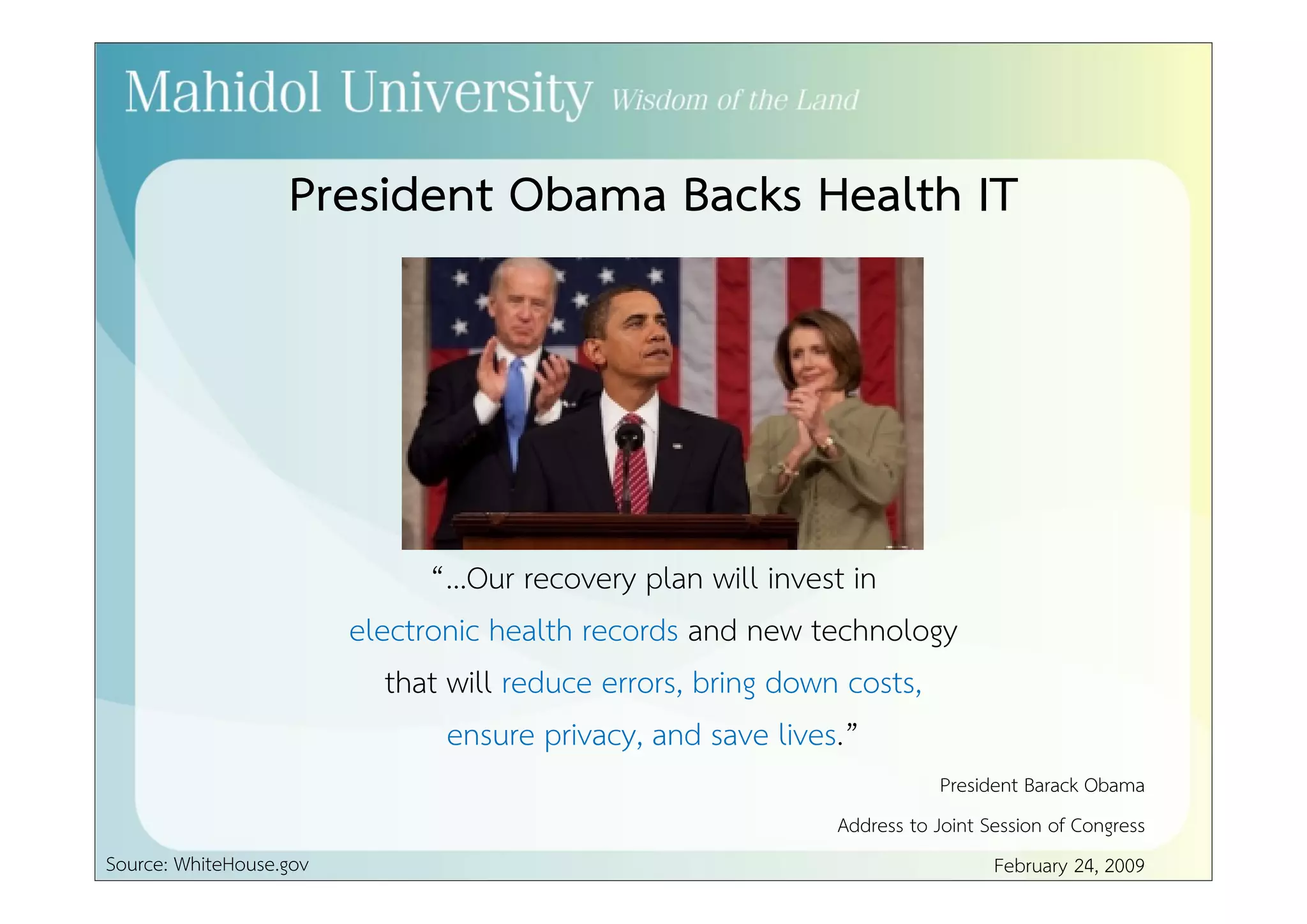
President Obama Backs Health IT 
“...Our recovery plan will invest in 
electronic health records and new technology 
that will reduce errors, bring down costs, 
ensure privacy, and save lives.” 
President Barack Obama 
Address to Joint Session of Congress 
Source: WhiteHouse.gov February 24, 2009
U.S. National Leadership on Health IT 
Office of the National Coordinator for Health Information Technology 
(ONC -- formerly ONCHIT) 
David Blumenthal, MD, MPP 
National Coordinator for 
Health Information Technology 
(2009 - 2011) 
Farzad Mostashari, MD, ScM 
National Coordinator for 
Health Information Technology 
(2011 - 2013) 
David Brailer, MD, PhD 
National Coordinator for 
Health Information Technology 
(2004 - 2007) 
Robert Kolodner, MD 
National Coordinator for 
Health Information Technology 
(2006 - 2009) 
Karen B. DeSalvo, MD, MPH, MSc 
National Coordinator for 
Health Information Technology 
(2014 - Present) 
Photos courtesy of U.S. Department of Health & Human Services
HITECH Act & 
“Meaningful Use” 
of EHRs
HITECH Act 
Blumenthal D. Launching HITECH. N Engl J Med. 2010 Feb 4;362(5):382-5.
“Meaningful Use” of EHRs 
• Use of “Certified EHR Technology” (CEHRT) by 
providers (eligible professionals, eligible hospitals 
& critical access hospitals) to achieve significant 
improvements in care 
• Financial incentives & penalties
Incentives for Eligible Professionals (Doctors) 
• Medicaid incentives for eligible professionals 
– Maximum $63,750 over 6 years beginning in 2011 
• Medicare payments for eligible professionals 
– Maximum $44,000 over 5 years
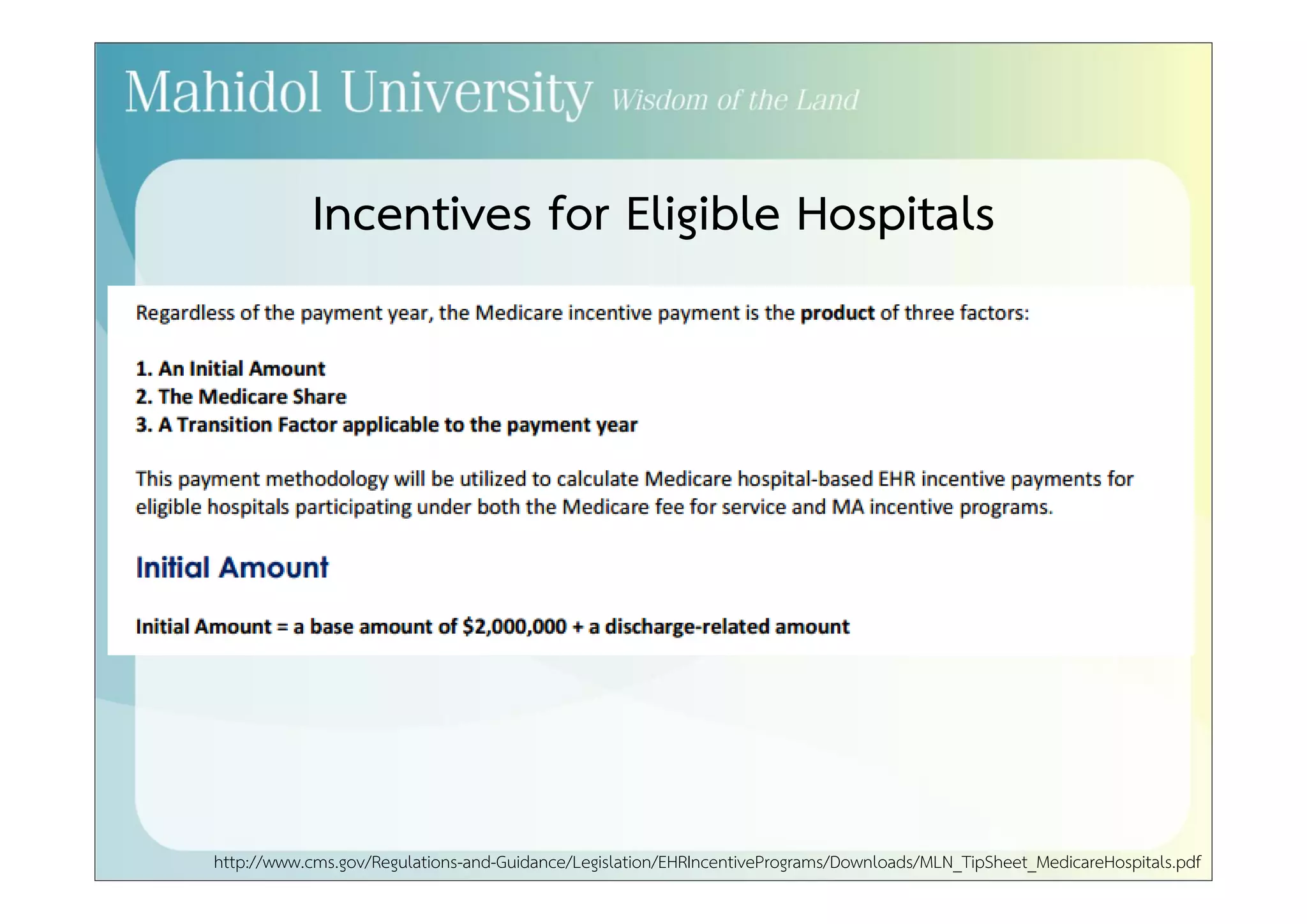
Incentives for Eligible Hospitals 
http://www.cms.gov/Regulations-and-Guidance/Legislation/EHRIncentivePrograms/Downloads/MLN_TipSheet_MedicareHospitals.pdf
“Meaningful Use” of A Pumpkin 
“Meaningful Use” 
of a Pumpkin 
Pumpkin 
Image Source & Idea Courtesy of Pat Wise at HIMSS, Oct. 2009
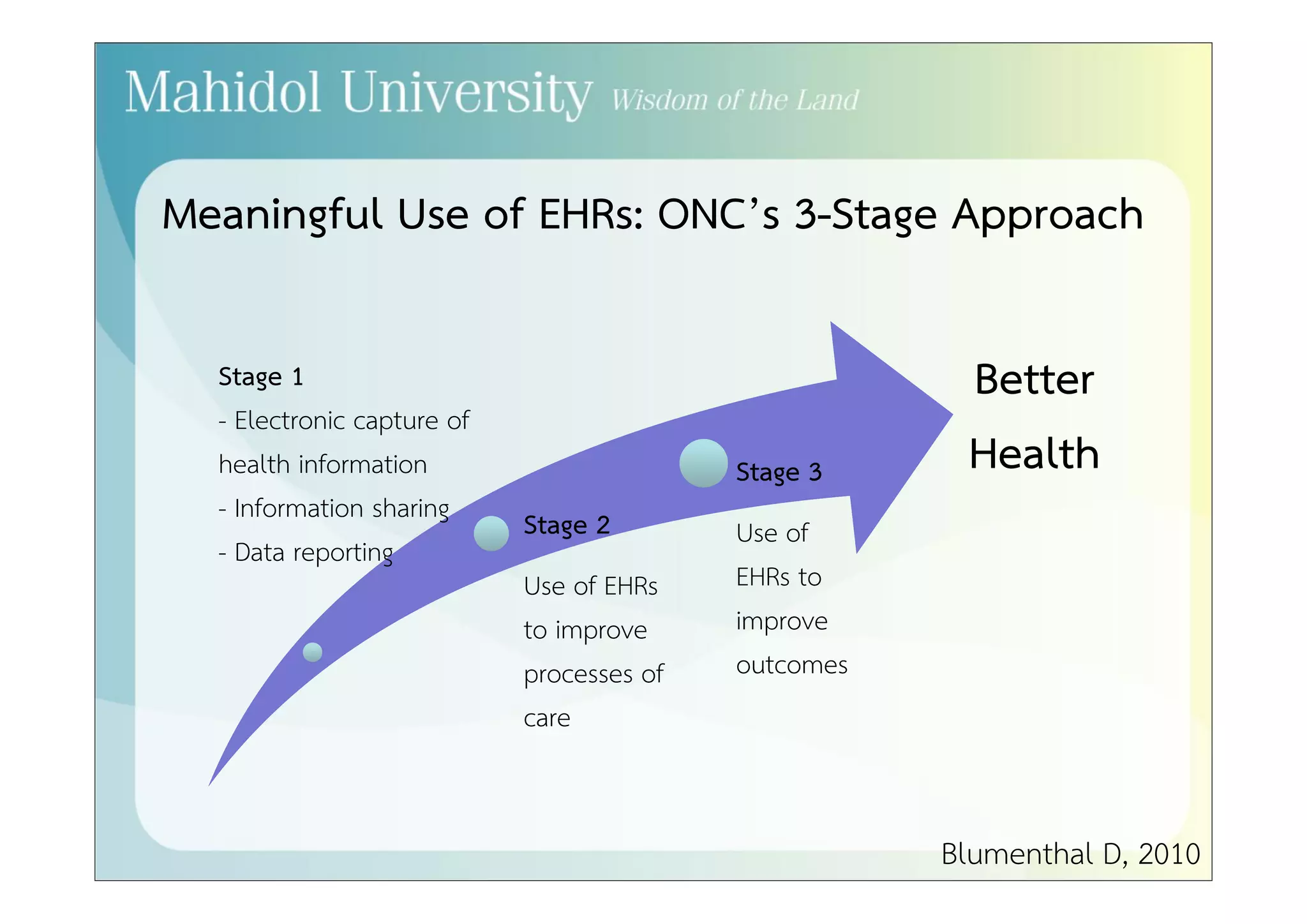
Meaningful Use of EHRs: ONC’s 3-Stage Approach 
Stage 1 
- Electronic capture of 
health information 
- Information sharing 
- Data reporting 
Stage 2 
Use of EHRs 
to improve 
processes of 
care 
Stage 3 
Use of 
EHRs to 
improve 
outcomes 
Better 
Health 
Blumenthal D, 2010
Components of Meaningful Use Regulations 
• Medicare & Medicaid Incentives for Meaningful Use of EHRs 
– Centers for Medicare and Medicaid Services (CMS) 
• Rule on Standards, Implementation Specifications & 
Certification Criteria 
• Certification Programs 
– Office of the National Coordinator for Health IT (ONC)
Meaningful Use Incentives: Stage 1 
Proposed Rule 
(Jan. 2010) 
• 23 Criteria for Hospitals to Pass 
• 25 Criteria for Professionals (Clinics) to Pass 
Public Hearing 
• Pace & Scope: too ambitious, demanding, inflexible 
• Few providers would likely qualify -> Little adoption 
Final Rule (2011) 
• Core Objectives (14 criteria for Hospitals, 15 for Professionals, required) 
• Menu Set (10 criteria, pick 5) 
Blumenthal D, Tavenner M. The “meaningful use” regulation for electronic health records. N Engl J Med. 2010;363(6):501-4.
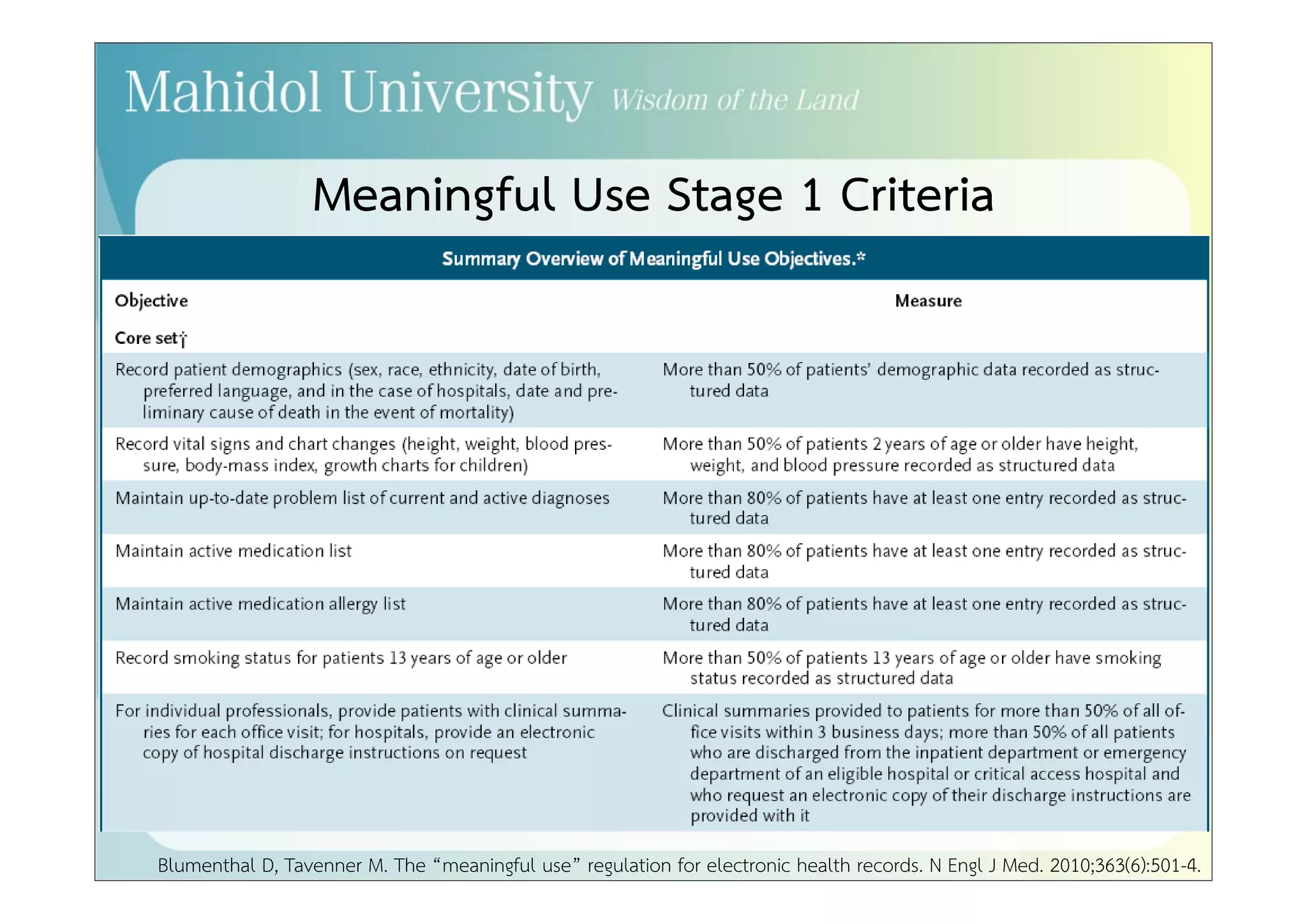
Meaningful Use Stage 1 Criteria 
Blumenthal D, Tavenner M. The “meaningful use” regulation for electronic health records. N Engl J Med. 2010;363(6):501-4.
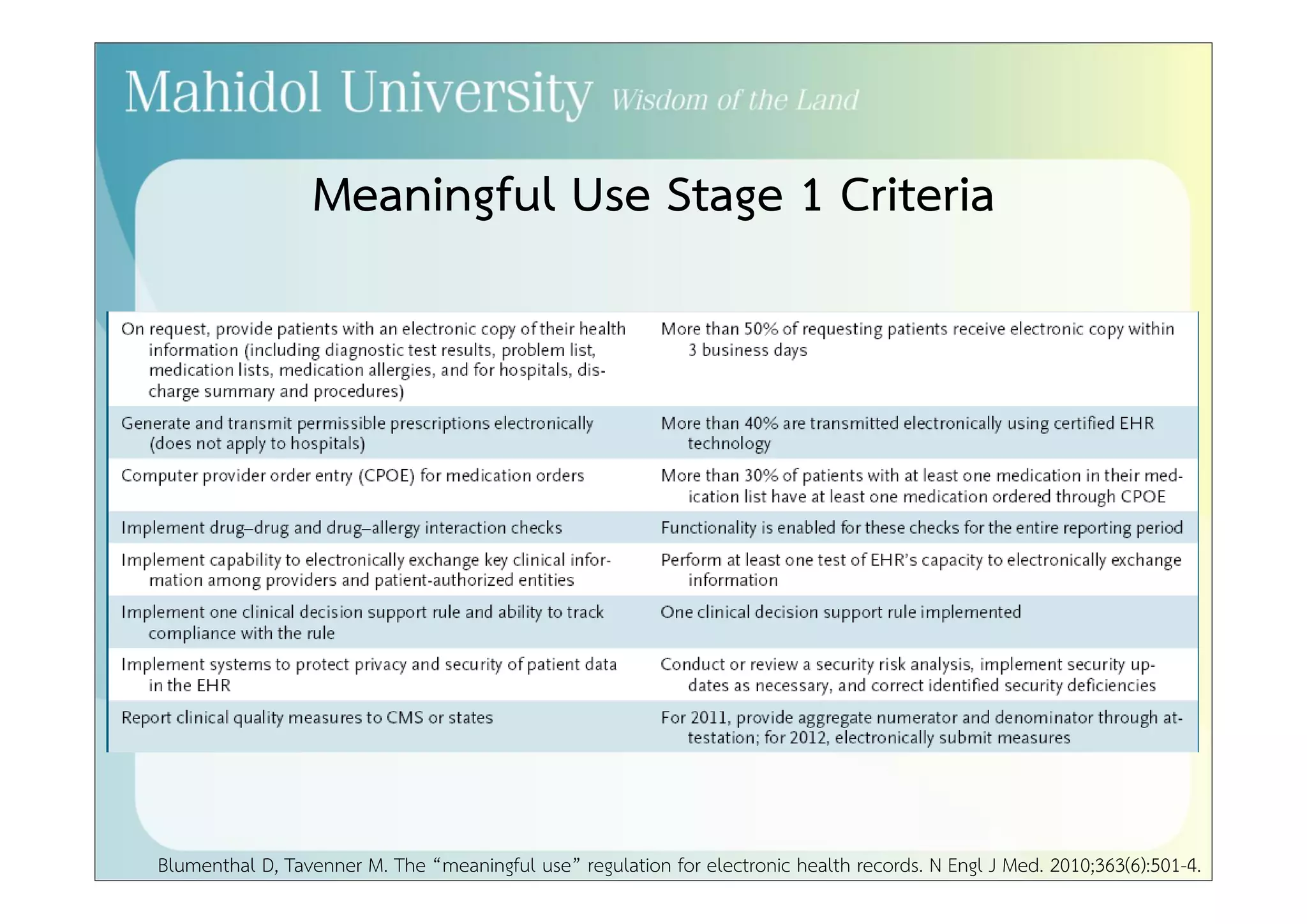
Meaningful Use Stage 1 Criteria 
Blumenthal D, Tavenner M. The “meaningful use” regulation for electronic health records. N Engl J Med. 2010;363(6):501-4.
Meaningful Use Stage 1 Criteria 
Blumenthal D, Tavenner M. The “meaningful use” regulation for electronic health records. N Engl J Med. 2010;363(6):501-4.
Meaningful Use Stage 1 Criteria 
Blumenthal D, Tavenner M. The “meaningful use” regulation for electronic health records. N Engl J Med. 2010;363(6):501-4.
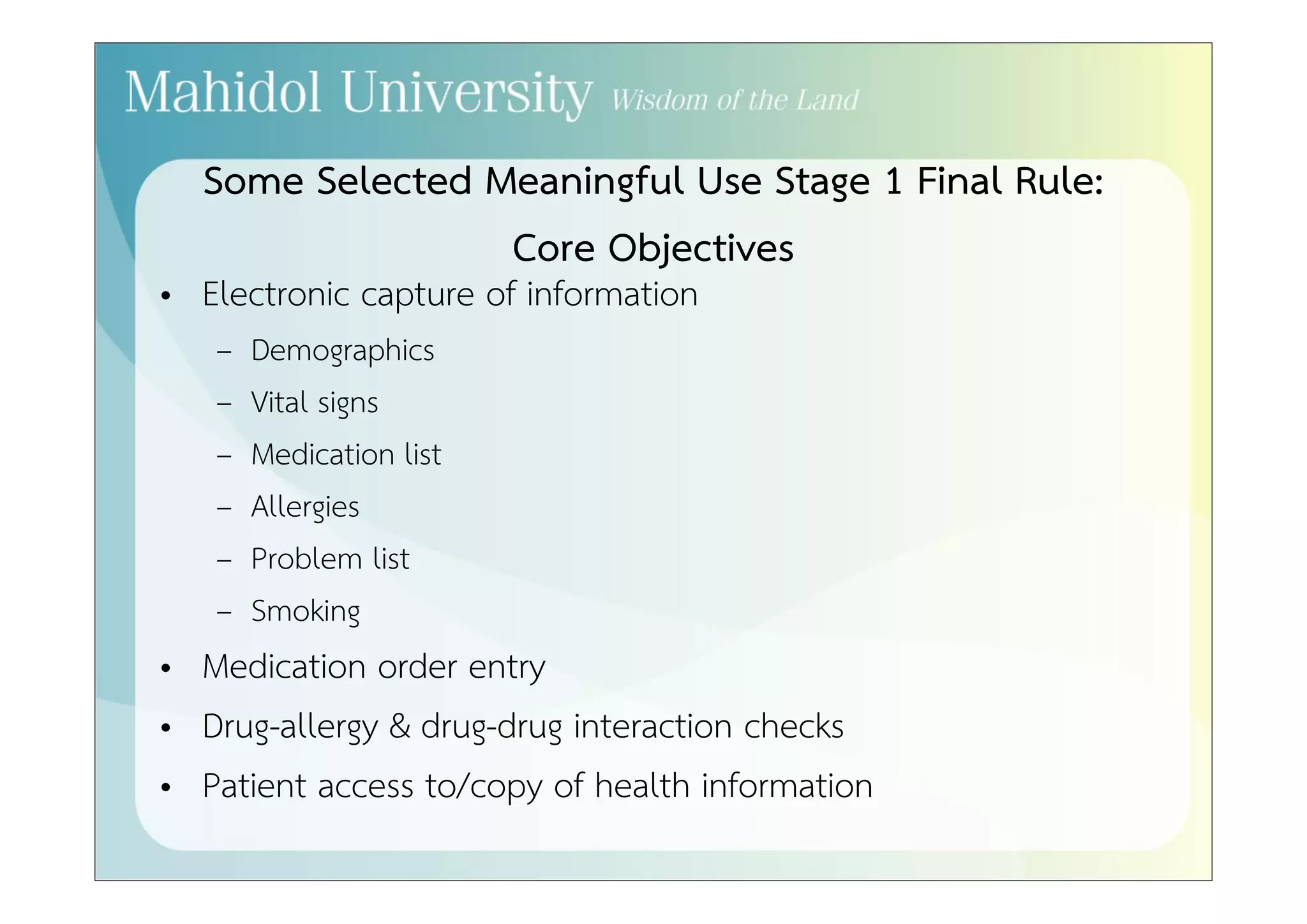
Some Selected Meaningful Use Stage 1 Final Rule: 
Core Objectives 
• Electronic capture of information 
– Demographics 
– Vital signs 
– Medication list 
– Allergies 
– Problem list 
– Smoking 
• Medication order entry 
• Drug-allergy & drug-drug interaction checks 
• Patient access to/copy of health information
Some Selected Meaningful Use Stage 1 Final Rule: 
Menu Set 
• Drug formulary checks 
• Lab results incorporation into EHRs 
• Generate lists of patients by specific conditions 
• Medication reconciliation 
• Electronic reporting to governmental agencies 
• Advanced directives for elderly patients 
• Patient reminders for certain services (for clinics) 
• Patient access to health information (for clinics)
Final Rule on Standards & Certification Criteria (Selected) 
• Content Exchange Standards 
– HL7 CDA Release 2 & CCD 
– NCPDP SCRIPT 
• Vocabularies 
• SNOMED CT 
– LOINC® 
– RxNorm® 
• Security 
– NIST-certified encryption algorithms 
• Etc.
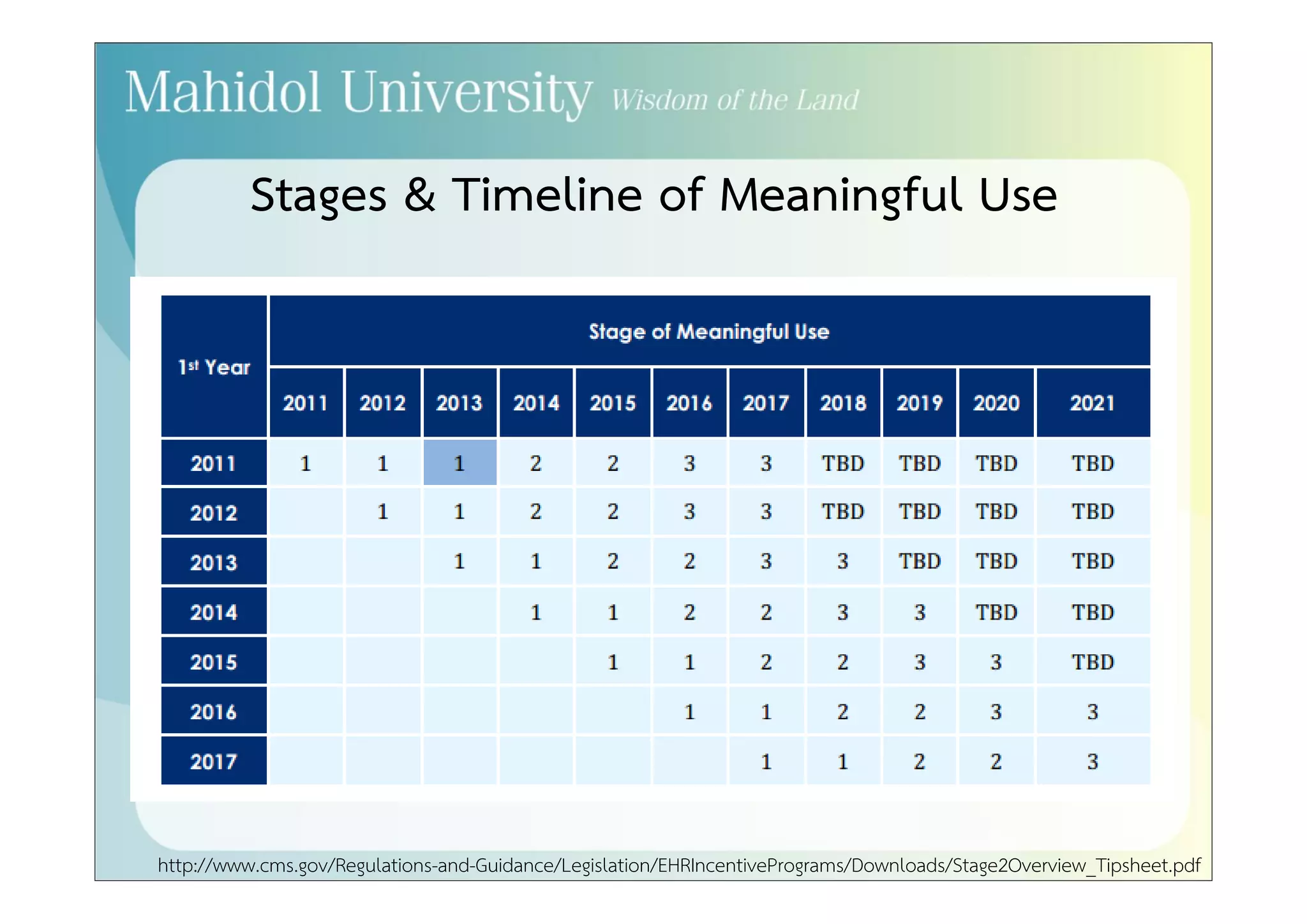
Stages & Timeline of Meaningful Use 
http://www.cms.gov/Regulations-and-Guidance/Legislation/EHRIncentivePrograms/Downloads/Stage2Overview_Tipsheet.pdf
Evolution of Meaningful Use Objectives in Each Stage 
• 2011 Definition Stage 1: 
– 14 Core Objectives for Hospitals 
– 15 Core Objectives for Professionals 
– Pick 5 of 10 Menu Set Objectives 
• 2013 Definition Stage 1: 
– 12 Core Objectives for Hospitals 
– 13 Core Objectives for Professionals 
– Pick 5 of 10 Menu Set Objectives
Evolution of Meaningful Use Objectives in Each Stage 
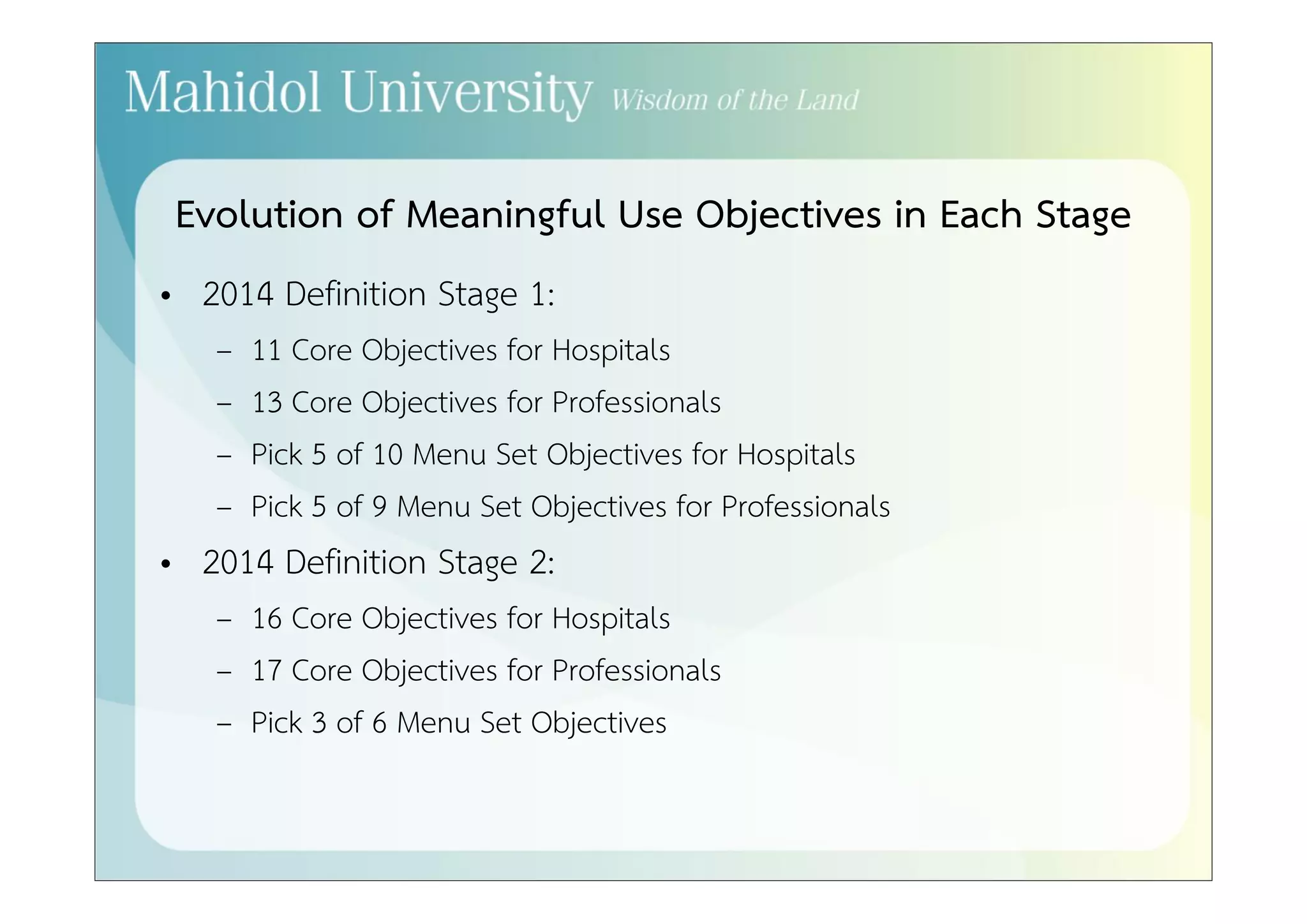
• 2014 Definition Stage 1: 
– 11 Core Objectives for Hospitals 
– 13 Core Objectives for Professionals 
– Pick 5 of 10 Menu Set Objectives for Hospitals 
– Pick 5 of 9 Menu Set Objectives for Professionals 
• 2014 Definition Stage 2: 
– 16 Core Objectives for Hospitals 
– 17 Core Objectives for Professionals 
– Pick 3 of 6 Menu Set Objectives
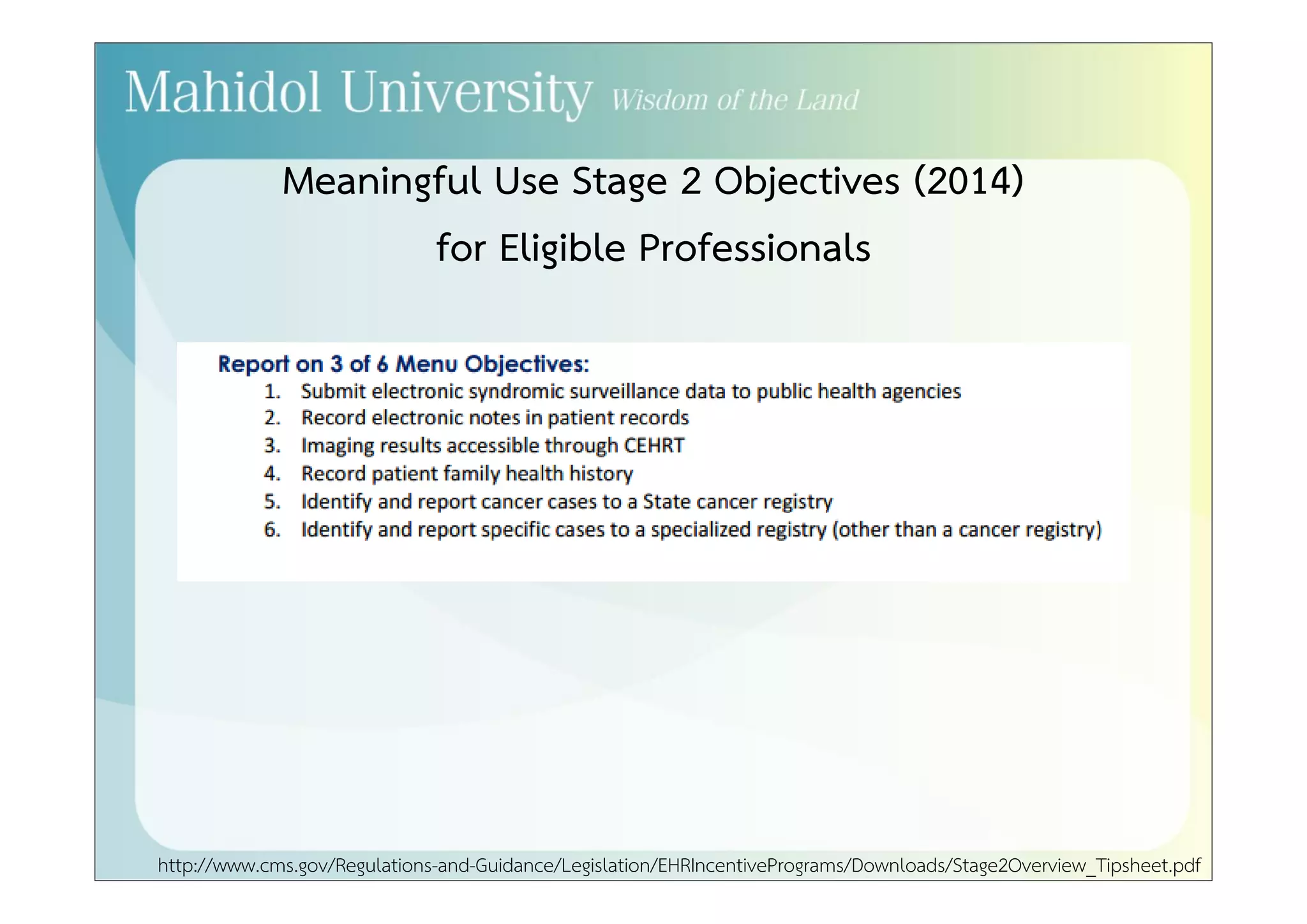
Meaningful Use Stage 2 Objectives (2014) 
for Eligible Professionals 
http://www.cms.gov/Regulations-and-Guidance/Legislation/EHRIncentivePrograms/Downloads/Stage2Overview_Tipsheet.pdf
Meaningful Use Stage 2 Objectives (2014) 
for Eligible Professionals 
http://www.cms.gov/Regulations-and-Guidance/Legislation/EHRIncentivePrograms/Downloads/Stage2Overview_Tipsheet.pdf
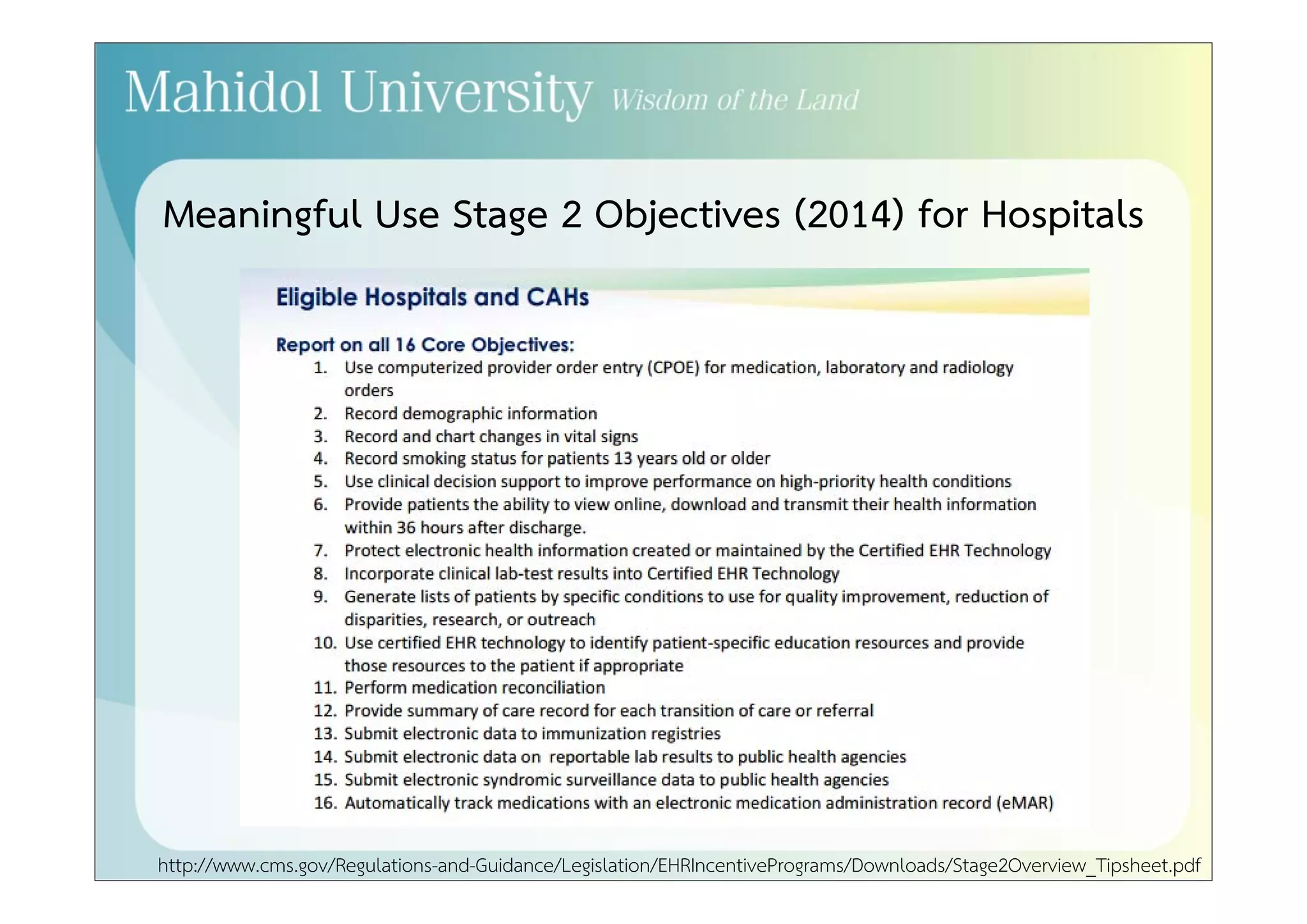
Meaningful Use Stage 2 Objectives (2014) for Hospitals 
http://www.cms.gov/Regulations-and-Guidance/Legislation/EHRIncentivePrograms/Downloads/Stage2Overview_Tipsheet.pdf
Meaningful Use Stage 2 Objectives (2014) for Hospitals 
http://www.cms.gov/Regulations-and-Guidance/Legislation/EHRIncentivePrograms/Downloads/Stage2Overview_Tipsheet.pdf
Critique: 
Lessons for Thailand 
Disclaimer: Personal opinions of the speaker
Lesson #1 
Clear aim toward improved quality & 
efficiency of health care.
Lesson #2 
Large health IT initiatives require 
leadership from the highest level 
of government.
Lesson #3 
To achieve widespread health IT 
adoption, substantial financial 
investment is necessary.
Lesson #4 
Leadership from a national 
organization with health informatics 
expertise is vital to success.
Lesson #5 
Criteria for “Meaningful Use” should 
be evidence-based 
to the extent possible.
Lesson #6 
Criteria for incentives should be 
realistic and flexible.
Lesson #7 
Criteria for incentives should be 
evolutionary.
Lesson #8 
Accept local diversity in technologies 
& requirements. 
Don’t aim for homogeneous 
environment.
Lesson #9 
Leverage existing standards 
to the extent possible. 
Don’t reinvent the wheel.
Lesson #10 
Acknowledge that more than one 
level of interoperability needs to be 
achieved.
Lesson #11 
A policy that attempts to move too 
fast or be too dynamic will greatly 
burden providers
Lesson #12 
“Meaningful Use” focuses too much 
on functionality, with questions on 
true interoperability, and with little 
attention on usability, ease of use & 
provider acceptance of technology
Take Home Message 
• Adoption of health IT still work in progress, even 
in developed countries 
• We can learn something from other countries 
• We need to do something, soon. 
• Don’t forget to build the workforce!!
Useful Online Resources 
• www.healthit.gov 
• www.cms.gov/Regulations-and- 
Guidance/Legislation/EHRIncentivePrograms/index.html 
• www.himss.org/EconomicStimulus/ 
• www.amia.org/public-policy/testimony-comments-reports 
• www.nejm.org/doi/full/10.1056/NEJMp0912825 
• www.nejm.org/doi/full/10.1056/NEJMp1006114
References (1) 
• Amarasingham R, Plantinga L, Diener-West M, Gaskin DJ, Powe NR. Clinical information technologies and 
inpatient outcomes: a multiple hospital study. Arch Intern Med. 2009;169(2):108-14. 
• Balas EA, Austin SM, Mitchell JA, Ewigman BG, Bopp KD, Brown GD. The clinical value of computerized 
information services. A review of 98 randomized clinical trials. Arch Fam Med. 1996;5(5):271-8. 
• Blumenthal D. Launching HITECH. N Engl J Med. 2010 Feb 4;362(5):382-5. 
• Blumenthal D, DesRoches C, Donelan K, Ferris T, Jha A, Kaushal R, Rao S, Rosenbaum S. Health information 
technology in the United States: the information base for progress [Internet]. Princeton (NJ): Robert Wood 
Johnson Foundation; 2006 [cited 2010 Oct 14]. 81 p. Available from: 
http://www.rwjf.org/files/publications/other/EHRReport0609.pdf 
• Blumenthal D, Tavenner M. The “meaningful use” regulation for electronic health records. N Engl J Med. 2010 
Aug 5;363(6):501-4. 
• Borzekowski R. Measuring the cost impact of hospital information systems: 1987-1994. J Health Econ. 
2009;28(5):939-49. 
• Chaudhry B, Wang J, Wu S, Maglione M, Mojica W, Roth E, Morton SC, Shekelle PG. Systematic review: impact 
of health information technology on quality, efficiency, and costs of medical care. Ann Intern Med. 
2006;144(10):742-52.
References (2) 
• Garg AX, Adhikari NKJ, McDonald H, Rosas-Arellano MP, Devereaux PJ, Beyene J, et al. Effects of computerized 
clinical decision support systems on practitioner performance and patient outcomes: a systematic review. 
JAMA. 2005;293(10):1223-38. 
• Hsiao C, Beatty PC, Hing ES, Woodwell DA. Electronic medical record/electronic health record use by office-based 
physicians: United States, 2008 and preliminary 2009 [Internet]. 2009 [cited 2010 Apr 12]; Available from: 
http://www.cdc.gov/nchs/data/hestat/emr_ehr/emr_ehr.pdf 
• Institute of Medicine, Board on Health Care Services, Committee on Data Standards for Patient Safety. Key 
Capabilities of an electronic health record system: letter report [Internet]. Washington, DC: National Academy 
of Sciences; 2003 [cited 2010 Oct 14]. 31 p. Available from: http://www.nap.edu/catalog/10781.html 
• Jha AK, DesRoches CM, Campbell EG, Donelan K, Rao SR, Ferris TG, Shields A, Rosenbaum S, Blumenthal D. 
Use of electronic health records in U.S. hospitals. N Engl J Med. 2009;360(16):1628-38. 
• Jha AK, Doolan D, Grandt D, Scott T, Bates DW. The use of health information technology in seven nations. Int 
J Med Inform. 2008;77(12):848-54. 
• Kaushal R, Shojania KG, Bates DW. Effects of computerized physician order entry and clinical decision support 
systems on medication safety: a systematic review. Arch. Intern. Med. 2003;163(12):1409-16.
References (3) 
• Parente ST, Dunbar JL. Is health information technology investment related to the financial performance of US 
hospitals? An exploratory analysis. Int J Healthc Technol Manag. 2001;3(1):48-58. 
• Schoen C, Osborn R, Huynh PT, Doty M, Puegh J, Zapert K. On the front lines of care: primary care doctors’ 
office systems, experiences, and views in seven countries. Health Aff (Millwood). 2006;25(6):w555-71. 
• Shiffman RN, Liaw Y, Brandt CA, Corb GJ. Computer-based guideline implementation systems: a systematic 
review of functionality and effectiveness. J Am Med Inform Assoc. 1999;6(2):104-14. 
• Van Rosse F, Maat B, Rademaker CMA, van Vught AJ, Egberts ACG, Bollen CW. The effect of computerized 
physician order entry on medication prescription errors and clinical outcome in pediatric and intensive care: a 
systematic review. Pediatrics. 2009;123(4):1184-90. 
• Yasnoff WA, Overhage JM, Humphreys BL, LaVenture M. A national agenda for public health informatics: 
summarized recommendations from the 2001 AMIA Spring Congress. J Am Med Inform Assoc. 2001 
Dec;8(6):535-545.

Policy Related to Health Information Systems: A U.S. Case Study

  • 1.
    Policy Related to Health Information Systems: A U.S. Case Study Nawanan Theera-Ampornpunt, M.D., Ph.D. Department of Community Medicine Faculty of Medicine Ramathibodi Hospital October 19, 2014 SlideShare.net/Nawanan nawanan.the@mahidol.ac.th Except where referred to or copied from other works
  • 2.
    Outline • ElectronicHealth Records & Health IT • U.S. eHealth Policy • HITECH Act & “Meaningful Use” of EHRs • Lessons for Thailand
  • 3.
  • 4.
  • 5.
    Electronic Health Records(EHRs) • Electronic documentation of health care provided to patients, as recorded by providers • Ideally longitudinal (e.g., life-long) records • Electronic Medical Records (EMRs) vs. Electronic Health Records (EHRs) often used interchangeably (or with some minor distinctions)
  • 6.
    • Are theyjust electronic documentation? Diag-nosis History & PE Treat-ments • Or do they have some other values? ... EHR Systems
  • 7.
    Some Benefits ofEHRs • Ubiquitous availability (anytime, anywhere, everyone who is authorized) • Multiple concurrent uses • The end of “Where the heck is the patient’s record?!?” • Ability to control & enforce access security • Structured data entry possible • Data presentation that is easier to understand (e.g. graphs) • Efficiency in data entry? (but sometimes it slows users down!) • Process improvement (business process reengineering/redesign, quality improvement) • No doctor’s handwriting!!!!!
  • 8.
    Benefits of HealthInformation Technology • Literature suggests improvement in health care through – Guideline adherence (Shiffman et al, 1999;Chaudhry et al, 2006) – Better documentation (Shiffman et al, 1999) – Practitioner decision making or process of care (Balas et al, 1996;Kaushal et al, 2003;Garg et al, 2005) – Medication safety (Kaushal et al, 2003;Chaudhry et al, 2006;van Rosse et al, 2009) – Patient surveillance & monitoring (Chaudhry et al, 2006) – Patient education/reminder (Balas et al, 1996) – Cost savings and better financial performance (Parente & Dunbar, 2001;Chaudhry et al, 2006;Amarasingham et al, 2009;Borzekowski, 2009)
  • 9.
    Functions that Shouldbe Part of EHR Systems • Computerized Medication Order Entry (IOM, 2003; Blumenthal et al, 2006) • Computerized Laboratory Order Entry (IOM, 2003) • Computerized Laboratory Results (IOM, 2003) • Physician Notes (IOM, 2003) • Patient Demographics (Blumenthal et al, 2006) • Problem Lists (Blumenthal et al, 2006) • Medication Lists (Blumenthal et al, 2006) • Discharge Summaries (Blumenthal et al, 2006) • Diagnostic Test Results (Blumenthal et al, 2006) • Radiologic Reports (Blumenthal et al, 2006)
  • 10.
    The Bigger Picture:Health Information Exchange Hospital A Hospital B Clinic C Government Lab Patient at Home
  • 11.
    Common Denominator •Health Information Technology • Electronic Health Records • Health Information Exchange
  • 12.
    Ultimate Goal =Health • Don’t implement technology just for technology’s sake. (Yasnoff et al, 2001 and many others) • “Don’t make use of excellent technology. Make excellent use of technology.” (Tangwongsan, Supachai. Personal communication, 2005.)
  • 13.
  • 14.
    U.S. Public PolicyRelated to eHealth 1991: IOM’s CPR Report published 1996: HIPAA enacted 2000-2001: IOM’s To Err Is Human & Crossing the Quality Chasm published 2004: George W. Bush’s Executive Order establishing ONCHIT (ONC) 2009-2010: ARRA/HITECH Act & “Meaningful Use” regulations
  • 15.
    Landmark IOM Reports (IOM, 2000) (IOM, 2001) (IOM, 2011)
  • 16.
    Patient Safety •To Err is Human (IOM, 2000) reported that: – 44,000 to 98,000 people die in U.S. hospitals each year as a result of preventable medical mistakes – Mistakes cost U.S. hospitals $17 billion to $29 billion yearly – Individual errors are not the main problem – Faulty systems, processes, and other conditions lead to preventable errors Health IT Workforce Curriculum Version 3.0/Spring 2012 Introduction to Healthcare and Public Health in the US: Regulating Healthcare - Lecture d
  • 17.
    Landmark IOM Reports:Summary • Humans are not perfect and are bound to make errors • Highlight problems in U.S. health care system that systematically contributes to medical errors and poor quality • Recommends reform • Health IT plays a role in improving patient safety
  • 18.
    Political Support BehindHealth IT “...We will make wider use of electronic records and other health information technology, to help control costs and reduce dangerous medical errors.” Source: Wikisource.org Image Source: Wikipedia.org President George W. Bush Sixth State of the Union Address January 31, 2006 ?
  • 19.
    U.S. Adoption ofHealth IT Ambulatory (Hsiao et al, 2009) Hospitals (Jha et al, 2009) Basic EHRs w/ notes 7.6% Comprehensive EHRs 1.5% CPOE 17% • U.S. lags behind other Western countries (Schoen et al, 2006;Jha et al, 2008) • Money and misalignment of benefits is the biggest reason
  • 20.
    American Recovery &Reinvestment Act (ARRA) • Economic Stimulus Legislation • Contains HITECH Act (Health Information Technology for Economic and Clinical Health Act) • ~ 20 billion dollars for Health IT investments Goals: 1. Boost economy (economic health) 2. Widespread adoption of Health IT (clinical health) Quality Patient Safety Costs
  • 21.
    President Obama BacksHealth IT “...Our recovery plan will invest in electronic health records and new technology that will reduce errors, bring down costs, ensure privacy, and save lives.” President Barack Obama Address to Joint Session of Congress Source: WhiteHouse.gov February 24, 2009
  • 22.
    U.S. National Leadershipon Health IT Office of the National Coordinator for Health Information Technology (ONC -- formerly ONCHIT) David Blumenthal, MD, MPP National Coordinator for Health Information Technology (2009 - 2011) Farzad Mostashari, MD, ScM National Coordinator for Health Information Technology (2011 - 2013) David Brailer, MD, PhD National Coordinator for Health Information Technology (2004 - 2007) Robert Kolodner, MD National Coordinator for Health Information Technology (2006 - 2009) Karen B. DeSalvo, MD, MPH, MSc National Coordinator for Health Information Technology (2014 - Present) Photos courtesy of U.S. Department of Health & Human Services
  • 23.
    HITECH Act & “Meaningful Use” of EHRs
  • 24.
    HITECH Act BlumenthalD. Launching HITECH. N Engl J Med. 2010 Feb 4;362(5):382-5.
  • 25.
    “Meaningful Use” ofEHRs • Use of “Certified EHR Technology” (CEHRT) by providers (eligible professionals, eligible hospitals & critical access hospitals) to achieve significant improvements in care • Financial incentives & penalties
  • 26.
    Incentives for EligibleProfessionals (Doctors) • Medicaid incentives for eligible professionals – Maximum $63,750 over 6 years beginning in 2011 • Medicare payments for eligible professionals – Maximum $44,000 over 5 years
  • 27.
    Incentives for EligibleHospitals http://www.cms.gov/Regulations-and-Guidance/Legislation/EHRIncentivePrograms/Downloads/MLN_TipSheet_MedicareHospitals.pdf
  • 28.
    “Meaningful Use” ofA Pumpkin “Meaningful Use” of a Pumpkin Pumpkin Image Source & Idea Courtesy of Pat Wise at HIMSS, Oct. 2009
  • 29.
    Meaningful Use ofEHRs: ONC’s 3-Stage Approach Stage 1 - Electronic capture of health information - Information sharing - Data reporting Stage 2 Use of EHRs to improve processes of care Stage 3 Use of EHRs to improve outcomes Better Health Blumenthal D, 2010
  • 30.
    Components of MeaningfulUse Regulations • Medicare & Medicaid Incentives for Meaningful Use of EHRs – Centers for Medicare and Medicaid Services (CMS) • Rule on Standards, Implementation Specifications & Certification Criteria • Certification Programs – Office of the National Coordinator for Health IT (ONC)
  • 31.
    Meaningful Use Incentives:Stage 1 Proposed Rule (Jan. 2010) • 23 Criteria for Hospitals to Pass • 25 Criteria for Professionals (Clinics) to Pass Public Hearing • Pace & Scope: too ambitious, demanding, inflexible • Few providers would likely qualify -> Little adoption Final Rule (2011) • Core Objectives (14 criteria for Hospitals, 15 for Professionals, required) • Menu Set (10 criteria, pick 5) Blumenthal D, Tavenner M. The “meaningful use” regulation for electronic health records. N Engl J Med. 2010;363(6):501-4.
  • 32.
    Meaningful Use Stage1 Criteria Blumenthal D, Tavenner M. The “meaningful use” regulation for electronic health records. N Engl J Med. 2010;363(6):501-4.
  • 33.
    Meaningful Use Stage1 Criteria Blumenthal D, Tavenner M. The “meaningful use” regulation for electronic health records. N Engl J Med. 2010;363(6):501-4.
  • 34.
    Meaningful Use Stage1 Criteria Blumenthal D, Tavenner M. The “meaningful use” regulation for electronic health records. N Engl J Med. 2010;363(6):501-4.
  • 35.
    Meaningful Use Stage1 Criteria Blumenthal D, Tavenner M. The “meaningful use” regulation for electronic health records. N Engl J Med. 2010;363(6):501-4.
  • 36.
    Some Selected MeaningfulUse Stage 1 Final Rule: Core Objectives • Electronic capture of information – Demographics – Vital signs – Medication list – Allergies – Problem list – Smoking • Medication order entry • Drug-allergy & drug-drug interaction checks • Patient access to/copy of health information
  • 37.
    Some Selected MeaningfulUse Stage 1 Final Rule: Menu Set • Drug formulary checks • Lab results incorporation into EHRs • Generate lists of patients by specific conditions • Medication reconciliation • Electronic reporting to governmental agencies • Advanced directives for elderly patients • Patient reminders for certain services (for clinics) • Patient access to health information (for clinics)
  • 38.
    Final Rule onStandards & Certification Criteria (Selected) • Content Exchange Standards – HL7 CDA Release 2 & CCD – NCPDP SCRIPT • Vocabularies • SNOMED CT – LOINC® – RxNorm® • Security – NIST-certified encryption algorithms • Etc.
  • 39.
    Stages & Timelineof Meaningful Use http://www.cms.gov/Regulations-and-Guidance/Legislation/EHRIncentivePrograms/Downloads/Stage2Overview_Tipsheet.pdf
  • 40.
    Evolution of MeaningfulUse Objectives in Each Stage • 2011 Definition Stage 1: – 14 Core Objectives for Hospitals – 15 Core Objectives for Professionals – Pick 5 of 10 Menu Set Objectives • 2013 Definition Stage 1: – 12 Core Objectives for Hospitals – 13 Core Objectives for Professionals – Pick 5 of 10 Menu Set Objectives
  • 41.
    Evolution of MeaningfulUse Objectives in Each Stage • 2014 Definition Stage 1: – 11 Core Objectives for Hospitals – 13 Core Objectives for Professionals – Pick 5 of 10 Menu Set Objectives for Hospitals – Pick 5 of 9 Menu Set Objectives for Professionals • 2014 Definition Stage 2: – 16 Core Objectives for Hospitals – 17 Core Objectives for Professionals – Pick 3 of 6 Menu Set Objectives
  • 42.
    Meaningful Use Stage2 Objectives (2014) for Eligible Professionals http://www.cms.gov/Regulations-and-Guidance/Legislation/EHRIncentivePrograms/Downloads/Stage2Overview_Tipsheet.pdf
  • 43.
    Meaningful Use Stage2 Objectives (2014) for Eligible Professionals http://www.cms.gov/Regulations-and-Guidance/Legislation/EHRIncentivePrograms/Downloads/Stage2Overview_Tipsheet.pdf
  • 44.
    Meaningful Use Stage2 Objectives (2014) for Hospitals http://www.cms.gov/Regulations-and-Guidance/Legislation/EHRIncentivePrograms/Downloads/Stage2Overview_Tipsheet.pdf
  • 45.
    Meaningful Use Stage2 Objectives (2014) for Hospitals http://www.cms.gov/Regulations-and-Guidance/Legislation/EHRIncentivePrograms/Downloads/Stage2Overview_Tipsheet.pdf
  • 46.
    Critique: Lessons forThailand Disclaimer: Personal opinions of the speaker
  • 47.
    Lesson #1 Clearaim toward improved quality & efficiency of health care.
  • 48.
    Lesson #2 Largehealth IT initiatives require leadership from the highest level of government.
  • 49.
    Lesson #3 Toachieve widespread health IT adoption, substantial financial investment is necessary.
  • 50.
    Lesson #4 Leadershipfrom a national organization with health informatics expertise is vital to success.
  • 51.
    Lesson #5 Criteriafor “Meaningful Use” should be evidence-based to the extent possible.
  • 52.
    Lesson #6 Criteriafor incentives should be realistic and flexible.
  • 53.
    Lesson #7 Criteriafor incentives should be evolutionary.
  • 54.
    Lesson #8 Acceptlocal diversity in technologies & requirements. Don’t aim for homogeneous environment.
  • 55.
    Lesson #9 Leverageexisting standards to the extent possible. Don’t reinvent the wheel.
  • 56.
    Lesson #10 Acknowledgethat more than one level of interoperability needs to be achieved.
  • 57.
    Lesson #11 Apolicy that attempts to move too fast or be too dynamic will greatly burden providers
  • 58.
    Lesson #12 “MeaningfulUse” focuses too much on functionality, with questions on true interoperability, and with little attention on usability, ease of use & provider acceptance of technology
  • 59.
    Take Home Message • Adoption of health IT still work in progress, even in developed countries • We can learn something from other countries • We need to do something, soon. • Don’t forget to build the workforce!!
  • 60.
    Useful Online Resources • www.healthit.gov • www.cms.gov/Regulations-and- Guidance/Legislation/EHRIncentivePrograms/index.html • www.himss.org/EconomicStimulus/ • www.amia.org/public-policy/testimony-comments-reports • www.nejm.org/doi/full/10.1056/NEJMp0912825 • www.nejm.org/doi/full/10.1056/NEJMp1006114
  • 61.
    References (1) •Amarasingham R, Plantinga L, Diener-West M, Gaskin DJ, Powe NR. Clinical information technologies and inpatient outcomes: a multiple hospital study. Arch Intern Med. 2009;169(2):108-14. • Balas EA, Austin SM, Mitchell JA, Ewigman BG, Bopp KD, Brown GD. The clinical value of computerized information services. A review of 98 randomized clinical trials. Arch Fam Med. 1996;5(5):271-8. • Blumenthal D. Launching HITECH. N Engl J Med. 2010 Feb 4;362(5):382-5. • Blumenthal D, DesRoches C, Donelan K, Ferris T, Jha A, Kaushal R, Rao S, Rosenbaum S. Health information technology in the United States: the information base for progress [Internet]. Princeton (NJ): Robert Wood Johnson Foundation; 2006 [cited 2010 Oct 14]. 81 p. Available from: http://www.rwjf.org/files/publications/other/EHRReport0609.pdf • Blumenthal D, Tavenner M. The “meaningful use” regulation for electronic health records. N Engl J Med. 2010 Aug 5;363(6):501-4. • Borzekowski R. Measuring the cost impact of hospital information systems: 1987-1994. J Health Econ. 2009;28(5):939-49. • Chaudhry B, Wang J, Wu S, Maglione M, Mojica W, Roth E, Morton SC, Shekelle PG. Systematic review: impact of health information technology on quality, efficiency, and costs of medical care. Ann Intern Med. 2006;144(10):742-52.
  • 62.
    References (2) •Garg AX, Adhikari NKJ, McDonald H, Rosas-Arellano MP, Devereaux PJ, Beyene J, et al. Effects of computerized clinical decision support systems on practitioner performance and patient outcomes: a systematic review. JAMA. 2005;293(10):1223-38. • Hsiao C, Beatty PC, Hing ES, Woodwell DA. Electronic medical record/electronic health record use by office-based physicians: United States, 2008 and preliminary 2009 [Internet]. 2009 [cited 2010 Apr 12]; Available from: http://www.cdc.gov/nchs/data/hestat/emr_ehr/emr_ehr.pdf • Institute of Medicine, Board on Health Care Services, Committee on Data Standards for Patient Safety. Key Capabilities of an electronic health record system: letter report [Internet]. Washington, DC: National Academy of Sciences; 2003 [cited 2010 Oct 14]. 31 p. Available from: http://www.nap.edu/catalog/10781.html • Jha AK, DesRoches CM, Campbell EG, Donelan K, Rao SR, Ferris TG, Shields A, Rosenbaum S, Blumenthal D. Use of electronic health records in U.S. hospitals. N Engl J Med. 2009;360(16):1628-38. • Jha AK, Doolan D, Grandt D, Scott T, Bates DW. The use of health information technology in seven nations. Int J Med Inform. 2008;77(12):848-54. • Kaushal R, Shojania KG, Bates DW. Effects of computerized physician order entry and clinical decision support systems on medication safety: a systematic review. Arch. Intern. Med. 2003;163(12):1409-16.
  • 63.
    References (3) •Parente ST, Dunbar JL. Is health information technology investment related to the financial performance of US hospitals? An exploratory analysis. Int J Healthc Technol Manag. 2001;3(1):48-58. • Schoen C, Osborn R, Huynh PT, Doty M, Puegh J, Zapert K. On the front lines of care: primary care doctors’ office systems, experiences, and views in seven countries. Health Aff (Millwood). 2006;25(6):w555-71. • Shiffman RN, Liaw Y, Brandt CA, Corb GJ. Computer-based guideline implementation systems: a systematic review of functionality and effectiveness. J Am Med Inform Assoc. 1999;6(2):104-14. • Van Rosse F, Maat B, Rademaker CMA, van Vught AJ, Egberts ACG, Bollen CW. The effect of computerized physician order entry on medication prescription errors and clinical outcome in pediatric and intensive care: a systematic review. Pediatrics. 2009;123(4):1184-90. • Yasnoff WA, Overhage JM, Humphreys BL, LaVenture M. A national agenda for public health informatics: summarized recommendations from the 2001 AMIA Spring Congress. J Am Med Inform Assoc. 2001 Dec;8(6):535-545.