Eliminating Lymphatic Filariasis in the Americas
                            A Winnable Battle


          Center for Global Health
          Division of Parasitic Diseases and Malaria
Lymphatic Filariasis (LF)


   Caused by worms spread from person-to-person by the
    bite of infected mosquitoes
   The worms live in the human lymphatic system and can
    cause:
     lymphedema (swelling) and elephantiasis in limbs and breasts
     hydrocele (severe fluid accumulation) affecting men’s genitalia


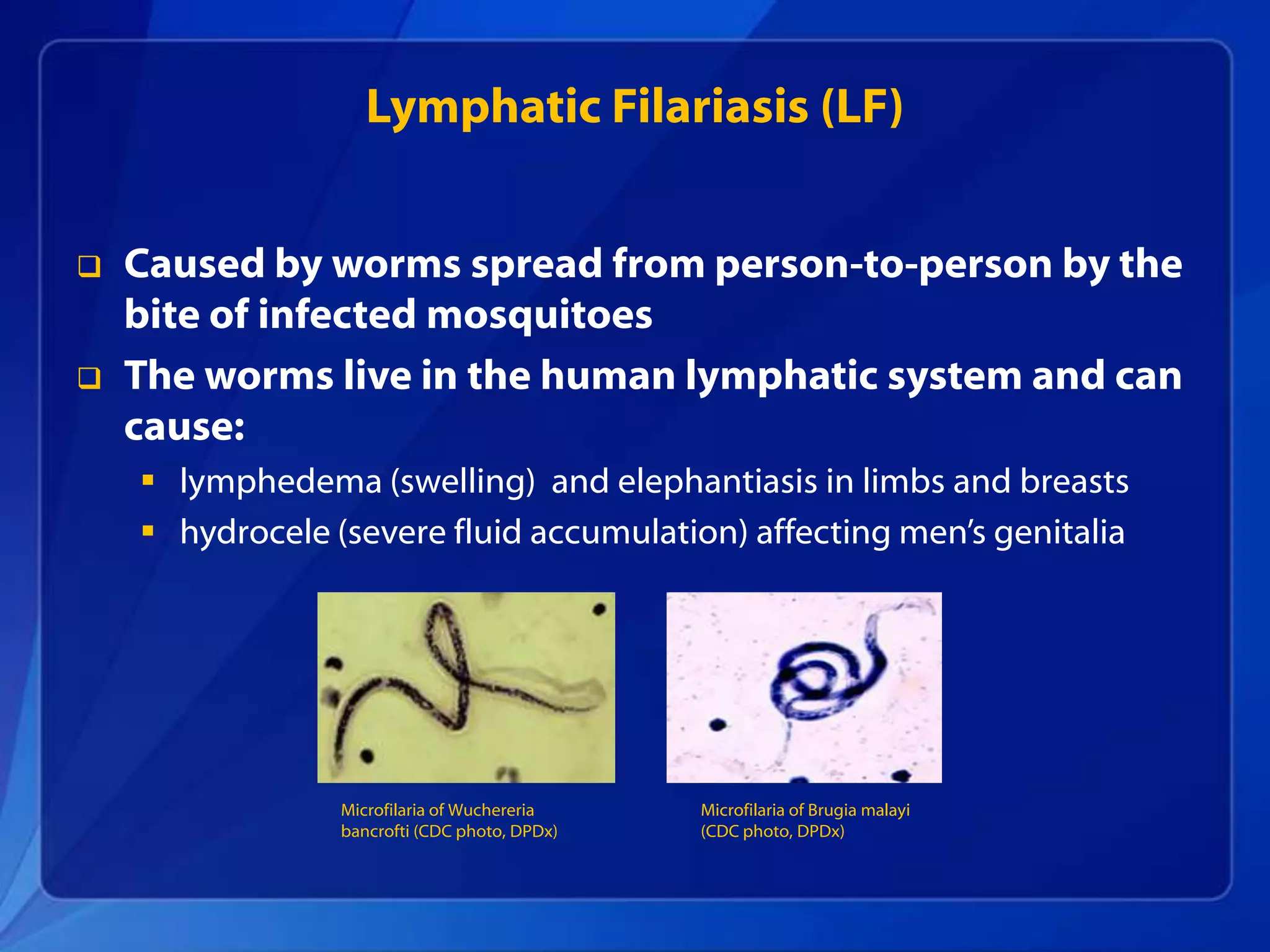
                 Microfilaria of Wuchereria    Microfilaria of Brugia malayi
                 bancrofti (CDC photo, DPDx)   (CDC photo, DPDx)
Health and societal impacts of LF

   Usually develop years after initial infection
   Cause pain, severe and irreversible disfigurement, loss
    of productivity, and social stigmatization


              lymphedema        elephantiasis
                                                   CDC photos
LF: A costly and disabling NTD
   One of the most disabling and economically costly
    neglected tropical diseases (NTDs)
     NTDs are a group of poverty-associated parasitic and bacterial
      infections affecting more than 1 billion persons
     NTDs are responsible for tremendous suffering and economic loss
   More than 120 million persons are infected with LF, a
    disease that can be eliminated


                                                Photo courtesy Carter Center/Emily Staub
Worldwide distribution of LF


1.34 billion at risk in world
Global impact of LF

   A leading cause of disability globally
   Endemic in 81 countries
   44 million persons suffer from chronic manifestations


            Photos courtesy of CDC. Left: Dr. Susan Montgomery, Middle and Right: CDC PHIL
Global Programme to Eliminate LF (GPELF)
   Target elimination date of 2020
   Launched by World Health Organization (WHO) in 2000
   Two-pronged strategy to:
    1.   Interrupt the spread of infection
    2.   Reduce the suffering of persons already infected
   To interrupt infection, medication is
    distributed to entire at-risk population through mass
    drug administration (MDA)
     At least 5 rounds on MDA are needed to interrupt transmission
     Treatment kills worms circulating in the blood
GPELF: Progress and successes
   53 countries have ongoing MDA campaigns
     37 countries have administered 5 or more rounds of MDA in many
      target areas
     2.8 billion doses of medicine delivered in first 9 years
   Treatment cost typically less than US $0.50 per person
    and often less than $0.10
   Transmission interruption has protected 6.6 million
    newborns from becoming infected with the disease
   Economic benefit of first 7 years of program estimated
    at $24 billion
   Full economic benefit could exceed US $55 billion
The economic impact of GPELF, 2000-2007


             Table courtesy of WHO GPELF
WHO Guidelines for LF Elimination Programs

Rounds annual
mass drug administration (MDA)
                                                      Post-MDA Period
 1       2         3       4       5     n


             Monitoring & Evaluation             Passive Surveillance ( > 5 years)

     Coverage
     Impact Assessment


          “Mapping”
                                          TAS             TAS               TAS


                                       TAS = transmission assessment survey
LF elimination in the Americas


   The Americas is the first region targeted for elimination
    of LF
     Improvements in standard of living have reduced disease
      prevalence in continental Americas and Caribbean Islands
     In areas where disease remained (Costa Rica, Suriname, and
      Trinidad and Tobago), transmission was interrupted through
      selective and community treatment
     Transmission still occurs in Guyana, Haiti, and parts of Brazil and
      the Dominican Republic
Notable achievements in the Americas

   Surveys carried out in the Dominican Republic suggest
    transmission interruption
   MDA treatment scaling up in Guyana and Haiti
     4.5 million of 8.6 million at-risk Haitians received MDA
     3 million Haitians treated since January 2010 earthquake
   Disease management programs operating in all four
    endemic countries


                                            CDC photo
Notable achievements in the Americas
   Although there is still active transmission in Guyana,
    Haiti, and parts of Brazil and the Dominican Republic,
    each country has achieved notable success in the fight
    against LF
   As of late 2009, nearly 5 million persons living in
    Americas had received MDA
   Elimination in the Americas is within reach
Progress in MDA for LF, WHO’s Region of the
            Americas, 2000-2009


              Graph courtesy of WHO GPELF
CDC and partner support
   CDC and its partners:
      Work with each country’s ministry of health to offer
       advice and expert consultation
      Develop monitoring and evaluation strategies
      Provide technical support
      Carry out operational research including working to
       understand:
        • Adherence to medication
        • Optimal surveillance methods
        • Strategies to accelerate elimination
Winning the battle against LF:
      What more can be done to eliminate LF by 2020?

   Continue and scale-up MDA programs to interrupt
    transmission
   Use operational research to develop strategies to
    accelerate the elimination of LF
   Increase each country’s efforts to provide appropriate
    care for persons with filarial disease
   Expand the reach of LF programs to include service
    delivery for other NTDs and health priorities
CDC partners
   We would like to acknowledge and thank our partners
    working to eliminate lymphatic filariasis:
       The Bill & Melinda Gates Foundation
       CBM International
       Eisai
       GlaxoSmithKline
       IMA World Health
       Inter-American Development Bank
       Merck
       Pan American Health Organization
       RTI International
       The Task Force for Global Health
       University of Notre Dame
       United States Agency for International Development (USAID)
Thank you
              www.cdc.gov/winnablebattles


For more information please contact Centers for Disease Control and Prevention

1600 Clifton Road NE, Atlanta, GA 30333
Telephone, 1-800-CDC-INFO (232-4636)/TTY: 1-888-232-6348
E-mail: cdcinfo@cdc.gov     Web: www.cdc.gov

The findings and conclusions in this report are those of the authors and do not necessarily represent the official
position of the Centers for Disease Control and Prevention.


                 Center for Global Health
                 Division of Parasitic Diseases and Malaria

Lymphatic Filariasis Winnable Battle presentation

  • 1.
    Eliminating Lymphatic Filariasisin the Americas A Winnable Battle Center for Global Health Division of Parasitic Diseases and Malaria
  • 2.
    Lymphatic Filariasis (LF)  Caused by worms spread from person-to-person by the bite of infected mosquitoes  The worms live in the human lymphatic system and can cause:  lymphedema (swelling) and elephantiasis in limbs and breasts  hydrocele (severe fluid accumulation) affecting men’s genitalia Microfilaria of Wuchereria Microfilaria of Brugia malayi bancrofti (CDC photo, DPDx) (CDC photo, DPDx)
  • 3.
    Health and societalimpacts of LF  Usually develop years after initial infection  Cause pain, severe and irreversible disfigurement, loss of productivity, and social stigmatization lymphedema elephantiasis CDC photos
  • 4.
    LF: A costlyand disabling NTD  One of the most disabling and economically costly neglected tropical diseases (NTDs)  NTDs are a group of poverty-associated parasitic and bacterial infections affecting more than 1 billion persons  NTDs are responsible for tremendous suffering and economic loss  More than 120 million persons are infected with LF, a disease that can be eliminated Photo courtesy Carter Center/Emily Staub
  • 5.
    Worldwide distribution ofLF 1.34 billion at risk in world
  • 6.
    Global impact ofLF  A leading cause of disability globally  Endemic in 81 countries  44 million persons suffer from chronic manifestations Photos courtesy of CDC. Left: Dr. Susan Montgomery, Middle and Right: CDC PHIL
  • 7.
    Global Programme toEliminate LF (GPELF)  Target elimination date of 2020  Launched by World Health Organization (WHO) in 2000  Two-pronged strategy to: 1. Interrupt the spread of infection 2. Reduce the suffering of persons already infected  To interrupt infection, medication is distributed to entire at-risk population through mass drug administration (MDA)  At least 5 rounds on MDA are needed to interrupt transmission  Treatment kills worms circulating in the blood
  • 8.
    GPELF: Progress andsuccesses  53 countries have ongoing MDA campaigns  37 countries have administered 5 or more rounds of MDA in many target areas  2.8 billion doses of medicine delivered in first 9 years  Treatment cost typically less than US $0.50 per person and often less than $0.10  Transmission interruption has protected 6.6 million newborns from becoming infected with the disease  Economic benefit of first 7 years of program estimated at $24 billion  Full economic benefit could exceed US $55 billion
  • 9.
    The economic impactof GPELF, 2000-2007 Table courtesy of WHO GPELF
  • 10.
    WHO Guidelines forLF Elimination Programs Rounds annual mass drug administration (MDA) Post-MDA Period 1 2 3 4 5 n Monitoring & Evaluation Passive Surveillance ( > 5 years) Coverage Impact Assessment “Mapping” TAS TAS TAS TAS = transmission assessment survey
  • 11.
    LF elimination inthe Americas  The Americas is the first region targeted for elimination of LF  Improvements in standard of living have reduced disease prevalence in continental Americas and Caribbean Islands  In areas where disease remained (Costa Rica, Suriname, and Trinidad and Tobago), transmission was interrupted through selective and community treatment  Transmission still occurs in Guyana, Haiti, and parts of Brazil and the Dominican Republic
  • 12.
    Notable achievements inthe Americas  Surveys carried out in the Dominican Republic suggest transmission interruption  MDA treatment scaling up in Guyana and Haiti  4.5 million of 8.6 million at-risk Haitians received MDA  3 million Haitians treated since January 2010 earthquake  Disease management programs operating in all four endemic countries CDC photo
  • 13.
    Notable achievements inthe Americas  Although there is still active transmission in Guyana, Haiti, and parts of Brazil and the Dominican Republic, each country has achieved notable success in the fight against LF  As of late 2009, nearly 5 million persons living in Americas had received MDA  Elimination in the Americas is within reach
  • 14.
    Progress in MDAfor LF, WHO’s Region of the Americas, 2000-2009 Graph courtesy of WHO GPELF
  • 15.
    CDC and partnersupport  CDC and its partners:  Work with each country’s ministry of health to offer advice and expert consultation  Develop monitoring and evaluation strategies  Provide technical support  Carry out operational research including working to understand: • Adherence to medication • Optimal surveillance methods • Strategies to accelerate elimination
  • 16.
    Winning the battleagainst LF: What more can be done to eliminate LF by 2020?  Continue and scale-up MDA programs to interrupt transmission  Use operational research to develop strategies to accelerate the elimination of LF  Increase each country’s efforts to provide appropriate care for persons with filarial disease  Expand the reach of LF programs to include service delivery for other NTDs and health priorities
  • 17.
    CDC partners  We would like to acknowledge and thank our partners working to eliminate lymphatic filariasis:  The Bill & Melinda Gates Foundation  CBM International  Eisai  GlaxoSmithKline  IMA World Health  Inter-American Development Bank  Merck  Pan American Health Organization  RTI International  The Task Force for Global Health  University of Notre Dame  United States Agency for International Development (USAID)
  • 18.
    Thank you www.cdc.gov/winnablebattles For more information please contact Centers for Disease Control and Prevention 1600 Clifton Road NE, Atlanta, GA 30333 Telephone, 1-800-CDC-INFO (232-4636)/TTY: 1-888-232-6348 E-mail: cdcinfo@cdc.gov Web: www.cdc.gov The findings and conclusions in this report are those of the authors and do not necessarily represent the official position of the Centers for Disease Control and Prevention. Center for Global Health Division of Parasitic Diseases and Malaria

Editor's Notes

  • #7 Chronic manifestations of LF include lyphedema and hydrocele. Image: Left: Children in western Kenya, courtesy Dr. Susan Montgomery, DVM, MPH Right: Elephantiasis of leg due to filariasis. Luzon, Philippines, CDC Public Health Image Library. Center: Photograph of a female Aedesaegypti mosquito as she was in the process of obtaining a "blood meal." Laboratory strains of Aedesaegypti can be infected with Brugia.
  • #8 Treatment consists of one or more the following medications: albendazole, ivermectin and/or diethylcarbamazine (DEC). These medications are readily available through pharmaceutical donations. Within the first 8 years of the worldwide elimination program, 1.9 billion treatments for lymphatic filariasis (LF) were delivered to more than 570 million people in 48 countries.
  • #9 The full potential economic benefit could be in excess of US$ 55 billion whenGPELF is extended to all endemic populations.
  • #11 This timeline illustrates the components of the WHO guidelines for LF elimination, and illustrates the various M and E components, from mapping to measuring coverage to sentinel sites to stopping MDA to post MDA surveillance Mapping determines which areas of the country are endemic for LF. The endemic areas are treated with at least 5 rounds of annual mass drug administration (or MDA), a stopping MDA survey determines whether further rounds of MDA are necessary, then the program moves into the post-MDA period. The main activity of this period is “passive surveillance”.Current guidelines also recommend repeating “stopping MDA” surveys at least twice in evaluation areas within the endemic districts.