SCIENCE
TECHNOLOGY &
NATION BUILDING
WEEK 4
OBJECTIVES:
• The students shall be able to:
• Explain how early Filipinos applied scientific principles in their
daily living;
• Present government policies on science and technology and
explain their importance to nation;
• Discuss the role of science and technology in nation- building;
INTRODUCTION:
•This lesson will discuss the influence of science and
technology in the development of the Philippine society.
It identifies government programs, projects, and policies
geared toward boasting the science and technological
capacity of the country. This lesson will also
include discussions on Philippine indigenous
science and technology.
INTRODUCTION:
•Scientists greatly help in the economic
development of a country. In the Philippines
have number of renowned scientists and
technologists whose exemplary works and
discoveries have contributed to the progress of
different industries.
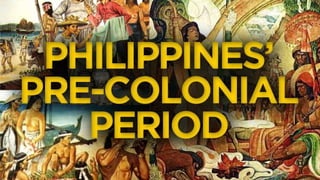
PRE-COLONIAL PERIOD (PREHISTORY-1565)
•The history of science and technology in the
Philippines started way back before the country
gained its independence from the American
colonizers.
•Before the coming of the Spanish colonizers, the early
inhabitants had their own culture & traditions. They
had their own belief system and indigenous
knowledge system that keeps them organized and
sustained their lives and communities for many
years.
PRE-COLONIAL PERIOD (PREHISTORY-1565)
• In pre- Spanish Philippines, SCIENCE is embedded in the way of
life of the people. Scientific knowledge is observed:
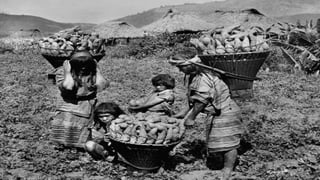
1. In the way they plant their crops that provide them food;
2. In taking care of their animals to help them in their daily
tasks, and for food production.
3. Science is observed in the way they interpret the movement of
the heavenly bodies in predicting seasons and climates, and
in organizing days into months and years.
4. They used science in preparing the soil for agricultural
purposes and discovered the medicinal uses of plants.
PRE-COLONIAL PERIOD
(PREHISTORY-1565)
•Technology is used by people in:
1. Building houses
2. Irrigations and in
3. Developing tools that they can use in their everyday
life. They developed tools for planting, hunting,
cooking and fishing; for fighting their enemies
during war or tribal conflicts; and for
transportation.
4. They also used technology in creating
musical instruments.
PRE-COLONIAL
HERBS AND HERBAL
MEDICINES
JAR (MANUNGGUL BULOL)
PRE-COLONIAL
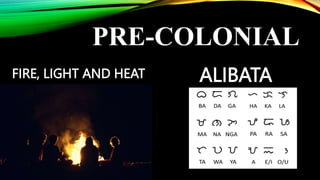
FIRE, LIGHT AND HEAT ALIBATA
PRE-COLONIAL PERIOD (PREHISTORY-1565)
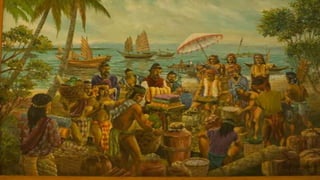
•Also, trading with China, Indonesia, Japan and other
nearby countries have influenced their lives by
providing opportunities for cultural and technological
exchange.
•All of these ancient practices in science and technology
are considered now as INDIGENOUS SCIENCE OR
FOLK SCIENCE.
EARLY DEPICTIONS OF PRE-COLONIAL
FILIPINOS
• Contrary to popular belief by the
Westerners, our ancestors are civilized
and cultured. They have:
• Own belief system (Animist Faith)
• Community organization (Barangay)
• Farming technology, irrigation, and
domestication of animals
• Medicinal use of plants (Herbal
Medicines)
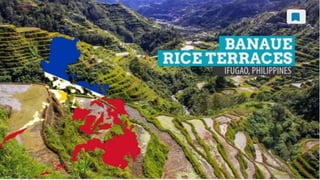
• Engineering (e.g. Terraces of the
Philippine Cordilleras)
• Mining of ores and metallurgy
• Trade with other civilizations
• Writing system (e.g. Baybayin)
• Weapons
• Sea-going vessels (e.g. Balangay)
• Musical instruments
• Tattooing practice (e.g. Batok of the
Butbut Tribe)
• Laws
SCIENCE IN PRE-COLONIAL PERIOD
•Planting crops that provide them food
•Taking care of animals
•Food production
•Interpret the movements of heavenly bodies to
predict seasons and climates
•Medicinal uses of plants
TECHNOLOGY IN PRE-COLONIAL PERIOD
• Building houses (bamboo woods, anahaw)
• Irrigation
• Developing tools (rocks and metals from other Nations)
• Musical instruments
• Metal Age Influence Gold and Silver jewelry
• Trading with other countries
• Indigenous or Folk Science
A. SOCIETY
•Mode of dressing
•Ornaments
•Houses
•Social classes
•Status of women
•Marriage customs
•Mixed marriages, Inheritance and Succession
B. POLITICS
1. Government
2. Laws
3. Legislation
4. Judicial process
5. Trial by Ordeal
C. RELIGION
1. Religious beliefs
2. Burial
3. Divination
D. ECONOMIC LIFE
1. Agriculture
2. Livestock
3. Fishing
4. Mining
5. Lumbering & Shipbuilding
6. Weaving
7. Trade
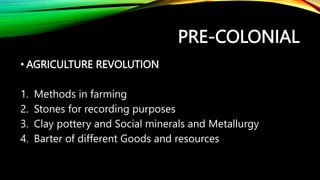
PRE-COLONIAL
• AGRICULTURE REVOLUTION
1. Methods in farming
2. Stones for recording purposes
3. Clay pottery and Social minerals and Metallurgy
4. Barter of different Goods and resources
E. CULTURE
1. Languages
2. System of writing
3. Literature
4. Music and Dance
5. Art
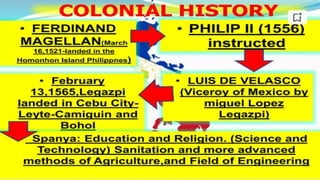
COLONIAL PERIOD
•Spanish Era
•American Era
SPANISH ERA (1565-1898)
•When the Spaniards colonized the country, they
brought with them their own culture and
practices. They established schools for boys
and girls and introduced the concept of
subjects and disciplines. It was the beginning of
formal science and technology in the country,
known now as school of science and technology.
SPANISH ERA (1565-1898)
• Learning of science in school focuses on understanding different
concepts related to the human body, plants, animals and heavenly
bodies. Technology focuses on using and developing house tools used in
everyday life.
• Life during the Spanish Era slowly became modernized, adapting some
Western technology and their ways of life. The Filipinos developed
ways to replicate technology brought by the Spaniards using indigenous
materials. Medicine and advanced science were introduced in formal
colleges and universities established by the Catholic orders.
SPANISH ERA (1565-1898)
• The GALLEON TRADE has brought additional technology and
development in the Philippines. Although it is only beneficial for
the Spaniards, these trades allowed other ideas, crops, tools,
cultural practices, technology, and Western practices to reach the
country. Some of the Filipino students who were able to study in
Europe also contributed to the advancement of medicine,
engineering, arts, music, and literature in the country.
• The Philippines, being considered as one of the centers of global
trade in Southeast Asia during that time, was considered to be one
of the most developed places in the region.
Although the country is blessed
with these developments, the
superstitious beliefs of the people
and the catholic doctrines and practices
during the Spanish era halted the growth
of science in the country. Upon the
arrival and colonization of the Spaniards,
they introduced to the Philippines the
following:
• Catholicism
• Reorganization of the Barrios
• Intramuros Manila
• Bridges in Tayabas, Quezon
• Spanish Language which
influenced Filipino Language
• Stronger construction materials
• Formal Education System (schools,
colleges, and universities – UST)
• Modern Western Medicine
• Manila-Acapulco Galleon Trade
(made the Philippines a center of
commerce in Southeast Asia, and the
link to the West via the Pacific
Ocean) Modern engineering and
architectural techniques Many firsts
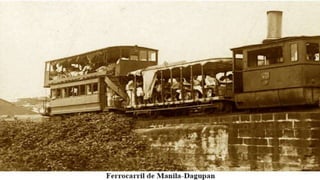
• –Railway (Ferrocarril de Manila-
Dagupan)
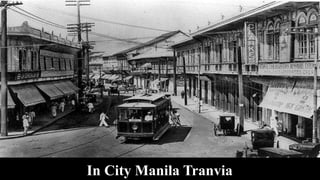
• –In-city rail system (Manila Tranvia)
• –Paved roads and bridges–Hospitals
In City Manila Tranvia
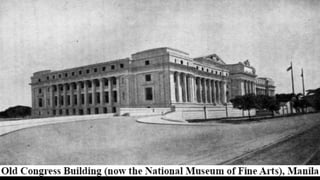
AMERICAN ERA (1898-1946)
• The Americans have more influence in the development of science and
technology in the Philippines compared to the Spaniards.
• Established the public education system
• Improved the engineering works and health conditions of the people.
• Established a modern research university, university of the Philippines.
• Created more public hospitals.
• Mineral resources were explored and exploited during the American times.
• Transportation and communication systems were improved, though not
accessible throughout the country.
AMERICAN ERA (1898-1946)
• The Americans did everything to “Americanize” the Philippines. They reorganized
the learning of science and introduced it in the public and private schools. In basic
education, science education focuses on nature studies and science and sanitation,
until it became a subject formally known as “Science.” The teaching of science in
higher education has also greatly improved and modernized. Researches were done
to control malaria, cholera, and tuberculosis and other tropical diseases. The
desire of the Americans to develop the human resources of the Philippines to serve
their own interests is somehow beneficial in the country. These allowed
American scholars to introduce new knowledge and technology in the
country. The Protestant church missions in different places in the country also
brought hospitals and schools to far flung areas. Little by little, these efforts built a
stronger foundation for science and technology in the country.
WORLD WAR II
• Has destabilized the development of the country in many ways.
Institutions and public facilities were turned into ashes, houses
were burned, and many lives were destroyed. The country had a
difficult time tore build itself from the ruins of the war. The
human spirit to survive and to rebuild the country may be strong
but the capacity of the country to bring back what was destroyed
was limited. The reparation funds focused on building some
institutions and public facilities like schools, hospitals and
transportation system. The reparation money from Japan was
also concentrated on building highways and providing
technological training and human resource development.
AMERICAN ERA (1898-1946)
• Since the establishment of the new republic, the whole nation has been
focusing on using its limited resources in improving S&T capability. It
has explored the use of ODA or Overseas Development Allocations from
the different countries to help the country improve its scientific
productivity and technological capability. Human resource development
is at the heart of this efforts focusing on producing more engineers,
Scientists, technology experts, doctors and other professionals in the
country. The development of science and technology in the Philippines,
based on its brief history, is shaped by several factors and influences.
Like in the history of science in other countries, it is always shaped by
human and social activities, both internal and external.
AMERICAN ERA (1898-1946)
• Internal influences: survival, culture, economic activities
• External influences: foreign colonizers, trades with foreign
countries, international economic demands. Science and
technology may have significant impact on the lives of the
people and in the development of the Philippine society.
However, improving the quality of science education still
remains as a big challenge in the country.
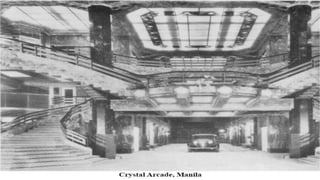
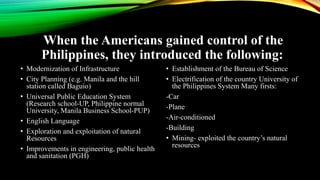
When the Americans gained control of the
Philippines, they introduced the following:
• Modernization of Infrastructure
• City Planning (e.g. Manila and the hill
station called Baguio)
• Universal Public Education System
(Research school-UP, Philippine normal
University, Manila Business School-PUP)
• English Language
• Exploration and exploitation of natural
Resources
• Improvements in engineering, public health
and sanitation (PGH)
• Establishment of the Bureau of Science
• Electrification of the country University of
the Philippines System Many firsts:
-Car
-Plane
-Air-conditioned
-Building
• Mining- exploited the country’s natural
resources
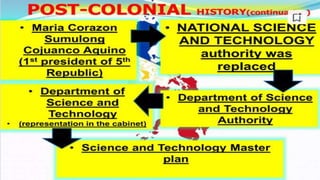
POST-COLONIAL PERIOD
Week-4-SCIENCE-TECHNOLOGY-NATION-BUILDING.pptx

Week-4-SCIENCE-TECHNOLOGY-NATION-BUILDING.pptx

  • 1.
  • 2.
    OBJECTIVES: • The studentsshall be able to: • Explain how early Filipinos applied scientific principles in their daily living; • Present government policies on science and technology and explain their importance to nation; • Discuss the role of science and technology in nation- building;
  • 3.
    INTRODUCTION: •This lesson willdiscuss the influence of science and technology in the development of the Philippine society. It identifies government programs, projects, and policies geared toward boasting the science and technological capacity of the country. This lesson will also include discussions on Philippine indigenous science and technology.
  • 4.
    INTRODUCTION: •Scientists greatly helpin the economic development of a country. In the Philippines have number of renowned scientists and technologists whose exemplary works and discoveries have contributed to the progress of different industries.
  • 6.
    PRE-COLONIAL PERIOD (PREHISTORY-1565) •Thehistory of science and technology in the Philippines started way back before the country gained its independence from the American colonizers. •Before the coming of the Spanish colonizers, the early inhabitants had their own culture & traditions. They had their own belief system and indigenous knowledge system that keeps them organized and sustained their lives and communities for many years.
  • 7.
    PRE-COLONIAL PERIOD (PREHISTORY-1565) •In pre- Spanish Philippines, SCIENCE is embedded in the way of life of the people. Scientific knowledge is observed: 1. In the way they plant their crops that provide them food; 2. In taking care of their animals to help them in their daily tasks, and for food production. 3. Science is observed in the way they interpret the movement of the heavenly bodies in predicting seasons and climates, and in organizing days into months and years. 4. They used science in preparing the soil for agricultural purposes and discovered the medicinal uses of plants.
  • 8.
    PRE-COLONIAL PERIOD (PREHISTORY-1565) •Technology isused by people in: 1. Building houses 2. Irrigations and in 3. Developing tools that they can use in their everyday life. They developed tools for planting, hunting, cooking and fishing; for fighting their enemies during war or tribal conflicts; and for transportation. 4. They also used technology in creating musical instruments.
  • 10.
  • 11.
  • 14.
    PRE-COLONIAL PERIOD (PREHISTORY-1565) •Also,trading with China, Indonesia, Japan and other nearby countries have influenced their lives by providing opportunities for cultural and technological exchange. •All of these ancient practices in science and technology are considered now as INDIGENOUS SCIENCE OR FOLK SCIENCE.
  • 15.
    EARLY DEPICTIONS OFPRE-COLONIAL FILIPINOS • Contrary to popular belief by the Westerners, our ancestors are civilized and cultured. They have: • Own belief system (Animist Faith) • Community organization (Barangay) • Farming technology, irrigation, and domestication of animals • Medicinal use of plants (Herbal Medicines) • Engineering (e.g. Terraces of the Philippine Cordilleras) • Mining of ores and metallurgy • Trade with other civilizations • Writing system (e.g. Baybayin) • Weapons • Sea-going vessels (e.g. Balangay) • Musical instruments • Tattooing practice (e.g. Batok of the Butbut Tribe) • Laws
  • 16.
    SCIENCE IN PRE-COLONIALPERIOD •Planting crops that provide them food •Taking care of animals •Food production •Interpret the movements of heavenly bodies to predict seasons and climates •Medicinal uses of plants
  • 17.
    TECHNOLOGY IN PRE-COLONIALPERIOD • Building houses (bamboo woods, anahaw) • Irrigation • Developing tools (rocks and metals from other Nations) • Musical instruments • Metal Age Influence Gold and Silver jewelry • Trading with other countries • Indigenous or Folk Science
  • 18.
    A. SOCIETY •Mode ofdressing •Ornaments •Houses •Social classes •Status of women •Marriage customs •Mixed marriages, Inheritance and Succession
  • 19.
    B. POLITICS 1. Government 2.Laws 3. Legislation 4. Judicial process 5. Trial by Ordeal
  • 20.
    C. RELIGION 1. Religiousbeliefs 2. Burial 3. Divination
  • 21.
    D. ECONOMIC LIFE 1.Agriculture 2. Livestock 3. Fishing 4. Mining 5. Lumbering & Shipbuilding 6. Weaving 7. Trade
  • 22.
    PRE-COLONIAL • AGRICULTURE REVOLUTION 1.Methods in farming 2. Stones for recording purposes 3. Clay pottery and Social minerals and Metallurgy 4. Barter of different Goods and resources
  • 23.
    E. CULTURE 1. Languages 2.System of writing 3. Literature 4. Music and Dance 5. Art
  • 24.
  • 26.
    SPANISH ERA (1565-1898) •Whenthe Spaniards colonized the country, they brought with them their own culture and practices. They established schools for boys and girls and introduced the concept of subjects and disciplines. It was the beginning of formal science and technology in the country, known now as school of science and technology.
  • 27.
    SPANISH ERA (1565-1898) •Learning of science in school focuses on understanding different concepts related to the human body, plants, animals and heavenly bodies. Technology focuses on using and developing house tools used in everyday life. • Life during the Spanish Era slowly became modernized, adapting some Western technology and their ways of life. The Filipinos developed ways to replicate technology brought by the Spaniards using indigenous materials. Medicine and advanced science were introduced in formal colleges and universities established by the Catholic orders.
  • 28.
    SPANISH ERA (1565-1898) •The GALLEON TRADE has brought additional technology and development in the Philippines. Although it is only beneficial for the Spaniards, these trades allowed other ideas, crops, tools, cultural practices, technology, and Western practices to reach the country. Some of the Filipino students who were able to study in Europe also contributed to the advancement of medicine, engineering, arts, music, and literature in the country. • The Philippines, being considered as one of the centers of global trade in Southeast Asia during that time, was considered to be one of the most developed places in the region.
  • 29.
    Although the countryis blessed with these developments, the superstitious beliefs of the people and the catholic doctrines and practices during the Spanish era halted the growth of science in the country. Upon the arrival and colonization of the Spaniards, they introduced to the Philippines the following:
  • 30.
    • Catholicism • Reorganizationof the Barrios • Intramuros Manila • Bridges in Tayabas, Quezon • Spanish Language which influenced Filipino Language • Stronger construction materials • Formal Education System (schools, colleges, and universities – UST) • Modern Western Medicine • Manila-Acapulco Galleon Trade (made the Philippines a center of commerce in Southeast Asia, and the link to the West via the Pacific Ocean) Modern engineering and architectural techniques Many firsts • –Railway (Ferrocarril de Manila- Dagupan) • –In-city rail system (Manila Tranvia) • –Paved roads and bridges–Hospitals
  • 32.
  • 33.
    AMERICAN ERA (1898-1946) •The Americans have more influence in the development of science and technology in the Philippines compared to the Spaniards. • Established the public education system • Improved the engineering works and health conditions of the people. • Established a modern research university, university of the Philippines. • Created more public hospitals. • Mineral resources were explored and exploited during the American times. • Transportation and communication systems were improved, though not accessible throughout the country.
  • 34.
    AMERICAN ERA (1898-1946) •The Americans did everything to “Americanize” the Philippines. They reorganized the learning of science and introduced it in the public and private schools. In basic education, science education focuses on nature studies and science and sanitation, until it became a subject formally known as “Science.” The teaching of science in higher education has also greatly improved and modernized. Researches were done to control malaria, cholera, and tuberculosis and other tropical diseases. The desire of the Americans to develop the human resources of the Philippines to serve their own interests is somehow beneficial in the country. These allowed American scholars to introduce new knowledge and technology in the country. The Protestant church missions in different places in the country also brought hospitals and schools to far flung areas. Little by little, these efforts built a stronger foundation for science and technology in the country.
  • 35.
    WORLD WAR II •Has destabilized the development of the country in many ways. Institutions and public facilities were turned into ashes, houses were burned, and many lives were destroyed. The country had a difficult time tore build itself from the ruins of the war. The human spirit to survive and to rebuild the country may be strong but the capacity of the country to bring back what was destroyed was limited. The reparation funds focused on building some institutions and public facilities like schools, hospitals and transportation system. The reparation money from Japan was also concentrated on building highways and providing technological training and human resource development.
  • 36.
    AMERICAN ERA (1898-1946) •Since the establishment of the new republic, the whole nation has been focusing on using its limited resources in improving S&T capability. It has explored the use of ODA or Overseas Development Allocations from the different countries to help the country improve its scientific productivity and technological capability. Human resource development is at the heart of this efforts focusing on producing more engineers, Scientists, technology experts, doctors and other professionals in the country. The development of science and technology in the Philippines, based on its brief history, is shaped by several factors and influences. Like in the history of science in other countries, it is always shaped by human and social activities, both internal and external.
  • 37.
    AMERICAN ERA (1898-1946) •Internal influences: survival, culture, economic activities • External influences: foreign colonizers, trades with foreign countries, international economic demands. Science and technology may have significant impact on the lives of the people and in the development of the Philippine society. However, improving the quality of science education still remains as a big challenge in the country.
  • 39.
    When the Americansgained control of the Philippines, they introduced the following: • Modernization of Infrastructure • City Planning (e.g. Manila and the hill station called Baguio) • Universal Public Education System (Research school-UP, Philippine normal University, Manila Business School-PUP) • English Language • Exploration and exploitation of natural Resources • Improvements in engineering, public health and sanitation (PGH) • Establishment of the Bureau of Science • Electrification of the country University of the Philippines System Many firsts: -Car -Plane -Air-conditioned -Building • Mining- exploited the country’s natural resources
  • 41.