HISTORY
OF
LOW BACK PAIN
DR. SAMSUL AREFIN
Resident
Dept . of Anesthesia ,Analgesia &
Intensive care
BSMMU
Common cause of low back pain
• Myofascial lower back pain
HNP of lumber spine
Spinal canal stenosis
Lumber spondylolysis
Spondylolisthesis
Facet Syndrome
Adult kyphosis and scoliosis
Infective pathology of spine eg. TB & osteomyelitis
Primary neoplasm of the neural tissue and MM
Metastatic disease of spine
Rheumatic conditions eg. Ankylosing spondylitis and fibromyalgia
Metabolic causes of back pain
FBSS
Ref. Handbook of pain medicine / G. Dureja / 2nd
ed
PAIN CLINIC ,BSMMU
10 years old boy comes with low back pain
26 years old boy comes with low back pain
65 years old female comes with the low back
pain
COMMON CAUSES OF BACK PAIN IN VARIOUS AGE
GROUPS
CHILDREN
ADOLESCENTS
YOUNG ADULTS
• scoliosis
• Spondylolisthesis
• Pyogenic or tuberculous infections
• Calve’s disease
• Scheuermann’s disease
• Scoliosis(idiopathic and postural)
• Mechanical baack pain
• Adolescent intervertebral disc syndrome
• Pyogenic or tuberculous infection
• Prolapsed intervertebral disc
• Spondylolidthesis
• Spinal fracture
• Ankylosing apondylitid
• Coccydynia
• Pyogenic or tuberculous infection
• Spinal stenosis
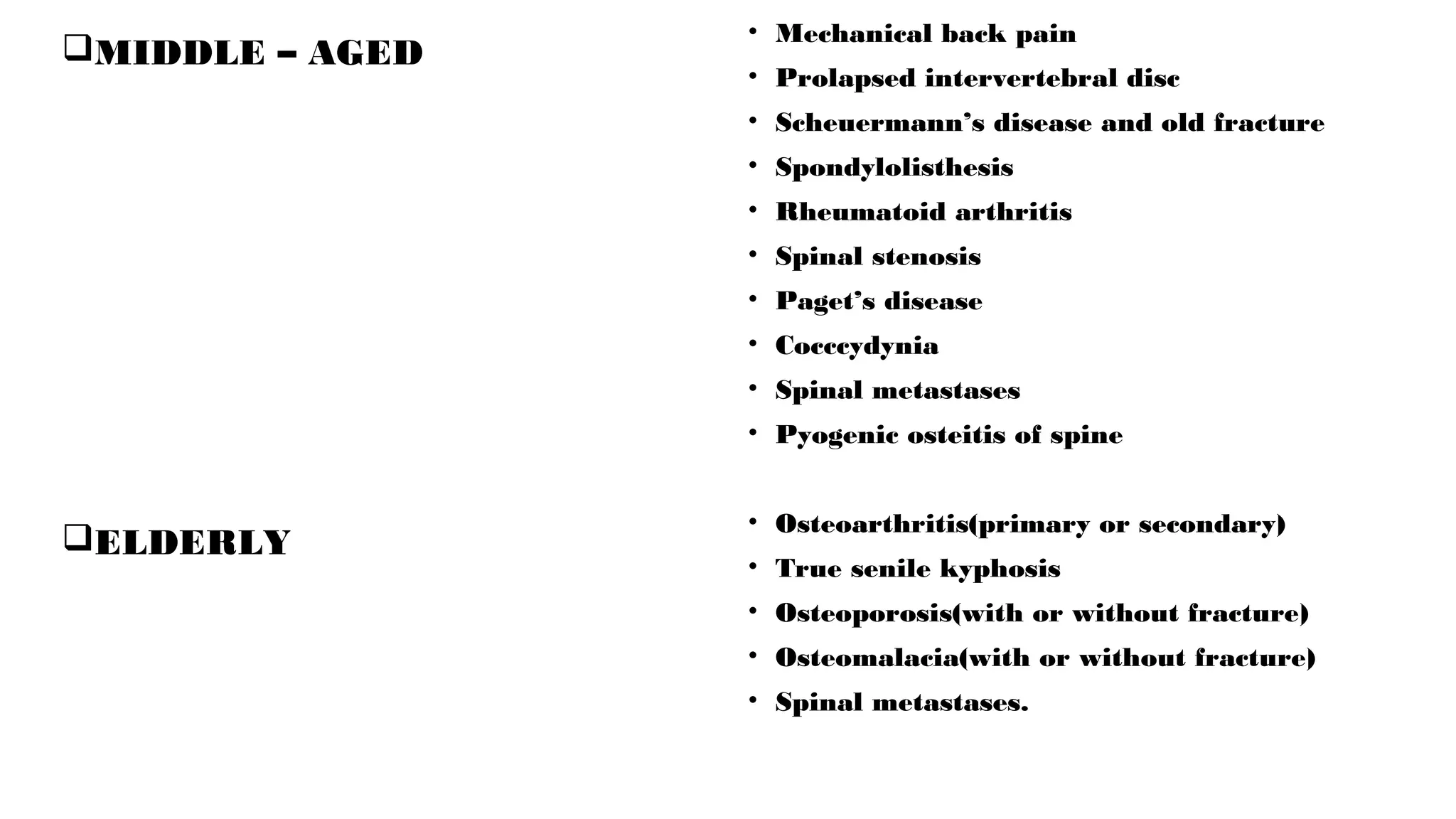
MIDDLE – AGED
ELDERLY
• Mechanical back pain
• Prolapsed intervertebral disc
• Scheuermann’s disease and old fracture
• Spondylolisthesis
• Rheumatoid arthritis
• Spinal stenosis
• Paget’s disease
• Cocccydynia
• Spinal metastases
• Pyogenic osteitis of spine
• Osteoarthritis(primary or secondary)
• True senile kyphosis
• Osteoporosis(with or without fracture)
• Osteomalacia(with or without fracture)
• Spinal metastases.
• Site and nature of pain : localized of diffuse
persistent or intermittent
• Onset of pain :
When did the symptoms commence?
pattern of onset: slow and insidious
rapid or sudden ( strongly suggestive of mechanical
factor)
history of an injury
( a sudden twist or strain or sneeze occurring when the
patient was in a flexed position :a common history for
intervertebral disc prolapse )
• Character of pain
Usually described by adjectives like
sharp, dull, burning, tingling, boring , stabing
Directly relevant previous history :
Is there any history of previous similar attack?
or any previous trouble with the spine ?
• Radiation of the pain :
does the pain radiates to the legs ?
how far down does the pain go & what are the area involved ?
commonly affaected nerve root L 4,L 5 &S1
•
Associated any paresthesia
N.B. Pain radiates into legs is not necessarily due to nerve root compression. It seems that irritation of facet joints
, ligaments and muscles may produce dull aching pain in the buttock and back of the thighs.
Pain arising from nerve root is usually sharp and knief like
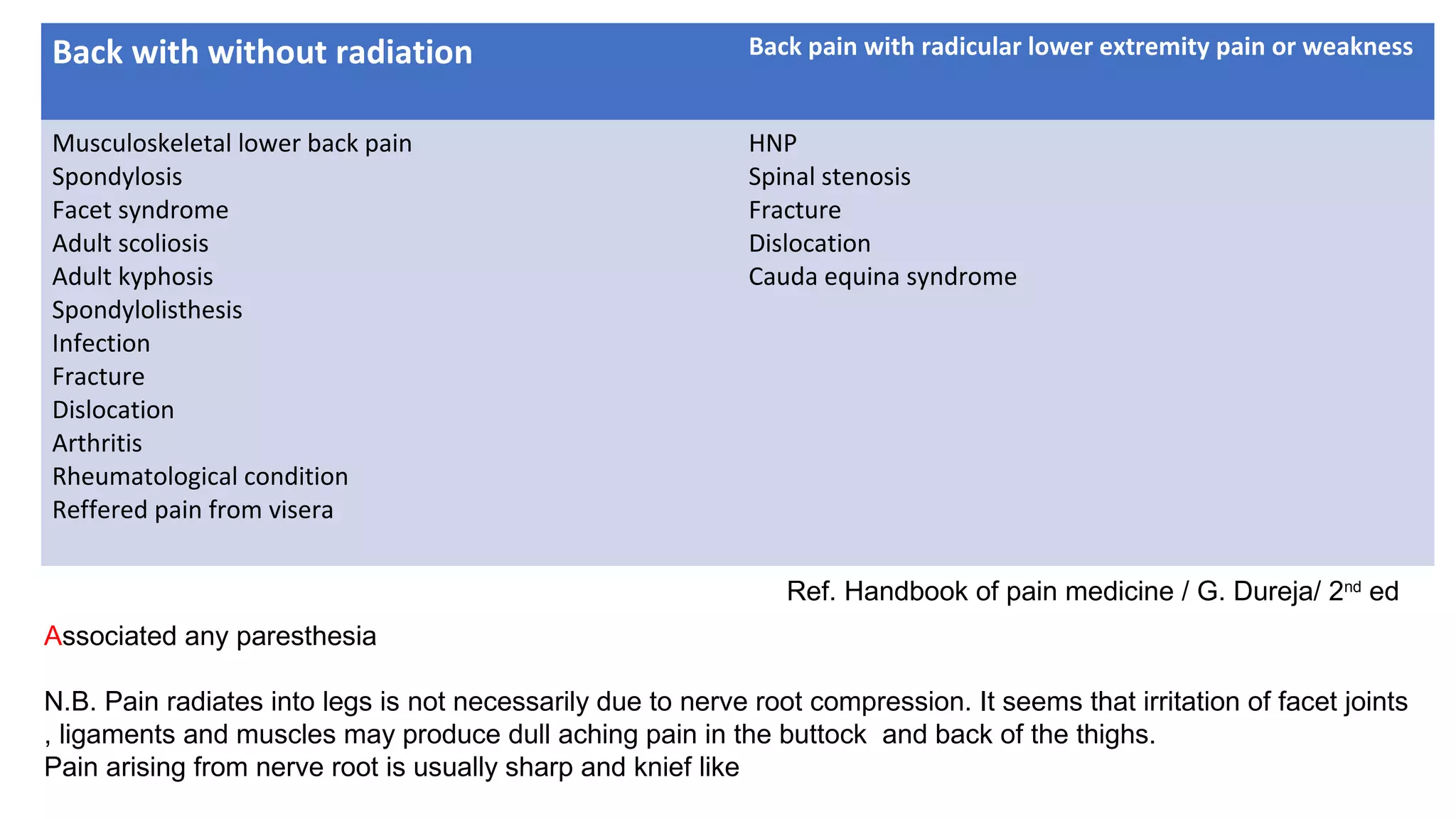
Back with without radiation Back pain with radicular lower extremity pain or weakness
Musculoskeletal lower back pain
Spondylosis
Facet syndrome
Adult scoliosis
Adult kyphosis
Spondylolisthesis
Infection
Fracture
Dislocation
Arthritis
Rheumatological condition
Reffered pain from visera
HNP
Spinal stenosis
Fracture
Dislocation
Cauda equina syndrome
Ref. Handbook of pain medicine / G. Dureja/ 2nd
ed
•
Timing of pain
Constant: back ache with spinal pathology ( tumour , infection or inflammation
constant night pain , distinct short lived pain when turning in bed) > Sleep disturbance
Episodic
In particular day or part of whole day
Any changes in severity as day progress
Morning pain associated with stiffness
Exacerbating and relieving factor
Mechanical back pain bending or sudden movement may make the pain worse
,whereas lying flat , particularly on a hard surface or applying local heat or even sitting, may
relieve pain.
During rest pain increase or decrease?
• Motor involvement
any weakness in the lower limbs or any muscle wasting or fibrillation?
Any disturbance of gait or balance , any tendency to giving way of the
legs , any sign of foot drop?
• Any constitutional symptoms : malaise , fever ,
weight loss
involvement of other joints
associated GIT problems
associated genitourinary symptoms
respiratory difficulty
major neurological disturbance
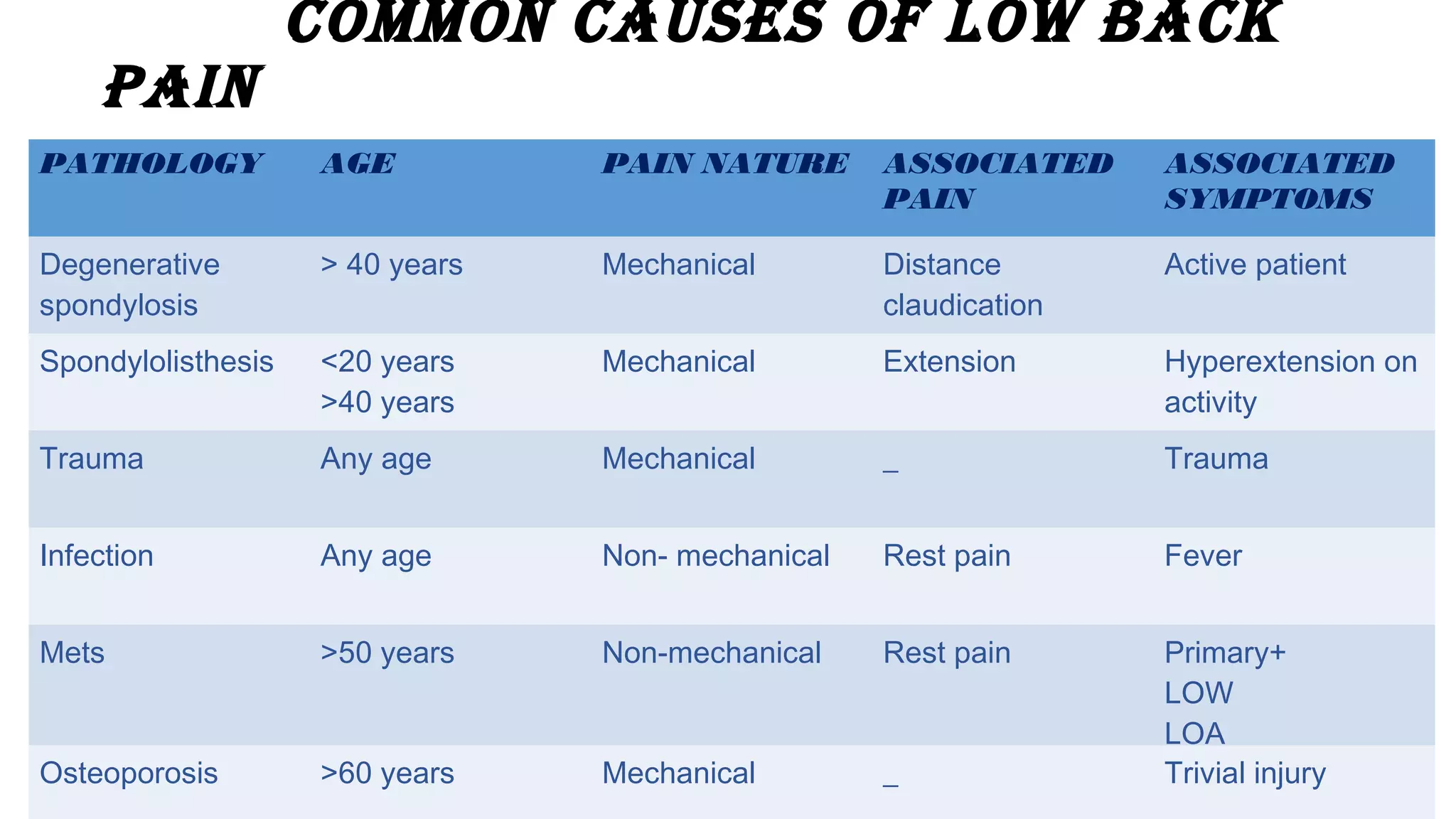
COMMON CAUSES OF LOW BACK
PAIN
PATHOLOGY AGE PAIN NATURE ASSOCIATED
PAIN
ASSOCIATED
SYMPTOMS
Degenerative
spondylosis
> 40 years Mechanical Distance
claudication
Active patient
Spondylolisthesis <20 years
>40 years
Mechanical Extension Hyperextension on
activity
Trauma Any age Mechanical _ Trauma
Infection Any age Non- mechanical Rest pain Fever
Mets >50 years Non-mechanical Rest pain Primary+
LOW
LOA
Osteoporosis >60 years Mechanical _ Trivial injury
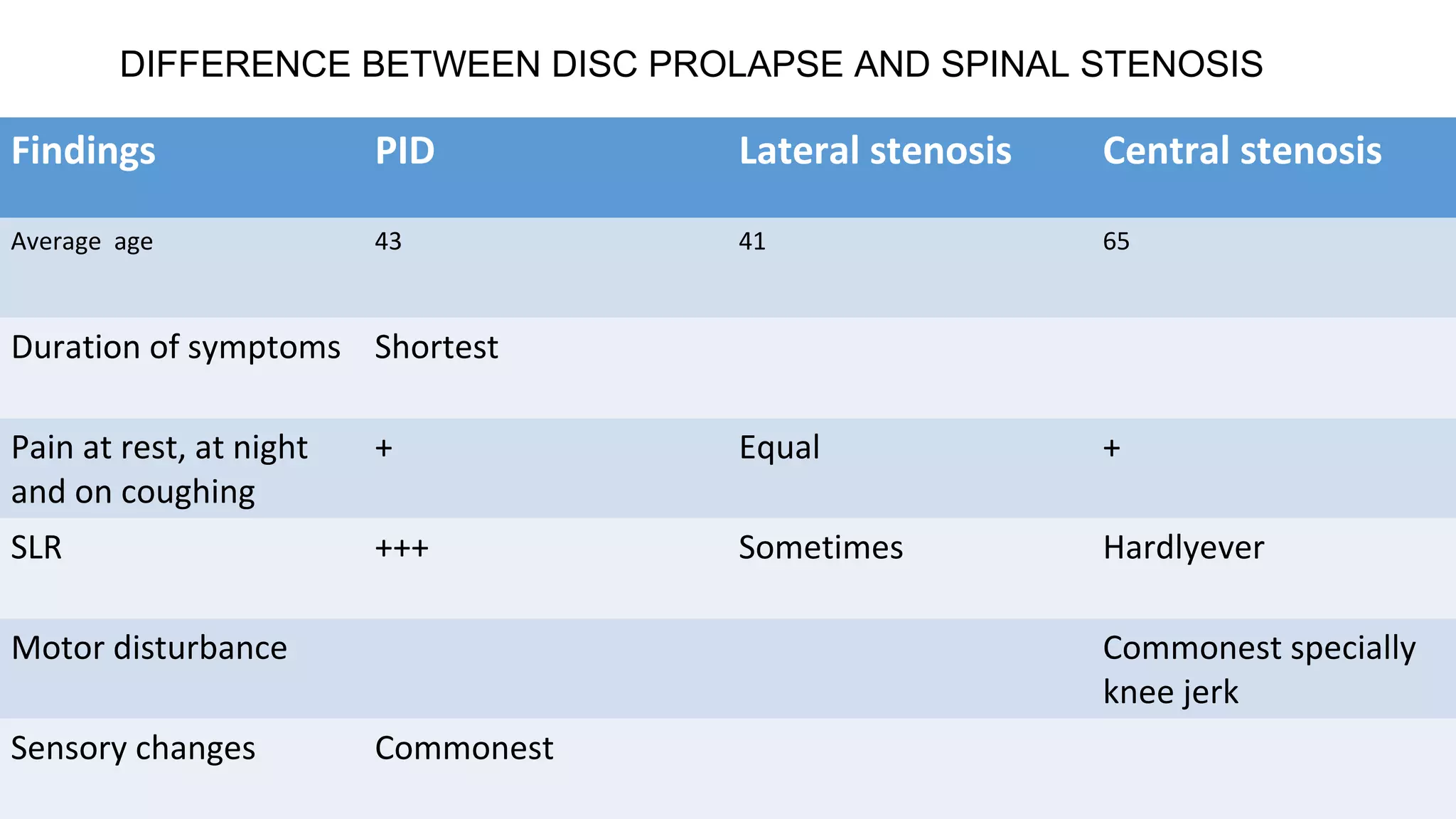
Findings PID Lateral stenosis Central stenosis
Average age 43 41 65
Duration of symptoms Shortest
Pain at rest, at night
and on coughing
+ Equal +
SLR +++ Sometimes Hardlyever
Motor disturbance Commonest specially
knee jerk
Sensory changes Commonest
DIFFERENCE BETWEEN DISC PROLAPSE AND SPINAL STENOSIS
RED FLAG FEATURES
•Histosry
• Age <20 years or >55 years
• Recent significant trauma
• Pain- thorasic (dissecting aneurysm)
• non-mechanical
(infection/tumour/pathological fracture)
• Fever(infection)
• Difficulty in micturition
• Faecal incontinence
• Motor weakness
• Sensory changes in the perineum( saddle
anesthesia)
• Sexual dysfunction( erectile/ejaculatory
failure)
• Gait change ( cauda equine syndrome)
• Bilateral sciatica
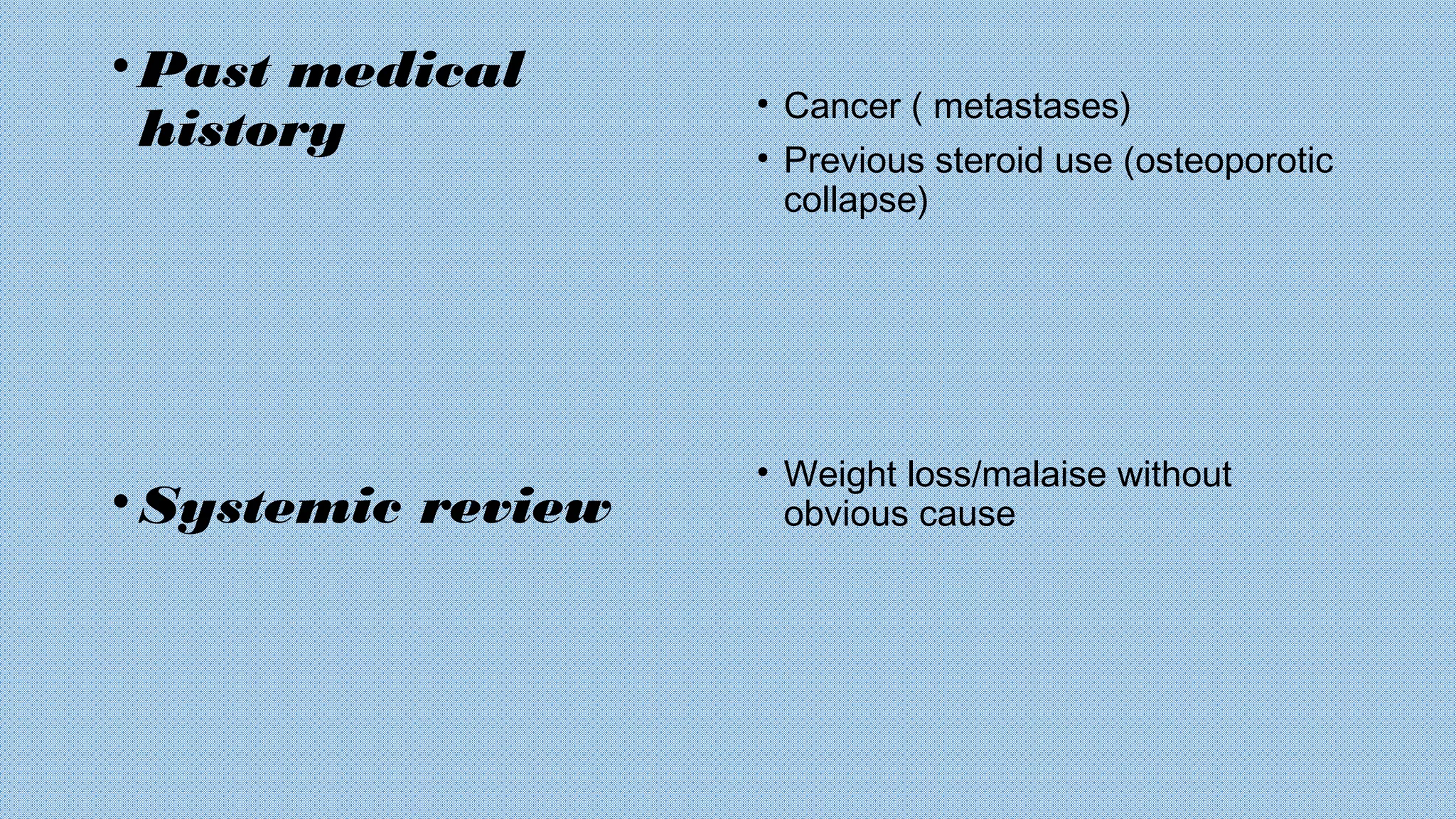
•Past medical
history
•Systemic review
• Cancer ( metastases)
• Previous steroid use (osteoporotic
collapse)
• Weight loss/malaise without
obvious cause
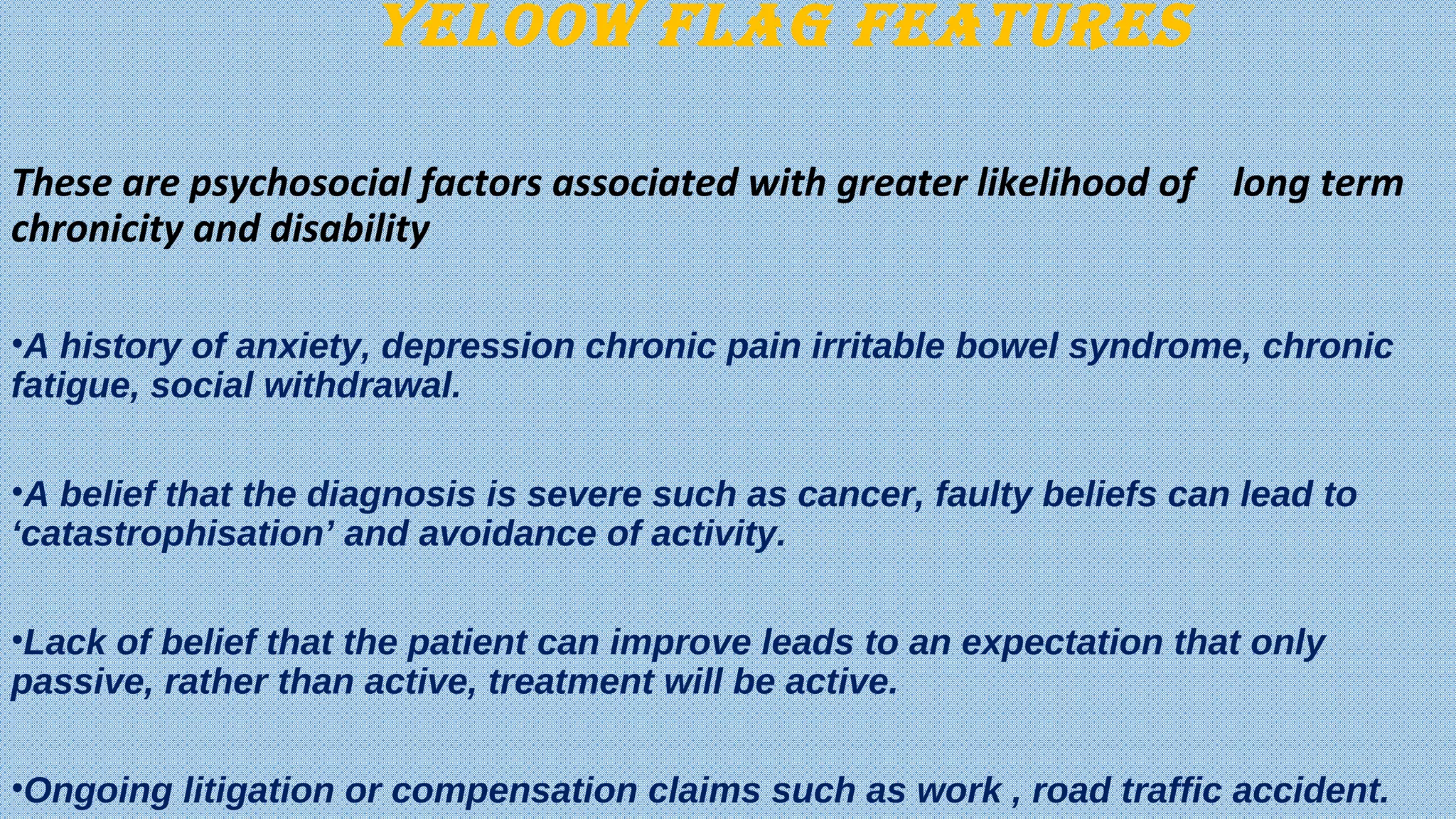
YELOOW FLAG FEAturEs
These are psychosocial factors associated with greater likelihood of long term
chronicity and disability
•A history of anxiety, depression chronic pain irritable bowel syndrome, chronic
fatigue, social withdrawal.
•A belief that the diagnosis is severe such as cancer, faulty beliefs can lead to
‘catastrophisation’ and avoidance of activity.
•Lack of belief that the patient can improve leads to an expectation that only
passive, rather than active, treatment will be active.
•Ongoing litigation or compensation claims such as work , road traffic accident.
Drug History
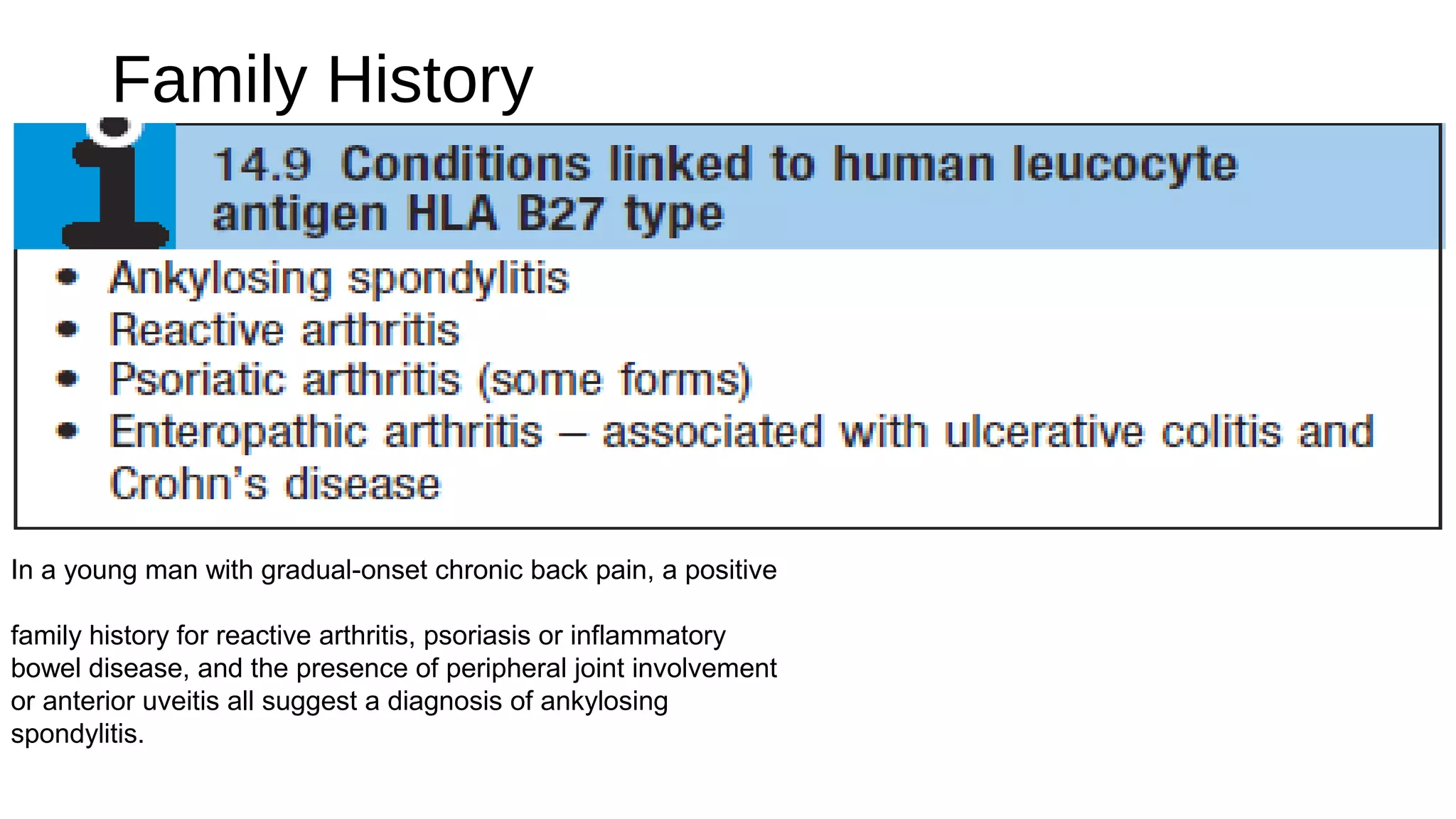
Family History
In a young man with gradual-onset chronic back pain, a positive
family history for reactive arthritis, psoriasis or inflammatory
bowel disease, and the presence of peripheral joint involvement
or anterior uveitis all suggest a diagnosis of ankylosing
spondylitis.
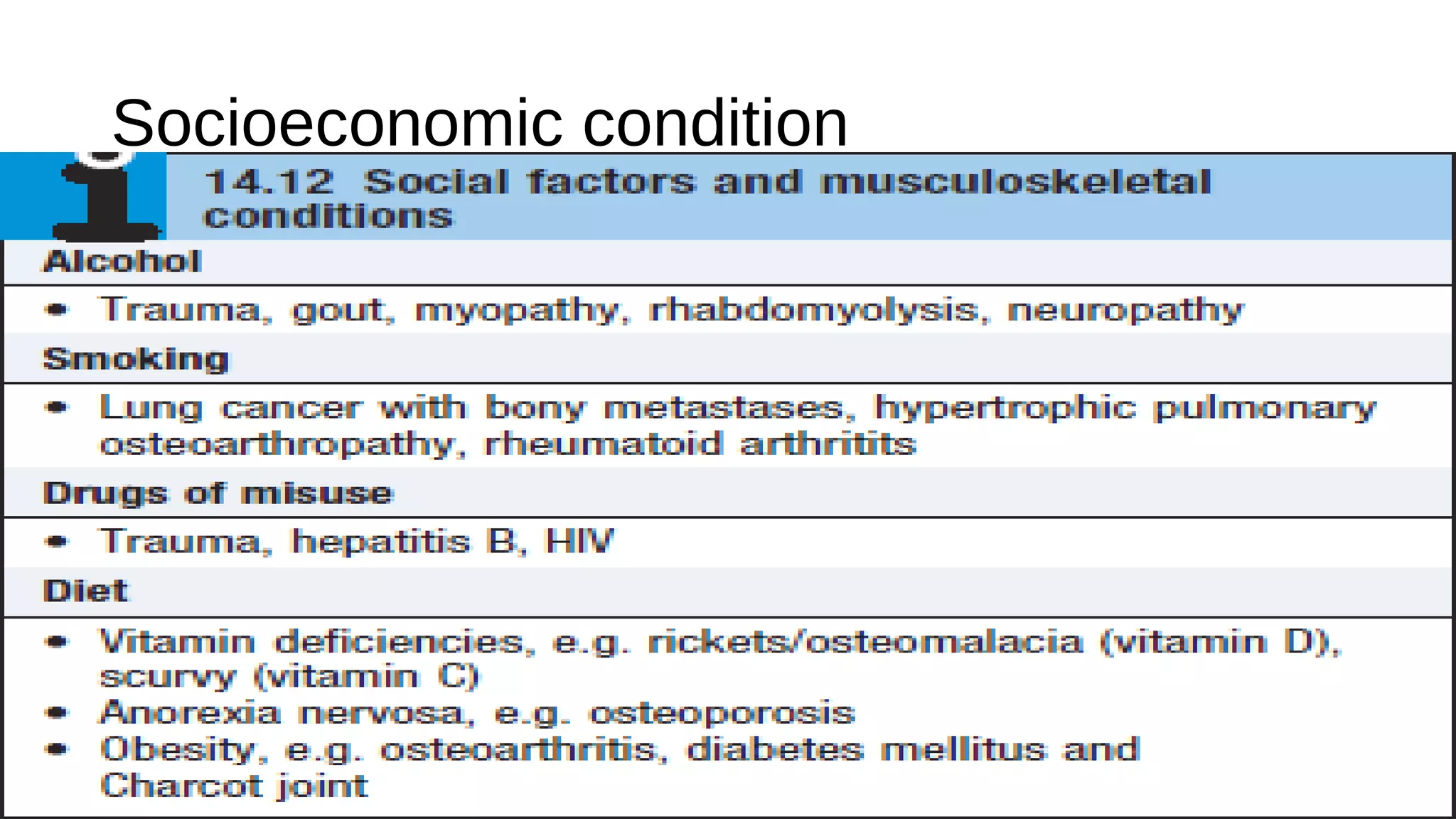
Socioeconomic condition
Occupational history
• Longstanding sitting, standing
Constant exrtemitiesmovement
Weight lifting
• Psychological history
Depression
Unemployment
Job satisfaction
Familial disharmony

History of Low back-pain

  • 1.
    HISTORY OF LOW BACK PAIN DR.SAMSUL AREFIN Resident Dept . of Anesthesia ,Analgesia & Intensive care BSMMU
  • 2.
    Common cause oflow back pain • Myofascial lower back pain HNP of lumber spine Spinal canal stenosis Lumber spondylolysis Spondylolisthesis Facet Syndrome Adult kyphosis and scoliosis Infective pathology of spine eg. TB & osteomyelitis Primary neoplasm of the neural tissue and MM Metastatic disease of spine Rheumatic conditions eg. Ankylosing spondylitis and fibromyalgia Metabolic causes of back pain FBSS Ref. Handbook of pain medicine / G. Dureja / 2nd ed
  • 3.
    PAIN CLINIC ,BSMMU 10years old boy comes with low back pain 26 years old boy comes with low back pain 65 years old female comes with the low back pain
  • 4.
    COMMON CAUSES OFBACK PAIN IN VARIOUS AGE GROUPS CHILDREN ADOLESCENTS YOUNG ADULTS • scoliosis • Spondylolisthesis • Pyogenic or tuberculous infections • Calve’s disease • Scheuermann’s disease • Scoliosis(idiopathic and postural) • Mechanical baack pain • Adolescent intervertebral disc syndrome • Pyogenic or tuberculous infection • Prolapsed intervertebral disc • Spondylolidthesis • Spinal fracture • Ankylosing apondylitid • Coccydynia • Pyogenic or tuberculous infection • Spinal stenosis
  • 5.
    MIDDLE – AGED ELDERLY •Mechanical back pain • Prolapsed intervertebral disc • Scheuermann’s disease and old fracture • Spondylolisthesis • Rheumatoid arthritis • Spinal stenosis • Paget’s disease • Cocccydynia • Spinal metastases • Pyogenic osteitis of spine • Osteoarthritis(primary or secondary) • True senile kyphosis • Osteoporosis(with or without fracture) • Osteomalacia(with or without fracture) • Spinal metastases.
  • 6.
    • Site andnature of pain : localized of diffuse persistent or intermittent • Onset of pain : When did the symptoms commence? pattern of onset: slow and insidious rapid or sudden ( strongly suggestive of mechanical factor) history of an injury ( a sudden twist or strain or sneeze occurring when the patient was in a flexed position :a common history for intervertebral disc prolapse )
  • 7.
    • Character ofpain Usually described by adjectives like sharp, dull, burning, tingling, boring , stabing Directly relevant previous history : Is there any history of previous similar attack? or any previous trouble with the spine ? • Radiation of the pain : does the pain radiates to the legs ? how far down does the pain go & what are the area involved ? commonly affaected nerve root L 4,L 5 &S1 •
  • 8.
    Associated any paresthesia N.B.Pain radiates into legs is not necessarily due to nerve root compression. It seems that irritation of facet joints , ligaments and muscles may produce dull aching pain in the buttock and back of the thighs. Pain arising from nerve root is usually sharp and knief like Back with without radiation Back pain with radicular lower extremity pain or weakness Musculoskeletal lower back pain Spondylosis Facet syndrome Adult scoliosis Adult kyphosis Spondylolisthesis Infection Fracture Dislocation Arthritis Rheumatological condition Reffered pain from visera HNP Spinal stenosis Fracture Dislocation Cauda equina syndrome Ref. Handbook of pain medicine / G. Dureja/ 2nd ed
  • 10.
    • Timing of pain Constant:back ache with spinal pathology ( tumour , infection or inflammation constant night pain , distinct short lived pain when turning in bed) > Sleep disturbance Episodic In particular day or part of whole day Any changes in severity as day progress Morning pain associated with stiffness Exacerbating and relieving factor Mechanical back pain bending or sudden movement may make the pain worse ,whereas lying flat , particularly on a hard surface or applying local heat or even sitting, may relieve pain. During rest pain increase or decrease?
  • 11.
    • Motor involvement anyweakness in the lower limbs or any muscle wasting or fibrillation? Any disturbance of gait or balance , any tendency to giving way of the legs , any sign of foot drop? • Any constitutional symptoms : malaise , fever , weight loss involvement of other joints associated GIT problems associated genitourinary symptoms respiratory difficulty major neurological disturbance
  • 12.
    COMMON CAUSES OFLOW BACK PAIN PATHOLOGY AGE PAIN NATURE ASSOCIATED PAIN ASSOCIATED SYMPTOMS Degenerative spondylosis > 40 years Mechanical Distance claudication Active patient Spondylolisthesis <20 years >40 years Mechanical Extension Hyperextension on activity Trauma Any age Mechanical _ Trauma Infection Any age Non- mechanical Rest pain Fever Mets >50 years Non-mechanical Rest pain Primary+ LOW LOA Osteoporosis >60 years Mechanical _ Trivial injury
  • 13.
    Findings PID Lateralstenosis Central stenosis Average age 43 41 65 Duration of symptoms Shortest Pain at rest, at night and on coughing + Equal + SLR +++ Sometimes Hardlyever Motor disturbance Commonest specially knee jerk Sensory changes Commonest DIFFERENCE BETWEEN DISC PROLAPSE AND SPINAL STENOSIS
  • 14.
    RED FLAG FEATURES •Histosry •Age <20 years or >55 years • Recent significant trauma • Pain- thorasic (dissecting aneurysm) • non-mechanical (infection/tumour/pathological fracture) • Fever(infection) • Difficulty in micturition • Faecal incontinence • Motor weakness • Sensory changes in the perineum( saddle anesthesia) • Sexual dysfunction( erectile/ejaculatory failure) • Gait change ( cauda equine syndrome) • Bilateral sciatica
  • 15.
    •Past medical history •Systemic review •Cancer ( metastases) • Previous steroid use (osteoporotic collapse) • Weight loss/malaise without obvious cause
  • 16.
    YELOOW FLAG FEAturEs Theseare psychosocial factors associated with greater likelihood of long term chronicity and disability •A history of anxiety, depression chronic pain irritable bowel syndrome, chronic fatigue, social withdrawal. •A belief that the diagnosis is severe such as cancer, faulty beliefs can lead to ‘catastrophisation’ and avoidance of activity. •Lack of belief that the patient can improve leads to an expectation that only passive, rather than active, treatment will be active. •Ongoing litigation or compensation claims such as work , road traffic accident.
  • 17.
  • 18.
    Family History In ayoung man with gradual-onset chronic back pain, a positive family history for reactive arthritis, psoriasis or inflammatory bowel disease, and the presence of peripheral joint involvement or anterior uveitis all suggest a diagnosis of ankylosing spondylitis.
  • 19.
  • 20.
    Occupational history • Longstandingsitting, standing Constant exrtemitiesmovement Weight lifting • Psychological history Depression Unemployment Job satisfaction Familial disharmony