READINGS IN
PHILIPPINE
HISTORY
SOCSCI 102
CHAPTER
01
DEFINITION OF HISTORY:
ISSUES, SOURCES AND
METHODOLOGY
● It is the study of the past as it is
described in written documents.
● It provides the analysis and
interpretation of the human past
enabling us to study continuity and
changes that take place over time.
HISTORY
● “History is the record of what one age
finds worthy of note in another.”
- Jacob Burckhardt
● “History, in it’s broadest sense, is
everything that ever happened”
-Henry Johnson
HISTORY by Historians:
● “History is the story of man’s
struggle through the ages against
Nature and it’s elements; .”
- Jawaharal Nehru
HISTORY by Historians:
NATURE
OF
HISTORY
PHILIPPINE
HISTORY
1.History is a study of the present in the
light of the past.
2. History is the study of man.
3. History is concerned with man in time.
4. History provides an objective record of
happenings.
5. History is multisided.
History is a study of the
present in the light of the
past.
-The present owes its existence on the past.
To understand how society has come to its
present form, there is a need to know its past.
History is the study of man.
-Past events are riddled with man’s
engagement in wars, his struggles to win his
independence.
History is concerned with
man in time.
-It deals with a series of events and
each events happen at a given point
in time.
History provides an objective
record of happenings.
They based their data on original
sources and make them free from
subjective interpretation.
History is multisided.
-It is not limited to one certain aspect
of man’s life, it covers all aspects as
they are all closely interrelated.
RELEVANCE
OF
HISTORY
PHILIPPINE
HISTORY
1.History helps us understand people and
societies.
2. History contributes to moral
understanding.
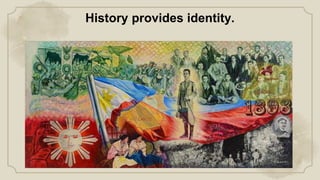
3. History provides identity.
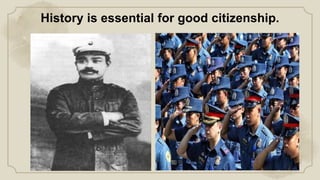
4. History is essential for good citizenship.
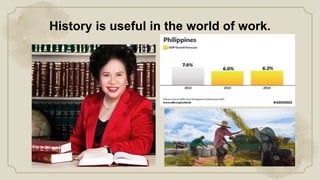
5. History is useful in the world of work.
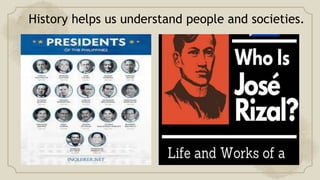
History helps us understand people and societies.
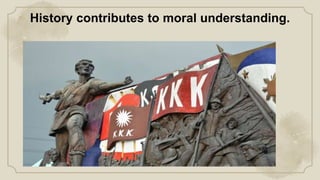
History contributes to moral understanding.
History provides identity.
History is essential for good citizenship.
History is useful in the world of work.
ROLES OF HISTORY
● It gives lessons that can be used
to make sense of the present.
● Great past can inspire people to
keep their good practices to
move forward.
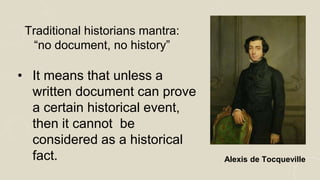
Traditional historians mantra:
“no document, no history”
Alexis de Tocqueville
• It means that unless a
written document can prove
a certain historical event,
then it cannot be
considered as a historical
fact.
● Restricting historical evidence as exclusively
written is also discrimination against other
social classes who were not recorded in
paper.
● Nobilities, monarchs, elites and even the
middle class would have their birth,
education, marriage and death as matters of
government and historical record.
● Does the absence of written
documents about them mean
that they were people of no
history or past?
Question:
QUESTIONS AND ISSUES IN HISTORY
1.What is history?
2. Why study history?
3.And history for whom?
HISTORIOGRAPHY
● It is the history of history.
● It covers how historians have
studied and developed history
including its sources, techniques,
and theoretical approaches.
POSITIVISM
Is the school of thought that
emerged between the 18th and
19th century. This thought requires
empirical and observable evidence
before one can claim that a
particular knowledge is true.
POST- COLONIALISM
● Is the school of thought that
emerged in the early 20th century
when formerly colonized nations
grappled with the idea of creating
their identities and understanding
their societies against the
shadows of their colonial past.
TwoThings in Writing History:
● 1. Tell the history of their nation that will
highlight their identity free from that
colonial discourse and knowledge.
2. To criticize the methods, effects, and
idea of colonialism.
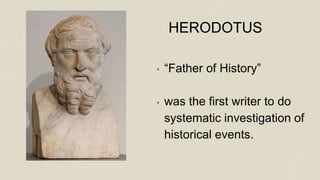
HERODOTUS
• “Father of History”
• was the first writer to do
systematic investigation of
historical events.
CHAPTER
01
PRIMARY SOURCES
PRIMARY SOURCES
● It provide the original materials
on which other research is
based and enable students and
other researchers to get as
close as possible to what
actually happened during a
particular event or era.
Are those sources
produced at the same
time as the event,
period, or subject
being studied
PRIMARY SOURCES
EXAMPLES OF PRIMARY
SOURCES
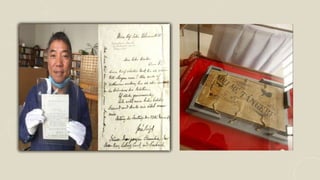
Autobiographies, Memoirs, diaries
personal letters and correspondence,
interviews, surveys, emails, blogs,
photographs, drawings magazines,
newspapers, audio recordings, artifacts
and government documents.
Are those sources
produced by an author
who used primary
sources to produce the
material
SECONDARY SOURCES

History: Definition, Sources and Methodologies

  • 1.
  • 3.
  • 4.
    ● It isthe study of the past as it is described in written documents. ● It provides the analysis and interpretation of the human past enabling us to study continuity and changes that take place over time. HISTORY
  • 5.
    ● “History isthe record of what one age finds worthy of note in another.” - Jacob Burckhardt ● “History, in it’s broadest sense, is everything that ever happened” -Henry Johnson HISTORY by Historians:
  • 6.
    ● “History isthe story of man’s struggle through the ages against Nature and it’s elements; .” - Jawaharal Nehru HISTORY by Historians:
  • 7.
  • 8.
    1.History is astudy of the present in the light of the past. 2. History is the study of man. 3. History is concerned with man in time. 4. History provides an objective record of happenings. 5. History is multisided.
  • 9.
    History is astudy of the present in the light of the past. -The present owes its existence on the past. To understand how society has come to its present form, there is a need to know its past.
  • 10.
    History is thestudy of man. -Past events are riddled with man’s engagement in wars, his struggles to win his independence.
  • 11.
    History is concernedwith man in time. -It deals with a series of events and each events happen at a given point in time.
  • 12.
    History provides anobjective record of happenings. They based their data on original sources and make them free from subjective interpretation.
  • 13.
    History is multisided. -Itis not limited to one certain aspect of man’s life, it covers all aspects as they are all closely interrelated.
  • 14.
  • 15.
    1.History helps usunderstand people and societies. 2. History contributes to moral understanding. 3. History provides identity. 4. History is essential for good citizenship. 5. History is useful in the world of work.
  • 16.
    History helps usunderstand people and societies.
  • 17.
    History contributes tomoral understanding.
  • 18.
  • 19.
    History is essentialfor good citizenship.
  • 20.
    History is usefulin the world of work.
  • 21.
    ROLES OF HISTORY ●It gives lessons that can be used to make sense of the present. ● Great past can inspire people to keep their good practices to move forward.
  • 22.
    Traditional historians mantra: “nodocument, no history” Alexis de Tocqueville • It means that unless a written document can prove a certain historical event, then it cannot be considered as a historical fact.
  • 23.
    ● Restricting historicalevidence as exclusively written is also discrimination against other social classes who were not recorded in paper. ● Nobilities, monarchs, elites and even the middle class would have their birth, education, marriage and death as matters of government and historical record.
  • 24.
    ● Does theabsence of written documents about them mean that they were people of no history or past? Question:
  • 25.
    QUESTIONS AND ISSUESIN HISTORY 1.What is history? 2. Why study history? 3.And history for whom?
  • 26.
    HISTORIOGRAPHY ● It isthe history of history. ● It covers how historians have studied and developed history including its sources, techniques, and theoretical approaches.
  • 27.
    POSITIVISM Is the schoolof thought that emerged between the 18th and 19th century. This thought requires empirical and observable evidence before one can claim that a particular knowledge is true.
  • 28.
    POST- COLONIALISM ● Isthe school of thought that emerged in the early 20th century when formerly colonized nations grappled with the idea of creating their identities and understanding their societies against the shadows of their colonial past.
  • 29.
    TwoThings in WritingHistory: ● 1. Tell the history of their nation that will highlight their identity free from that colonial discourse and knowledge. 2. To criticize the methods, effects, and idea of colonialism.
  • 30.
    HERODOTUS • “Father ofHistory” • was the first writer to do systematic investigation of historical events.
  • 32.
  • 33.
    PRIMARY SOURCES ● Itprovide the original materials on which other research is based and enable students and other researchers to get as close as possible to what actually happened during a particular event or era.
  • 34.
    Are those sources producedat the same time as the event, period, or subject being studied PRIMARY SOURCES
  • 35.
    EXAMPLES OF PRIMARY SOURCES Autobiographies,Memoirs, diaries personal letters and correspondence, interviews, surveys, emails, blogs, photographs, drawings magazines, newspapers, audio recordings, artifacts and government documents.
  • 36.
    Are those sources producedby an author who used primary sources to produce the material SECONDARY SOURCES

Editor's Notes

  • #23 Question: sa isang relasyon, maniniwala ka ba kaagad sa nasagap mong masa