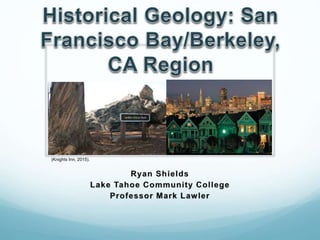
(Knights Inn, 2015).
 The bay area and Berkeley, CA are home
to many different rock forms and wildlife
including the famous, Indian Rock Park.
The park was a gift to the City of Berkeley
from Mason-McDuffie Real Estate
Company during its development of the
Northbrae area.
 1.18 acres
 Features: rock outcrop with carved steps
and areas for rock climbing, Multi-
purpose turf, Picnic area, and
Vista/overlook with gorgeous view of the
San Francisco Bay
(Indian Rock Plaques, 2003).
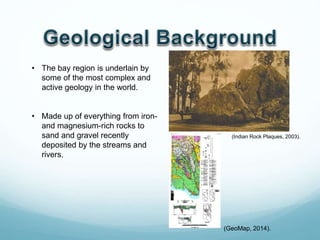
• The bay region is underlain by
some of the most complex and
active geology in the world.
• Made up of everything from iron-
and magnesium-rich rocks to
sand and gravel recently
deposited by the streams and
rivers.
(GeoMap, 2014).
The Berkeley Squirrel
(Shields, 2016).
How/When Have They
Evolved and Changed Over
Time?
 The earliest fossil evidence for squirrels was found in western
North America and dated to about 36 million years ago.
 At about 11 million years ago, there was an explosive
diversification of genera of squirrels that inhabited the islands and
continental land masses of Southeast Asia.
 There is evidence for the Asia-North America migration of certain
ground squirrel lineages, which appears to come after a
subsequent period when there were rising sea levels.
(Squirrels Family Tree, 2003).
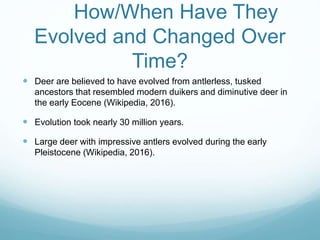
Berkeley Hills Deer
(Shields, 2016).
How/When Have They
Evolved and Changed Over
Time?
 Deer are believed to have evolved from antlerless, tusked
ancestors that resembled modern duikers and diminutive deer in
the early Eocene (Wikipedia, 2016).
 Evolution took nearly 30 million years.
 Large deer with impressive antlers evolved during the early
Pleistocene (Wikipedia, 2016).
California Manroot (Marah
fabaceus)
(Shields, 2016).
Evolutionary History of the
California Manroot
 Native to the San Francisco Bay Area.
 Native American Tribes once used it to soothe aches
and pains.
 Has some medicinal use.
 Also referred to as the Wild Cucumber plant.
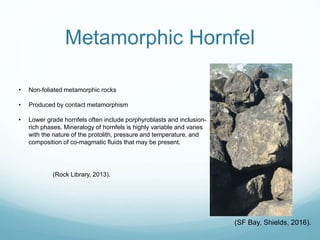
Metamorphic Hornfel
(SF Bay, Shields, 2016).
• Non-foliated metamorphic rocks
• Produced by contact metamorphism
• Lower grade hornfels often include porphyroblasts and inclusion-
rich phases. Mineralogy of hornfels is highly variable and varies
with the nature of the protolith, pressure and temperature, and
composition of co-magmatic fluids that may be present.
(Rock Library, 2013).
Igneous Rhyolite
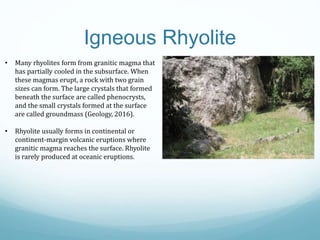
• Many rhyolites form from granitic magma that
has partially cooled in the subsurface. When
these magmas erupt, a rock with two grain
sizes can form. The large crystals that formed
beneath the surface are called phenocrysts,
and the small crystals formed at the surface
are called groundmass (Geology, 2016).
• Rhyolite usually forms in continental or
continent-margin volcanic eruptions where
granitic magma reaches the surface. Rhyolite
is rarely produced at oceanic eruptions.
Sedimentary Sandstone
(Shields, 2016).
• Sandstone is a sedimentary rock
composed of sand-size grains of
mineral, rock, or organic material. It
also contains a cementing material
that binds the sand grains together
and may contain a matrix of silt- or
clay-size particles that occupy the
spaces between the sand grains.
• Sandstone is one of the most
common types of sedimentary rock
and is found in sedimentary basins
throughout the world. It is often
mined for use as a construction
material or as a raw material used in
manufacturing. In the subsurface,
sandstone often serves as an aquifer
for groundwater or as a reservoir for
oil and natural gas.
(Geology, 2013).
Principle of Inclusions
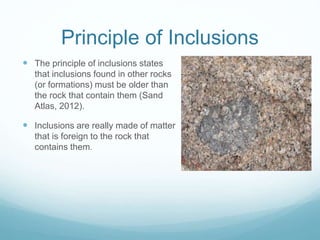
 The principle of inclusions states
that inclusions found in other rocks
(or formations) must be older than
the rock that contain them (Sand
Atlas, 2012).
 Inclusions are really made of matter
that is foreign to the rock that
contains them.
Disconformity
 An erosion surface
between two packages
of sediment.
 The lower package of
sediments was not tilted
prior to deposition of the
upper sediment
package.
(Shields, 2016).
References
 Retrieved from http://www.sandatlas.org/principle-of-inclusions/
 Retrieved from http://berkeleyplaques.org/wp-content/uploads/2014/01/IndianRock_03.jpg
 Retrieved from http://www.knightsinnberkeley.com/blog/wp-content/uploads/2015/11/Indian-Rock-
Park.jpg
 Retrieved from http://geomaps.wr.usgs.gov/sfbay/geomap.html
 Deer - Wikipedia, the free encyclopedia. (n.d.). Retrieved June 12, 2016, from https://en.wikipedia.org/
wiki/Deer#Evolution
 Rhyolite: An extrusive igneous rock. Photos and definition. (n.d.). Retrieved from http://geology.com/
rocks/rhyolite.shtml
 Rock Library | Imperial College London. (n.d.). Retrieved from https://wwwf.imperial.ac.uk/
earthscienceandengineering/rocklibrary/viewglossrecord.php?Term=hornfels
 Squirrels' Evolutionary Family Tree Reveals Influence of Climate, Geology | Duke Today. (n.d.). Retrieved
from https://today.duke.edu/2003/02/squirreltree0302.html

Historical Geology Presentation

  • 1.
  • 2.
     The bayarea and Berkeley, CA are home to many different rock forms and wildlife including the famous, Indian Rock Park. The park was a gift to the City of Berkeley from Mason-McDuffie Real Estate Company during its development of the Northbrae area.  1.18 acres  Features: rock outcrop with carved steps and areas for rock climbing, Multi- purpose turf, Picnic area, and Vista/overlook with gorgeous view of the San Francisco Bay
  • 3.
    (Indian Rock Plaques,2003). • The bay region is underlain by some of the most complex and active geology in the world. • Made up of everything from iron- and magnesium-rich rocks to sand and gravel recently deposited by the streams and rivers. (GeoMap, 2014).
  • 4.
  • 5.
    How/When Have They Evolvedand Changed Over Time?  The earliest fossil evidence for squirrels was found in western North America and dated to about 36 million years ago.  At about 11 million years ago, there was an explosive diversification of genera of squirrels that inhabited the islands and continental land masses of Southeast Asia.  There is evidence for the Asia-North America migration of certain ground squirrel lineages, which appears to come after a subsequent period when there were rising sea levels. (Squirrels Family Tree, 2003).
  • 6.
  • 7.
    How/When Have They Evolvedand Changed Over Time?  Deer are believed to have evolved from antlerless, tusked ancestors that resembled modern duikers and diminutive deer in the early Eocene (Wikipedia, 2016).  Evolution took nearly 30 million years.  Large deer with impressive antlers evolved during the early Pleistocene (Wikipedia, 2016).
  • 8.
  • 9.
    Evolutionary History ofthe California Manroot  Native to the San Francisco Bay Area.  Native American Tribes once used it to soothe aches and pains.  Has some medicinal use.  Also referred to as the Wild Cucumber plant.
  • 10.
    Metamorphic Hornfel (SF Bay,Shields, 2016). • Non-foliated metamorphic rocks • Produced by contact metamorphism • Lower grade hornfels often include porphyroblasts and inclusion- rich phases. Mineralogy of hornfels is highly variable and varies with the nature of the protolith, pressure and temperature, and composition of co-magmatic fluids that may be present. (Rock Library, 2013).
  • 11.
    Igneous Rhyolite • Manyrhyolites form from granitic magma that has partially cooled in the subsurface. When these magmas erupt, a rock with two grain sizes can form. The large crystals that formed beneath the surface are called phenocrysts, and the small crystals formed at the surface are called groundmass (Geology, 2016). • Rhyolite usually forms in continental or continent-margin volcanic eruptions where granitic magma reaches the surface. Rhyolite is rarely produced at oceanic eruptions.
  • 12.
    Sedimentary Sandstone (Shields, 2016). •Sandstone is a sedimentary rock composed of sand-size grains of mineral, rock, or organic material. It also contains a cementing material that binds the sand grains together and may contain a matrix of silt- or clay-size particles that occupy the spaces between the sand grains. • Sandstone is one of the most common types of sedimentary rock and is found in sedimentary basins throughout the world. It is often mined for use as a construction material or as a raw material used in manufacturing. In the subsurface, sandstone often serves as an aquifer for groundwater or as a reservoir for oil and natural gas. (Geology, 2013).
  • 13.
    Principle of Inclusions The principle of inclusions states that inclusions found in other rocks (or formations) must be older than the rock that contain them (Sand Atlas, 2012).  Inclusions are really made of matter that is foreign to the rock that contains them.
  • 14.
    Disconformity  An erosionsurface between two packages of sediment.  The lower package of sediments was not tilted prior to deposition of the upper sediment package. (Shields, 2016).
  • 15.
    References  Retrieved fromhttp://www.sandatlas.org/principle-of-inclusions/  Retrieved from http://berkeleyplaques.org/wp-content/uploads/2014/01/IndianRock_03.jpg  Retrieved from http://www.knightsinnberkeley.com/blog/wp-content/uploads/2015/11/Indian-Rock- Park.jpg  Retrieved from http://geomaps.wr.usgs.gov/sfbay/geomap.html  Deer - Wikipedia, the free encyclopedia. (n.d.). Retrieved June 12, 2016, from https://en.wikipedia.org/ wiki/Deer#Evolution  Rhyolite: An extrusive igneous rock. Photos and definition. (n.d.). Retrieved from http://geology.com/ rocks/rhyolite.shtml  Rock Library | Imperial College London. (n.d.). Retrieved from https://wwwf.imperial.ac.uk/ earthscienceandengineering/rocklibrary/viewglossrecord.php?Term=hornfels  Squirrels' Evolutionary Family Tree Reveals Influence of Climate, Geology | Duke Today. (n.d.). Retrieved from https://today.duke.edu/2003/02/squirreltree0302.html