The Bay Area/San Jose
Robert Garcia
Geology 103 Summer 2018
Field Assignment
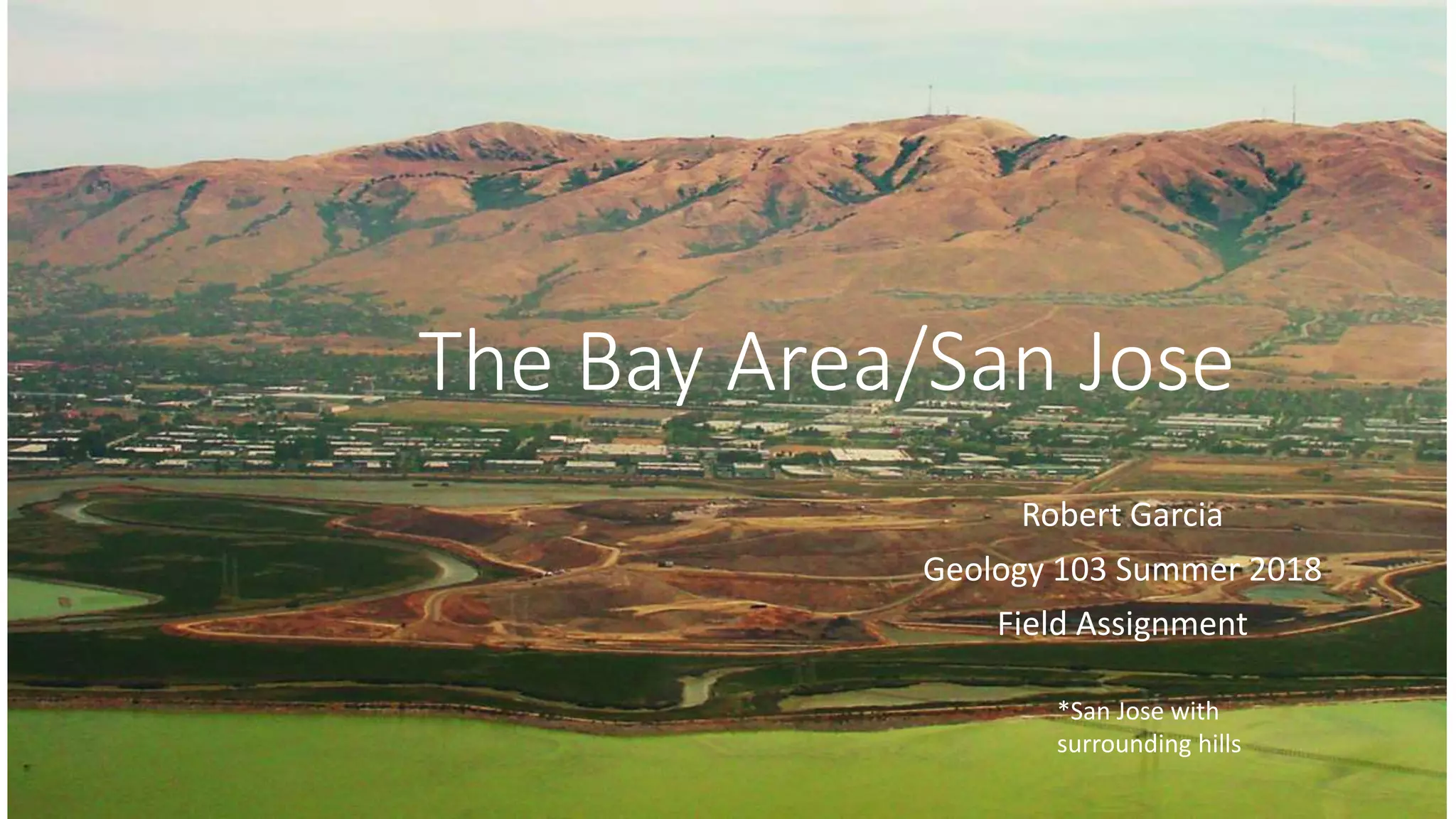
*San Jose with
surrounding hills
Bay Area Formation
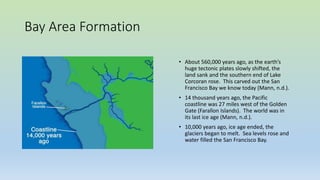
• About 560,000 years ago, as the earth’s
huge tectonic plates slowly shifted, the
land sank and the southern end of Lake
Corcoran rose. This carved out the San
Francisco Bay we know today (Mann, n.d.).
• 14 thousand years ago, the Pacific
coastline was 27 miles west of the Golden
Gate (Farallon Islands). The world was in
its last ice age (Mann, n.d.).
• 10,000 years ago, ice age ended, the
glaciers began to melt. Sea levels rose and
water filled the San Francisco Bay.
Bay Area Geology
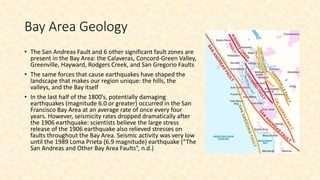
• The San Andreas Fault and 6 other significant fault zones are
present in the Bay Area: the Calaveras, Concord-Green Valley,
Greenville, Hayward, Rodgers Creek, and San Gregorio Faults
• The same forces that cause earthquakes have shaped the
landscape that makes our region unique: the hills, the
valleys, and the Bay itself
• In the last half of the 1800’s, potentially damaging
earthquakes (magnitude 6.0 or greater) occurred in the San
Francisco Bay Area at an average rate of once every four
years. However, seismicity rates dropped dramatically after
the 1906 earthquake: scientists believe the large stress
release of the 1906 earthquake also relieved stresses on
faults throughout the Bay Area. Seismic activity was very low
until the 1989 Loma Prieta (6.9 magnitude) earthquake (“The
San Andreas and Other Bay Area Faults”, n.d.)
Where I Found Samples, San Jose
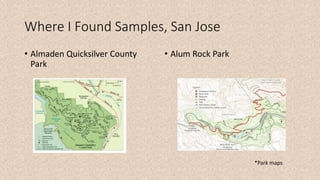
• Almaden Quicksilver County
Park
• Alum Rock Park
*Park maps
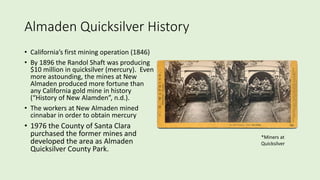
Almaden Quicksilver History
• California’s first mining operation (1846)
• By 1896 the Randol Shaft was producing
$10 million in quicksilver (mercury). Even
more astounding, the mines at New
Almaden produced more fortune than
any California gold mine in history
(“History of New Alamden”, n.d.).
• The workers at New Almaden mined
cinnabar in order to obtain mercury
• 1976 the County of Santa Clara
purchased the former mines and
developed the area as Almaden
Quicksilver County Park.
*Miners at
Quicksilver
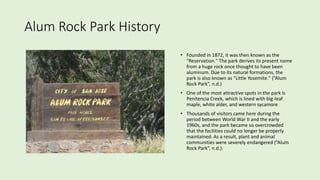
Alum Rock Park History
• Founded in 1872, it was then known as the
"Reservation." The park derives its present name
from a huge rock once thought to have been
aluminum. Due to its natural formations, the
park is also known as "Little Yosemite." (”Alum
Rock Park”, n.d.)
• One of the most attractive spots in the park is
Penitencia Creek, which is lined with big-leaf
maple, white alder, and western sycamore
• Thousands of visitors came here during the
period between World War II and the early
1960s, and the park became so overcrowded
that the facilities could no longer be properly
maintained. As a result, plant and animal
communities were severely endangered (”Alum
Rock Park”, n.d.).
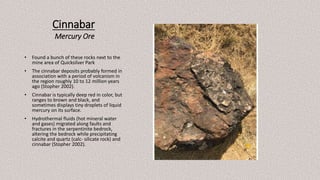
Cinnabar
Mercury Ore
• Found a bunch of these rocks next to the
mine area of Quicksilver Park
• The cinnabar deposits probably formed in
association with a period of volcanism in
the region roughly 10 to 12 million years
ago (Stopher 2002).
• Cinnabar is typically deep red in color, but
ranges to brown and black, and
sometimes displays tiny droplets of liquid
mercury on its surface.
• Hydrothermal fluids (hot mineral water
and gases) migrated along faults and
fractures in the serpentinite bedrock,
altering the bedrock while precipitating
calcite and quartz (calc- silicate rock) and
cinnabar (Stopher 2002).
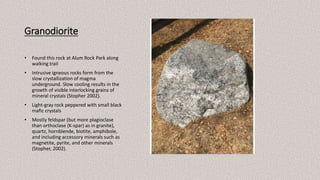
Granodiorite
• Found this rock at Alum Rock Park along
walking trail
• Intrusive igneous rocks form from the
slow crystallization of magma
underground. Slow cooling results in the
growth of visible interlocking grains of
mineral crystals (Stopher 2002).
• Light-gray rock peppered with small black
mafic crystals
• Mostly feldspar (but more plagioclase
than orthoclase (K-spar) as in granite),
quartz, hornblende, biotite, amphibole,
and including accessory minerals such as
magnetite, pyrite, and other minerals
(Stopher, 2002).
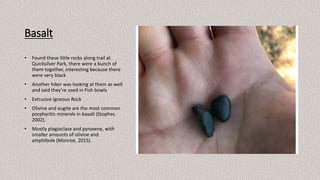
Basalt
• Found these little rocks along trail at
Quicksilver Park, there were a bunch of
them together, interesting because there
were very black
• Another hiker was looking at them as well
and said they’re used in Fish bowls
• Extrusive Igneous Rock
• Olivine and augite are the most common
porphyritic minerals in basalt (Stopher,
2002).
• Mostly plagioclase and pyroxene, with
smaller amounts of olivine and
amphibole (Monroe, 2015).
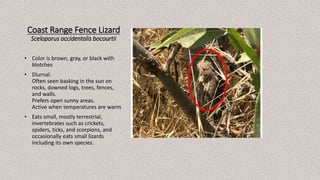
Coast Range Fence Lizard
Sceloporus occidentalis bocourtii
• Color is brown, gray, or black with
blotches
• Diurnal.
Often seen basking in the sun on
rocks, downed logs, trees, fences,
and walls.
Prefers open sunny areas.
Active when temperatures are warm
• Eats small, mostly terrestrial,
invertebrates such as crickets,
spiders, ticks, and scorpions, and
occasionally eats small lizards
including its own species.
How Have Lizards Changed Over Time?
• Amniotic egg freed reptiles from constraint of having to be by water (Monroe,
2015).
• Reptiles arose 310-320 million years ago during the Carbonifieros period
• Early lizards as well as lizards today are still very agile on land
• Lizards started to show up in Mesozoic Era during the Jurassic/Cretaceous Period
Family Phrynosomatidae Zebra-tailed, Earless, Fringe-toed, Spiny,
Tree, Side-blotched, and Horned Lizards
Fitzinger, 1843
Genus Sceloporus Spiny Lizards Wiegmann, 1828
Species occidentalis Western Fence Lizard Baird and Girard, 1852
Subspecies bocourtii Coast Range Fence Lizard Boulenger, 1885
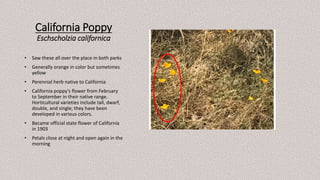
California Poppy
Eschscholzia californica
• Saw these all over the place in both parks
• Generally orange in color but sometimes
yellow
• Perennial herb native to California
• California poppy’s flower from February
to September in their native range.
Horticultural varieties include tall, dwarf,
double, and single; they have been
developed in various colors.
• Became official state flower of California
in 1903
• Petals close at night and open again in the
morning
Poppy Evolution
• When Russian ships were sailing off the California coast in the 1800's they marveled at the golden
hillsides that they saw. The reason they were golden was because they were covered with
California poppies.
• The poppy is considered a very archaic plant and the ancestry of it is not totally known. They are
generally regarded as belonging to the subclass Magnoliidae but this seems to be speculation
(Burt).
• The California poppy is an Angiosperm, which are flowering plants. It then branches off into the
Euangiosperms and then into the Eudicots. From there it goes into the Ranunculales and finally
into Papaveraceae, which is the poppy family.
• Angiosperms replaced gymnosperms dominance from the Jurassic/Early Cretaceous (Monroe,
2015).
• Angiosperms have adapted to nearly every terrestrial habitat due to their method of
reproduction, especially animal pollinators (insects) (Monroe, 2015).
• Account for more than 90% of all land plant species (Monroe, 2015).
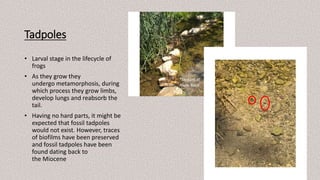
Tadpoles
• Larval stage in the lifecycle of
frogs
• As they grow they
undergo metamorphosis, during
which process they grow limbs,
develop lungs and reabsorb the
tail.
• Having no hard parts, it might be
expected that fossil tadpoles
would not exist. However, traces
of biofilms have been preserved
and fossil tadpoles have been
found dating back to
the Miocene
*Stream at
Alum Rock
When Did Frogs Evolve?
• Frogs developed out of lungfish about 375 million years ago, in
the Devonian period. They used their lungs to leave the water and live
on land (Karr, 2018)
• In the Devonian period, it was hotter and drier on Earth than usual.
That’s because a lot of the land was gathered together into one
continent, Gondwana. So a lot of smaller seas were drying up. The
fish in these seas needed another way to live (Karr, 2018).
• Being able to survive on land was a big advantage for frogs, and they
did pretty well. But frogs still had to live close to water. They lay
their eggs and their sperm in the water to make new tadpoles, and
the tadpoles have to live in water.
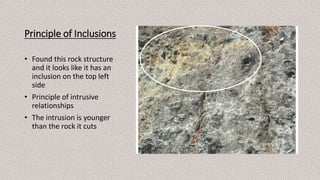
Principle of Inclusions
• Found this rock structure
and it looks like it has an
inclusion on the top left
side
• Principle of intrusive
relationships
• The intrusion is younger
than the rock it cuts
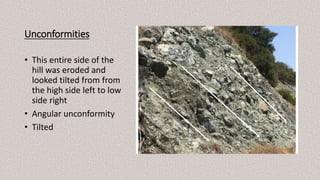
Unconformities
• This entire side of the
hill was eroded and
looked tilted from from
the high side left to low
side right
• Angular unconformity
• Tilted
References
• Alum Rock Park. (n.d.). Retrieved August 10, 2018, from https://www.u-s-history.com/pages/h3097.html
• Burt, J. (n.d.). Biogeography of the California Poppy - San Francisco State ... Retrieved August 11, 2018, from
http://www.bing.com/cr?IG=D47F631B5033448F9A4B72EF0D16613E&CID=2DA1FC9C4B766D311136F0D44A8B6CDA&rd=1&h=5plqwtJvyo
qMo_BRrr--G71ggUQWCaXYZLAalw_14VY&v=1&r=http://online.sfsu.edu/bholzman/courses/Fall02
projects/calpoppy.html&p=DevEx.LB.1,5522.1
• CaliforniaHerps.com, Reptiles and Amphibians of California. (n.d.). Retrieved August 11, 2018, from
http://www.californiaherps.com/lizards/pages/s.o.bocourtii.html
• Carr, K. (2018, May 11). Evolution of Frogs - Biology. Retrieved August 11, 2018, from https://quatr.us/biology/evolution-frogs-biology.htm
• Mann, L. (n.d.). The Formation of San Francisco Bay. Retrieved August 10, 2018, from
http://www.bing.com/cr?IG=FAD8402515194B43B31B73C04A25FF1D&CID=06BD9AAE059A6398187996E904676241&rd=1&h=gQHSkzTck
QKf46FSnaDT-wjLMaQJDn8TdHB0SBx-M9g&v=1&r=http://education.savingthebay.org/wp-content/guides/The-Formation-of-San-Francisco-
Bay.pdf&p=DevEx.LB.1,5065.1
• Monroe, J. S., & Wicander, R. (2015). The changing earth: Exploring geology and evolution. Stamford, CT: Cengage Learning.
• History of New Almaden. (n.d.). Retrieved August 10, 2018, from
http://onlineexhibits.historysanjose.org/neighborhoods/newalmaden/index.html
• Stopher, P. (2002, June 11). Rocks and Geology in the San Francisco Bay Region. Retrieved August 11, 2018, from
https://pubs.usgs.gov/bul/2195/
• The San Andreas and Other Bay Area Faults. (n.d.). Retrieved August 10, 2018, from
https://earthquake.usgs.gov/earthquakes/events/1906calif/virtualtour/bayarea.php

Field Assignment

  • 1.
    The Bay Area/SanJose Robert Garcia Geology 103 Summer 2018 Field Assignment *San Jose with surrounding hills
  • 2.
    Bay Area Formation •About 560,000 years ago, as the earth’s huge tectonic plates slowly shifted, the land sank and the southern end of Lake Corcoran rose. This carved out the San Francisco Bay we know today (Mann, n.d.). • 14 thousand years ago, the Pacific coastline was 27 miles west of the Golden Gate (Farallon Islands). The world was in its last ice age (Mann, n.d.). • 10,000 years ago, ice age ended, the glaciers began to melt. Sea levels rose and water filled the San Francisco Bay.
  • 3.
    Bay Area Geology •The San Andreas Fault and 6 other significant fault zones are present in the Bay Area: the Calaveras, Concord-Green Valley, Greenville, Hayward, Rodgers Creek, and San Gregorio Faults • The same forces that cause earthquakes have shaped the landscape that makes our region unique: the hills, the valleys, and the Bay itself • In the last half of the 1800’s, potentially damaging earthquakes (magnitude 6.0 or greater) occurred in the San Francisco Bay Area at an average rate of once every four years. However, seismicity rates dropped dramatically after the 1906 earthquake: scientists believe the large stress release of the 1906 earthquake also relieved stresses on faults throughout the Bay Area. Seismic activity was very low until the 1989 Loma Prieta (6.9 magnitude) earthquake (“The San Andreas and Other Bay Area Faults”, n.d.)
  • 4.
    Where I FoundSamples, San Jose • Almaden Quicksilver County Park • Alum Rock Park *Park maps
  • 5.
    Almaden Quicksilver History •California’s first mining operation (1846) • By 1896 the Randol Shaft was producing $10 million in quicksilver (mercury). Even more astounding, the mines at New Almaden produced more fortune than any California gold mine in history (“History of New Alamden”, n.d.). • The workers at New Almaden mined cinnabar in order to obtain mercury • 1976 the County of Santa Clara purchased the former mines and developed the area as Almaden Quicksilver County Park. *Miners at Quicksilver
  • 6.
    Alum Rock ParkHistory • Founded in 1872, it was then known as the "Reservation." The park derives its present name from a huge rock once thought to have been aluminum. Due to its natural formations, the park is also known as "Little Yosemite." (”Alum Rock Park”, n.d.) • One of the most attractive spots in the park is Penitencia Creek, which is lined with big-leaf maple, white alder, and western sycamore • Thousands of visitors came here during the period between World War II and the early 1960s, and the park became so overcrowded that the facilities could no longer be properly maintained. As a result, plant and animal communities were severely endangered (”Alum Rock Park”, n.d.).
  • 7.
    Cinnabar Mercury Ore • Founda bunch of these rocks next to the mine area of Quicksilver Park • The cinnabar deposits probably formed in association with a period of volcanism in the region roughly 10 to 12 million years ago (Stopher 2002). • Cinnabar is typically deep red in color, but ranges to brown and black, and sometimes displays tiny droplets of liquid mercury on its surface. • Hydrothermal fluids (hot mineral water and gases) migrated along faults and fractures in the serpentinite bedrock, altering the bedrock while precipitating calcite and quartz (calc- silicate rock) and cinnabar (Stopher 2002).
  • 8.
    Granodiorite • Found thisrock at Alum Rock Park along walking trail • Intrusive igneous rocks form from the slow crystallization of magma underground. Slow cooling results in the growth of visible interlocking grains of mineral crystals (Stopher 2002). • Light-gray rock peppered with small black mafic crystals • Mostly feldspar (but more plagioclase than orthoclase (K-spar) as in granite), quartz, hornblende, biotite, amphibole, and including accessory minerals such as magnetite, pyrite, and other minerals (Stopher, 2002).
  • 9.
    Basalt • Found theselittle rocks along trail at Quicksilver Park, there were a bunch of them together, interesting because there were very black • Another hiker was looking at them as well and said they’re used in Fish bowls • Extrusive Igneous Rock • Olivine and augite are the most common porphyritic minerals in basalt (Stopher, 2002). • Mostly plagioclase and pyroxene, with smaller amounts of olivine and amphibole (Monroe, 2015).
  • 10.
    Coast Range FenceLizard Sceloporus occidentalis bocourtii • Color is brown, gray, or black with blotches • Diurnal. Often seen basking in the sun on rocks, downed logs, trees, fences, and walls. Prefers open sunny areas. Active when temperatures are warm • Eats small, mostly terrestrial, invertebrates such as crickets, spiders, ticks, and scorpions, and occasionally eats small lizards including its own species.
  • 11.
    How Have LizardsChanged Over Time? • Amniotic egg freed reptiles from constraint of having to be by water (Monroe, 2015). • Reptiles arose 310-320 million years ago during the Carbonifieros period • Early lizards as well as lizards today are still very agile on land • Lizards started to show up in Mesozoic Era during the Jurassic/Cretaceous Period Family Phrynosomatidae Zebra-tailed, Earless, Fringe-toed, Spiny, Tree, Side-blotched, and Horned Lizards Fitzinger, 1843 Genus Sceloporus Spiny Lizards Wiegmann, 1828 Species occidentalis Western Fence Lizard Baird and Girard, 1852 Subspecies bocourtii Coast Range Fence Lizard Boulenger, 1885
  • 12.
    California Poppy Eschscholzia californica •Saw these all over the place in both parks • Generally orange in color but sometimes yellow • Perennial herb native to California • California poppy’s flower from February to September in their native range. Horticultural varieties include tall, dwarf, double, and single; they have been developed in various colors. • Became official state flower of California in 1903 • Petals close at night and open again in the morning
  • 13.
    Poppy Evolution • WhenRussian ships were sailing off the California coast in the 1800's they marveled at the golden hillsides that they saw. The reason they were golden was because they were covered with California poppies. • The poppy is considered a very archaic plant and the ancestry of it is not totally known. They are generally regarded as belonging to the subclass Magnoliidae but this seems to be speculation (Burt). • The California poppy is an Angiosperm, which are flowering plants. It then branches off into the Euangiosperms and then into the Eudicots. From there it goes into the Ranunculales and finally into Papaveraceae, which is the poppy family. • Angiosperms replaced gymnosperms dominance from the Jurassic/Early Cretaceous (Monroe, 2015). • Angiosperms have adapted to nearly every terrestrial habitat due to their method of reproduction, especially animal pollinators (insects) (Monroe, 2015). • Account for more than 90% of all land plant species (Monroe, 2015).
  • 14.
    Tadpoles • Larval stagein the lifecycle of frogs • As they grow they undergo metamorphosis, during which process they grow limbs, develop lungs and reabsorb the tail. • Having no hard parts, it might be expected that fossil tadpoles would not exist. However, traces of biofilms have been preserved and fossil tadpoles have been found dating back to the Miocene *Stream at Alum Rock
  • 15.
    When Did FrogsEvolve? • Frogs developed out of lungfish about 375 million years ago, in the Devonian period. They used their lungs to leave the water and live on land (Karr, 2018) • In the Devonian period, it was hotter and drier on Earth than usual. That’s because a lot of the land was gathered together into one continent, Gondwana. So a lot of smaller seas were drying up. The fish in these seas needed another way to live (Karr, 2018). • Being able to survive on land was a big advantage for frogs, and they did pretty well. But frogs still had to live close to water. They lay their eggs and their sperm in the water to make new tadpoles, and the tadpoles have to live in water.
  • 16.
    Principle of Inclusions •Found this rock structure and it looks like it has an inclusion on the top left side • Principle of intrusive relationships • The intrusion is younger than the rock it cuts
  • 17.
    Unconformities • This entireside of the hill was eroded and looked tilted from from the high side left to low side right • Angular unconformity • Tilted
  • 18.
    References • Alum RockPark. (n.d.). Retrieved August 10, 2018, from https://www.u-s-history.com/pages/h3097.html • Burt, J. (n.d.). Biogeography of the California Poppy - San Francisco State ... Retrieved August 11, 2018, from http://www.bing.com/cr?IG=D47F631B5033448F9A4B72EF0D16613E&CID=2DA1FC9C4B766D311136F0D44A8B6CDA&rd=1&h=5plqwtJvyo qMo_BRrr--G71ggUQWCaXYZLAalw_14VY&v=1&r=http://online.sfsu.edu/bholzman/courses/Fall02 projects/calpoppy.html&p=DevEx.LB.1,5522.1 • CaliforniaHerps.com, Reptiles and Amphibians of California. (n.d.). Retrieved August 11, 2018, from http://www.californiaherps.com/lizards/pages/s.o.bocourtii.html • Carr, K. (2018, May 11). Evolution of Frogs - Biology. Retrieved August 11, 2018, from https://quatr.us/biology/evolution-frogs-biology.htm • Mann, L. (n.d.). The Formation of San Francisco Bay. Retrieved August 10, 2018, from http://www.bing.com/cr?IG=FAD8402515194B43B31B73C04A25FF1D&CID=06BD9AAE059A6398187996E904676241&rd=1&h=gQHSkzTck QKf46FSnaDT-wjLMaQJDn8TdHB0SBx-M9g&v=1&r=http://education.savingthebay.org/wp-content/guides/The-Formation-of-San-Francisco- Bay.pdf&p=DevEx.LB.1,5065.1 • Monroe, J. S., & Wicander, R. (2015). The changing earth: Exploring geology and evolution. Stamford, CT: Cengage Learning. • History of New Almaden. (n.d.). Retrieved August 10, 2018, from http://onlineexhibits.historysanjose.org/neighborhoods/newalmaden/index.html • Stopher, P. (2002, June 11). Rocks and Geology in the San Francisco Bay Region. Retrieved August 11, 2018, from https://pubs.usgs.gov/bul/2195/ • The San Andreas and Other Bay Area Faults. (n.d.). Retrieved August 10, 2018, from https://earthquake.usgs.gov/earthquakes/events/1906calif/virtualtour/bayarea.php