Earth Science by Carolina Ditan
Early Science
Stone age (dating back about a million years)
Bronze age (dating back about 4,000 B.C.)
Dawn of modern western civilization (dating
back 200 B.C.)
Earth Science by Carolina Ditan
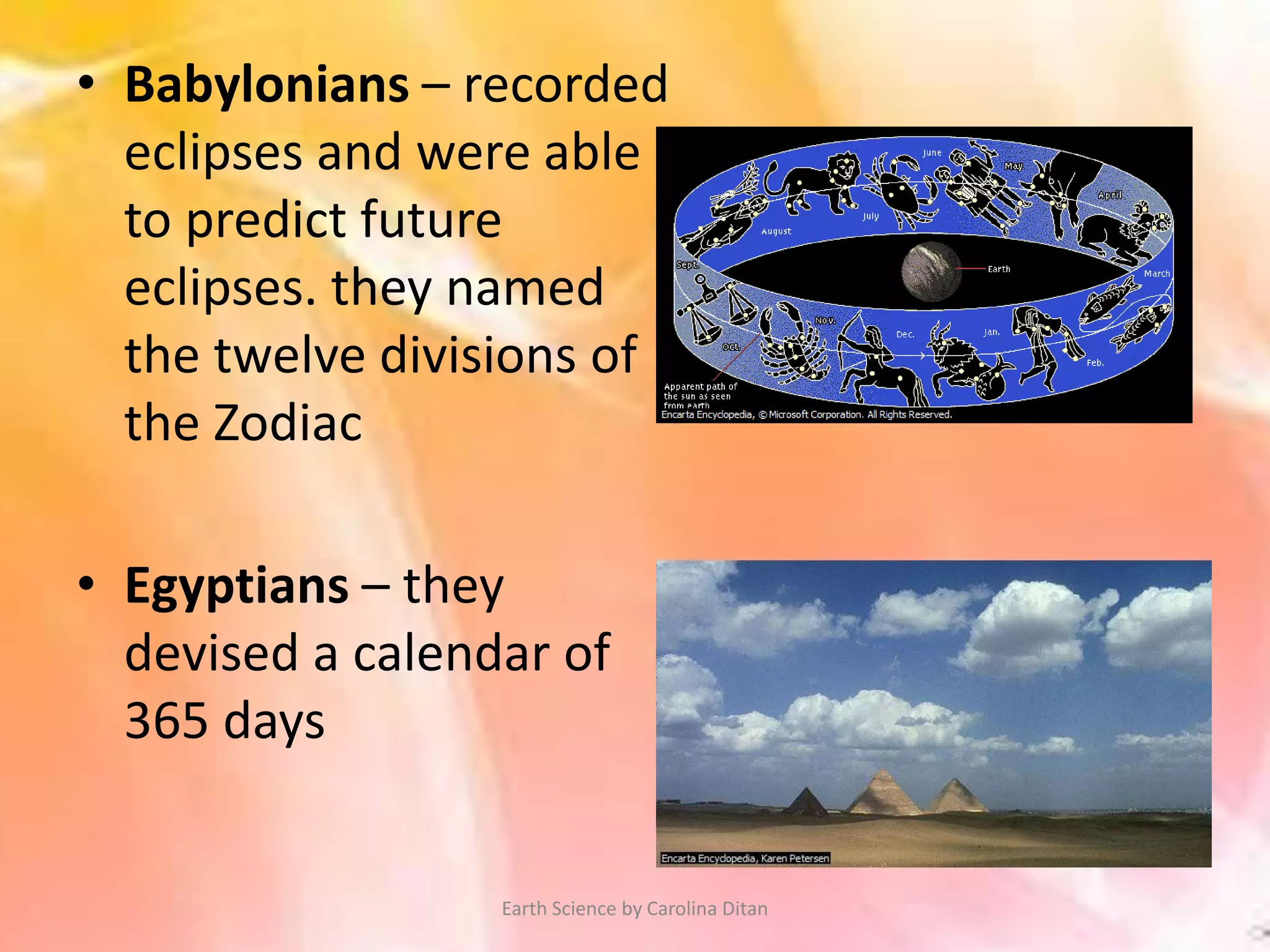
• Babylonians – recorded
eclipses and were able
to predict future
eclipses. they named
the twelve divisions of
the Zodiac
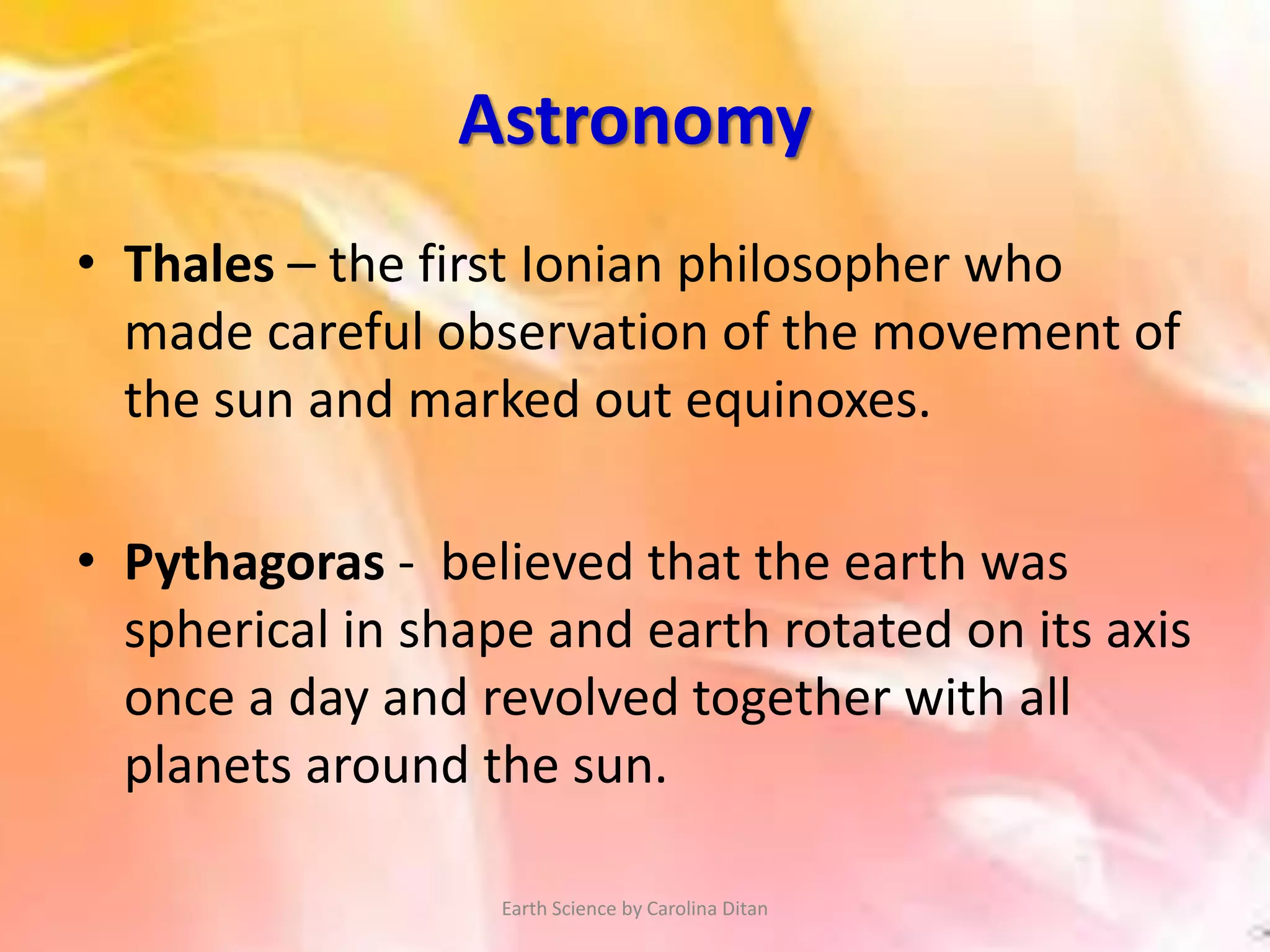
• Egyptians – they
devised a calendar of
365 days
Earth Science by Carolina Ditan
Astronomy
• Thales – the first Ionian philosopher who
made careful observation of the movement of
the sun and marked out equinoxes.
• Pythagoras - believed that the earth was
spherical in shape and earth rotated on its axis
once a day and revolved together with all
planets around the sun.
Earth Science by Carolina Ditan
• Anaxagoras - discovered the cause of the
phases of the moon and observed that the
moon have mountains, valley and plains.
• Eudoxus – believed that earth is the center of
the universe.
• Aristotle – greatest ancient scientist
Earth Science by Carolina Ditan
• Aristharchus - he had accurate understanding
of the arrangement and the movement of the
solar system.
Discovered that the changing seasons are
caused by the earth’s tilted axis and elliptical
orbit around the sun
• Hipparchus – discovered the precession of the
equinoxes.
Earth Science by Carolina Ditan
• Claudius Ptolemy – believed that earth was
the center of the universe and develop the
Geocentric on Ptolemic theory.
• Nicolaus Copernicus – theorized the
heliocentric system in which the planets
moves around the sun. Sun is the center of
the solar system.
• Johannes Kepler – proposed the Planetary
Motions
Earth Science by Carolina Ditan
• Galileo Galilei - discovered telescope. He
used it to discover the ring of the Saturn and 4
moons of the Jupiter.
• Isaac Newton – proposed the Law of
Gravitation
• John Dalton – developed his Atomic theory
Earth Science by Carolina Ditan

Historical background of Earth Science

  • 1.
    Earth Science byCarolina Ditan
  • 2.
    Early Science Stone age(dating back about a million years) Bronze age (dating back about 4,000 B.C.) Dawn of modern western civilization (dating back 200 B.C.) Earth Science by Carolina Ditan
  • 3.
    • Babylonians –recorded eclipses and were able to predict future eclipses. they named the twelve divisions of the Zodiac • Egyptians – they devised a calendar of 365 days Earth Science by Carolina Ditan
  • 4.
    Astronomy • Thales –the first Ionian philosopher who made careful observation of the movement of the sun and marked out equinoxes. • Pythagoras - believed that the earth was spherical in shape and earth rotated on its axis once a day and revolved together with all planets around the sun. Earth Science by Carolina Ditan
  • 5.
    • Anaxagoras -discovered the cause of the phases of the moon and observed that the moon have mountains, valley and plains. • Eudoxus – believed that earth is the center of the universe. • Aristotle – greatest ancient scientist Earth Science by Carolina Ditan
  • 6.
    • Aristharchus -he had accurate understanding of the arrangement and the movement of the solar system. Discovered that the changing seasons are caused by the earth’s tilted axis and elliptical orbit around the sun • Hipparchus – discovered the precession of the equinoxes. Earth Science by Carolina Ditan
  • 7.
    • Claudius Ptolemy– believed that earth was the center of the universe and develop the Geocentric on Ptolemic theory. • Nicolaus Copernicus – theorized the heliocentric system in which the planets moves around the sun. Sun is the center of the solar system. • Johannes Kepler – proposed the Planetary Motions Earth Science by Carolina Ditan
  • 8.
    • Galileo Galilei- discovered telescope. He used it to discover the ring of the Saturn and 4 moons of the Jupiter. • Isaac Newton – proposed the Law of Gravitation • John Dalton – developed his Atomic theory Earth Science by Carolina Ditan

Editor's Notes

  • #5 Ionian- member of any of the Greek peoples who settled on the islands of the Aegean Sea and western shore of Asia Minor toward the end of the second millennium. . Equinoxes – the day when day and night are the same length. (either of the two times each year as about March 21 and September 23 when the sun crosses the equator and day and night are everywhere on earth of approximately equal length.
  • #7 Precession of the equinoxes - slow westward (toward the west) motion of the equinoxes along the ecliptic caused by the gravitational action of sun and moon upon the protuberant (sticking out from a surface usually with a curved or rounded shape: prominent) matter about the earth’s equator.