• K R G E E S _______________________ 1. They are much noted for
their contributions in different fields. They were not only great
philosophers but great scientists and mathematicians as well.
• C I M E L O T P
• L E D O M _______________________ 2. It claims that the planets
moved in a complicated system of circles. This model also became
known as the Ptolemic System.
• T O B A L E
• R O D I H S P E ______________________3. The shape of the Earth. It has
bulging equator and squeezed poles.
• T H O N R
• S R A T _______________________4. It was believed to be in fixed
position in the sky. However, when the Greeks traveled to places nearer the
equator, like Egypt, they noticed that it is closer to the horizon.
• S A R T I T L O E______________________5. A student of Plato and
considered as one of the great philosophers of his time; his earth-centered
view dominated for almost 2,000 years.
• C E I L S P E ______________________6. An astronomical event that
occurs when an astronomical object or spacecraft is temporarily obscured by
passing into the shadow of another body or by having another body pass
between it and the viewer.
• H S A W O D _______________________7. A dark (real image) area where light from
a light source is blocked by an opaque object.
• R A E T O S H T E N S E
• _______________________8. A Greek philosopher who computed the
circumference of the Earth and who gave the most accurate size during their time.
• T R E R G R O D A E
• M O I T O N _______________________9. An apparent change in the movement of
the planet through the sky. It is not real in that the planet does not physically start
moving backwards in its orbit. It just appears to do so because of the relative
positions of the planet and Earth and how they are moving around the Sun.
• W T I N R E
• L O S I C T E S _____________________10. A moment when the Sun's path in the
sky is farthest south in the Northern Hemisphere or farthest north in the Southern
Hemisphere.
• M M U S R E
• L O S I C T E S _____________________11. The longest day of the year. In the
Northern Hemisphere it is in June, while in the Southern Hemisphere it's in
December.
• S H L E O I C E T N R I M
• ______________________12. The astronomical model in which the
Earth and planets revolve around the Sun at the center of the Solar System.
• T R S I M E G O E N C
• _______________________13. Any theory of the structure of the solar system (or the
universe) in which Earth is assumed to be at the center of it all.
• C O L N I U A S
• S C O E P R N I U C
• _______________________14. He considered the sun as the stationery center of the
universe. He classified Earth as a planet just like Mercury, Venus, Mars, Jupiter, and Saturn.
• L L I E A G O
• G I A L I L E ________________________15. He was the greatest Italian scientist of the
Renaissance. Due to the telescope, he was able to discover and observe important astronomical
facts such as lunar craters, the phases of the Venus, the moons of Jupiter, sun spots, and the sizes
of the stars.
ANCIENT ASTRONOMY
• Key Terms
• • Oblate spheroid: the shape of the Earth. It has bulging equator and squeezed
poles.
• • Solstice: either of the two times in the year, the summer solstice and the winter
solstice, when the sun reaches its highest or lowest point in the sky at noon, marked by
the longest and shortest days.
• • Eclipse: an obscuring of the light from one celestial body by the passage of
another between it and the observer or between it and its source of illumination.
• • Heliocentrism: the astronomical model in which the Earth and planets revolve
around the Sun.
• • Geocentrism: any theory of the structure of the solar system (or the universe) in
which Earth is assumed to be at the center of it all.
• Around 500 B.C., most Greeks believed that the Earth was round, not flat. It
was Pythagoras and his pupils who were first to propose a spherical Earth.
• In 500 to 430 B.C., Anaxagoras further supported Pythagoras' proposal
through his observations of the shadows that the Earth cast on the Moon
during a lunar eclipse. He observed that during a lunar eclipse, the Earth's
shadow was reflected on the Moon's surface. The shadow reflected was
circular.
• Around 340 B.C., Aristotle listed several arguments for a spherical Earth
which included the positions of the North Star, the shape of the Moon and
the Sun, and the disappearance of the ships when they sail over the horizon
NORTH STAR
•The North Star was believed to be at a
fixed position in the sky. However, when
the Greeks traveled to places nearer
the equator, like Egypt, they noticed
that the North Star is closer to the
horizon.
• The Shape of the Sun and the Moon
• Aristotle argued that if the Moon and the Sun were both spherical,
then perhaps, the Earth was also spherical.
• Disappearing Ships
• If the Earth was flat, then a ship traveling away from an observer
should become smaller and smaller until it disappeared. However,
the Greeks observed that the ship became smaller and then its
hull disappeared first before the sail as if it was being enveloped
by the water until it completely disappeared.
The Size of the Spherical Earth
• Ancient scholars tried to provide proof of a spherical Earth and its
circumference through calculations. It was Eratosthenes who gave
the most accurate size during their time. While he was working at
the Library of Alexandria in Northern Egypt, he received
correspondence from Syene in Southern Egypt which stated that a
vertical object did not cast any shadow at noontime during the
summer solstice. But this was not the case in Alexandria where, at
noon time during the summer solstice, a vertical object still casts
a shadow. These observations could only mean that the Sun, during
this time in Alexandria, was not directly overhead.
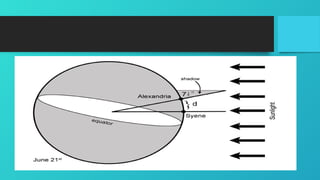
• Eratosthenes then determined the angle the Sun made with the vertical
direction by measuring the shadow that a vertical stick cast. He found out
that in Alexandria, the Sun makes an angle of 7.2° from the vertical while
0° in Syene. To explain the difference, he hypothesized that the light rays
coming from the sun are parallel, and the Earth is curved.
• From his measurements, he computed the circumference of the Earth to
be approximately 250 000 stadia (a stadium is a unit of measurement used
to describe the size of a typical stadium at the time), about 40 000
kilometers.
• Our understanding about the different heavenly bodies can be credited to
the important findings of the following Greek astronomers:
• a.Anaxagoras
• Anaxagoras was able to explain what causes the phases of the moon.
• According to him, the moon shone only by reflected sunlight. Since it is a sphere, only half of
it illuminated at a time. This illuminated part that is visible from the earth changes
periodically.
• b.Eudoxus
• Eudoxus proposed a system of fixed spheres. He believed that the Sun, the moon, the five
known planets and the stars were attached to these spheres which carried the heavenly bodies
while they revolved around the stationary Earth.
• c.Aristotle
• Aristotle was a student of Plato. For him, the earth is spherical in shape since it always casts a
curved shadow when it eclipses the moon. He also believed that the earth was the center of
the universe. The planets and stars were concentric, crystalline spheres centered on the earth.
• d. Aristarchus
• Aristarchus is the very first Greek to profess the heliocentric view. The word helios means sun; centric means centered.
This heliocentric view considered the sun as the center of the universe. He learned that the sun was many time farther
than the moon and that it was much larger than the earth. He also made an attempt to calculate the distance of the sun
and the moon by using geometric principles. He based his calculations on his estimated diameters of the earth and moon,
and expressed distance in terms of diameter. However, the measurements he got were very small and there were a lot of
observational errors.
• e. Eratosthenes
• The first successful attempt to determine the size of the earth was made by him. He did this by applying geometric
principles. He observed the angles of the noonday sun in two Egyptian cities that were almost opposite each other- Syene
(now Aswan) in the south and Alexandria in the north. He assumed they were in the same longitude.
• f. Hipparchus
• Hipparchus is considered as the greatest of the early Greek astronomers. He observed and compared the brightness of 850
stars and arranged them into order of brightness or magnitude.
• He developed a method for predicting the times of lunar eclipses to within a few hours. Aside from this, he also measured
the length of the year to within minutes of the modern value.
• g. Claudius Ptolemy
• He believed that the earth was the center of the universe. His Ptolemic Model claimed that the planets moved in a
complicated system of circles. This geocentric model also became known as the Ptolemic System.
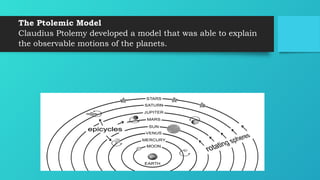
The Ptolemic Model
Claudius Ptolemy developed a model that was able to explain
the observable motions of the planets.
• According to the Ptolemic Mode, the sun, the moon, and the other
planets move in circular orbits around the earth. However, if
observed night after night, these planets move slightly eastward
among the stars. At a certain point, the planet appears to stop
then moves in the opposite direction for some time; after which it
will resume its eartward motion. This westward drift of the
planets is called retrograde motion.
• To justify his earth-centered model using retrograde motion, he
further explained that the planets orbited on small circles, called
epicycles, revolving around large circles called deferents.
Aristotle’s Conclusion
• Aristotle lived in ancient Greece more than three hundred years before the Common Era
(or Before Christ). In those days, most people believed that many gods ruled the universe.
• A happy god, for instance, might allow an abundant harvest while an angry god would
show his fury with storms or earthquakes. Aristotle decided he could understand the world
through observation and by using logic and reason. Later scientists called Aristotle the
Father of Natural Science because centuries after the ancient scholar’s death, his methods
formed the basis of the scientific method.
• Most people in Aristotle’s time believed the earth was flat, but he did not agree. He
studied and used scientific methods to prove that his conclusion was correct. Firstly,
Aristotle considered the position of the North Star. The farther north you journeyed, the
closer the North Star seemed to move to the middle of the sky. But if someone were to
travel south of what we now call the equator, the North Star could not be seen at all. He
also watched ships sailing into port. He noticed that at a distance, he could see the tops
of their sails before he saw the rest of the ship. Aristotle deduced that this was because of
the curvature of the earth. And lastly he observed the shadow cast during eclipses.

drwfsgajngkfghwsbdgfbsjkefhsdvbeksjwfbbn

drwfsgajngkfghwsbdgfbsjkefhsdvbeksjwfbbn

  • 2.
    • K RG E E S _______________________ 1. They are much noted for their contributions in different fields. They were not only great philosophers but great scientists and mathematicians as well. • C I M E L O T P • L E D O M _______________________ 2. It claims that the planets moved in a complicated system of circles. This model also became known as the Ptolemic System. • T O B A L E • R O D I H S P E ______________________3. The shape of the Earth. It has bulging equator and squeezed poles.
  • 3.
    • T HO N R • S R A T _______________________4. It was believed to be in fixed position in the sky. However, when the Greeks traveled to places nearer the equator, like Egypt, they noticed that it is closer to the horizon. • S A R T I T L O E______________________5. A student of Plato and considered as one of the great philosophers of his time; his earth-centered view dominated for almost 2,000 years. • C E I L S P E ______________________6. An astronomical event that occurs when an astronomical object or spacecraft is temporarily obscured by passing into the shadow of another body or by having another body pass between it and the viewer.
  • 4.
    • H SA W O D _______________________7. A dark (real image) area where light from a light source is blocked by an opaque object. • R A E T O S H T E N S E • _______________________8. A Greek philosopher who computed the circumference of the Earth and who gave the most accurate size during their time. • T R E R G R O D A E • M O I T O N _______________________9. An apparent change in the movement of the planet through the sky. It is not real in that the planet does not physically start moving backwards in its orbit. It just appears to do so because of the relative positions of the planet and Earth and how they are moving around the Sun.
  • 5.
    • W TI N R E • L O S I C T E S _____________________10. A moment when the Sun's path in the sky is farthest south in the Northern Hemisphere or farthest north in the Southern Hemisphere. • M M U S R E • L O S I C T E S _____________________11. The longest day of the year. In the Northern Hemisphere it is in June, while in the Southern Hemisphere it's in December. • S H L E O I C E T N R I M • ______________________12. The astronomical model in which the Earth and planets revolve around the Sun at the center of the Solar System.
  • 6.
    • T RS I M E G O E N C • _______________________13. Any theory of the structure of the solar system (or the universe) in which Earth is assumed to be at the center of it all. • C O L N I U A S • S C O E P R N I U C • _______________________14. He considered the sun as the stationery center of the universe. He classified Earth as a planet just like Mercury, Venus, Mars, Jupiter, and Saturn. • L L I E A G O • G I A L I L E ________________________15. He was the greatest Italian scientist of the Renaissance. Due to the telescope, he was able to discover and observe important astronomical facts such as lunar craters, the phases of the Venus, the moons of Jupiter, sun spots, and the sizes of the stars.
  • 7.
    ANCIENT ASTRONOMY • KeyTerms • • Oblate spheroid: the shape of the Earth. It has bulging equator and squeezed poles. • • Solstice: either of the two times in the year, the summer solstice and the winter solstice, when the sun reaches its highest or lowest point in the sky at noon, marked by the longest and shortest days. • • Eclipse: an obscuring of the light from one celestial body by the passage of another between it and the observer or between it and its source of illumination. • • Heliocentrism: the astronomical model in which the Earth and planets revolve around the Sun. • • Geocentrism: any theory of the structure of the solar system (or the universe) in which Earth is assumed to be at the center of it all.
  • 8.
    • Around 500B.C., most Greeks believed that the Earth was round, not flat. It was Pythagoras and his pupils who were first to propose a spherical Earth. • In 500 to 430 B.C., Anaxagoras further supported Pythagoras' proposal through his observations of the shadows that the Earth cast on the Moon during a lunar eclipse. He observed that during a lunar eclipse, the Earth's shadow was reflected on the Moon's surface. The shadow reflected was circular. • Around 340 B.C., Aristotle listed several arguments for a spherical Earth which included the positions of the North Star, the shape of the Moon and the Sun, and the disappearance of the ships when they sail over the horizon
  • 9.
    NORTH STAR •The NorthStar was believed to be at a fixed position in the sky. However, when the Greeks traveled to places nearer the equator, like Egypt, they noticed that the North Star is closer to the horizon.
  • 10.
    • The Shapeof the Sun and the Moon • Aristotle argued that if the Moon and the Sun were both spherical, then perhaps, the Earth was also spherical. • Disappearing Ships • If the Earth was flat, then a ship traveling away from an observer should become smaller and smaller until it disappeared. However, the Greeks observed that the ship became smaller and then its hull disappeared first before the sail as if it was being enveloped by the water until it completely disappeared.
  • 11.
    The Size ofthe Spherical Earth • Ancient scholars tried to provide proof of a spherical Earth and its circumference through calculations. It was Eratosthenes who gave the most accurate size during their time. While he was working at the Library of Alexandria in Northern Egypt, he received correspondence from Syene in Southern Egypt which stated that a vertical object did not cast any shadow at noontime during the summer solstice. But this was not the case in Alexandria where, at noon time during the summer solstice, a vertical object still casts a shadow. These observations could only mean that the Sun, during this time in Alexandria, was not directly overhead.
  • 13.
    • Eratosthenes thendetermined the angle the Sun made with the vertical direction by measuring the shadow that a vertical stick cast. He found out that in Alexandria, the Sun makes an angle of 7.2° from the vertical while 0° in Syene. To explain the difference, he hypothesized that the light rays coming from the sun are parallel, and the Earth is curved. • From his measurements, he computed the circumference of the Earth to be approximately 250 000 stadia (a stadium is a unit of measurement used to describe the size of a typical stadium at the time), about 40 000 kilometers. • Our understanding about the different heavenly bodies can be credited to the important findings of the following Greek astronomers:
  • 14.
    • a.Anaxagoras • Anaxagoraswas able to explain what causes the phases of the moon. • According to him, the moon shone only by reflected sunlight. Since it is a sphere, only half of it illuminated at a time. This illuminated part that is visible from the earth changes periodically. • b.Eudoxus • Eudoxus proposed a system of fixed spheres. He believed that the Sun, the moon, the five known planets and the stars were attached to these spheres which carried the heavenly bodies while they revolved around the stationary Earth. • c.Aristotle • Aristotle was a student of Plato. For him, the earth is spherical in shape since it always casts a curved shadow when it eclipses the moon. He also believed that the earth was the center of the universe. The planets and stars were concentric, crystalline spheres centered on the earth.
  • 15.
    • d. Aristarchus •Aristarchus is the very first Greek to profess the heliocentric view. The word helios means sun; centric means centered. This heliocentric view considered the sun as the center of the universe. He learned that the sun was many time farther than the moon and that it was much larger than the earth. He also made an attempt to calculate the distance of the sun and the moon by using geometric principles. He based his calculations on his estimated diameters of the earth and moon, and expressed distance in terms of diameter. However, the measurements he got were very small and there were a lot of observational errors. • e. Eratosthenes • The first successful attempt to determine the size of the earth was made by him. He did this by applying geometric principles. He observed the angles of the noonday sun in two Egyptian cities that were almost opposite each other- Syene (now Aswan) in the south and Alexandria in the north. He assumed they were in the same longitude. • f. Hipparchus • Hipparchus is considered as the greatest of the early Greek astronomers. He observed and compared the brightness of 850 stars and arranged them into order of brightness or magnitude. • He developed a method for predicting the times of lunar eclipses to within a few hours. Aside from this, he also measured the length of the year to within minutes of the modern value. • g. Claudius Ptolemy • He believed that the earth was the center of the universe. His Ptolemic Model claimed that the planets moved in a complicated system of circles. This geocentric model also became known as the Ptolemic System.
  • 16.
    The Ptolemic Model ClaudiusPtolemy developed a model that was able to explain the observable motions of the planets.
  • 17.
    • According tothe Ptolemic Mode, the sun, the moon, and the other planets move in circular orbits around the earth. However, if observed night after night, these planets move slightly eastward among the stars. At a certain point, the planet appears to stop then moves in the opposite direction for some time; after which it will resume its eartward motion. This westward drift of the planets is called retrograde motion. • To justify his earth-centered model using retrograde motion, he further explained that the planets orbited on small circles, called epicycles, revolving around large circles called deferents.
  • 18.
    Aristotle’s Conclusion • Aristotlelived in ancient Greece more than three hundred years before the Common Era (or Before Christ). In those days, most people believed that many gods ruled the universe. • A happy god, for instance, might allow an abundant harvest while an angry god would show his fury with storms or earthquakes. Aristotle decided he could understand the world through observation and by using logic and reason. Later scientists called Aristotle the Father of Natural Science because centuries after the ancient scholar’s death, his methods formed the basis of the scientific method. • Most people in Aristotle’s time believed the earth was flat, but he did not agree. He studied and used scientific methods to prove that his conclusion was correct. Firstly, Aristotle considered the position of the North Star. The farther north you journeyed, the closer the North Star seemed to move to the middle of the sky. But if someone were to travel south of what we now call the equator, the North Star could not be seen at all. He also watched ships sailing into port. He noticed that at a distance, he could see the tops of their sails before he saw the rest of the ship. Aristotle deduced that this was because of the curvature of the earth. And lastly he observed the shadow cast during eclipses.