Historic Timeline 
Edited 2014. Original presentation developed by 
Kitselas Treaty Office, July 2012
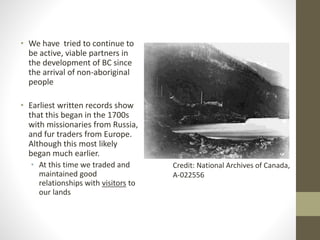
• We have tried to continue to 
be active, viable partners in 
the development of BC since 
the arrival of non-aboriginal 
people 
• Earliest written records show 
that this began in the 1700s 
with missionaries from Russia, 
and fur traders from Europe. 
Although this most likely 
began much earlier. 
• At this time we traded and 
maintained good 
relationships with visitors to 
our lands 
Credit: National Archives of Canada, 
A-022556
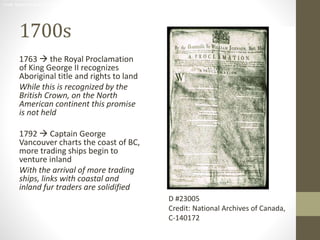
D #23005 
Credit: National Archives of Canada, C-140172 
1700s 
1763  the Royal Proclamation 
of King George II recognizes 
Aboriginal title and rights to land 
While this is recognized by the 
British Crown, on the North 
American continent this promise 
is not held 
1792  Captain George 
Vancouver charts the coast of BC, 
more trading ships begin to 
venture inland 
With the arrival of more trading 
ships, links with coastal and 
inland fur traders are solidified 
D #23005 
Credit: National Archives of Canada, 
C-140172
1800-1850 
1830  aware of the spread of new disease, the HBC begins 
inoculating Native people against smallpox throughout what is 
now known as Canada 
The epidemic reaches BC in the 1860s, thousands die from 
smallpox. 1 in 3 aboriginal people die in the epidemic 
1843  HBC begins laying down boundaries in BC 
This lays the foundation for how land and territories will be 
parceled out to non-aboriginal peoples
1850-1860 
1858  British government passes an act establishing direct rule 
on mainland BC. James Douglas, the first governor of BC, maps 
Indian Reserves 
1859  William Downie claims the Skeena pass in Gitksan 
territory as a route for the Pacific Railroad, soon after more 
extensive exploration begins along the Skeena River 
This railroad corridor is still used today
1860-1900 
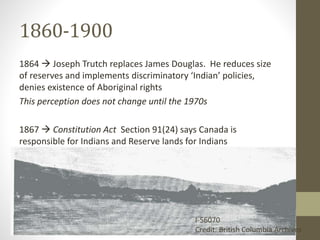
1864  Joseph Trutch replaces James Douglas. He reduces size 
of reserves and implements discriminatory ‘Indian’ policies, 
denies existence of Aboriginal rights 
This perception does not change until the 1970s 
1867  Constitution Act Section 91(24) says Canada is 
responsible for Indians and Reserve lands for Indians 
I-56070 
Credit: British Columbia Archives
1860-1900 
1876  Indian Act imposed 
1880s  Government begins to remove aboriginal children from 
their homes, placing them in Residential Schools 
Schools begin to phase out in the 1960s, the last one closes in the 
1990s
1860-1900 
1884  Parliament outlaws the potlatch, the primary social, 
economic and political express of most Native cultures on the 
Northwest Coast 
1887  Tsimshian and Nisga’a Chiefs travel to Victoria to press 
for treaties and self-government. They are turned away. 
“Since the arrival of the first Europeans in the Nass Valley, the Nisga'a nation has 
attempted to negotiate on numerous occasions and to sign a treaty relating to their land 
claims. In the mid 1880s, aboriginal leaders started making representations to the 
authorities. However, their efforts met with no success for several decades, because the 
leaders at the time refused to recognize the aboriginal titles to the land they were 
claiming” Right Honourable Ghislain Fournier Manicouagan, QC speaking in front of 
Canadian Parliament
1900-1930 
1915  McKenna-McBride Commission re-evaluated reserve 
lands and resulted in significant changes to reserve lands in BC. 
Local First Nations were a part of this Commission making 
passionate pleas to have their lands restored. Their concerns 
were dismissed.
1900-1930 
1927  Canada makes it illegal for Aboriginal people to organize 
to discuss land claims or raise funds to hire a lawyer. Resistance 
moves underground
1931-1950 
1931  Tsimshian and Haida form Native Brotherhood to secretly 
discuss land claims and form protests on fishing, lands, taxation 
and social issues. 
“…we suffer as a minority race and as wards, or minors without a voice in 
regard to our own welfare. We are prisoners of a controlling power in our own 
country – a country which has stood up under the chaos of two world wars, 
beneath the guise of democracy and freedom, yet has enslaved a native people 
in their own home land.” 
~ Jack Beynon, Tsimshian, Port Simpson, 1931 
1949  Native men allowed to vote provincially, native people 
can vote federally in 1960
1950-2000 
1951  Canada amends the Indian Act, removing the anti-potlatch 
and anti-land claims provisions 
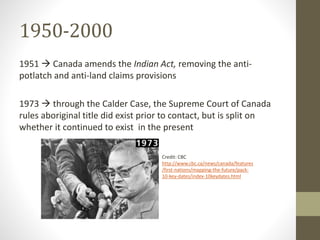
1973  through the Calder Case, the Supreme Court of Canada 
rules aboriginal title did exist prior to contact, but is split on 
whether it continued to exist in the present 
Credit: CBC 
http://www.cbc.ca/news/canada/features 
/first-nations/mapping-the-future/pack- 
10-key-dates/index-10keydates.html
1950-2000 
1982  Constitution Act recognizes and affirms Aboriginal and 
treaty rights 
1984  Tsimshian Tribal Council (TTC) is formed, representing 
the 7 Tsimshian groups in the Northwest 
1990  The 7 Tsimshian groups enter into modern-day treaty 
negotiations 
2004  Tsimshian Tribal Council disbands. Treaty negotiations 
continue with Kitselas, Kitsumkalum, Kitasoo, Hartley Bay and 
Metlakatla as part of the Tsimshian First Nations Treaty Society
The future 
The Tsimshian Nations could have Final Agreements, ushering in 
a new era of political and socioeconomic opportunity free from 
the bounds of the Indian Act

Historic timeline

  • 1.
    Historic Timeline Edited2014. Original presentation developed by Kitselas Treaty Office, July 2012
  • 2.
    • We havetried to continue to be active, viable partners in the development of BC since the arrival of non-aboriginal people • Earliest written records show that this began in the 1700s with missionaries from Russia, and fur traders from Europe. Although this most likely began much earlier. • At this time we traded and maintained good relationships with visitors to our lands Credit: National Archives of Canada, A-022556
  • 3.
    D #23005 Credit:National Archives of Canada, C-140172 1700s 1763  the Royal Proclamation of King George II recognizes Aboriginal title and rights to land While this is recognized by the British Crown, on the North American continent this promise is not held 1792  Captain George Vancouver charts the coast of BC, more trading ships begin to venture inland With the arrival of more trading ships, links with coastal and inland fur traders are solidified D #23005 Credit: National Archives of Canada, C-140172
  • 4.
    1800-1850 1830 aware of the spread of new disease, the HBC begins inoculating Native people against smallpox throughout what is now known as Canada The epidemic reaches BC in the 1860s, thousands die from smallpox. 1 in 3 aboriginal people die in the epidemic 1843  HBC begins laying down boundaries in BC This lays the foundation for how land and territories will be parceled out to non-aboriginal peoples
  • 5.
    1850-1860 1858 British government passes an act establishing direct rule on mainland BC. James Douglas, the first governor of BC, maps Indian Reserves 1859  William Downie claims the Skeena pass in Gitksan territory as a route for the Pacific Railroad, soon after more extensive exploration begins along the Skeena River This railroad corridor is still used today
  • 6.
    1860-1900 1864 Joseph Trutch replaces James Douglas. He reduces size of reserves and implements discriminatory ‘Indian’ policies, denies existence of Aboriginal rights This perception does not change until the 1970s 1867  Constitution Act Section 91(24) says Canada is responsible for Indians and Reserve lands for Indians I-56070 Credit: British Columbia Archives
  • 7.
    1860-1900 1876 Indian Act imposed 1880s  Government begins to remove aboriginal children from their homes, placing them in Residential Schools Schools begin to phase out in the 1960s, the last one closes in the 1990s
  • 8.
    1860-1900 1884 Parliament outlaws the potlatch, the primary social, economic and political express of most Native cultures on the Northwest Coast 1887  Tsimshian and Nisga’a Chiefs travel to Victoria to press for treaties and self-government. They are turned away. “Since the arrival of the first Europeans in the Nass Valley, the Nisga'a nation has attempted to negotiate on numerous occasions and to sign a treaty relating to their land claims. In the mid 1880s, aboriginal leaders started making representations to the authorities. However, their efforts met with no success for several decades, because the leaders at the time refused to recognize the aboriginal titles to the land they were claiming” Right Honourable Ghislain Fournier Manicouagan, QC speaking in front of Canadian Parliament
  • 9.
    1900-1930 1915 McKenna-McBride Commission re-evaluated reserve lands and resulted in significant changes to reserve lands in BC. Local First Nations were a part of this Commission making passionate pleas to have their lands restored. Their concerns were dismissed.
  • 10.
    1900-1930 1927 Canada makes it illegal for Aboriginal people to organize to discuss land claims or raise funds to hire a lawyer. Resistance moves underground
  • 11.
    1931-1950 1931 Tsimshian and Haida form Native Brotherhood to secretly discuss land claims and form protests on fishing, lands, taxation and social issues. “…we suffer as a minority race and as wards, or minors without a voice in regard to our own welfare. We are prisoners of a controlling power in our own country – a country which has stood up under the chaos of two world wars, beneath the guise of democracy and freedom, yet has enslaved a native people in their own home land.” ~ Jack Beynon, Tsimshian, Port Simpson, 1931 1949  Native men allowed to vote provincially, native people can vote federally in 1960
  • 12.
    1950-2000 1951 Canada amends the Indian Act, removing the anti-potlatch and anti-land claims provisions 1973  through the Calder Case, the Supreme Court of Canada rules aboriginal title did exist prior to contact, but is split on whether it continued to exist in the present Credit: CBC http://www.cbc.ca/news/canada/features /first-nations/mapping-the-future/pack- 10-key-dates/index-10keydates.html
  • 13.
    1950-2000 1982 Constitution Act recognizes and affirms Aboriginal and treaty rights 1984  Tsimshian Tribal Council (TTC) is formed, representing the 7 Tsimshian groups in the Northwest 1990  The 7 Tsimshian groups enter into modern-day treaty negotiations 2004  Tsimshian Tribal Council disbands. Treaty negotiations continue with Kitselas, Kitsumkalum, Kitasoo, Hartley Bay and Metlakatla as part of the Tsimshian First Nations Treaty Society
  • 14.
    The future TheTsimshian Nations could have Final Agreements, ushering in a new era of political and socioeconomic opportunity free from the bounds of the Indian Act