Hispanic Health Presentation
February 04, 2014
Purpose and Objectives












The main objective is to approach the target population with CLAS
principals with respect to culturally sensitive care.
CLAS provides effective, equitable, understandable and respectful
quality care and services that are responsive to diverse cultural health
beliefs and practices, preferred languages, health literacy and other
communication needs (CLAS, 2013).
The presentation focuses on health related issues within the
Hispanic/Latino populations
The presentation will give national, state, and city demographical
information about the target population
This project will explore the major religion influence on the
population, most common disease found in the Latino population, and
purposed recommendations to render aid to the affected community.
We will explore alternative healthcare options for Mexican-American
population such as seeking a Curandero or herbal practitioner.
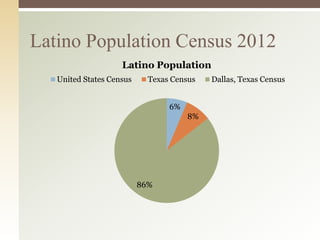
Latino Population Census 2012
Latino Population
United States Census

Texas Census

6%
8%

86%

Dallas, Texas Census
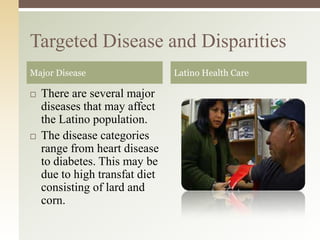
Targeted Disease and Disparities
Major Disease




There are several major
diseases that may affect
the Latino population.
The disease categories
range from heart disease
to diabetes. This may be
due to high transfat diet
consisting of lard and
corn.

Latino Health Care
Major Diseases that Effect Latinos









Coronary Heart Disease
Atherosclerotic risk factors
Chronic Hypertension
Stroke
Diabetes Mellitus Type 2
Cancer Malignances
End stage renal disease
(Talamantes et.al, 2013)
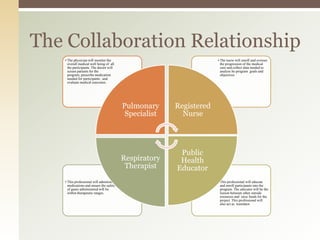
The Collaboration Relationship
• The physician will monitor the
overall medical well being of all
the participants. The doctor will
screen patients for the
program, prescribe medication
needed for participants , and
evaluate medical outcomes.

• The nurse will enroll and oversee
the progression of the medical
care and collect data needed to
analyze he program goals and
objectives.

Pulmonary
Specialist

Respiratory
Therapist
• This professional will administer
medications and ensure the safety
of gases administered will be
within therapeutic ranges.

Registered
Nurse

Public
Health
Educator
• This professional will educate
and enroll participants into the
program. The educator will be the
liaison between other outside
resources and raise funds for the
project. This professional will
also act as translator.
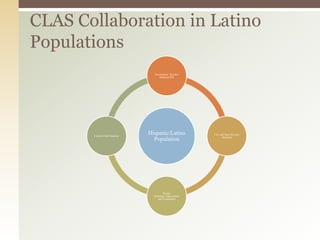
CLAS Collaboration in Latino
Populations
Government Services
Medicare/SSI

Cultural Folk Medicine

Hispanic/Latino
Population

Private
Donation, Endowments
and Foundations

City and State Services
Medicaid
Medical Care Organization






This chart illustrates the chain in which services
are rendered to the patients.
Governmental funded services such as Medicare
and social security insurance provides fee-forservice options for practitioners that care for
elderly citizens.
City and county funded services such as Medicaid
are provided for those residents that cannot afford
conventional care. This program is ran by the state
in which the person is residing.
Medical Care Organization




Private funded donations are usually endowment
funds, charity foundations, or professional
associations. This is an opportunity for the funded
hospital to render paid services to the community
without overhead expense.
Folk medical practitioners are medical practitioners
that will render traditional care services to the
population as an herbal doctor. This person is the link
between God and man (Baldwin, 2013). Health
departments may also educate the practitioner in
reporting disease outbreaks, proper protocol in
treatment of disease, and resource links in referring
the patient to conventional methods.
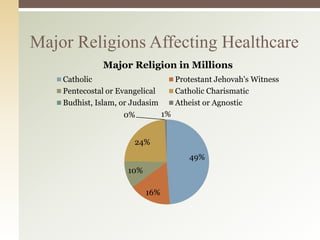
Major Religions Affecting Healthcare
Major Religion in Millions
Catholic
Pentecostal or Evangelical
Budhist, Islam, or Judasim

Protestant Jehovah's Witness
Catholic Charismatic
Atheist or Agnostic
1%

0%
24%

49%
10%
16%
Dietary and Cultural Practices








Traditional dietary practice patterns are influenced by
the country of origin. Many Hispanics maintain their
element of culture and diet (Diet.com, 2014).
Traditional dietary habits may include rice and
beans, fruits, whole milk, and vegetables. Traditional
Hispanic diets will never consist of processed
products such as processed meats (Diet.com, 2014).
Hispanics that migrate to the United States tend to
become acculturated and may develop chronic
diseases such as diabetes and heart disease.
Heart disease and diabetes may be related to the
adoption of American’s fast food processed diet.
Cultural Barriers Affecting Medical
Care






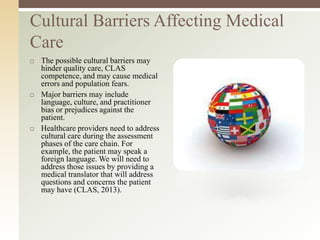
The possible cultural barriers may
hinder quality care, CLAS
competence, and may cause medical
errors and population fears.
Major barriers may include
language, culture, and practitioner
bias or prejudices against the
patient.
Healthcare providers need to address
cultural care during the assessment
phases of the care chain. For
example, the patient may speak a
foreign language. We will need to
address those issues by providing a
medical translator that will address
questions and concerns the patient
may have (CLAS, 2013).
Conventional versus Folk Medicine








Patients that are seeking medical treatment may
face oppositions due to several environmental and
social factors.
Inability to pay for rendered services or elect
private insurance
Undocumented Resident
Unemployment
Inability to communicate with healthcare
practitioners (impending doom).
Conventional versus Folk Medicine






Some undocumented workers may elect to consult a
“Curandero” or a herbal practitioner. This may be the
only option for a population that cannot afford a
degreed practitioner of health.
Most that are employed as “day workers” may be
injured and cannot afford primary care for their
injuries. These action may become fatal if not treated
by a licensed practitioner.
Medical centers must address issues such as proper
self-management treatment to prevent disparities
among the Latino population.
Curanderos “Latin Folk Practitioners”






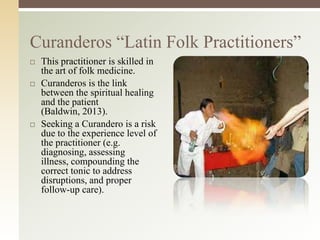
This practitioner is skilled in
the art of folk medicine.
Curanderos is the link
between the spiritual healing
and the patient
(Baldwin, 2013).
Seeking a Curandero is a risk
due to the experience level of
the practitioner (e.g.
diagnosing, assessing
illness, compounding the
correct tonic to address
disruptions, and proper
follow-up care).
Recommendations










In the Latino population there are many that are undocumented
and may contribute to our medical expenditure.
There must be a collaboration with local state and city public
health departments to utilize preventive health education model to
reduce disparities.
Healthcare facilities must collaborate with solid network chain to
carry the load of undocumented charity care.
Undocumented workers tend to ignore symptoms of illness that
can cause prolonged rehabilitation, hospital stays, public health
infections, and even death (Xiung et al, 2012).
We must address healthcare issues such as dietary
habits, environmental contamination, and chronic illness with
cultural sensitive materials to instill trust within the United States
medical system.
Recommendation




I recommend seeking degreed and licensed
herbalist or holistic practitioners for wellness.
In the research, some Hispanics will seek out
alternative therapists. I highly recommend seeking
a Curandero that has experience in
diagnosing, examining and assessing metaphysicalogical demands on the body, dietary
habits, and making sure that he or she is skilled in
follow-up care and can detect limits in practice.
References








Simmons, J. (2013). Seeking a cure for health disparities
among Hispanics, The Hispanic Outlook in Higher
Education 23, 10-13
Perez, A. (2013). Acculturation and illness perception of
hypertension among Hispanic adults, Retrieved from
http://search.proquest.com.ezproxy.liberty.edu:2048/docvi
ew/921483351/abstract?accountid=12085.
Murrary, B. (2013). Latino religion in the United States
demographic shift and trend, San Diego, CA, National
Hispanic Christian Leadership Conference
Xiung, H. S. (2012). Medical Expenditures Associated
with Non-Fatal Occupational Injuries Among Immigrant
and US Born Workers. BMH Public Health , 678.
References








US Census. (2012). State and County quick facts, Retrieved from
http://quickfacts.census.gov/qfd/states/00000.html.
Talamantes, M., Lindeman, R., Mouton, C. (2013).
Enthnogeriatric Curriculum Model Health and Healthcare of
Hispanic/Latino America Elders, Stanford University, Retrieved
from http://www.stanford.edu/group/ethnoger/hispaniclatino.html.
HHS. (2013). The National CLAS Standards, Department of
Health and Human Services of Minority Health, Retrieved from
http://minorityhealth.hhs.gov/templates/browse.aspx?lvl=2&lvlID
=15.
Braxton , M. (2014). Hispanic and Latino Diet, Retrieved from
http://www.diet.com/store/facts/hispanic-and-latino-diet

Hispanic health presentation

  • 1.
  • 2.
    Purpose and Objectives       Themain objective is to approach the target population with CLAS principals with respect to culturally sensitive care. CLAS provides effective, equitable, understandable and respectful quality care and services that are responsive to diverse cultural health beliefs and practices, preferred languages, health literacy and other communication needs (CLAS, 2013). The presentation focuses on health related issues within the Hispanic/Latino populations The presentation will give national, state, and city demographical information about the target population This project will explore the major religion influence on the population, most common disease found in the Latino population, and purposed recommendations to render aid to the affected community. We will explore alternative healthcare options for Mexican-American population such as seeking a Curandero or herbal practitioner.
  • 3.
    Latino Population Census2012 Latino Population United States Census Texas Census 6% 8% 86% Dallas, Texas Census
  • 4.
    Targeted Disease andDisparities Major Disease   There are several major diseases that may affect the Latino population. The disease categories range from heart disease to diabetes. This may be due to high transfat diet consisting of lard and corn. Latino Health Care
  • 5.
    Major Diseases thatEffect Latinos        Coronary Heart Disease Atherosclerotic risk factors Chronic Hypertension Stroke Diabetes Mellitus Type 2 Cancer Malignances End stage renal disease (Talamantes et.al, 2013)
  • 6.
    The Collaboration Relationship •The physician will monitor the overall medical well being of all the participants. The doctor will screen patients for the program, prescribe medication needed for participants , and evaluate medical outcomes. • The nurse will enroll and oversee the progression of the medical care and collect data needed to analyze he program goals and objectives. Pulmonary Specialist Respiratory Therapist • This professional will administer medications and ensure the safety of gases administered will be within therapeutic ranges. Registered Nurse Public Health Educator • This professional will educate and enroll participants into the program. The educator will be the liaison between other outside resources and raise funds for the project. This professional will also act as translator.
  • 7.
    CLAS Collaboration inLatino Populations Government Services Medicare/SSI Cultural Folk Medicine Hispanic/Latino Population Private Donation, Endowments and Foundations City and State Services Medicaid
  • 8.
    Medical Care Organization    Thischart illustrates the chain in which services are rendered to the patients. Governmental funded services such as Medicare and social security insurance provides fee-forservice options for practitioners that care for elderly citizens. City and county funded services such as Medicaid are provided for those residents that cannot afford conventional care. This program is ran by the state in which the person is residing.
  • 9.
    Medical Care Organization   Privatefunded donations are usually endowment funds, charity foundations, or professional associations. This is an opportunity for the funded hospital to render paid services to the community without overhead expense. Folk medical practitioners are medical practitioners that will render traditional care services to the population as an herbal doctor. This person is the link between God and man (Baldwin, 2013). Health departments may also educate the practitioner in reporting disease outbreaks, proper protocol in treatment of disease, and resource links in referring the patient to conventional methods.
  • 10.
    Major Religions AffectingHealthcare Major Religion in Millions Catholic Pentecostal or Evangelical Budhist, Islam, or Judasim Protestant Jehovah's Witness Catholic Charismatic Atheist or Agnostic 1% 0% 24% 49% 10% 16%
  • 11.
    Dietary and CulturalPractices     Traditional dietary practice patterns are influenced by the country of origin. Many Hispanics maintain their element of culture and diet (Diet.com, 2014). Traditional dietary habits may include rice and beans, fruits, whole milk, and vegetables. Traditional Hispanic diets will never consist of processed products such as processed meats (Diet.com, 2014). Hispanics that migrate to the United States tend to become acculturated and may develop chronic diseases such as diabetes and heart disease. Heart disease and diabetes may be related to the adoption of American’s fast food processed diet.
  • 12.
    Cultural Barriers AffectingMedical Care    The possible cultural barriers may hinder quality care, CLAS competence, and may cause medical errors and population fears. Major barriers may include language, culture, and practitioner bias or prejudices against the patient. Healthcare providers need to address cultural care during the assessment phases of the care chain. For example, the patient may speak a foreign language. We will need to address those issues by providing a medical translator that will address questions and concerns the patient may have (CLAS, 2013).
  • 13.
    Conventional versus FolkMedicine      Patients that are seeking medical treatment may face oppositions due to several environmental and social factors. Inability to pay for rendered services or elect private insurance Undocumented Resident Unemployment Inability to communicate with healthcare practitioners (impending doom).
  • 14.
    Conventional versus FolkMedicine    Some undocumented workers may elect to consult a “Curandero” or a herbal practitioner. This may be the only option for a population that cannot afford a degreed practitioner of health. Most that are employed as “day workers” may be injured and cannot afford primary care for their injuries. These action may become fatal if not treated by a licensed practitioner. Medical centers must address issues such as proper self-management treatment to prevent disparities among the Latino population.
  • 15.
    Curanderos “Latin FolkPractitioners”    This practitioner is skilled in the art of folk medicine. Curanderos is the link between the spiritual healing and the patient (Baldwin, 2013). Seeking a Curandero is a risk due to the experience level of the practitioner (e.g. diagnosing, assessing illness, compounding the correct tonic to address disruptions, and proper follow-up care).
  • 16.
    Recommendations      In the Latinopopulation there are many that are undocumented and may contribute to our medical expenditure. There must be a collaboration with local state and city public health departments to utilize preventive health education model to reduce disparities. Healthcare facilities must collaborate with solid network chain to carry the load of undocumented charity care. Undocumented workers tend to ignore symptoms of illness that can cause prolonged rehabilitation, hospital stays, public health infections, and even death (Xiung et al, 2012). We must address healthcare issues such as dietary habits, environmental contamination, and chronic illness with cultural sensitive materials to instill trust within the United States medical system.
  • 17.
    Recommendation   I recommend seekingdegreed and licensed herbalist or holistic practitioners for wellness. In the research, some Hispanics will seek out alternative therapists. I highly recommend seeking a Curandero that has experience in diagnosing, examining and assessing metaphysicalogical demands on the body, dietary habits, and making sure that he or she is skilled in follow-up care and can detect limits in practice.
  • 18.
    References     Simmons, J. (2013).Seeking a cure for health disparities among Hispanics, The Hispanic Outlook in Higher Education 23, 10-13 Perez, A. (2013). Acculturation and illness perception of hypertension among Hispanic adults, Retrieved from http://search.proquest.com.ezproxy.liberty.edu:2048/docvi ew/921483351/abstract?accountid=12085. Murrary, B. (2013). Latino religion in the United States demographic shift and trend, San Diego, CA, National Hispanic Christian Leadership Conference Xiung, H. S. (2012). Medical Expenditures Associated with Non-Fatal Occupational Injuries Among Immigrant and US Born Workers. BMH Public Health , 678.
  • 19.
    References     US Census. (2012).State and County quick facts, Retrieved from http://quickfacts.census.gov/qfd/states/00000.html. Talamantes, M., Lindeman, R., Mouton, C. (2013). Enthnogeriatric Curriculum Model Health and Healthcare of Hispanic/Latino America Elders, Stanford University, Retrieved from http://www.stanford.edu/group/ethnoger/hispaniclatino.html. HHS. (2013). The National CLAS Standards, Department of Health and Human Services of Minority Health, Retrieved from http://minorityhealth.hhs.gov/templates/browse.aspx?lvl=2&lvlID =15. Braxton , M. (2014). Hispanic and Latino Diet, Retrieved from http://www.diet.com/store/facts/hispanic-and-latino-diet

Editor's Notes

  • #4 The population statistics were taken from the United States Census Bureau (US Census, 2012)
  • #8 Chain of continue services within the cultural sensitive population.