Polypharmacy Prevention in
Older Adults over 60
Anthony Wallace
Doctor of Public Health
Master of Human Services – Health and Wellness
Presentation Contents
• The purpose for the project
• The goal/objectives
• Population description
• The intervention
• The outcomes
• The recommendations
• Questions and Answers Session
The Purpose
• The purpose of the project is to discover the gaps within the present
intervention and discover new evidence based practices in efforts to
improve continued participation in the HomeMeds program. The
present service gaps that are present are significant and may be due
to the lack of volunteers.
• By using HomeMeds, we wanted to asses the scope in which this
technological intervention is able to use the START and STOPP
method within outpatient older population.
• At the end of the study, we are hoping that the START and STOPP
method used in the HomeMeds program will become an effective
tool in preventing polypharmacy in older American populations.
What is Polypharmacy?
According to Lim, McStea, Ching,
Azmi, and Aziz (2017), polypharmacy
is a common feature of hospitalized
older adults, and its often
considered a marker of disease
severity and clinical complexity.
Polypharmacy was defined as the
concurrent use of five (5) or more
medications. These include
prescription, non-prescribed, and
over-the-counter medications
including dietary supplements such
as vitamins, minerals, herbals, and
other botanicals.
Goals and Objectives
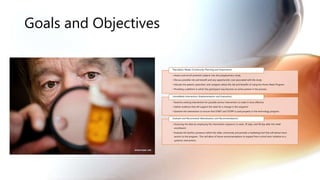
• Assess and enroll potential subjects into the polypharmacy study
• Discuss possible risk and benefit and any opportunistic cost associated with the study
• Educate the patient, prescriber, and caregiver about the risk and benefits of using the Home Meds Program.
• Providing a platform in which the participant may become an active partner in the process.
Population Needs (Community Planning and Assessment)
• Examine existing intervention for possible service intervention to make it more effective
• Gather evidence that will support the need for a change in the sequence
• Examine the intervention to ensure that START and STOPP is used properly in the technology program.
HomeMeds Intervention (Implementation and Evaluation)
• Assessing the data by employing the intervention sequence (1 week, 30 days, and 60 day after the initial
enrollment)
• Evaluate the facility’s presence within the older community and provide a marketing tool that will attract more
seniors to the program. This will allow of future recommendations to expand from a short term initiative to a
systemic intervention.
Evaluate and Recommend (Reevaluation and Recommendation)
The Study Population
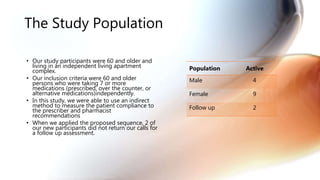
Population Active
Male 4
Female 9
Follow up 2
• Our study participants were 60 and older and
living in an independent living apartment
complex.
• Our inclusion criteria were 60 and older
persons who were taking 7 or more
medications (prescribed, over the counter, or
alternative medications)independently.
• In this study, we were able to use an indirect
method to measure the patient compliance to
the prescriber and pharmacist
recommendations
• When we applied the proposed sequence, 2 of
our new participants did not return our calls for
a follow up assessment.
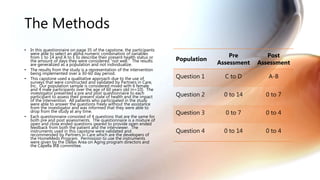
The Methods
Population
Pre
Assessment
Post
Assessment
Question 1 C to D A-B
Question 2 0 to 14 0 to 7
Question 3 0 to 7 0 to 4
Question 4 0 to 14 0 to 4
• In this questionnaire on page 35 of the capstone, the participants
were able to select an alpha numeric combination of variables
from 1 to 14 and A to E to describe their present health status or
the amount of days they were considered “not well.” The results
are generalized as a population and not individualize.
• The results from the study is a representation of the intervention
being implemented over a 30-60 day period.
• This capstone used a qualitative approach due to the use of
surveys that were constructed and validated by Partners in Care,
Inc. Our population sample is considered mixed with 6 female
and 4 male participants over the age of 60 years old (n=10). The
investigator presented a pre and post questionnaire to each
participant to assess their present state of health and the impact
of the intervention. All patients who participated in the study
were able to answer the questions freely without the assistance
from the investigator and was informed that they were able to
drop from the study at any time.
• Each questionnaire consisted of 4 questions that are the same for
both pre and post assessments. The questionnaire is a mixture of
open and close ended questions geared to provide open ended
feedback from both the patient and the interviewer. The
instruments used in this capstone were validated and
recommended by Partners in Care which are the developers of
the HomeMeds Program. Permission to use the instruments
were given by the Dallas Area on Aging program directors and
the Capella IRB committee.
The Intervention
• The HomeMeds medication alert system was used for
this project as an assessment tool for researchers and
healthcare professionals to assess potentially dangerous
medication interferences. The objective was to get as
much data from the patients such as the types of
medications they are presently taking, the frequency or
duration, and the mode in which they are taking their
medications i.e. mouth, rectal, transdermal.
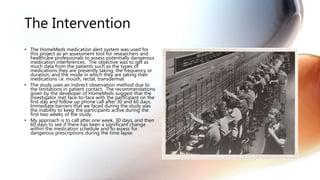
• The study uses an indirect observation method due to
the limitations in patient contact. The recommendations
given by the developer of HomeMeds suggest that the
investigator met face-to-face with the participant on the
first day and follow up phone call after 30 and 60 days.
Immediate barriers that we faced during the study was
the inability to keep the participants active during the
first two weeks of the study.
• My approach is to call after one week, 30 days, and then
60 days to see if there has been a significant change
within the medication schedule and to assess for
dangerous prescriptions during the time lapse.
Outcomes
• Out of the 11 patients that were able included in our
study more than half the number of days of
discomfort were less than 7 rather than 14 days
during the post-test. Also, more than 90% of the
participants reported that their general health is
either excellent or very good as compared to the pre-
test good or fair. The study objectives were met due
to the significant improvement in the health status of
each patient.
• The assessment instruments used provided a distinct
picture of how the health status of each patient
changed during and after the study. The goal was to
formulate an intervention that was evidence-based
proven to promote health in the elderly population
by educating the patient about potentially dangerous
cocktails located in their medicine cabinet. The
questionnaire also allowed the patient to discover
how many physicians were recommending treatment
for managing chronic disease symptoms but not
curing the disease itself. According to the results
from the post-study survey, patients reported an
overall general health improvement by 10.0% from
the pre-survey during the 30 days review period.
Recommendations
• After conducting the study, it is recommended that the hosting
organization conduct frequent phone calls to the participants after
enrollment. This will allow the participant to ask questions and
update their medication record. This recommendation will also
provide more data when evaluating the HomeMeds program for
effectiveness in the future. The recommendation may even boost the
facility motto “self-empowerment”.
• It is recommended that after initial enrollment, the staff must contact
the participants in the following sequence one week after, 30 days,
and 60 days. This will allow for the participants to become
empowered in advocating for themselves as well as receive the
support needed from the consulting health professional to guide
them in the deprescription process.
Questions and Answer
Dr. Anthony Wallace
Linkedin Profile
https://www.linkedin.com/i
n/dr-anthony-wallace-
drph-m-a-bsc-lcdc-i-rrs-
22999531/.

PolyPharmacy Prevention in Older Populations

  • 1.
    Polypharmacy Prevention in OlderAdults over 60 Anthony Wallace Doctor of Public Health Master of Human Services – Health and Wellness
  • 2.
    Presentation Contents • Thepurpose for the project • The goal/objectives • Population description • The intervention • The outcomes • The recommendations • Questions and Answers Session
  • 3.
    The Purpose • Thepurpose of the project is to discover the gaps within the present intervention and discover new evidence based practices in efforts to improve continued participation in the HomeMeds program. The present service gaps that are present are significant and may be due to the lack of volunteers. • By using HomeMeds, we wanted to asses the scope in which this technological intervention is able to use the START and STOPP method within outpatient older population. • At the end of the study, we are hoping that the START and STOPP method used in the HomeMeds program will become an effective tool in preventing polypharmacy in older American populations.
  • 4.
    What is Polypharmacy? Accordingto Lim, McStea, Ching, Azmi, and Aziz (2017), polypharmacy is a common feature of hospitalized older adults, and its often considered a marker of disease severity and clinical complexity. Polypharmacy was defined as the concurrent use of five (5) or more medications. These include prescription, non-prescribed, and over-the-counter medications including dietary supplements such as vitamins, minerals, herbals, and other botanicals.
  • 5.
    Goals and Objectives •Assess and enroll potential subjects into the polypharmacy study • Discuss possible risk and benefit and any opportunistic cost associated with the study • Educate the patient, prescriber, and caregiver about the risk and benefits of using the Home Meds Program. • Providing a platform in which the participant may become an active partner in the process. Population Needs (Community Planning and Assessment) • Examine existing intervention for possible service intervention to make it more effective • Gather evidence that will support the need for a change in the sequence • Examine the intervention to ensure that START and STOPP is used properly in the technology program. HomeMeds Intervention (Implementation and Evaluation) • Assessing the data by employing the intervention sequence (1 week, 30 days, and 60 day after the initial enrollment) • Evaluate the facility’s presence within the older community and provide a marketing tool that will attract more seniors to the program. This will allow of future recommendations to expand from a short term initiative to a systemic intervention. Evaluate and Recommend (Reevaluation and Recommendation)
  • 6.
    The Study Population PopulationActive Male 4 Female 9 Follow up 2 • Our study participants were 60 and older and living in an independent living apartment complex. • Our inclusion criteria were 60 and older persons who were taking 7 or more medications (prescribed, over the counter, or alternative medications)independently. • In this study, we were able to use an indirect method to measure the patient compliance to the prescriber and pharmacist recommendations • When we applied the proposed sequence, 2 of our new participants did not return our calls for a follow up assessment.
  • 7.
    The Methods Population Pre Assessment Post Assessment Question 1C to D A-B Question 2 0 to 14 0 to 7 Question 3 0 to 7 0 to 4 Question 4 0 to 14 0 to 4 • In this questionnaire on page 35 of the capstone, the participants were able to select an alpha numeric combination of variables from 1 to 14 and A to E to describe their present health status or the amount of days they were considered “not well.” The results are generalized as a population and not individualize. • The results from the study is a representation of the intervention being implemented over a 30-60 day period. • This capstone used a qualitative approach due to the use of surveys that were constructed and validated by Partners in Care, Inc. Our population sample is considered mixed with 6 female and 4 male participants over the age of 60 years old (n=10). The investigator presented a pre and post questionnaire to each participant to assess their present state of health and the impact of the intervention. All patients who participated in the study were able to answer the questions freely without the assistance from the investigator and was informed that they were able to drop from the study at any time. • Each questionnaire consisted of 4 questions that are the same for both pre and post assessments. The questionnaire is a mixture of open and close ended questions geared to provide open ended feedback from both the patient and the interviewer. The instruments used in this capstone were validated and recommended by Partners in Care which are the developers of the HomeMeds Program. Permission to use the instruments were given by the Dallas Area on Aging program directors and the Capella IRB committee.
  • 8.
    The Intervention • TheHomeMeds medication alert system was used for this project as an assessment tool for researchers and healthcare professionals to assess potentially dangerous medication interferences. The objective was to get as much data from the patients such as the types of medications they are presently taking, the frequency or duration, and the mode in which they are taking their medications i.e. mouth, rectal, transdermal. • The study uses an indirect observation method due to the limitations in patient contact. The recommendations given by the developer of HomeMeds suggest that the investigator met face-to-face with the participant on the first day and follow up phone call after 30 and 60 days. Immediate barriers that we faced during the study was the inability to keep the participants active during the first two weeks of the study. • My approach is to call after one week, 30 days, and then 60 days to see if there has been a significant change within the medication schedule and to assess for dangerous prescriptions during the time lapse.
  • 9.
    Outcomes • Out ofthe 11 patients that were able included in our study more than half the number of days of discomfort were less than 7 rather than 14 days during the post-test. Also, more than 90% of the participants reported that their general health is either excellent or very good as compared to the pre- test good or fair. The study objectives were met due to the significant improvement in the health status of each patient. • The assessment instruments used provided a distinct picture of how the health status of each patient changed during and after the study. The goal was to formulate an intervention that was evidence-based proven to promote health in the elderly population by educating the patient about potentially dangerous cocktails located in their medicine cabinet. The questionnaire also allowed the patient to discover how many physicians were recommending treatment for managing chronic disease symptoms but not curing the disease itself. According to the results from the post-study survey, patients reported an overall general health improvement by 10.0% from the pre-survey during the 30 days review period.
  • 10.
    Recommendations • After conductingthe study, it is recommended that the hosting organization conduct frequent phone calls to the participants after enrollment. This will allow the participant to ask questions and update their medication record. This recommendation will also provide more data when evaluating the HomeMeds program for effectiveness in the future. The recommendation may even boost the facility motto “self-empowerment”. • It is recommended that after initial enrollment, the staff must contact the participants in the following sequence one week after, 30 days, and 60 days. This will allow for the participants to become empowered in advocating for themselves as well as receive the support needed from the consulting health professional to guide them in the deprescription process.
  • 11.
    Questions and Answer Dr.Anthony Wallace Linkedin Profile https://www.linkedin.com/i n/dr-anthony-wallace- drph-m-a-bsc-lcdc-i-rrs- 22999531/.