CLUSTER PRESENTATION
1
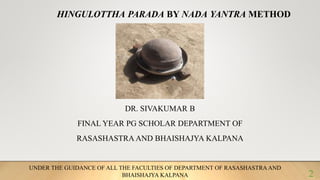
HINGULOTTHA PARADA BY NADA YANTRA METHOD
DR. SIVAKUMAR B
FINAL YEAR PG SCHOLAR DEPARTMENT OF
RASASHASTRA AND BHAISHAJYA KALPANA
UNDER THE GUIDANCE OF ALL THE FACULTIES OF DEPARTMENT OF RASASHASTRA AND
BHAISHAJYA KALPANA 2
INTRODUCTION
• Shodhita Parada is one of the essential component of Rasaushadhis mentioned in
Rasashastra classics. The Ayurvedic literature claimed that Parada would be used for
medicinal purposes only after Samanya Shodhana and Ashtasamskaras.
• The Samanya Shodhana and Ashtasamskaras of Parada is a tedious and expensive
procedure.
• To overcome these drawbacks, the Acharyas of Rasashastra preferred using Hingulottha
Parada. That is Parada extracted from Shodhita Hingula, which is said to be equally
potent as Ashta Samskarita Parada.
• In this study, an attempt has been made to extract Parada from processed Hingula
through Nada Yantra method (Kanduka Yantra Method).
3
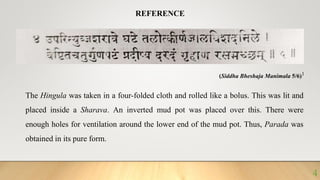
(Siddha Bheshaja Manimala 5/6)1
REFERENCE
The Hingula was taken in a four-folded cloth and rolled like a bolus. This was lit and
placed inside a Sharava. An inverted mud pot was placed over this. There were
enough holes for ventilation around the lower end of the mud pot. Thus, Parada was
obtained in its pure form.
4
MATERIAL AND METHOD
EQUIPMENTS
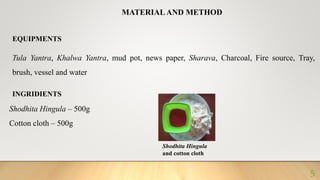
Tula Yantra, Khalwa Yantra, mud pot, news paper, Sharava, Charcoal, Fire source, Tray,
brush, vessel and water
INGRIDIENTS
Shodhita Hingula – 500g
Cotton cloth – 500g
Shodhita Hingula
and cotton cloth
5
METHOD OF PREPARATION
PURVA KARMA
Purification of raw Hingula2
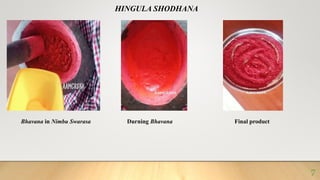
The fine powder of Hingula was made using a mortar and pestle. This powder was then
levigated (Bhavana) with Nimbu Swarasa (lemon juice) seven times and allowed to dry.
The product obtained after drying is called Shodhita Hingula (purified cinnabar).
6
Bhavana in Nimbu Swarasa Durning Bhavana Final product
HINGULA SHODHANA
7
PRADHANA KARMA
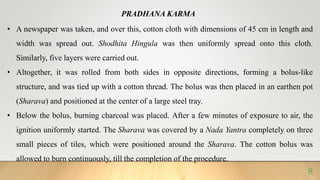
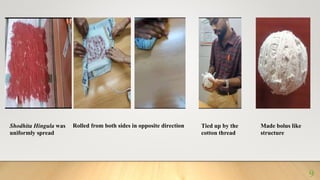
• A newspaper was taken, and over this, cotton cloth with dimensions of 45 cm in length and
width was spread out. Shodhita Hingula was then uniformly spread onto this cloth.
Similarly, five layers were carried out.
• Altogether, it was rolled from both sides in opposite directions, forming a bolus-like
structure, and was tied up with a cotton thread. The bolus was then placed in an earthen pot
(Sharava) and positioned at the center of a large steel tray.
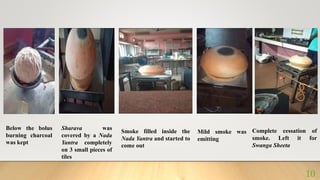
• Below the bolus, burning charcoal was placed. After a few minutes of exposure to air, the
ignition uniformly started. The Sharava was covered by a Nada Yantra completely on three
small pieces of tiles, which were positioned around the Sharava. The cotton bolus was
allowed to burn continuously, till the completion of the procedure.
8
Shodhita Hingula was
uniformly spread
Rolled from both sides in opposite direction Tied up by the
cotton thread
Made bolus like
structure
9
Below the bolus
burning charcoal
was kept
Sharava was
covered by a Nada
Yantra completely
on 3 small pieces of
tiles
Smoke filled inside the
Nada Yantra and started to
come out
Mild smoke was
emitting
Complete cessation of
smoke. Left it for
Swanga Sheeta
10
PASCHAT KARMA
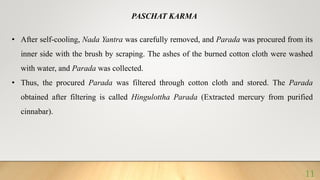
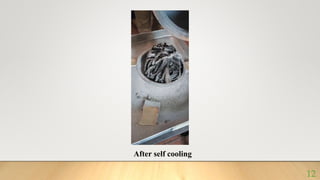
• After self-cooling, Nada Yantra was carefully removed, and Parada was procured from its
inner side with the brush by scraping. The ashes of the burned cotton cloth were washed
with water, and Parada was collected.
• Thus, the procured Parada was filtered through cotton cloth and stored. The Parada
obtained after filtering is called Hingulottha Parada (Extracted mercury from purified
cinnabar).
11
After self cooling
12
OBSERVATIONS
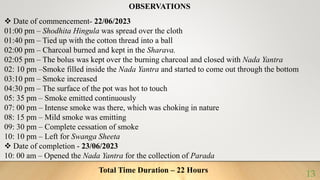
 Date of commencement- 22/06/2023
01:00 pm – Shodhita Hingula was spread over the cloth
01:40 pm – Tied up with the cotton thread into a ball
02:00 pm – Charcoal burned and kept in the Sharava.
02:05 pm – The bolus was kept over the burning charcoal and closed with Nada Yantra
02: 10 pm –Smoke filled inside the Nada Yantra and started to come out through the bottom
03:10 pm – Smoke increased
04:30 pm – The surface of the pot was hot to touch
05: 35 pm – Smoke emitted continuously
07: 00 pm – Intense smoke was there, which was choking in nature
08: 15 pm – Mild smoke was emitting
09: 30 pm – Complete cessation of smoke
10: 10 pm – Left for Swanga Sheeta
 Date of completion - 23/06/2023
10: 00 am – Opened the Nada Yantra for the collection of Parada
Total Time Duration – 22 Hours
13
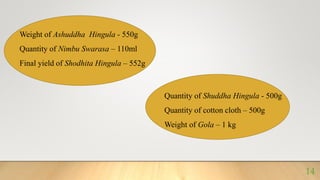
Weight of Ashuddha Hingula - 550g
Quantity of Nimbu Swarasa – 110ml
Final yield of Shodhita Hingula – 552g
Quantity of Shuddha Hingula - 500g
Quantity of cotton cloth – 500g
Weight of Gola – 1 kg
14
RESULT
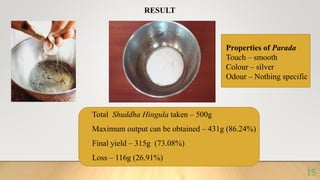
Total Shuddha Hingula taken – 500g
Maximum output can be obtained – 431g (86.24%)
Final yield – 315g (73.08%)
Loss – 116g (26.91%)
15
Properties of Parada
Touch – smooth
Colour – silver
Odour – Nothing specific
DISCUSSION
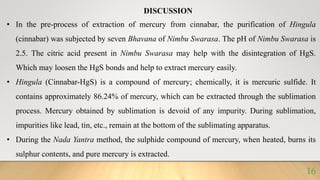
• In the pre-process of extraction of mercury from cinnabar, the purification of Hingula
(cinnabar) was subjected by seven Bhavana of Nimbu Swarasa. The pH of Nimbu Swarasa is
2.5. The citric acid present in Nimbu Swarasa may help with the disintegration of HgS.
Which may loosen the HgS bonds and help to extract mercury easily.
• Hingula (Cinnabar-HgS) is a compound of mercury; chemically, it is mercuric sulfide. It
contains approximately 86.24% of mercury, which can be extracted through the sublimation
process. Mercury obtained by sublimation is devoid of any impurity. During sublimation,
impurities like lead, tin, etc., remain at the bottom of the sublimating apparatus.
• During the Nada Yantra method, the sulphide compound of mercury, when heated, burns its
sulphur contents, and pure mercury is extracted.
16
• Shuddha Hingula was spread over the cotton cloth and the weight of cotton cloth
should be equal to that of Hingula. The idea behind this may be providing
sufficient fuel needed to produce heat for the complete extraction of Parada.
• The Parada collects on the inner surface of Nada Yantra which was collected by
scraping.
• Vapors of mercury and sulfur also escape during the process, which may cause
choking. Hence, the procedure should be done in the open air, and precautions
should be taken by using a mask and wearing gloves.
17
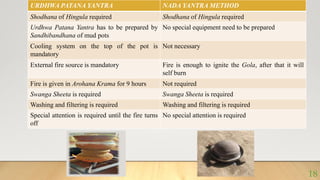
URDHWA PATANA YANTRA NADA YANTRA METHOD
Shodhana of Hingula required Shodhana of Hingula required
Urdhwa Patana Yantra has to be prepared by
Sandhibandhana of mud pots
No special equipment need to be prepared
Cooling system on the top of the pot is
mandatory
Not necessary
External fire source is mandatory Fire is enough to ignite the Gola, after that it will
self burn
Fire is given in Arohana Krama for 9 hours Not required
Swanga Sheeta is required Swanga Sheeta is required
Washing and filtering is required Washing and filtering is required
Special attention is required until the fire turns
off
No special attention is required
18
CONCLUSION
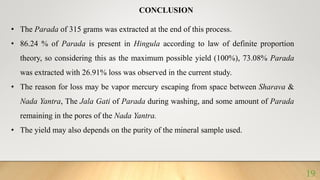
• The Parada of 315 grams was extracted at the end of this process.
• 86.24 % of Parada is present in Hingula according to law of definite proportion
theory, so considering this as the maximum possible yield (100%), 73.08% Parada
was extracted with 26.91% loss was observed in the current study.
• The reason for loss may be vapor mercury escaping from space between Sharava &
Nada Yantra, The Jala Gati of Parada during washing, and some amount of Parada
remaining in the pores of the Nada Yantra.
• The yield may also depends on the purity of the mineral sample used.
19
RESEARCH UPDATE
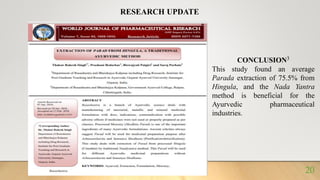
CONCLUSION3
This study found an average
Parada extraction of 75.5% from
Hingula, and the Nada Yantra
method is beneficial for the
Ayurvedic pharmaceutical
industries.
20
1. Bhatta K. R., Siddha Bhaishajya Manimala, Bhatta R. K., Hindi commentary, Krishna Das Academy, Varanasi, 199,
Page no 356.
2. Sadanand Sharma, Rasatarangini, with Prasadanee Vyakhya of Haridutta Shastri and Hindi commentary by
Ayurvedacharya Pandit Dharmananda Shastri. Eleventh Edition: 1979, Reprint: 2009, Motilal Banarasidas, Delhi, Page
no 202.
3. Rakesh et al., Extraction Of Parad From Hingula, A Traditional Ayurvedic Method, World Journal of Pharmaceutical
Research, Volume 7, Issue 05 Page no 1026-1032. [cited on 08/11/2023]
REFERENCE
21
22

Hingulotha Parada extraction by Nadayantra .pptx

  • 1.
  • 2.
    HINGULOTTHA PARADA BYNADA YANTRA METHOD DR. SIVAKUMAR B FINAL YEAR PG SCHOLAR DEPARTMENT OF RASASHASTRA AND BHAISHAJYA KALPANA UNDER THE GUIDANCE OF ALL THE FACULTIES OF DEPARTMENT OF RASASHASTRA AND BHAISHAJYA KALPANA 2
  • 3.
    INTRODUCTION • Shodhita Paradais one of the essential component of Rasaushadhis mentioned in Rasashastra classics. The Ayurvedic literature claimed that Parada would be used for medicinal purposes only after Samanya Shodhana and Ashtasamskaras. • The Samanya Shodhana and Ashtasamskaras of Parada is a tedious and expensive procedure. • To overcome these drawbacks, the Acharyas of Rasashastra preferred using Hingulottha Parada. That is Parada extracted from Shodhita Hingula, which is said to be equally potent as Ashta Samskarita Parada. • In this study, an attempt has been made to extract Parada from processed Hingula through Nada Yantra method (Kanduka Yantra Method). 3
  • 4.
    (Siddha Bheshaja Manimala5/6)1 REFERENCE The Hingula was taken in a four-folded cloth and rolled like a bolus. This was lit and placed inside a Sharava. An inverted mud pot was placed over this. There were enough holes for ventilation around the lower end of the mud pot. Thus, Parada was obtained in its pure form. 4
  • 5.
    MATERIAL AND METHOD EQUIPMENTS TulaYantra, Khalwa Yantra, mud pot, news paper, Sharava, Charcoal, Fire source, Tray, brush, vessel and water INGRIDIENTS Shodhita Hingula – 500g Cotton cloth – 500g Shodhita Hingula and cotton cloth 5
  • 6.
    METHOD OF PREPARATION PURVAKARMA Purification of raw Hingula2 The fine powder of Hingula was made using a mortar and pestle. This powder was then levigated (Bhavana) with Nimbu Swarasa (lemon juice) seven times and allowed to dry. The product obtained after drying is called Shodhita Hingula (purified cinnabar). 6
  • 7.
    Bhavana in NimbuSwarasa Durning Bhavana Final product HINGULA SHODHANA 7
  • 8.
    PRADHANA KARMA • Anewspaper was taken, and over this, cotton cloth with dimensions of 45 cm in length and width was spread out. Shodhita Hingula was then uniformly spread onto this cloth. Similarly, five layers were carried out. • Altogether, it was rolled from both sides in opposite directions, forming a bolus-like structure, and was tied up with a cotton thread. The bolus was then placed in an earthen pot (Sharava) and positioned at the center of a large steel tray. • Below the bolus, burning charcoal was placed. After a few minutes of exposure to air, the ignition uniformly started. The Sharava was covered by a Nada Yantra completely on three small pieces of tiles, which were positioned around the Sharava. The cotton bolus was allowed to burn continuously, till the completion of the procedure. 8
  • 9.
    Shodhita Hingula was uniformlyspread Rolled from both sides in opposite direction Tied up by the cotton thread Made bolus like structure 9
  • 10.
    Below the bolus burningcharcoal was kept Sharava was covered by a Nada Yantra completely on 3 small pieces of tiles Smoke filled inside the Nada Yantra and started to come out Mild smoke was emitting Complete cessation of smoke. Left it for Swanga Sheeta 10
  • 11.
    PASCHAT KARMA • Afterself-cooling, Nada Yantra was carefully removed, and Parada was procured from its inner side with the brush by scraping. The ashes of the burned cotton cloth were washed with water, and Parada was collected. • Thus, the procured Parada was filtered through cotton cloth and stored. The Parada obtained after filtering is called Hingulottha Parada (Extracted mercury from purified cinnabar). 11
  • 12.
  • 13.
    OBSERVATIONS  Date ofcommencement- 22/06/2023 01:00 pm – Shodhita Hingula was spread over the cloth 01:40 pm – Tied up with the cotton thread into a ball 02:00 pm – Charcoal burned and kept in the Sharava. 02:05 pm – The bolus was kept over the burning charcoal and closed with Nada Yantra 02: 10 pm –Smoke filled inside the Nada Yantra and started to come out through the bottom 03:10 pm – Smoke increased 04:30 pm – The surface of the pot was hot to touch 05: 35 pm – Smoke emitted continuously 07: 00 pm – Intense smoke was there, which was choking in nature 08: 15 pm – Mild smoke was emitting 09: 30 pm – Complete cessation of smoke 10: 10 pm – Left for Swanga Sheeta  Date of completion - 23/06/2023 10: 00 am – Opened the Nada Yantra for the collection of Parada Total Time Duration – 22 Hours 13
  • 14.
    Weight of AshuddhaHingula - 550g Quantity of Nimbu Swarasa – 110ml Final yield of Shodhita Hingula – 552g Quantity of Shuddha Hingula - 500g Quantity of cotton cloth – 500g Weight of Gola – 1 kg 14
  • 15.
    RESULT Total Shuddha Hingulataken – 500g Maximum output can be obtained – 431g (86.24%) Final yield – 315g (73.08%) Loss – 116g (26.91%) 15 Properties of Parada Touch – smooth Colour – silver Odour – Nothing specific
  • 16.
    DISCUSSION • In thepre-process of extraction of mercury from cinnabar, the purification of Hingula (cinnabar) was subjected by seven Bhavana of Nimbu Swarasa. The pH of Nimbu Swarasa is 2.5. The citric acid present in Nimbu Swarasa may help with the disintegration of HgS. Which may loosen the HgS bonds and help to extract mercury easily. • Hingula (Cinnabar-HgS) is a compound of mercury; chemically, it is mercuric sulfide. It contains approximately 86.24% of mercury, which can be extracted through the sublimation process. Mercury obtained by sublimation is devoid of any impurity. During sublimation, impurities like lead, tin, etc., remain at the bottom of the sublimating apparatus. • During the Nada Yantra method, the sulphide compound of mercury, when heated, burns its sulphur contents, and pure mercury is extracted. 16
  • 17.
    • Shuddha Hingulawas spread over the cotton cloth and the weight of cotton cloth should be equal to that of Hingula. The idea behind this may be providing sufficient fuel needed to produce heat for the complete extraction of Parada. • The Parada collects on the inner surface of Nada Yantra which was collected by scraping. • Vapors of mercury and sulfur also escape during the process, which may cause choking. Hence, the procedure should be done in the open air, and precautions should be taken by using a mask and wearing gloves. 17
  • 18.
    URDHWA PATANA YANTRANADA YANTRA METHOD Shodhana of Hingula required Shodhana of Hingula required Urdhwa Patana Yantra has to be prepared by Sandhibandhana of mud pots No special equipment need to be prepared Cooling system on the top of the pot is mandatory Not necessary External fire source is mandatory Fire is enough to ignite the Gola, after that it will self burn Fire is given in Arohana Krama for 9 hours Not required Swanga Sheeta is required Swanga Sheeta is required Washing and filtering is required Washing and filtering is required Special attention is required until the fire turns off No special attention is required 18
  • 19.
    CONCLUSION • The Paradaof 315 grams was extracted at the end of this process. • 86.24 % of Parada is present in Hingula according to law of definite proportion theory, so considering this as the maximum possible yield (100%), 73.08% Parada was extracted with 26.91% loss was observed in the current study. • The reason for loss may be vapor mercury escaping from space between Sharava & Nada Yantra, The Jala Gati of Parada during washing, and some amount of Parada remaining in the pores of the Nada Yantra. • The yield may also depends on the purity of the mineral sample used. 19
  • 20.
    RESEARCH UPDATE CONCLUSION3 This studyfound an average Parada extraction of 75.5% from Hingula, and the Nada Yantra method is beneficial for the Ayurvedic pharmaceutical industries. 20
  • 21.
    1. Bhatta K.R., Siddha Bhaishajya Manimala, Bhatta R. K., Hindi commentary, Krishna Das Academy, Varanasi, 199, Page no 356. 2. Sadanand Sharma, Rasatarangini, with Prasadanee Vyakhya of Haridutta Shastri and Hindi commentary by Ayurvedacharya Pandit Dharmananda Shastri. Eleventh Edition: 1979, Reprint: 2009, Motilal Banarasidas, Delhi, Page no 202. 3. Rakesh et al., Extraction Of Parad From Hingula, A Traditional Ayurvedic Method, World Journal of Pharmaceutical Research, Volume 7, Issue 05 Page no 1026-1032. [cited on 08/11/2023] REFERENCE 21
  • 22.