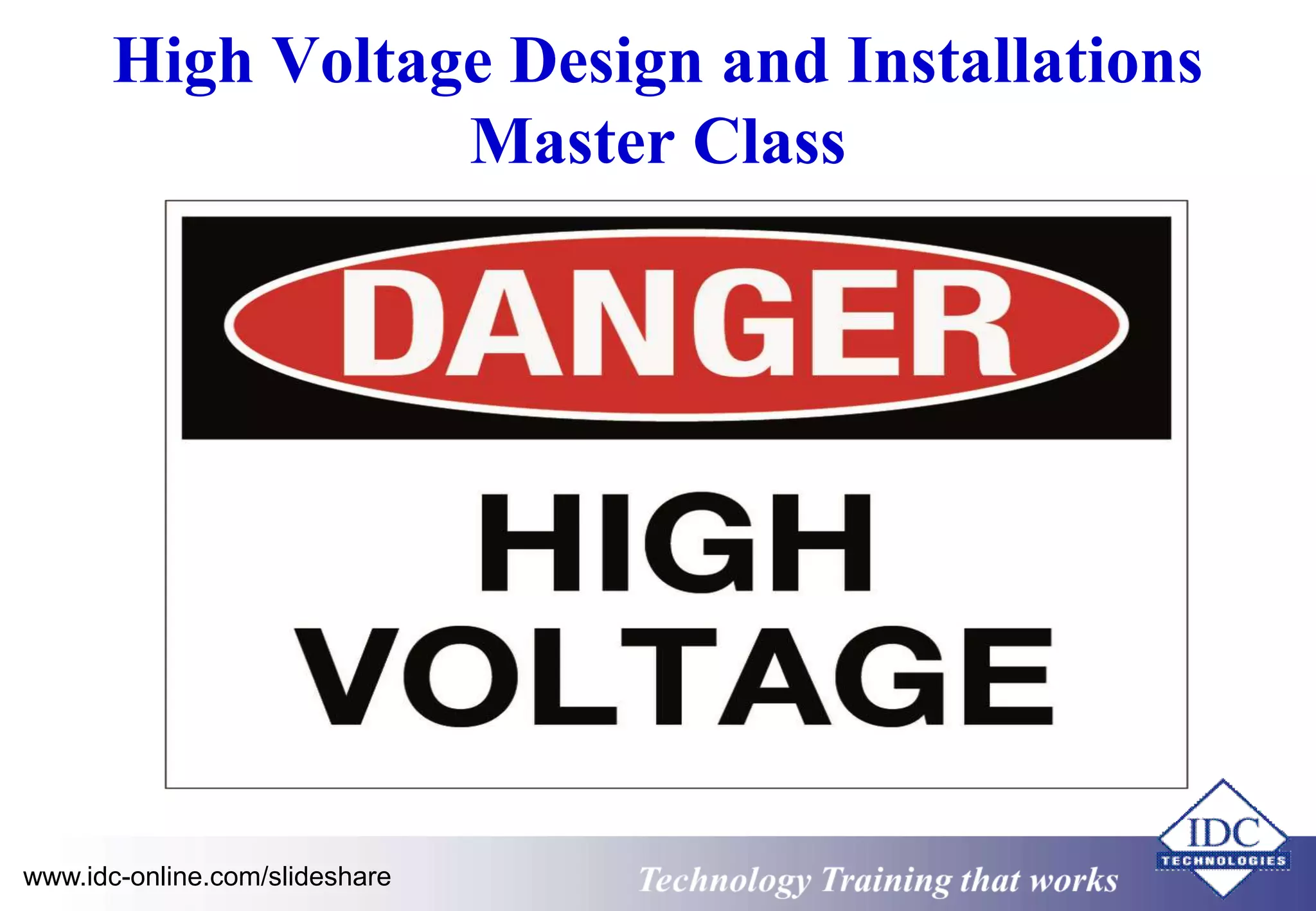
High Voltage Design and Installations 
Master Class 
www.idc-online.com/slideshare TTeecchhnnoollooggyy TTrraaiinniinngg tthhaatt Wwoorrkkss
HV Installations 
• This workshop refers to all installations operating in 
excess of 1 kV a.c. 
• In some countries certain facilities may be subject to 
additional legislation e.g. mines and quarries. 
www.idc-online.com/slideshare TTeecchhnnoollooggyy TTrraaiinniinngg tthhaatt Wwoorrkkss
Fundamental requirements 
• Installations, equipment must be capable of withstanding 
electrical, mechanical stresses, together with climatic, 
environmental impacts anticipated on site 
• Installations, equipment must identify safety requirements to 
be met for levels of segregation 
• Installations must be designed, constructed, erected to safely 
withstand mechanical, thermal effects resulting from short-circuit 
currents 
• Sets mandatory structural requirements 
• Sets mandatory climatic and environmental requirements 
www.idc-online.com/slideshare TTeecchhnnoollooggyy TTrraaiinniinngg tthhaatt Wwoorrkkss
Equipment 
• Covers specific primary equipment selection requirements 
• Includes circuit breakers, disconnectors, power transformers, 
reactors, gas insulated switchgear (GIS), CTs, VTs, surge 
arresters, and capacitor banks 
• Power transformers, and HV switchgear and control gear - 
relevant standards contain additional detailed requirements 
• Additional specific requirements for cables 
• Overhead lines shall comply with C(b)1 
www.idc-online.com/slideshare TTeecchhnnoollooggyy TTrraaiinniinngg tthhaatt Wwoorrkkss
Installation 
• General requirements for circuit arrangement, circuit 
documentation, lighting, operational safety and labelling 
• Specific requirements for open type indoor, outdoor 
installations 
• Specific requirements for indoor switchboard installations 
• Specific requirements for buildings including prefabricated 
substations, installations on mast, pole or tower 
• Contains drawings of operational application of safety 
clearances 
www.idc-online.com/slideshare TTeecchhnnoollooggyy TTrraaiinniinngg tthhaatt Wwoorrkkss
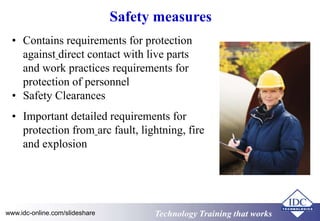
Safety measures 
• Contains requirements for protection 
against direct contact with live parts 
and work practices requirements for 
protection of personnel 
• Safety Clearances 
• Important detailed requirements for 
protection from arc fault, lightning, fire 
and explosion 
www.idc-online.com/slideshare TTeecchhnnoollooggyy TTrraaiinniinngg tthhaatt Wwoorrkkss
Earthing systems 
• Design, installation, testing and maintenance of earthing 
system should be such, that it operates under all conditions 
and ensures acceptable safety compliance in any place to 
which persons have legitimate access 
• Provides criteria to ensure that integrity of equipment 
connected and in proximity to earthing system is maintained 
www.idc-online.com/slideshare TTeecchhnnoollooggyy TTrraaiinniinngg tthhaatt Wwoorrkkss
Earthing - Safety criteria 
• Shock hazard to human beings - Current that is sufficient to 
cause ventricular fibrillation flowing through region of the 
heart 
• Current limit, for power-frequency purposes, shall be derived 
from IEC 60479 , BS EN 60479 etc 
• For HV installation design, this current limit should be 
translated into voltage limits for comparison with calculated 
step and touch voltages, taking into account impedance 
present in body current path 
www.idc-online.com/slideshare TTeecchhnnoollooggyy TTrraaiinniinngg tthhaatt Wwoorrkkss
Earthing - Safety voltage limits 
• Shall take into account following factors: 
– Proportion of current flowing through region of heart (based on Heart 
Current Factor, IEC 60479); 
– Permissible ventricular fibrillation (based on IEC 60479) 
– Body impedance along current path (based on IEC 60479) 
– Resistance between body contact points (e.g. metal structure to hand 
including glove, feet to ground including shoes/gravel) 
– Fault duration 
– Probability of fault occurrence, presence of human beings in location 
where they will be exposed to voltage 
www.idc-online.com/slideshare TTeecchhnnoollooggyy TTrraaiinniinngg tthhaatt Wwoorrkkss
Insulation co-ordination 
• Insulation coordination shall be in accordance with IEC 
60071 “Insulation Coordination” 
• However, Basic Impulse Level (BIL) co-ordination is 
difficult to inspect 
• Insulation strength must be co-ordinated to withstand 
lightning and switching impulse level 
• Must have a co-ordinated BIL - Power transformers, earthing 
compensators, circuit breakers, CTs, VTs, cables, cable 
joints, cable sealing ends 
www.idc-online.com/slideshare TTeecchhnnoollooggyy TTrraaiinniinngg tthhaatt Wwoorrkkss
Insulation co-ordination 
• Process of determining proper insulation levels of various 
components in power system and their arrangements 
• Selection of insulation structure that will withstand voltage 
stresses to which system/equipment will be imposed to, 
together with proper surge arrester 
• Process is determined from known characteristics of voltage 
surges and characteristics of surge arresters 
www.idc-online.com/slideshare TTeecchhnnoollooggyy TTrraaiinniinngg tthhaatt Wwoorrkkss
Basic insulation level (BIL) 
• Insulation strength of equipment (transformers, circuit breakers, etc.) 
should be higher than that of lightning arresters, other surge protective 
devices 
• To protect equipment from overvoltages, necessary to fix insulation 
level for system so that no insulation should break down or flash over 
below this level 
• Reference insulation level expressed as impulse crest (or peak) voltage 
with standard wave not longer than 1.2 x 50 ɥsec wave 
• Impulse takes 1.2 μsec to reach peak and then decays to 50% of peak in 
50 μsec 
www.idc-online.com/slideshare TTeecchhnnoollooggyy TTrraaiinniinngg tthhaatt Wwoorrkkss
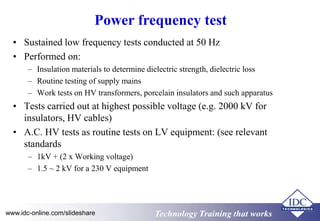
Power frequency test 
• Sustained low frequency tests conducted at 50 Hz 
• Performed on: 
– Insulation materials to determine dielectric strength, dielectric loss 
– Routine testing of supply mains 
– Work tests on HV transformers, porcelain insulators and such apparatus 
• Tests carried out at highest possible voltage (e.g. 2000 kV for 
insulators, HV cables) 
• A.C. HV tests as routine tests on LV equipment: (see relevant 
standards 
– 1kV + (2 x Working voltage) 
– 1.5 ~ 2 kV for a 230 V equipment 
www.idc-online.com/slideshare TTeecchhnnoollooggyy TTrraaiinniinngg tthhaatt Wwoorrkkss
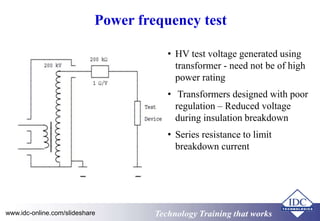
Power frequency test 
• HV test voltage generated using 
transformer - need not be of high 
power rating 
• Transformers designed with poor 
regulation – Reduced voltage 
during insulation breakdown 
• Series resistance to limit 
breakdown current 
www.idc-online.com/slideshare TTeecchhnnoollooggyy TTrraaiinniinngg tthhaatt Wwoorrkkss
Typical Scope of Standards 
High voltage installation 
• Electricity network substation, under control of electricity network 
operator or entity authorised by license/other legal instrument to convey 
electricity 
• High voltage parts of electrical installation of power station including 
all auxiliary systems, interconnecting lines, cables between power 
stations, if on same site 
• High voltage parts of electrical installation not covered in (a) and (b) 
above. May include but not limited to consumer and customer 
electrical installations serving premises such as factories, commercial 
facilities, industrial plants, institutional facilities and mine sites” 
www.idc-online.com/slideshare TTeecchhnnoollooggyy TTrraaiinniinngg tthhaatt Wwoorrkkss
Typical Scope & Definitions 
• AS 2067 refers to mine site electrical installations by 
exception; Standard applies to mine site electrical 
installations, parts of such installations for which mining 
specific legislation does not set other or additional 
requirements 
• AS 2067 contains mandatory requirements for Western 
Australian mine sites as per “Mines Safety and Inspection 
Regulations” 1995 r. 5.3 
www.idc-online.com/slideshare TTeecchhnnoollooggyy TTrraaiinniinngg tthhaatt Wwoorrkkss
AS 2067- Exclusions 
• AS 2067 does not apply to design, erection of any of following: 
– Overhead lines, underground cables between separate installations 
(Dealt with in AS/NZS 7000) 
– Ship and offshore installations 
– Mine site electrical installations, parts of such installations (Fixed 
infrastructure compliant with AS/NZS 3000 covered by AS 2067) 
– Switchgear and/or transformers and/or electrical equipment located 
within closed electrical operating area supplied at LV and where 
contact cannot be made with HV conductors. 
(e.g. X-ray equipment) 
– Test sites 
www.idc-online.com/slideshare TTeecchhnnoollooggyy TTrraaiinniinngg tthhaatt Wwoorrkkss
AS 2067- Status 
• AS 2067:2008 “Substations and high voltage installations exceeding 
1kV A.C.” (replacing AS 2067:1984 “Switchgear assemblies and 
ancillary equipment for alternating voltages above 1kV”) 
• Amendment 1 of AS 2067:2008 published in 2010 
• Project approved by Standards Australia to review AS2067 – 
commenced in 2012 
– Sub-committees have been established to consider: 
 Earthing of installations 
 Arc flash hazards of electrical installations 
www.idc-online.com/slideshare TTeecchhnnoollooggyy TTrraaiinniinngg tthhaatt Wwoorrkkss
DO YOU WANT TO KNOW MORE? 
If you are interested in further training or information, please 
visit: 
http://idc-online.com/slideshare 
www.idc-online.com/slideshare TTeecchhnnoollooggyy TTrraaiinniinngg tthhaatt Wwoorrkkss

High Voltage Design and Installations Master Class

  • 1.
    High Voltage Designand Installations Master Class www.idc-online.com/slideshare TTeecchhnnoollooggyy TTrraaiinniinngg tthhaatt Wwoorrkkss
  • 2.
    HV Installations •This workshop refers to all installations operating in excess of 1 kV a.c. • In some countries certain facilities may be subject to additional legislation e.g. mines and quarries. www.idc-online.com/slideshare TTeecchhnnoollooggyy TTrraaiinniinngg tthhaatt Wwoorrkkss
  • 3.
    Fundamental requirements •Installations, equipment must be capable of withstanding electrical, mechanical stresses, together with climatic, environmental impacts anticipated on site • Installations, equipment must identify safety requirements to be met for levels of segregation • Installations must be designed, constructed, erected to safely withstand mechanical, thermal effects resulting from short-circuit currents • Sets mandatory structural requirements • Sets mandatory climatic and environmental requirements www.idc-online.com/slideshare TTeecchhnnoollooggyy TTrraaiinniinngg tthhaatt Wwoorrkkss
  • 4.
    Equipment • Coversspecific primary equipment selection requirements • Includes circuit breakers, disconnectors, power transformers, reactors, gas insulated switchgear (GIS), CTs, VTs, surge arresters, and capacitor banks • Power transformers, and HV switchgear and control gear - relevant standards contain additional detailed requirements • Additional specific requirements for cables • Overhead lines shall comply with C(b)1 www.idc-online.com/slideshare TTeecchhnnoollooggyy TTrraaiinniinngg tthhaatt Wwoorrkkss
  • 5.
    Installation • Generalrequirements for circuit arrangement, circuit documentation, lighting, operational safety and labelling • Specific requirements for open type indoor, outdoor installations • Specific requirements for indoor switchboard installations • Specific requirements for buildings including prefabricated substations, installations on mast, pole or tower • Contains drawings of operational application of safety clearances www.idc-online.com/slideshare TTeecchhnnoollooggyy TTrraaiinniinngg tthhaatt Wwoorrkkss
  • 6.
    Safety measures •Contains requirements for protection against direct contact with live parts and work practices requirements for protection of personnel • Safety Clearances • Important detailed requirements for protection from arc fault, lightning, fire and explosion www.idc-online.com/slideshare TTeecchhnnoollooggyy TTrraaiinniinngg tthhaatt Wwoorrkkss
  • 7.
    Earthing systems •Design, installation, testing and maintenance of earthing system should be such, that it operates under all conditions and ensures acceptable safety compliance in any place to which persons have legitimate access • Provides criteria to ensure that integrity of equipment connected and in proximity to earthing system is maintained www.idc-online.com/slideshare TTeecchhnnoollooggyy TTrraaiinniinngg tthhaatt Wwoorrkkss
  • 8.
    Earthing - Safetycriteria • Shock hazard to human beings - Current that is sufficient to cause ventricular fibrillation flowing through region of the heart • Current limit, for power-frequency purposes, shall be derived from IEC 60479 , BS EN 60479 etc • For HV installation design, this current limit should be translated into voltage limits for comparison with calculated step and touch voltages, taking into account impedance present in body current path www.idc-online.com/slideshare TTeecchhnnoollooggyy TTrraaiinniinngg tthhaatt Wwoorrkkss
  • 9.
    Earthing - Safetyvoltage limits • Shall take into account following factors: – Proportion of current flowing through region of heart (based on Heart Current Factor, IEC 60479); – Permissible ventricular fibrillation (based on IEC 60479) – Body impedance along current path (based on IEC 60479) – Resistance between body contact points (e.g. metal structure to hand including glove, feet to ground including shoes/gravel) – Fault duration – Probability of fault occurrence, presence of human beings in location where they will be exposed to voltage www.idc-online.com/slideshare TTeecchhnnoollooggyy TTrraaiinniinngg tthhaatt Wwoorrkkss
  • 10.
    Insulation co-ordination •Insulation coordination shall be in accordance with IEC 60071 “Insulation Coordination” • However, Basic Impulse Level (BIL) co-ordination is difficult to inspect • Insulation strength must be co-ordinated to withstand lightning and switching impulse level • Must have a co-ordinated BIL - Power transformers, earthing compensators, circuit breakers, CTs, VTs, cables, cable joints, cable sealing ends www.idc-online.com/slideshare TTeecchhnnoollooggyy TTrraaiinniinngg tthhaatt Wwoorrkkss
  • 11.
    Insulation co-ordination •Process of determining proper insulation levels of various components in power system and their arrangements • Selection of insulation structure that will withstand voltage stresses to which system/equipment will be imposed to, together with proper surge arrester • Process is determined from known characteristics of voltage surges and characteristics of surge arresters www.idc-online.com/slideshare TTeecchhnnoollooggyy TTrraaiinniinngg tthhaatt Wwoorrkkss
  • 12.
    Basic insulation level(BIL) • Insulation strength of equipment (transformers, circuit breakers, etc.) should be higher than that of lightning arresters, other surge protective devices • To protect equipment from overvoltages, necessary to fix insulation level for system so that no insulation should break down or flash over below this level • Reference insulation level expressed as impulse crest (or peak) voltage with standard wave not longer than 1.2 x 50 ɥsec wave • Impulse takes 1.2 μsec to reach peak and then decays to 50% of peak in 50 μsec www.idc-online.com/slideshare TTeecchhnnoollooggyy TTrraaiinniinngg tthhaatt Wwoorrkkss
  • 13.
    Power frequency test • Sustained low frequency tests conducted at 50 Hz • Performed on: – Insulation materials to determine dielectric strength, dielectric loss – Routine testing of supply mains – Work tests on HV transformers, porcelain insulators and such apparatus • Tests carried out at highest possible voltage (e.g. 2000 kV for insulators, HV cables) • A.C. HV tests as routine tests on LV equipment: (see relevant standards – 1kV + (2 x Working voltage) – 1.5 ~ 2 kV for a 230 V equipment www.idc-online.com/slideshare TTeecchhnnoollooggyy TTrraaiinniinngg tthhaatt Wwoorrkkss
  • 14.
    Power frequency test • HV test voltage generated using transformer - need not be of high power rating • Transformers designed with poor regulation – Reduced voltage during insulation breakdown • Series resistance to limit breakdown current www.idc-online.com/slideshare TTeecchhnnoollooggyy TTrraaiinniinngg tthhaatt Wwoorrkkss
  • 15.
    Typical Scope ofStandards High voltage installation • Electricity network substation, under control of electricity network operator or entity authorised by license/other legal instrument to convey electricity • High voltage parts of electrical installation of power station including all auxiliary systems, interconnecting lines, cables between power stations, if on same site • High voltage parts of electrical installation not covered in (a) and (b) above. May include but not limited to consumer and customer electrical installations serving premises such as factories, commercial facilities, industrial plants, institutional facilities and mine sites” www.idc-online.com/slideshare TTeecchhnnoollooggyy TTrraaiinniinngg tthhaatt Wwoorrkkss
  • 16.
    Typical Scope &Definitions • AS 2067 refers to mine site electrical installations by exception; Standard applies to mine site electrical installations, parts of such installations for which mining specific legislation does not set other or additional requirements • AS 2067 contains mandatory requirements for Western Australian mine sites as per “Mines Safety and Inspection Regulations” 1995 r. 5.3 www.idc-online.com/slideshare TTeecchhnnoollooggyy TTrraaiinniinngg tthhaatt Wwoorrkkss
  • 17.
    AS 2067- Exclusions • AS 2067 does not apply to design, erection of any of following: – Overhead lines, underground cables between separate installations (Dealt with in AS/NZS 7000) – Ship and offshore installations – Mine site electrical installations, parts of such installations (Fixed infrastructure compliant with AS/NZS 3000 covered by AS 2067) – Switchgear and/or transformers and/or electrical equipment located within closed electrical operating area supplied at LV and where contact cannot be made with HV conductors. (e.g. X-ray equipment) – Test sites www.idc-online.com/slideshare TTeecchhnnoollooggyy TTrraaiinniinngg tthhaatt Wwoorrkkss
  • 18.
    AS 2067- Status • AS 2067:2008 “Substations and high voltage installations exceeding 1kV A.C.” (replacing AS 2067:1984 “Switchgear assemblies and ancillary equipment for alternating voltages above 1kV”) • Amendment 1 of AS 2067:2008 published in 2010 • Project approved by Standards Australia to review AS2067 – commenced in 2012 – Sub-committees have been established to consider:  Earthing of installations  Arc flash hazards of electrical installations www.idc-online.com/slideshare TTeecchhnnoollooggyy TTrraaiinniinngg tthhaatt Wwoorrkkss
  • 19.
    DO YOU WANTTO KNOW MORE? If you are interested in further training or information, please visit: http://idc-online.com/slideshare www.idc-online.com/slideshare TTeecchhnnoollooggyy TTrraaiinniinngg tthhaatt Wwoorrkkss