Which of the following social customsWhich of the following social customs
are similar or different to yourare similar or different to your
country?country?
The English are said to be reserved inThe English are said to be reserved in
manners, dress and speech. We aremanners, dress and speech. We are
famous for our politeness, self-disciplinefamous for our politeness, self-discipline
and especially for our sense of humour.and especially for our sense of humour.
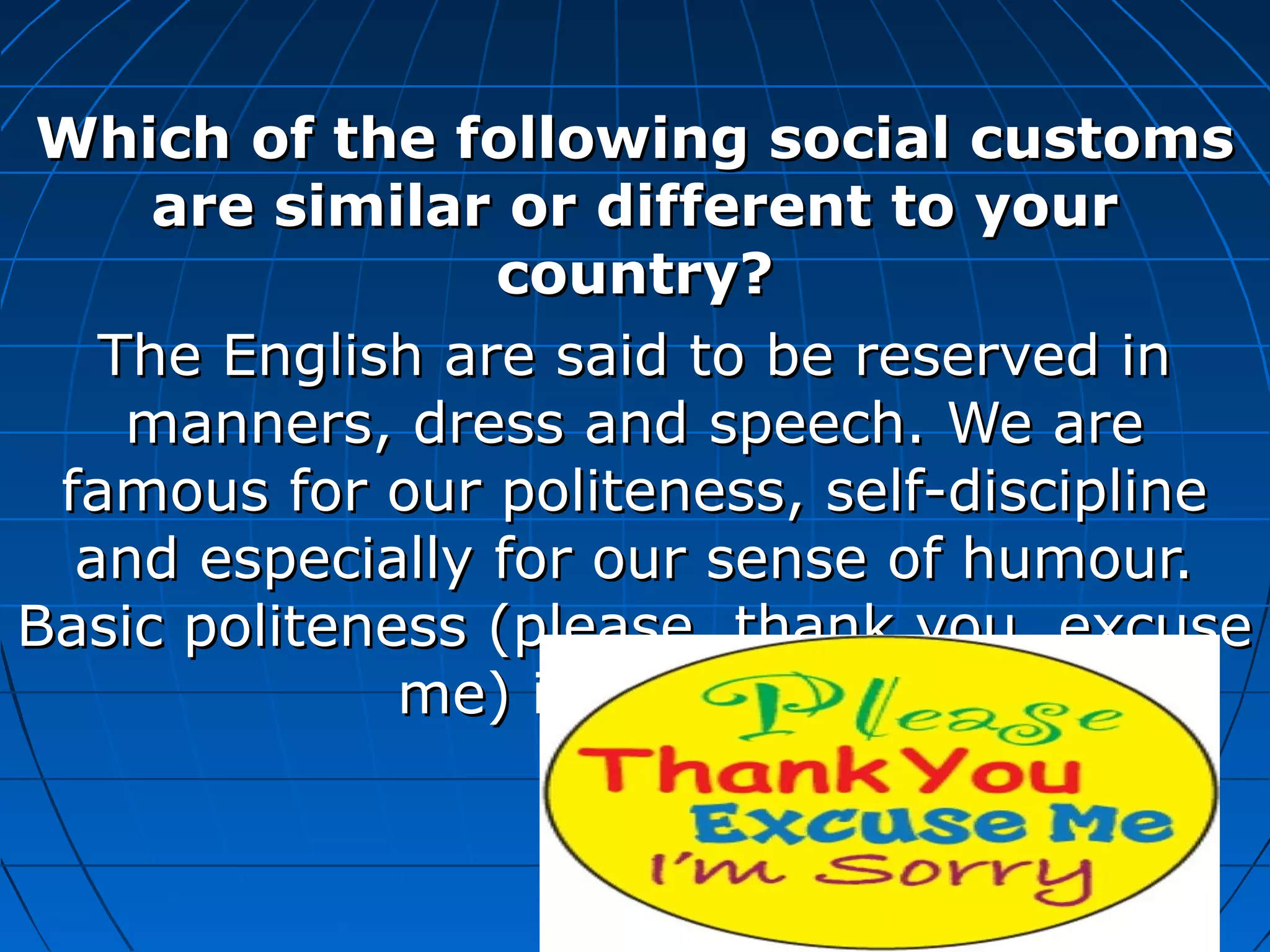
Basic politeness (please, thank you, excuseBasic politeness (please, thank you, excuse
me) is expected.me) is expected.
 How to greet someoneHow to greet someone
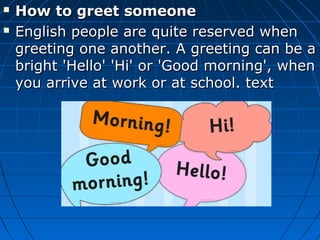
 English people are quite reserved whenEnglish people are quite reserved when
greeting one another. A greeting can be agreeting one another. A greeting can be a
bright 'Hello' 'Hi' or 'Good morning', whenbright 'Hello' 'Hi' or 'Good morning', when
you arrive at work or at school. textyou arrive at work or at school. text
 Terms of Endearment - Names we may call youTerms of Endearment - Names we may call you
 You may be called by many different 'affectionate'You may be called by many different 'affectionate'
names, according to which part of the England you arenames, according to which part of the England you are
visiting. Do not be offended, this is quite normal. Forvisiting. Do not be offended, this is quite normal. For
example, you may be called dear, dearie, flower, love,example, you may be called dear, dearie, flower, love,
chick, chuck, me duck, me duckie, mate, guv, son,chick, chuck, me duck, me duckie, mate, guv, son,
ma'am, madam, miss, sir, or treacle, according to yourma'am, madam, miss, sir, or treacle, according to your
sex, age and location. text taken from and copyright ofsex, age and location. text taken from and copyright of
projcetbritain.comprojcetbritain.com
 Message from one of our visitorsMessage from one of our visitors
""In Staffordshire and the West Midlands both men andIn Staffordshire and the West Midlands both men and
women use the term 'duck' when speaking to anotherwomen use the term 'duck' when speaking to another
person irrespective of their sex. I was quite shockedperson irrespective of their sex. I was quite shocked
when I first arrived here in Staffordshire from Londonwhen I first arrived here in Staffordshire from London
to be called 'Duck' by a man and now I find it veryto be called 'Duck' by a man and now I find it very
endearing and reassuring and far better than that awfulendearing and reassuring and far better than that awful
term 'Mate'.term 'Mate'.""
JimJim
StaffordshireStaffordshire
 Interesting FactInteresting Fact
The 'affectionate' name 'duck' is thoughtThe 'affectionate' name 'duck' is thought
to come from the Anglo-Saxon wordto come from the Anglo-Saxon word
''ducisducis' which was meant as a term of' which was meant as a term of
respect; similar to the Middle Englishrespect; similar to the Middle English
'duc', 'duk' which denotes a leader,'duc', 'duk' which denotes a leader,
commander, general; from which comescommander, general; from which comes
the title 'Duke' and the Old French wordthe title 'Duke' and the Old French word
'ducheé' - the territory ruled by a Duke.'ducheé' - the territory ruled by a Duke.
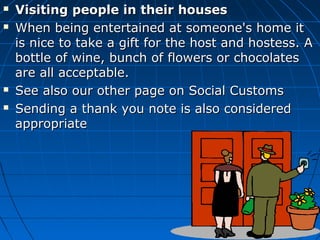
 Visiting people in their housesVisiting people in their houses
 When being entertained at someone's home itWhen being entertained at someone's home it
is nice to take a gift for the host and hostess. Ais nice to take a gift for the host and hostess. A
bottle of wine, bunch of flowers or chocolatesbottle of wine, bunch of flowers or chocolates
are all acceptable.are all acceptable.
 See also our other page on Social CustomsSee also our other page on Social Customs
 Sending a thank you note is also consideredSending a thank you note is also considered
appropriateappropriate
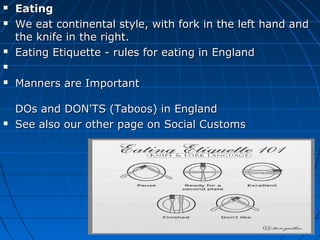
 EatingEating
 We eat continental style, with fork in the left hand andWe eat continental style, with fork in the left hand and
the knife in the right.the knife in the right.
 Eating Etiquette - rules for eating in EnglandEating Etiquette - rules for eating in England

 Manners are ImportantManners are Important
DOs and DON'TS (Taboos) in EnglandDOs and DON'TS (Taboos) in England
 See also our other page on Social CustomsSee also our other page on Social Customs
 In England...In England...
 Do stand in line:Do stand in line: text taken from andtext taken from and
copyright of projcetbritain.comcopyright of projcetbritain.com
 In England we like to form orderlyIn England we like to form orderly
queues (standing in line) and waitqueues (standing in line) and wait
patiently for our turn e.g. boarding a bus.patiently for our turn e.g. boarding a bus.
It is usual to queue when required, andIt is usual to queue when required, and
expected that you will take your correctexpected that you will take your correct
turn and not push in front. 'Queueturn and not push in front. 'Queue
jumping' is frowned upon.jumping' is frowned upon.
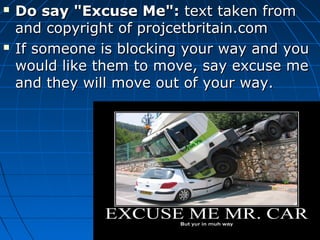
 Do say "Excuse Me":Do say "Excuse Me": text taken fromtext taken from
and copyright of projcetbritain.comand copyright of projcetbritain.com
 If someone is blocking your way and youIf someone is blocking your way and you
would like them to move, say excuse mewould like them to move, say excuse me
and they will move out of your way.and they will move out of your way.
 Do Pay as you Go:Do Pay as you Go:
 Pay for drinks as you order them inPay for drinks as you order them in
pubs and other types of bars.pubs and other types of bars.
 Do say "Please" and "Thank you":Do say "Please" and "Thank you":
 It is very good manners to say "please"It is very good manners to say "please"
and "thank you". It is considered rude ifand "thank you". It is considered rude if
you don't. You will notice in England thatyou don't. You will notice in England that
we say 'thank you' a lot. text taken fromwe say 'thank you' a lot. text taken from
 Do cover your Mouth:Do cover your Mouth:
 When yawning or coughing always coverWhen yawning or coughing always cover
your mouth with your hand.your mouth with your hand.
 Do Shake Hands:Do Shake Hands:
 When you are first introduced toWhen you are first introduced to
someone, shake their right hand withsomeone, shake their right hand with
your own right hand.your own right hand.
 Do say sorry:Do say sorry:
 If you accidentally bump into someone,If you accidentally bump into someone,
say 'sorry'. They probably will too, even ifsay 'sorry'. They probably will too, even if
it was your fault! This is a habit and canit was your fault! This is a habit and can
be seen as very amusing by an 'outsider'.be seen as very amusing by an 'outsider'.
 Do Smile:Do Smile: text taken from and copyrighttext taken from and copyright
of projcetbritain.comof projcetbritain.com
 A smiling face is a welcoming face.A smiling face is a welcoming face.
 Do Drive on the left side of the roadDo Drive on the left side of the road
 Find out more about driving text takenFind out more about driving text taken
from and copyright of projcetbritain.comfrom and copyright of projcetbritain.com
 Do open doors for other peopleDo open doors for other people
 Men and women both hold open the doorMen and women both hold open the door
for each other. It depends on who goesfor each other. It depends on who goes
through the door first.through the door first.
 In England...In England...
 Do not greet people with a kiss:Do not greet people with a kiss:
We only kiss people who are close friends and relatives.We only kiss people who are close friends and relatives.
 Avoid talking loudly in publicAvoid talking loudly in public
 It is impolite to stare at anyone in public.It is impolite to stare at anyone in public.
Privacy is highly regarded. text taken from andPrivacy is highly regarded. text taken from and
copyright of projcetbritain.comcopyright of projcetbritain.com
 Do not ask a lady her ageDo not ask a lady her age
It is considered impolite to ask a lady her ageIt is considered impolite to ask a lady her age
 Do not pick your nose in public:Do not pick your nose in public:
We are disgusted by this. If your nostrils need de-We are disgusted by this. If your nostrils need de-
bugging, use a handkerchief.bugging, use a handkerchief.
 Avoid doing gestures such as backslapping andAvoid doing gestures such as backslapping and
hugginghugging
This is only done among close friends.This is only done among close friends.
 Do not spit.Do not spit.
Spitting in the street is considered to be very badSpitting in the street is considered to be very bad
mannered.mannered.
 Do not burp in publicDo not burp in public
You may feel better by burping loudlyYou may feel better by burping loudly
after eating or drinking, but other peopleafter eating or drinking, but other people
will not! If you can not stop a burp fromwill not! If you can not stop a burp from
bursting out, then cover your mouth withbursting out, then cover your mouth with
your hand and say 'excuse me'your hand and say 'excuse me'
afterwards.afterwards.
 Do not pass wind in publicDo not pass wind in public text takentext taken
from and copyright of projcetbritain.comfrom and copyright of projcetbritain.com
Now how can we say this politely? Let'sNow how can we say this politely? Let's
say that you want to pass wind. What dosay that you want to pass wind. What do
you do? Go somewhere private and let ityou do? Go somewhere private and let it
out. If you accidentally pass wind inout. If you accidentally pass wind in
company say 'pardon me'.company say 'pardon me'.
 Belinda sent sent us an email on theBelinda sent sent us an email on the
indelicate subject of 'passing wind' inindelicate subject of 'passing wind' in
public:public:"The expression 'pardon me' would be"The expression 'pardon me' would be
considered by the upper classes to be ratherconsidered by the upper classes to be rather
common. When I was growing up, I was toldcommon. When I was growing up, I was told
by my mother, at school and by my aunt whoby my mother, at school and by my aunt who
was a nanny to an aristocratic family that thewas a nanny to an aristocratic family that the
correct thing to do if this happens is to carrycorrect thing to do if this happens is to carry
on as if nothing's happened and for the entireon as if nothing's happened and for the entire
company to ignore it completely as if they'vecompany to ignore it completely as if they've
never noticed. ( even if it's very obvious). Inever noticed. ( even if it's very obvious). I
think young people nowadays would probablythink young people nowadays would probably
be more inclined to laugh it off but certainlybe more inclined to laugh it off but certainly
the older generation in 'polite company' wouldthe older generation in 'polite company' would
never, ever draw attention to the incident bynever, ever draw attention to the incident by
apologising.apologising. Basically the advice is sayBasically the advice is say
'excuse me' for mouth burps, ignore'excuse me' for mouth burps, ignore
bottom burpsbottom burps."."
 It is impolite speak with your mouthIt is impolite speak with your mouth
full of foodfull of food
 Do not ask personal or intimateDo not ask personal or intimate
questionsquestions
We like our privacy. Please do not askWe like our privacy. Please do not ask
questions such as "How much money doquestions such as "How much money do
you earn?" "How much do you weigh?" oryou earn?" "How much do you weigh?" or
"Why aren't you married?". text taken"Why aren't you married?". text taken
from and copyright of projcetbritain.comfrom and copyright of projcetbritain.com
 Never eat off a knife when having aNever eat off a knife when having a
meal.meal.
 In all countries in Britain ...In all countries in Britain ...
 Women in Britain are entitled to equal respect and status as menWomen in Britain are entitled to equal respect and status as men
(and indeed vice versa) in all areas of life and tend to have more(and indeed vice versa) in all areas of life and tend to have more
independence and responsibility than in some other cultures.independence and responsibility than in some other cultures.
Women are usually independent and accustomed to enteringWomen are usually independent and accustomed to entering
public places unaccompanied. It is usual for women to go out andpublic places unaccompanied. It is usual for women to go out and
about on their own as well as with friends. Men and women mixabout on their own as well as with friends. Men and women mix
freely.freely.
 It is ok for women to eat alone in a restaurant.It is ok for women to eat alone in a restaurant.
 It is ok for women to wander around on their own.It is ok for women to wander around on their own.
 It is ok for women to drink beer.It is ok for women to drink beer.

Costums and behavior UK people

  • 1.
    Which of thefollowing social customsWhich of the following social customs are similar or different to yourare similar or different to your country?country? The English are said to be reserved inThe English are said to be reserved in manners, dress and speech. We aremanners, dress and speech. We are famous for our politeness, self-disciplinefamous for our politeness, self-discipline and especially for our sense of humour.and especially for our sense of humour. Basic politeness (please, thank you, excuseBasic politeness (please, thank you, excuse me) is expected.me) is expected.
  • 2.
     How togreet someoneHow to greet someone  English people are quite reserved whenEnglish people are quite reserved when greeting one another. A greeting can be agreeting one another. A greeting can be a bright 'Hello' 'Hi' or 'Good morning', whenbright 'Hello' 'Hi' or 'Good morning', when you arrive at work or at school. textyou arrive at work or at school. text
  • 3.
     Terms ofEndearment - Names we may call youTerms of Endearment - Names we may call you  You may be called by many different 'affectionate'You may be called by many different 'affectionate' names, according to which part of the England you arenames, according to which part of the England you are visiting. Do not be offended, this is quite normal. Forvisiting. Do not be offended, this is quite normal. For example, you may be called dear, dearie, flower, love,example, you may be called dear, dearie, flower, love, chick, chuck, me duck, me duckie, mate, guv, son,chick, chuck, me duck, me duckie, mate, guv, son, ma'am, madam, miss, sir, or treacle, according to yourma'am, madam, miss, sir, or treacle, according to your sex, age and location. text taken from and copyright ofsex, age and location. text taken from and copyright of projcetbritain.comprojcetbritain.com  Message from one of our visitorsMessage from one of our visitors ""In Staffordshire and the West Midlands both men andIn Staffordshire and the West Midlands both men and women use the term 'duck' when speaking to anotherwomen use the term 'duck' when speaking to another person irrespective of their sex. I was quite shockedperson irrespective of their sex. I was quite shocked when I first arrived here in Staffordshire from Londonwhen I first arrived here in Staffordshire from London to be called 'Duck' by a man and now I find it veryto be called 'Duck' by a man and now I find it very endearing and reassuring and far better than that awfulendearing and reassuring and far better than that awful term 'Mate'.term 'Mate'."" JimJim StaffordshireStaffordshire
  • 4.
     Interesting FactInterestingFact The 'affectionate' name 'duck' is thoughtThe 'affectionate' name 'duck' is thought to come from the Anglo-Saxon wordto come from the Anglo-Saxon word ''ducisducis' which was meant as a term of' which was meant as a term of respect; similar to the Middle Englishrespect; similar to the Middle English 'duc', 'duk' which denotes a leader,'duc', 'duk' which denotes a leader, commander, general; from which comescommander, general; from which comes the title 'Duke' and the Old French wordthe title 'Duke' and the Old French word 'ducheé' - the territory ruled by a Duke.'ducheé' - the territory ruled by a Duke.
  • 5.
     Visiting peoplein their housesVisiting people in their houses  When being entertained at someone's home itWhen being entertained at someone's home it is nice to take a gift for the host and hostess. Ais nice to take a gift for the host and hostess. A bottle of wine, bunch of flowers or chocolatesbottle of wine, bunch of flowers or chocolates are all acceptable.are all acceptable.  See also our other page on Social CustomsSee also our other page on Social Customs  Sending a thank you note is also consideredSending a thank you note is also considered appropriateappropriate
  • 6.
     EatingEating  Weeat continental style, with fork in the left hand andWe eat continental style, with fork in the left hand and the knife in the right.the knife in the right.  Eating Etiquette - rules for eating in EnglandEating Etiquette - rules for eating in England   Manners are ImportantManners are Important DOs and DON'TS (Taboos) in EnglandDOs and DON'TS (Taboos) in England  See also our other page on Social CustomsSee also our other page on Social Customs
  • 7.
     In England...InEngland...  Do stand in line:Do stand in line: text taken from andtext taken from and copyright of projcetbritain.comcopyright of projcetbritain.com  In England we like to form orderlyIn England we like to form orderly queues (standing in line) and waitqueues (standing in line) and wait patiently for our turn e.g. boarding a bus.patiently for our turn e.g. boarding a bus. It is usual to queue when required, andIt is usual to queue when required, and expected that you will take your correctexpected that you will take your correct turn and not push in front. 'Queueturn and not push in front. 'Queue jumping' is frowned upon.jumping' is frowned upon.
  • 8.
     Do say"Excuse Me":Do say "Excuse Me": text taken fromtext taken from and copyright of projcetbritain.comand copyright of projcetbritain.com  If someone is blocking your way and youIf someone is blocking your way and you would like them to move, say excuse mewould like them to move, say excuse me and they will move out of your way.and they will move out of your way.
  • 9.
     Do Payas you Go:Do Pay as you Go:  Pay for drinks as you order them inPay for drinks as you order them in pubs and other types of bars.pubs and other types of bars.
  • 10.
     Do say"Please" and "Thank you":Do say "Please" and "Thank you":  It is very good manners to say "please"It is very good manners to say "please" and "thank you". It is considered rude ifand "thank you". It is considered rude if you don't. You will notice in England thatyou don't. You will notice in England that we say 'thank you' a lot. text taken fromwe say 'thank you' a lot. text taken from
  • 11.
     Do coveryour Mouth:Do cover your Mouth:  When yawning or coughing always coverWhen yawning or coughing always cover your mouth with your hand.your mouth with your hand.  Do Shake Hands:Do Shake Hands:  When you are first introduced toWhen you are first introduced to someone, shake their right hand withsomeone, shake their right hand with your own right hand.your own right hand.
  • 12.
     Do saysorry:Do say sorry:  If you accidentally bump into someone,If you accidentally bump into someone, say 'sorry'. They probably will too, even ifsay 'sorry'. They probably will too, even if it was your fault! This is a habit and canit was your fault! This is a habit and can be seen as very amusing by an 'outsider'.be seen as very amusing by an 'outsider'.  Do Smile:Do Smile: text taken from and copyrighttext taken from and copyright of projcetbritain.comof projcetbritain.com  A smiling face is a welcoming face.A smiling face is a welcoming face.  Do Drive on the left side of the roadDo Drive on the left side of the road  Find out more about driving text takenFind out more about driving text taken from and copyright of projcetbritain.comfrom and copyright of projcetbritain.com  Do open doors for other peopleDo open doors for other people  Men and women both hold open the doorMen and women both hold open the door for each other. It depends on who goesfor each other. It depends on who goes through the door first.through the door first.
  • 13.
     In England...InEngland...  Do not greet people with a kiss:Do not greet people with a kiss: We only kiss people who are close friends and relatives.We only kiss people who are close friends and relatives.  Avoid talking loudly in publicAvoid talking loudly in public  It is impolite to stare at anyone in public.It is impolite to stare at anyone in public. Privacy is highly regarded. text taken from andPrivacy is highly regarded. text taken from and copyright of projcetbritain.comcopyright of projcetbritain.com  Do not ask a lady her ageDo not ask a lady her age It is considered impolite to ask a lady her ageIt is considered impolite to ask a lady her age  Do not pick your nose in public:Do not pick your nose in public: We are disgusted by this. If your nostrils need de-We are disgusted by this. If your nostrils need de- bugging, use a handkerchief.bugging, use a handkerchief.  Avoid doing gestures such as backslapping andAvoid doing gestures such as backslapping and hugginghugging This is only done among close friends.This is only done among close friends.  Do not spit.Do not spit. Spitting in the street is considered to be very badSpitting in the street is considered to be very bad mannered.mannered.
  • 14.
     Do notburp in publicDo not burp in public You may feel better by burping loudlyYou may feel better by burping loudly after eating or drinking, but other peopleafter eating or drinking, but other people will not! If you can not stop a burp fromwill not! If you can not stop a burp from bursting out, then cover your mouth withbursting out, then cover your mouth with your hand and say 'excuse me'your hand and say 'excuse me' afterwards.afterwards.  Do not pass wind in publicDo not pass wind in public text takentext taken from and copyright of projcetbritain.comfrom and copyright of projcetbritain.com Now how can we say this politely? Let'sNow how can we say this politely? Let's say that you want to pass wind. What dosay that you want to pass wind. What do you do? Go somewhere private and let ityou do? Go somewhere private and let it out. If you accidentally pass wind inout. If you accidentally pass wind in company say 'pardon me'.company say 'pardon me'.
  • 15.
     Belinda sentsent us an email on theBelinda sent sent us an email on the indelicate subject of 'passing wind' inindelicate subject of 'passing wind' in public:public:"The expression 'pardon me' would be"The expression 'pardon me' would be considered by the upper classes to be ratherconsidered by the upper classes to be rather common. When I was growing up, I was toldcommon. When I was growing up, I was told by my mother, at school and by my aunt whoby my mother, at school and by my aunt who was a nanny to an aristocratic family that thewas a nanny to an aristocratic family that the correct thing to do if this happens is to carrycorrect thing to do if this happens is to carry on as if nothing's happened and for the entireon as if nothing's happened and for the entire company to ignore it completely as if they'vecompany to ignore it completely as if they've never noticed. ( even if it's very obvious). Inever noticed. ( even if it's very obvious). I think young people nowadays would probablythink young people nowadays would probably be more inclined to laugh it off but certainlybe more inclined to laugh it off but certainly the older generation in 'polite company' wouldthe older generation in 'polite company' would never, ever draw attention to the incident bynever, ever draw attention to the incident by apologising.apologising. Basically the advice is sayBasically the advice is say 'excuse me' for mouth burps, ignore'excuse me' for mouth burps, ignore bottom burpsbottom burps."."
  • 16.
     It isimpolite speak with your mouthIt is impolite speak with your mouth full of foodfull of food  Do not ask personal or intimateDo not ask personal or intimate questionsquestions We like our privacy. Please do not askWe like our privacy. Please do not ask questions such as "How much money doquestions such as "How much money do you earn?" "How much do you weigh?" oryou earn?" "How much do you weigh?" or "Why aren't you married?". text taken"Why aren't you married?". text taken from and copyright of projcetbritain.comfrom and copyright of projcetbritain.com  Never eat off a knife when having aNever eat off a knife when having a meal.meal.
  • 17.
     In allcountries in Britain ...In all countries in Britain ...  Women in Britain are entitled to equal respect and status as menWomen in Britain are entitled to equal respect and status as men (and indeed vice versa) in all areas of life and tend to have more(and indeed vice versa) in all areas of life and tend to have more independence and responsibility than in some other cultures.independence and responsibility than in some other cultures. Women are usually independent and accustomed to enteringWomen are usually independent and accustomed to entering public places unaccompanied. It is usual for women to go out andpublic places unaccompanied. It is usual for women to go out and about on their own as well as with friends. Men and women mixabout on their own as well as with friends. Men and women mix freely.freely.  It is ok for women to eat alone in a restaurant.It is ok for women to eat alone in a restaurant.  It is ok for women to wander around on their own.It is ok for women to wander around on their own.  It is ok for women to drink beer.It is ok for women to drink beer.