By :bathsheba devadas
Group 95
2013
Did
you
know

?
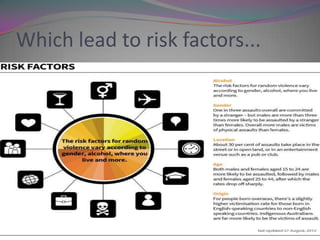
Which lead to risk factors...
Name one risk? I can name
thousand!!!!
 Risks:
 Continuous or repeated intoxication may lead to

physical and psychical addiction. Functions of the
brain and the nervous system may be affected, leading
to considerable personality damage, difficulties
concentrating and increased memory loss.
Neurological disorders like epilepsy are also possible.
In addition, internal organs are often damaged.
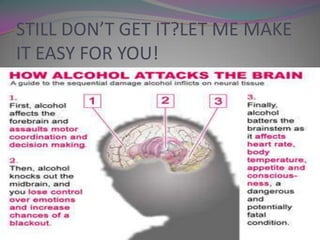
STILL DON’T GET IT?LET ME MAKE
IT EASY FOR YOU!
The best-known conditions are enlargements of
the liver: fatty liver, liver cirrhosis and alcohol
hepatitis. The pancreas, the stomach, the mucosal
membrane of the stomach and the intestine may
be affected, as well.
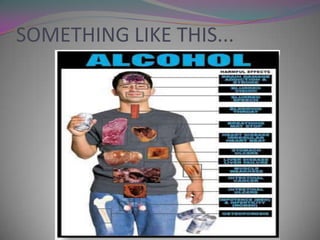
SOMETHING LIKE THIS...
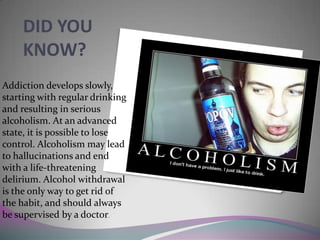
DID YOU
KNOW?
Addiction develops slowly,
starting with regular drinking
and resulting in serious
alcoholism. At an advanced
state, it is possible to lose
control. Alcoholism may lead
to hallucinations and end
with a life-threatening
delirium. Alcohol withdrawal
is the only way to get rid of
the habit, and should always
be supervised by a doctor.
Alcoholism affects sleep during
sober periods
The study indicates that in long-term alcoholics who
had not had a drink for up to 719 days, the percentage of
slow wave sleep or deep sleep was significantly lower.
 Slow wave sleep and more light stage

1 sleep is reflective of poorer sleep
quality, which could act as an
exacerbating factor in alcoholics'
cognitive decline.
 Although women had better sleep
efficiency and fewer wake periods
than men, no significant interactions
between sex and alcoholism
diagnosis were found for any
measures.
 This suggests that women show the
same general pattern of alcoholismrelated sleep changes as men.

 Principal investigator Ian Colrain,

psychologist at the University of
Melbourne, was also surprised to find
that a significant increase in the
percentage of rapid eye movement
(REM) sleep, usually associated with
dreams, persisted in alcoholics who
had abstained for an extended period.
 The study involved 42 alcoholics who
were recruited from an inpatient
treatment programme and 42 controls.
 Estimated lifetime alcohol
consumption was significantly higher
in male alcoholics (1,607.2 kg) than
female alcoholics (843.7 kg).
Alcohol dependence is more common among males.
It usually sets in during the latter part of the second decade or
during the early part of the third decade of life.

The term 'Alcohol dependence' is usually used in reference to
the mental, physical, or social damage that results from an
excessive consumption of alcohol. Alcohol dependence is
characterized by an increased preoccupation with the drug and
reduced control over its intake.
Alcohol dependence
 Alcohol dependence is often a chronic, progressive disease,

which, if left untreated, can prove to be fatal.
Alcohol dependence may also be contributed by genetic,
psychological, and social factors.
Alcohol abuse is generally considered when a person
engages in excessive drinking, resulting in health or social
problems, but is not dependent on alcohol on a regular
basis.
Alcohol dependence
 It generally affects the perception, thinking, and

coordination, impairing judgment, reducing inhibitions,
and increasing the person’s aggressiveness.
Alcohol abusers are often more likely to be associated with
high-risk, reckless, or violent behaviours than non-abusers.
Alcohol dependence is seen more commonly associated in
males, usually starting in their late twenties, or early
thirties of life.
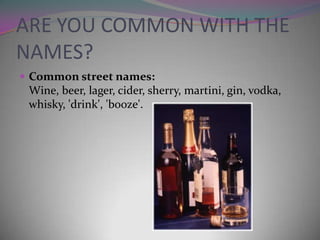
ARE YOU COMMON WITH THE
NAMES?
 Common street names:

Wine, beer, lager, cider, sherry, martini, gin, vodka,
whisky, 'drink', 'booze'.
WHAT HAPPEN IF YOU TRY IT?
 The risks:

Too much in one go can slow your body down to the point where
it stops working altogether. Many fatal overdoses with drugs
such as heroin and tranquillisers happen when people have been
boozing. Taking more than one drug at the same time is often
dangerous and unpredictable, alcohol is one of the worst mixers.
You probably know all the dangers of long term heavy drinking alcoholism, the dts, stomach and liver damage, obesity, brain
damage, risk of cancers, memory loss, mood swings and
personality changes, etc. But what about less heavy, regular
drinking? Accidents are much more likely - traffic and
pedestrian accidents, operating machinery, falling over, etc. Male
violence against both men and women is common and some
men sexually harass women when drunk.
WHAT IF ONE OF YOUR LOVED
ONES HAVE THIS PROBLEM? HOW
WOULD YOU SPOT THEM BEFORE
IT IS TOO LATE!!!!!
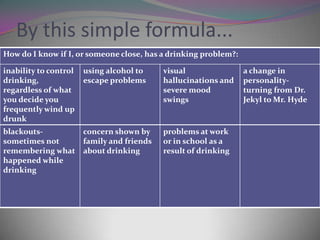
By this simple formula...
How do I know if I, or someone close, has a drinking problem?:
inability to control
drinking,
regardless of what
you decide you
frequently wind up
drunk

using alcohol to
escape problems

visual
hallucinations and
severe mood
swings

blackoutssometimes not
remembering what
happened while
drinking

concern shown by
family and friends
about drinking

problems at work
or in school as a
result of drinking

a change in
personalityturning from Dr.
Jekyl to Mr. Hyde
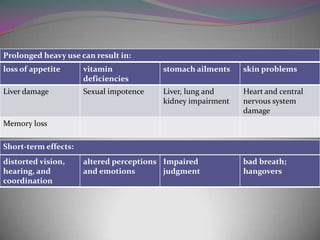
Prolonged heavy use can result in:
loss of appetite

vitamin
deficiencies

stomach ailments

skin problems

Liver damage

Sexual impotence

Liver, lung and
kidney impairment

Heart and central
nervous system
damage

Memory loss
Short-term effects:
distorted vision,
hearing, and
coordination

altered perceptions Impaired
and emotions
judgment

bad breath;
hangovers
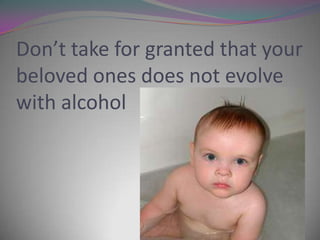
Don’t take for granted that your
beloved ones does not evolve
with alcohol
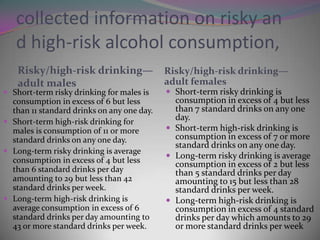
collected information on risky an
d high-risk alcohol consumption,
Risky/high-risk drinking—
adult males

 Short-term risky drinking for males is

consumption in excess of 6 but less
than 11 standard drinks on any one day.
 Short-term high-risk drinking for
males is consumption of 11 or more
standard drinks on any one day.
 Long-term risky drinking is average
consumption in excess of 4 but less
than 6 standard drinks per day
amounting to 29 but less than 42
standard drinks per week.
 Long-term high-risk drinking is
average consumption in excess of 6
standard drinks per day amounting to
43 or more standard drinks per week.

Risky/high-risk drinking—
adult females
 Short-term risky drinking is

consumption in excess of 4 but less
than 7 standard drinks on any one
day.
 Short-term high-risk drinking is
consumption in excess of 7 or more
standard drinks on any one day.
 Long-term risky drinking is average
consumption in excess of 2 but less
than 5 standard drinks per day
amounting to 15 but less than 28
standard drinks per week.
 Long-term high-risk drinking is
consumption in excess of 4 standard
drinks per day which amounts to 29
or more standard drinks per week
In every topic, it has it’s own pros
and cons ...ALCOHOL is one of it
but it has more cons than pros and
that’s why, its better to stay away
from it than regretting you have
spoiled your life and future
the end.

High risk groups with alcohol

  • 1.
  • 2.
  • 4.
    Which lead torisk factors...
  • 5.
    Name one risk?I can name thousand!!!!  Risks:  Continuous or repeated intoxication may lead to physical and psychical addiction. Functions of the brain and the nervous system may be affected, leading to considerable personality damage, difficulties concentrating and increased memory loss. Neurological disorders like epilepsy are also possible. In addition, internal organs are often damaged.
  • 6.
    STILL DON’T GETIT?LET ME MAKE IT EASY FOR YOU!
  • 7.
    The best-known conditionsare enlargements of the liver: fatty liver, liver cirrhosis and alcohol hepatitis. The pancreas, the stomach, the mucosal membrane of the stomach and the intestine may be affected, as well.
  • 8.
  • 9.
    DID YOU KNOW? Addiction developsslowly, starting with regular drinking and resulting in serious alcoholism. At an advanced state, it is possible to lose control. Alcoholism may lead to hallucinations and end with a life-threatening delirium. Alcohol withdrawal is the only way to get rid of the habit, and should always be supervised by a doctor.
  • 10.
    Alcoholism affects sleepduring sober periods The study indicates that in long-term alcoholics who had not had a drink for up to 719 days, the percentage of slow wave sleep or deep sleep was significantly lower.  Slow wave sleep and more light stage 1 sleep is reflective of poorer sleep quality, which could act as an exacerbating factor in alcoholics' cognitive decline.  Although women had better sleep efficiency and fewer wake periods than men, no significant interactions between sex and alcoholism diagnosis were found for any measures.  This suggests that women show the same general pattern of alcoholismrelated sleep changes as men.  Principal investigator Ian Colrain, psychologist at the University of Melbourne, was also surprised to find that a significant increase in the percentage of rapid eye movement (REM) sleep, usually associated with dreams, persisted in alcoholics who had abstained for an extended period.  The study involved 42 alcoholics who were recruited from an inpatient treatment programme and 42 controls.  Estimated lifetime alcohol consumption was significantly higher in male alcoholics (1,607.2 kg) than female alcoholics (843.7 kg).
  • 11.
    Alcohol dependence ismore common among males. It usually sets in during the latter part of the second decade or during the early part of the third decade of life. The term 'Alcohol dependence' is usually used in reference to the mental, physical, or social damage that results from an excessive consumption of alcohol. Alcohol dependence is characterized by an increased preoccupation with the drug and reduced control over its intake.
  • 12.
    Alcohol dependence  Alcoholdependence is often a chronic, progressive disease, which, if left untreated, can prove to be fatal. Alcohol dependence may also be contributed by genetic, psychological, and social factors. Alcohol abuse is generally considered when a person engages in excessive drinking, resulting in health or social problems, but is not dependent on alcohol on a regular basis.
  • 13.
    Alcohol dependence  Itgenerally affects the perception, thinking, and coordination, impairing judgment, reducing inhibitions, and increasing the person’s aggressiveness. Alcohol abusers are often more likely to be associated with high-risk, reckless, or violent behaviours than non-abusers. Alcohol dependence is seen more commonly associated in males, usually starting in their late twenties, or early thirties of life.
  • 14.
    ARE YOU COMMONWITH THE NAMES?  Common street names: Wine, beer, lager, cider, sherry, martini, gin, vodka, whisky, 'drink', 'booze'.
  • 15.
    WHAT HAPPEN IFYOU TRY IT?  The risks: Too much in one go can slow your body down to the point where it stops working altogether. Many fatal overdoses with drugs such as heroin and tranquillisers happen when people have been boozing. Taking more than one drug at the same time is often dangerous and unpredictable, alcohol is one of the worst mixers. You probably know all the dangers of long term heavy drinking alcoholism, the dts, stomach and liver damage, obesity, brain damage, risk of cancers, memory loss, mood swings and personality changes, etc. But what about less heavy, regular drinking? Accidents are much more likely - traffic and pedestrian accidents, operating machinery, falling over, etc. Male violence against both men and women is common and some men sexually harass women when drunk.
  • 16.
    WHAT IF ONEOF YOUR LOVED ONES HAVE THIS PROBLEM? HOW WOULD YOU SPOT THEM BEFORE IT IS TOO LATE!!!!!
  • 17.
    By this simpleformula... How do I know if I, or someone close, has a drinking problem?: inability to control drinking, regardless of what you decide you frequently wind up drunk using alcohol to escape problems visual hallucinations and severe mood swings blackoutssometimes not remembering what happened while drinking concern shown by family and friends about drinking problems at work or in school as a result of drinking a change in personalityturning from Dr. Jekyl to Mr. Hyde
  • 18.
    Prolonged heavy usecan result in: loss of appetite vitamin deficiencies stomach ailments skin problems Liver damage Sexual impotence Liver, lung and kidney impairment Heart and central nervous system damage Memory loss Short-term effects: distorted vision, hearing, and coordination altered perceptions Impaired and emotions judgment bad breath; hangovers
  • 19.
    Don’t take forgranted that your beloved ones does not evolve with alcohol
  • 20.
    collected information onrisky an d high-risk alcohol consumption, Risky/high-risk drinking— adult males  Short-term risky drinking for males is consumption in excess of 6 but less than 11 standard drinks on any one day.  Short-term high-risk drinking for males is consumption of 11 or more standard drinks on any one day.  Long-term risky drinking is average consumption in excess of 4 but less than 6 standard drinks per day amounting to 29 but less than 42 standard drinks per week.  Long-term high-risk drinking is average consumption in excess of 6 standard drinks per day amounting to 43 or more standard drinks per week. Risky/high-risk drinking— adult females  Short-term risky drinking is consumption in excess of 4 but less than 7 standard drinks on any one day.  Short-term high-risk drinking is consumption in excess of 7 or more standard drinks on any one day.  Long-term risky drinking is average consumption in excess of 2 but less than 5 standard drinks per day amounting to 15 but less than 28 standard drinks per week.  Long-term high-risk drinking is consumption in excess of 4 standard drinks per day which amounts to 29 or more standard drinks per week
  • 21.
    In every topic,it has it’s own pros and cons ...ALCOHOL is one of it but it has more cons than pros and that’s why, its better to stay away from it than regretting you have spoiled your life and future
  • 22.