Interconnection Issues at
Higher Penetrations
Sky C. Stanfield

1
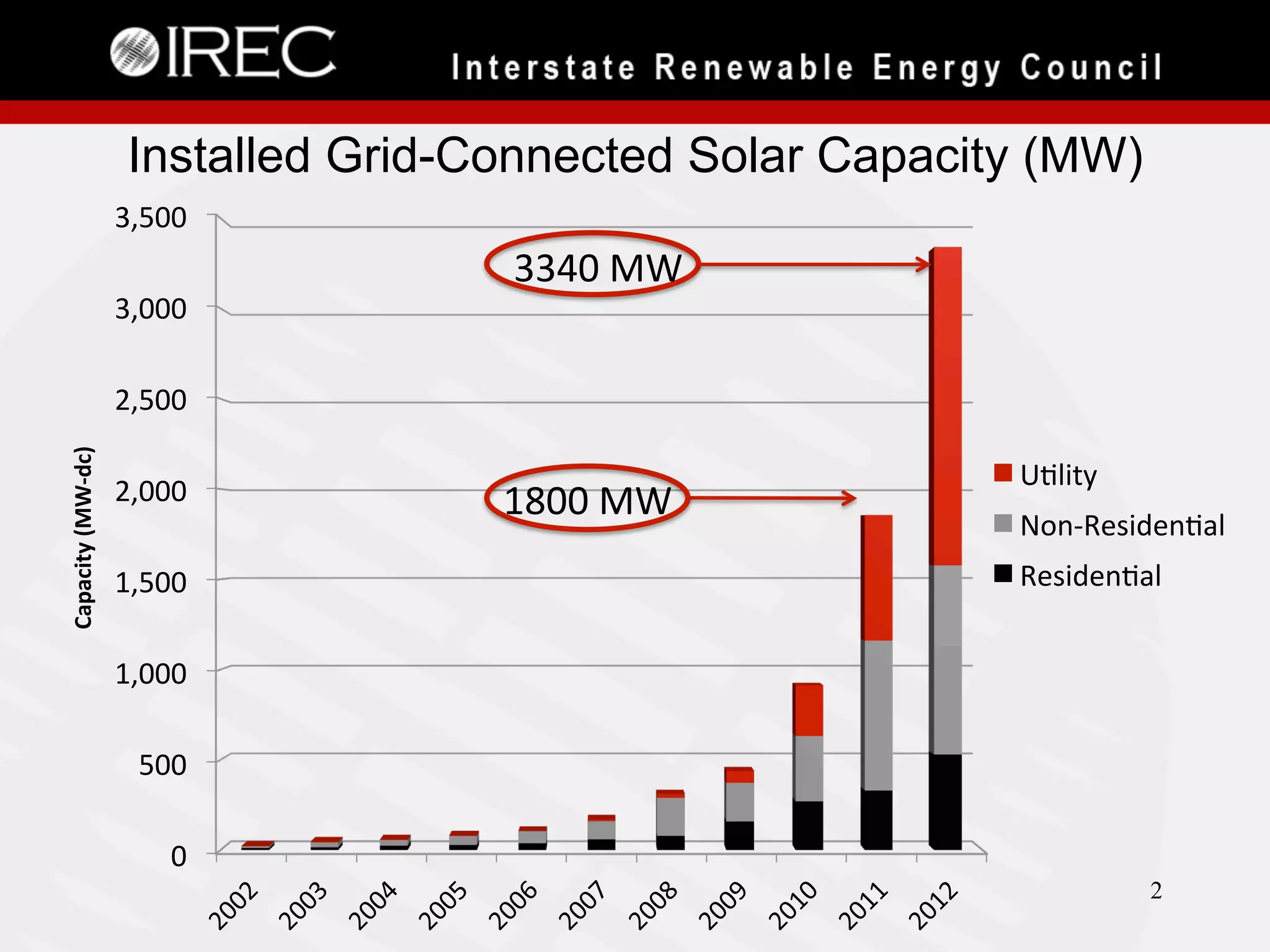
Installed Grid-Connected Solar Capacity (MW)
3,500	
  
3,000	
  

3340	
  MW	
  

Capacity	
  (MW-­‐dc)	
  

2,500	
  
2,000	
  
1,500	
  

1800	
  MW	
  

U)lity	
  
Non-­‐Residen)al	
  
Residen)al	
  

1,000	
  
500	
  
0	
  
2
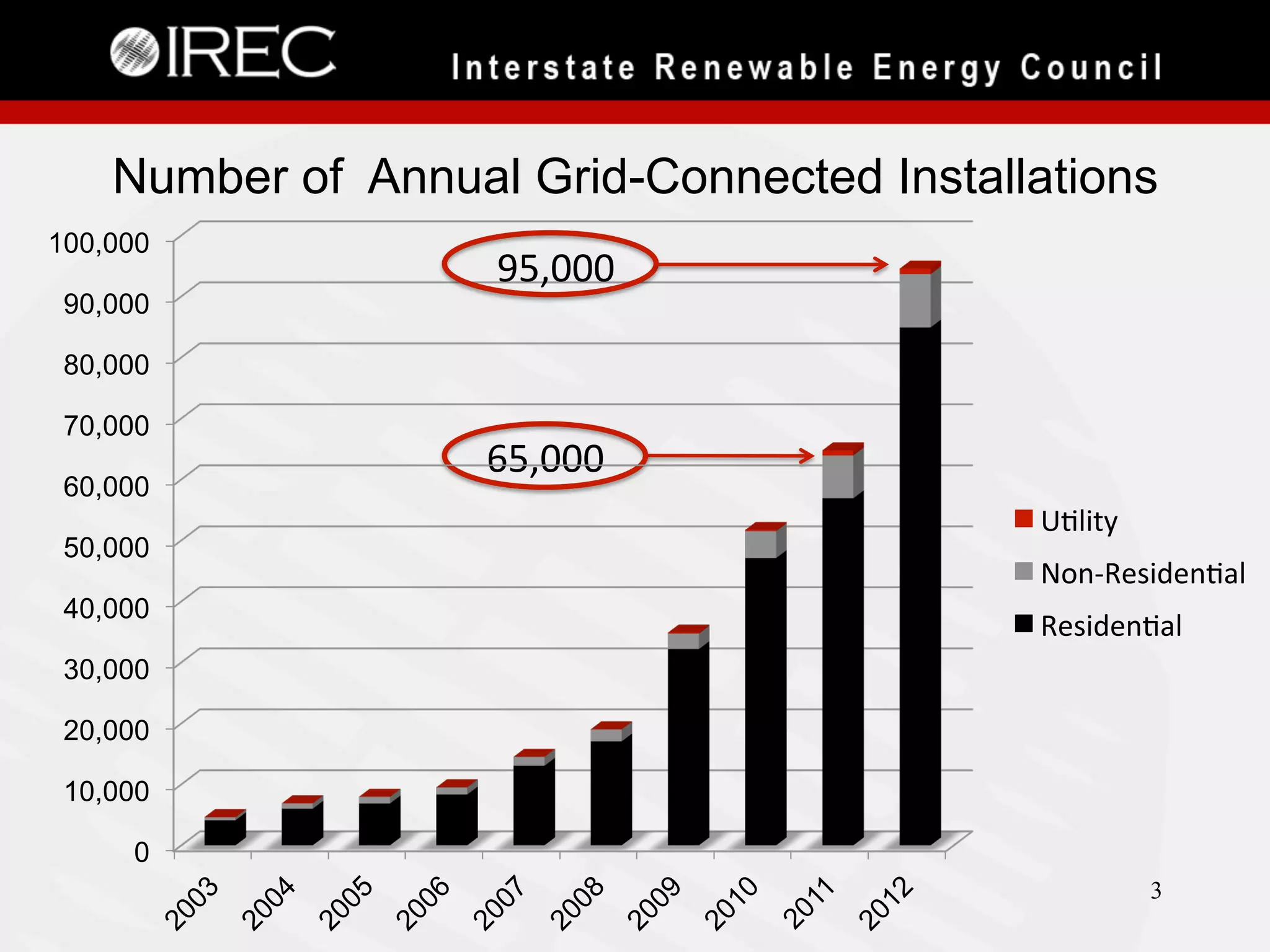
Number of Annual Grid-Connected Installations
100,000
90,000

95,000	
  

80,000
70,000
60,000
50,000
40,000

65,000	
  
U)lity	
  
Non-­‐Residen)al	
  
Residen)al	
  

30,000
20,000
10,000
0
3
Most Interconnection Procedures
Were Designed for a Different Era
•  FERC adopted SGIP in 2005, subsequently
many states adopted procedures modeled on
SGIP or the original California Rule 21
–  In 2005 the US installed 79 MW of grid connected
PV
–  In 2012 the US installed 3,300 MW of grid
connected PV

•  Until last year, few states had updated their
procedures to reflect this changing reality
4
Key Reasons for Updating
Interconnection Procedures
• 
• 
• 
• 
• 

High volume of interconnection applications
Increased penetration on distribution circuits
Backlogged study queues
Unclear review requirements
Lack of transparency regarding system
conditions
•  Better procedures = lower costs for solar
customers and utilities/rate payers
5
Interconnection Rules
Are Changing
•  Both state and federally regulated
procedures in California have been
updated
•  Hawaii, Massachusetts, Ohio and others
have recently adopted or are considering
changes
•  FERC is currently considering significant
updates to SGIP
6
A Few Principles for Efficient
Interconnection
•  Filter projects before applications are filed
•  Enable developers to select low-cost sites
•  Apply the appropriate amount of study to
each project
•  Ensure timelines are clear and complied
with
•  Allow opportunities for cost sharing
7
New and Noteworthy
Approaches to Interconnection
• 
• 
• 
• 
• 
• 

Pre-Application Reports and other tools
Fast Track size limits
Improved Supplemental Review
Differentiated Study Processes
Group/Cluster Studies
Up Next: Integrated Distribution Planning?
8
Pre-Application Report
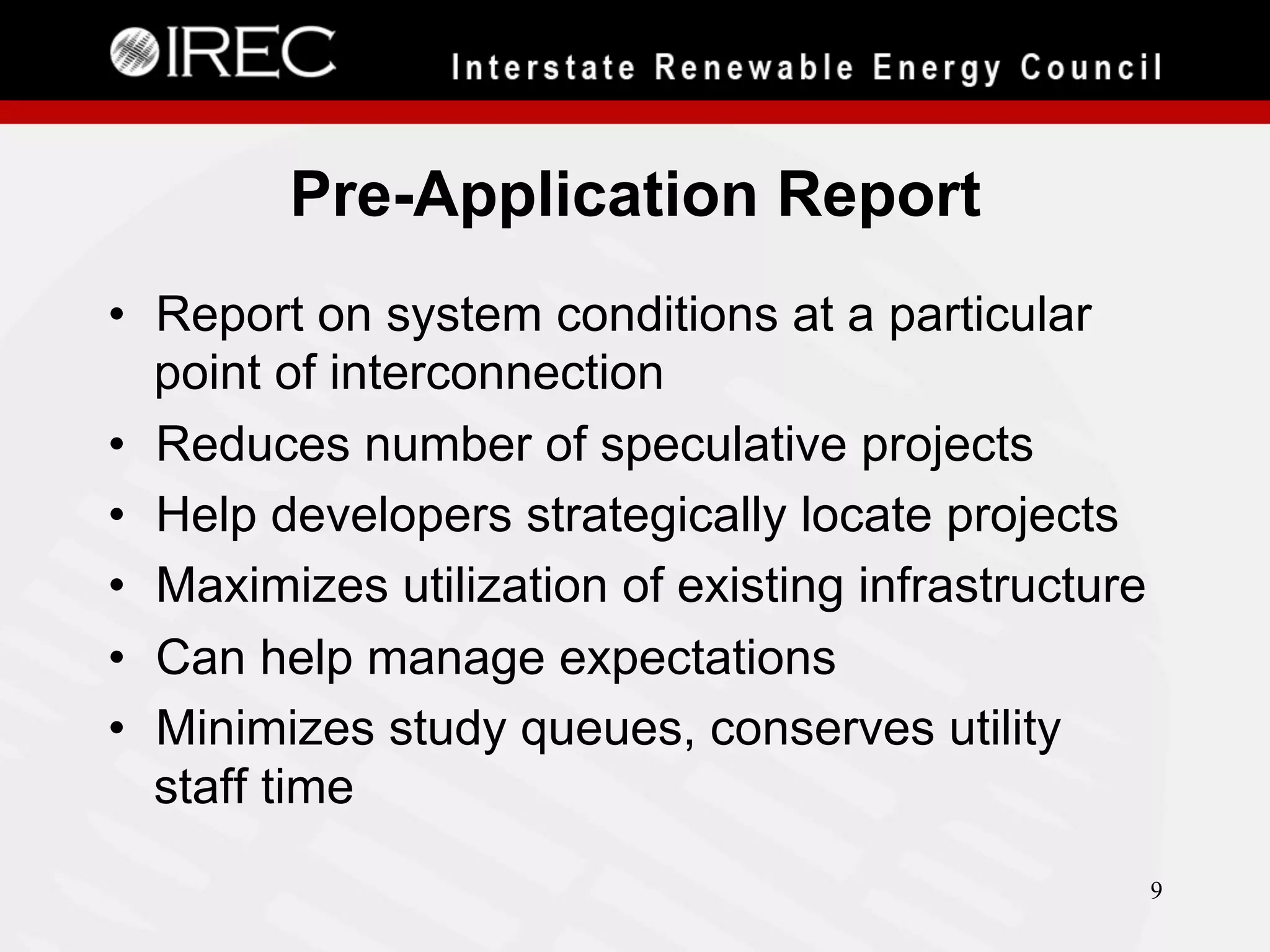
•  Report on system conditions at a particular
point of interconnection
•  Reduces number of speculative projects
•  Help developers strategically locate projects
•  Maximizes utilization of existing infrastructure
•  Can help manage expectations
•  Minimizes study queues, conserves utility
staff time
9
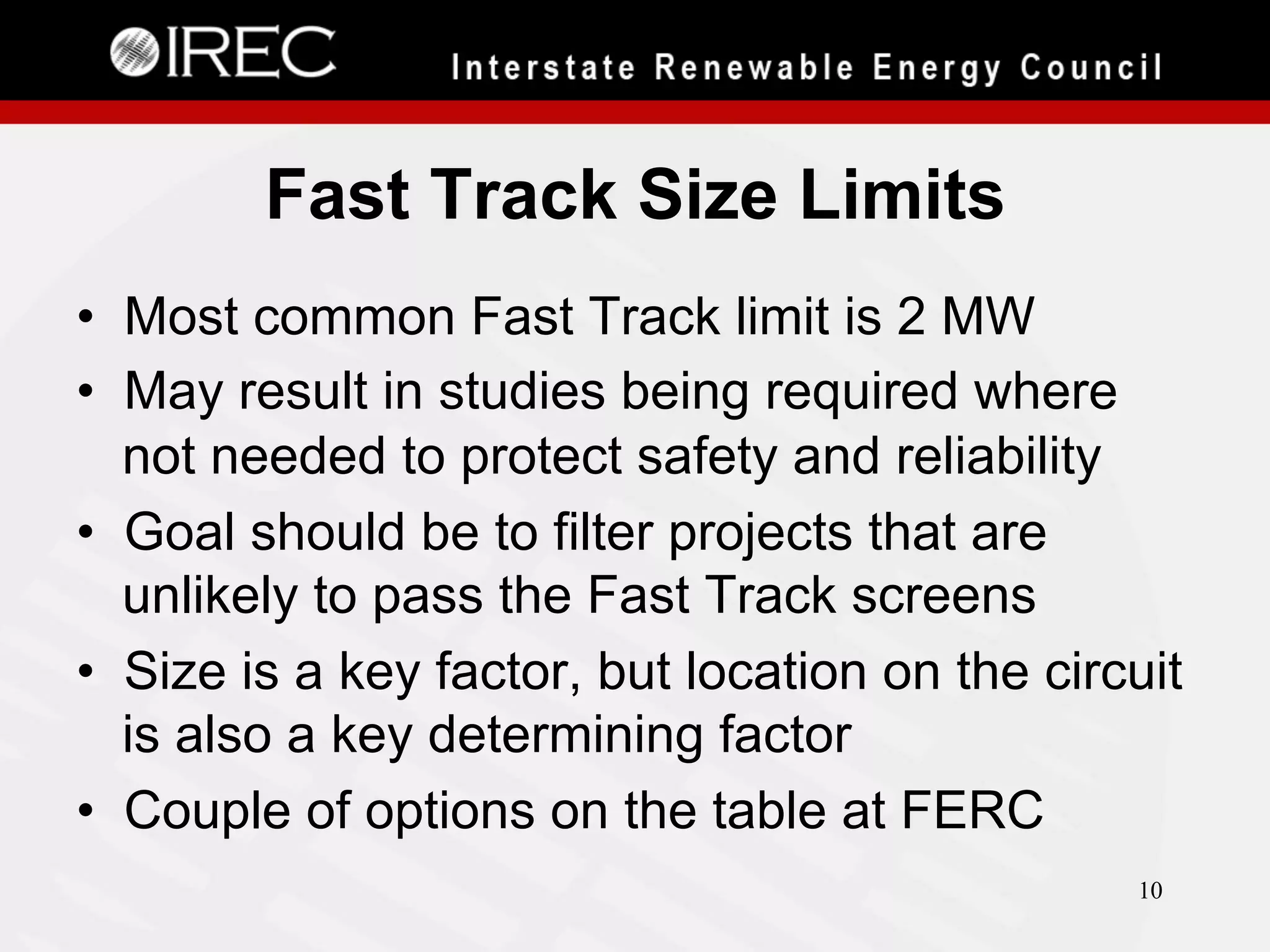
Fast Track Size Limits
•  Most common Fast Track limit is 2 MW
•  May result in studies being required where
not needed to protect safety and reliability
•  Goal should be to filter projects that are
unlikely to pass the Fast Track screens
•  Size is a key factor, but location on the circuit
is also a key determining factor
•  Couple of options on the table at FERC
10
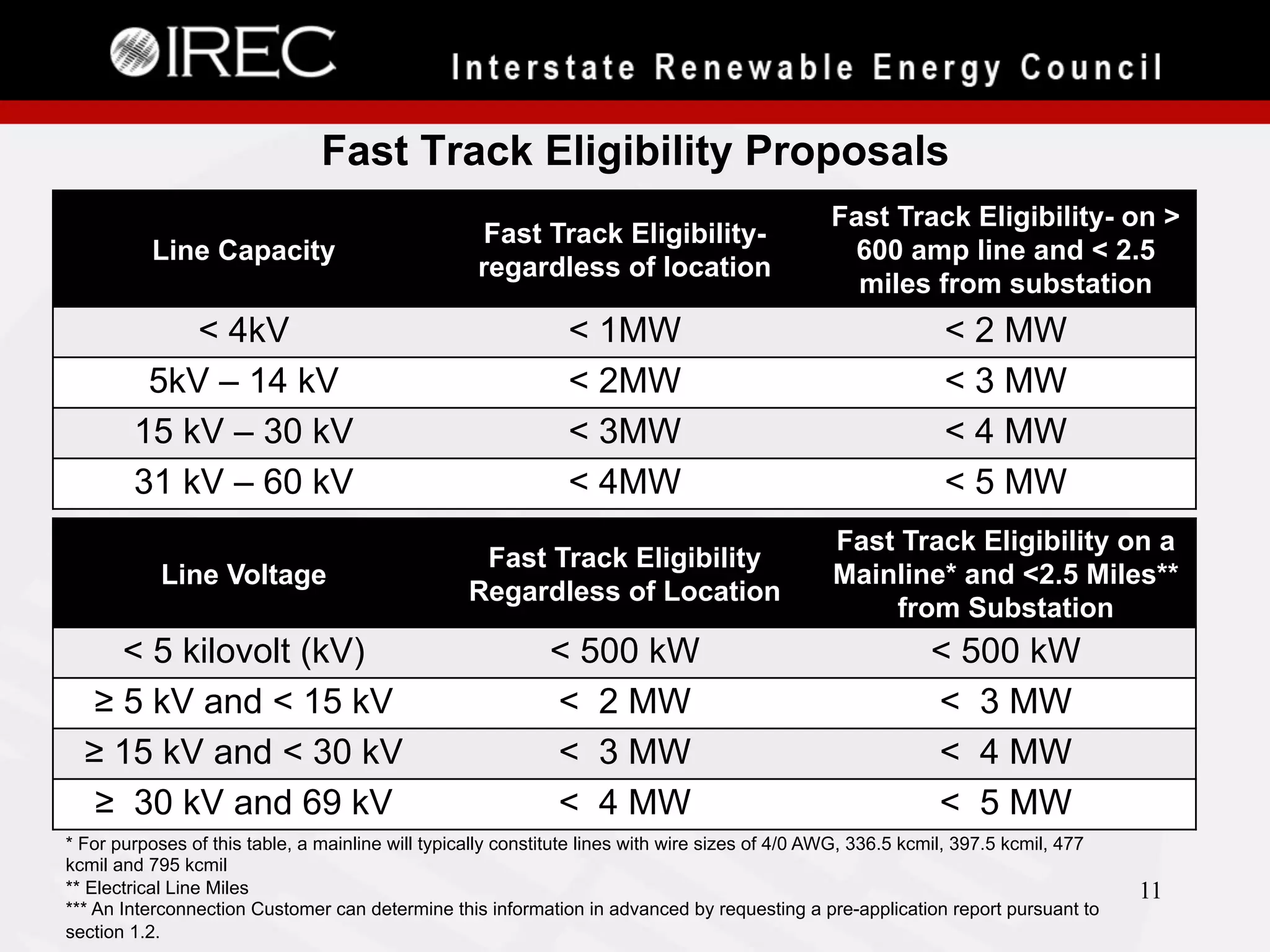
Fast Track Eligibility Proposals
Line Capacity

Fast Track Eligibilityregardless of location

Fast Track Eligibility- on >
600 amp line and < 2.5
miles from substation

< 4kV
5kV – 14 kV
15 kV – 30 kV
31 kV – 60 kV

< 1MW
< 2MW
< 3MW
< 4MW

< 2 MW
< 3 MW
< 4 MW
< 5 MW

Line Voltage

Fast Track Eligibility
Regardless of Location

Fast Track Eligibility on a
Mainline* and <2.5 Miles**
from Substation

< 5 kilovolt (kV)
≥ 5 kV and < 15 kV
≥ 15 kV and < 30 kV
≥ 30 kV and 69 kV

< 500 kW
< 2 MW
< 3 MW
< 4 MW

< 500 kW
< 3 MW
< 4 MW
< 5 MW

* For purposes of this table, a mainline will typically constitute lines with wire sizes of 4/0 AWG, 336.5 kcmil, 397.5 kcmil, 477
kcmil and 795 kcmil
** Electrical Line Miles
*** An Interconnection Customer can determine this information in advanced by requesting a pre-application report pursuant to
section 1.2.

11
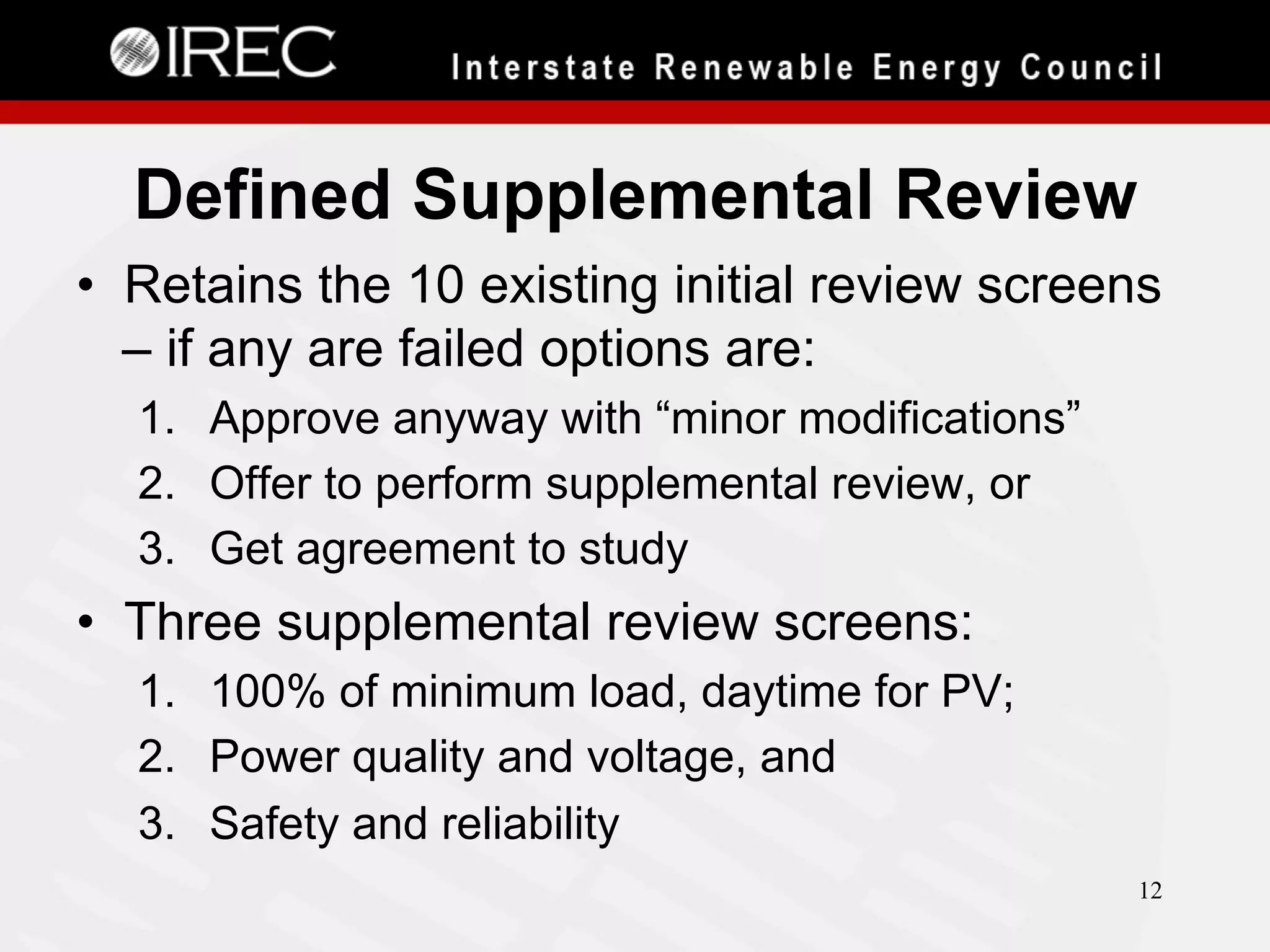
Defined Supplemental Review
•  Retains the 10 existing initial review screens
– if any are failed options are:
1.  Approve anyway with “minor modifications”
2.  Offer to perform supplemental review, or
3.  Get agreement to study

•  Three supplemental review screens:
1.  100% of minimum load, daytime for PV;
2.  Power quality and voltage, and
3.  Safety and reliability
12
Differentiated Study Processes
• 
• 
• 
• 
• 
• 

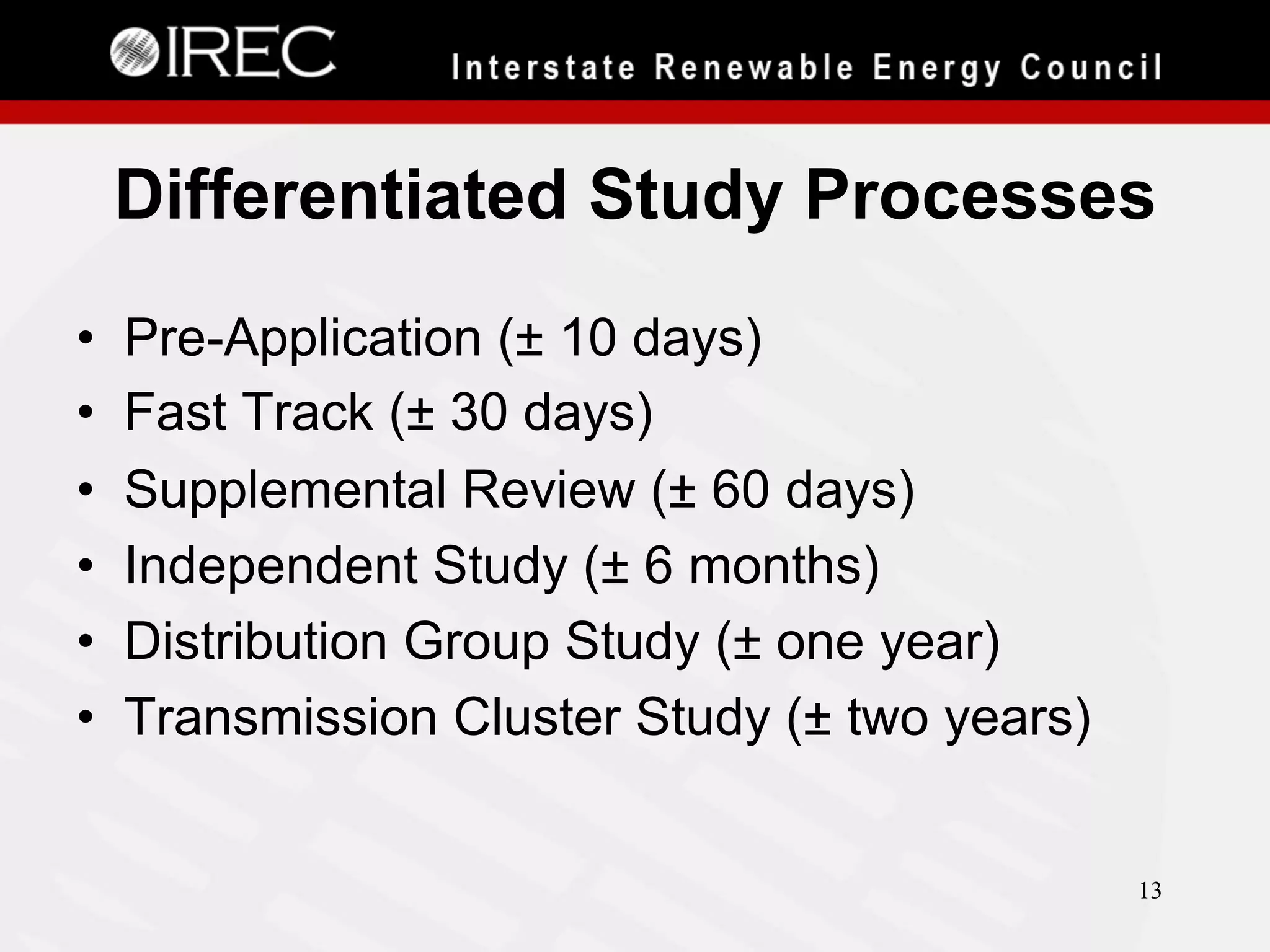
Pre-Application (± 10 days)
Fast Track (± 30 days)
Supplemental Review (± 60 days)
Independent Study (± 6 months)
Distribution Group Study (± one year)
Transmission Cluster Study (± two years)
13
Group/Cluster Studies
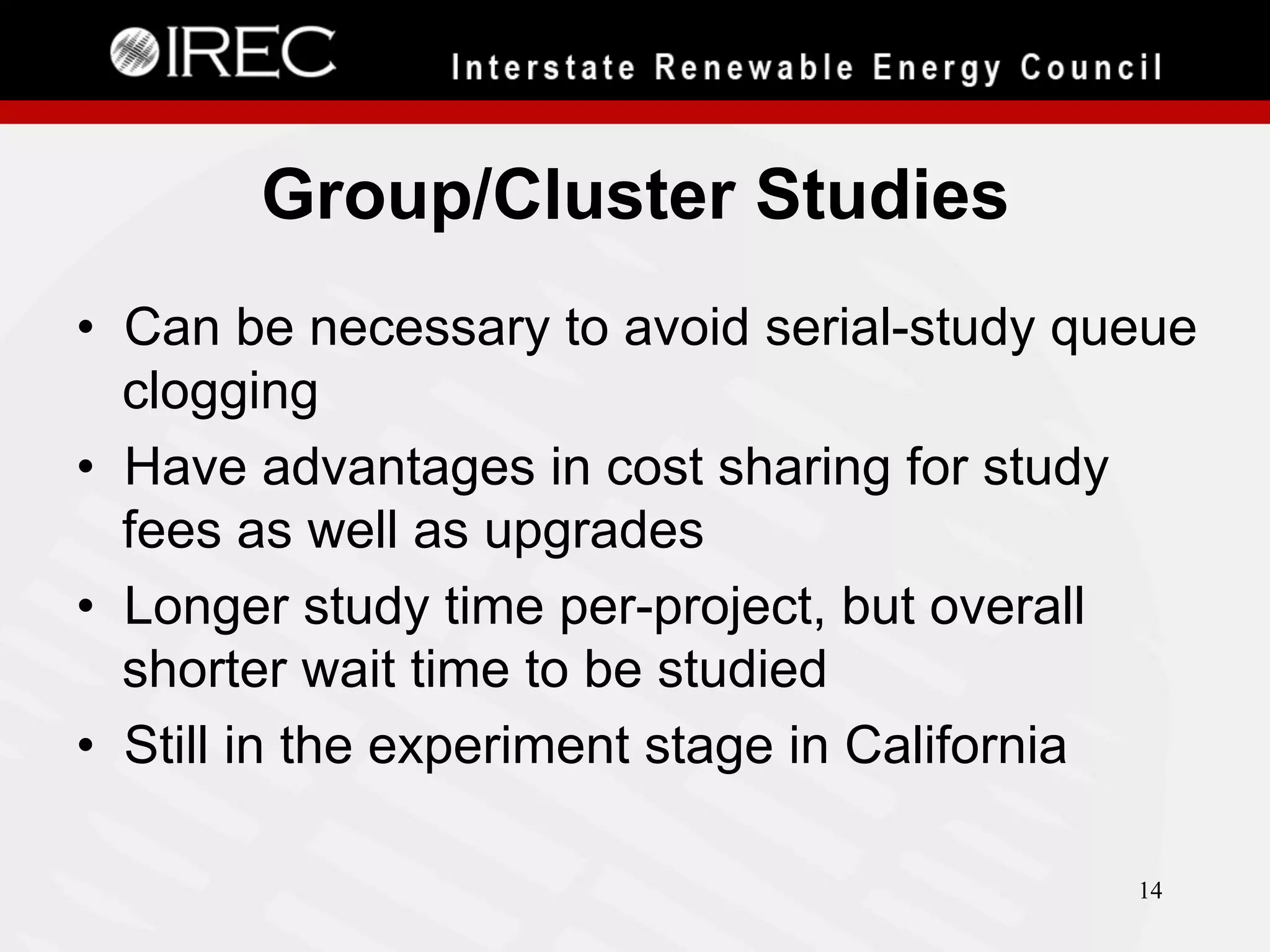
•  Can be necessary to avoid serial-study queue
clogging
•  Have advantages in cost sharing for study
fees as well as upgrades
•  Longer study time per-project, but overall
shorter wait time to be studied
•  Still in the experiment stage in California
14
Integrated Distribution Planning
• 
• 
• 
• 

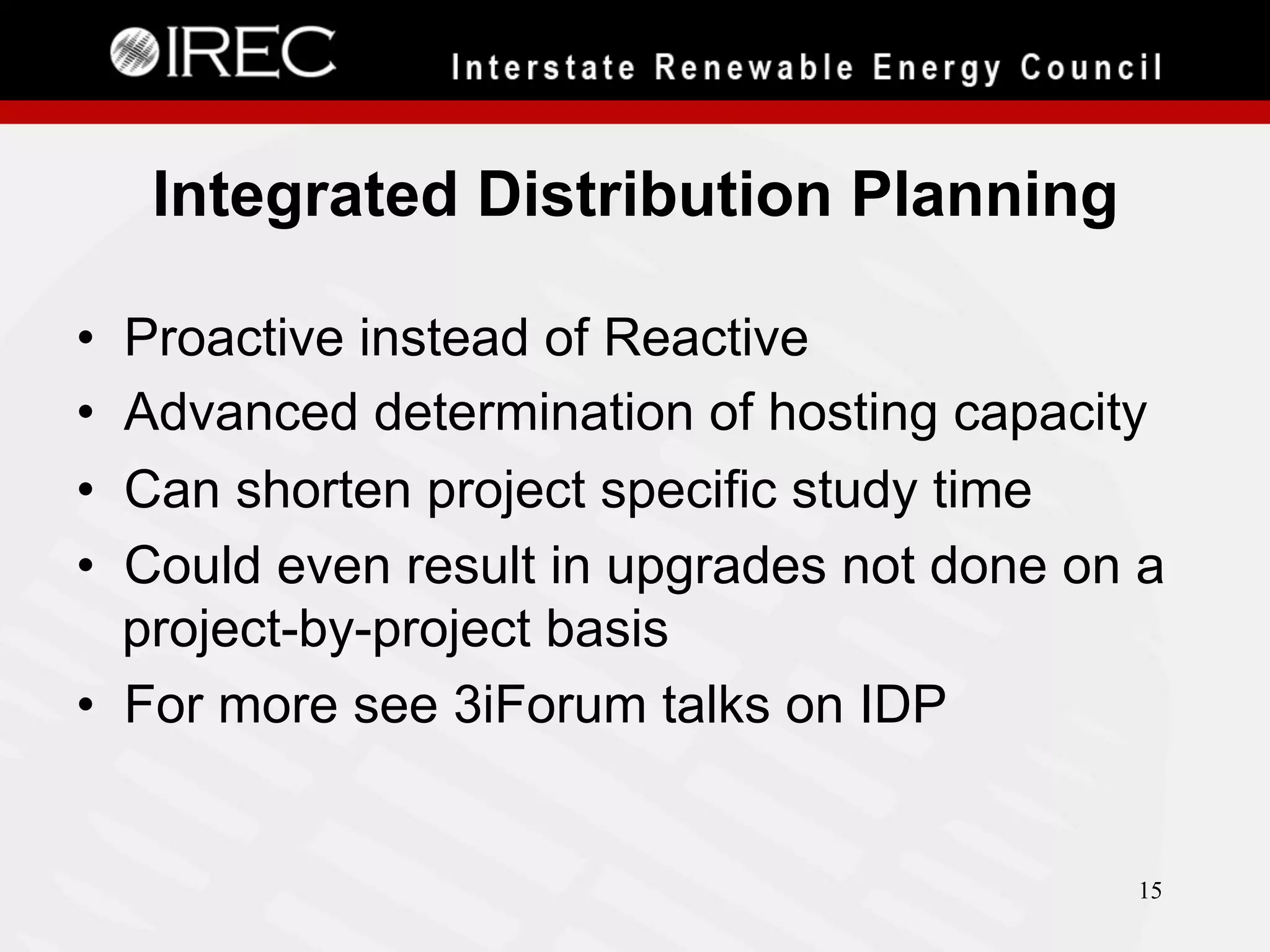
Proactive instead of Reactive
Advanced determination of hosting capacity
Can shorten project specific study time
Could even result in upgrades not done on a
project-by-project basis
•  For more see 3iForum talks on IDP

15
Questions?
Sky Stanfield
Keyes, Fox & Wiedman LLP
(510) 314-8204
sstanfield@kfwlaw.com

16
What is FERC Doing with SGIP?
•  Issued a NOPR in January 2013 post SEIA
petition
•  Workshops were held, Comments filed in June
•  Considering a rule similar to Rule 21
•  Why does it matter?
–  Model for state procedures
–  Could help facilitate greater penetration of DG at lower
cost to developers

•  Watch for decision later this year or early next
17
THANKS to our generous sponsors for the
2013 3iForum and 3iAwards

Interconnection Issues at Higher Penetrations

  • 1.
    Interconnection Issues at HigherPenetrations Sky C. Stanfield 1
  • 2.
    Installed Grid-Connected SolarCapacity (MW) 3,500   3,000   3340  MW   Capacity  (MW-­‐dc)   2,500   2,000   1,500   1800  MW   U)lity   Non-­‐Residen)al   Residen)al   1,000   500   0   2
  • 3.
    Number of AnnualGrid-Connected Installations 100,000 90,000 95,000   80,000 70,000 60,000 50,000 40,000 65,000   U)lity   Non-­‐Residen)al   Residen)al   30,000 20,000 10,000 0 3
  • 4.
    Most Interconnection Procedures WereDesigned for a Different Era •  FERC adopted SGIP in 2005, subsequently many states adopted procedures modeled on SGIP or the original California Rule 21 –  In 2005 the US installed 79 MW of grid connected PV –  In 2012 the US installed 3,300 MW of grid connected PV •  Until last year, few states had updated their procedures to reflect this changing reality 4
  • 5.
    Key Reasons forUpdating Interconnection Procedures •  •  •  •  •  High volume of interconnection applications Increased penetration on distribution circuits Backlogged study queues Unclear review requirements Lack of transparency regarding system conditions •  Better procedures = lower costs for solar customers and utilities/rate payers 5
  • 6.
    Interconnection Rules Are Changing • Both state and federally regulated procedures in California have been updated •  Hawaii, Massachusetts, Ohio and others have recently adopted or are considering changes •  FERC is currently considering significant updates to SGIP 6
  • 7.
    A Few Principlesfor Efficient Interconnection •  Filter projects before applications are filed •  Enable developers to select low-cost sites •  Apply the appropriate amount of study to each project •  Ensure timelines are clear and complied with •  Allow opportunities for cost sharing 7
  • 8.
    New and Noteworthy Approachesto Interconnection •  •  •  •  •  •  Pre-Application Reports and other tools Fast Track size limits Improved Supplemental Review Differentiated Study Processes Group/Cluster Studies Up Next: Integrated Distribution Planning? 8
  • 9.
    Pre-Application Report •  Reporton system conditions at a particular point of interconnection •  Reduces number of speculative projects •  Help developers strategically locate projects •  Maximizes utilization of existing infrastructure •  Can help manage expectations •  Minimizes study queues, conserves utility staff time 9
  • 10.
    Fast Track SizeLimits •  Most common Fast Track limit is 2 MW •  May result in studies being required where not needed to protect safety and reliability •  Goal should be to filter projects that are unlikely to pass the Fast Track screens •  Size is a key factor, but location on the circuit is also a key determining factor •  Couple of options on the table at FERC 10
  • 11.
    Fast Track EligibilityProposals Line Capacity Fast Track Eligibilityregardless of location Fast Track Eligibility- on > 600 amp line and < 2.5 miles from substation < 4kV 5kV – 14 kV 15 kV – 30 kV 31 kV – 60 kV < 1MW < 2MW < 3MW < 4MW < 2 MW < 3 MW < 4 MW < 5 MW Line Voltage Fast Track Eligibility Regardless of Location Fast Track Eligibility on a Mainline* and <2.5 Miles** from Substation < 5 kilovolt (kV) ≥ 5 kV and < 15 kV ≥ 15 kV and < 30 kV ≥ 30 kV and 69 kV < 500 kW < 2 MW < 3 MW < 4 MW < 500 kW < 3 MW < 4 MW < 5 MW * For purposes of this table, a mainline will typically constitute lines with wire sizes of 4/0 AWG, 336.5 kcmil, 397.5 kcmil, 477 kcmil and 795 kcmil ** Electrical Line Miles *** An Interconnection Customer can determine this information in advanced by requesting a pre-application report pursuant to section 1.2. 11
  • 12.
    Defined Supplemental Review • Retains the 10 existing initial review screens – if any are failed options are: 1.  Approve anyway with “minor modifications” 2.  Offer to perform supplemental review, or 3.  Get agreement to study •  Three supplemental review screens: 1.  100% of minimum load, daytime for PV; 2.  Power quality and voltage, and 3.  Safety and reliability 12
  • 13.
    Differentiated Study Processes •  •  •  •  •  •  Pre-Application(± 10 days) Fast Track (± 30 days) Supplemental Review (± 60 days) Independent Study (± 6 months) Distribution Group Study (± one year) Transmission Cluster Study (± two years) 13
  • 14.
    Group/Cluster Studies •  Canbe necessary to avoid serial-study queue clogging •  Have advantages in cost sharing for study fees as well as upgrades •  Longer study time per-project, but overall shorter wait time to be studied •  Still in the experiment stage in California 14
  • 15.
    Integrated Distribution Planning •  •  •  •  Proactiveinstead of Reactive Advanced determination of hosting capacity Can shorten project specific study time Could even result in upgrades not done on a project-by-project basis •  For more see 3iForum talks on IDP 15
  • 16.
    Questions? Sky Stanfield Keyes, Fox& Wiedman LLP (510) 314-8204 sstanfield@kfwlaw.com 16
  • 17.
    What is FERCDoing with SGIP? •  Issued a NOPR in January 2013 post SEIA petition •  Workshops were held, Comments filed in June •  Considering a rule similar to Rule 21 •  Why does it matter? –  Model for state procedures –  Could help facilitate greater penetration of DG at lower cost to developers •  Watch for decision later this year or early next 17
  • 18.
    THANKS to ourgenerous sponsors for the 2013 3iForum and 3iAwards