Teaching
At the end of the lesson the students are
able to:
a. Identify the different levels of
values according to Max Scheler’s
hierarchy of values;
b. Explain the importance of
prioritizing the higher values over the
lower values;
c. Demonstrate the application of
values in various situations and
Values
Formation on
Teaching
TEACHING AS
YOUR VOCATION
MISSION,
PROFESSION
ACTIVITY
ACROSTIC STRENGTHENER
In a half (cross-wise) sheet of paper, using the letters of your first name, write the
values that are innate from you. Then answer the following questions.
E.g.:
K - Kindness
H - Health
E - Excellence
N - Nobility
T - Truth
Processing questions:
1. How do you prioritize your values in your life?
2. How do your values afeect your decisions and actions as a future educator and as
an individual?
3. How do you cope with the challenges and temptations that may compromoze your
values?
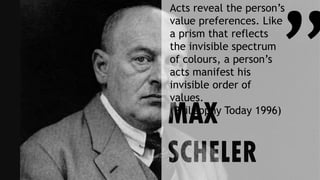
Acts reveal the person’s
value preferences. Like
a prism that reflects
the invisible spectrum
of colours, a person’s
acts manifest his
invisible order of
values.
(Philisophy Today 1996)
• Values are both
caught and taught,
and teachers need
to develop them
alive.
• Scheler’s
hierarchy of
values shows our
preferences and
decisions in
PLEASURE VALUES
a. The pleasant against the unpleasant
b. The agreeable against the agreeable
• Sensual feelings
• Experiences of pleasure of pain
VITAL VALUES
a. Values pertaining to the well-being
either of the individual community
• Health
• Vitality
b. Values of vital being
• Capability
• excellence
SPIRITUAL VALUES
a. Values independent of the whole
sphere of the body and environment;
b. Gasped in spiritual acts of preferring,
loving and hating
• Aesthetic values, beauty against
ugliness
• Values of right and wrong
• Values of pure knowledge
VALUES OF THE
HOLY
a. Appear only in regard to the object
intentionally given as “absolute
objects”
• Belief
• Adoration
• Bliss
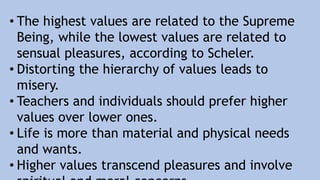
• The highest values are related to the Supreme
Being, while the lowest values are related to
sensual pleasures, according to Scheler.
• Distorting the hierarchy of values leads to
misery.
• Teachers and individuals should prefer higher
values over lower ones.
• Life is more than material and physical needs
and wants.
• Higher values transcend pleasures and involve
QUIZ
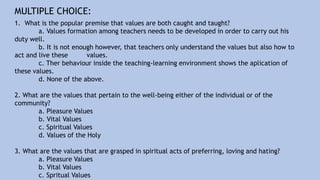
MULTIPLE CHOICE:
1. What is the popular premise that values are both caught and taught?
a. Values formation among teachers needs to be developed in order to carry out his
duty well.
b. It is not enough however, that teachers only understand the values but also how to
act and live these values.
c. Ther behaviour inside the teaching-learning environment shows the aplication of
these values.
d. None of the above.
2. What are the values that pertain to the well-being either of the individual or of the
community?
a. Pleasure Values
b. Vital Values
c. Spiritual Values
d. Values of the Holy
3. What are the values that are grasped in spiritual acts of preferring, loving and hating?
a. Pleasure Values
b. Vital Values
c. Spritual Values
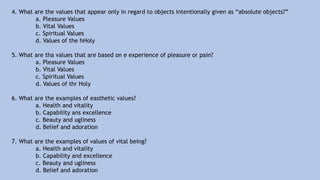
4. What are the values that appear only in regard to objects intentionally given as “absolute objects?”
a. Pleasure Values
b. Vital Values
c. Spiritual Values
d. Values of the hHoly
5. What are tha values that are based on e experience of pleasure or pain?
a. Pleasure Values
b. Vital Values
c. Spiritual Values
d. Values of thr Holy
6. What are the examples of easthetic values?
a. Health and vitality
b. Capability ans excellence
c. Beauty and ugliness
d. Belief and adoration
7. What are the examples of values of vital being?
a. Health and vitality
b. Capability and excellence
c. Beauty and ugliness
d. Belief and adoration
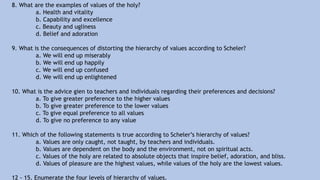
8. What are the examples of values of the holy?
a. Health and vitality
b. Capability and excellence
c. Beauty and ugliness
d. Belief and adoration
9. What is the consequences of distorting the hierarchy of values according to Scheler?
a. We will end up miserably
b. We will end up happily
c. We will end up confused
d. We will end up enlightened
10. What is the advice gien to teachers and individuals regarding their preferences and decisions?
a. To give greater preference to the higher values
b. To give greater preference to the lower values
c. To give equal preference to all values
d. To give no preference to any value
11. Which of the following statements is true according to Scheler’s hierarchy of values?
a. Values are only caught, not taught, by teachers and individuals.
b. Values are dependent on the body and the environment, not on spiritual acts.
c. Values of the holy are related to absolute objects that inspire belief, adoration, and bliss.
d. Values of pleasure are the highest values, while values of the holy are the lowest values.
12 - 15. Enumerate the four levels of hierarchy of values.
ASSIGNMENT AND REFLECTION
• In a one whole sheet of paper
write a reflection on what you
learnt from the lesson and how
you can apply it in your future
teaching profession.
• Submission will be tomorrow.
Thank you for
your
Participation!

Hierarchy of Values (Max Scheler).pptx

  • 1.
    Teaching At the endof the lesson the students are able to: a. Identify the different levels of values according to Max Scheler’s hierarchy of values; b. Explain the importance of prioritizing the higher values over the lower values; c. Demonstrate the application of values in various situations and
  • 2.
  • 3.
  • 4.
  • 5.
    ACROSTIC STRENGTHENER In ahalf (cross-wise) sheet of paper, using the letters of your first name, write the values that are innate from you. Then answer the following questions. E.g.: K - Kindness H - Health E - Excellence N - Nobility T - Truth Processing questions: 1. How do you prioritize your values in your life? 2. How do your values afeect your decisions and actions as a future educator and as an individual? 3. How do you cope with the challenges and temptations that may compromoze your values?
  • 6.
    Acts reveal theperson’s value preferences. Like a prism that reflects the invisible spectrum of colours, a person’s acts manifest his invisible order of values. (Philisophy Today 1996)
  • 7.
    • Values areboth caught and taught, and teachers need to develop them alive. • Scheler’s hierarchy of values shows our preferences and decisions in
  • 9.
    PLEASURE VALUES a. Thepleasant against the unpleasant b. The agreeable against the agreeable • Sensual feelings • Experiences of pleasure of pain
  • 10.
    VITAL VALUES a. Valuespertaining to the well-being either of the individual community • Health • Vitality b. Values of vital being • Capability • excellence
  • 11.
    SPIRITUAL VALUES a. Valuesindependent of the whole sphere of the body and environment; b. Gasped in spiritual acts of preferring, loving and hating • Aesthetic values, beauty against ugliness • Values of right and wrong • Values of pure knowledge
  • 12.
    VALUES OF THE HOLY a.Appear only in regard to the object intentionally given as “absolute objects” • Belief • Adoration • Bliss
  • 13.
    • The highestvalues are related to the Supreme Being, while the lowest values are related to sensual pleasures, according to Scheler. • Distorting the hierarchy of values leads to misery. • Teachers and individuals should prefer higher values over lower ones. • Life is more than material and physical needs and wants. • Higher values transcend pleasures and involve
  • 14.
  • 15.
    MULTIPLE CHOICE: 1. Whatis the popular premise that values are both caught and taught? a. Values formation among teachers needs to be developed in order to carry out his duty well. b. It is not enough however, that teachers only understand the values but also how to act and live these values. c. Ther behaviour inside the teaching-learning environment shows the aplication of these values. d. None of the above. 2. What are the values that pertain to the well-being either of the individual or of the community? a. Pleasure Values b. Vital Values c. Spiritual Values d. Values of the Holy 3. What are the values that are grasped in spiritual acts of preferring, loving and hating? a. Pleasure Values b. Vital Values c. Spritual Values
  • 16.
    4. What arethe values that appear only in regard to objects intentionally given as “absolute objects?” a. Pleasure Values b. Vital Values c. Spiritual Values d. Values of the hHoly 5. What are tha values that are based on e experience of pleasure or pain? a. Pleasure Values b. Vital Values c. Spiritual Values d. Values of thr Holy 6. What are the examples of easthetic values? a. Health and vitality b. Capability ans excellence c. Beauty and ugliness d. Belief and adoration 7. What are the examples of values of vital being? a. Health and vitality b. Capability and excellence c. Beauty and ugliness d. Belief and adoration
  • 17.
    8. What arethe examples of values of the holy? a. Health and vitality b. Capability and excellence c. Beauty and ugliness d. Belief and adoration 9. What is the consequences of distorting the hierarchy of values according to Scheler? a. We will end up miserably b. We will end up happily c. We will end up confused d. We will end up enlightened 10. What is the advice gien to teachers and individuals regarding their preferences and decisions? a. To give greater preference to the higher values b. To give greater preference to the lower values c. To give equal preference to all values d. To give no preference to any value 11. Which of the following statements is true according to Scheler’s hierarchy of values? a. Values are only caught, not taught, by teachers and individuals. b. Values are dependent on the body and the environment, not on spiritual acts. c. Values of the holy are related to absolute objects that inspire belief, adoration, and bliss. d. Values of pleasure are the highest values, while values of the holy are the lowest values. 12 - 15. Enumerate the four levels of hierarchy of values.
  • 18.
    ASSIGNMENT AND REFLECTION •In a one whole sheet of paper write a reflection on what you learnt from the lesson and how you can apply it in your future teaching profession. • Submission will be tomorrow.
  • 19.