ITSM Sourcing specialization 2010 Directing Sourcing and Services
Agenda Shared Service Centers What is directing Processmodel for directing Roles within the directing organisation Learning Task 3 Questions and answers
Shared Services
Definition and goal of a Shared Service Center (SSC) We speak about an SSC as supporting processes within an organization on an approximately similar way, are delivered a new, semi-autonomous unit and on the basis of agreements it provides services to other units The goal of an SSC is generally to improve the service quality while cutting costs SSC versus centralization, service-oriented versus task
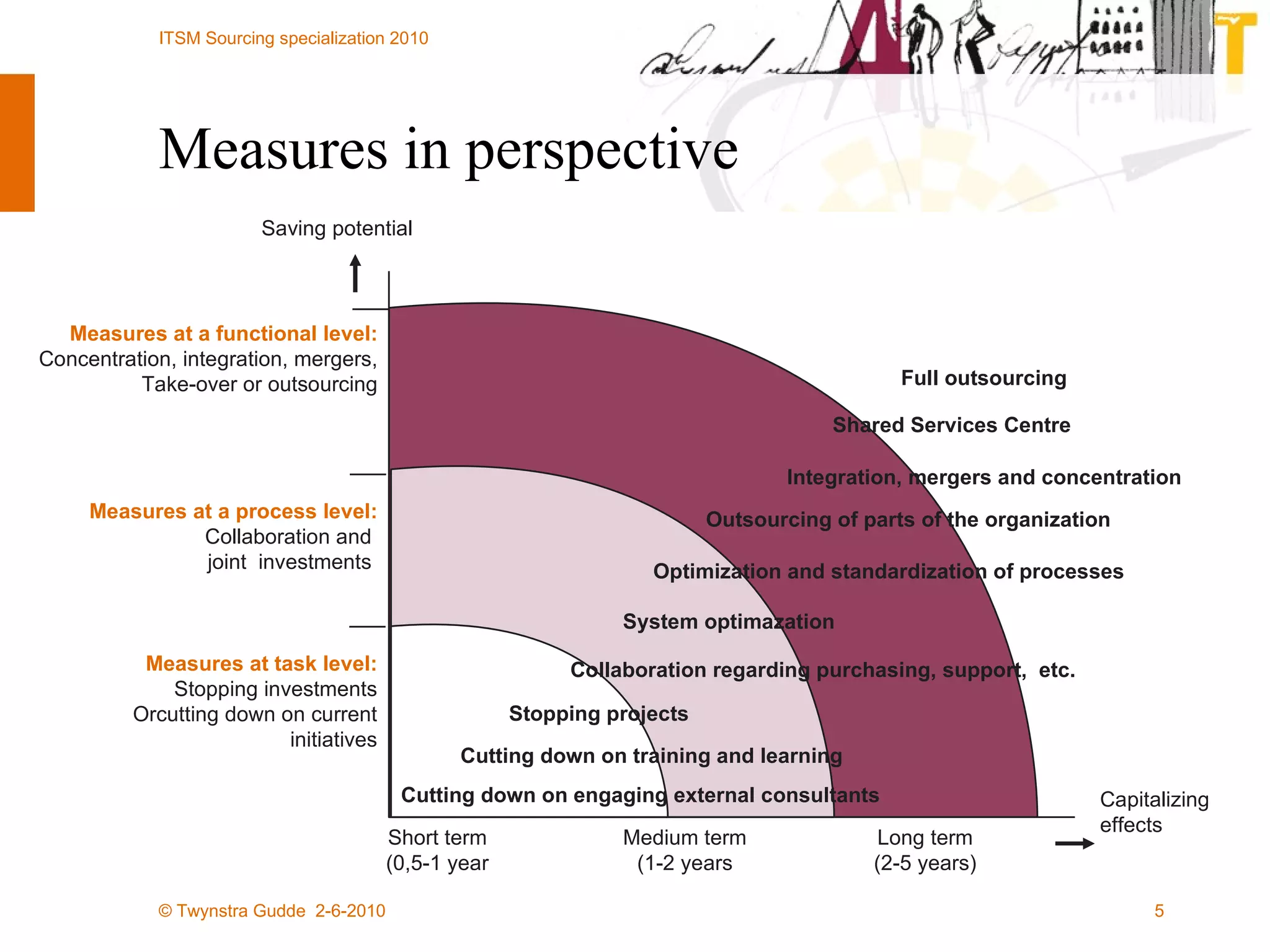
Measures in perspective Measures at task level: Stopping investments Orcutting down on current initiatives Measures at a process level: Collaboration and  joint  investments  Measures at a functional level: Concentration, integration, mergers, Take-over or outsourcing Saving potential Short term (0,5-1 year Medium term (1-2 years Long term (2-5 years) Stopping projects Cutting down on training and learning Cutting down on engaging external consultants System optimazation Collaboration regarding purchasing, support,  etc. Optimization and standardization of processes Integration, mergers and concentration Outsourcing of parts of the organization Shared Services Centre Full outsourcing Capitalizing effects
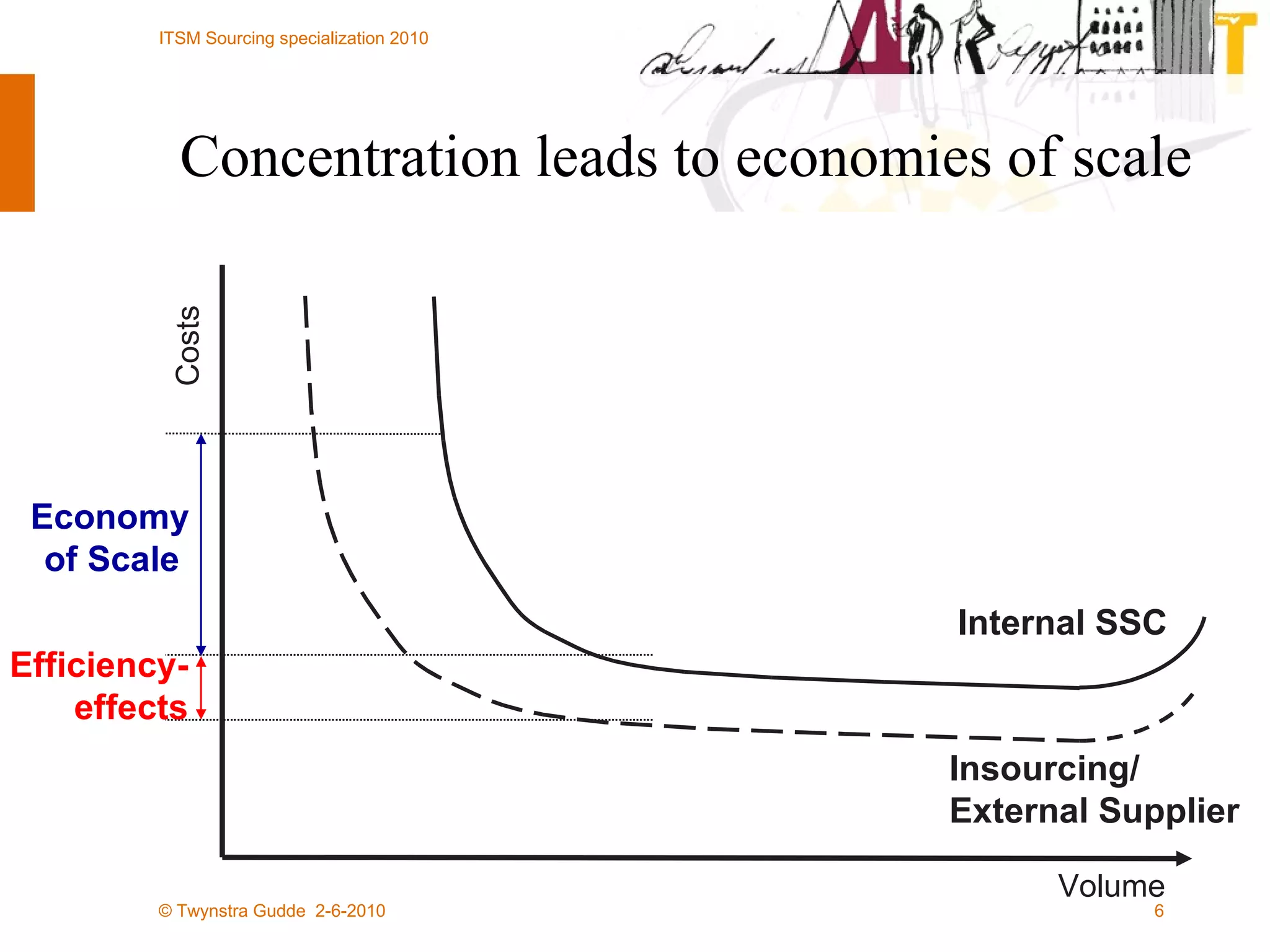
Concentration leads to economies of scale Internal SSC Insourcing/ External Supplier Costs Volume Efficiency- effects Economy of Scale
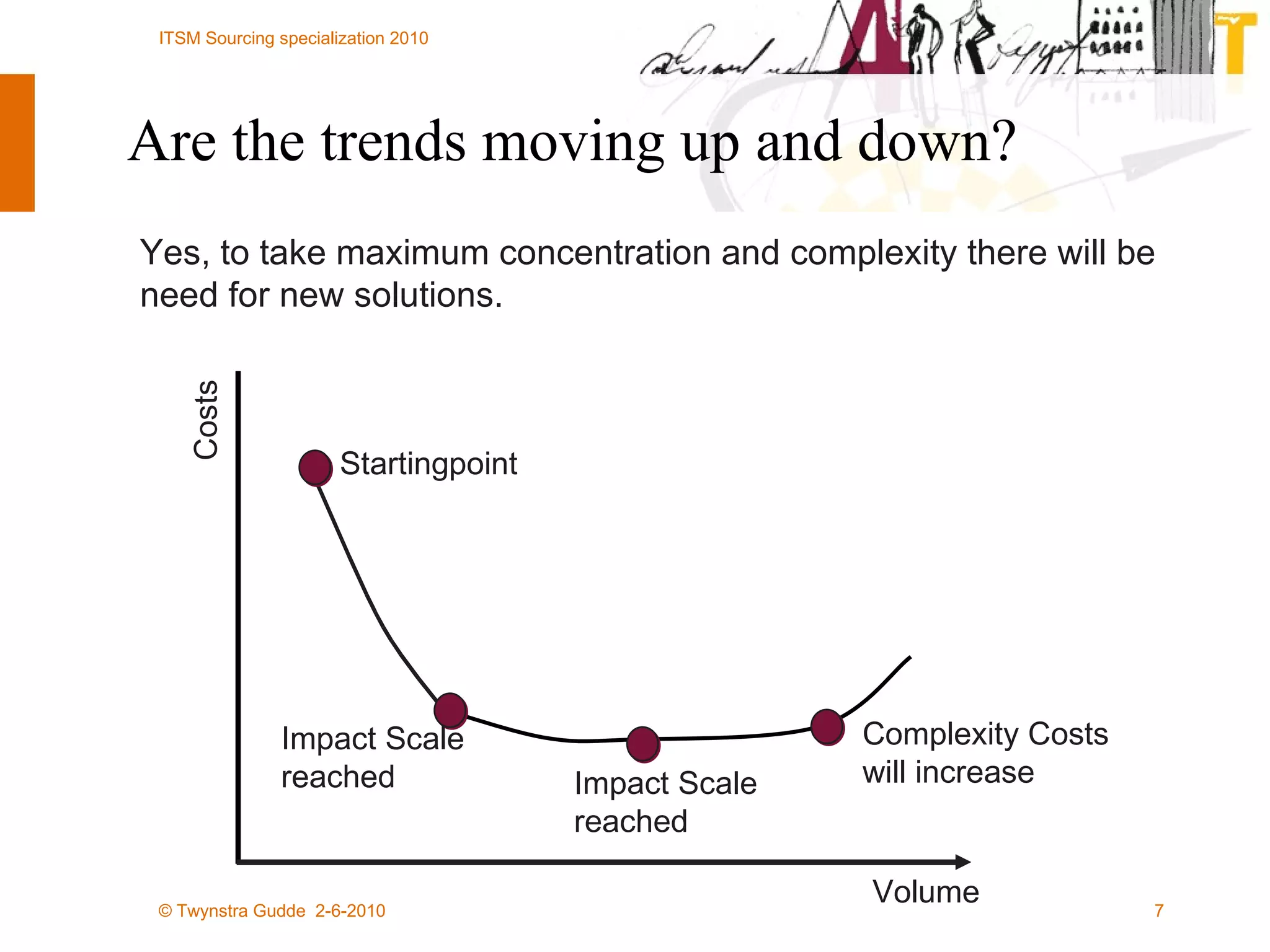
Are the trends moving up and down? Yes, to take maximum concentration and complexity there will be need for new solutions. Costs Volume Startingpoint Impact Scale  reached Impact Scale  reached Complexity Costs  will increase
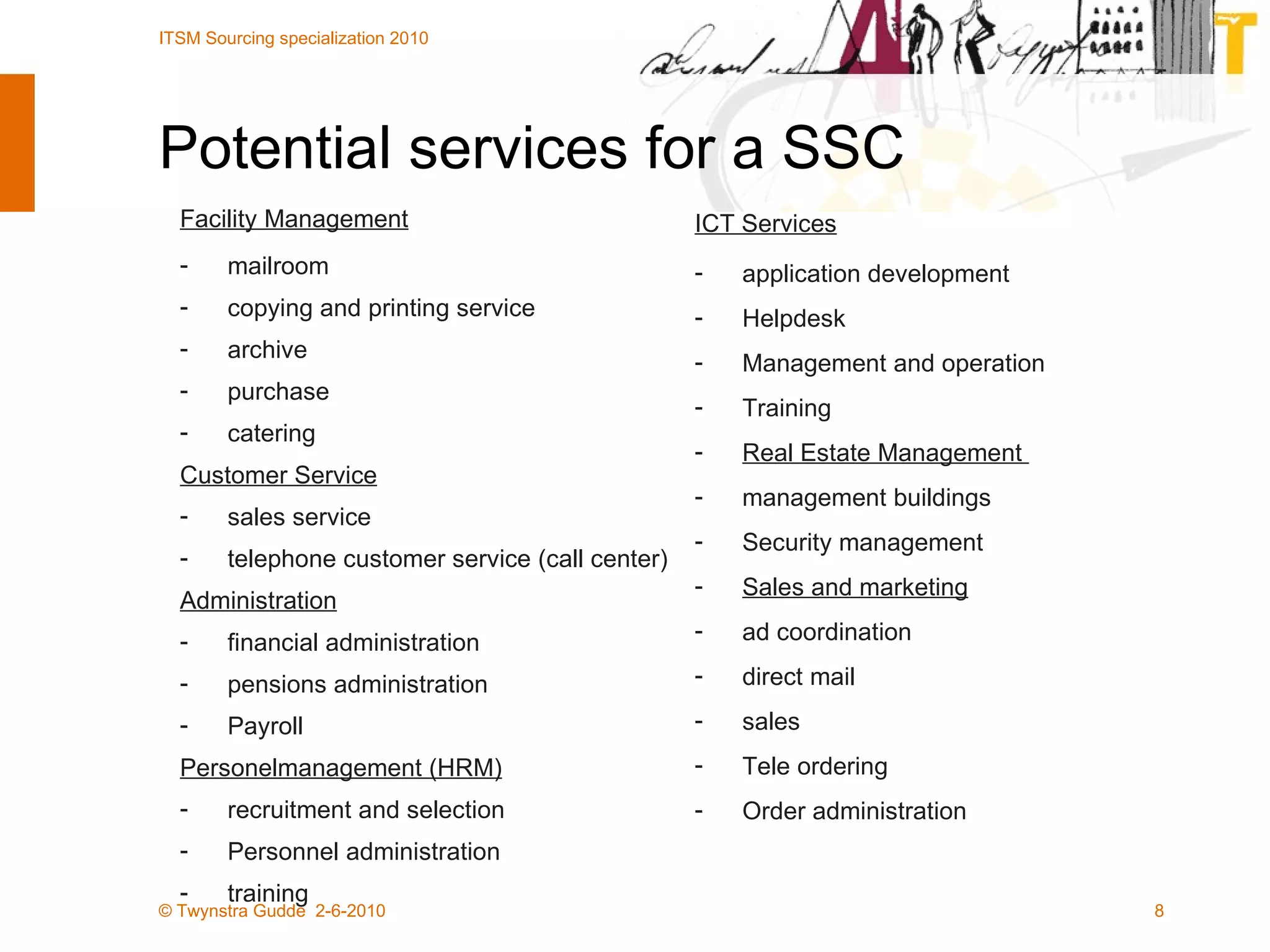
Potential services for a SSC Facility Management mailroom  copying and printing service archive  purchase  catering Customer Service sales service telephone customer service (call center) Administration financial administration  pensions administration  Payroll Personelmanagement (HRM) recruitment and selection  Personnel administration training ICT Services application development Helpdesk  Management and operation  Training Real Estate Management  management buildings Security management Sales and marketing ad coordination  direct mail  sales Tele ordering  Order administration
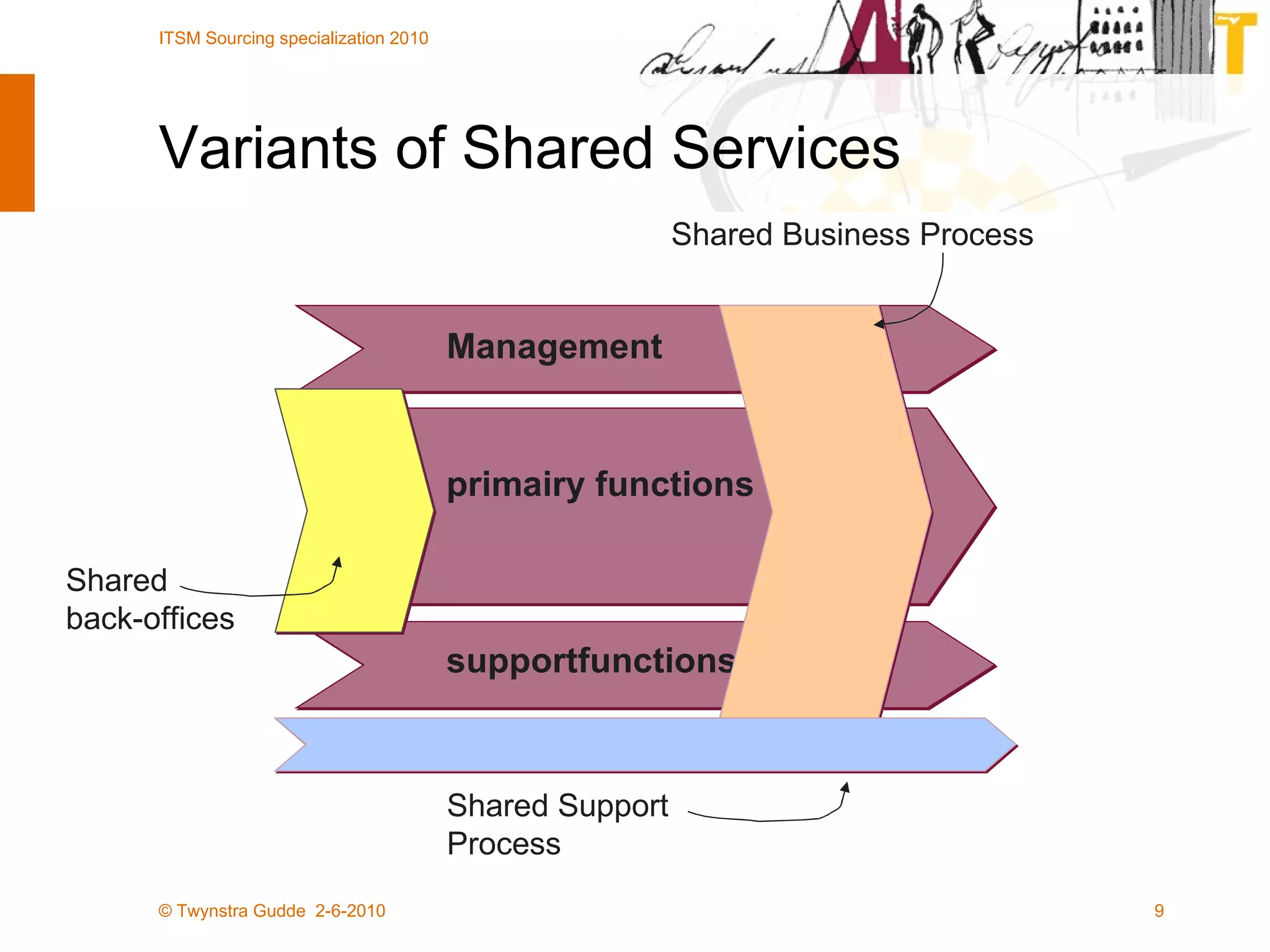
Variants of Shared Services supportfunctions Management   primairy functions Shared Support Process Shared Business Process Shared back-offices
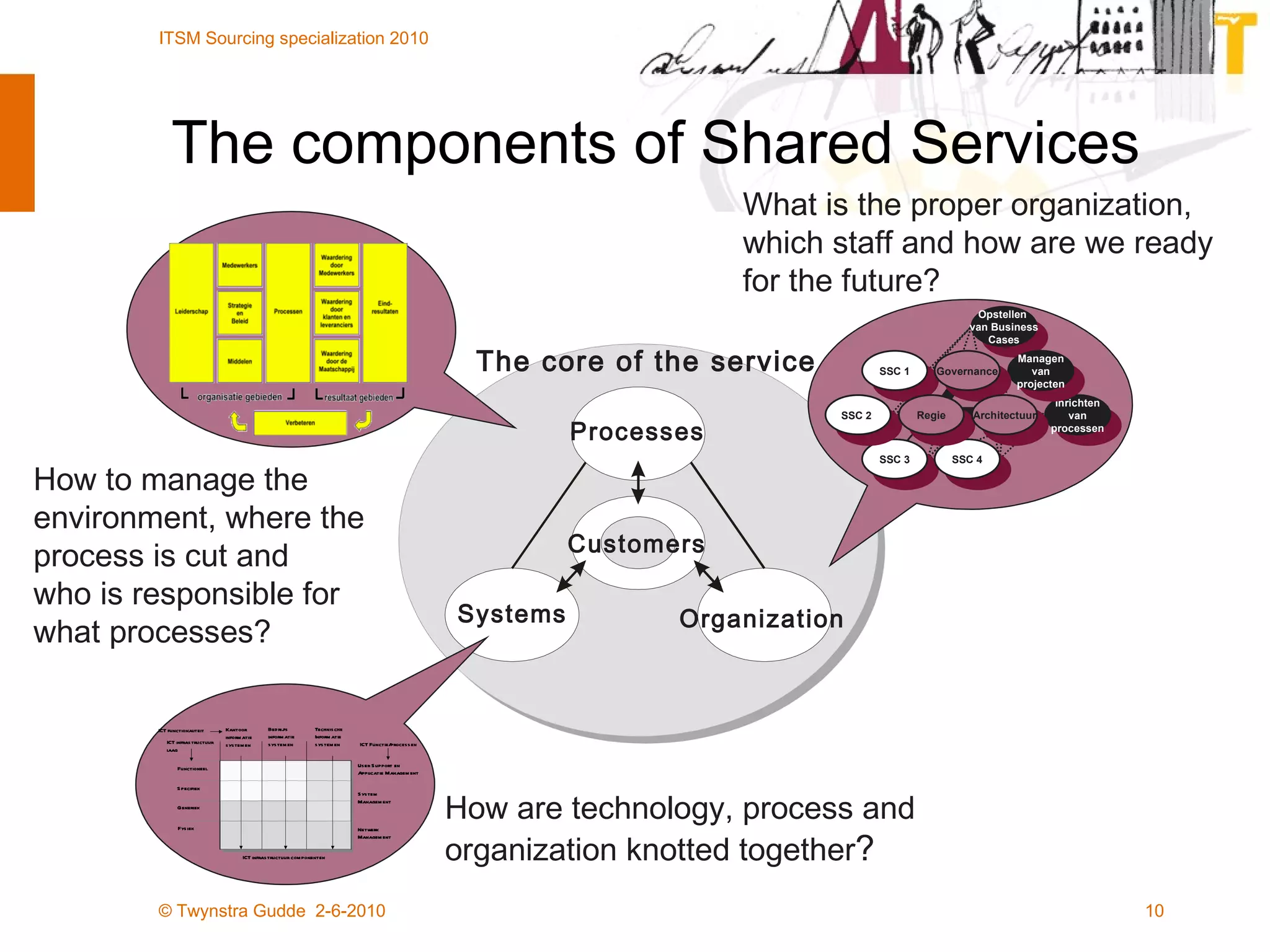
The components of Shared Services How to manage the  environment, where the  process is cut and  who is responsible for  what processes? What is the proper organization, which staff and how are we ready for the future? How are technology, process and organization knotted together ? The core of the service Processes Organization Systems Customers SSC 1 SSC 3 SSC 2  SSC 4 Opstellen  van Business Cases Inrichten van processen Managen van projecten Governance Regie Architectuur
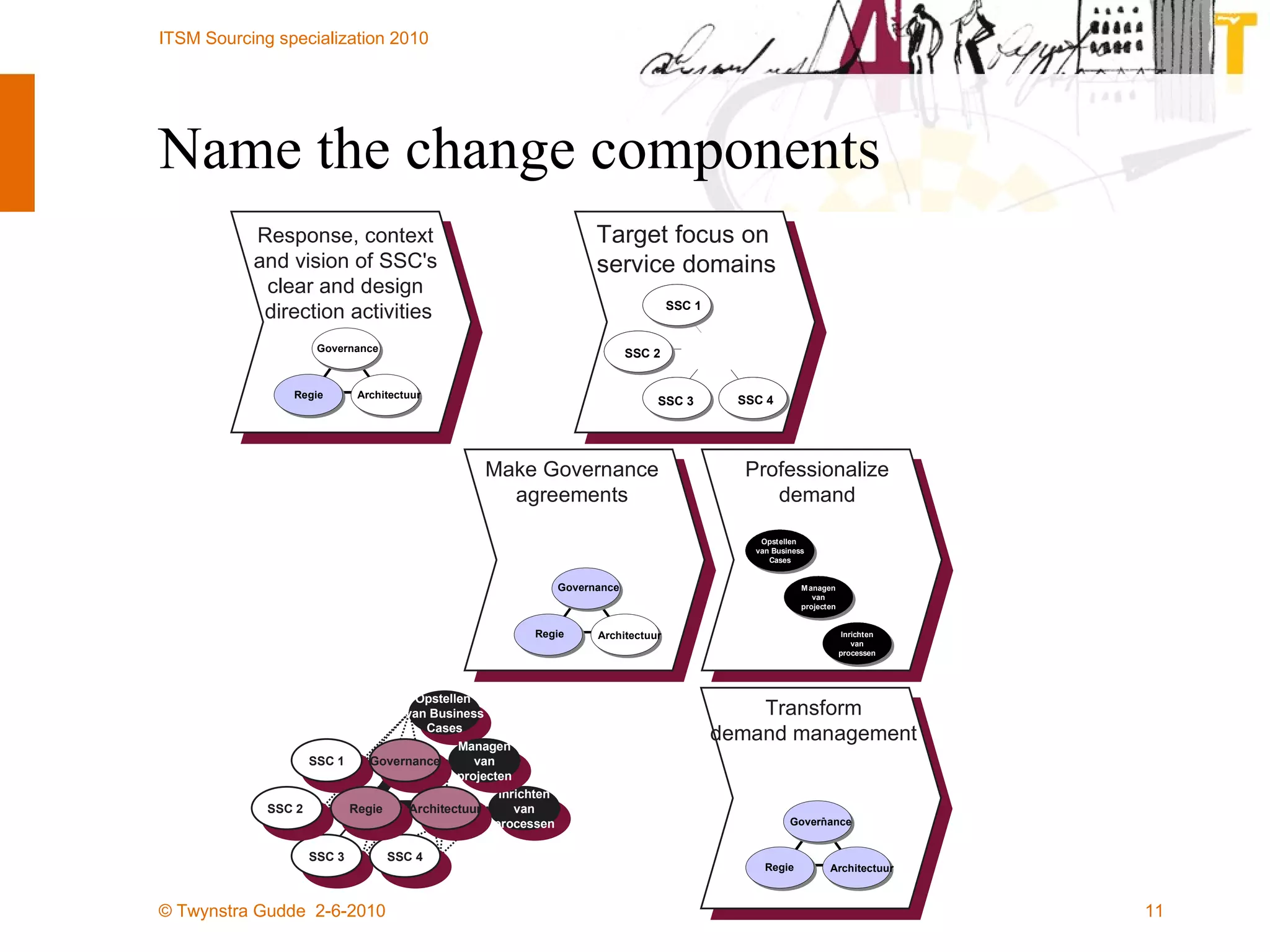
Name the change components Ontwikkelen maatwerk Ontwikkelen maatwerk Beheer infrastructuur Beheer infrastructuur Beheer & draaien  pakketten Beheer & draaien  pakketten Support/ Helpdesk Support/ Helpdesk Ontwikkelen maatwerk SSC 1 Beheer infrastructuur SSC 3 Beheer & draaien  pakketten SSC 2 Support/ Helpdesk SSC 4 Response, context  and vision of SSC's  clear and design  direction activities Target focus on  service domains ICT - governance Governance Regie Regie Architectuur Architectuur Make Governance agreements Professionalize demand ICT - governance Governance Regie Regie Architectuur Architectuur Transform demand management ICT - governance - Governance Regie Regie Architectuur Architectuur SSC 1 SSC 3 SSC 2  SSC 4 Opstellen  van Business Cases Inrichten van processen Managen van projecten Governance Regie Architectuur
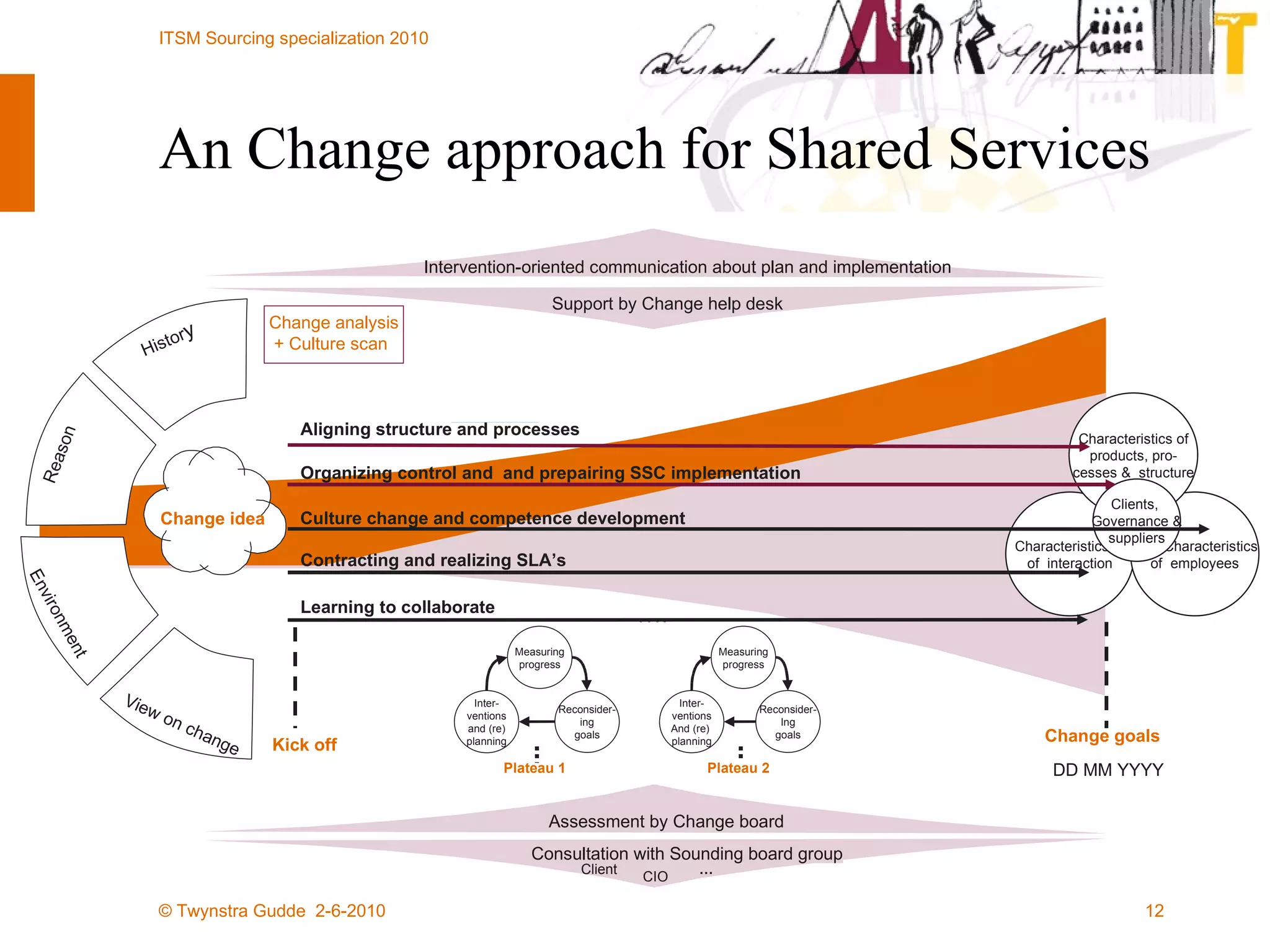
An Change approach for Shared Services … . Change idea Intervention-oriented communication about plan and implementation Support by Change help desk Assessment by Change board Consultation with Sounding board group CIO Client … Characteristics  of  interaction Characteristics of  employees Characteristics of products, pro- cesses &  structure Clients,  Governance & suppliers Histor y Reason Environment View on change Kick off Change analysis + Culture scan DD MM YYYY Change goals Aligning structure and processes Organizing control and  and prepairing SSC implementation Contracting and realizing SLA’s Culture change and competence development Learning to collaborate Inter- ventions And (re)  planning Reconsider- Ing goals Measuring progress Plateau 2 Inter- ventions and (re) planning Reconsider- ing goals Measuring progress Plateau 1
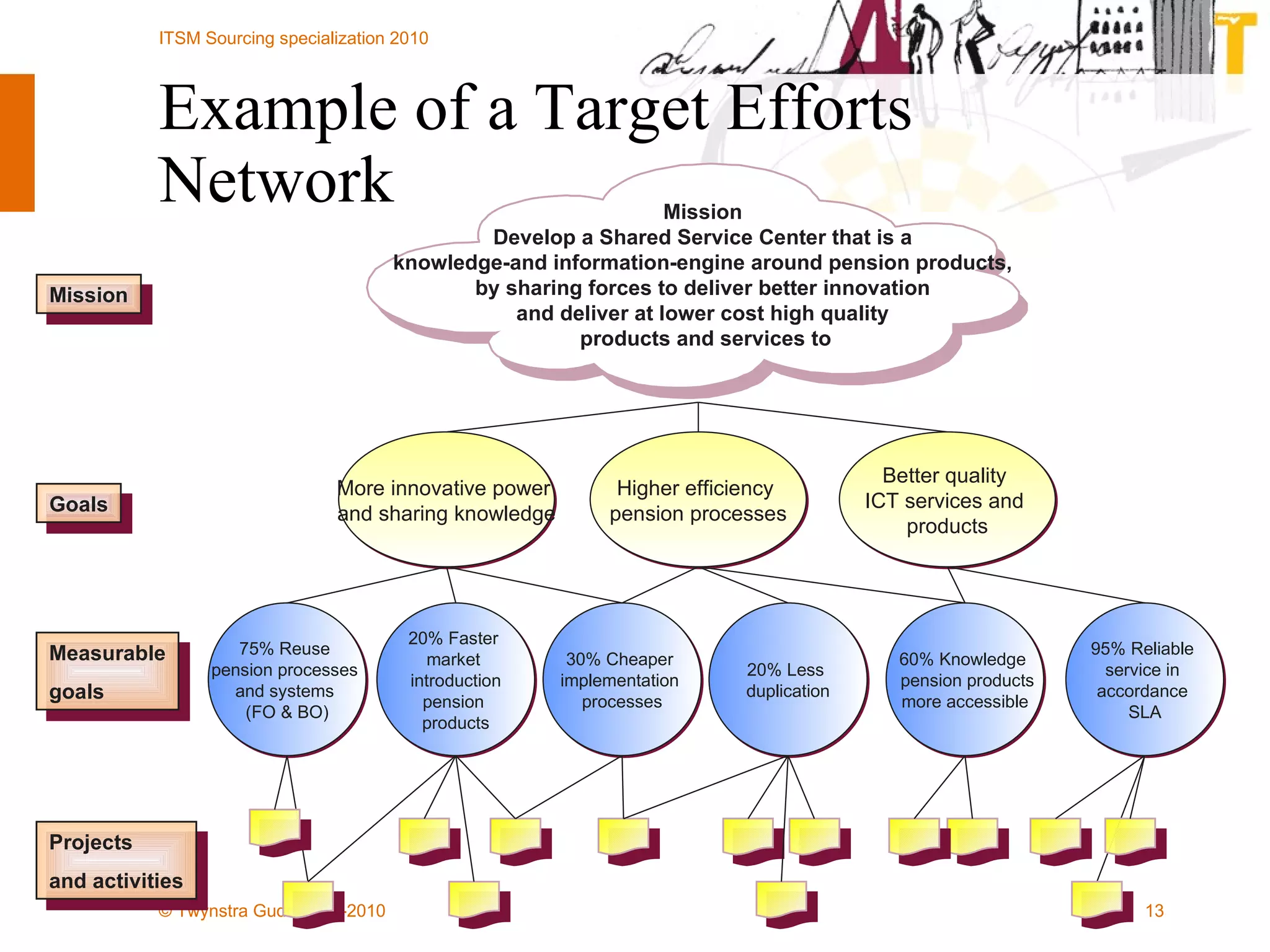
Example of a Target Efforts Network More innovative power  and sharing knowledge Higher efficiency  pension processes Better quality  ICT services and  products 75% Reuse  pension processes  and systems  (FO & BO) 20% Faster  market  introduction pension  products 30% Cheaper  implementation  processes 20% Less  duplication 60% Knowledge    pension products  more accessible 95% Reliable  service in  accordance  SLA Mission Goals Measurable goals Projects and activities Mission  Develop a Shared Service Center that is a  knowledge-and information-engine around pension products,  by sharing forces to deliver better innovation  and deliver at lower cost high quality  products and services to
What is directing?
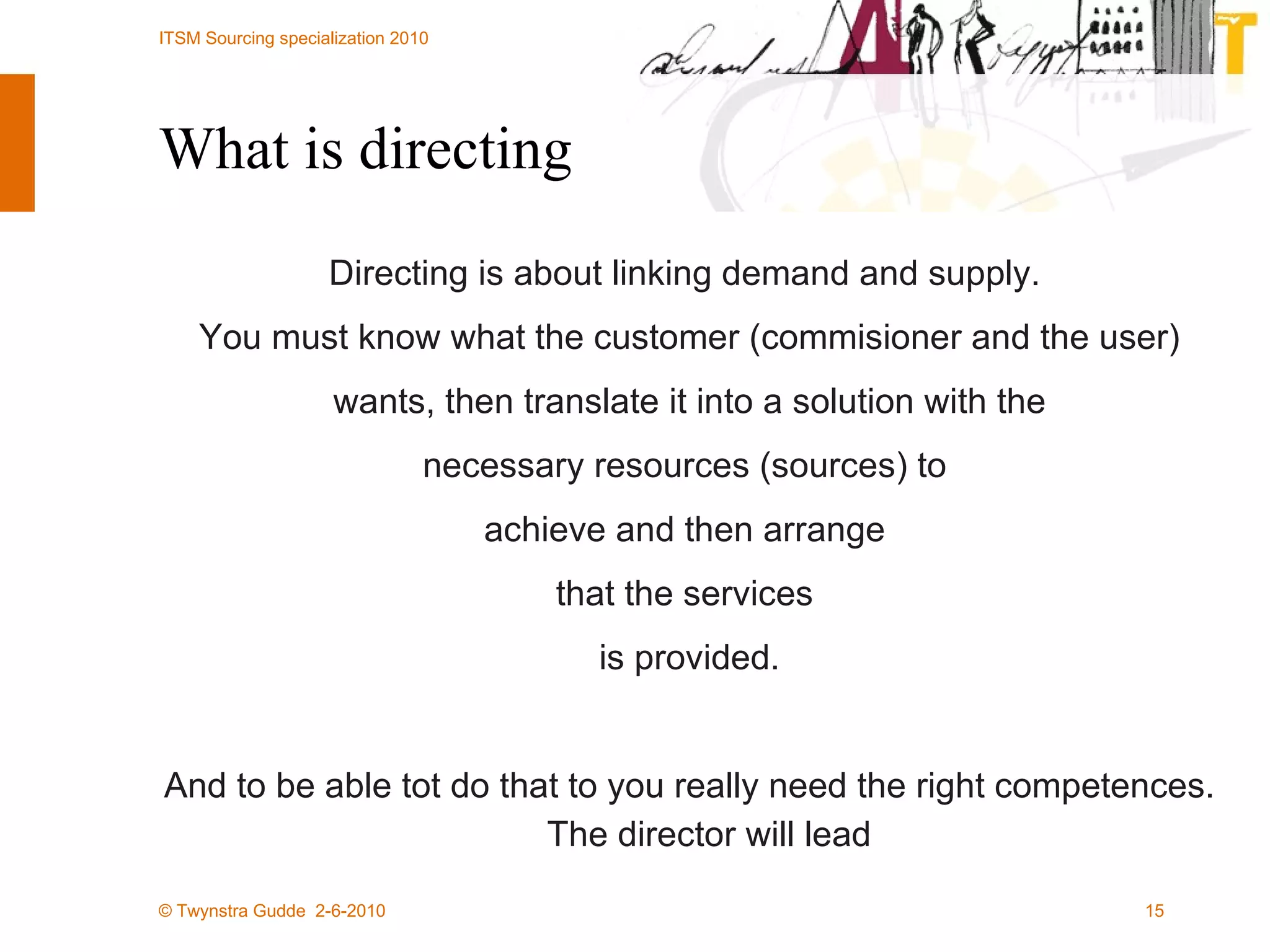
What is directing Directing is about linking demand and supply.  You must know what the customer (commisioner and the user) wants, then translate it into a solution with the  necessary resources (sources) to  achieve and then arrange  that the services  is provided. And to be able tot do that to you really need the right competences. The director will lead
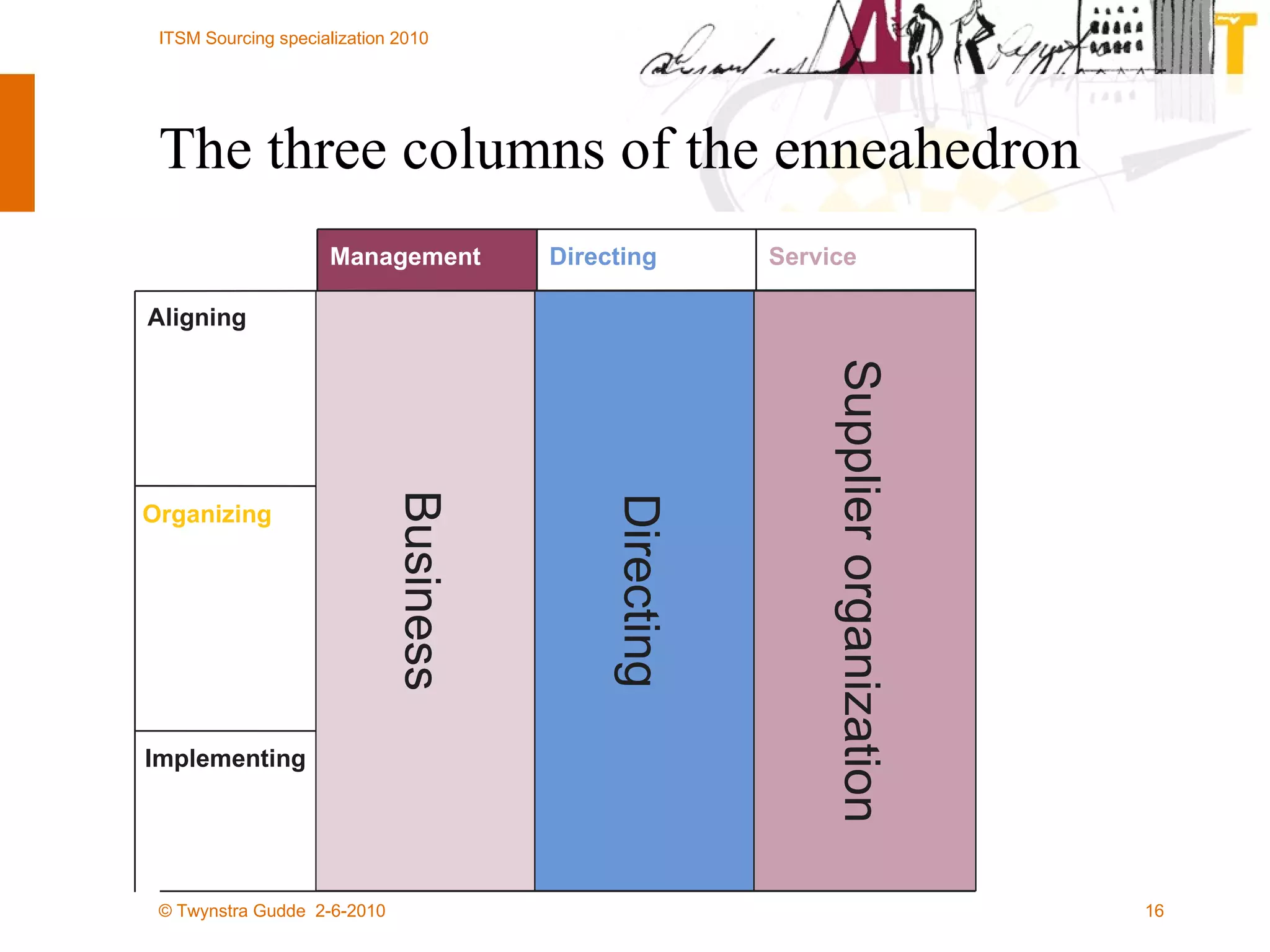
The three columns of the enneahedron  Beheren en exploiteren ICT services Beheren en gebruiken informatievoozieningen Ontwerpen en exploiteren bedrijfsvoering Implementing Ontwerpen en plannen ICT service Ontwerpen en plannen informatie voorziening en regie Ontwerpen en plannen bedrijfsvoering Organizing Bepalen strategie ICT service Bepalen strategie informatie voorziening en regie Bepalen strategie bedrijfsvoering Aligning Service Directing Management Business Directing Supplier organization
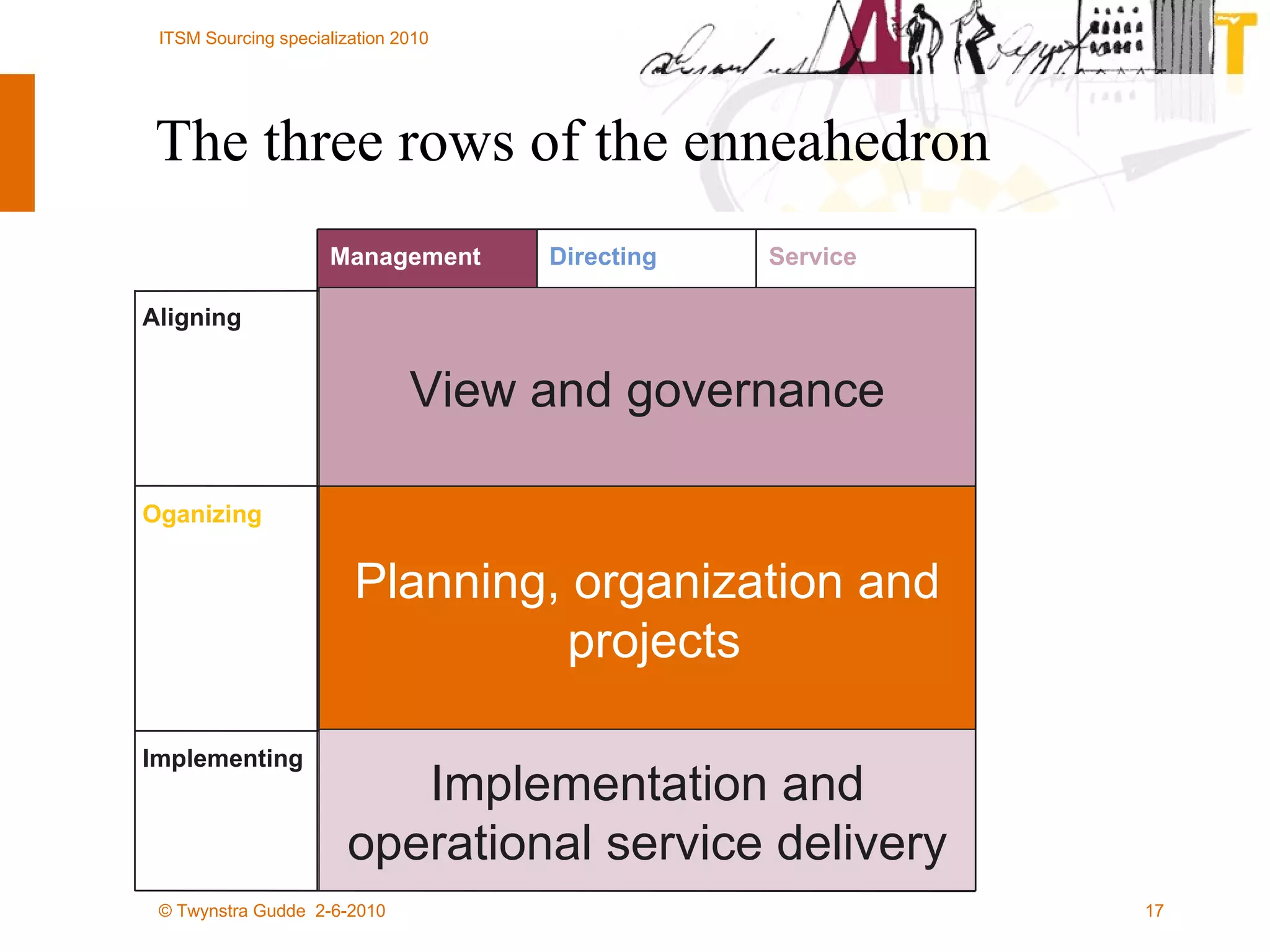
The three rows of the enneahedron Beheren en exploiteren ICT services Beheren en gebruiken informatievoozieningen Ontwerpen en exploiteren bedrijfsvoering Implementing Ontwerpen en plannen ICT service Ontwerpen en plannen informatie voorziening en regie Ontwerpen en plannen bedrijfsvoering Oganizing Bepalen strategie ICT service Bepalen strategie informatie voorziening en regie Bepalen strategie bedrijfsvoering Aligning Service Directing Management View and governance Planning, organization and projects Implementation and operational service delivery
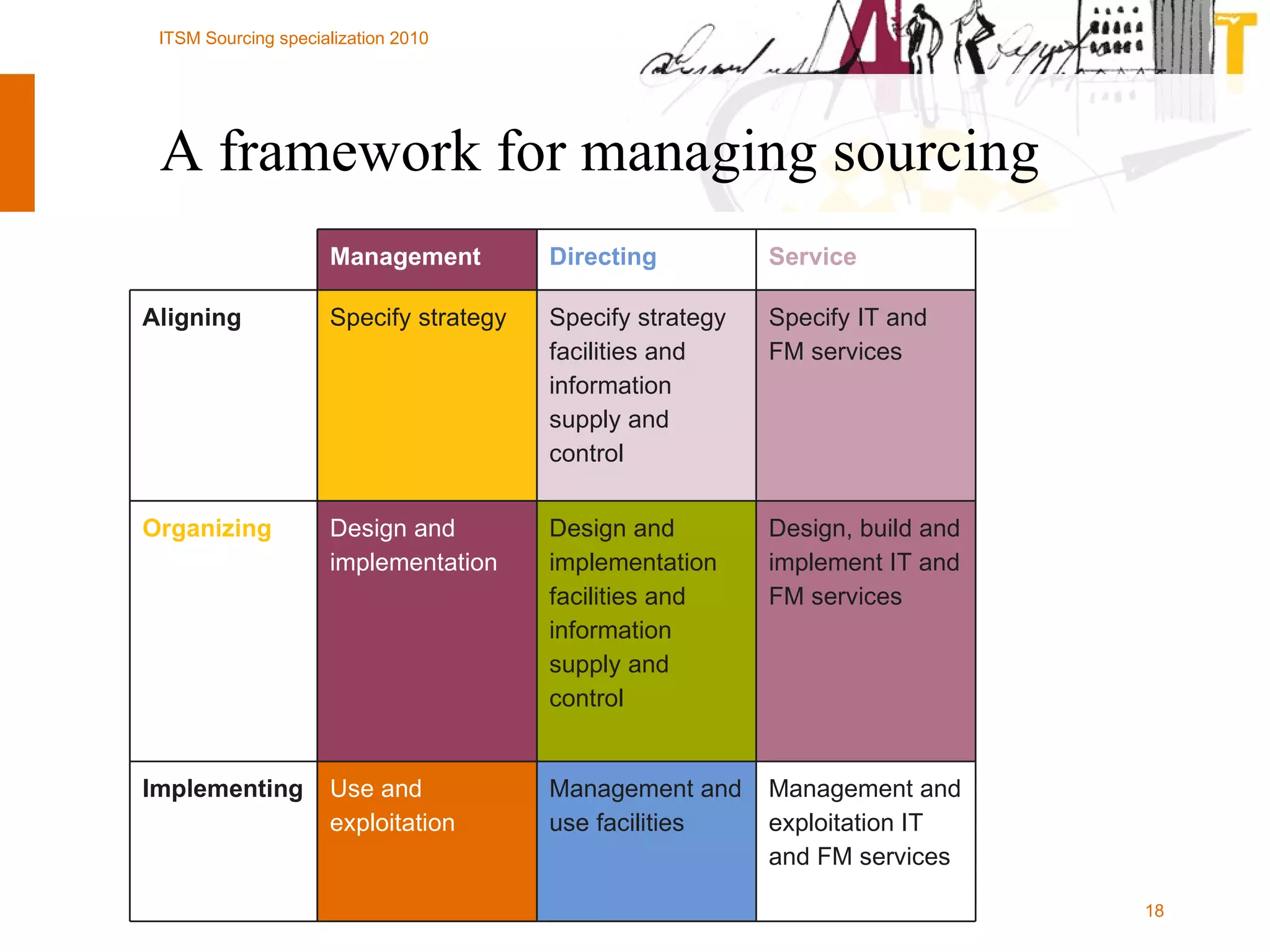
A framework for managing sourcing Management and exploitation IT and FM services Management and use facilities Use and exploitation Implementing Design, build and implement IT and FM services Design and implementation facilities and  information supply and control Design and implementation Organizing Specify IT and FM services Specify strategy facilities and  information supply and control Specify strategy Aligning Service Directing Management
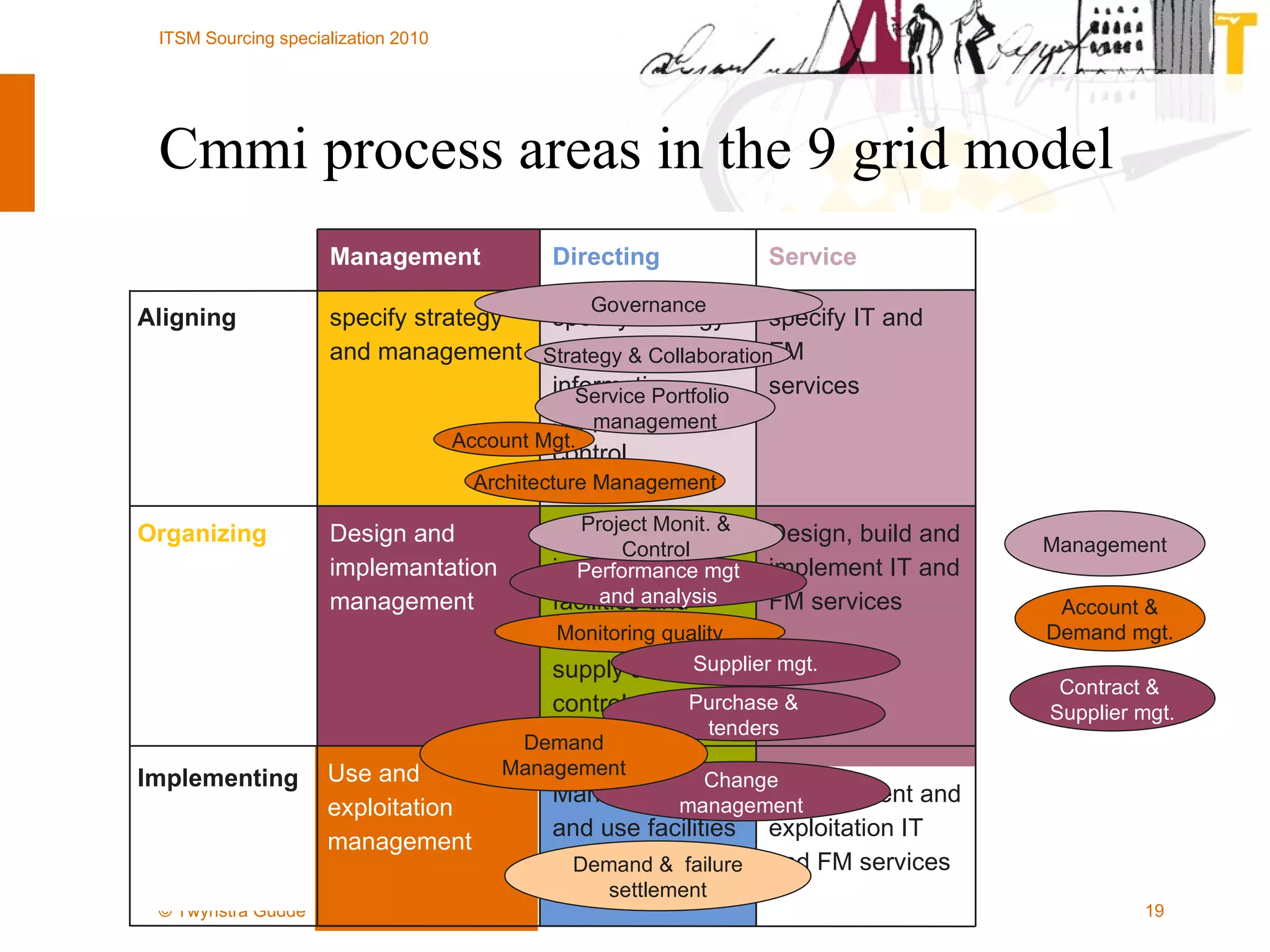
Cmmi process areas in the 9 grid model Implementing Management and exploitation IT and FM services Management and use facilities Use and exploitation management Design, build and implement IT and FM services Design and implementation facilities and  information supply and control Design and implemantation management Organizing specify IT and FM services specify strategy facilities and  information supply and control specify strategy and management Aligning Service Directing Management Monitoring quality Performance mgt and analysis Project Monit. & Control Supplier mgt. Change management Purchase & tenders Governance Account Mgt. Strategy & Collaboration Service Portfolio  management Architecture Management Demand Management Demand &  failure settlement Account & Demand mgt. Management Contract &  Supplier mgt.
Processmodel for directing
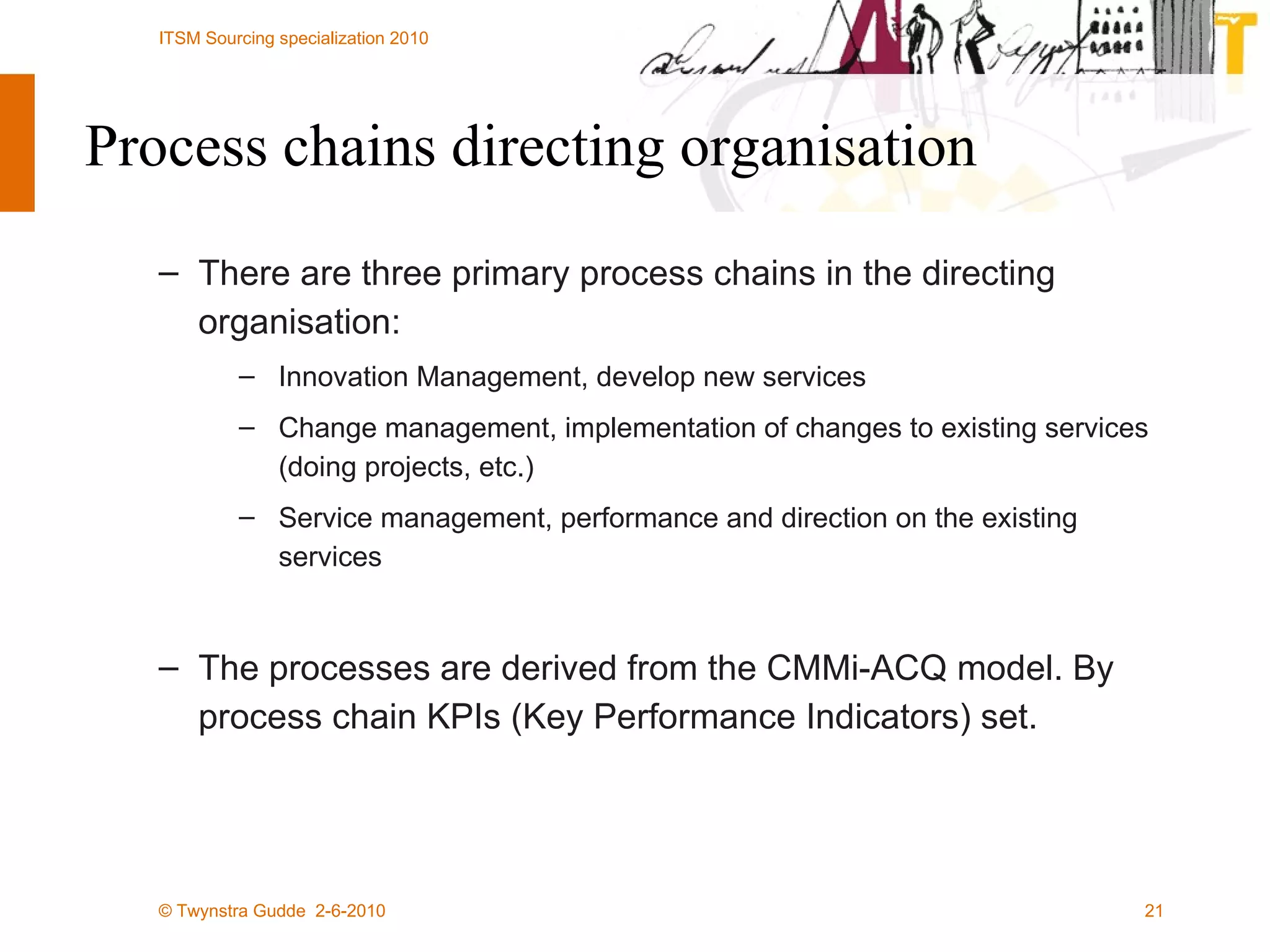
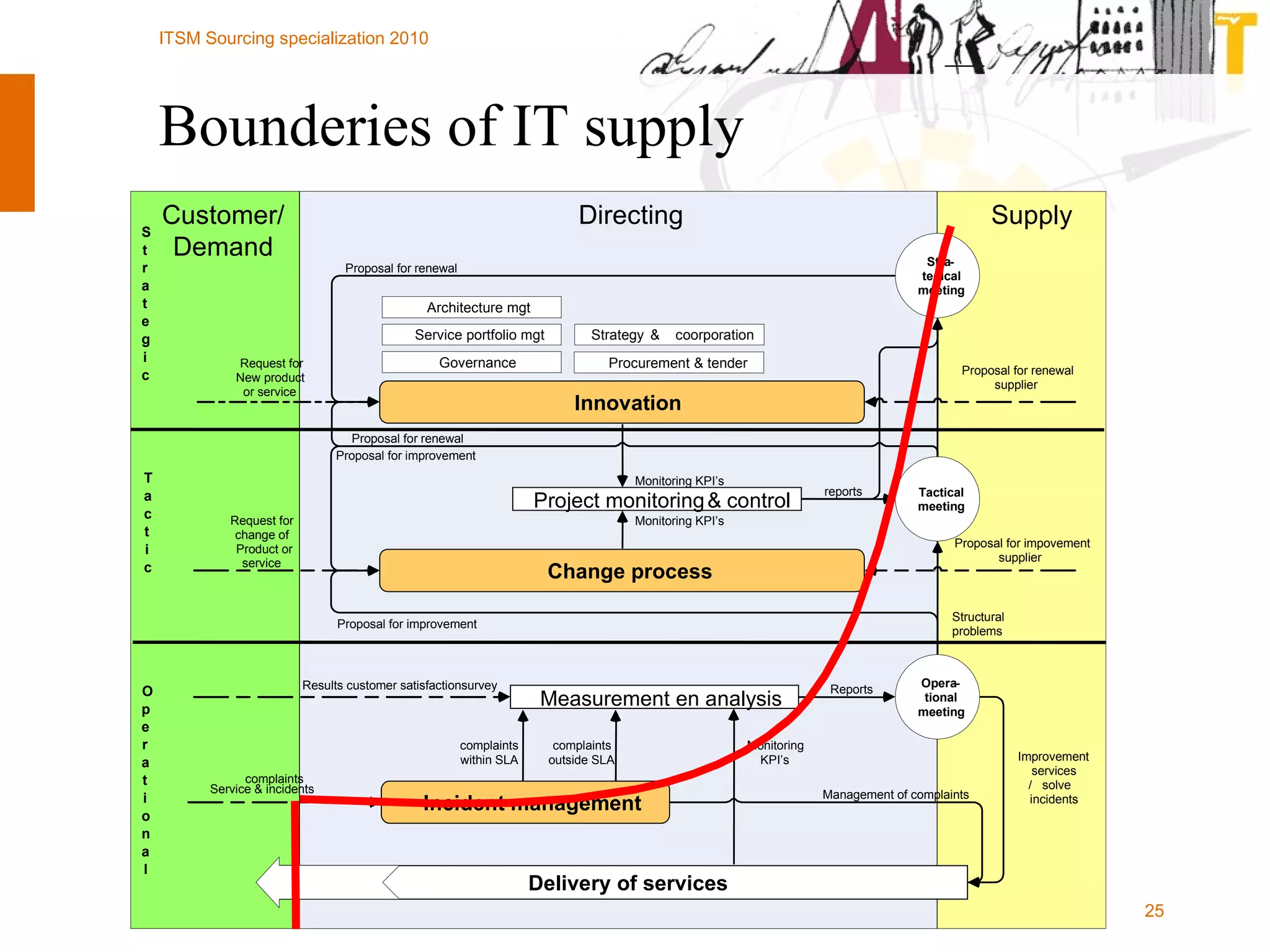
There are three primary process chains in the directing organisation: Innovation Management, develop new services  Change management, implementation of changes to existing services (doing projects, etc.)  Service management, performance and direction on the existing services The processes are derived from the CMMi-ACQ model. By process chain KPIs (Key Performance Indicators) set. Process chains directing organisation
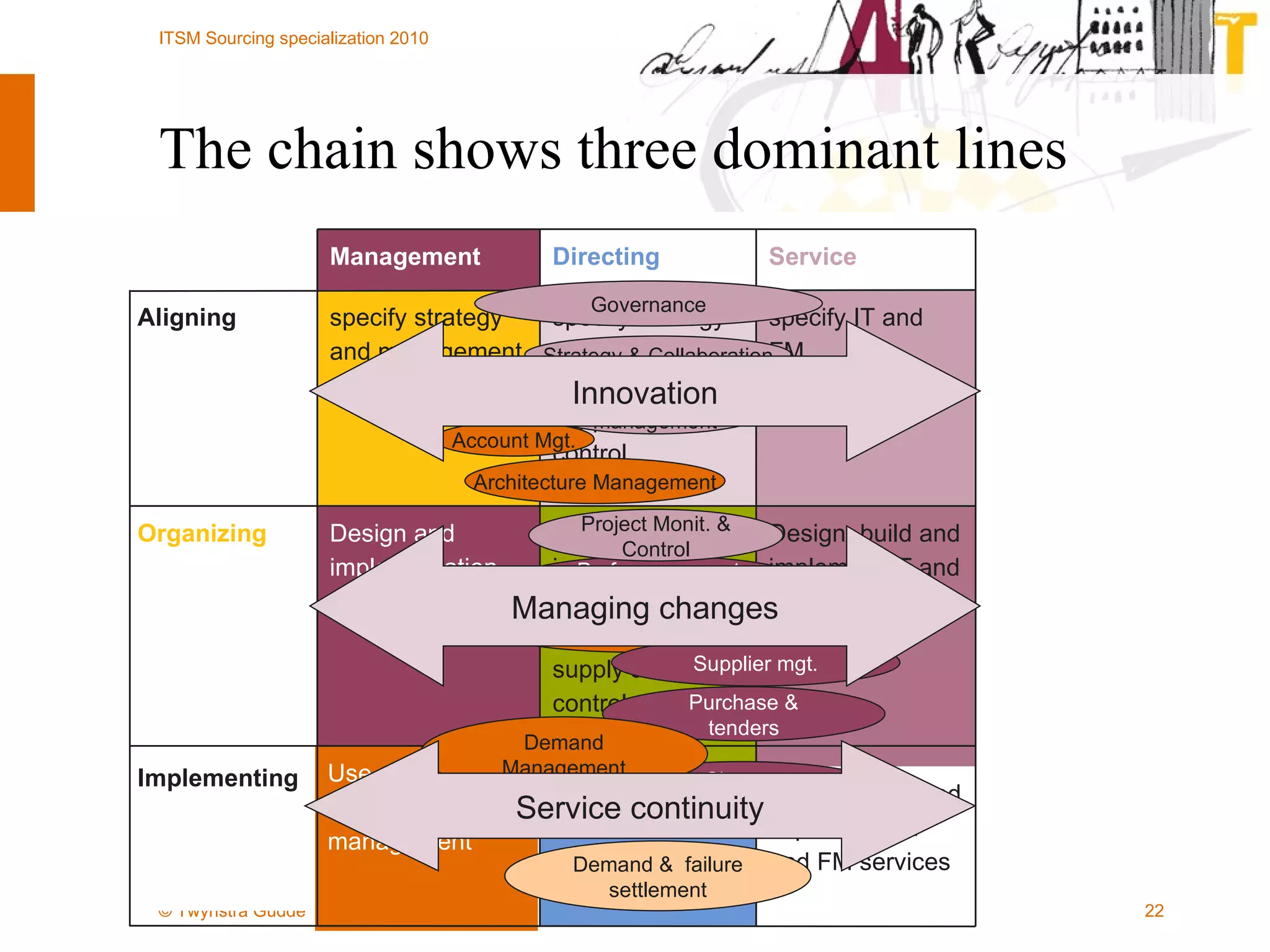
The chain shows three dominant lines Implementing Management and exploitation IT and FM services Management and use facilities Use and exploitation management Design, build and implement IT and FM services Design and implementation facilities and  information supply and control Design and implemantation management Organizing specify IT and FM services specify strategy facilities and  information supply and control specify strategy and management Aligning Service Directing Management Monitoring quality Performance mgt and analysis Project Monit. & Control Supplier mgt. Change management Purchase & tenders Governance Account Mgt. Strategy & Collaboration Service Portfolio  management Architecture Management Demand Management Demand &  failure settlement Innovation Managing changes Service continuity
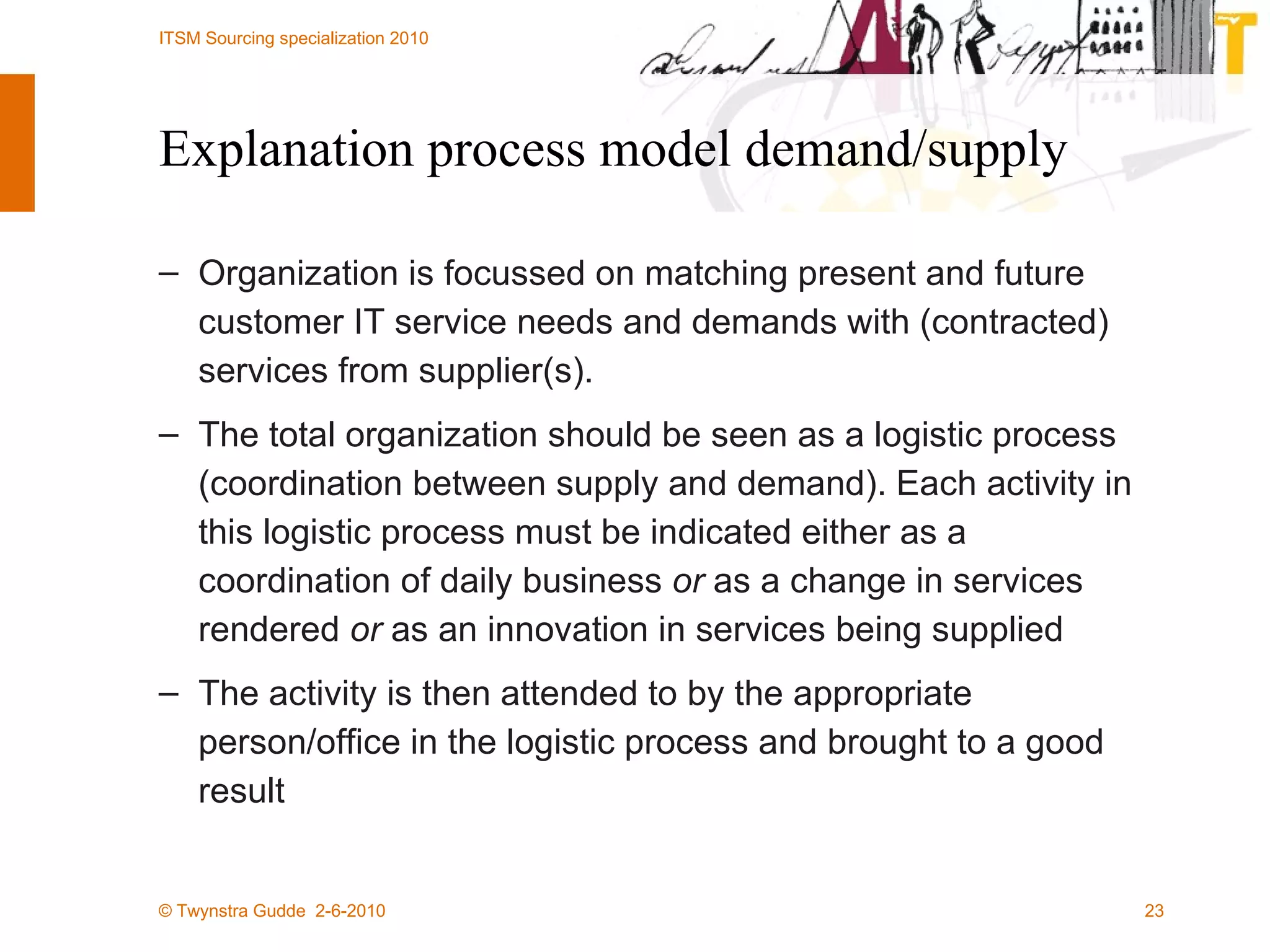
Explanation process model demand/supply Organization is focussed on matching present and future customer IT service needs and demands with (contracted) services from supplier(s).  The total organization should be seen as a logistic process (coordination between supply and demand). Each activity in this logistic process must be indicated either as a coordination of daily business  or  as a change in services rendered  or  as an innovation in services being supplied  The activity is then attended to by the appropriate person/office in the logistic process and brought to a good result
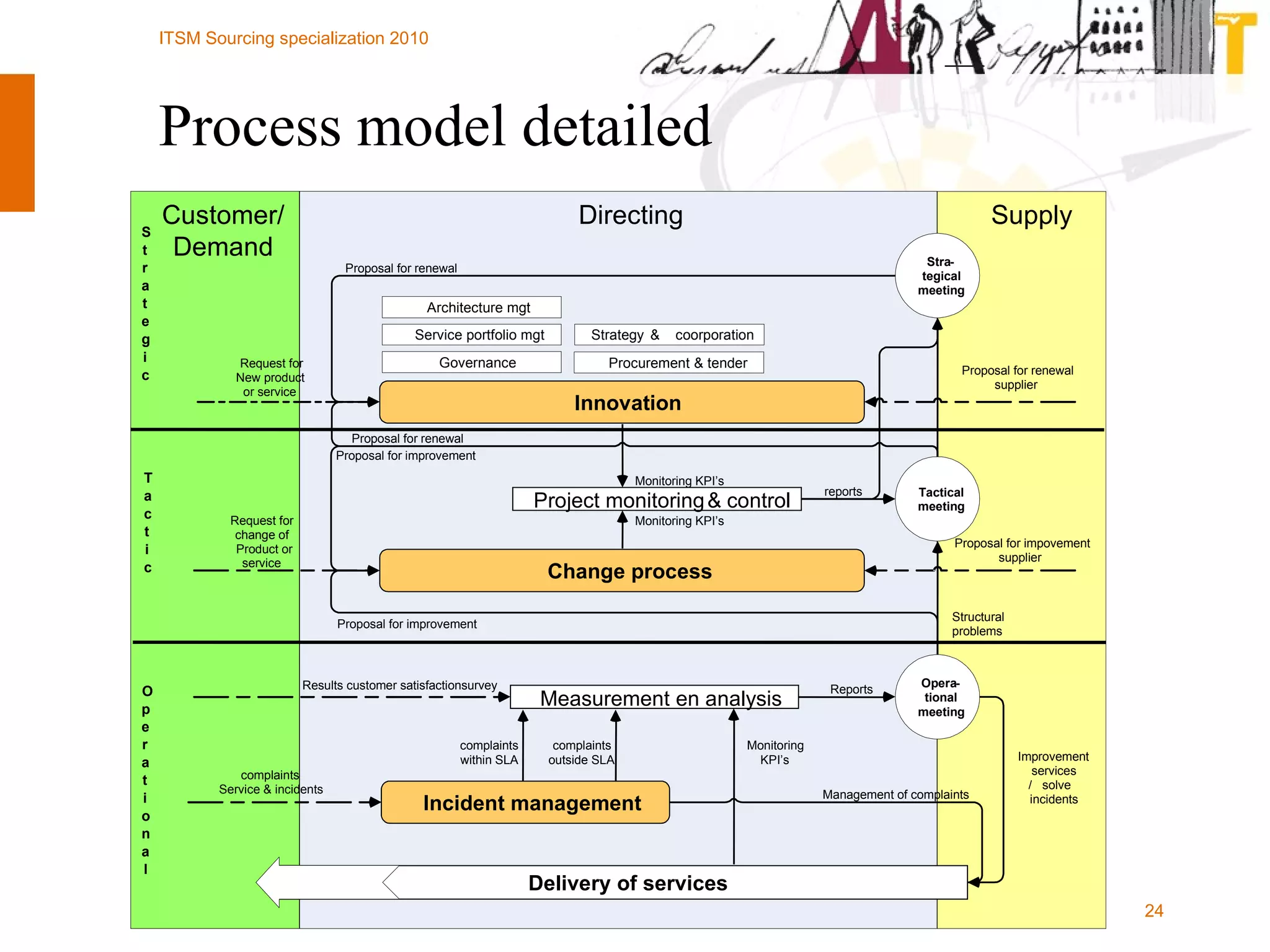
Process model detailed Supply Directing Customer/ Demand Delivery of services Incident management Measurement en analysis Opera - tional  meeting Tactical  meeting - Change process Innovation Request for  change of  Product or service Request for New product  or service complaints  within SLA Management of complaints Results customer satisfactionsurvey Monitoring  KPI’s complaints  outside SLA Improvement  services / solve  incidents Reports Structural  problems Proposal for impovement  supplier Proposal for renewal  supplier Proposal for improvement Proposal for renewal Governance Service portfolio mgt Architecture mgt Procurement & tender Strategy  &  coorporation Monitoring KPI’s Proposal for renewal reports S t r a t e g i c T a c t i c O p e r a t i o n a l Stra tegical  meeting Project monitoring  control &  Monitoring KPI’s Proposal for improvement complaints  Service & incidents
Bounderies of IT supply Supply Directing Customer/ Demand Delivery of services Incident management Measurement en analysis Opera - tional  meeting Tactical  meeting - Change process Innovation Request for  change of  Product or service Request for New product  or service complaints  within SLA Management of complaints Results customer satisfactionsurvey Monitoring  KPI’s complaints  outside SLA Improvement  services / solve  incidents Reports Structural  problems Proposal for impovement  supplier Proposal for renewal  supplier Proposal for improvement Proposal for renewal Governance Service portfolio mgt Architecture mgt Procurement & tender Strategy  &  coorporation Monitoring KPI’s Proposal for renewal reports S t r a t e g i c T a c t i c O p e r a t i o n a l Stra tegical  meeting Project monitoring  control &  Monitoring KPI’s Proposal for improvement complaints  Service & incidents
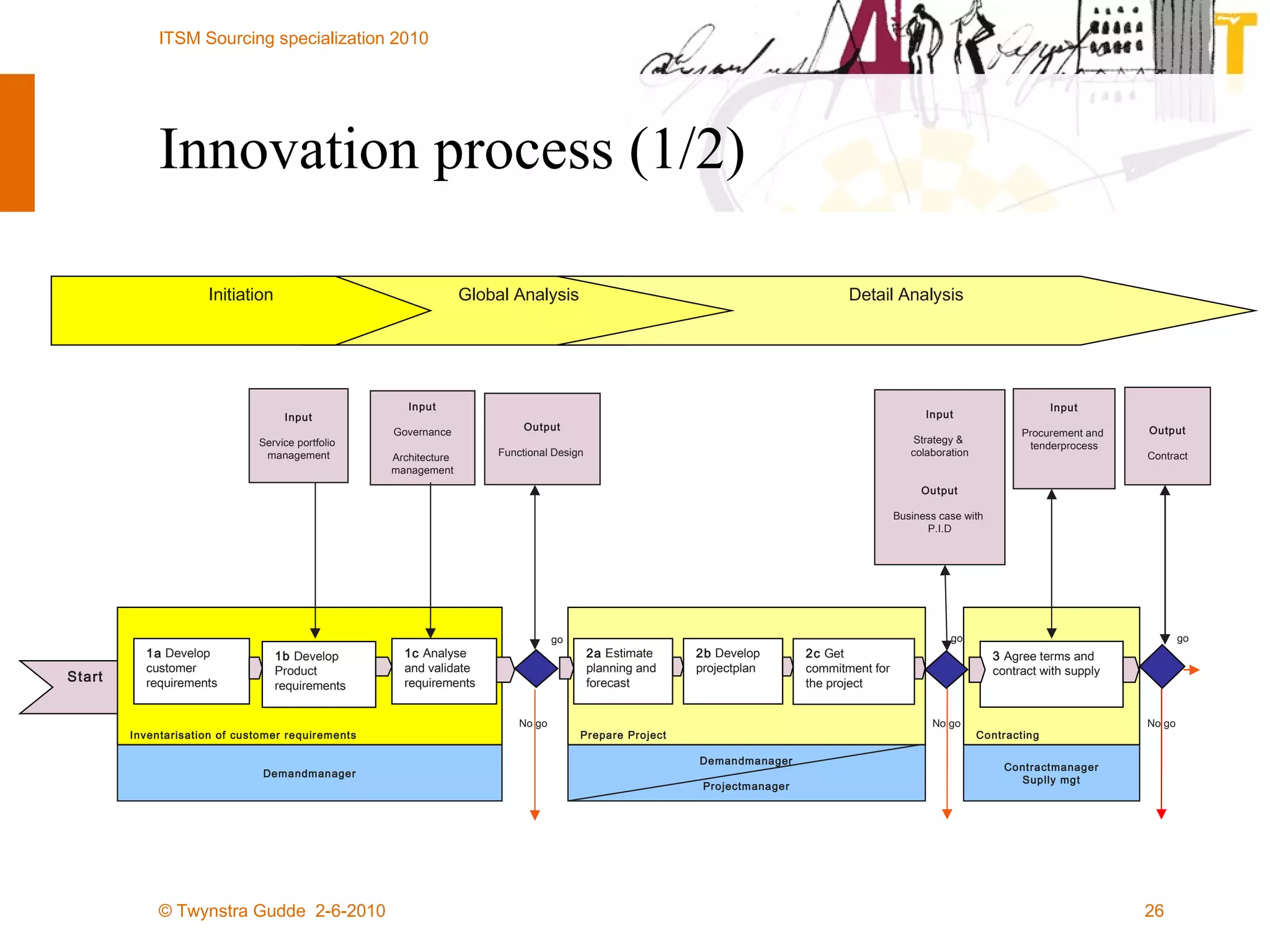
Innovation process (1/2) Start Global Analysis Initiation Detail Analysis Contracting  3  Agree terms and contract with supply Inventarisation of customer requirements 1a  Develop customer requirements 1b  Develop Product requirements 1c  Analyse and validate requirements Prepare Project 2a  Estimate planning and forecast 2b  Develop projectplan 2c  Get commitment for the project go No go Input Service portfolio  management Input Governance Architecture  management Output Functional Design  Input Strategy &  colaboration Output Business case with  P.I.D Input Procurement and  tenderprocess Demandmanager Demandmanager Projectmanager Contractmanager Suplly mgt Output Contract go No go go No go
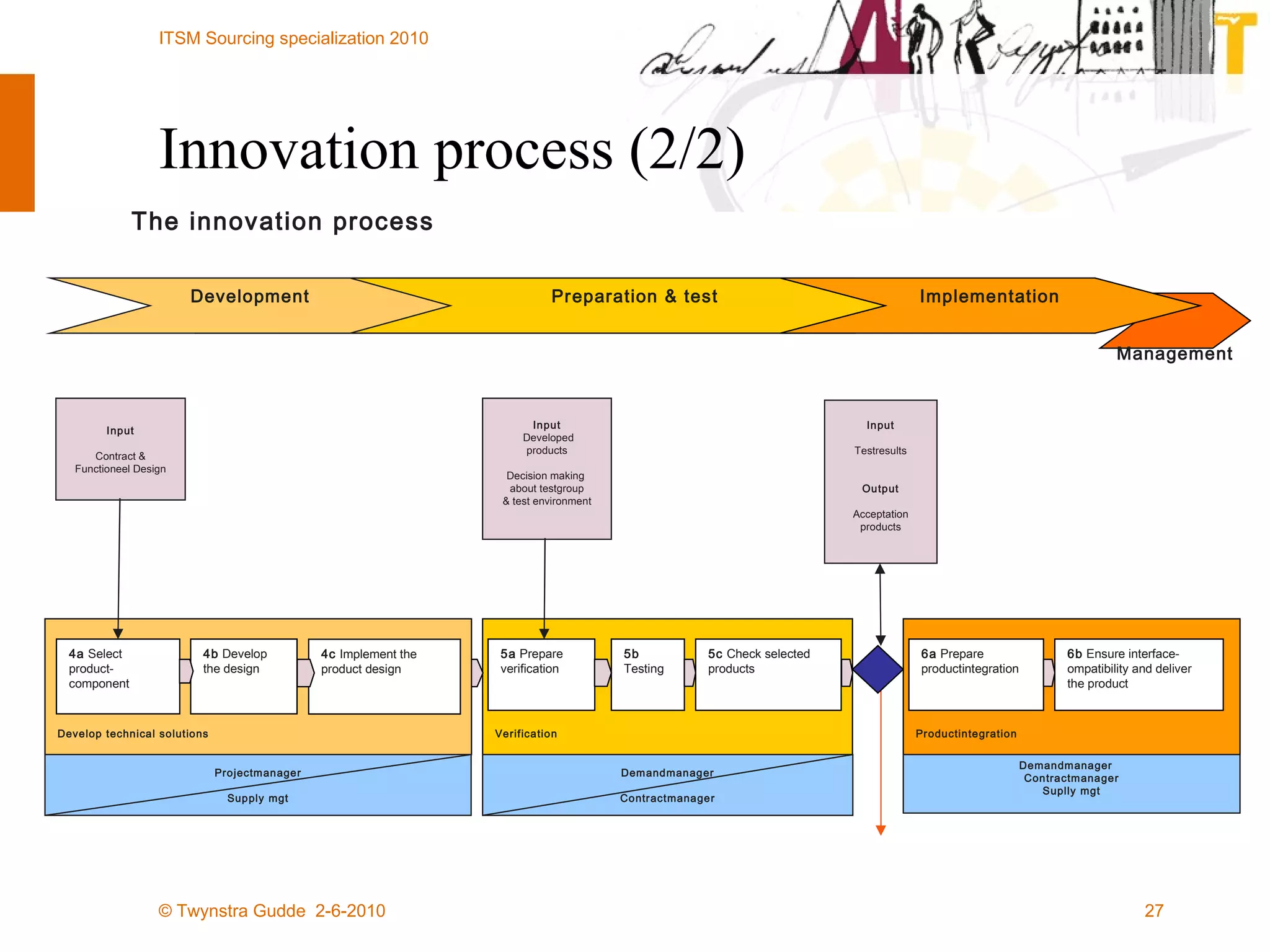
Innovation process (2/2) Productintegration  Verification 5a  Prepare verification 5b  Testing 5c  Check selected products 6a  Prepare productintegration 6b  Ensure interface- ompatibility and deliver the product The innovation process Input Developed products Decision making  about testgroup & test environment Input Testresults Output Acceptation products Demandmanager Contractmanager Demandmanager  Contractmanager Suplly mgt Develop technical solutions 4a  Select product-component 4b  Develop the design 4c  Implement the product design Projectmanager Supply mgt Input Contract & Functioneel Design Management Preparation & test Implementation Development
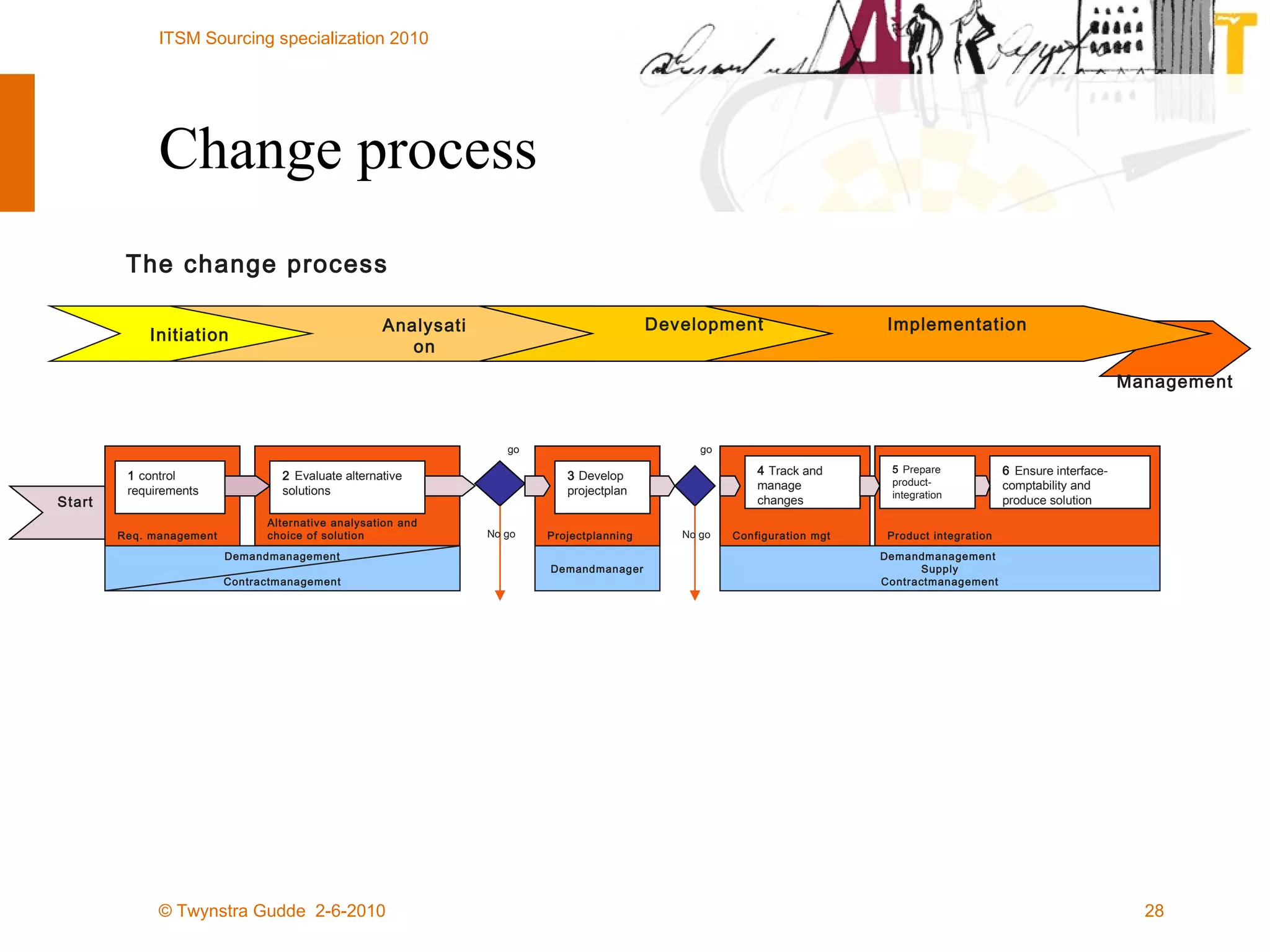
Change process Start The change process Initiation Management Alternative analysation and choice of solution Req. management  1  control requirements 2  Evaluate alternative solutions Demandmanagement Contractmanagement Configuration mgt Projectplanning  3  Develop projectplan 4  Track and manage changes Product integration  5  Prepare product-integration 6  Ensure interface- comptability and produce solution Demandmanager Demandmanagement  Supply Contractmanagement Development Implementation No go go No go go Analysation
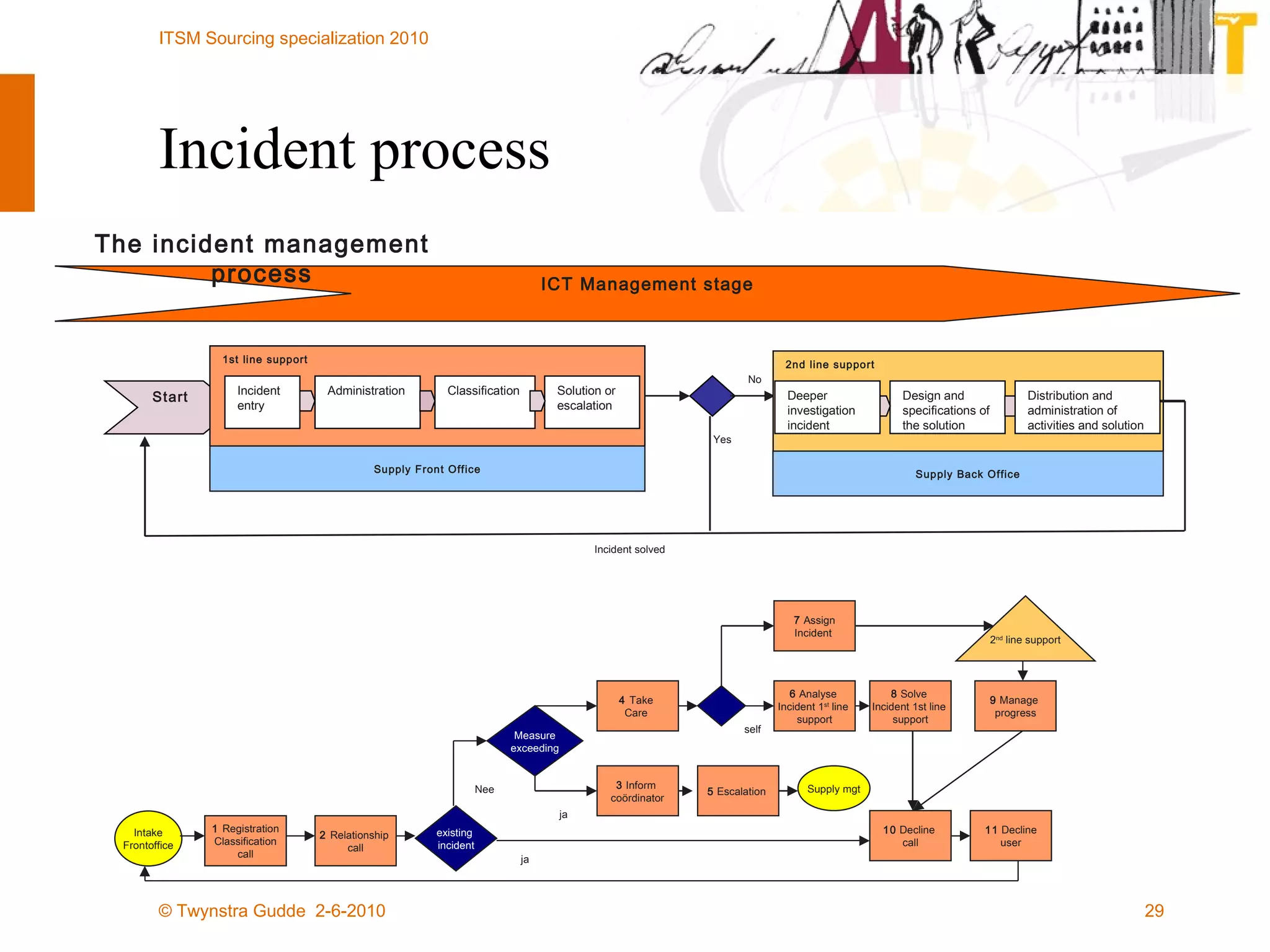
Incident process Start ICT Management stage 1st line support Administration Classification Incident entry Incident solved Yes No 2nd line support Design and specifications of the solution Solution or escalation Intake Frontoffice 2 nd  line support 1  Registration Classification call 2  Relationship  call 10  Decline  call 11  Decline user 5  Escalation  6  Analyse  Incident 1 st  line  support 8  Solve  Incident 1st line  support 3  Inform  coördinator 4  Take  Care  existing  incident Measure exceeding Supply mgt 7  Assign Incident  9  Manage  progress ja Nee ja self The incident management process Supply Front Office Supply Back Office Deeper investigation incident Distribution and administration of activities and solution
Roles within the directing organisation
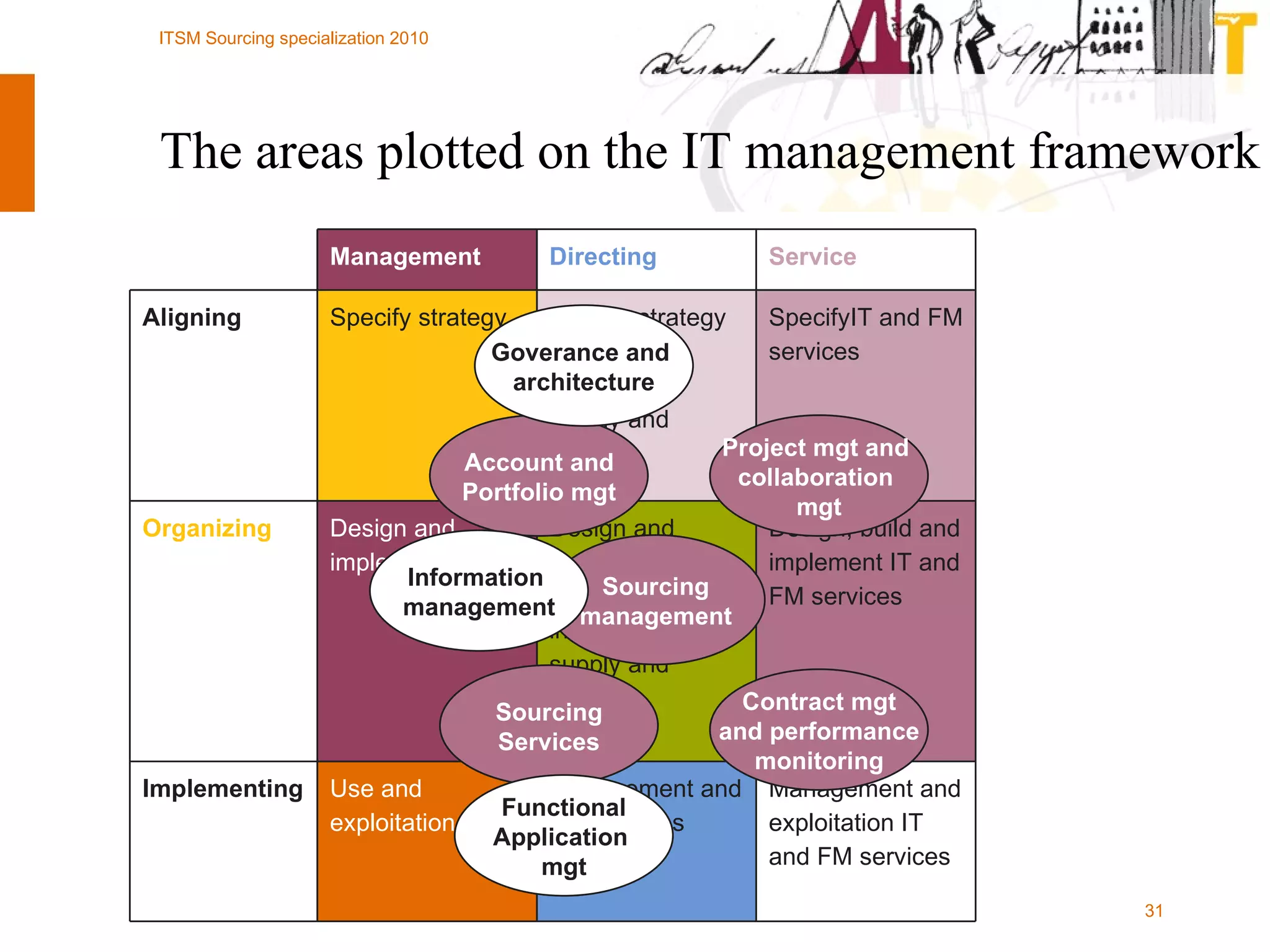
The areas plotted on the IT management framework Management and exploitation IT and FM services Management and use facilities Use and exploitation Implementing Design, build and implement IT and FM services Design and implementation facilities and  information supply and control Design and implementation Organizing SpecifyIT and FM services Specify strategy facilities and  information supply and control Specify strategy Aligning Service Directing Management Sourcing management Project mgt and  collaboration  mgt Account and Portfolio mgt Contract mgt and performance monitoring Sourcing Services Information  management Functional Application  mgt Goverance and  architecture
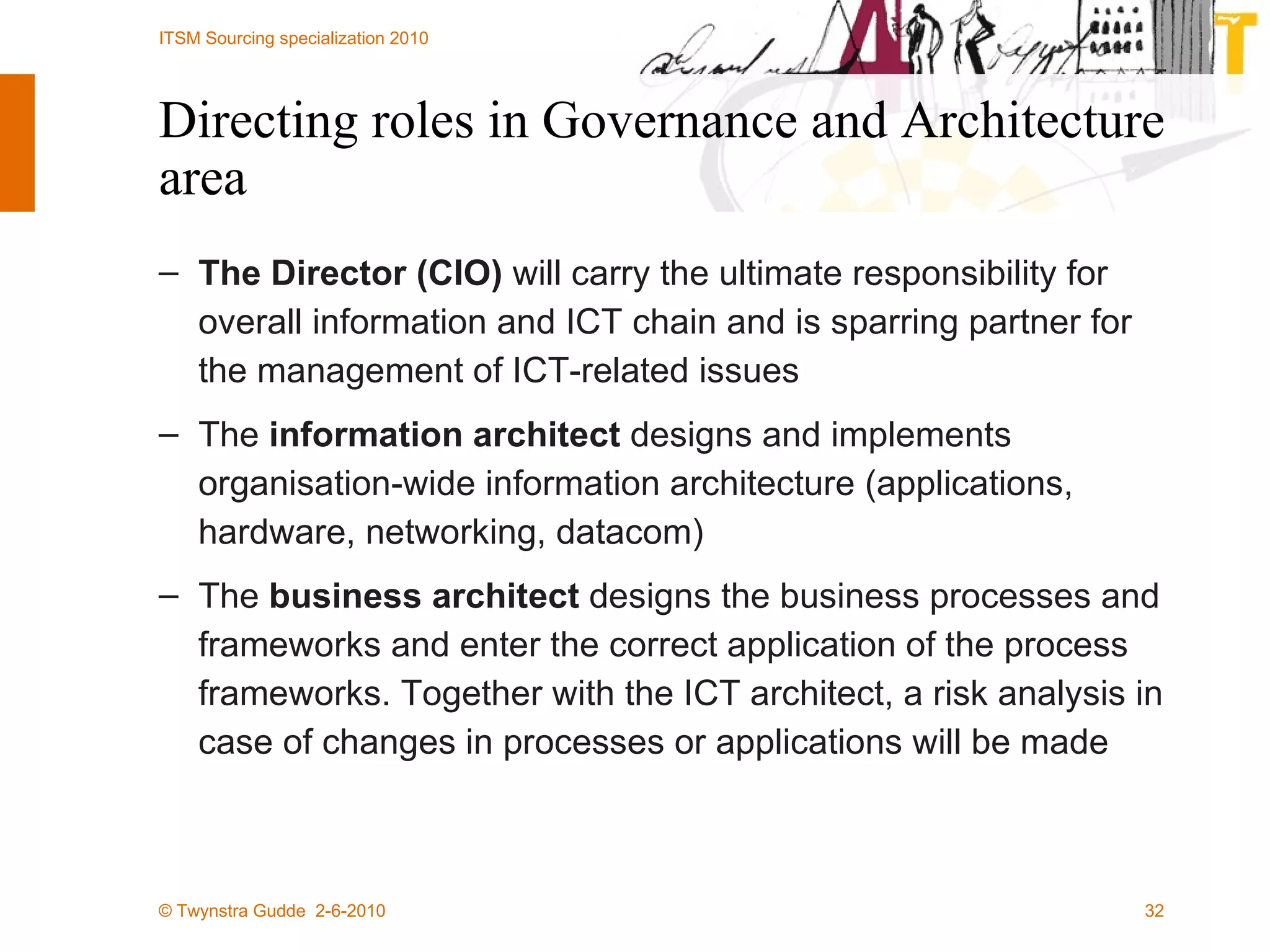
Directing roles in Governance and Architecture area The Director (CIO)  will carry the ultimate responsibility for overall information and ICT chain and is sparring partner for the management of ICT-related issues  The  information architect  designs and implements organisation-wide information architecture (applications, hardware, networking, datacom)  The  business architect  designs the business processes and frameworks and enter the correct application of the process frameworks. Together with the ICT architect, a risk analysis in case of changes in processes or applications will be made
The information management area The  Information Manager  advises on solutions in the field of ICT for business to better support in achieving their objectives. It is a long term vision and planning and should develop a framework for planning and assessment of renewal and modification of information systems.
Account and Portfolio mgt areas The  ICT consultant  advises organisation-wide, sought and unsolicited, on solutions in the field of ICT business in order to better support their goals using ICT solutions The  Information Analyst  focuses on analyzing and advising on how the information flows within the customer organisation can be supported by the current system landscape
Project mgt and collaboration mgt The  Project manager  executes projects in the field of ICT (from the initiation tot the transfer to the existing organization)
Contract mgt and performance monitoring The  Contract Coordinator  focuses on the creation and implementation of the supplier strategy, mapping product / vendor combinations and building and maintaining existing relationships The  Purchaser  focuses on the procurement of services, and if products and people at the right price, performance levels, and compliance are buyed with contractual agreements is that can be monitored The  Demand Manager  focuses on developing and maintaining relationships with external ICT suppliers and on the steering / leading the team in - and outside staff responsible for the daily operation (including Service Desk and Field Services)
Sourcing management area The  Service Level Coordinator  is responsible for monitoring and managing the delivery of agreed ICT products and services by external parties as defined in Service Level Agreements on quality, availability and cost. The  Project & Change Coordinator , will direct on all new and ongoing projects and (big) changes regarding the ICT systems (internal and external capacity, content, planning, budget, priority)
Sourcing Services area The  keyuser  provides the functional management of one or more applications tailored to the specific business processes.  The key point of the users are from a group of users to use a specific application and the application of this application within a sector or management.  The  process specialists  support the key user for the translation of the process of sector specific management or automated applications. They are experts in the field of process and work within the framework of the business architect suggests.
The Functional application mgt area The  Functional Application Manager  provides the functional management of one or more applications tailored to the specific business and focuses on analyzing and advising on how the information flows within the organisation can be supported by ICT applications. He/She will also support in testing and implementation of changes.  The  Technical Application Manager  is responsible for the availability and performance of the ICT systems
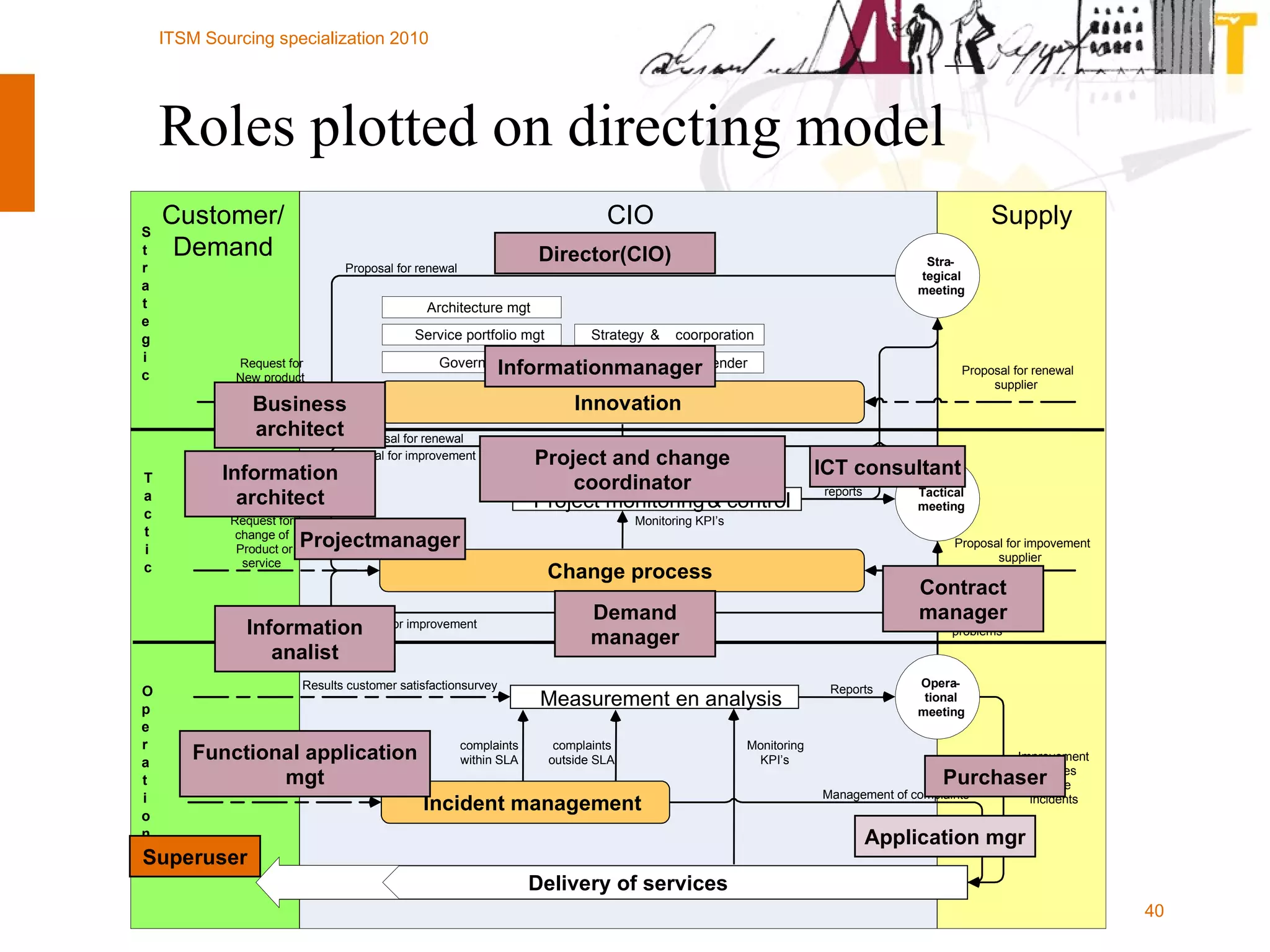
Roles plotted on directing model Supply CIO Customer/ Demand Delivery of services Incident management Measurement en analysis Opera - tional  meeting Tactical  meeting - Change process Innovation Request for  change of  Product or service Request for New product  or service complaints  within SLA Management of complaints Results customer satisfactionsurvey Monitoring  KPI’s complaints  outside SLA Improvement  services / solve  incidents Reports Structural  problems Proposal for impovement  supplier Proposal for renewal  supplier Proposal for improvement Proposal for renewal Governance Service portfolio mgt Architecture mgt Procurement & tender Strategy  &  coorporation Monitoring KPI’s Proposal for renewal reports S t r a t e g i c T a c t i c O p e r a t i o n a l Stra tegical  meeting Project monitoring  control &  Monitoring KPI’s Proposal for improvement complaints  Service & incidents ICT consultant Information analist Business architect Functional application mgt Application mgr Purchaser Contract manager Superuser Projectmanager Informationmanager Information architect Project and change coordinator Director(CIO) Demand manager
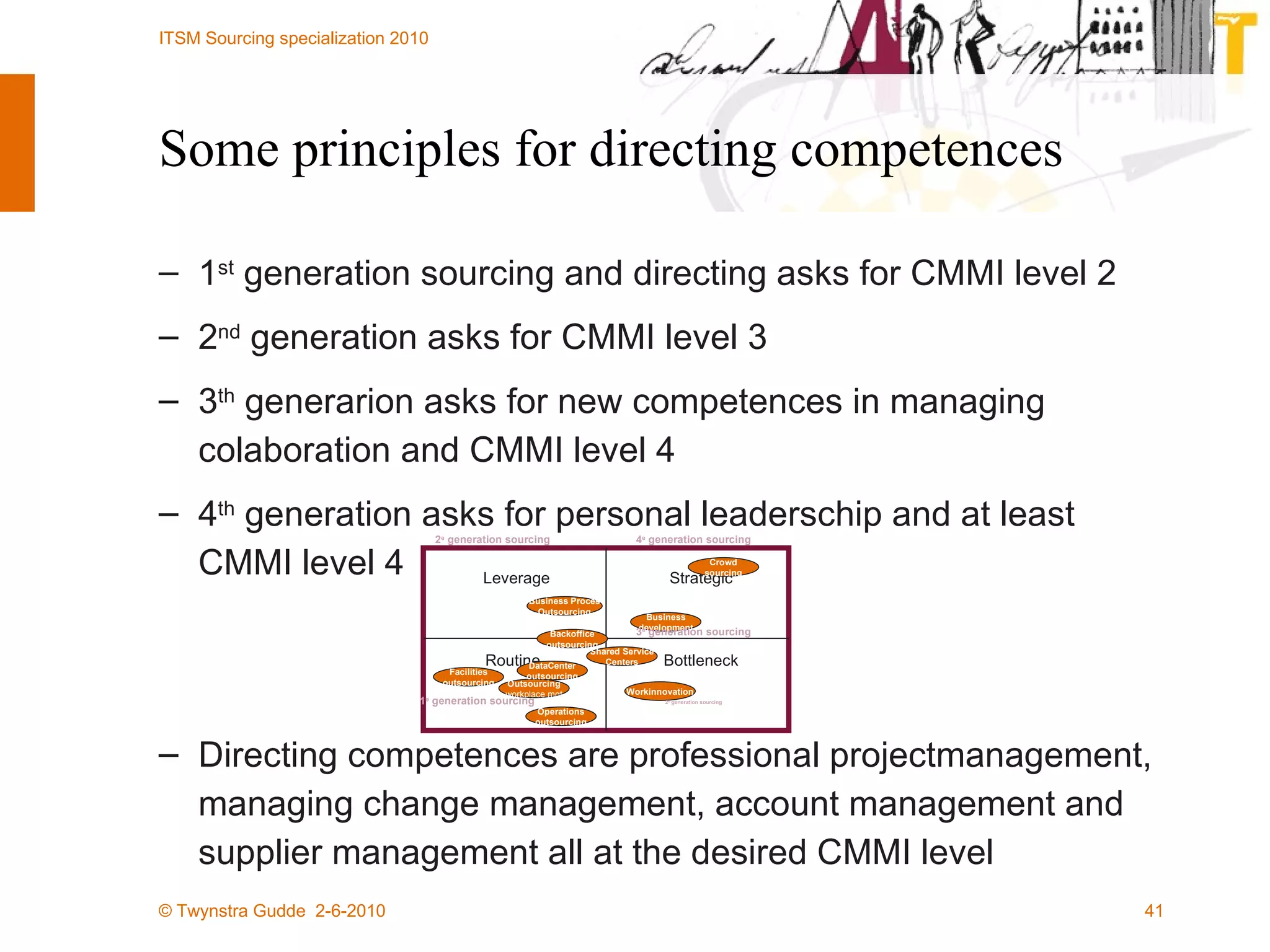
Some principles for directing competences 1 st  generation sourcing and directing asks for CMMI level 2 2 nd  generation asks for CMMI level 3 3 th  generarion asks for new competences in managing colaboration and CMMI level 4 4 th  generation asks for personal leaderschip and at least CMMI level 4 Directing competences are professional projectmanagement, managing change management, account management and supplier management all at the desired CMMI level Strategic Leverage Bottleneck  Routine Business Proces Outsourcing Backoffice outsourcing Outsourcing workplace mgt Business development Shared Service Centers DataCenter outsourcing Facilities outsourcing Workinnovation 1 e  generation sourcing 2 e  generation sourcing 4 e  generation sourcing 3 e  generation sourcing 2 e  generation sourcing Crowd sourcing Operations outsourcing
At the end… Setting up a directing organisation (the new ICT organisation) is a radical change….use the change colours Filling in the roles is changing competences and changing people A clear process model will help to implement the directing activities Always use the three models; 9 grid, Kraljic and CMMI
All rights reserved. No part of this presentation may be reproduced or published in any form or by any means without the prior written permission of Twynstra Gudde. Frank Willems [email_address] www.twynstragudde.nl

Sourcing Lecture 5 Directing Sourcing And Services

  • 1.
    ITSM Sourcing specialization2010 Directing Sourcing and Services
  • 2.
    Agenda Shared ServiceCenters What is directing Processmodel for directing Roles within the directing organisation Learning Task 3 Questions and answers
  • 3.
  • 4.
    Definition and goalof a Shared Service Center (SSC) We speak about an SSC as supporting processes within an organization on an approximately similar way, are delivered a new, semi-autonomous unit and on the basis of agreements it provides services to other units The goal of an SSC is generally to improve the service quality while cutting costs SSC versus centralization, service-oriented versus task
  • 5.
    Measures in perspectiveMeasures at task level: Stopping investments Orcutting down on current initiatives Measures at a process level: Collaboration and joint investments Measures at a functional level: Concentration, integration, mergers, Take-over or outsourcing Saving potential Short term (0,5-1 year Medium term (1-2 years Long term (2-5 years) Stopping projects Cutting down on training and learning Cutting down on engaging external consultants System optimazation Collaboration regarding purchasing, support, etc. Optimization and standardization of processes Integration, mergers and concentration Outsourcing of parts of the organization Shared Services Centre Full outsourcing Capitalizing effects
  • 6.
    Concentration leads toeconomies of scale Internal SSC Insourcing/ External Supplier Costs Volume Efficiency- effects Economy of Scale
  • 7.
    Are the trendsmoving up and down? Yes, to take maximum concentration and complexity there will be need for new solutions. Costs Volume Startingpoint Impact Scale reached Impact Scale reached Complexity Costs will increase
  • 8.
    Potential services fora SSC Facility Management mailroom copying and printing service archive purchase catering Customer Service sales service telephone customer service (call center) Administration financial administration pensions administration Payroll Personelmanagement (HRM) recruitment and selection Personnel administration training ICT Services application development Helpdesk Management and operation Training Real Estate Management management buildings Security management Sales and marketing ad coordination direct mail sales Tele ordering Order administration
  • 9.
    Variants of SharedServices supportfunctions Management primairy functions Shared Support Process Shared Business Process Shared back-offices
  • 10.
    The components ofShared Services How to manage the environment, where the process is cut and who is responsible for what processes? What is the proper organization, which staff and how are we ready for the future? How are technology, process and organization knotted together ? The core of the service Processes Organization Systems Customers SSC 1 SSC 3 SSC 2 SSC 4 Opstellen van Business Cases Inrichten van processen Managen van projecten Governance Regie Architectuur
  • 11.
    Name the changecomponents Ontwikkelen maatwerk Ontwikkelen maatwerk Beheer infrastructuur Beheer infrastructuur Beheer & draaien pakketten Beheer & draaien pakketten Support/ Helpdesk Support/ Helpdesk Ontwikkelen maatwerk SSC 1 Beheer infrastructuur SSC 3 Beheer & draaien pakketten SSC 2 Support/ Helpdesk SSC 4 Response, context and vision of SSC's clear and design direction activities Target focus on service domains ICT - governance Governance Regie Regie Architectuur Architectuur Make Governance agreements Professionalize demand ICT - governance Governance Regie Regie Architectuur Architectuur Transform demand management ICT - governance - Governance Regie Regie Architectuur Architectuur SSC 1 SSC 3 SSC 2 SSC 4 Opstellen van Business Cases Inrichten van processen Managen van projecten Governance Regie Architectuur
  • 12.
    An Change approachfor Shared Services … . Change idea Intervention-oriented communication about plan and implementation Support by Change help desk Assessment by Change board Consultation with Sounding board group CIO Client … Characteristics of interaction Characteristics of employees Characteristics of products, pro- cesses & structure Clients, Governance & suppliers Histor y Reason Environment View on change Kick off Change analysis + Culture scan DD MM YYYY Change goals Aligning structure and processes Organizing control and and prepairing SSC implementation Contracting and realizing SLA’s Culture change and competence development Learning to collaborate Inter- ventions And (re) planning Reconsider- Ing goals Measuring progress Plateau 2 Inter- ventions and (re) planning Reconsider- ing goals Measuring progress Plateau 1
  • 13.
    Example of aTarget Efforts Network More innovative power and sharing knowledge Higher efficiency pension processes Better quality ICT services and products 75% Reuse pension processes and systems (FO & BO) 20% Faster market introduction pension products 30% Cheaper implementation processes 20% Less duplication 60% Knowledge   pension products more accessible 95% Reliable service in accordance SLA Mission Goals Measurable goals Projects and activities Mission Develop a Shared Service Center that is a knowledge-and information-engine around pension products, by sharing forces to deliver better innovation and deliver at lower cost high quality products and services to
  • 14.
  • 15.
    What is directingDirecting is about linking demand and supply. You must know what the customer (commisioner and the user) wants, then translate it into a solution with the necessary resources (sources) to achieve and then arrange that the services is provided. And to be able tot do that to you really need the right competences. The director will lead
  • 16.
    The three columnsof the enneahedron Beheren en exploiteren ICT services Beheren en gebruiken informatievoozieningen Ontwerpen en exploiteren bedrijfsvoering Implementing Ontwerpen en plannen ICT service Ontwerpen en plannen informatie voorziening en regie Ontwerpen en plannen bedrijfsvoering Organizing Bepalen strategie ICT service Bepalen strategie informatie voorziening en regie Bepalen strategie bedrijfsvoering Aligning Service Directing Management Business Directing Supplier organization
  • 17.
    The three rowsof the enneahedron Beheren en exploiteren ICT services Beheren en gebruiken informatievoozieningen Ontwerpen en exploiteren bedrijfsvoering Implementing Ontwerpen en plannen ICT service Ontwerpen en plannen informatie voorziening en regie Ontwerpen en plannen bedrijfsvoering Oganizing Bepalen strategie ICT service Bepalen strategie informatie voorziening en regie Bepalen strategie bedrijfsvoering Aligning Service Directing Management View and governance Planning, organization and projects Implementation and operational service delivery
  • 18.
    A framework formanaging sourcing Management and exploitation IT and FM services Management and use facilities Use and exploitation Implementing Design, build and implement IT and FM services Design and implementation facilities and information supply and control Design and implementation Organizing Specify IT and FM services Specify strategy facilities and information supply and control Specify strategy Aligning Service Directing Management
  • 19.
    Cmmi process areasin the 9 grid model Implementing Management and exploitation IT and FM services Management and use facilities Use and exploitation management Design, build and implement IT and FM services Design and implementation facilities and information supply and control Design and implemantation management Organizing specify IT and FM services specify strategy facilities and information supply and control specify strategy and management Aligning Service Directing Management Monitoring quality Performance mgt and analysis Project Monit. & Control Supplier mgt. Change management Purchase & tenders Governance Account Mgt. Strategy & Collaboration Service Portfolio management Architecture Management Demand Management Demand & failure settlement Account & Demand mgt. Management Contract & Supplier mgt.
  • 20.
  • 21.
    There are threeprimary process chains in the directing organisation: Innovation Management, develop new services Change management, implementation of changes to existing services (doing projects, etc.) Service management, performance and direction on the existing services The processes are derived from the CMMi-ACQ model. By process chain KPIs (Key Performance Indicators) set. Process chains directing organisation
  • 22.
    The chain showsthree dominant lines Implementing Management and exploitation IT and FM services Management and use facilities Use and exploitation management Design, build and implement IT and FM services Design and implementation facilities and information supply and control Design and implemantation management Organizing specify IT and FM services specify strategy facilities and information supply and control specify strategy and management Aligning Service Directing Management Monitoring quality Performance mgt and analysis Project Monit. & Control Supplier mgt. Change management Purchase & tenders Governance Account Mgt. Strategy & Collaboration Service Portfolio management Architecture Management Demand Management Demand & failure settlement Innovation Managing changes Service continuity
  • 23.
    Explanation process modeldemand/supply Organization is focussed on matching present and future customer IT service needs and demands with (contracted) services from supplier(s). The total organization should be seen as a logistic process (coordination between supply and demand). Each activity in this logistic process must be indicated either as a coordination of daily business or as a change in services rendered or as an innovation in services being supplied The activity is then attended to by the appropriate person/office in the logistic process and brought to a good result
  • 24.
    Process model detailedSupply Directing Customer/ Demand Delivery of services Incident management Measurement en analysis Opera - tional meeting Tactical meeting - Change process Innovation Request for change of Product or service Request for New product or service complaints within SLA Management of complaints Results customer satisfactionsurvey Monitoring KPI’s complaints outside SLA Improvement services / solve incidents Reports Structural problems Proposal for impovement supplier Proposal for renewal supplier Proposal for improvement Proposal for renewal Governance Service portfolio mgt Architecture mgt Procurement & tender Strategy & coorporation Monitoring KPI’s Proposal for renewal reports S t r a t e g i c T a c t i c O p e r a t i o n a l Stra tegical meeting Project monitoring control & Monitoring KPI’s Proposal for improvement complaints Service & incidents
  • 25.
    Bounderies of ITsupply Supply Directing Customer/ Demand Delivery of services Incident management Measurement en analysis Opera - tional meeting Tactical meeting - Change process Innovation Request for change of Product or service Request for New product or service complaints within SLA Management of complaints Results customer satisfactionsurvey Monitoring KPI’s complaints outside SLA Improvement services / solve incidents Reports Structural problems Proposal for impovement supplier Proposal for renewal supplier Proposal for improvement Proposal for renewal Governance Service portfolio mgt Architecture mgt Procurement & tender Strategy & coorporation Monitoring KPI’s Proposal for renewal reports S t r a t e g i c T a c t i c O p e r a t i o n a l Stra tegical meeting Project monitoring control & Monitoring KPI’s Proposal for improvement complaints Service & incidents
  • 26.
    Innovation process (1/2)Start Global Analysis Initiation Detail Analysis Contracting 3 Agree terms and contract with supply Inventarisation of customer requirements 1a Develop customer requirements 1b Develop Product requirements 1c Analyse and validate requirements Prepare Project 2a Estimate planning and forecast 2b Develop projectplan 2c Get commitment for the project go No go Input Service portfolio management Input Governance Architecture management Output Functional Design Input Strategy & colaboration Output Business case with P.I.D Input Procurement and tenderprocess Demandmanager Demandmanager Projectmanager Contractmanager Suplly mgt Output Contract go No go go No go
  • 27.
    Innovation process (2/2)Productintegration Verification 5a Prepare verification 5b Testing 5c Check selected products 6a Prepare productintegration 6b Ensure interface- ompatibility and deliver the product The innovation process Input Developed products Decision making about testgroup & test environment Input Testresults Output Acceptation products Demandmanager Contractmanager Demandmanager Contractmanager Suplly mgt Develop technical solutions 4a Select product-component 4b Develop the design 4c Implement the product design Projectmanager Supply mgt Input Contract & Functioneel Design Management Preparation & test Implementation Development
  • 28.
    Change process StartThe change process Initiation Management Alternative analysation and choice of solution Req. management 1 control requirements 2 Evaluate alternative solutions Demandmanagement Contractmanagement Configuration mgt Projectplanning 3 Develop projectplan 4 Track and manage changes Product integration 5 Prepare product-integration 6 Ensure interface- comptability and produce solution Demandmanager Demandmanagement Supply Contractmanagement Development Implementation No go go No go go Analysation
  • 29.
    Incident process StartICT Management stage 1st line support Administration Classification Incident entry Incident solved Yes No 2nd line support Design and specifications of the solution Solution or escalation Intake Frontoffice 2 nd line support 1 Registration Classification call 2 Relationship call 10 Decline call 11 Decline user 5 Escalation 6 Analyse Incident 1 st line support 8 Solve Incident 1st line support 3 Inform coördinator 4 Take Care existing incident Measure exceeding Supply mgt 7 Assign Incident 9 Manage progress ja Nee ja self The incident management process Supply Front Office Supply Back Office Deeper investigation incident Distribution and administration of activities and solution
  • 30.
    Roles within thedirecting organisation
  • 31.
    The areas plottedon the IT management framework Management and exploitation IT and FM services Management and use facilities Use and exploitation Implementing Design, build and implement IT and FM services Design and implementation facilities and information supply and control Design and implementation Organizing SpecifyIT and FM services Specify strategy facilities and information supply and control Specify strategy Aligning Service Directing Management Sourcing management Project mgt and collaboration mgt Account and Portfolio mgt Contract mgt and performance monitoring Sourcing Services Information management Functional Application mgt Goverance and architecture
  • 32.
    Directing roles inGovernance and Architecture area The Director (CIO) will carry the ultimate responsibility for overall information and ICT chain and is sparring partner for the management of ICT-related issues The information architect designs and implements organisation-wide information architecture (applications, hardware, networking, datacom) The business architect designs the business processes and frameworks and enter the correct application of the process frameworks. Together with the ICT architect, a risk analysis in case of changes in processes or applications will be made
  • 33.
    The information managementarea The Information Manager advises on solutions in the field of ICT for business to better support in achieving their objectives. It is a long term vision and planning and should develop a framework for planning and assessment of renewal and modification of information systems.
  • 34.
    Account and Portfoliomgt areas The ICT consultant advises organisation-wide, sought and unsolicited, on solutions in the field of ICT business in order to better support their goals using ICT solutions The Information Analyst focuses on analyzing and advising on how the information flows within the customer organisation can be supported by the current system landscape
  • 35.
    Project mgt andcollaboration mgt The Project manager executes projects in the field of ICT (from the initiation tot the transfer to the existing organization)
  • 36.
    Contract mgt andperformance monitoring The Contract Coordinator focuses on the creation and implementation of the supplier strategy, mapping product / vendor combinations and building and maintaining existing relationships The Purchaser focuses on the procurement of services, and if products and people at the right price, performance levels, and compliance are buyed with contractual agreements is that can be monitored The Demand Manager focuses on developing and maintaining relationships with external ICT suppliers and on the steering / leading the team in - and outside staff responsible for the daily operation (including Service Desk and Field Services)
  • 37.
    Sourcing management areaThe Service Level Coordinator is responsible for monitoring and managing the delivery of agreed ICT products and services by external parties as defined in Service Level Agreements on quality, availability and cost. The Project & Change Coordinator , will direct on all new and ongoing projects and (big) changes regarding the ICT systems (internal and external capacity, content, planning, budget, priority)
  • 38.
    Sourcing Services areaThe keyuser provides the functional management of one or more applications tailored to the specific business processes. The key point of the users are from a group of users to use a specific application and the application of this application within a sector or management. The process specialists support the key user for the translation of the process of sector specific management or automated applications. They are experts in the field of process and work within the framework of the business architect suggests.
  • 39.
    The Functional applicationmgt area The Functional Application Manager provides the functional management of one or more applications tailored to the specific business and focuses on analyzing and advising on how the information flows within the organisation can be supported by ICT applications. He/She will also support in testing and implementation of changes. The Technical Application Manager is responsible for the availability and performance of the ICT systems
  • 40.
    Roles plotted ondirecting model Supply CIO Customer/ Demand Delivery of services Incident management Measurement en analysis Opera - tional meeting Tactical meeting - Change process Innovation Request for change of Product or service Request for New product or service complaints within SLA Management of complaints Results customer satisfactionsurvey Monitoring KPI’s complaints outside SLA Improvement services / solve incidents Reports Structural problems Proposal for impovement supplier Proposal for renewal supplier Proposal for improvement Proposal for renewal Governance Service portfolio mgt Architecture mgt Procurement & tender Strategy & coorporation Monitoring KPI’s Proposal for renewal reports S t r a t e g i c T a c t i c O p e r a t i o n a l Stra tegical meeting Project monitoring control & Monitoring KPI’s Proposal for improvement complaints Service & incidents ICT consultant Information analist Business architect Functional application mgt Application mgr Purchaser Contract manager Superuser Projectmanager Informationmanager Information architect Project and change coordinator Director(CIO) Demand manager
  • 41.
    Some principles fordirecting competences 1 st generation sourcing and directing asks for CMMI level 2 2 nd generation asks for CMMI level 3 3 th generarion asks for new competences in managing colaboration and CMMI level 4 4 th generation asks for personal leaderschip and at least CMMI level 4 Directing competences are professional projectmanagement, managing change management, account management and supplier management all at the desired CMMI level Strategic Leverage Bottleneck Routine Business Proces Outsourcing Backoffice outsourcing Outsourcing workplace mgt Business development Shared Service Centers DataCenter outsourcing Facilities outsourcing Workinnovation 1 e generation sourcing 2 e generation sourcing 4 e generation sourcing 3 e generation sourcing 2 e generation sourcing Crowd sourcing Operations outsourcing
  • 42.
    At the end…Setting up a directing organisation (the new ICT organisation) is a radical change….use the change colours Filling in the roles is changing competences and changing people A clear process model will help to implement the directing activities Always use the three models; 9 grid, Kraljic and CMMI
  • 43.
    All rights reserved.No part of this presentation may be reproduced or published in any form or by any means without the prior written permission of Twynstra Gudde. Frank Willems [email_address] www.twynstragudde.nl