Name : Gohil Hetalba
Std
: M.A. – I Sem – 2
Sub : paper no : (12)
Roll no : 08
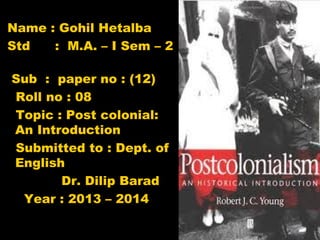
Topic : Post colonial:
An Introduction
Submitted to : Dept. of
English
Dr. Dilip Barad
Year : 2013 – 2014
Introduction
Definition
Origin
Post colonial writer and their
work
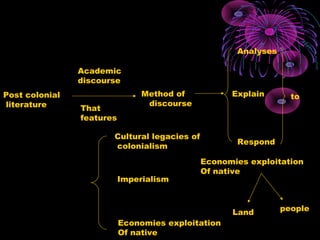
Analyses
Academic
discourse
Post colonial
literature

That
features

Method of
discourse

Explain

Cultural legacies of
colonialism

Imperialism

to

Respond
Economies exploitation
Of native

Economies exploitation
Of native

Land

people
Definition
 Post colonialism is the
theoretical wing of
postcoloniality. It refers to a
mode of reading, political,
analysis and cultural resistance/
intervention that deals with the
history of colonialism and
present Neo – colonial
structures.
Mode of
reading

Social Problems

Post colonialism
refers to
Intervention
Political analysis

Cultural resistance
Colonial rule

Resistance
Adaptation

Oppression

Gives idea to
understand
Asia
Robert young

Tricoinentalism

Africa
America
Origin
Post colonial writing began
with the independence of the
colonial countries.
Post colonial theory can be
said to have originated in the
mid – twentieth century text of
Franz fanon, Aime Cesaire, and
Albert Memmi.
The three major
characteristics of the post
colonial writing

The silencing and marginalization of
the post colonial voice by the
imperial centre.
The abrogation of the imperial
centre within the text.
The active appropriation of the
language and culture of the centre.
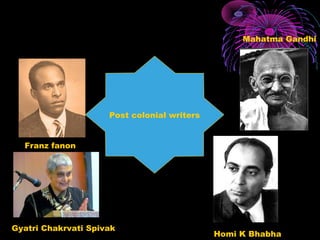
Mahatma Gandhi

Post colonial writers
Franz fanon

Gyatri Chakrvati Spivak

Homi K Bhabha
African culture and European culture
Clash

Colonizers

Whites

Traditionalism

Tension

Different Cultures

Colonized

Blacks

Modernism
Writer and their works
• Homi Bhabha : - Still life ( 2004)
• On Cultural choice ( 2ooo)
• Fanon’s work : Black skin white
mask
• Sociology of revolution
• Gyatri Spivak’s work: Selected
subaltern studies
• Gandhiji’s work :
Post colonial : An introduction paper no : 11 ( Post colonial literature)

Post colonial : An introduction paper no : 11 ( Post colonial literature)

Editor's Notes