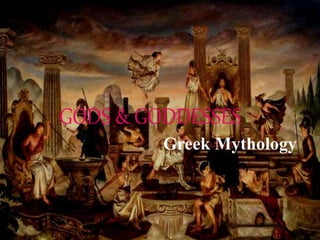
Greek Mythology
GODS & GODDESSES
APOLLO
God of music, arts, knowledge, healing, plague,
prophecy, poetry, manly beauty, and archery. He is the
son of Zeus and Leto, and the twin brother of Artemis.
Both Apollo and Artemis use a bow and arrow. Apollo is
often incorrectly identified as the god of the sun.
Although Apollo is the god of the sun in Roman
mythology, Helios is the god of the sun in Greek
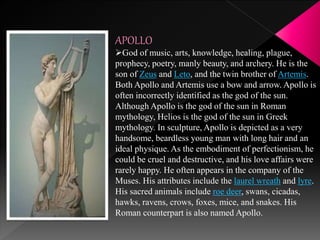
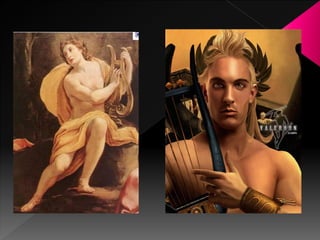
mythology. In sculpture, Apollo is depicted as a very
handsome, beardless young man with long hair and an
ideal physique. As the embodiment of perfectionism, he
could be cruel and destructive, and his love affairs were
rarely happy. He often appears in the company of the
Muses. His attributes include the laurel wreath and lyre.
His sacred animals include roe deer, swans, cicadas,
hawks, ravens, crows, foxes, mice, and snakes. His
Roman counterpart is also named Apollo.
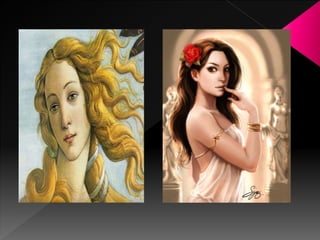
AphroditE
Goddess of beauty, love, desire, and pleasure.
Although married to Hephaestus she had many
lovers, most notably Ares, Adonis, and Anchises.
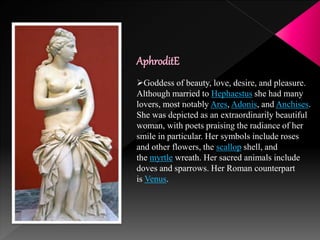
She was depicted as an extraordinarily beautiful
woman, with poets praising the radiance of her
smile in particular. Her symbols include roses
and other flowers, the scallop shell, and
the myrtle wreath. Her sacred animals include
doves and sparrows. Her Roman counterpart
is Venus.
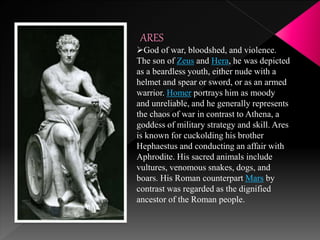
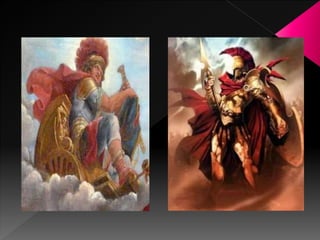
ARES
God of war, bloodshed, and violence.
The son of Zeus and Hera, he was depicted
as a beardless youth, either nude with a
helmet and spear or sword, or as an armed
warrior. Homer portrays him as moody
and unreliable, and he generally represents
the chaos of war in contrast to Athena, a
goddess of military strategy and skill. Ares
is known for cuckolding his brother
Hephaestus and conducting an affair with
Aphrodite. His sacred animals include
vultures, venomous snakes, dogs, and
boars. His Roman counterpart Mars by
contrast was regarded as the dignified
ancestor of the Roman people.
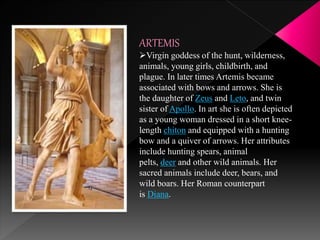
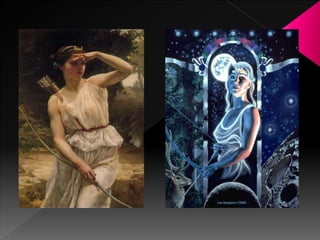
ARTEMIS
Virgin goddess of the hunt, wilderness,
animals, young girls, childbirth, and
plague. In later times Artemis became
associated with bows and arrows. She is
the daughter of Zeus and Leto, and twin
sister of Apollo. In art she is often depicted
as a young woman dressed in a short knee-
length chiton and equipped with a hunting
bow and a quiver of arrows. Her attributes
include hunting spears, animal
pelts, deer and other wild animals. Her
sacred animals include deer, bears, and
wild boars. Her Roman counterpart
is Diana.
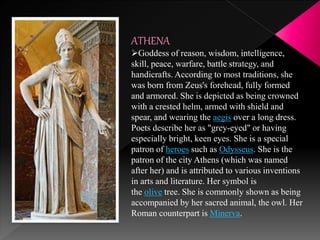
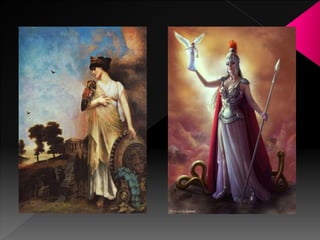
ATHENA
Goddess of reason, wisdom, intelligence,
skill, peace, warfare, battle strategy, and
handicrafts. According to most traditions, she
was born from Zeus's forehead, fully formed
and armored. She is depicted as being crowned
with a crested helm, armed with shield and
spear, and wearing the aegis over a long dress.
Poets describe her as "grey-eyed" or having
especially bright, keen eyes. She is a special
patron of heroes such as Odysseus. She is the
patron of the city Athens (which was named
after her) and is attributed to various inventions
in arts and literature. Her symbol is
the olive tree. She is commonly shown as being
accompanied by her sacred animal, the owl. Her
Roman counterpart is Minerva.
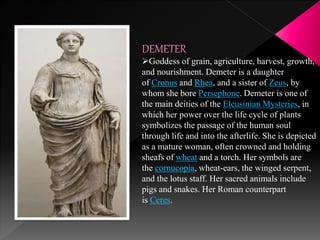
DEMETER
Goddess of grain, agriculture, harvest, growth,
and nourishment. Demeter is a daughter
of Cronus and Rhea, and a sister of Zeus, by
whom she bore Persephone. Demeter is one of
the main deities of the Eleusinian Mysteries, in
which her power over the life cycle of plants
symbolizes the passage of the human soul
through life and into the afterlife. She is depicted
as a mature woman, often crowned and holding
sheafs of wheat and a torch. Her symbols are
the cornucopia, wheat-ears, the winged serpent,
and the lotus staff. Her sacred animals include
pigs and snakes. Her Roman counterpart
is Ceres.
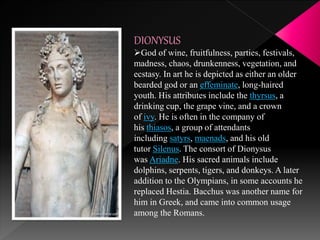
DIONYSUS
God of wine, fruitfulness, parties, festivals,
madness, chaos, drunkenness, vegetation, and
ecstasy. In art he is depicted as either an older
bearded god or an effeminate, long-haired
youth. His attributes include the thyrsus, a
drinking cup, the grape vine, and a crown
of ivy. He is often in the company of
his thiasos, a group of attendants
including satyrs, maenads, and his old
tutor Silenus. The consort of Dionysus
was Ariadne. His sacred animals include
dolphins, serpents, tigers, and donkeys. A later
addition to the Olympians, in some accounts he
replaced Hestia. Bacchus was another name for
him in Greek, and came into common usage
among the Romans.
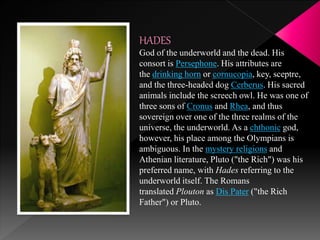
HADES
God of the underworld and the dead. His
consort is Persephone. His attributes are
the drinking horn or cornucopia, key, sceptre,
and the three-headed dog Cerberus. His sacred
animals include the screech owl. He was one of
three sons of Cronus and Rhea, and thus
sovereign over one of the three realms of the
universe, the underworld. As a chthonic god,
however, his place among the Olympians is
ambiguous. In the mystery religions and
Athenian literature, Pluto ("the Rich") was his
preferred name, with Hades referring to the
underworld itself. The Romans
translated Plouton as Dis Pater ("the Rich
Father") or Pluto.
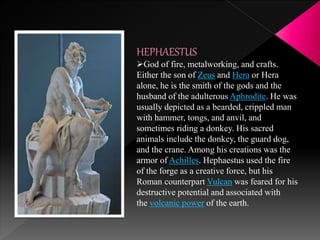
HEPHAESTUS
God of fire, metalworking, and crafts.
Either the son of Zeus and Hera or Hera
alone, he is the smith of the gods and the
husband of the adulterous Aphrodite. He was
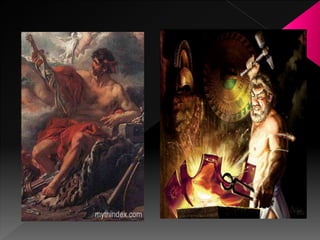
usually depicted as a bearded, crippled man
with hammer, tongs, and anvil, and
sometimes riding a donkey. His sacred
animals include the donkey, the guard dog,
and the crane. Among his creations was the
armor of Achilles. Hephaestus used the fire
of the forge as a creative force, but his
Roman counterpart Vulcan was feared for his
destructive potential and associated with
the volcanic power of the earth.
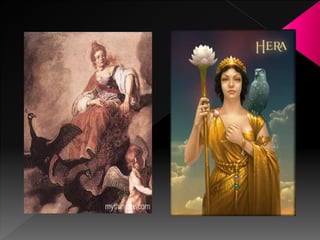
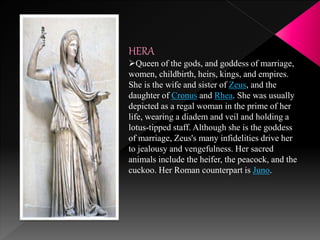
HERA
Queen of the gods, and goddess of marriage,
women, childbirth, heirs, kings, and empires.
She is the wife and sister of Zeus, and the
daughter of Cronus and Rhea. She was usually
depicted as a regal woman in the prime of her
life, wearing a diadem and veil and holding a
lotus-tipped staff. Although she is the goddess
of marriage, Zeus's many infidelities drive her
to jealousy and vengefulness. Her sacred
animals include the heifer, the peacock, and the
cuckoo. Her Roman counterpart is Juno.
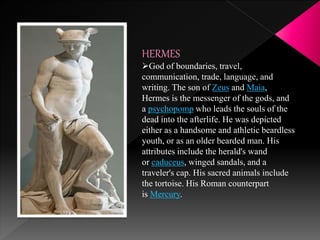
HERMES
God of boundaries, travel,
communication, trade, language, and
writing. The son of Zeus and Maia,
Hermes is the messenger of the gods, and
a psychopomp who leads the souls of the
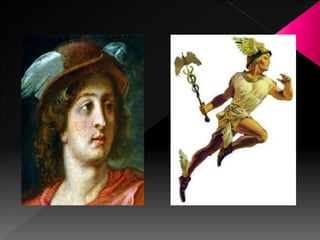
dead into the afterlife. He was depicted
either as a handsome and athletic beardless
youth, or as an older bearded man. His
attributes include the herald's wand
or caduceus, winged sandals, and a
traveler's cap. His sacred animals include
the tortoise. His Roman counterpart
is Mercury.
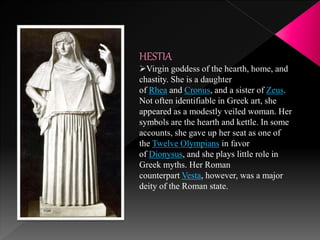
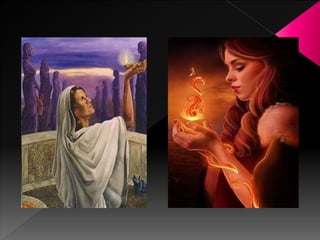
HESTIA
Virgin goddess of the hearth, home, and
chastity. She is a daughter
of Rhea and Cronus, and a sister of Zeus.
Not often identifiable in Greek art, she
appeared as a modestly veiled woman. Her
symbols are the hearth and kettle. In some
accounts, she gave up her seat as one of
the Twelve Olympians in favor
of Dionysus, and she plays little role in
Greek myths. Her Roman
counterpart Vesta, however, was a major
deity of the Roman state.
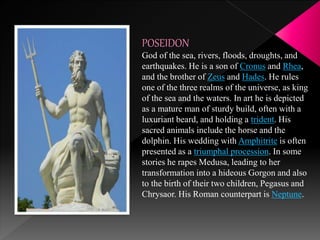
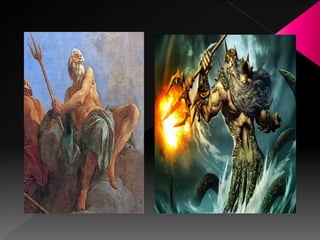
POSEIDON
God of the sea, rivers, floods, droughts, and
earthquakes. He is a son of Cronus and Rhea,
and the brother of Zeus and Hades. He rules
one of the three realms of the universe, as king
of the sea and the waters. In art he is depicted
as a mature man of sturdy build, often with a
luxuriant beard, and holding a trident. His
sacred animals include the horse and the
dolphin. His wedding with Amphitrite is often
presented as a triumphal procession. In some
stories he rapes Medusa, leading to her
transformation into a hideous Gorgon and also
to the birth of their two children, Pegasus and
Chrysaor. His Roman counterpart is Neptune.
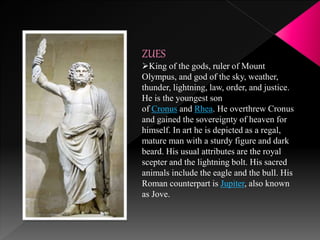
ZUES
King of the gods, ruler of Mount
Olympus, and god of the sky, weather,
thunder, lightning, law, order, and justice.
He is the youngest son
of Cronus and Rhea. He overthrew Cronus
and gained the sovereignty of heaven for
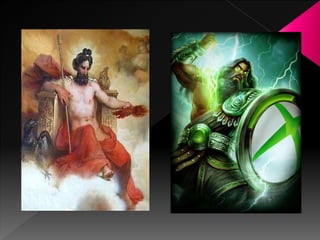
himself. In art he is depicted as a regal,
mature man with a sturdy figure and dark
beard. His usual attributes are the royal
scepter and the lightning bolt. His sacred
animals include the eagle and the bull. His
Roman counterpart is Jupiter, also known
as Jove.
Bethel Ann C. Tiburcio
H11-C

Bethel ann tiburcio

  • 1.
  • 2.
    APOLLO God of music,arts, knowledge, healing, plague, prophecy, poetry, manly beauty, and archery. He is the son of Zeus and Leto, and the twin brother of Artemis. Both Apollo and Artemis use a bow and arrow. Apollo is often incorrectly identified as the god of the sun. Although Apollo is the god of the sun in Roman mythology, Helios is the god of the sun in Greek mythology. In sculpture, Apollo is depicted as a very handsome, beardless young man with long hair and an ideal physique. As the embodiment of perfectionism, he could be cruel and destructive, and his love affairs were rarely happy. He often appears in the company of the Muses. His attributes include the laurel wreath and lyre. His sacred animals include roe deer, swans, cicadas, hawks, ravens, crows, foxes, mice, and snakes. His Roman counterpart is also named Apollo.
  • 4.
    AphroditE Goddess of beauty,love, desire, and pleasure. Although married to Hephaestus she had many lovers, most notably Ares, Adonis, and Anchises. She was depicted as an extraordinarily beautiful woman, with poets praising the radiance of her smile in particular. Her symbols include roses and other flowers, the scallop shell, and the myrtle wreath. Her sacred animals include doves and sparrows. Her Roman counterpart is Venus.
  • 6.
    ARES God of war,bloodshed, and violence. The son of Zeus and Hera, he was depicted as a beardless youth, either nude with a helmet and spear or sword, or as an armed warrior. Homer portrays him as moody and unreliable, and he generally represents the chaos of war in contrast to Athena, a goddess of military strategy and skill. Ares is known for cuckolding his brother Hephaestus and conducting an affair with Aphrodite. His sacred animals include vultures, venomous snakes, dogs, and boars. His Roman counterpart Mars by contrast was regarded as the dignified ancestor of the Roman people.
  • 8.
    ARTEMIS Virgin goddess ofthe hunt, wilderness, animals, young girls, childbirth, and plague. In later times Artemis became associated with bows and arrows. She is the daughter of Zeus and Leto, and twin sister of Apollo. In art she is often depicted as a young woman dressed in a short knee- length chiton and equipped with a hunting bow and a quiver of arrows. Her attributes include hunting spears, animal pelts, deer and other wild animals. Her sacred animals include deer, bears, and wild boars. Her Roman counterpart is Diana.
  • 10.
    ATHENA Goddess of reason,wisdom, intelligence, skill, peace, warfare, battle strategy, and handicrafts. According to most traditions, she was born from Zeus's forehead, fully formed and armored. She is depicted as being crowned with a crested helm, armed with shield and spear, and wearing the aegis over a long dress. Poets describe her as "grey-eyed" or having especially bright, keen eyes. She is a special patron of heroes such as Odysseus. She is the patron of the city Athens (which was named after her) and is attributed to various inventions in arts and literature. Her symbol is the olive tree. She is commonly shown as being accompanied by her sacred animal, the owl. Her Roman counterpart is Minerva.
  • 12.
    DEMETER Goddess of grain,agriculture, harvest, growth, and nourishment. Demeter is a daughter of Cronus and Rhea, and a sister of Zeus, by whom she bore Persephone. Demeter is one of the main deities of the Eleusinian Mysteries, in which her power over the life cycle of plants symbolizes the passage of the human soul through life and into the afterlife. She is depicted as a mature woman, often crowned and holding sheafs of wheat and a torch. Her symbols are the cornucopia, wheat-ears, the winged serpent, and the lotus staff. Her sacred animals include pigs and snakes. Her Roman counterpart is Ceres.
  • 14.
    DIONYSUS God of wine,fruitfulness, parties, festivals, madness, chaos, drunkenness, vegetation, and ecstasy. In art he is depicted as either an older bearded god or an effeminate, long-haired youth. His attributes include the thyrsus, a drinking cup, the grape vine, and a crown of ivy. He is often in the company of his thiasos, a group of attendants including satyrs, maenads, and his old tutor Silenus. The consort of Dionysus was Ariadne. His sacred animals include dolphins, serpents, tigers, and donkeys. A later addition to the Olympians, in some accounts he replaced Hestia. Bacchus was another name for him in Greek, and came into common usage among the Romans.
  • 16.
    HADES God of theunderworld and the dead. His consort is Persephone. His attributes are the drinking horn or cornucopia, key, sceptre, and the three-headed dog Cerberus. His sacred animals include the screech owl. He was one of three sons of Cronus and Rhea, and thus sovereign over one of the three realms of the universe, the underworld. As a chthonic god, however, his place among the Olympians is ambiguous. In the mystery religions and Athenian literature, Pluto ("the Rich") was his preferred name, with Hades referring to the underworld itself. The Romans translated Plouton as Dis Pater ("the Rich Father") or Pluto.
  • 18.
    HEPHAESTUS God of fire,metalworking, and crafts. Either the son of Zeus and Hera or Hera alone, he is the smith of the gods and the husband of the adulterous Aphrodite. He was usually depicted as a bearded, crippled man with hammer, tongs, and anvil, and sometimes riding a donkey. His sacred animals include the donkey, the guard dog, and the crane. Among his creations was the armor of Achilles. Hephaestus used the fire of the forge as a creative force, but his Roman counterpart Vulcan was feared for his destructive potential and associated with the volcanic power of the earth.
  • 20.
    HERA Queen of thegods, and goddess of marriage, women, childbirth, heirs, kings, and empires. She is the wife and sister of Zeus, and the daughter of Cronus and Rhea. She was usually depicted as a regal woman in the prime of her life, wearing a diadem and veil and holding a lotus-tipped staff. Although she is the goddess of marriage, Zeus's many infidelities drive her to jealousy and vengefulness. Her sacred animals include the heifer, the peacock, and the cuckoo. Her Roman counterpart is Juno.
  • 22.
    HERMES God of boundaries,travel, communication, trade, language, and writing. The son of Zeus and Maia, Hermes is the messenger of the gods, and a psychopomp who leads the souls of the dead into the afterlife. He was depicted either as a handsome and athletic beardless youth, or as an older bearded man. His attributes include the herald's wand or caduceus, winged sandals, and a traveler's cap. His sacred animals include the tortoise. His Roman counterpart is Mercury.
  • 24.
    HESTIA Virgin goddess ofthe hearth, home, and chastity. She is a daughter of Rhea and Cronus, and a sister of Zeus. Not often identifiable in Greek art, she appeared as a modestly veiled woman. Her symbols are the hearth and kettle. In some accounts, she gave up her seat as one of the Twelve Olympians in favor of Dionysus, and she plays little role in Greek myths. Her Roman counterpart Vesta, however, was a major deity of the Roman state.
  • 26.
    POSEIDON God of thesea, rivers, floods, droughts, and earthquakes. He is a son of Cronus and Rhea, and the brother of Zeus and Hades. He rules one of the three realms of the universe, as king of the sea and the waters. In art he is depicted as a mature man of sturdy build, often with a luxuriant beard, and holding a trident. His sacred animals include the horse and the dolphin. His wedding with Amphitrite is often presented as a triumphal procession. In some stories he rapes Medusa, leading to her transformation into a hideous Gorgon and also to the birth of their two children, Pegasus and Chrysaor. His Roman counterpart is Neptune.
  • 28.
    ZUES King of thegods, ruler of Mount Olympus, and god of the sky, weather, thunder, lightning, law, order, and justice. He is the youngest son of Cronus and Rhea. He overthrew Cronus and gained the sovereignty of heaven for himself. In art he is depicted as a regal, mature man with a sturdy figure and dark beard. His usual attributes are the royal scepter and the lightning bolt. His sacred animals include the eagle and the bull. His Roman counterpart is Jupiter, also known as Jove.
  • 30.
    Bethel Ann C.Tiburcio H11-C