THE GODS
- Isthe set of stories about gods and goddesses, heroes, and
rituals in Ancient Greeks.
- The Greeks did not believe that gods created the universe,
because they believe that the universe created them.
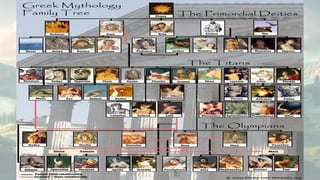
First gods- gods of Uranus (heaven) and Gaea (earth).
Titans – is their children
Gods – is their grandchildren
3.
Definition of terms
Titans- a group of immortal giants who ruled the world before the
Olympians. They were the first generation of gods, and were children of Gaea
(Earth) and Uranus (Heaven).
Olympians - a group of 12 gods and goddesses in Greek mythology who lived
on Mount Olympus. They are the most important gods in the Greek
mythology.
Mount Olympus - was the home of the gods, including Zeus, Hera, Poseidon,
and others. It was also the center of divine power and the site of Zeus' throne.
4.
Titans character
Uranus –ruler of the known universe
Gaea – wife of Uranus, mother of everything beautiful in the world.
Ocean – Son of Uranus and Gaea, was married to his sister Tethys and had
numerous children called Oceanids.
Tethys- daughter of Uranus and Gaea, was married to her brother, Oceanus.
Hyperion- Son of Uranus and Gaea, Father of the moon, sun, and dawn.
Mnemosyne- daughter of Uranus and Gaea, goddess of memory.
Themis-translated into Justice, human-like representation of the natural and
moral order. His name comes from Greek word meaning "divine law" or
"that which is put in place“.
5.
Titans character
Iapetus –his name derives from the Greek word meaning “to pierce usually
with a spear.” God of craftmanship.
Atlas – son of Iapetus, the leader of the Titan rebellion against Zues. He
was condemned to eternally hold up the sky.
Prometheus – son of Iapetus and was the savior of mankind.
Clymene – was one of the elder Oceanids and the Titan goddess of fame
and renown.
6.
THE TWELVE OLYMPIANSOVERVIEW
1. Zues (Jupiter) – the chief
His two brothers next;
2. Poseidon (Neptune), and
3. Hades (Pluto)
4. Hestia (Vestia) their sister;
5. Hera (Juno) Zue’s wife, and
6. Ares (Mars) their son:
Zue’s children:
7. Athena (Minerva)
8. Apollo
9. Aphrodite (Venus)
10. Hermes (Mercury) and
11. Artemis (Diana)
Hera’s son:
12. Hephaestus (Vulcan)
sometimes said to be the son of
Zues too.
7.
OLYMPUS
The twelve mainGreek gods, known as the Olympians, lived on Mount
Olympus. Initially, Olympus was seen as a real mountain in Greece (Mt.
Olympus in Thessaly), but over time, it came to be thought of as a magical
place high above the earth.
Olympus had a grand entrance guarded by the Seasons, and inside were the
gods' homes. They enjoyed eternal happiness there, free from bad weather,
always bathed in sunshine, and listening to Apollo's music. Olympus was a
special place where the gods lived and ruled together.
9.
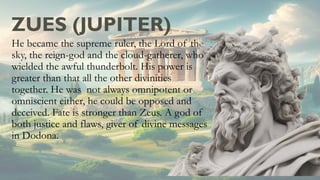
ZUES (JUPITER)
He becamethe supreme ruler, the Lord of the
sky, the reign-god and the cloud-gatherer, who
wielded the awful thunderbolt. His power is
greater than that all the other divinities
together. He was not always omnipotent or
omniscient either, he could be opposed and
deceived. Fate is stronger than Zeus. A god of
both justice and flaws, giver of divine messages
in Dodona.
10.
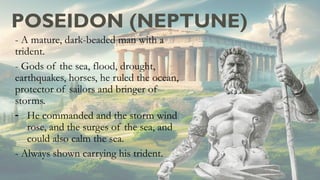
POSEIDON (NEPTUNE)
- Amature, dark-beaded man with a
trident.
- Gods of the sea, flood, drought,
earthquakes, horses, he ruled the ocean,
protector of sailors and bringer of
storms.
- He commanded and the storm wind
rose, and the surges of the sea, and
could also calm the sea.
- Always shown carrying his trident.
11.
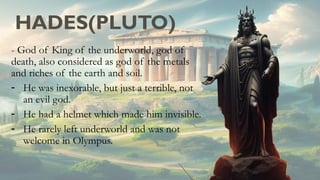
HADES(PLUTO)
- God ofKing of the underworld, god of
death, also considered as god of the metals
and riches of the earth and soil.
- He was inexorable, but just a terrible, not
an evil god.
- He had a helmet which made him invisible.
- He rarely left underworld and was not
welcome in Olympus.
12.
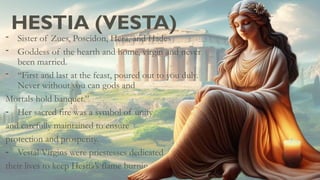
HESTIA (VESTA)
- Sisterof Zues, Poseidon, Hera, and Hades
- Goddess of the hearth and home, virgin and never
been married.
- “First and last at the feast, poured out to you duly.
Never without you can gods and
Mortals hold banquet.”
- Her sacred fire was a symbol of unity
and carefully maintained to ensure
protection and prosperity.
- Vestal Virgins were priestesses dedicated
their lives to keep Hestia’s flame burning
13.
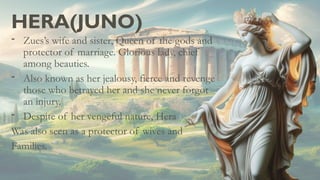
HERA(JUNO)
- Zues’s wifeand sister, Queen of the gods and
protector of marriage. Glorious lady, chief
among beauties.
- Also known as her jealousy, fierce and revenge
those who betrayed her and she never forgot
an injury.
- Despite of her vengeful nature, Hera
Was also seen as a protector of wives and
Families.
14.
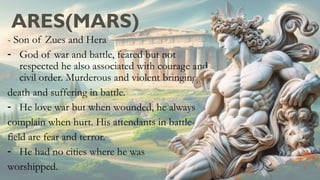
ARES(MARS)
- Son ofZues and Hera
- God of war and battle, feared but not
respected he also associated with courage and
civil order. Murderous and violent bringing
death and suffering in battle.
- He love war but when wounded, he always
complain when hurt. His attendants in battle-
field are fear and terror.
- He had no cities where he was
worshipped.
15.
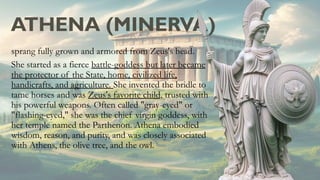
ATHENA (MINERVA)
sprang fullygrown and armored from Zeus's head.
She started as a fierce battle-goddess but later became
the protector of the State, home, civilized life,
handicrafts, and agriculture. She invented the bridle to
tame horses and was Zeus's favorite child, trusted with
his powerful weapons. Often called "gray-eyed" or
"flashing-eyed," she was the chief virgin goddess, with
her temple named the Parthenon. Athena embodied
wisdom, reason, and purity, and was closely associated
with Athens, the olive tree, and the owl.
16.
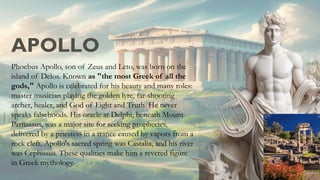
APOLLO
Phoebus Apollo, sonof Zeus and Leto, was born on the
island of Delos. Known as "the most Greek of all the
gods," Apollo is celebrated for his beauty and many roles:
master musician playing the golden lyre, far-shooting
archer, healer, and God of Light and Truth. He never
speaks falsehoods. His oracle at Delphi, beneath Mount
Parnassus, was a major site for seeking prophecies,
delivered by a priestess in a trance caused by vapors from a
rock cleft. Apollo's sacred spring was Castalia, and his river
was Cephissus. These qualities make him a revered figure
in Greek mythology.
17.
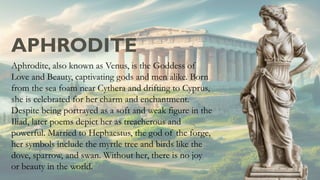
APHRODITE
Aphrodite, also knownas Venus, is the Goddess of
Love and Beauty, captivating gods and men alike. Born
from the sea foam near Cythera and drifting to Cyprus,
she is celebrated for her charm and enchantment.
Despite being portrayed as a soft and weak figure in the
Iliad, later poems depict her as treacherous and
powerful. Married to Hephaestus, the god of the forge,
her symbols include the myrtle tree and birds like the
dove, sparrow, and swan. Without her, there is no joy
or beauty in the world.
18.
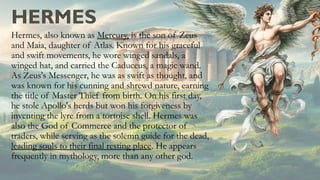
HERMES
Hermes, also knownas Mercury, is the son of Zeus
and Maia, daughter of Atlas. Known for his graceful
and swift movements, he wore winged sandals, a
winged hat, and carried the Caduceus, a magic wand.
As Zeus's Messenger, he was as swift as thought, and
was known for his cunning and shrewd nature, earning
the title of Master Thief from birth. On his first day,
he stole Apollo's herds but won his forgiveness by
inventing the lyre from a tortoise shell. Hermes was
also the God of Commerce and the protector of
traders, while serving as the solemn guide for the dead,
leading souls to their final resting place. He appears
frequently in mythology, more than any other god.
19.
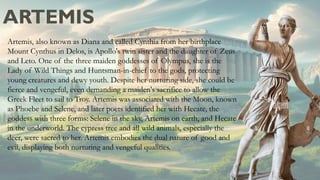
ARTEMIS
Artemis, also knownas Diana and called Cynthia from her birthplace
Mount Cynthus in Delos, is Apollo's twin sister and the daughter of Zeus
and Leto. One of the three maiden goddesses of Olympus, she is the
Lady of Wild Things and Huntsman-in-chief to the gods, protecting
young creatures and dewy youth. Despite her nurturing side, she could be
fierce and vengeful, even demanding a maiden's sacrifice to allow the
Greek Fleet to sail to Troy. Artemis was associated with the Moon, known
as Phoebe and Selene, and later poets identified her with Hecate, the
goddess with three forms: Selene in the sky, Artemis on earth, and Hecate
in the underworld. The cypress tree and all wild animals, especially the
deer, were sacred to her. Artemis embodies the dual nature of good and
evil, displaying both nurturing and vengeful qualities.
20.
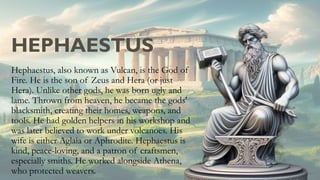
HEPHAESTUS
Hephaestus, also knownas Vulcan, is the God of
Fire. He is the son of Zeus and Hera (or just
Hera). Unlike other gods, he was born ugly and
lame. Thrown from heaven, he became the gods'
blacksmith, creating their homes, weapons, and
tools. He had golden helpers in his workshop and
was later believed to work under volcanoes. His
wife is either Aglaia or Aphrodite. Hephaestus is
kind, peace-loving, and a patron of craftsmen,
especially smiths. He worked alongside Athena,
who protected weavers.




![The Olympians Powerpoint[1]](https://cdn.slidesharecdn.com/ss_thumbnails/theolympianspowerpoint1-1234051763059636-3-thumbnail.jpg?width=640&height=640&fit=bounds)


