Submitted By: Bhanu Pratap Singh 10609079 Bithika Bishesh 10609080 Chetna Kohli 10609081 Deepshikha Jain 10609082 Divya Bhatia 10609083 Garima Sharma 10609084 Gaurav Passy 10609085
Supermarkets    Literature Review    –  Influencing Customers     –  Trends in Supermarket Optimization     Impulse Shopping    Swarm-Moves    –  Rationale  –  What   –  How - Customer Profiles  –  How - Database   –  On-Sale Factor  –  Swarm Factor  –  Decision Rule     Results    Conclusion and Future Work   
In today's multi-billion dollar supermarket  industry, Impulse shopping accounts for 2 out of 3 purchases.  Despite the current situation, most retail stores attempt to benefit from the fact that  people are impulsive in nature as a way to maximize  their profits.  In order to improve on current levels of sales, retail stores and supermarkets need to  look at out-of-the-box to solutions that may, at  first, not appear useful.  One such approach is the study of levels of self-organization in people while  they are doing their shopping.  This thesis discusses  the status-quo of supermarket optimization and leaps  into how a supermarket can  use real-time simulation  information about customer purchases and apply models inspired by RFID and feedback to customers empower customers with leading products sales level .
Intent : To understand the factors that influence customer shopping behavior in a supermarket for increased sales and profits by stretching their buying limit . Questions attended:   1.What would be the benefit of using RFID tags and scanners in the Supermarkets ? 2. What is the collective customers’ choice in given amount of time with a set of customers? 3. What is the effect of depth of promotion on sales volume?
Tools & Measures  :     1. RFID (radio-frequency identification)   Identifies data and information  through radio signals on the tags  implanted on the products which helps to gather a regular information about the buying pattern of the customer.   2. Neural Networks using KDD (Knowledge Discovery in Databases) Identifies patterns and information in the past data to predict the future sales and requirements of weekly demand on  items in a supermarket.    
Proposed Model    Swarm Sale Model : A simulation  model which forms the basis of this research after understanding  mob mentality defined as  “A human observing others performing a task is inclined to “join in” and perform the same task”.   Concepts used in Swarm Sale Model    Impulse Shopping- Here the real time customers in the store buys product based on the average shopping behavior of other customers in the store thinking as a so-called good value offer      Constituent of Swarm Sale Model   A. Customers’ Profiles: represents the purchase probability of customer per product category.   B. Sales Model : . This model will increase the probability of purchase of buying a product    C. Herd model: attempts to capture the average choice of the most common item(s) customers are buying.    D. Cheaters : A customer that can be controlled by the supermarket for their own benefit but it treated as an ordinary agent by other agents.
Herd model demonstrate better realistic performance  over Customer profiles, Cheaters and Sales model .It serves as an effective marketing tool for supermarkets to increase their sales volume based on emergent properties of customers in the store.    Herd model with the simulation was able to answer many of the above listed questions in a real supermarket setting.
More profit and sales is the number one priority for every manufacturer to live, succeed and be in the business.   There are generally two ways to do this    Out-store tactics: , inventory management, advertising campaigns, marketing, product positioning, pricing etc From manufacturing of the product to place it in the supermarket shelves.    In-store tactics:  When customers reaches the supermarket: Bargains,   everyday low prices, special and limited offers, buy-one-get-one, free samples, shelf-reorganization.
In the future the Swarm-Moves could be extended to answer many other questions that could also help retail stores in their decision making process: 1. What is the effect of products’ individual factors on impulse shopping? 2. What is the most prominent factor to increase impulse shopping in real-time? 3. Should we impose ’cross categorization’ to increase sales in a given time? Or should we impose ’uniform categorization’ to help the customer to find a product and to save time? 4. What is the most common path of customers? 5. What would be the effect of adding shelves and/or product in sales of supermarket?
 
Two opposite goals - Retailers want to keep the customers in the store for as long as possible while customers want to leave the store as soon as they finished their planned shopping.  Background Music, Greetings, Smiley, EDLP, Bargains, Sales, Internet Booths, ATM, Barber Shops, Pharmacy all are trying to keep the customer as long as they can.     Customer visits Supermarket (on average) 2 to 4 times per week
Both approaches either work before customers enter the market (Out-store) and after they leave the market (In-Store for next set of customers)
Immediate, unintended, powerful and persistent urge to buy the product   Unplanned Buying.  Classification  Pure Impulse:  Immediate urge to buy a product which breaks the normal shopping pattern.   
–  Reminder Impulse:  Shopper sees an item and remembers that he is out of stock or an advertisement about that product.    –  Suggestion Impulse:  Customer has no prior experience of an item, he saw the item and realized the need for it.    –  Planned Impulse:  Customer wants to buy some product given it is on sale or have some special bargain.
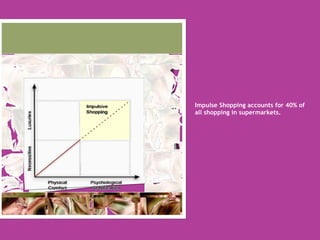
Impulse Shopping accounts for 40% of all shopping in supermarkets.
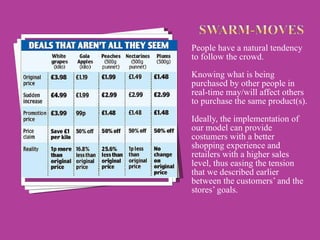
People have a natural tendency to follow the crowd.  Knowing what is being purchased by other people in real-time may/will affect others to purchase the same product(s).   Ideally, the implementation of our model can provide costumers with a better shopping experience and retailers with a higher sales level, thus easing the tension that we described earlier between the customers’ and the stores’ goals.
Customers equipped with RFID-enabled shopping carts can get information about other costumers purchases yet informing the store of their own shopping.  The  Swarm-Moves  simulator attempts to capture the   ’ Collective Average Choice ’ that costumers are taking.    No need to worry about “ Why ”. (Customer’s ages, sex, status, pay etc)  Just “ What ”
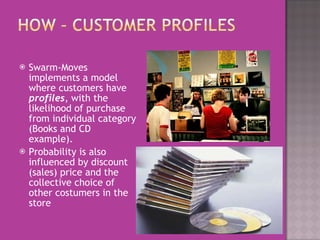
Swarm-Moves implements a model where customers have  profiles , with the likelihood of purchase from individual   category (Books and CD example).   Probability is also influenced by discount (sales) price and the collective choice of other costumers in the store
Database contains the inventory of Swarm-Mall (The Virtual Supermarket)  It has 120 products with following attributes  Item Name, Price, Size, Advertisement Percentage,  Prominent Display (Yes, No), Weight, Product Life, On-Sale percentage, Category, Good-will (Brand name)
 
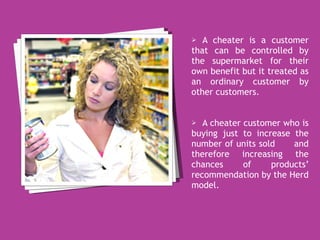
A cheater is a customer that can be controlled by the supermarket for their own benefit but it treated as an ordinary customer by other customers.  A cheater customer who is buying just to increase the number of units sold  and therefore increasing the chances of products’ recommendation by the Herd model.
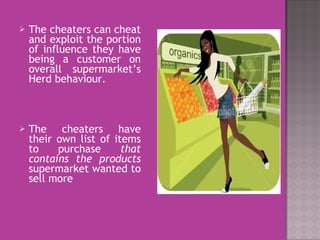
The cheaters can cheat and exploit the portion of influence they have being a customer on overall supermarket’s Herd behaviour. The cheaters have their own list of items to purchase  that contains the products  supermarket wanted to sell more
Implementation of supermarket simulation uses: 1. A database where profiles of agents (customers) and products are present. 2 The product profiles basically represent the product description, that includes name, code, color, size, weight, price, promotion, brand, expiry date (if any) etc. The database contains 120 products in total. Assumptions for simulation : 1.  Agents have enough money to buy. 2.  Agents can see only one product at a time and cannot buy the same product twice. 3  There is no shortage of products in the shelves and all agents are equipped with RFID equipped shopping carts
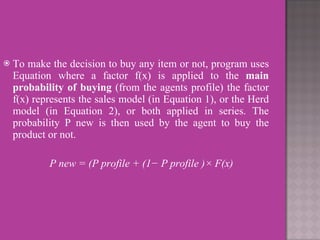
To make the decision to buy any item or not, program uses Equation where a factor f(x) is applied to the  main probability of buying  (from the agents profile) the factor f(x) represents the sales model (in Equation 1), or the Herd model (in Equation 2), or both applied in series. The probability P new is then used by the agent to buy the product or not. P new = (P profile + (1− P profile )× F(x)
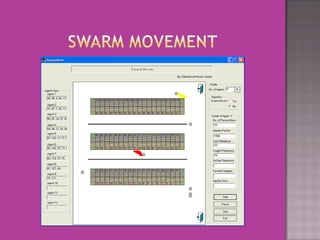
As soon as the simulation starts, the trolleys will have all planned items. Simulation starts when agents enter the supermarket from the main  door. Yellow lens shows scanning of the items & the red lens blinks. Simulation ends when all agents exit through the exit gate.
 
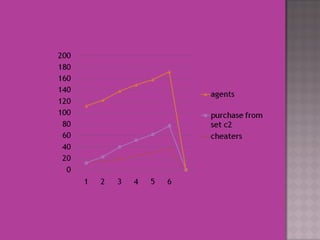
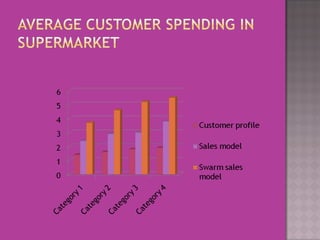
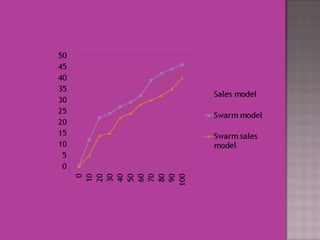
This section concentrates on demonstrating  that Herd model is indeed a model able to show improvements on the  overall sales  volumes in supermarkets


Herd model is a sales tool In comparison to other models , Herd model offer similar results without losing money on sales deals or price reduction It is able to generate better unit sales by incorporating Average Common Choices
Swarm model contribution looks like the sigmoid.  There is a threshold point in graph which changes the customers decision to buy the product and at certain point it will stabilize.  These threshold and stabilization point can be different for each product of different categories
The simulation offers an effective marketing tool for supermarkets to increase their sales volume based on collective choice of customers.  The Swarm-Factor has the similar effects as of depth of promotion in supermarket sales.  Environmental information can be used to influence customers to buy more on impulse.  The initial results should be validated in a real supermarket setting.
Cheaters    Addition of multiple entrance and exits  Combine Bargains  Effect of other factors like price, weight, size, advertisement and prominent display on Sales Volume and Impulse Shopping.


herd behavior consumer behavior

  • 1.
    Submitted By: BhanuPratap Singh 10609079 Bithika Bishesh 10609080 Chetna Kohli 10609081 Deepshikha Jain 10609082 Divya Bhatia 10609083 Garima Sharma 10609084 Gaurav Passy 10609085
  • 2.
    Supermarkets  Literature Review   – Influencing Customers   – Trends in Supermarket Optimization   Impulse Shopping   Swarm-Moves   – Rationale – What – How - Customer Profiles – How - Database – On-Sale Factor – Swarm Factor – Decision Rule   Results   Conclusion and Future Work  
  • 3.
    In today's multi-billiondollar supermarket  industry, Impulse shopping accounts for 2 out of 3 purchases.  Despite the current situation, most retail stores attempt to benefit from the fact that  people are impulsive in nature as a way to maximize  their profits.  In order to improve on current levels of sales, retail stores and supermarkets need to  look at out-of-the-box to solutions that may, at  first, not appear useful.  One such approach is the study of levels of self-organization in people while  they are doing their shopping.  This thesis discusses the status-quo of supermarket optimization and leaps  into how a supermarket can use real-time simulation  information about customer purchases and apply models inspired by RFID and feedback to customers empower customers with leading products sales level .
  • 4.
    Intent : Tounderstand the factors that influence customer shopping behavior in a supermarket for increased sales and profits by stretching their buying limit . Questions attended:   1.What would be the benefit of using RFID tags and scanners in the Supermarkets ? 2. What is the collective customers’ choice in given amount of time with a set of customers? 3. What is the effect of depth of promotion on sales volume?
  • 5.
    Tools & Measures :     1. RFID (radio-frequency identification)   Identifies data and information  through radio signals on the tags  implanted on the products which helps to gather a regular information about the buying pattern of the customer.   2. Neural Networks using KDD (Knowledge Discovery in Databases) Identifies patterns and information in the past data to predict the future sales and requirements of weekly demand on items in a supermarket.    
  • 6.
    Proposed Model   Swarm Sale Model : A simulation  model which forms the basis of this research after understanding  mob mentality defined as  “A human observing others performing a task is inclined to “join in” and perform the same task”.   Concepts used in Swarm Sale Model   Impulse Shopping- Here the real time customers in the store buys product based on the average shopping behavior of other customers in the store thinking as a so-called good value offer     Constituent of Swarm Sale Model   A. Customers’ Profiles: represents the purchase probability of customer per product category.   B. Sales Model : . This model will increase the probability of purchase of buying a product   C. Herd model: attempts to capture the average choice of the most common item(s) customers are buying.   D. Cheaters : A customer that can be controlled by the supermarket for their own benefit but it treated as an ordinary agent by other agents.
  • 7.
    Herd model demonstratebetter realistic performance  over Customer profiles, Cheaters and Sales model .It serves as an effective marketing tool for supermarkets to increase their sales volume based on emergent properties of customers in the store.   Herd model with the simulation was able to answer many of the above listed questions in a real supermarket setting.
  • 8.
    More profit andsales is the number one priority for every manufacturer to live, succeed and be in the business.   There are generally two ways to do this   Out-store tactics: , inventory management, advertising campaigns, marketing, product positioning, pricing etc From manufacturing of the product to place it in the supermarket shelves.   In-store tactics: When customers reaches the supermarket: Bargains, everyday low prices, special and limited offers, buy-one-get-one, free samples, shelf-reorganization.
  • 9.
    In the futurethe Swarm-Moves could be extended to answer many other questions that could also help retail stores in their decision making process: 1. What is the effect of products’ individual factors on impulse shopping? 2. What is the most prominent factor to increase impulse shopping in real-time? 3. Should we impose ’cross categorization’ to increase sales in a given time? Or should we impose ’uniform categorization’ to help the customer to find a product and to save time? 4. What is the most common path of customers? 5. What would be the effect of adding shelves and/or product in sales of supermarket?
  • 10.
  • 11.
    Two opposite goals- Retailers want to keep the customers in the store for as long as possible while customers want to leave the store as soon as they finished their planned shopping. Background Music, Greetings, Smiley, EDLP, Bargains, Sales, Internet Booths, ATM, Barber Shops, Pharmacy all are trying to keep the customer as long as they can.   Customer visits Supermarket (on average) 2 to 4 times per week
  • 12.
    Both approaches eitherwork before customers enter the market (Out-store) and after they leave the market (In-Store for next set of customers)
  • 13.
    Immediate, unintended, powerfuland persistent urge to buy the product   Unplanned Buying. Classification Pure Impulse: Immediate urge to buy a product which breaks the normal shopping pattern.  
  • 14.
    – ReminderImpulse: Shopper sees an item and remembers that he is out of stock or an advertisement about that product.   – Suggestion Impulse: Customer has no prior experience of an item, he saw the item and realized the need for it.   – Planned Impulse: Customer wants to buy some product given it is on sale or have some special bargain.
  • 15.
    Impulse Shopping accountsfor 40% of all shopping in supermarkets.
  • 16.
    People have anatural tendency to follow the crowd. Knowing what is being purchased by other people in real-time may/will affect others to purchase the same product(s).   Ideally, the implementation of our model can provide costumers with a better shopping experience and retailers with a higher sales level, thus easing the tension that we described earlier between the customers’ and the stores’ goals.
  • 17.
    Customers equipped withRFID-enabled shopping carts can get information about other costumers purchases yet informing the store of their own shopping. The Swarm-Moves simulator attempts to capture the   ’ Collective Average Choice ’ that costumers are taking.   No need to worry about “ Why ”. (Customer’s ages, sex, status, pay etc) Just “ What ”
  • 18.
    Swarm-Moves implements amodel where customers have profiles , with the likelihood of purchase from individual category (Books and CD example).   Probability is also influenced by discount (sales) price and the collective choice of other costumers in the store
  • 19.
    Database contains theinventory of Swarm-Mall (The Virtual Supermarket)  It has 120 products with following attributes Item Name, Price, Size, Advertisement Percentage, Prominent Display (Yes, No), Weight, Product Life, On-Sale percentage, Category, Good-will (Brand name)
  • 20.
  • 21.
    A cheater isa customer that can be controlled by the supermarket for their own benefit but it treated as an ordinary customer by other customers. A cheater customer who is buying just to increase the number of units sold and therefore increasing the chances of products’ recommendation by the Herd model.
  • 22.
    The cheaters cancheat and exploit the portion of influence they have being a customer on overall supermarket’s Herd behaviour. The cheaters have their own list of items to purchase that contains the products supermarket wanted to sell more
  • 23.
    Implementation of supermarketsimulation uses: 1. A database where profiles of agents (customers) and products are present. 2 The product profiles basically represent the product description, that includes name, code, color, size, weight, price, promotion, brand, expiry date (if any) etc. The database contains 120 products in total. Assumptions for simulation : 1. Agents have enough money to buy. 2. Agents can see only one product at a time and cannot buy the same product twice. 3 There is no shortage of products in the shelves and all agents are equipped with RFID equipped shopping carts
  • 24.
    To make thedecision to buy any item or not, program uses Equation where a factor f(x) is applied to the main probability of buying (from the agents profile) the factor f(x) represents the sales model (in Equation 1), or the Herd model (in Equation 2), or both applied in series. The probability P new is then used by the agent to buy the product or not. P new = (P profile + (1− P profile )× F(x)
  • 25.
    As soon asthe simulation starts, the trolleys will have all planned items. Simulation starts when agents enter the supermarket from the main door. Yellow lens shows scanning of the items & the red lens blinks. Simulation ends when all agents exit through the exit gate.
  • 26.
  • 27.
    This section concentrateson demonstrating that Herd model is indeed a model able to show improvements on the overall sales volumes in supermarkets
  • 28.
  • 29.
  • 30.
  • 31.
    Herd model isa sales tool In comparison to other models , Herd model offer similar results without losing money on sales deals or price reduction It is able to generate better unit sales by incorporating Average Common Choices
  • 32.
    Swarm model contributionlooks like the sigmoid. There is a threshold point in graph which changes the customers decision to buy the product and at certain point it will stabilize. These threshold and stabilization point can be different for each product of different categories
  • 33.
    The simulation offersan effective marketing tool for supermarkets to increase their sales volume based on collective choice of customers. The Swarm-Factor has the similar effects as of depth of promotion in supermarket sales. Environmental information can be used to influence customers to buy more on impulse. The initial results should be validated in a real supermarket setting.
  • 34.
    Cheaters  Addition of multiple entrance and exits Combine Bargains Effect of other factors like price, weight, size, advertisement and prominent display on Sales Volume and Impulse Shopping.
  • 35.
  • 36.

Editor's Notes

  • #30 Even though the cheaters pattern of purchasing was increasing similarly there was a corresponding increase in purchases from list C