Finding faster growth: new customers
Stop interrupting shoppers


            Share this                 Opinion Leader
Stop interrupting shoppers


To broaden product consideration and grow
sales, category managers and shopper marketers
must abandon disruption – and focus on helping
shoppers find what they are looking for.


         Share this                       Opinion Leader

                                                       2
Stop interrupting shoppers


Retailers and manufacturers don’t draw up planograms       purchased from a category – and 45 percent buy
for fun. And at the risk of sounding cynical, they don’t   exactly the same product. In case you think this


                                                                                                                                   69%
usually draw them up just to make shoppers’ lives          only applies to pre-planned purchases, 66 percent
easier. Their objective is, naturally enough, a more       of confectionery shoppers in supermarkets (about
self-interested one: most planograms aim to influence      as impulsive as supermarket purchasing gets) have
shoppers’ decisions, affecting what they buy and           already decided on the brand they will buy when they
                                                                                                                       of supermarket shoppers buy the same
increasing the amount that they spend. As such they        enter the store.
                                                                                                                       brand as they did last time
embody an assumption: that shoppers are actually
making decisions in-store, considering choices and         Shoppers spend the vast majority of their time at


                                                                                                                                   45%
weighing up options. The problem is that for most          the shelf searching for the product they know they
shoppers and most purchases, this assumption is very       want – and when they are busy searching for specific
wide of the mark.                                          products they are not open to influence; in fact,
                                                           they are effectively blind to anything not relevant
                                                                                                                       of supermarket shoppers buy exactly
Choosing or searching?                                     to the task in hand. An experiment by ‘Shopology’
                                                                                                                       the same product
TNS has spent more than 20 years observing shopper         proved just how difficult it is to distract shoppers
behaviour. And all of that observation points to one       when they are in search mode. Researchers placed a
overriding conclusion: for the majority of shoppers, the   pack of beer in the middle of a cereal shelf and then     The price of disruption
purchase process has little to do with decision-making;    videoed shoppers’ reactions to it. You’d think this was   The approach that most category managers and
it has everything to do with finding something that        attention-grabbing and disruptive; in fact, hardly any    shopper marketers take to this challenge is to
the shopper has already decided to buy. Purchasing         shoppers even noticed the beer. The fact is that when     interrupt the search and attempt to jump-start
data show that 69 percent of supermarket shoppers          shoppers are in search mode, they don’t see what          a consideration process, inviting the shopper to
buy the same brand as they did last time they              they are not looking for.                                 connect with the category. From a superficial look at


                 Share this                                                                                                                              Opinion Leader

                                                                                                                                                                         3
Stop interrupting shoppers


shopper behaviour, you’d think this approach works:
we see people pausing in front of a category, we
watch them scanning the shelf and we assume that
they are weighing up different options and thinking
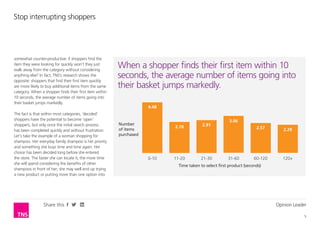
                                                           Work with the shopper’s
through their purchases. But appearances can be
dangerously deceptive. When you look a little deeper
below the surface, you quickly see that the disruptive
                                                           agenda rather than trying
merchandising strategy isn’t really leading to more
open-minded shopping; instead it’s creating more
frustrating searching – and that is hugely counter-
                                                           to change it.
productive for all concerned.
                                                         positive emotion on the four occasions when he or           handed. Our disruptive approach hasn’t opened these
We like to think of shopping as a positive experience,   she sees a relevant product.                                shopper’s minds to other purchases – it’s stopped
centred on finding solutions to satisfy wants and                                                                    them buying anything at all. Even more frustratingly,
needs. Searching, on the other hand is essentially       All of this happens very rapidly, and barely consciously,   20 percent of the items shoppers have specifically
negative: shoppers spend their time de-selecting         but that degree of negative feeling does affect the         planned to buy don’t make it into the basket.
large numbers of products so that they can focus         shopping experience. The longer a shopper spends
on the ones that they are actually interested in.        looking for a product within a category, the greater        Working with the search agenda
Eye-tracking may show that a shopper rapidly scans       the likelihood of them giving up and walking away           The way to opening the minds of shoppers isn’t to
100 items within a category but if we overlay EEG        from the shelf without putting anything in their            interrupt or extend their search; it’s to help them
results, we can see that 96 of them are rejected.        basket. In fact, on average, 30 percent of grocery          complete it; to work with the shopper’s agenda rather
And rejection isn’t fun. Our shopper only experiences    shoppers who browse a shelf walk away empty-                than trying to change it. At first glance this seems


                Share this                                                                                                                               Opinion Leader

                                                                                                                                                                         4
Stop interrupting shoppers


somewhat counter-productive: if shoppers find the
item they were looking for quickly won’t they just
walk away from the category without considering
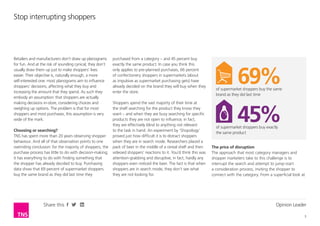
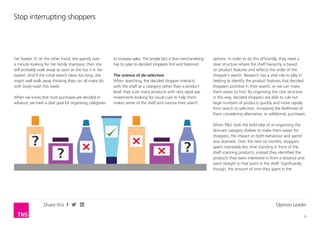
                                                         When a shopper finds their first item within 10
anything else? In fact, TNS’s research shows the
opposite: shoppers that find their first item quickly
                                                         seconds, the average number of items going into
are more likely to buy additional items from the same    their basket jumps markedly.
category. When a shopper finds their first item within
10 seconds, the average number of items going into
their basket jumps markedly.
                                                                     4.48
The fact is that within most categories, ‘decided’
shoppers have the potential to become ‘open’                                                             3.06
shoppers, but only once the initial search process       Number                           2.91
                                                                            2.78                                       2.57
has been completed quickly and without frustration.      of items                                                                 2.29
Let’s take the example of a woman shopping for           purchased
shampoo. Her everyday family shampoo is her priority
and something she buys time and time again. Her
choice has been decided long before she entered
the store. The faster she can locate it, the more time               0-10   11-20        21-30          31-60         60-120      120+
she will spend considering the benefits of other
                                                                              Time taken to select first product (seconds)
shampoos in front of her; she may well end up trying
a new product or putting more than one option into


                 Share this                                                                                                    Opinion Leader

                                                                                                                                            5
Stop interrupting shoppers


her basket. If, on the other hand, she spends over        to increase sales. The simple fact is that merchandising   options. In order to do this efficiently, they need a
a minute looking for her family shampoo, then she         has to cater to decided shoppers first and foremost.       clear structure where the shelf hierarchy is based
will probably walk away as soon as she has it in her                                                                 on product features and reflects the order of the
basket. And if the initial search takes too long, she     The science of de-selection                                shopper’s search. Research has a vital role to play in
might well walk away thinking they can all make do        When searching, the decided shopper interacts              helping to identify the product features that decided
with body wash this week.                                 with the shelf at a category rather than a product         shoppers prioritise in their search, so we can make
                                                          level: they scan many products with very rapid eye         them easier to find. By organising the core structure
When we know that most purchases are decided in           movements looking for visual cues to help them             in this way, decided shoppers are able to rule out
advance, we have a clear goal for organising categories   makes sense of the shelf and narrow their search           large numbers of products quickly and move rapidly
                                                                                                                     from search to selection, increasing the likelihood of
                                                                                                                     them considering alternative, or additional, purchases.

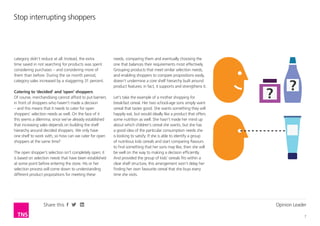
                                                                                                                     When P&G took the bold step of re-organising the
                                                                                                                     skincare category shelves to make them easier for


          ?
                                                                                                                     shoppers, the impact on both behaviour and spend
                                                                                                                     was dramatic. Over the next six months, shoppers


                         ?                                                                           ?               spent noticeably less time standing in front of the
                                                                                                                     shelf scanning products; instead they identified the
                                                                                                                     products they were interested in from a distance and
                                                                                                                     went straight to that point in the shelf. Significantly
                                                                                                                     though, the amount of time they spent in the


                 Share this                                                                                                                               Opinion Leader

                                                                                                                                                                               6
Stop interrupting shoppers


category didn’t reduce at all. Instead, the extra        needs, comparing them and eventually choosing the
time saved in not searching for products was spent       one that balances their requirements most effectively.
considering purchases – and considering more of          Grouping products that meet similar selection needs,
them than before. During the six month period,           and enabling shoppers to compare propositions easily,


                                                                                                                                ?
category sales increased by a staggering 31 percent.     doesn’t undermine a core shelf hierarchy built around
                                                         product features; in fact, it supports and strengthens it.
Catering to ‘decided’ and ‘open’ shoppers
Of course, merchandising cannot afford to put barriers
in front of shoppers who haven’t made a decision
                                                         Let’s take the example of a mother shopping for
                                                         breakfast cereal. Her two school-age sons simply want
                                                                                                                      ?
– and this means that it needs to cater for open         cereal that tastes good. She wants something they will
shoppers’ selection needs as well. On the face of it     happily eat, but would ideally like a product that offers
this seems a dilemma, since we’ve already established    some nutrition as well. She hasn’t made her mind up
that increasing sales depends on building the shelf      about which children’s cereal she wants, but she has
hierarchy around decided shoppers. We only have          a good idea of the particular consumption needs she
one shelf to work with, so how can we cater for open     is looking to satisfy. If she is able to identify a group
shoppers at the same time?                               of nutritious kids cereals and start comparing flavours
                                                         to find something that her sons may like, then she will
The open shopper’s selection isn’t completely open; it   be well on the way to making a decision efficiently.
is based on selection needs that have been established   And provided the group of kids’ cereals fits within a
at some point before entering the store. His or her      clear shelf structure, this arrangement won’t delay her
selection process will come down to understanding        finding her own favourite cereal that she buys every
different product propositions for meeting these         time she visits.


                 Share this                                                                                               Opinion Leader

                                                                                                                                       7
Stop interrupting shoppers


The role of packaging communication                         Principles for category planning                           growth when it has a clear objective of its own – and
Similar principles and a similar hierarchy of priorities    Applying consistent principles based around actual         the evidence of actual shopper behaviour makes it
apply to manufacturers looking to increase share of         shopper behaviour isn’t the same as suggesting             clear what this objective should be. If manufacturers
spend within a category. Once again, it is essential        a one-size-fits-all solution for category planning.        and retailers want to increase consideration and spend
to prioritise rapid visual communication with the           Merchandising will always remain a complex art, in         they must organise categories to reduce search time
vast majority of shoppers who are decided as to the         which many different elements are brought together         and ensure that decided shoppers find what they are
product features they want – and are engaged in             to meet a range of conscious and sub-conscious             looking for as quickly as possible. In doing so, they will
rapid, sub-conscious searching. Key product features        shopper needs. An understanding of the precise             be putting shoppers in control of the time they spend
that are relevant to such a search must be prioritised in   priorities of decided and open shoppers in each            in store – inviting them to spend less of that time
the package design and communicated where possible          category is essential for planning shelf hierarchies and   searching and more of that time shopping. It’s a leap
through colour and visual cues, since the product           product groupings effectively. However, that planning      of faith, but one that is long overdue.
only has a split second to establish its relevance. More    process can be rendered far more effective at driving
specific product benefits that may persuade an open
shopper to pick that product over another can be
communicated through text, since they have a longer
window of opportunity to engage with these shoppers           Precise priorities of decided and open shoppers
during their consideration process. The pink colour of
a packet of prawn cocktail flavoured crisps is a great        in each category is essential for planning shelf
example of the first form of communication; clear copy
stressing reduced fat or increased flavour is a great         hierarchies and product groupings.
example of the second.


                  Share this                                                                                                                                  Opinion Leader

                                                                                                                                                                                8
About Opinion Leaders
Opinion Leaders is part of a regular series of articles from TNS consultants, based on their expertise gathered
through working on client assignments in over 80 markets globally, with additional insights gained through
TNS proprietary studies such as Digital Life, Mobile Life and the Commitment Economy.

About TNS
                                                                                                                              About the author
                                                                                                                  Pat McCann is Global Director for TNS Retail &
TNS advises clients on specific growth strategies around new market entry, innovation, brand switching and
                                                                                                                  Shopper, responsible for developing best practice
stakeholder management, based on long-established expertise and market-leading solutions. With a presence         shopper solutions and enhancing shopper insight
in over 80 countries, TNS has more conversations with the world’s consumers than anyone else and understands      delivery.
individual human behaviours and attitudes across every cultural, economic and political region of the world.
                                                                                                                  She started her career at Nielsen and then worked
TNS is part of Kantar, one of the world’s largest insight, information and consultancy groups.                    clientside at Avon and Allied Lyons before joining
                                                                                                                  TNS.
Please visit www.tnsglobal.com for more information.
                                                                                                                  With over 20 years experience as a buyer and
                                                                                                                  supplier of shopper and consumer research, Pat was
Get in touch
                                                                                                                  instrumental in establishing this global practice area
If you would like to talk to us about anything you have read in this report, please get in touch via              and in acquiring shopper specialists, Sorensen and ID
enquiries@tnsglobal.com or via Twitter @tns_global                                                                Magasin.


                  Share this                                                                                                                           Opinion Leader

                                                                                                                                                                           9

Stop interrupting shoppers

  • 1.
    Finding faster growth:new customers Stop interrupting shoppers Share this Opinion Leader
  • 2.
    Stop interrupting shoppers Tobroaden product consideration and grow sales, category managers and shopper marketers must abandon disruption – and focus on helping shoppers find what they are looking for. Share this Opinion Leader 2
  • 3.
    Stop interrupting shoppers Retailersand manufacturers don’t draw up planograms purchased from a category – and 45 percent buy for fun. And at the risk of sounding cynical, they don’t exactly the same product. In case you think this 69% usually draw them up just to make shoppers’ lives only applies to pre-planned purchases, 66 percent easier. Their objective is, naturally enough, a more of confectionery shoppers in supermarkets (about self-interested one: most planograms aim to influence as impulsive as supermarket purchasing gets) have shoppers’ decisions, affecting what they buy and already decided on the brand they will buy when they of supermarket shoppers buy the same increasing the amount that they spend. As such they enter the store. brand as they did last time embody an assumption: that shoppers are actually making decisions in-store, considering choices and Shoppers spend the vast majority of their time at 45% weighing up options. The problem is that for most the shelf searching for the product they know they shoppers and most purchases, this assumption is very want – and when they are busy searching for specific wide of the mark. products they are not open to influence; in fact, they are effectively blind to anything not relevant of supermarket shoppers buy exactly Choosing or searching? to the task in hand. An experiment by ‘Shopology’ the same product TNS has spent more than 20 years observing shopper proved just how difficult it is to distract shoppers behaviour. And all of that observation points to one when they are in search mode. Researchers placed a overriding conclusion: for the majority of shoppers, the pack of beer in the middle of a cereal shelf and then The price of disruption purchase process has little to do with decision-making; videoed shoppers’ reactions to it. You’d think this was The approach that most category managers and it has everything to do with finding something that attention-grabbing and disruptive; in fact, hardly any shopper marketers take to this challenge is to the shopper has already decided to buy. Purchasing shoppers even noticed the beer. The fact is that when interrupt the search and attempt to jump-start data show that 69 percent of supermarket shoppers shoppers are in search mode, they don’t see what a consideration process, inviting the shopper to buy the same brand as they did last time they they are not looking for. connect with the category. From a superficial look at Share this Opinion Leader 3
  • 4.
    Stop interrupting shoppers shopperbehaviour, you’d think this approach works: we see people pausing in front of a category, we watch them scanning the shelf and we assume that they are weighing up different options and thinking Work with the shopper’s through their purchases. But appearances can be dangerously deceptive. When you look a little deeper below the surface, you quickly see that the disruptive agenda rather than trying merchandising strategy isn’t really leading to more open-minded shopping; instead it’s creating more frustrating searching – and that is hugely counter- to change it. productive for all concerned. positive emotion on the four occasions when he or handed. Our disruptive approach hasn’t opened these We like to think of shopping as a positive experience, she sees a relevant product. shopper’s minds to other purchases – it’s stopped centred on finding solutions to satisfy wants and them buying anything at all. Even more frustratingly, needs. Searching, on the other hand is essentially All of this happens very rapidly, and barely consciously, 20 percent of the items shoppers have specifically negative: shoppers spend their time de-selecting but that degree of negative feeling does affect the planned to buy don’t make it into the basket. large numbers of products so that they can focus shopping experience. The longer a shopper spends on the ones that they are actually interested in. looking for a product within a category, the greater Working with the search agenda Eye-tracking may show that a shopper rapidly scans the likelihood of them giving up and walking away The way to opening the minds of shoppers isn’t to 100 items within a category but if we overlay EEG from the shelf without putting anything in their interrupt or extend their search; it’s to help them results, we can see that 96 of them are rejected. basket. In fact, on average, 30 percent of grocery complete it; to work with the shopper’s agenda rather And rejection isn’t fun. Our shopper only experiences shoppers who browse a shelf walk away empty- than trying to change it. At first glance this seems Share this Opinion Leader 4
  • 5.
    Stop interrupting shoppers somewhatcounter-productive: if shoppers find the item they were looking for quickly won’t they just walk away from the category without considering When a shopper finds their first item within 10 anything else? In fact, TNS’s research shows the opposite: shoppers that find their first item quickly seconds, the average number of items going into are more likely to buy additional items from the same their basket jumps markedly. category. When a shopper finds their first item within 10 seconds, the average number of items going into their basket jumps markedly. 4.48 The fact is that within most categories, ‘decided’ shoppers have the potential to become ‘open’ 3.06 shoppers, but only once the initial search process Number 2.91 2.78 2.57 has been completed quickly and without frustration. of items 2.29 Let’s take the example of a woman shopping for purchased shampoo. Her everyday family shampoo is her priority and something she buys time and time again. Her choice has been decided long before she entered the store. The faster she can locate it, the more time 0-10 11-20 21-30 31-60 60-120 120+ she will spend considering the benefits of other Time taken to select first product (seconds) shampoos in front of her; she may well end up trying a new product or putting more than one option into Share this Opinion Leader 5
  • 6.
    Stop interrupting shoppers herbasket. If, on the other hand, she spends over to increase sales. The simple fact is that merchandising options. In order to do this efficiently, they need a a minute looking for her family shampoo, then she has to cater to decided shoppers first and foremost. clear structure where the shelf hierarchy is based will probably walk away as soon as she has it in her on product features and reflects the order of the basket. And if the initial search takes too long, she The science of de-selection shopper’s search. Research has a vital role to play in might well walk away thinking they can all make do When searching, the decided shopper interacts helping to identify the product features that decided with body wash this week. with the shelf at a category rather than a product shoppers prioritise in their search, so we can make level: they scan many products with very rapid eye them easier to find. By organising the core structure When we know that most purchases are decided in movements looking for visual cues to help them in this way, decided shoppers are able to rule out advance, we have a clear goal for organising categories makes sense of the shelf and narrow their search large numbers of products quickly and move rapidly from search to selection, increasing the likelihood of them considering alternative, or additional, purchases. When P&G took the bold step of re-organising the skincare category shelves to make them easier for ? shoppers, the impact on both behaviour and spend was dramatic. Over the next six months, shoppers ? ? spent noticeably less time standing in front of the shelf scanning products; instead they identified the products they were interested in from a distance and went straight to that point in the shelf. Significantly though, the amount of time they spent in the Share this Opinion Leader 6
  • 7.
    Stop interrupting shoppers categorydidn’t reduce at all. Instead, the extra needs, comparing them and eventually choosing the time saved in not searching for products was spent one that balances their requirements most effectively. considering purchases – and considering more of Grouping products that meet similar selection needs, them than before. During the six month period, and enabling shoppers to compare propositions easily, ? category sales increased by a staggering 31 percent. doesn’t undermine a core shelf hierarchy built around product features; in fact, it supports and strengthens it. Catering to ‘decided’ and ‘open’ shoppers Of course, merchandising cannot afford to put barriers in front of shoppers who haven’t made a decision Let’s take the example of a mother shopping for breakfast cereal. Her two school-age sons simply want ? – and this means that it needs to cater for open cereal that tastes good. She wants something they will shoppers’ selection needs as well. On the face of it happily eat, but would ideally like a product that offers this seems a dilemma, since we’ve already established some nutrition as well. She hasn’t made her mind up that increasing sales depends on building the shelf about which children’s cereal she wants, but she has hierarchy around decided shoppers. We only have a good idea of the particular consumption needs she one shelf to work with, so how can we cater for open is looking to satisfy. If she is able to identify a group shoppers at the same time? of nutritious kids cereals and start comparing flavours to find something that her sons may like, then she will The open shopper’s selection isn’t completely open; it be well on the way to making a decision efficiently. is based on selection needs that have been established And provided the group of kids’ cereals fits within a at some point before entering the store. His or her clear shelf structure, this arrangement won’t delay her selection process will come down to understanding finding her own favourite cereal that she buys every different product propositions for meeting these time she visits. Share this Opinion Leader 7
  • 8.
    Stop interrupting shoppers Therole of packaging communication Principles for category planning growth when it has a clear objective of its own – and Similar principles and a similar hierarchy of priorities Applying consistent principles based around actual the evidence of actual shopper behaviour makes it apply to manufacturers looking to increase share of shopper behaviour isn’t the same as suggesting clear what this objective should be. If manufacturers spend within a category. Once again, it is essential a one-size-fits-all solution for category planning. and retailers want to increase consideration and spend to prioritise rapid visual communication with the Merchandising will always remain a complex art, in they must organise categories to reduce search time vast majority of shoppers who are decided as to the which many different elements are brought together and ensure that decided shoppers find what they are product features they want – and are engaged in to meet a range of conscious and sub-conscious looking for as quickly as possible. In doing so, they will rapid, sub-conscious searching. Key product features shopper needs. An understanding of the precise be putting shoppers in control of the time they spend that are relevant to such a search must be prioritised in priorities of decided and open shoppers in each in store – inviting them to spend less of that time the package design and communicated where possible category is essential for planning shelf hierarchies and searching and more of that time shopping. It’s a leap through colour and visual cues, since the product product groupings effectively. However, that planning of faith, but one that is long overdue. only has a split second to establish its relevance. More process can be rendered far more effective at driving specific product benefits that may persuade an open shopper to pick that product over another can be communicated through text, since they have a longer window of opportunity to engage with these shoppers Precise priorities of decided and open shoppers during their consideration process. The pink colour of a packet of prawn cocktail flavoured crisps is a great in each category is essential for planning shelf example of the first form of communication; clear copy stressing reduced fat or increased flavour is a great hierarchies and product groupings. example of the second. Share this Opinion Leader 8
  • 9.
    About Opinion Leaders OpinionLeaders is part of a regular series of articles from TNS consultants, based on their expertise gathered through working on client assignments in over 80 markets globally, with additional insights gained through TNS proprietary studies such as Digital Life, Mobile Life and the Commitment Economy. About TNS About the author Pat McCann is Global Director for TNS Retail & TNS advises clients on specific growth strategies around new market entry, innovation, brand switching and Shopper, responsible for developing best practice stakeholder management, based on long-established expertise and market-leading solutions. With a presence shopper solutions and enhancing shopper insight in over 80 countries, TNS has more conversations with the world’s consumers than anyone else and understands delivery. individual human behaviours and attitudes across every cultural, economic and political region of the world. She started her career at Nielsen and then worked TNS is part of Kantar, one of the world’s largest insight, information and consultancy groups. clientside at Avon and Allied Lyons before joining TNS. Please visit www.tnsglobal.com for more information. With over 20 years experience as a buyer and supplier of shopper and consumer research, Pat was Get in touch instrumental in establishing this global practice area If you would like to talk to us about anything you have read in this report, please get in touch via and in acquiring shopper specialists, Sorensen and ID enquiries@tnsglobal.com or via Twitter @tns_global Magasin. Share this Opinion Leader 9