Yohann Gelder R
Menu Design
HOSPITALITY INDUSTRY
Menu
❖ It comes from the Latin
minutus meaning small and
refers to a small list of
Foods.
❖ A list of the foods and
Beverages that may be
ordered at a restaurant
Menu Design:
• The restaurant menú is the backbone of the business, it depende largely
on the success or failure of your performance in the gourmet twist.
• When designing a menú, you should consider several factors, such as
inventory, local style, the audience you want to attract and many others.
• The menu represent largely profit business, design or engineering is of
great importance and there is a lot of factors to consider.
1.CREATE A SKETCH BASIC MENU
FORMAT:
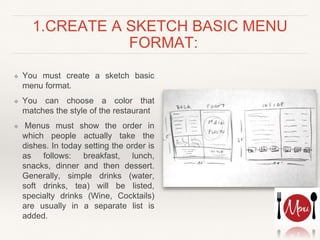
❖ You must create a sketch basic
menu format.
❖ You can choose a color that
matches the style of the restaurant
❖ Menus must show the order in
which people actually take the
dishes. In today setting the order is
as follows: breakfast, lunch,
snacks, dinner and then dessert.
Generally, simple drinks (water,
soft drinks, tea) will be listed,
specialty drinks (Wine, Cocktails)
are usually in a separate list is
added.
❖ You should be visually divide the menu into sections.
Should be separate categories of food using a large,
simple headers, if you have a large number of items,
place each on its own page.
❖ When offered a variety of food, you may need several
sections: breakfast, lunch, dinner and subsections:
Fish, Poultry, Vegetarian Food, Pasta, Salads or per
type.
2. MAKE A LIST OF MEALS AND
PRICES
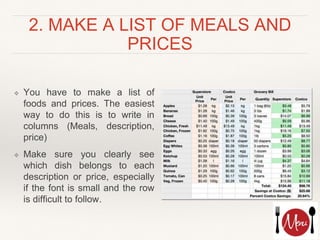
❖ You have to make a list of
foods and prices. The easiest
way to do this is to write in
columns (Meals, description,
price)
❖ Make sure you clearly see
which dish belongs to each
description or price, especially
if the font is small and the row
is difficult to follow.
3.DESCRIPTION OF EACH
DISH
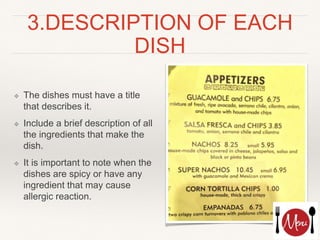
❖ The dishes must have a title
that describes it.
❖ Include a brief description of all
the ingredients that make the
dish.
❖ It is important to note when the
dishes are spicy or have any
ingredient that may cause
allergic reaction.
4.ADD PHOTOS BUT WITH
CAUTION.
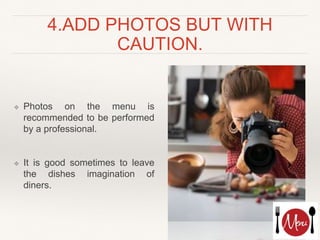
❖ Photos on the menu is
recommended to be performed
by a professional.
❖ It is good sometimes to leave
the dishes imagination of
diners.
5. GIVES GOOD RESULTS GIVE ATTENTION TO THE
FINER DETAILS THE SECOND TIME THE MODELS ARE
REVIEWED:
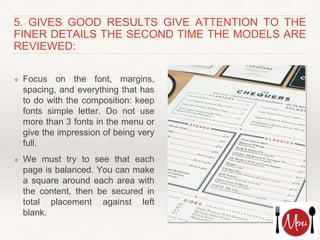
❖ Focus on the font, margins,
spacing, and everything that has
to do with the composition: keep
fonts simple letter. Do not use
more than 3 fonts in the menu or
give the impression of being very
full.
❖ We must try to see that each
page is balanced. You can make
a square around each area with
the content, then be secured in
total placement against left
blank.
6.SELECT THE FINAL
FORMAT:
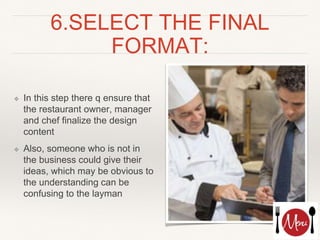
❖ In this step there q ensure that
the restaurant owner, manager
and chef finalize the design
content
❖ Also, someone who is not in
the business could give their
ideas, which may be obvious to
the understanding can be
confusing to the layman
7. PROOF, READ AND PRINT THE FINAL
DESIGN:
❖ To close must be proofread and print the final design.
❖ Review all the menu in great detail, errors in the menu give a
poor message about the quality of the establishment.
❖ Print your new menu and ready for the success of the
restaurant.
YOHANN GELDER
THANK YOU

Menu design presentation mac

  • 1.
    Yohann Gelder R MenuDesign HOSPITALITY INDUSTRY
  • 2.
    Menu ❖ It comesfrom the Latin minutus meaning small and refers to a small list of Foods. ❖ A list of the foods and Beverages that may be ordered at a restaurant
  • 3.
    Menu Design: • Therestaurant menú is the backbone of the business, it depende largely on the success or failure of your performance in the gourmet twist. • When designing a menú, you should consider several factors, such as inventory, local style, the audience you want to attract and many others. • The menu represent largely profit business, design or engineering is of great importance and there is a lot of factors to consider.
  • 4.
    1.CREATE A SKETCHBASIC MENU FORMAT: ❖ You must create a sketch basic menu format. ❖ You can choose a color that matches the style of the restaurant ❖ Menus must show the order in which people actually take the dishes. In today setting the order is as follows: breakfast, lunch, snacks, dinner and then dessert. Generally, simple drinks (water, soft drinks, tea) will be listed, specialty drinks (Wine, Cocktails) are usually in a separate list is added.
  • 5.
    ❖ You shouldbe visually divide the menu into sections. Should be separate categories of food using a large, simple headers, if you have a large number of items, place each on its own page. ❖ When offered a variety of food, you may need several sections: breakfast, lunch, dinner and subsections: Fish, Poultry, Vegetarian Food, Pasta, Salads or per type.
  • 6.
    2. MAKE ALIST OF MEALS AND PRICES ❖ You have to make a list of foods and prices. The easiest way to do this is to write in columns (Meals, description, price) ❖ Make sure you clearly see which dish belongs to each description or price, especially if the font is small and the row is difficult to follow.
  • 7.
    3.DESCRIPTION OF EACH DISH ❖The dishes must have a title that describes it. ❖ Include a brief description of all the ingredients that make the dish. ❖ It is important to note when the dishes are spicy or have any ingredient that may cause allergic reaction.
  • 8.
    4.ADD PHOTOS BUTWITH CAUTION. ❖ Photos on the menu is recommended to be performed by a professional. ❖ It is good sometimes to leave the dishes imagination of diners.
  • 9.
    5. GIVES GOODRESULTS GIVE ATTENTION TO THE FINER DETAILS THE SECOND TIME THE MODELS ARE REVIEWED: ❖ Focus on the font, margins, spacing, and everything that has to do with the composition: keep fonts simple letter. Do not use more than 3 fonts in the menu or give the impression of being very full. ❖ We must try to see that each page is balanced. You can make a square around each area with the content, then be secured in total placement against left blank.
  • 10.
    6.SELECT THE FINAL FORMAT: ❖In this step there q ensure that the restaurant owner, manager and chef finalize the design content ❖ Also, someone who is not in the business could give their ideas, which may be obvious to the understanding can be confusing to the layman
  • 11.
    7. PROOF, READAND PRINT THE FINAL DESIGN: ❖ To close must be proofread and print the final design. ❖ Review all the menu in great detail, errors in the menu give a poor message about the quality of the establishment. ❖ Print your new menu and ready for the success of the restaurant.
  • 12.