INTRODUCTION
NAME : SIDHANT JENA
ROLL NUMBER: BS(B)-23-192
CLASS: +3 3rd
YEAR
DEPARTMENT OF ZOOLOGY
GUIDED BY : ASUTOSH SIR
HEPATITIS C VIRUS (HCV)
1. INTRODUCTION TO HEPATITIS C VIRUS
2. DISCOVERY AND HISTORY OF HEPATITIS C
3. STRUCTURE OF HCV
4. MODE OF TRANSMISSON
5. SYMPTOMS OF HCV
6. STAGES OF HCV
7. DIAGNOSIS AND TREATMENT OF HCV
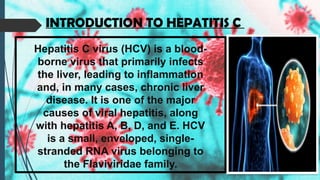
Hepatitis C virus (HCV) is a blood-
borne virus that primarily infects
the liver, leading to inflammation
and, in many cases, chronic liver
disease. It is one of the major
causes of viral hepatitis, along
with hepatitis A, B, D, and E. HCV
is a small, enveloped, single-
stranded RNA virus belonging to
the Flaviviridae family.
INTRODUCTION TO HEPATITIS C
DISCOVERY AND HISTORY OF HEPATITIS C
The discovery of hepatitis C virus (HCV) is one of the most important breakthroughs in
medical science.
Discovered in between 1970s—1990s. Previously the Hepatitis C(HCV) is known as
“NON-A NON-B HEPATITIS”(NANBH).
The discovery of Hepatitis C(HCV) was a collective effort ,not the work
of a single individuals. It happened over more than a decade,with
three main scientists making key contribution at different stages.
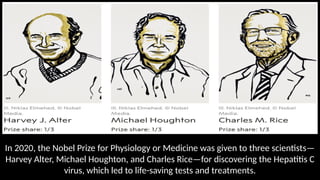
In 2020, the Nobel Prize for Physiology or Medicine was given to three scientists—
Harvey Alter, Michael Houghton, and Charles Rice—for discovering the Hepatitis C
virus, which led to life-saving tests and treatments.
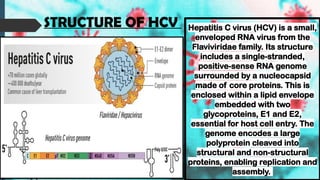
Hepatitis C virus (HCV) is a small,
enveloped RNA virus from the
Flaviviridae family. Its structure
includes a single-stranded,
positive-sense RNA genome
surrounded by a nucleocapsid
made of core proteins. This is
enclosed within a lipid envelope
embedded with two
glycoproteins, E1 and E2,
essential for host cell entry. The
genome encodes a large
polyprotein cleaved into
structural and non-structural
proteins, enabling replication and
assembly.
STRUCTURE OF HCV
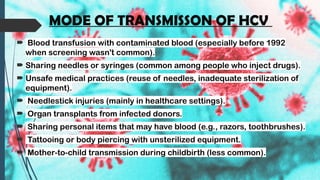
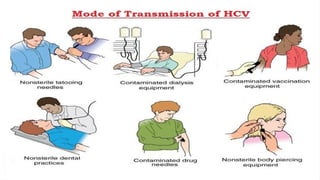
MODE OF TRANSMISSON OF HCV
 Blood transfusion with contaminated blood (especially before 1992
when screening wasn't common).
 Sharing needles or syringes (common among people who inject drugs).
 Unsafe medical practices (reuse of needles, inadequate sterilization of
equipment).
 Needlestick injuries (mainly in healthcare settings).
 Organ transplants from infected donors.
 Sharing personal items that may have blood (e.g., razors, toothbrushes).
 Tattooing or body piercing with unsterilized equipment.
 Mother-to-child transmission during childbirth (less common).
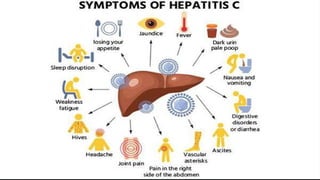
SYMPTOMS OF HCV
 Fatigue – Feeling unusually tired is one of the most common symptoms.
 Fever – Mild, flu-like fever may occur in acute infection.
 Nausea – A feeling of sickness or urge to vomit.
 Loss of appetite – Decreased desire to eat.
 Abdominal pain – Especially in the upper right side (liver area)
 Dark urine – Urine may appear tea or cola-colored.
 Clay-colored stools – Stools may lose their normal brown color.
 Jaundice – Yellowing of the skin and eyes.
 Joint pain – Discomfort or pain in the joints.
 Depression or mood changes – Can occur especially in chronic cases.
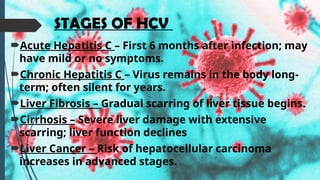
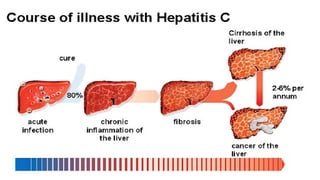
STAGES OF HCV
Acute Hepatitis C – First 6 months after infection; may
have mild or no symptoms.
Chronic Hepatitis C – Virus remains in the body long-
term; often silent for years.
Liver Fibrosis – Gradual scarring of liver tissue begins.
Cirrhosis – Severe liver damage with extensive
scarring; liver function declines
Liver Cancer – Risk of hepatocellular carcinoma
increases in advanced stages.
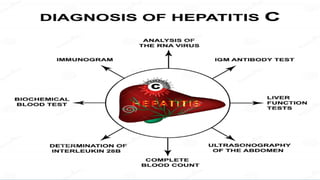
DIAGNOSIS OF HCV
 History taking – Assess risk factors (travel, drug use, transfusions, etc.).
 Physical examination – Check for jaundice, liver tenderness, hepatomegaly.
 Liver function tests (LFTs) – Elevated ALT, AST, bilirubin.
 Serologic tests – Detect specific viral markers (HAV, HBV, HCV, etc.).
 HBsAg / anti-HCV – Screen for hepatitis B and C.
 IgM anti-HAV / anti-HBc – Confirm acute infection.
 PCR / NAT – Detect viral RNA or DNA for confirmation.
 Ultrasound abdomen – Assess liver size and rule out obstruction.
 Liver biopsy (if needed) – Evaluate extent of liver damage.
 Additional tests – Coagulation profile, albumin, and other supportive labs.
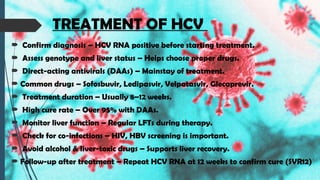
TREATMENT OF HCV
 Confirm diagnosis – HCV RNA positive before starting treatment.
 Assess genotype and liver status – Helps choose proper drugs.
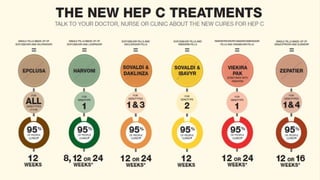
 Direct-acting antivirals (DAAs) – Mainstay of treatment.
 Common drugs – Sofosbuvir, Ledipasvir, Velpatasvir, Glecaprevir.
 Treatment duration – Usually 8–12 weeks.
 High cure rate – Over 95% with DAAs.
 Monitor liver function – Regular LFTs during therapy.
 Check for co-infections – HIV, HBV screening is important.
 Avoid alcohol & liver-toxic drugs – Supports liver recovery.
 Follow-up after treatment – Repeat HCV RNA at 12 weeks to confirm cure (SVR12)
CONCLUSION
Hepatitis C virus (HCV), discovered in 1989, is a major
cause of chronic liver disease worldwide. It often begins
with mild or no symptoms but can progress to fatigue,
jaundice, and liver damage over time. Early diagnosis
through antibody and RNA testing is crucial. Modern
treatment with direct-acting antivirals offers cure rates
above 95%, typically within 8–12 weeks. Preventing
transmission, regular monitoring, and timely treatment
significantly reduce complications like cirrhosis and liver
cancer, improving patient outcomes.
THANK YOU

HCV.pptx it is very useful for studentss

  • 1.
    INTRODUCTION NAME : SIDHANTJENA ROLL NUMBER: BS(B)-23-192 CLASS: +3 3rd YEAR DEPARTMENT OF ZOOLOGY GUIDED BY : ASUTOSH SIR
  • 2.
    HEPATITIS C VIRUS(HCV) 1. INTRODUCTION TO HEPATITIS C VIRUS 2. DISCOVERY AND HISTORY OF HEPATITIS C 3. STRUCTURE OF HCV 4. MODE OF TRANSMISSON 5. SYMPTOMS OF HCV 6. STAGES OF HCV 7. DIAGNOSIS AND TREATMENT OF HCV
  • 3.
    Hepatitis C virus(HCV) is a blood- borne virus that primarily infects the liver, leading to inflammation and, in many cases, chronic liver disease. It is one of the major causes of viral hepatitis, along with hepatitis A, B, D, and E. HCV is a small, enveloped, single- stranded RNA virus belonging to the Flaviviridae family. INTRODUCTION TO HEPATITIS C
  • 4.
    DISCOVERY AND HISTORYOF HEPATITIS C The discovery of hepatitis C virus (HCV) is one of the most important breakthroughs in medical science. Discovered in between 1970s—1990s. Previously the Hepatitis C(HCV) is known as “NON-A NON-B HEPATITIS”(NANBH). The discovery of Hepatitis C(HCV) was a collective effort ,not the work of a single individuals. It happened over more than a decade,with three main scientists making key contribution at different stages.
  • 5.
    In 2020, theNobel Prize for Physiology or Medicine was given to three scientists— Harvey Alter, Michael Houghton, and Charles Rice—for discovering the Hepatitis C virus, which led to life-saving tests and treatments.
  • 6.
    Hepatitis C virus(HCV) is a small, enveloped RNA virus from the Flaviviridae family. Its structure includes a single-stranded, positive-sense RNA genome surrounded by a nucleocapsid made of core proteins. This is enclosed within a lipid envelope embedded with two glycoproteins, E1 and E2, essential for host cell entry. The genome encodes a large polyprotein cleaved into structural and non-structural proteins, enabling replication and assembly. STRUCTURE OF HCV
  • 7.
    MODE OF TRANSMISSONOF HCV  Blood transfusion with contaminated blood (especially before 1992 when screening wasn't common).  Sharing needles or syringes (common among people who inject drugs).  Unsafe medical practices (reuse of needles, inadequate sterilization of equipment).  Needlestick injuries (mainly in healthcare settings).  Organ transplants from infected donors.  Sharing personal items that may have blood (e.g., razors, toothbrushes).  Tattooing or body piercing with unsterilized equipment.  Mother-to-child transmission during childbirth (less common).
  • 9.
    SYMPTOMS OF HCV Fatigue – Feeling unusually tired is one of the most common symptoms.  Fever – Mild, flu-like fever may occur in acute infection.  Nausea – A feeling of sickness or urge to vomit.  Loss of appetite – Decreased desire to eat.  Abdominal pain – Especially in the upper right side (liver area)  Dark urine – Urine may appear tea or cola-colored.  Clay-colored stools – Stools may lose their normal brown color.  Jaundice – Yellowing of the skin and eyes.  Joint pain – Discomfort or pain in the joints.  Depression or mood changes – Can occur especially in chronic cases.
  • 11.
    STAGES OF HCV AcuteHepatitis C – First 6 months after infection; may have mild or no symptoms. Chronic Hepatitis C – Virus remains in the body long- term; often silent for years. Liver Fibrosis – Gradual scarring of liver tissue begins. Cirrhosis – Severe liver damage with extensive scarring; liver function declines Liver Cancer – Risk of hepatocellular carcinoma increases in advanced stages.
  • 13.
    DIAGNOSIS OF HCV History taking – Assess risk factors (travel, drug use, transfusions, etc.).  Physical examination – Check for jaundice, liver tenderness, hepatomegaly.  Liver function tests (LFTs) – Elevated ALT, AST, bilirubin.  Serologic tests – Detect specific viral markers (HAV, HBV, HCV, etc.).  HBsAg / anti-HCV – Screen for hepatitis B and C.  IgM anti-HAV / anti-HBc – Confirm acute infection.  PCR / NAT – Detect viral RNA or DNA for confirmation.  Ultrasound abdomen – Assess liver size and rule out obstruction.  Liver biopsy (if needed) – Evaluate extent of liver damage.  Additional tests – Coagulation profile, albumin, and other supportive labs.
  • 15.
    TREATMENT OF HCV Confirm diagnosis – HCV RNA positive before starting treatment.  Assess genotype and liver status – Helps choose proper drugs.  Direct-acting antivirals (DAAs) – Mainstay of treatment.  Common drugs – Sofosbuvir, Ledipasvir, Velpatasvir, Glecaprevir.  Treatment duration – Usually 8–12 weeks.  High cure rate – Over 95% with DAAs.  Monitor liver function – Regular LFTs during therapy.  Check for co-infections – HIV, HBV screening is important.  Avoid alcohol & liver-toxic drugs – Supports liver recovery.  Follow-up after treatment – Repeat HCV RNA at 12 weeks to confirm cure (SVR12)
  • 17.
    CONCLUSION Hepatitis C virus(HCV), discovered in 1989, is a major cause of chronic liver disease worldwide. It often begins with mild or no symptoms but can progress to fatigue, jaundice, and liver damage over time. Early diagnosis through antibody and RNA testing is crucial. Modern treatment with direct-acting antivirals offers cure rates above 95%, typically within 8–12 weeks. Preventing transmission, regular monitoring, and timely treatment significantly reduce complications like cirrhosis and liver cancer, improving patient outcomes.

  • 18.