Reading
with your child
     How best to support your child in
becoming a independent and confident reader
Today’s session...
•To share ways of helping children to
enjoy texts and become confident
readers
•To provide prompts for developing
 basic reading skills
• A chance to discuss with others
about reading with your child at
home
Introducing the text
•Discuss the title.
• Discuss the pictures.

•Ask children to point out anything interesting in the pictures and
talk about what might be happening at that point in the story.
• What do you think is going to happen in the story?
• Has this ever happened to you?
• What do you already know about.....?
• Introduce new or difficult vocabulary before you start reading.

• NOW the child is ready to read.
Sources of information children use to
                      decode
                        print


•   Children learn to read in many different ways, using many different
    sources of information
•    Pictures
     Phonics-letter/sound knowledge
     Quick recognition of sight words
     Visual-the way the word looks
    Meaning-predicting words through context

    Grammar-predicting words using sentence structure
Sources of information children use to
                  decode
                    print


PICTURES are an important source of information


•Pictures in a text are hugely important in enabling a child to
predict text and should be used together with a second source of
information e.g. at the emergent level we may prompt by saying
“Get your mouth ready to say the first letter and check the picture
for a clue.” At a slightly higher level, such as blue a prompt such as
“find any small words in big words that you know and check the
picture...”
Phonics

•   44 phonemes/sounds in the English language
•   Phonemes put together to construct some simple words BUT
    NOT ALL!
•   65% of all words are phonetically irregular.
•   Many letters combine to produce ‘new’ sounds eg -ch   -th
     -sh -igh
•   Some sounds are represented by different graphemes e.g. m-
    ow d-ough r-oa-d


Sounding out is one way a child can decode an unknown word
   BUT it is not the only way.
Using phonics and/or visual
          prompts to support reading


• Can you sound these letters together (e.g. c-a-t)

• Robot speak!

Are there any parts/chunks of the word you can read? (e.g. st-art-ed     started).
• What sound do these letters together make?          (e.g. n – ight   night).
• Does it look right, does it match the letter sounds in the word?
Using Meaning
          as a source of information
•   Meaning is paramount and is the only reason for reading!


•   Confidence in own spoken language enables a reader to predict text
    through their own knowledge and experience.
•   Understanding the text at every stage allows a reader to predict and
    make an informed attempt at an unknown word.
•   Having prior knowledge about the story promotes engagement with text
    and allows the reader to decode AND understand new vocabulary.
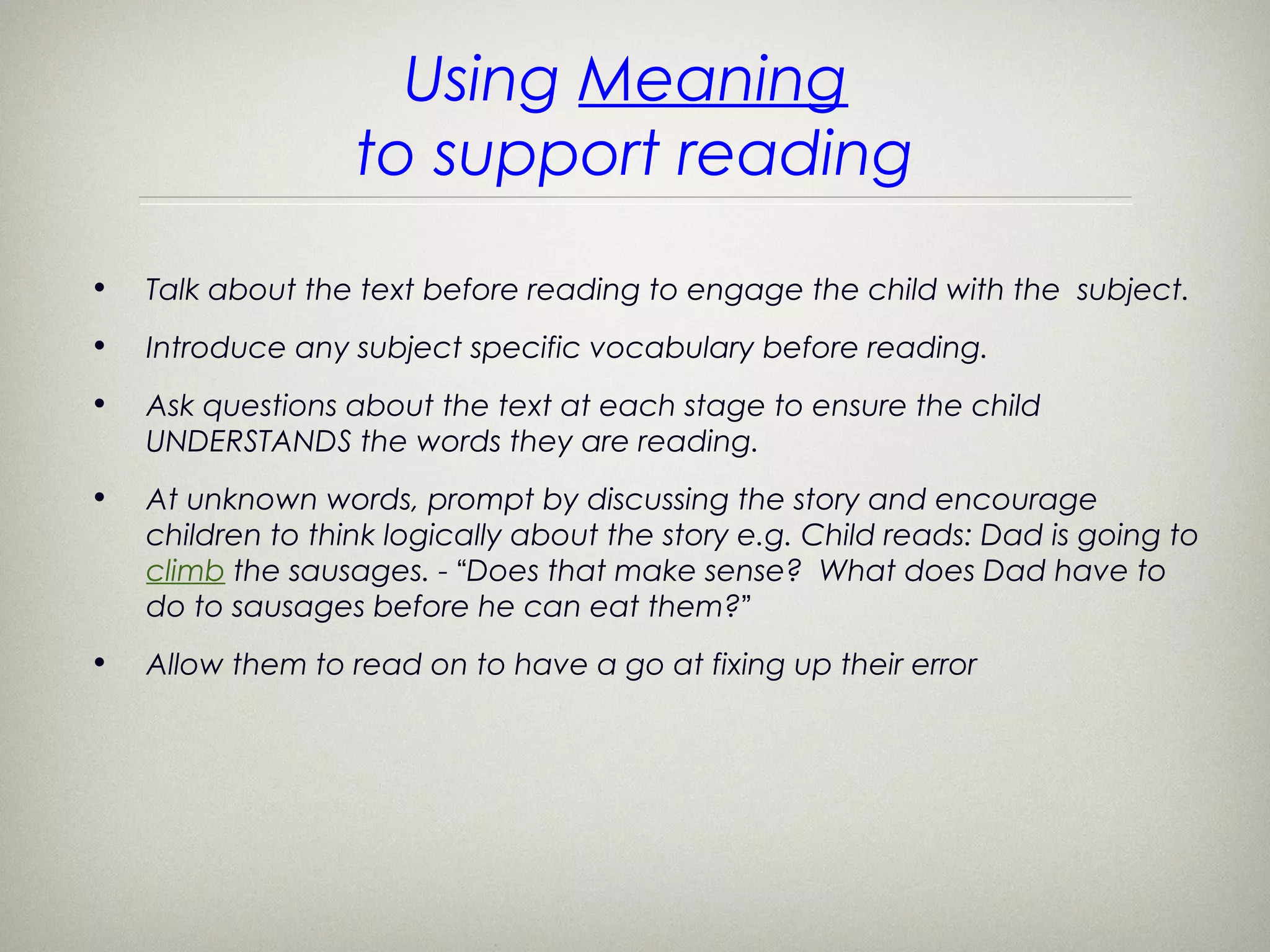
Using Meaning
                   to support reading
•   Talk about the text before reading to engage the child with the subject.
•   Introduce any subject specific vocabulary before reading.
•   Ask questions about the text at each stage to ensure the child
    UNDERSTANDS the words they are reading.
•   At unknown words, prompt by discussing the story and encourage
    children to think logically about the story e.g. Child reads: Dad is going to
    climb the sausages. - “Does that make sense? What does Dad have to
    do to sausages before he can eat them?”
•   Allow them to read on to have a go at fixing up their error
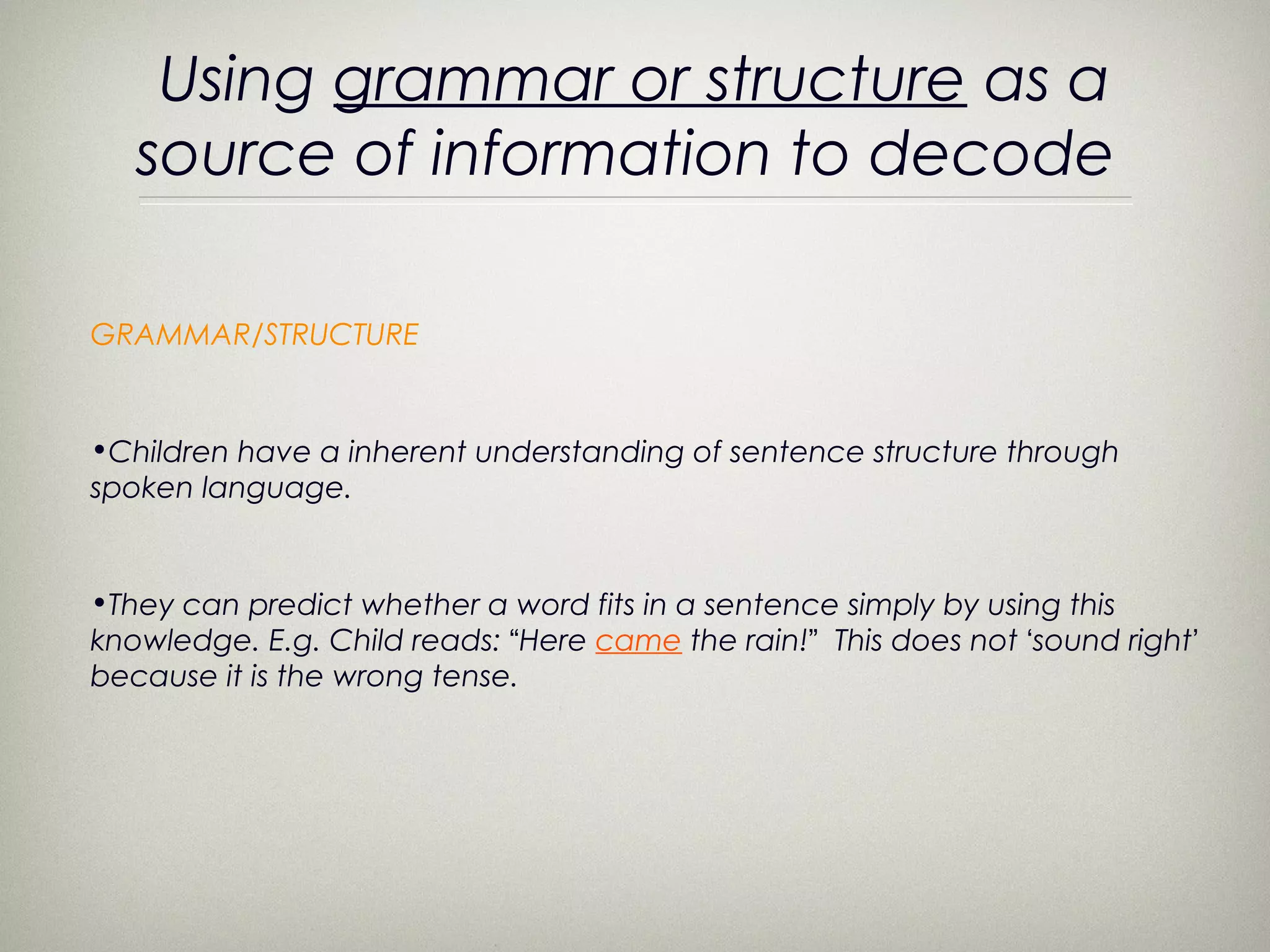
Using grammar or structure as a
   source of information to decode

GRAMMAR/STRUCTURE


•Children have a inherent understanding of sentence structure through
spoken language.


•They can predict whether a word fits in a sentence simply by using this
knowledge. E.g. Child reads: “Here came the rain!” This does not ‘sound right’
because it is the wrong tense.
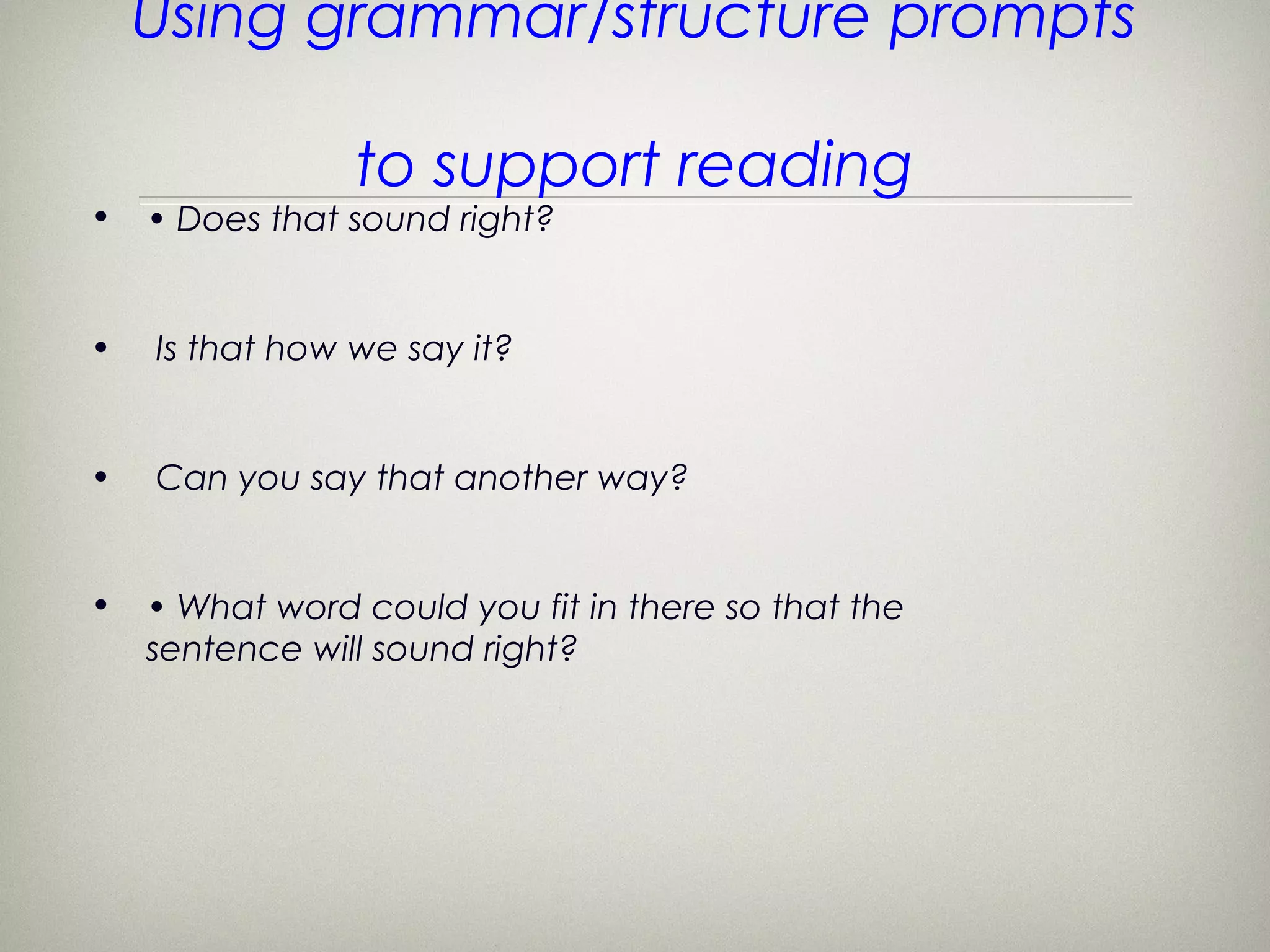
Using grammar/structure prompts

                to support reading
•   • Does that sound right?


•   Is that how we say it?


•   Can you say that another way?


•   • What word could you fit in there so that the
    sentence will sound right?
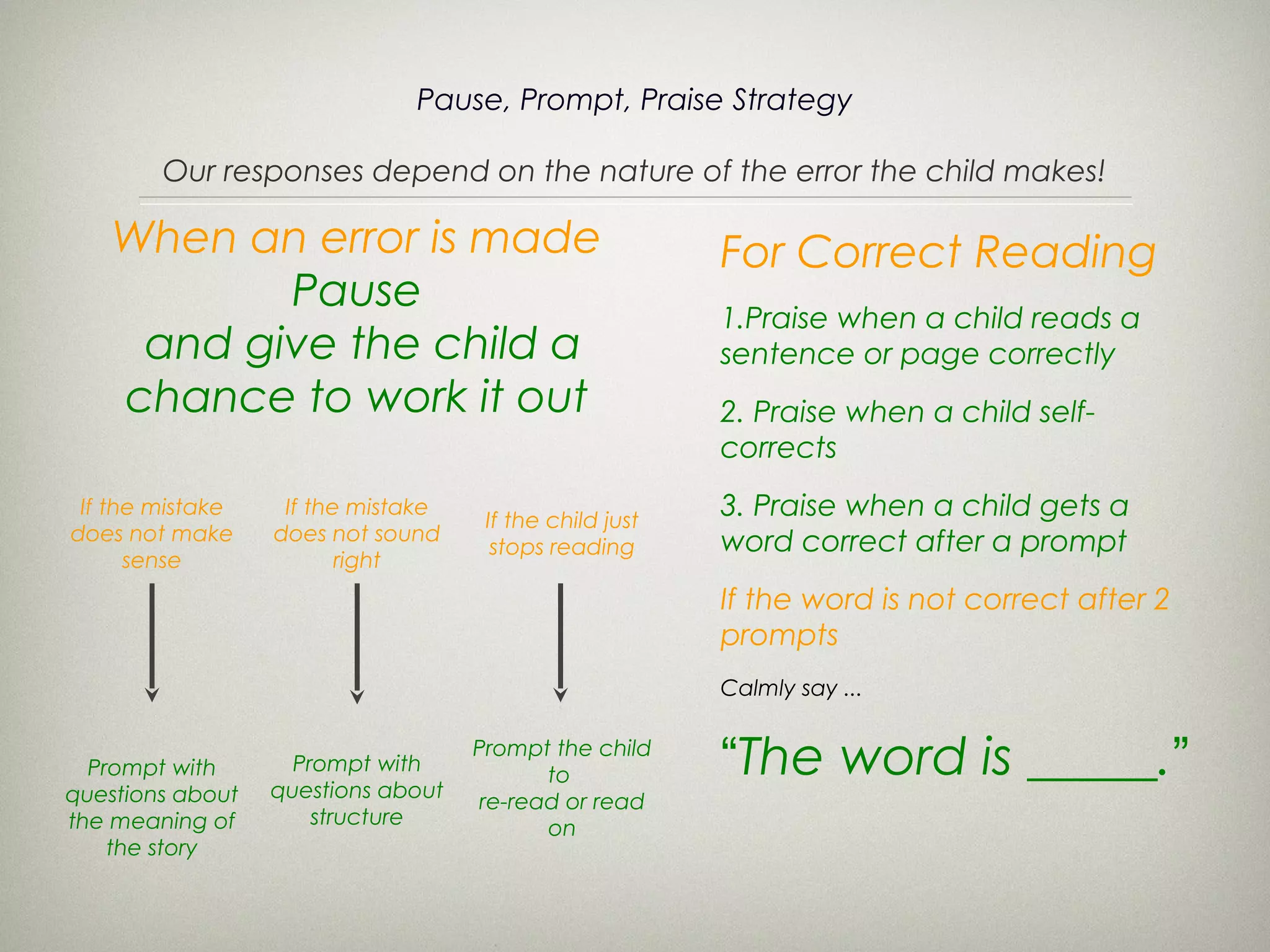
Pause, Prompt, Praise Strategy

        Our responses depend on the nature of the error the child makes!

    When an error is made                                For Correct Reading
           Pause
                                                         1.Praise when a child reads a
     and give the child a                                sentence or page correctly
    chance to work it out                                2. Praise when a child self-
                                                         corrects
 If the mistake    If the mistake
                                     If the child just
                                                         3. Praise when a child gets a
does not make     does not sound                         word correct after a prompt
                                      stops reading
      sense              right
                                                         If the word is not correct after 2
                                                         prompts
                                                         Calmly say ...


  Prompt with       Prompt with
                  questions about
                                    Prompt the child
                                           to            “The word is _____.”
questions about                      re-read or read
the meaning of        structure            on
    the story
Good readers...

✴   Have good phonics knowledge.
✴   Are able to instantly read high
    frequency words.
✴   Question themselves while reading.
✴   Cross-check one source of
    information with another.
✴   Monitor their own reading and self-
    correct independently.
Our aim is for children to ...

★   use all 3 sources of information-meaning, structure, visual/phonics
    independently
★   monitor their own reading and self-correct independently
★   read with fluency, phrasing and expression
★   read with confidence and enjoyment
★   engage with the story
★   comprehend what they read ....
• READ FOR MEANING

Helping your child to read

  • 1.
    Reading with your child How best to support your child in becoming a independent and confident reader
  • 2.
    Today’s session... •To shareways of helping children to enjoy texts and become confident readers •To provide prompts for developing basic reading skills • A chance to discuss with others about reading with your child at home
  • 3.
    Introducing the text •Discussthe title. • Discuss the pictures. •Ask children to point out anything interesting in the pictures and talk about what might be happening at that point in the story. • What do you think is going to happen in the story? • Has this ever happened to you? • What do you already know about.....? • Introduce new or difficult vocabulary before you start reading. • NOW the child is ready to read.
  • 4.
    Sources of informationchildren use to decode print • Children learn to read in many different ways, using many different sources of information • Pictures Phonics-letter/sound knowledge Quick recognition of sight words Visual-the way the word looks Meaning-predicting words through context Grammar-predicting words using sentence structure
  • 5.
    Sources of informationchildren use to decode print PICTURES are an important source of information •Pictures in a text are hugely important in enabling a child to predict text and should be used together with a second source of information e.g. at the emergent level we may prompt by saying “Get your mouth ready to say the first letter and check the picture for a clue.” At a slightly higher level, such as blue a prompt such as “find any small words in big words that you know and check the picture...”
  • 6.
    Phonics • 44 phonemes/sounds in the English language • Phonemes put together to construct some simple words BUT NOT ALL! • 65% of all words are phonetically irregular. • Many letters combine to produce ‘new’ sounds eg -ch -th -sh -igh • Some sounds are represented by different graphemes e.g. m- ow d-ough r-oa-d Sounding out is one way a child can decode an unknown word BUT it is not the only way.
  • 7.
    Using phonics and/orvisual prompts to support reading • Can you sound these letters together (e.g. c-a-t) • Robot speak! Are there any parts/chunks of the word you can read? (e.g. st-art-ed started). • What sound do these letters together make? (e.g. n – ight night). • Does it look right, does it match the letter sounds in the word?
  • 8.
    Using Meaning as a source of information • Meaning is paramount and is the only reason for reading! • Confidence in own spoken language enables a reader to predict text through their own knowledge and experience. • Understanding the text at every stage allows a reader to predict and make an informed attempt at an unknown word. • Having prior knowledge about the story promotes engagement with text and allows the reader to decode AND understand new vocabulary.
  • 9.
    Using Meaning to support reading • Talk about the text before reading to engage the child with the subject. • Introduce any subject specific vocabulary before reading. • Ask questions about the text at each stage to ensure the child UNDERSTANDS the words they are reading. • At unknown words, prompt by discussing the story and encourage children to think logically about the story e.g. Child reads: Dad is going to climb the sausages. - “Does that make sense? What does Dad have to do to sausages before he can eat them?” • Allow them to read on to have a go at fixing up their error
  • 10.
    Using grammar orstructure as a source of information to decode GRAMMAR/STRUCTURE •Children have a inherent understanding of sentence structure through spoken language. •They can predict whether a word fits in a sentence simply by using this knowledge. E.g. Child reads: “Here came the rain!” This does not ‘sound right’ because it is the wrong tense.
  • 11.
    Using grammar/structure prompts to support reading • • Does that sound right? • Is that how we say it? • Can you say that another way? • • What word could you fit in there so that the sentence will sound right?
  • 12.
    Pause, Prompt, PraiseStrategy Our responses depend on the nature of the error the child makes! When an error is made For Correct Reading Pause 1.Praise when a child reads a and give the child a sentence or page correctly chance to work it out 2. Praise when a child self- corrects If the mistake If the mistake If the child just 3. Praise when a child gets a does not make does not sound word correct after a prompt stops reading sense right If the word is not correct after 2 prompts Calmly say ... Prompt with Prompt with questions about Prompt the child to “The word is _____.” questions about re-read or read the meaning of structure on the story
  • 13.
    Good readers... ✴ Have good phonics knowledge. ✴ Are able to instantly read high frequency words. ✴ Question themselves while reading. ✴ Cross-check one source of information with another. ✴ Monitor their own reading and self- correct independently.
  • 14.
    Our aim isfor children to ... ★ use all 3 sources of information-meaning, structure, visual/phonics independently ★ monitor their own reading and self-correct independently ★ read with fluency, phrasing and expression ★ read with confidence and enjoyment ★ engage with the story ★ comprehend what they read .... • READ FOR MEANING