Prof. T. S. Patel
Outline:
●
●
●
●
●
●
●
.
.
.
• The antenna acts similarly to an
electrically short dipole
ormonopole, and the radiation
pattern, similar to these antennas is
omnidirectional, with maximum
radiation atright angles to the helix
axis.
• The radiation is linearl! polari"ed
parallel to the helix axis.
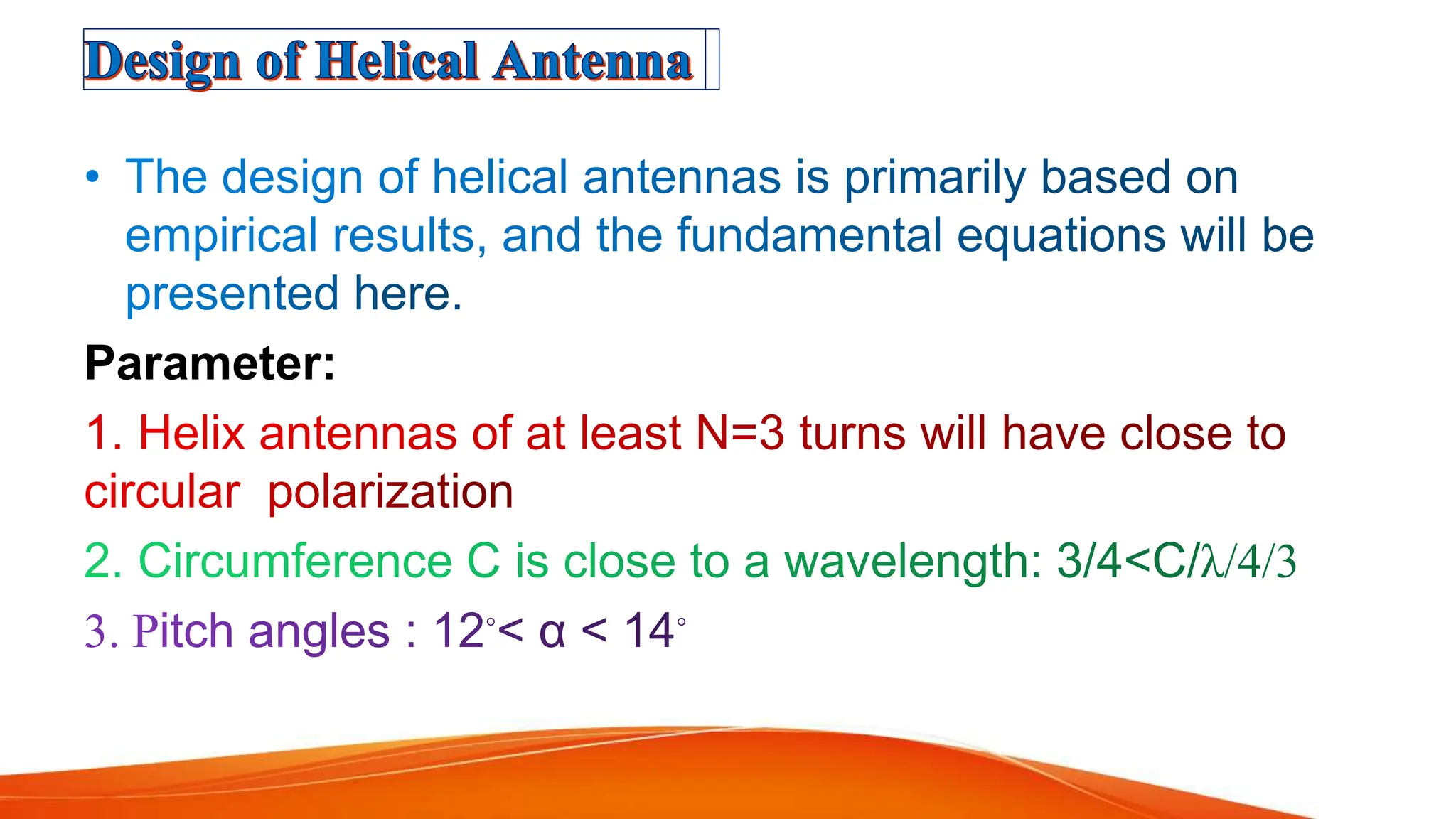
Parameter:
• HPBW: • FNBW:
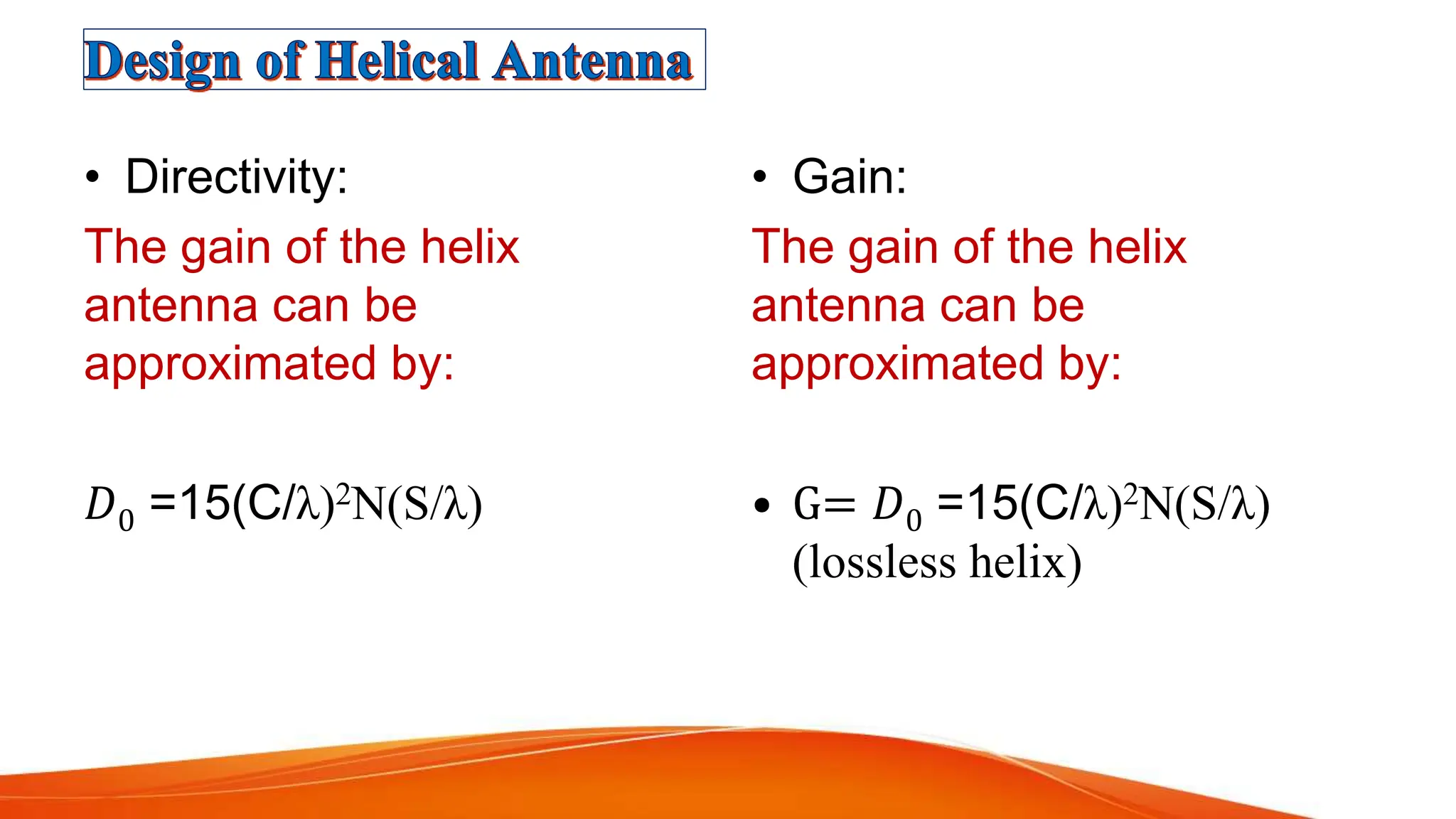
• Directivity:
The gain of the helix
antenna can be
approximated by:
𝐷0 =15(C/λ)2N(S/λ)
• Gain:
The gain of the helix
antenna can be
approximated by:
• G= 𝐷0 =15(C/λ)2N(S/λ)
(lossless helix)
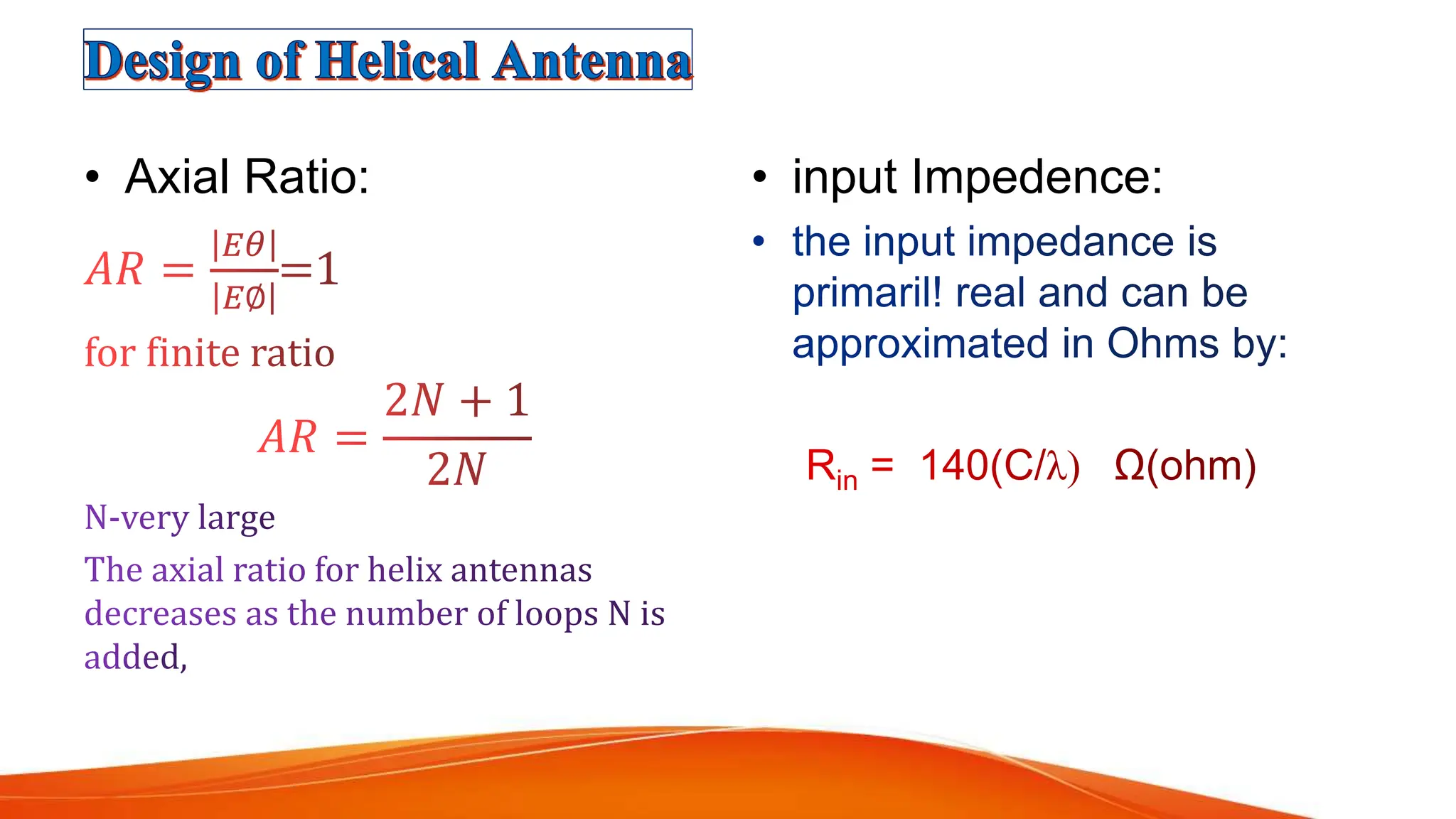
• Axial Ratio: • input Impedence:
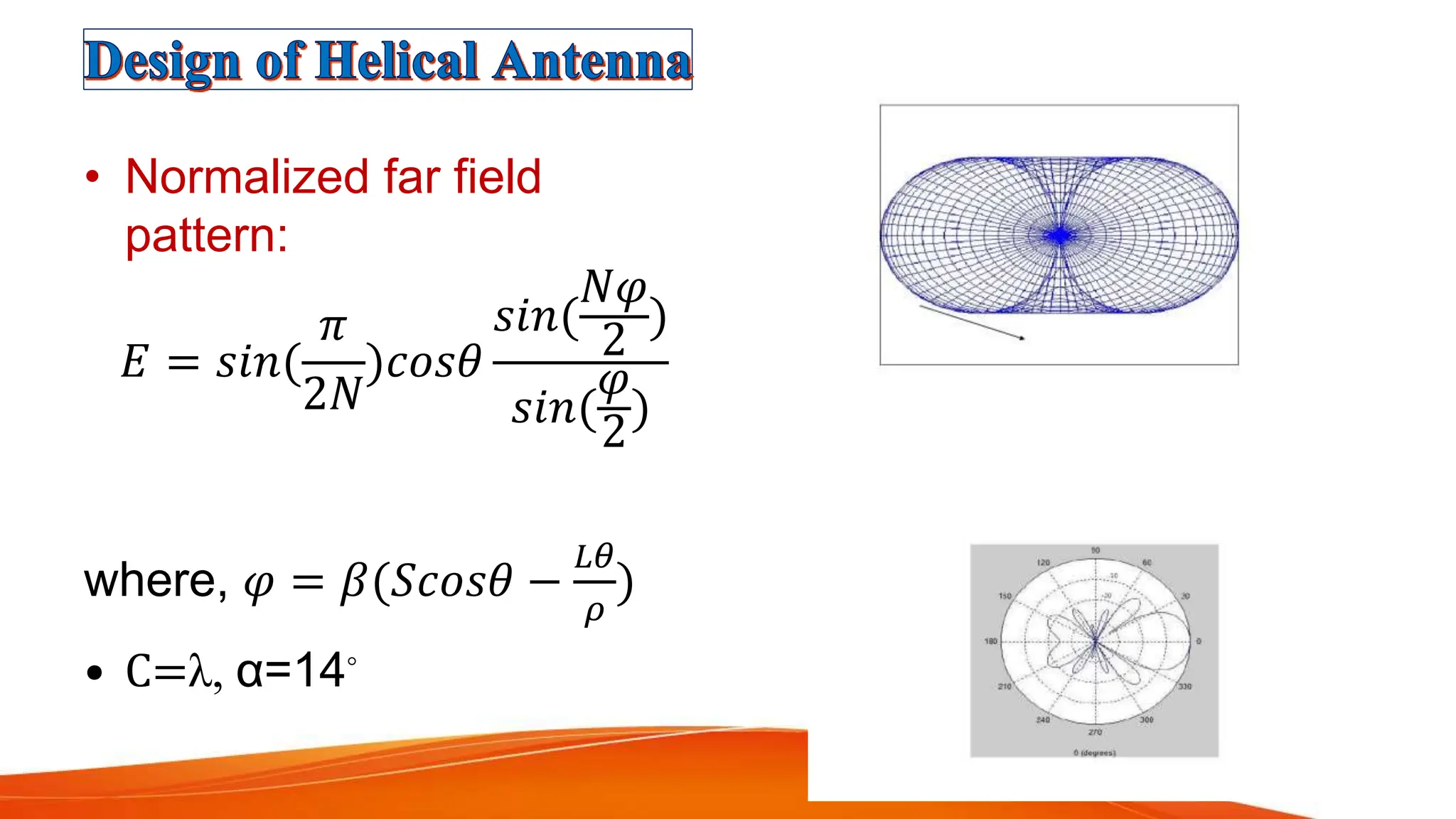
• Normalized far field
pattern:
𝐸 = 𝑠𝑖𝑛(
𝜋
2𝑁
)𝑐𝑜𝑠𝜃
𝑠𝑖𝑛(
𝑁𝜑
2
)
𝑠𝑖𝑛(
𝜑
2
)
where, 𝜑 = 𝛽(𝑆𝑐𝑜𝑠𝜃 −
𝐿𝜃
𝜌
)
• C=λ, α=14◦
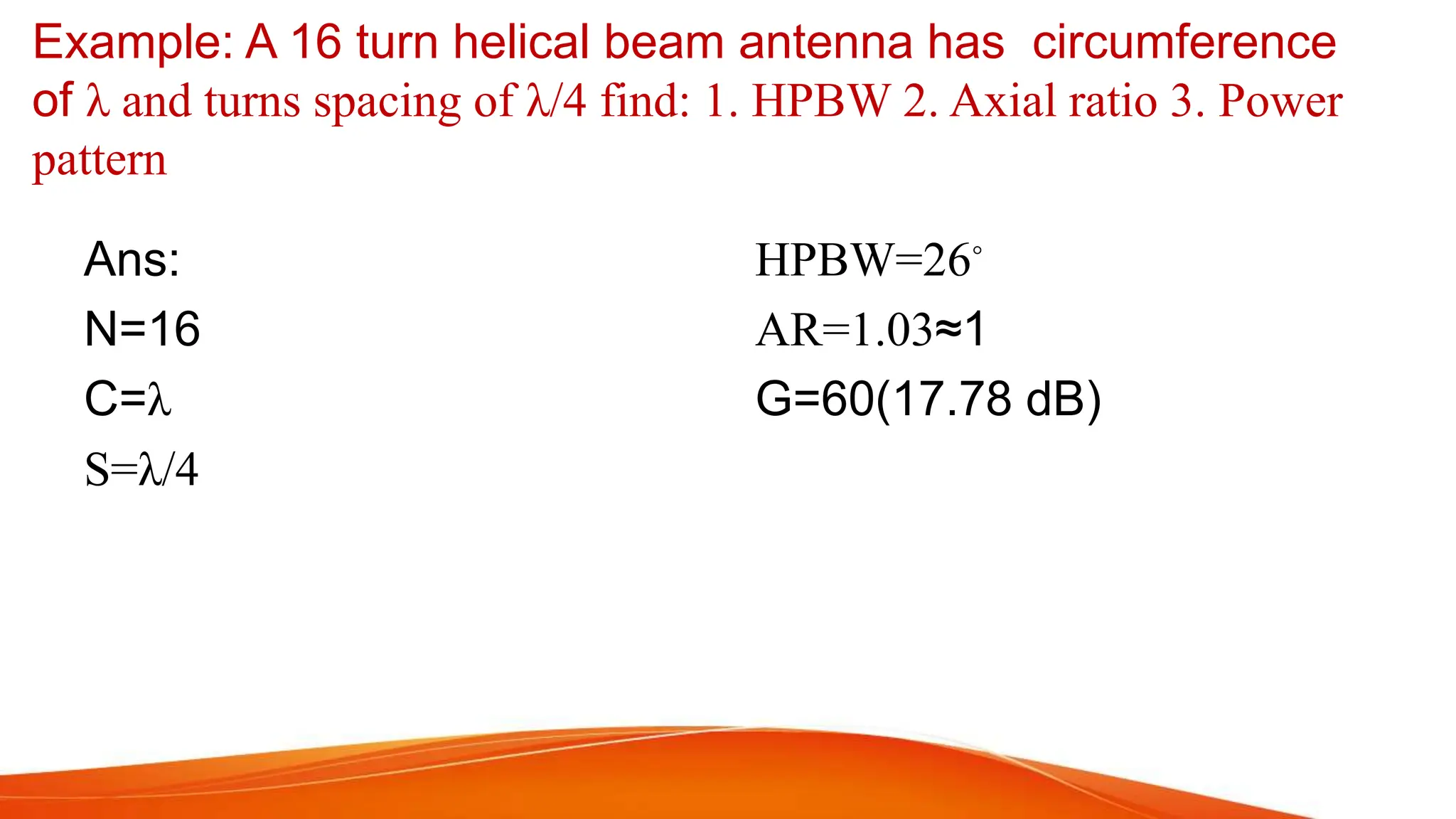
Example: A 16 turn helical beam antenna has circumference
of λ and turns spacing of λ/4 find: 1. HPBW 2. Axial ratio 3. Power
pattern
Ans:
N=16
C=λ
S=λ/4
HPBW=26◦
AR=1.03≈1
G=60(17.78 dB)
Example: Calculate the directivity HPBW and terminating
resistance for helix operating in axial mode
Input:
N=9
f=2 GHz
C=0.8 λ
S=0.2 λ
Ans:
D0 = 17.28
HPBW=48.45◦
Terminating Resistance
RL=Rin=140(C/λ)=112 Ω
Example: A helix operated at 2 GHz has dimensions S=5 cm,
D=10 cm, N=20, find out 3 dB beamwidth and directivity.
Input:
• f= 2 GHz
• S=5 cm
• D=10 cm
• N=20
Ans:
• λ=c/f=15 cm
• C=πD=31.42 cm
• HPBW=9.61◦
• D0 = 438.8 (26.42 dB)
• It is used for transmission and reception of VHF signals through ionosphere
• It is used for satellite and radiometry applications.
• Advantages:
 It is simple in design.
 it uses circular polarised pattern,
 It can be used for broadband
applications due to wider
bandwidth.
 It can be used at HF/VHF
frequencies for transmission and
reception.
 It offers higher directivity.
 It is very robust in construction.
• Disadvantages
 It is large in size. This requires
more space for installation.
 For higher number of turns its
efficiency decreases. The maximum
efficiency of about 80% can be
achieved with the use of 3 to 4
turns.
 It is higher in cost.

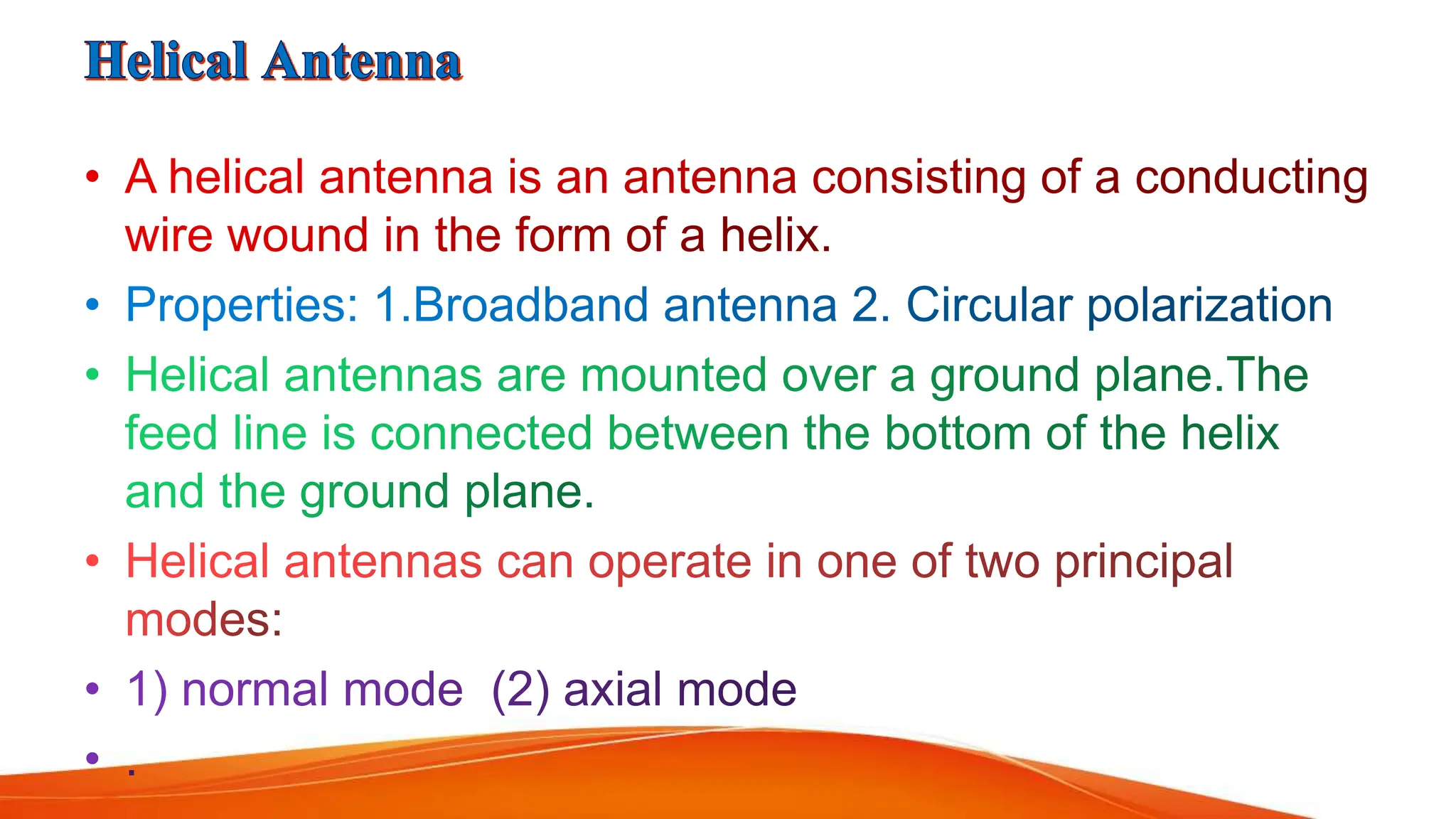
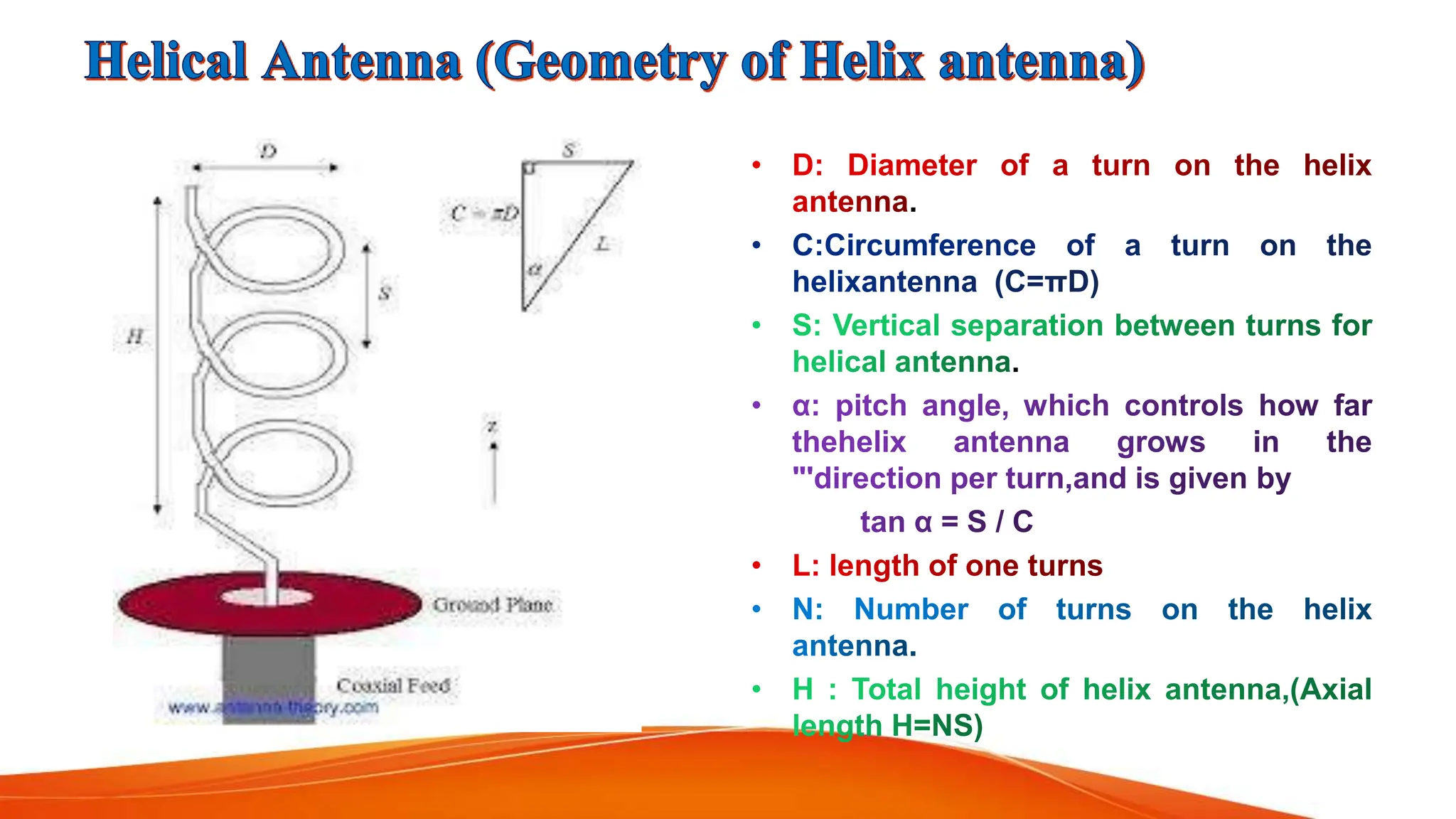
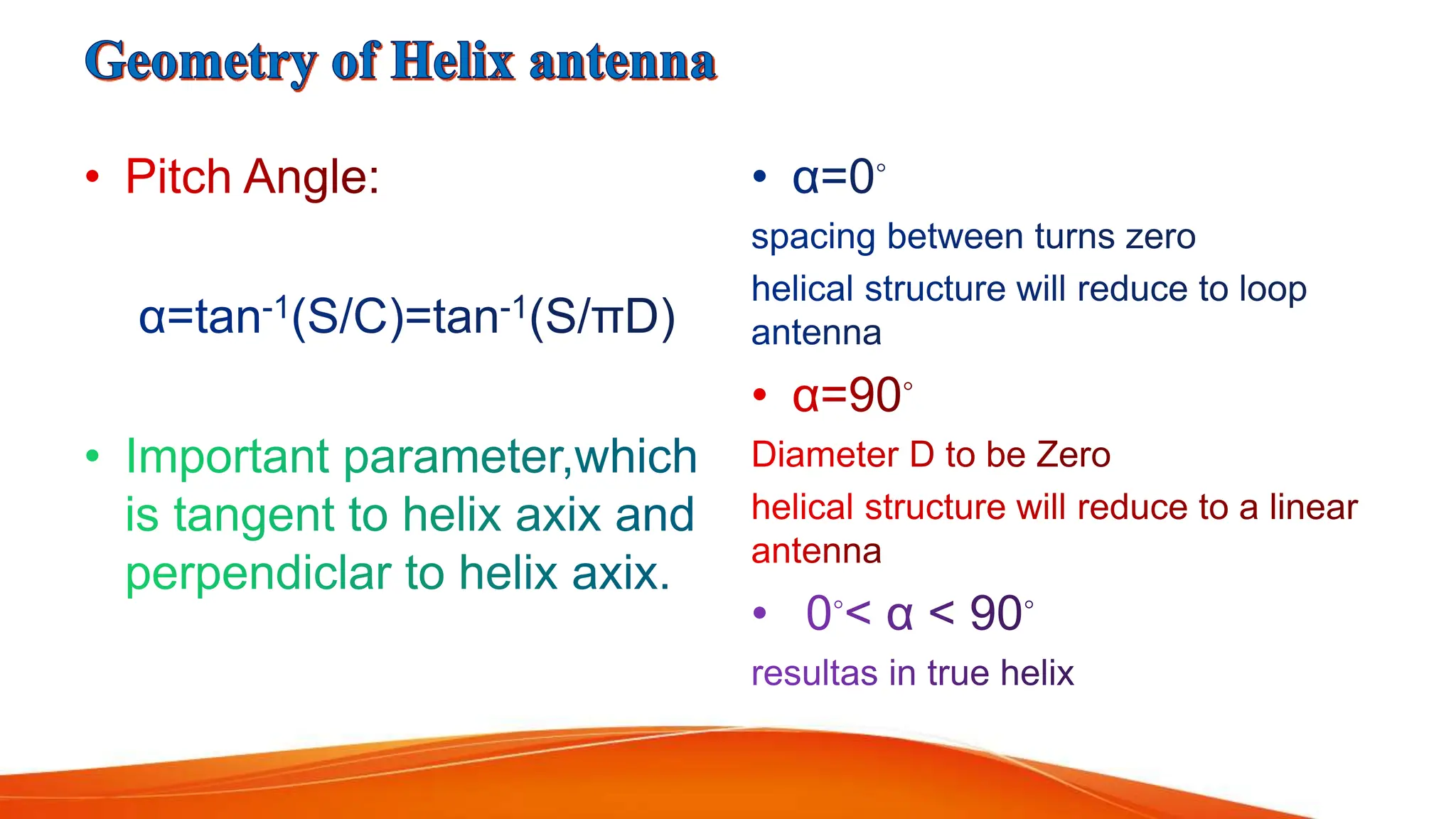
helical antenna, construction, geometry and design criteria and example

  • 1.
  • 2.
  • 4.
  • 5.
  • 7.
    • The antennaacts similarly to an electrically short dipole ormonopole, and the radiation pattern, similar to these antennas is omnidirectional, with maximum radiation atright angles to the helix axis. • The radiation is linearl! polari"ed parallel to the helix axis.
  • 9.
  • 10.
  • 11.
    • Directivity: The gainof the helix antenna can be approximated by: 𝐷0 =15(C/λ)2N(S/λ) • Gain: The gain of the helix antenna can be approximated by: • G= 𝐷0 =15(C/λ)2N(S/λ) (lossless helix)
  • 12.
    • Axial Ratio:• input Impedence:
  • 13.
    • Normalized farfield pattern: 𝐸 = 𝑠𝑖𝑛( 𝜋 2𝑁 )𝑐𝑜𝑠𝜃 𝑠𝑖𝑛( 𝑁𝜑 2 ) 𝑠𝑖𝑛( 𝜑 2 ) where, 𝜑 = 𝛽(𝑆𝑐𝑜𝑠𝜃 − 𝐿𝜃 𝜌 ) • C=λ, α=14◦
  • 14.
    Example: A 16turn helical beam antenna has circumference of λ and turns spacing of λ/4 find: 1. HPBW 2. Axial ratio 3. Power pattern Ans: N=16 C=λ S=λ/4 HPBW=26◦ AR=1.03≈1 G=60(17.78 dB)
  • 15.
    Example: Calculate thedirectivity HPBW and terminating resistance for helix operating in axial mode Input: N=9 f=2 GHz C=0.8 λ S=0.2 λ Ans: D0 = 17.28 HPBW=48.45◦ Terminating Resistance RL=Rin=140(C/λ)=112 Ω
  • 16.
    Example: A helixoperated at 2 GHz has dimensions S=5 cm, D=10 cm, N=20, find out 3 dB beamwidth and directivity. Input: • f= 2 GHz • S=5 cm • D=10 cm • N=20 Ans: • λ=c/f=15 cm • C=πD=31.42 cm • HPBW=9.61◦ • D0 = 438.8 (26.42 dB)
  • 17.
    • It isused for transmission and reception of VHF signals through ionosphere • It is used for satellite and radiometry applications. • Advantages:  It is simple in design.  it uses circular polarised pattern,  It can be used for broadband applications due to wider bandwidth.  It can be used at HF/VHF frequencies for transmission and reception.  It offers higher directivity.  It is very robust in construction. • Disadvantages  It is large in size. This requires more space for installation.  For higher number of turns its efficiency decreases. The maximum efficiency of about 80% can be achieved with the use of 3 to 4 turns.  It is higher in cost.