Pricing
Pricing is not a math problem 
It's a judgment problem
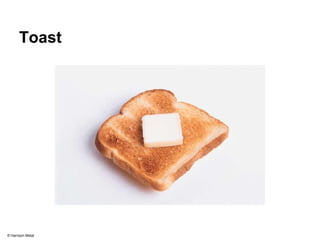
Toast 
© Harrison Metal
How much would you pay? 
○ Toaster 
© Harrison Metal
How much would you pay? 
○ Toaster 
○ Mechanical timer lets you get exactly the degree of toasting you prefer 
© Harrison Metal
How much would you pay? 
○ Toaster 
○ Mechanical timer lets you get exactly the degree of toasting you prefer 
○ Faster warm-up ensures perfect browning right from the first slice 
© Harrison Metal
How much would you pay? 
○ Toaster 
○ Mechanical timer lets you get exactly the degree of toasting you prefer 
○ Faster warm-up ensures perfect browning right from the first slice 
○ Defrost setting for frozen bread before toasting 
© Harrison Metal
How much would you pay? 
○ Toaster 
○ Mechanical timer lets you get exactly the degree of toasting you prefer 
○ Faster warm-up ensures perfect browning right from the first slice 
○ Defrost setting for frozen bread before toasting 
○ Bagel setting to warm one side and toast the other 
© Harrison Metal
How much would you pay? 
○ Toaster 
○ Mechanical timer lets you get exactly the degree of toasting you prefer 
○ Faster warm-up ensures perfect browning right from the first slice 
○ Defrost setting for frozen bread before toasting 
○ Bagel setting to warm one side and toast the other 
○ Award-winning ProHeat elements guaranteed for two years 
© Harrison Metal
How much would you pay? 
○ Toaster 
○ Mechanical timer lets you get exactly the degree of toasting you prefer 
○ Faster warm-up ensures perfect browning right from the first slice 
○ Defrost setting for frozen bread before toasting 
○ Bagel setting to warm one side and toast the other 
○ Award-winning ProHeat elements guaranteed for two years 
○ Superlative quality, hand-assembled in England 
© Harrison Metal
How much would you pay? 
○ Toaster 
○ Mechanical timer lets you get exactly the degree of toasting you prefer 
○ Faster warm-up ensures perfect browning right from the first slice 
○ Defrost setting for frozen bread before toasting 
○ Bagel setting to warm one side and toast the other 
○ Award-winning ProHeat elements guaranteed for two years 
○ Superlative quality, hand-assembled in England 
○ Iconic design, stainless steel costs manufacturer $130 to make it 
© Harrison Metal
How much would you pay? 
○ Toaster 
○ Mechanical timer lets you get exactly the degree of toasting you prefer 
○ Faster warm-up ensures perfect browning right from the first slice 
○ Defrost setting for frozen bread before toasting 
○ Bagel setting to warm one side and toast the other 
○ Award-winning ProHeat elements guaranteed for two years 
○ Superlative quality, hand-assembled in England 
○ Iconic design, stainless steel costs manufacturer $130 to make it 
○ Dualit brand, available at Williams-Sonoma 
© Harrison Metal
How much would you pay? 
○ Toaster 
○ Mechanical timer lets you get exactly the degree of toasting you prefer 
○ Faster warm-up ensures perfect browning right from the first slice 
○ Defrost setting for frozen bread before toasting 
○ Bagel setting to warm one side and toast the other 
○ Award-winning ProHeat elements guaranteed for two years 
○ Superlative quality, hand-assembled in England 
○ Iconic design, stainless steel costs manufacturer $70 to make it 
○ Dualit brand, available at Williams-Sonoma 
○ It's the same toaster that Queen Elizabeth uses at Buckingham Palace 
© Harrison Metal
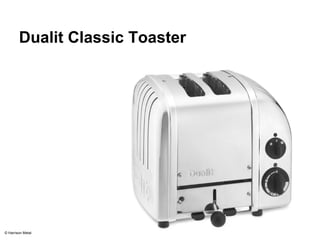
Dualit Classic Toaster 
© Harrison Metal
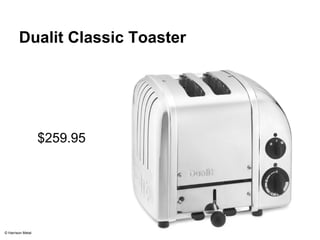
Dualit Classic Toaster 
$259.95 
© Harrison Metal
How might we think about pricing? 
● Standard model of supply and demand is powerful. It has some very nice 
features for understanding pricing 
○ Downward sloping demand curves, utility and preference 
○ "Elasticity" that links change in quantity to change in price 
○ Supply curves, marginal costs of production and variable unit costs 
○ Buyers and sellers use reason to make decisions 
● But the standard model is less useful when managing pricing 
○ New markets where demand is highly uncertain 
○ Software, digital services where variable unit costs approach zero 
○ Markets where humans make decisions only partly based on reason 
© Harrison Metal
... in a different way? 
● Behavioral economics offers helpful modifications to the standard model 
○ Intuition and reasoning operate together in a compound system 
○ "Utility" is reference-dependent and loss-averse 
○ Complex decision-making is simplified using prototypes as anchors, 
and accessible analytic techniques 
● You can use four simple tools to improve your pricing judgment 
○ Map substitutes and complements for your product 
○ Design for both the intuitive and the rational p.o.v. of users 
○ Create value-based prototypes (perceived value > price) 
○ Build assortments to probe demand and increase conversion 
© Harrison Metal
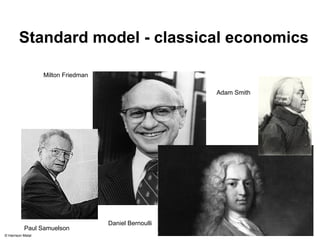
Standard model - classical economics 
Paul Samuelson 
Daniel Bernoulli 
Milton Friedman 
Adam Smith 
© Harrison Metal
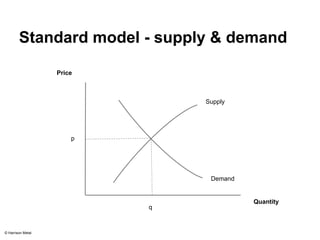
Standard model - supply & demand 
Price 
Quantity 
Supply 
Demand 
p 
q 
© Harrison Metal
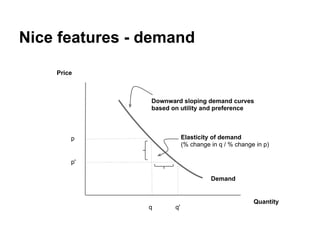
Nice features - demand 
Price 
Downward sloping demand curves 
based on utility and preference 
Quantity 
Demand 
p 
q 
Elasticity of demand 
(% change in q / % change in p) 
p' 
q'
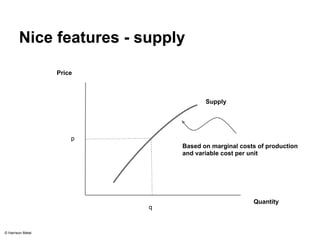
Nice features - supply 
Price 
Quantity 
Supply 
p 
q 
Based on marginal costs of production 
and variable cost per unit 
© Harrison Metal
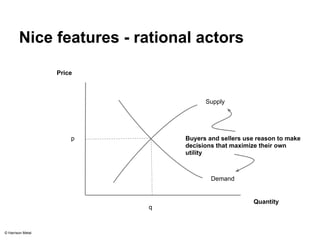
Nice features - rational actors 
Price 
Quantity 
Supply 
Demand 
p 
q 
Buyers and sellers use reason to make 
decisions that maximize their own 
utility 
© Harrison Metal
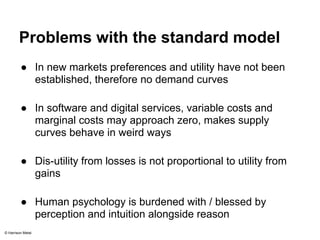
Problems with the standard model 
● In new markets preferences and utility have not been 
established, therefore no demand curves 
● In software and digital services, variable costs and 
marginal costs may approach zero, makes supply 
curves behave in weird ways 
● Dis-utility from losses is not proportional to utility from 
gains 
● Human psychology is burdened with / blessed by 
perception and intuition alongside reason 
© Harrison Metal
The psychologists 
Daniel Kahneman and Amos Tversky 
© Harrison Metal
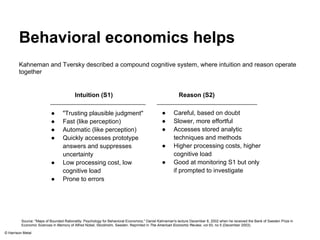
Behavioral economics helps 
Kahneman and Tversky described a compound cognitive system, where intuition and reason operate 
together 
Intuition (S1) Reason (S2) 
● "Trusting plausible judgment" 
● Fast (like perception) 
● Automatic (like perception) 
● Quickly accesses prototype 
answers and suppresses 
uncertainty 
● Low processing cost, low 
cognitive load 
● Prone to errors 
● Careful, based on doubt 
● Slower, more effortful 
● Accesses stored analytic 
techniques and methods 
● Higher processing costs, higher 
cognitive load 
● Good at monitoring S1 but only 
if prompted to investigate 
Source: "Maps of Bounded Rationality: Psychology for Behavioral Economics," Daniel Kahneman's lecture December 8, 2002 when he received the Bank of Sweden Prize in 
Economic Sciences in Memory of Alfred Nobel, Stockholm, Sweden. Reprinted in The American Economic Review, vol 93, no 5 (December 2003). 
© Harrison Metal
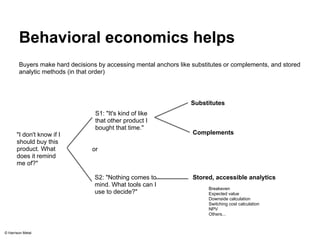
Behavioral economics helps 
Buyers make hard decisions by accessing mental anchors like substitutes or complements, and stored 
analytic methods (in that order) 
"I don't know if I 
should buy this 
product. What 
does it remind 
me of?" 
S1: "It's kind of like 
that other product I 
bought that time." 
S2: "Nothing comes to 
mind. What tools can I 
use to decide?" 
Substitutes 
Complements 
Stored, accessible analytics 
Breakeven 
Expected value 
Downside calculation 
Switching cost calculation 
NPV 
Others... 
or 
© Harrison Metal
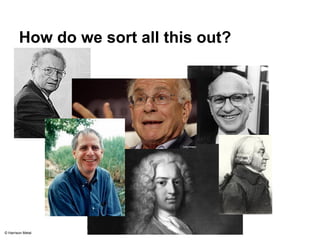
How do we sort all this out? 
© Harrison Metal
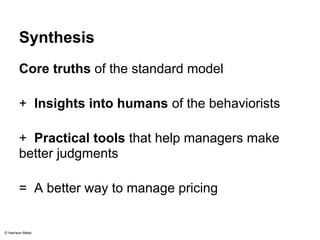
Synthesis 
Core truths of the standard model 
+ Insights into humans of the behaviorists 
+ Practical tools that help managers make 
better judgments 
= A better way to manage pricing 
© Harrison Metal
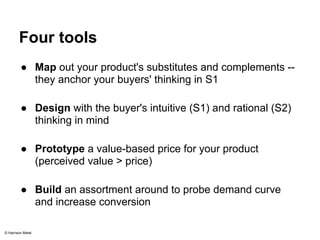
Four tools 
● Map out your product's substitutes and complements -- 
they anchor your buyers' thinking in S1 
● Design with the buyer's intuitive (S1) and rational (S2) 
thinking in mind 
● Prototype a value-based price for your product 
(perceived value > price) 
● Build an assortment around to probe demand curve 
and increase conversion 
© Harrison Metal
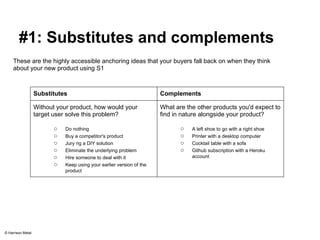
#1: Substitutes and complements 
These are the highly accessible anchoring ideas that your buyers fall back on when they think 
about your new product using S1 
Substitutes Complements 
Without your product, how would your 
target user solve this problem? 
○ Do nothing 
○ Buy a competitor's product 
○ Jury rig a DIY solution 
○ Eliminate the underlying problem 
○ Hire someone to deal with it 
○ Keep using your earlier version of the 
product 
What are the other products you'd expect to 
find in nature alongside your product? 
○ A left shoe to go with a right shoe 
○ Printer with a desktop computer 
○ Cocktail table with a sofa 
○ Github subscription with a Heroku 
account 
© Harrison Metal
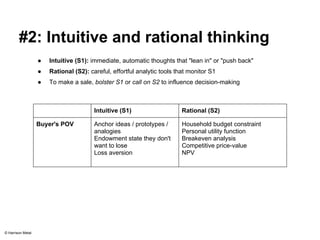
#2: Intuitive and rational thinking 
● Intuitive (S1): immediate, automatic thoughts that "lean in" or "push back" 
● Rational (S2): careful, effortful analytic tools that monitor S1 
● To make a sale, bolster S1 or call on S2 to influence decision-making 
Intuitive (S1) Rational (S2) 
Buyer's POV Anchor ideas / prototypes / 
analogies 
Endowment state they don't 
want to lose 
Loss aversion 
Household budget constraint 
Personal utility function 
Breakeven analysis 
Competitive price-value 
NPV 
© Harrison Metal
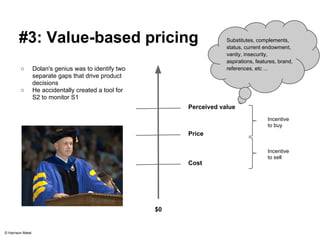
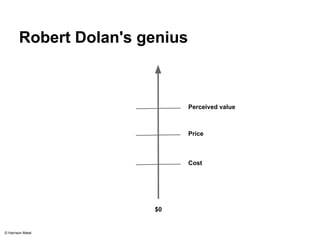
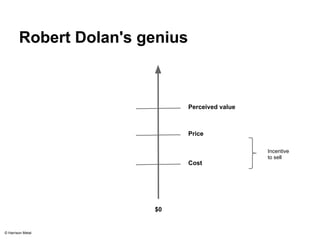
#3: Value-based pricing 
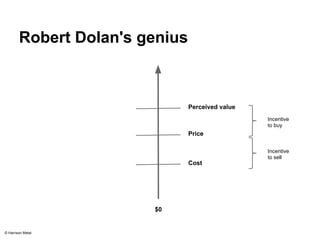
○ Dolan's genius was to identify two 
separate gaps that drive product 
decisions 
○ He accidentally created a tool for 
S2 to monitor S1 
$0 
Substitutes, complements, 
status, current endowment, 
vanity, insecurity, 
aspirations, features, brand, 
references, etc ... 
Perceived value 
Price 
Cost 
Incentive 
to buy 
Incentive 
to sell 
© Harrison Metal
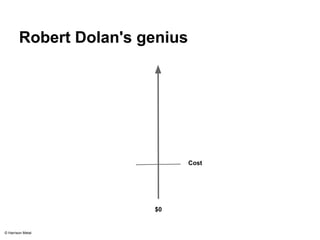
Robert Dolan's genius 
$0 
Cost 
© Harrison Metal
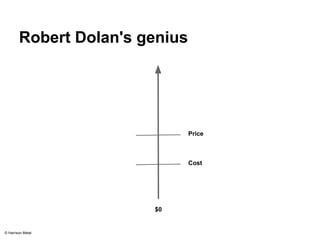
Robert Dolan's genius 
$0 
Price 
Cost 
© Harrison Metal
Robert Dolan's genius 
$0 
Perceived value 
Price 
Cost 
© Harrison Metal
Robert Dolan's genius 
$0 
Perceived value 
Price 
Cost 
Incentive 
to sell 
© Harrison Metal
Robert Dolan's genius 
$0 
Perceived value 
Price 
Cost 
Incentive 
to buy 
Incentive 
to sell 
© Harrison Metal
Robert Dolan's genius 
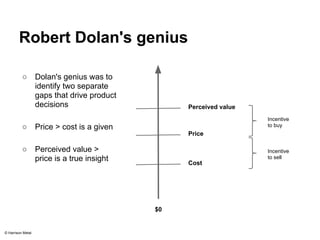
○ Dolan's genius was to 
identify two separate 
gaps that drive product 
decisions 
○ Price > cost is a given 
○ Perceived value > 
price is a true insight 
$0 
Perceived value 
Price 
Cost 
Incentive 
to buy 
Incentive 
to sell 
© Harrison Metal
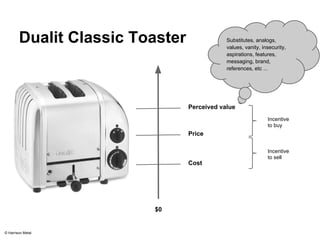
Dualit Classic Toaster 
$0 
Substitutes, analogs, 
values, vanity, insecurity, 
aspirations, features, 
messaging, brand, 
references, etc ... 
Perceived value 
Price 
Cost 
Incentive 
to buy 
Incentive 
to sell 
© Harrison Metal
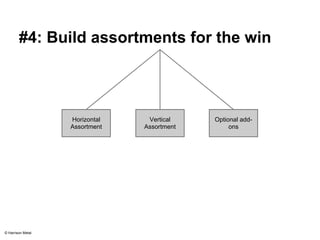
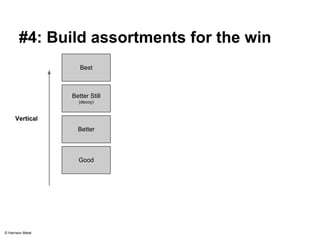
#4: Build assortments for the win 
Horizontal 
Assortment 
Vertical 
Assortment 
Optional add-ons 
© Harrison Metal
#4: Build assortments for the win 
Best 
Better Still 
(decoy) 
Better 
Good 
Vertical 
© Harrison Metal
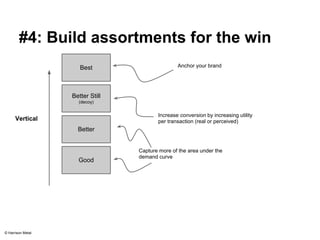
#4: Build assortments for the win 
Best 
Better Still 
(decoy) 
Anchor your brand 
Vertical Increase conversion by increasing utility 
Better 
Good 
per transaction (real or perceived) 
Capture more of the area under the 
demand curve 
© Harrison Metal
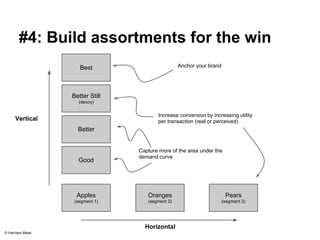
#4: Build assortments for the win 
Apples 
(segment 1) 
Increase conversion by increasing utility 
per transaction (real or perceived) 
Oranges 
(segment 2) 
Pears 
(segment 3) 
Best 
Better Still 
(decoy) 
Better 
Good 
Vertical 
Horizontal 
Anchor your brand 
Capture more of the area under the 
demand curve 
© Harrison Metal
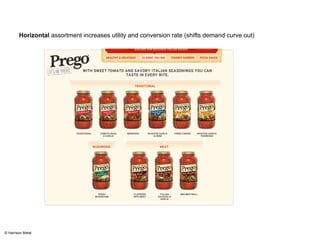
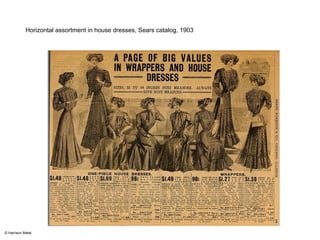
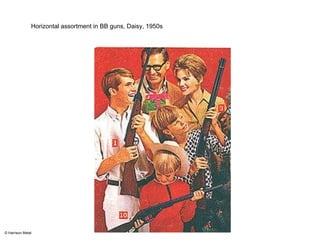
Horizontal assortment increases utility and conversion rate (shifts demand curve out) 
© Harrison Metal
Horizontal assortment in house dresses, Sears catalog, 1903 
© Harrison Metal
Horizontal assortment in BB guns, Daisy, 1950s 
© Harrison Metal
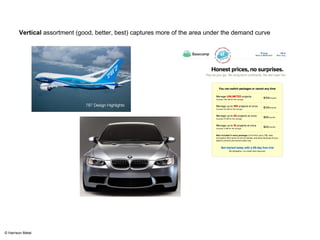
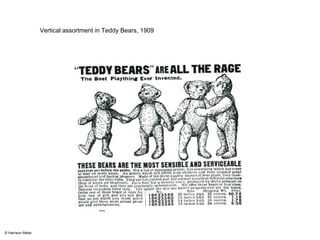
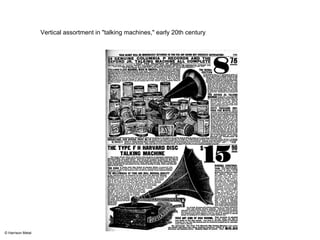
Vertical assortment (good, better, best) captures more of the area under the demand curve 
© Harrison Metal
Vertical assortment in Teddy Bears, 1909 
Idea #2 
Good-Better-Best Wins 
© Harrison Metal
Vertical assortment in "talking machines," early 20th century 
© Harrison Metal
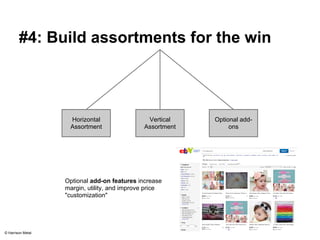
#4: Build assortments for the win 
Horizontal 
Assortment 
Vertical 
Assortment 
Optional add-ons 
© Harrison Metal 
Optional add-on features increase 
margin, utility, and improve price 
"customization"
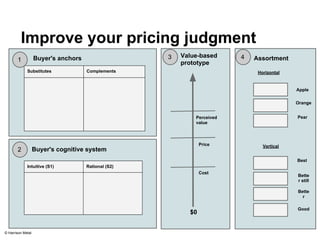
Improve your pricing judgment 
Buyer's anchors 
Substitutes Complements 
Intuitive (S1) Rational (S2) 
Perceived 
value 
$0 
Price 
Cost 
Apple 
Best 
Bette 
r 
Good 
Horizontal 
Vertical 
Orange 
Pear 
1 
2 
3 Value-based 4 Assortment 
prototype 
Buyer's cognitive system 
© Harrison Metal 
Bette 
r still
Applying the Toolkit 
The Case of the Dualit Toaster 
© Harrison Metal
Nice features - wealth, utility, risk 
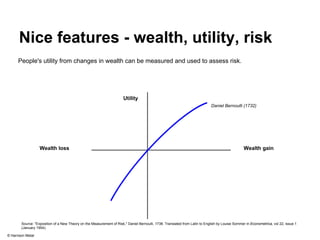
People's utility from changes in wealth can be measured and used to assess risk. 
Utility 
Daniel Bernoulli (1732) 
Wealth loss Wealth gain 
Source: "Exposition of a New Theory on the Measurement of Risk," Daniel Bernoulli, 1738. Translated from Latin to English by Louise Sommer in Econometrica, vol 22, issue 1 
(January 1954). 
© Harrison Metal
Behavioral economics helps 
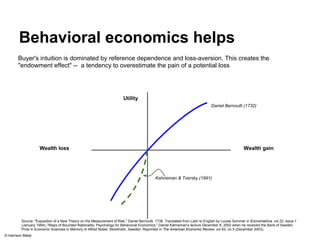
Buyer's intuition is dominated by reference dependence and loss-aversion. This creates the 
"endowment effect" -- a tendency to overestimate the pain of a potential loss 
Utility 
Daniel Bernoulli (1732) 
Wealth loss Wealth gain 
Kahneman & Tversky (1991) 
Source: "Exposition of a New Theory on the Measurement of Risk," Daniel Bernoulli, 1738. Translated from Latin to English by Louise Sommer in Econometrica, vol 22, issue 1 
(January 1954); "Maps of Bounded Rationality: Psychology for Behavioral Economics," Daniel Kahneman's lecture December 8, 2002 when he received the Bank of Sweden 
Prize in Economic Sciences in Memory of Alfred Nobel, Stockholm, Sweden. Reprinted in The American Economic Review, vol 93, no 5 (December 2003). 
© Harrison Metal
Dualit Classic Toaster 
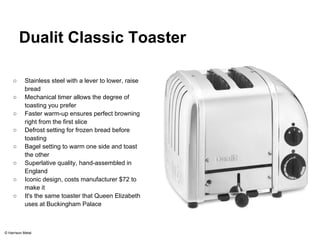
○ Stainless steel with a lever to lower, raise 
bread 
○ Mechanical timer allows the degree of 
toasting you prefer 
○ Faster warm-up ensures perfect browning 
right from the first slice 
○ Defrost setting for frozen bread before 
toasting 
○ Bagel setting to warm one side and toast 
the other 
○ Superlative quality, hand-assembled in 
England 
○ Iconic design, costs manufacturer $72 to 
make it 
○ It's the same toaster that Queen Elizabeth 
uses at Buckingham Palace 
© Harrison Metal
#1: Substitutes and complements 
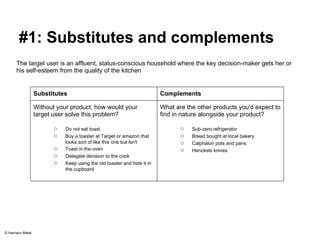
The target user is an affluent, status-conscious household where the key decision-maker gets her or 
his self-esteem from the quality of the kitchen 
Substitutes Complements 
Without your product, how would your 
target user solve this problem? 
○ Do not eat toast 
○ Buy a toaster at Target or amazon that 
looks sort of like this one but isn't 
○ Toast in the oven 
○ Delegate decision to the cook 
○ Keep using the old toaster and hide it in 
the cupboard 
What are the other products you'd expect to 
find in nature alongside your product? 
○ Sub-zero refrigerator 
○ Bread bought at local bakery 
○ Calphalon pots and pans 
○ Henckels knives 
© Harrison Metal
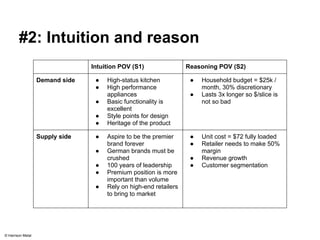
#2: Intuition and reason 
Intuition POV (S1) Reasoning POV (S2) 
Demand side ● High-status kitchen 
● High performance 
appliances 
● Basic functionality is 
excellent 
● Style points for design 
● Heritage of the product 
● Household budget = $25k / 
month, 30% discretionary 
● Lasts 3x longer so $/slice is 
not so bad 
Supply side ● Aspire to be the premier 
brand forever 
● German brands must be 
crushed 
● 100 years of leadership 
● Premium position is more 
important than volume 
● Rely on high-end retailers 
to bring to market 
● Unit cost = $72 fully loaded 
● Retailer needs to make 50% 
margin 
● Revenue growth 
● Customer segmentation 
© Harrison Metal
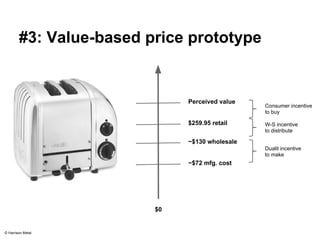
#3: Value-based price prototype 
$0 
Perceived value 
~$130 wholesale 
~$72 mfg. cost 
W-S incentive 
to distribute 
Dualit incentive 
to make 
$259.95 retail 
Consumer incentive 
to buy 
© Harrison Metal
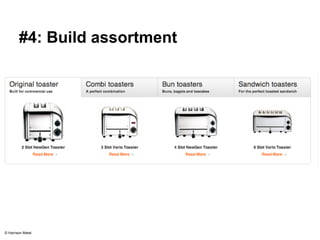
#4: Build assortment 
© Harrison Metal

Harrison Metal's Michael Dearing on Pricing

  • 1.
  • 2.
    Pricing is nota math problem It's a judgment problem
  • 3.
  • 4.
    How much wouldyou pay? ○ Toaster © Harrison Metal
  • 5.
    How much wouldyou pay? ○ Toaster ○ Mechanical timer lets you get exactly the degree of toasting you prefer © Harrison Metal
  • 6.
    How much wouldyou pay? ○ Toaster ○ Mechanical timer lets you get exactly the degree of toasting you prefer ○ Faster warm-up ensures perfect browning right from the first slice © Harrison Metal
  • 7.
    How much wouldyou pay? ○ Toaster ○ Mechanical timer lets you get exactly the degree of toasting you prefer ○ Faster warm-up ensures perfect browning right from the first slice ○ Defrost setting for frozen bread before toasting © Harrison Metal
  • 8.
    How much wouldyou pay? ○ Toaster ○ Mechanical timer lets you get exactly the degree of toasting you prefer ○ Faster warm-up ensures perfect browning right from the first slice ○ Defrost setting for frozen bread before toasting ○ Bagel setting to warm one side and toast the other © Harrison Metal
  • 9.
    How much wouldyou pay? ○ Toaster ○ Mechanical timer lets you get exactly the degree of toasting you prefer ○ Faster warm-up ensures perfect browning right from the first slice ○ Defrost setting for frozen bread before toasting ○ Bagel setting to warm one side and toast the other ○ Award-winning ProHeat elements guaranteed for two years © Harrison Metal
  • 10.
    How much wouldyou pay? ○ Toaster ○ Mechanical timer lets you get exactly the degree of toasting you prefer ○ Faster warm-up ensures perfect browning right from the first slice ○ Defrost setting for frozen bread before toasting ○ Bagel setting to warm one side and toast the other ○ Award-winning ProHeat elements guaranteed for two years ○ Superlative quality, hand-assembled in England © Harrison Metal
  • 11.
    How much wouldyou pay? ○ Toaster ○ Mechanical timer lets you get exactly the degree of toasting you prefer ○ Faster warm-up ensures perfect browning right from the first slice ○ Defrost setting for frozen bread before toasting ○ Bagel setting to warm one side and toast the other ○ Award-winning ProHeat elements guaranteed for two years ○ Superlative quality, hand-assembled in England ○ Iconic design, stainless steel costs manufacturer $130 to make it © Harrison Metal
  • 12.
    How much wouldyou pay? ○ Toaster ○ Mechanical timer lets you get exactly the degree of toasting you prefer ○ Faster warm-up ensures perfect browning right from the first slice ○ Defrost setting for frozen bread before toasting ○ Bagel setting to warm one side and toast the other ○ Award-winning ProHeat elements guaranteed for two years ○ Superlative quality, hand-assembled in England ○ Iconic design, stainless steel costs manufacturer $130 to make it ○ Dualit brand, available at Williams-Sonoma © Harrison Metal
  • 13.
    How much wouldyou pay? ○ Toaster ○ Mechanical timer lets you get exactly the degree of toasting you prefer ○ Faster warm-up ensures perfect browning right from the first slice ○ Defrost setting for frozen bread before toasting ○ Bagel setting to warm one side and toast the other ○ Award-winning ProHeat elements guaranteed for two years ○ Superlative quality, hand-assembled in England ○ Iconic design, stainless steel costs manufacturer $70 to make it ○ Dualit brand, available at Williams-Sonoma ○ It's the same toaster that Queen Elizabeth uses at Buckingham Palace © Harrison Metal
  • 14.
    Dualit Classic Toaster © Harrison Metal
  • 15.
    Dualit Classic Toaster $259.95 © Harrison Metal
  • 16.
    How might wethink about pricing? ● Standard model of supply and demand is powerful. It has some very nice features for understanding pricing ○ Downward sloping demand curves, utility and preference ○ "Elasticity" that links change in quantity to change in price ○ Supply curves, marginal costs of production and variable unit costs ○ Buyers and sellers use reason to make decisions ● But the standard model is less useful when managing pricing ○ New markets where demand is highly uncertain ○ Software, digital services where variable unit costs approach zero ○ Markets where humans make decisions only partly based on reason © Harrison Metal
  • 17.
    ... in adifferent way? ● Behavioral economics offers helpful modifications to the standard model ○ Intuition and reasoning operate together in a compound system ○ "Utility" is reference-dependent and loss-averse ○ Complex decision-making is simplified using prototypes as anchors, and accessible analytic techniques ● You can use four simple tools to improve your pricing judgment ○ Map substitutes and complements for your product ○ Design for both the intuitive and the rational p.o.v. of users ○ Create value-based prototypes (perceived value > price) ○ Build assortments to probe demand and increase conversion © Harrison Metal
  • 18.
    Standard model -classical economics Paul Samuelson Daniel Bernoulli Milton Friedman Adam Smith © Harrison Metal
  • 19.
    Standard model -supply & demand Price Quantity Supply Demand p q © Harrison Metal
  • 20.
    Nice features -demand Price Downward sloping demand curves based on utility and preference Quantity Demand p q Elasticity of demand (% change in q / % change in p) p' q'
  • 21.
    Nice features -supply Price Quantity Supply p q Based on marginal costs of production and variable cost per unit © Harrison Metal
  • 22.
    Nice features -rational actors Price Quantity Supply Demand p q Buyers and sellers use reason to make decisions that maximize their own utility © Harrison Metal
  • 23.
    Problems with thestandard model ● In new markets preferences and utility have not been established, therefore no demand curves ● In software and digital services, variable costs and marginal costs may approach zero, makes supply curves behave in weird ways ● Dis-utility from losses is not proportional to utility from gains ● Human psychology is burdened with / blessed by perception and intuition alongside reason © Harrison Metal
  • 24.
    The psychologists DanielKahneman and Amos Tversky © Harrison Metal
  • 25.
    Behavioral economics helps Kahneman and Tversky described a compound cognitive system, where intuition and reason operate together Intuition (S1) Reason (S2) ● "Trusting plausible judgment" ● Fast (like perception) ● Automatic (like perception) ● Quickly accesses prototype answers and suppresses uncertainty ● Low processing cost, low cognitive load ● Prone to errors ● Careful, based on doubt ● Slower, more effortful ● Accesses stored analytic techniques and methods ● Higher processing costs, higher cognitive load ● Good at monitoring S1 but only if prompted to investigate Source: "Maps of Bounded Rationality: Psychology for Behavioral Economics," Daniel Kahneman's lecture December 8, 2002 when he received the Bank of Sweden Prize in Economic Sciences in Memory of Alfred Nobel, Stockholm, Sweden. Reprinted in The American Economic Review, vol 93, no 5 (December 2003). © Harrison Metal
  • 26.
    Behavioral economics helps Buyers make hard decisions by accessing mental anchors like substitutes or complements, and stored analytic methods (in that order) "I don't know if I should buy this product. What does it remind me of?" S1: "It's kind of like that other product I bought that time." S2: "Nothing comes to mind. What tools can I use to decide?" Substitutes Complements Stored, accessible analytics Breakeven Expected value Downside calculation Switching cost calculation NPV Others... or © Harrison Metal
  • 27.
    How do wesort all this out? © Harrison Metal
  • 28.
    Synthesis Core truthsof the standard model + Insights into humans of the behaviorists + Practical tools that help managers make better judgments = A better way to manage pricing © Harrison Metal
  • 29.
    Four tools ●Map out your product's substitutes and complements -- they anchor your buyers' thinking in S1 ● Design with the buyer's intuitive (S1) and rational (S2) thinking in mind ● Prototype a value-based price for your product (perceived value > price) ● Build an assortment around to probe demand curve and increase conversion © Harrison Metal
  • 30.
    #1: Substitutes andcomplements These are the highly accessible anchoring ideas that your buyers fall back on when they think about your new product using S1 Substitutes Complements Without your product, how would your target user solve this problem? ○ Do nothing ○ Buy a competitor's product ○ Jury rig a DIY solution ○ Eliminate the underlying problem ○ Hire someone to deal with it ○ Keep using your earlier version of the product What are the other products you'd expect to find in nature alongside your product? ○ A left shoe to go with a right shoe ○ Printer with a desktop computer ○ Cocktail table with a sofa ○ Github subscription with a Heroku account © Harrison Metal
  • 31.
    #2: Intuitive andrational thinking ● Intuitive (S1): immediate, automatic thoughts that "lean in" or "push back" ● Rational (S2): careful, effortful analytic tools that monitor S1 ● To make a sale, bolster S1 or call on S2 to influence decision-making Intuitive (S1) Rational (S2) Buyer's POV Anchor ideas / prototypes / analogies Endowment state they don't want to lose Loss aversion Household budget constraint Personal utility function Breakeven analysis Competitive price-value NPV © Harrison Metal
  • 32.
    #3: Value-based pricing ○ Dolan's genius was to identify two separate gaps that drive product decisions ○ He accidentally created a tool for S2 to monitor S1 $0 Substitutes, complements, status, current endowment, vanity, insecurity, aspirations, features, brand, references, etc ... Perceived value Price Cost Incentive to buy Incentive to sell © Harrison Metal
  • 33.
    Robert Dolan's genius $0 Cost © Harrison Metal
  • 34.
    Robert Dolan's genius $0 Price Cost © Harrison Metal
  • 35.
    Robert Dolan's genius $0 Perceived value Price Cost © Harrison Metal
  • 36.
    Robert Dolan's genius $0 Perceived value Price Cost Incentive to sell © Harrison Metal
  • 37.
    Robert Dolan's genius $0 Perceived value Price Cost Incentive to buy Incentive to sell © Harrison Metal
  • 38.
    Robert Dolan's genius ○ Dolan's genius was to identify two separate gaps that drive product decisions ○ Price > cost is a given ○ Perceived value > price is a true insight $0 Perceived value Price Cost Incentive to buy Incentive to sell © Harrison Metal
  • 39.
    Dualit Classic Toaster $0 Substitutes, analogs, values, vanity, insecurity, aspirations, features, messaging, brand, references, etc ... Perceived value Price Cost Incentive to buy Incentive to sell © Harrison Metal
  • 40.
    #4: Build assortmentsfor the win Horizontal Assortment Vertical Assortment Optional add-ons © Harrison Metal
  • 41.
    #4: Build assortmentsfor the win Best Better Still (decoy) Better Good Vertical © Harrison Metal
  • 42.
    #4: Build assortmentsfor the win Best Better Still (decoy) Anchor your brand Vertical Increase conversion by increasing utility Better Good per transaction (real or perceived) Capture more of the area under the demand curve © Harrison Metal
  • 43.
    #4: Build assortmentsfor the win Apples (segment 1) Increase conversion by increasing utility per transaction (real or perceived) Oranges (segment 2) Pears (segment 3) Best Better Still (decoy) Better Good Vertical Horizontal Anchor your brand Capture more of the area under the demand curve © Harrison Metal
  • 44.
    Horizontal assortment increasesutility and conversion rate (shifts demand curve out) © Harrison Metal
  • 45.
    Horizontal assortment inhouse dresses, Sears catalog, 1903 © Harrison Metal
  • 46.
    Horizontal assortment inBB guns, Daisy, 1950s © Harrison Metal
  • 47.
    Vertical assortment (good,better, best) captures more of the area under the demand curve © Harrison Metal
  • 48.
    Vertical assortment inTeddy Bears, 1909 Idea #2 Good-Better-Best Wins © Harrison Metal
  • 49.
    Vertical assortment in"talking machines," early 20th century © Harrison Metal
  • 50.
    #4: Build assortmentsfor the win Horizontal Assortment Vertical Assortment Optional add-ons © Harrison Metal Optional add-on features increase margin, utility, and improve price "customization"
  • 51.
    Improve your pricingjudgment Buyer's anchors Substitutes Complements Intuitive (S1) Rational (S2) Perceived value $0 Price Cost Apple Best Bette r Good Horizontal Vertical Orange Pear 1 2 3 Value-based 4 Assortment prototype Buyer's cognitive system © Harrison Metal Bette r still
  • 52.
    Applying the Toolkit The Case of the Dualit Toaster © Harrison Metal
  • 53.
    Nice features -wealth, utility, risk People's utility from changes in wealth can be measured and used to assess risk. Utility Daniel Bernoulli (1732) Wealth loss Wealth gain Source: "Exposition of a New Theory on the Measurement of Risk," Daniel Bernoulli, 1738. Translated from Latin to English by Louise Sommer in Econometrica, vol 22, issue 1 (January 1954). © Harrison Metal
  • 54.
    Behavioral economics helps Buyer's intuition is dominated by reference dependence and loss-aversion. This creates the "endowment effect" -- a tendency to overestimate the pain of a potential loss Utility Daniel Bernoulli (1732) Wealth loss Wealth gain Kahneman & Tversky (1991) Source: "Exposition of a New Theory on the Measurement of Risk," Daniel Bernoulli, 1738. Translated from Latin to English by Louise Sommer in Econometrica, vol 22, issue 1 (January 1954); "Maps of Bounded Rationality: Psychology for Behavioral Economics," Daniel Kahneman's lecture December 8, 2002 when he received the Bank of Sweden Prize in Economic Sciences in Memory of Alfred Nobel, Stockholm, Sweden. Reprinted in The American Economic Review, vol 93, no 5 (December 2003). © Harrison Metal
  • 55.
    Dualit Classic Toaster ○ Stainless steel with a lever to lower, raise bread ○ Mechanical timer allows the degree of toasting you prefer ○ Faster warm-up ensures perfect browning right from the first slice ○ Defrost setting for frozen bread before toasting ○ Bagel setting to warm one side and toast the other ○ Superlative quality, hand-assembled in England ○ Iconic design, costs manufacturer $72 to make it ○ It's the same toaster that Queen Elizabeth uses at Buckingham Palace © Harrison Metal
  • 56.
    #1: Substitutes andcomplements The target user is an affluent, status-conscious household where the key decision-maker gets her or his self-esteem from the quality of the kitchen Substitutes Complements Without your product, how would your target user solve this problem? ○ Do not eat toast ○ Buy a toaster at Target or amazon that looks sort of like this one but isn't ○ Toast in the oven ○ Delegate decision to the cook ○ Keep using the old toaster and hide it in the cupboard What are the other products you'd expect to find in nature alongside your product? ○ Sub-zero refrigerator ○ Bread bought at local bakery ○ Calphalon pots and pans ○ Henckels knives © Harrison Metal
  • 57.
    #2: Intuition andreason Intuition POV (S1) Reasoning POV (S2) Demand side ● High-status kitchen ● High performance appliances ● Basic functionality is excellent ● Style points for design ● Heritage of the product ● Household budget = $25k / month, 30% discretionary ● Lasts 3x longer so $/slice is not so bad Supply side ● Aspire to be the premier brand forever ● German brands must be crushed ● 100 years of leadership ● Premium position is more important than volume ● Rely on high-end retailers to bring to market ● Unit cost = $72 fully loaded ● Retailer needs to make 50% margin ● Revenue growth ● Customer segmentation © Harrison Metal
  • 58.
    #3: Value-based priceprototype $0 Perceived value ~$130 wholesale ~$72 mfg. cost W-S incentive to distribute Dualit incentive to make $259.95 retail Consumer incentive to buy © Harrison Metal
  • 59.
    #4: Build assortment © Harrison Metal