Research Methods in Nursing NUR 602
Celeste Connelly, Kelly Gibson,
Ashley McCann Rogers & Amy Squire
Introduction
 5.7 million Americans live with heart failure (HF).
 The cost of care of HF patients was $37.2 billion dollars

in 2009.
 Rapid readmission (readmission to an acute care
facility within 30 days of discharge) for Medicare
patients was 26.9% in 2010.
 Management of heart failure consumes more resources
than any other diagnosis….
 We need to improve care and cut costs.
Purpose of the Study/Hypothesis
• To determine if a nurse-delivered discharge planning

bundle that includes a follow-up phone call within 1
week of discharge will decrease the rate of unplanned
admissions among patients with a primary or
secondary diagnosis of HF.
• The addition of a follow-up phone call to a discharge

care bundle will reduce the rapid readmission of
patients with HF to the hospital.
Procedures
 January 1 – June 30 – Retrospective chart review to determine

number of rapid readmissions conducted by Quality Improvement
Department of a local hospital. IRB approval obtained from
University of North Carolina at Greensboro. Study was deemed
exempt Category #4. All information was de-identified before
included in the study.

 July 1 – September 30 – Staff education/preparation of unit for

introduction of new discharge care bundle that will include HF
patients - #1 admitting diagnosis on the unit

 October 1 – December 31 – Implement the discharge planning

bundle that includes follow-up phone call.

 January 1 – June 30 - Collect data about rapid readmissions

following implementation the new care bundle.
Sampling and Setting
 Target Population: Patients hospitalized for HF.
 Setting: An inpatient 20 bed telemetry unit of a local hospital staffed with
30 RN’s/10 CNA’s /4 Monitor Tech’s

1.
2.
3.

Inclusion Criteria:
Age 65 or older
Discharge diagnosis of HF (as the primary or secondary diagnosis)
Alert and competent to read, understand and speak English


1.
2.
3.

Exclusion Criteria:
Skilled Nursing Facility (SNF) patients
Department of Correction residents
Pregnant women


1.

Protection of Human Rights:
All demographic information was stored on a secure server with
protection by a 2 password system
Patients gave consent to be contacted by telephone following hospital
stay

2.
Discharge Care Bundle
 Patients will receive an educational plan that follows the

Self Care of Heart Failure Index (SCHFI) developed in
studies done by Riegel, Lee, Dickson & Carlson (2004).
 Education Concepts/Goals - Self-care maintenance, Self-

care management and Self-care monitoring/confidence.
 The intention of the follow-up phone call is to monitor the

patient understanding of the goals of the program and to
follow their progress as well as answer any questions they
may have. A graduate nurse researcher will attempt to
contact all patients within a week of discharge.
Follow-up Phone Call
 Medications:
What medications are you taking and are you taking them as prescribed?
Do you have any questions about your medications?
• Activity:
Are you able to participate in some type of physical activity daily?
 Weight:
Do you weigh yourself daily? Has your weight stayed the same, increased
by > 3# in a day or >5# in a week?
 Diet: Are you following a low sodium diet?
 Symptom Management:
Do your feet/ankles/hands swell? Are you short of breath when you climb
stairs or get dressed in the morning? Are you tired all the time? Can you
participate in your usual activities?
• Follow-up:
Have you seen your primary care provider for your follow-up appointment?
• Can I help you with any other information?
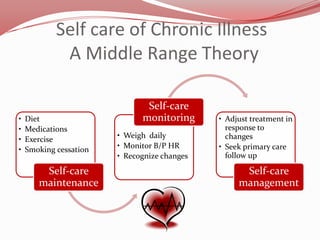
Self care of Chronic Illness
A Middle Range Theory

•
•
•
•

Diet
Medications
Exercise
Smoking cessation

Self-care
maintenance

Self-care
monitoring
• Weigh daily
• Monitor B/P HR
• Recognize changes

• Adjust treatment in
response to
changes
• Seek primary care
follow up

Self-care
management
Research Approach/Design
 This study will use a Quantitative approach to define if an

enhanced educational program and follow-up phone call
(independent variable) would reduce rapid readmission
(dependent variable) of HF patients after hospitalization.
 This is a Quality Improvement study that will attempt to
show a relationship between the enhanced educational
program and better outcomes for HF patients.
 We will use a pretest/posttest design as we are collecting
information about rapid readmission both before the
discharge planning bundle is initiated and after to
determine the change in rapid readmissions.
Outcomes/Statistics
 At the end of our study we will report the number of

readmissions that occurred during the six month period
following the introduction of the discharge planning
bundle.
 Additionally, we may be able to identify any areas of the
educational program that can be improved, indicating
further Quality Improvement opportunities.
 We will employ a graduate student statistician to assist
with the evaluation of the study.
Limitations
 We will have a small sample because we have limited

the initiation of the discharge care bundle to one
specific unit in one hospital.
 We have chosen to use a convenience sample which
may limit the ability to apply our findings to a larger
population.
 The discharge planning bundle is being introduced as
a new standard of care but we do not know if the
education is completed or delivered in a consistent
manner with each HF patient.
Budget
 Materials /copying fees
 Professional services of statistician

 Total Cost of study

50
500

$ 550
Resources



















American Heart Association. (2012). ACCF/AHA/AMA-PCPI 2011 Performance Measures for Adults with Heart Failure.
doi:10.1161/CIR.06013e3182507bec
Bradke, P. M. & Brubjerm E. (2011). To reduce heart failure readmissions use the teach-back method. Patient Education Management, 18(10),
109-120.
Centers for Medicare & Medicaid Services Readmissions Reduction program. (2013). Retrieved 2013 ACCF/AHA guideline for the management
of heart failure: executive summary. from CMS.gov: http://www.cms.gov/Medicare-Fee-forService
Coleman, E. A. (2003). Fallling through the cracks: Challenges and opportunities for improving transitional care for persons with continuous
complex care needs. Journal of the American Geriatrics Society, 49, 549-555.
Hart, P. L., Spiva, L. & Kimble, L. P. (2011). Nurses' knowledge of heart failure education principles survey: a psychometric study. Journal of
Clinical Nursing, 20, 3020-3028.
American Heart Association. (2013). Retrieved from Heart Disease and Stroke Statistics-2013 Update/Heart Failure:
http://www.heart.org/HEARTORG/General/Heart-and-Stroke-Association-Statistics_UCM_319043_SubHome Page.jsp#
Hines, P. A., Yu, K. & Randall, M. (2010, March-April). Preventing heart failure readmissions: Is your organization prepared? Nursing
Economic$, 28(2), 74-86.
Jaarsma, T., Stromberg, A., Gal, T. B., Cameron, J., Driscoll, A., Hans-Dirk, D. & Inkrot, S. (2013). Comparison of self care behaviors of heart
failure patients in 15 countries worldwide. Patient Education and Counseling, 92(1), 114-120.
McHugh, M. D., & Ma, C. (2013). Hospital nursing and 30 day readmissions among medicare patients with heart failure, acute myocardial
infarction and pneumonia. Medical Care, 51(1), 52-59.
Paradis, V. Cossette, S., Frasure-Smith, N., Heppell, S. & Guertin, M. C. (2010). The efficacy of motivational nursing intervention based on the
stages of change on self-care in heart failure patients. Journal of Cardiovascular Nursing, 25(2), 130-141.
Polit, D. F. & Beck C. T. (2012). Nursing research: Generating and assessing evidence for nursing practice. Philadelphia: Wolters
Kluwer/Lippincott Williams & Wilkins.
Riegel, B. & Dickson, V. V. (2008). A situation-specific theory of heart failure self-care. Journal of Cardiovascular Nursing, 23(3), 190-196.
Riegel, B., Lee, C. S., Dickson, V. V. & Carlson, B. (2009). An update on the self-care of heart failure index. Journal of Cardiovascular Nursing,
24(6), 485-497.
Riegel, B., Jaarsma, , T. & Stromberg, A. (2012). A middle-range theory of self-care of chronic illness. Advances in Nursing Science, 35(3), 194204.
Silow-Carroll, S., Edwards, J. N. & Lashbrook A. (2011). Reducing hospital readmissions: Lessons from top-performing hospitals. The
Commonwealth Fund.
Yancy, C. W., Jessup, M., Bozkurt, B., Butler, J., Casey, D. E. Drazner, M. H. & Fonarow, G. C. (2013). 2013 ACCF/AHA guideline for the
management of heart failure: executive summary. Journal of the American College of Cardiology, 62(13), 1495-1539.

Heart failure resources

  • 1.
    Research Methods inNursing NUR 602 Celeste Connelly, Kelly Gibson, Ashley McCann Rogers & Amy Squire
  • 2.
    Introduction  5.7 millionAmericans live with heart failure (HF).  The cost of care of HF patients was $37.2 billion dollars in 2009.  Rapid readmission (readmission to an acute care facility within 30 days of discharge) for Medicare patients was 26.9% in 2010.  Management of heart failure consumes more resources than any other diagnosis….  We need to improve care and cut costs.
  • 3.
    Purpose of theStudy/Hypothesis • To determine if a nurse-delivered discharge planning bundle that includes a follow-up phone call within 1 week of discharge will decrease the rate of unplanned admissions among patients with a primary or secondary diagnosis of HF. • The addition of a follow-up phone call to a discharge care bundle will reduce the rapid readmission of patients with HF to the hospital.
  • 4.
    Procedures  January 1– June 30 – Retrospective chart review to determine number of rapid readmissions conducted by Quality Improvement Department of a local hospital. IRB approval obtained from University of North Carolina at Greensboro. Study was deemed exempt Category #4. All information was de-identified before included in the study.  July 1 – September 30 – Staff education/preparation of unit for introduction of new discharge care bundle that will include HF patients - #1 admitting diagnosis on the unit  October 1 – December 31 – Implement the discharge planning bundle that includes follow-up phone call.  January 1 – June 30 - Collect data about rapid readmissions following implementation the new care bundle.
  • 5.
    Sampling and Setting Target Population: Patients hospitalized for HF.  Setting: An inpatient 20 bed telemetry unit of a local hospital staffed with 30 RN’s/10 CNA’s /4 Monitor Tech’s  1. 2. 3. Inclusion Criteria: Age 65 or older Discharge diagnosis of HF (as the primary or secondary diagnosis) Alert and competent to read, understand and speak English  1. 2. 3. Exclusion Criteria: Skilled Nursing Facility (SNF) patients Department of Correction residents Pregnant women  1. Protection of Human Rights: All demographic information was stored on a secure server with protection by a 2 password system Patients gave consent to be contacted by telephone following hospital stay 2.
  • 6.
    Discharge Care Bundle Patients will receive an educational plan that follows the Self Care of Heart Failure Index (SCHFI) developed in studies done by Riegel, Lee, Dickson & Carlson (2004).  Education Concepts/Goals - Self-care maintenance, Self- care management and Self-care monitoring/confidence.  The intention of the follow-up phone call is to monitor the patient understanding of the goals of the program and to follow their progress as well as answer any questions they may have. A graduate nurse researcher will attempt to contact all patients within a week of discharge.
  • 7.
    Follow-up Phone Call Medications: What medications are you taking and are you taking them as prescribed? Do you have any questions about your medications? • Activity: Are you able to participate in some type of physical activity daily?  Weight: Do you weigh yourself daily? Has your weight stayed the same, increased by > 3# in a day or >5# in a week?  Diet: Are you following a low sodium diet?  Symptom Management: Do your feet/ankles/hands swell? Are you short of breath when you climb stairs or get dressed in the morning? Are you tired all the time? Can you participate in your usual activities? • Follow-up: Have you seen your primary care provider for your follow-up appointment? • Can I help you with any other information?
  • 8.
    Self care ofChronic Illness A Middle Range Theory • • • • Diet Medications Exercise Smoking cessation Self-care maintenance Self-care monitoring • Weigh daily • Monitor B/P HR • Recognize changes • Adjust treatment in response to changes • Seek primary care follow up Self-care management
  • 9.
    Research Approach/Design  Thisstudy will use a Quantitative approach to define if an enhanced educational program and follow-up phone call (independent variable) would reduce rapid readmission (dependent variable) of HF patients after hospitalization.  This is a Quality Improvement study that will attempt to show a relationship between the enhanced educational program and better outcomes for HF patients.  We will use a pretest/posttest design as we are collecting information about rapid readmission both before the discharge planning bundle is initiated and after to determine the change in rapid readmissions.
  • 10.
    Outcomes/Statistics  At theend of our study we will report the number of readmissions that occurred during the six month period following the introduction of the discharge planning bundle.  Additionally, we may be able to identify any areas of the educational program that can be improved, indicating further Quality Improvement opportunities.  We will employ a graduate student statistician to assist with the evaluation of the study.
  • 11.
    Limitations  We willhave a small sample because we have limited the initiation of the discharge care bundle to one specific unit in one hospital.  We have chosen to use a convenience sample which may limit the ability to apply our findings to a larger population.  The discharge planning bundle is being introduced as a new standard of care but we do not know if the education is completed or delivered in a consistent manner with each HF patient.
  • 12.
    Budget  Materials /copyingfees  Professional services of statistician  Total Cost of study 50 500 $ 550
  • 13.
    Resources                  American Heart Association.(2012). ACCF/AHA/AMA-PCPI 2011 Performance Measures for Adults with Heart Failure. doi:10.1161/CIR.06013e3182507bec Bradke, P. M. & Brubjerm E. (2011). To reduce heart failure readmissions use the teach-back method. Patient Education Management, 18(10), 109-120. Centers for Medicare & Medicaid Services Readmissions Reduction program. (2013). Retrieved 2013 ACCF/AHA guideline for the management of heart failure: executive summary. from CMS.gov: http://www.cms.gov/Medicare-Fee-forService Coleman, E. A. (2003). Fallling through the cracks: Challenges and opportunities for improving transitional care for persons with continuous complex care needs. Journal of the American Geriatrics Society, 49, 549-555. Hart, P. L., Spiva, L. & Kimble, L. P. (2011). Nurses' knowledge of heart failure education principles survey: a psychometric study. Journal of Clinical Nursing, 20, 3020-3028. American Heart Association. (2013). Retrieved from Heart Disease and Stroke Statistics-2013 Update/Heart Failure: http://www.heart.org/HEARTORG/General/Heart-and-Stroke-Association-Statistics_UCM_319043_SubHome Page.jsp# Hines, P. A., Yu, K. & Randall, M. (2010, March-April). Preventing heart failure readmissions: Is your organization prepared? Nursing Economic$, 28(2), 74-86. Jaarsma, T., Stromberg, A., Gal, T. B., Cameron, J., Driscoll, A., Hans-Dirk, D. & Inkrot, S. (2013). Comparison of self care behaviors of heart failure patients in 15 countries worldwide. Patient Education and Counseling, 92(1), 114-120. McHugh, M. D., & Ma, C. (2013). Hospital nursing and 30 day readmissions among medicare patients with heart failure, acute myocardial infarction and pneumonia. Medical Care, 51(1), 52-59. Paradis, V. Cossette, S., Frasure-Smith, N., Heppell, S. & Guertin, M. C. (2010). The efficacy of motivational nursing intervention based on the stages of change on self-care in heart failure patients. Journal of Cardiovascular Nursing, 25(2), 130-141. Polit, D. F. & Beck C. T. (2012). Nursing research: Generating and assessing evidence for nursing practice. Philadelphia: Wolters Kluwer/Lippincott Williams & Wilkins. Riegel, B. & Dickson, V. V. (2008). A situation-specific theory of heart failure self-care. Journal of Cardiovascular Nursing, 23(3), 190-196. Riegel, B., Lee, C. S., Dickson, V. V. & Carlson, B. (2009). An update on the self-care of heart failure index. Journal of Cardiovascular Nursing, 24(6), 485-497. Riegel, B., Jaarsma, , T. & Stromberg, A. (2012). A middle-range theory of self-care of chronic illness. Advances in Nursing Science, 35(3), 194204. Silow-Carroll, S., Edwards, J. N. & Lashbrook A. (2011). Reducing hospital readmissions: Lessons from top-performing hospitals. The Commonwealth Fund. Yancy, C. W., Jessup, M., Bozkurt, B., Butler, J., Casey, D. E. Drazner, M. H. & Fonarow, G. C. (2013). 2013 ACCF/AHA guideline for the management of heart failure: executive summary. Journal of the American College of Cardiology, 62(13), 1495-1539.