“Practical tips on taking care of the spirit’s temple” Jason L. McKeown, M.D.
Our goals for today Define obesity and BMI Examine the obesity epidemic in the US Reveal consequences of obesity Look at nutrition and its importance to health Discuss basic concepts for weight loss Recommendations for exercise Discuss sleep hygiene Summarize healthy living
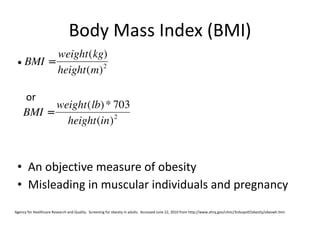
Body Mass Index (BMI) or  An objective measure of obesity Misleading in muscular individuals and pregnancy Agency for Healthcare Research and Quality.  Screening for obesity in adults.  Accessed June 22, 2010 from http://www.ahrq.gov/clinic/3rduspstf/obesity/obeswh.htm
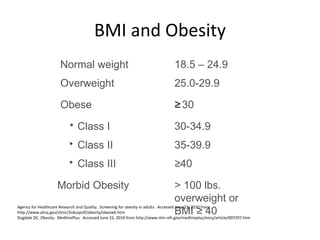
BMI and Obesity Agency for Healthcare Research and Quality.  Screening for obesity in adults.  Accessed June 22, 2010 from http://www.ahrq.gov/clinic/3rduspstf/obesity/obeswh.htm Dugdale DC. Obesity.  MedlinePlus.  Accessed June 22, 2010 from http://www.nlm.nih.gov/medlineplus/ency/article/007297.htm Normal weight 18.5 – 24.9 Overweight 25.0-29.9 Obese ≥ 30 Class I 30-34.9 Class II 35-39.9 Class III ≥ 40 Morbid Obesity > 100 lbs. overweight or  BMI ≥ 40
BMI calculator www.nhlbisupport.com/bmi/bmicalc.htm
The Obesity Epidemic Major  modifiable  cause of death in U.S.  Being obese is expensive! In 2000, the societal cost of obesity was about $117 billion.  Now it’s estimated at $147 billion! (25% increase in 10 years!) Obese people spend $1,500 more each year on health care. Obese patients had 80% higher per capita spending for prescription drugs. The prevalence of obesity has increased in the U.S. with  no sign of slowing . . .
What Causes Obesity? Genes Hormones/gland problems Clowns The royal family Lifestyle Our friends and family
The Bad Fat--  Intra-Abdominal Fat Fat around the waist creates increased risk for heart disease, diabetes, cancer. . . Abnormal levels: Women > 35”  Men > 40” NIH Expert Panel Report,  Am J Clin Nutr  1998;68:899-917
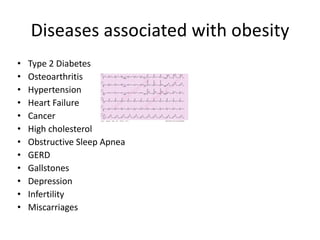
Diseases associated with obesity Type 2 Diabetes Osteoarthritis Hypertension Heart Failure Cancer High cholesterol Obstructive Sleep Apnea GERD Gallstones  Depression  Infertility Miscarriages
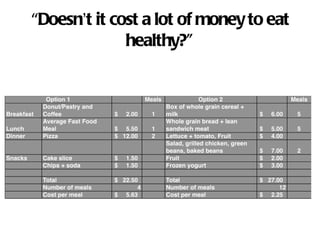
“ Doesn ’ t it cost a lot of money to eat healthy?”
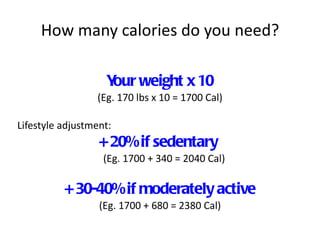
How many calories do you need? Your weight x 10 (Eg. 170 lbs x 10 = 1700 Cal) Lifestyle adjustment: + 20% if sedentary  (Eg. 1700 + 340 = 2040 Cal) + 30-40% if moderately active (Eg. 1700 + 680 = 2380 Cal)
Start Small, Think Big! Excess calories- many of us are getting calories and don ’ t realize it Cut out sugar containing beverages (fruit punches, Kool-Aid, sodas, Frappuccinos) Eat fewer concentrated sweets (desserts, candy, snacks) Watch your portion sizes Write down what you eat Calorie listings– coming to your local restaurant menu!
Start Small, Think Big! Fat -  most changes if instituted over a longer time period are imperceptible Go from whole milk to 2% then to 1% or skim Use lower fat cheese (2%) Avoid trans fat, frying; use more olive oil, canola oil
Start Small, Think Big! Red meat -  Limit to 1-2 times per week Substitute alternatives in familiar recipes Turkey for beef Diets high in fat, excess calories, and red meats have been linked to increased cancer risk.
Start Small, Think Big! Fruit and vegetables - increase your intake  Most of us get less than 5/day Add 1 to breakfast, lunch, and dinner Add extra vegetables when dining out or choose the vegetables instead of the fries Try fruit and vegetables in convenient packages Diets low in fruit and vegetables and fiber have also been linked to increased cancer risk.
Start Small, Think Big! Fiber -  More whole grain products on the market these days Find breads that say 100% whole grain or have whole grain as the first ingredient
You can do it! Don ’ t be afraid to try something new! Don ’ t be a pill popper– extra vitamin supplements, eg. B12 shots, don ’ t work! Eat the real foods– the whole food is better for you and it ’ s the way God intended.
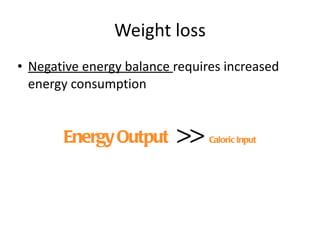
Weight loss Negative energy balance  requires increased energy consumption Energy Output  >>  Caloric Input
How to start an exercise program Get checked out by your family physician first. Cardio– brisk walking, jogging, treadmill, elliptical, etc. Goal is to  maintain elevated heart rate  to ensure max calorie burning. At least 3 time a week (preferably 5), 30 min per session 30 minutes does not have to be consecutive Cardio burns fat, reduces bone loss, risk of heart disease, cancer and depression
Getting started– How much is enough? Cardio intensity Karnoven formula to calculate target HR www.briancalkins.com / HeartRate.htm   Resistance training Use weight that is light enough to do 12-15 reps x 3 with exertion, but not exhaustion, ie. It shouldn’t be too easy. . . 2-3 times a week alternating muscle groups
But do  something! Walk the stairs at the hospitals Park as far from the church building as possible
Healthy Sleep  Habits Get 7-9 hours of sleep Go to bed and get up at about the same time  every  day. Develop a pre-sleep routine Use relaxation to help you fall asleep Protect your sleep time; enlist your family and friends!
Healthy Sleep  Habits Sleeping environment: No animals! Cooler temperature Dark (eye shades, room darkening shades) Quiet (unplug phone, turn off pager, use ear plugs, white noise machine) Avoid going to bed hungry, but no heavy meals within 3 hours of sleep.  Get regular exercise but avoid heavy exercise within 3 hours of sleep.
Couch to 5k programs www.eatright.uab.edu www.realage.com  (Mike Roizen, Dr. Oz)
DON’T GIVE UP!!! Make a commitment!  Stick to it! Phil 3:12-14 , Paul was  never satisfied . . . We shouldn’t be either!!! whether spiritually OR physically. Eyes ahead!  Press on toward your goal.
So whether you eat or drink, or whatever you do, do all to the glory of God. I Corinthians 10:31

Healthy ptp condensed-1

  • 1.
    “Practical tips ontaking care of the spirit’s temple” Jason L. McKeown, M.D.
  • 2.
    Our goals fortoday Define obesity and BMI Examine the obesity epidemic in the US Reveal consequences of obesity Look at nutrition and its importance to health Discuss basic concepts for weight loss Recommendations for exercise Discuss sleep hygiene Summarize healthy living
  • 3.
    Body Mass Index(BMI) or An objective measure of obesity Misleading in muscular individuals and pregnancy Agency for Healthcare Research and Quality. Screening for obesity in adults. Accessed June 22, 2010 from http://www.ahrq.gov/clinic/3rduspstf/obesity/obeswh.htm
  • 4.
    BMI and ObesityAgency for Healthcare Research and Quality. Screening for obesity in adults. Accessed June 22, 2010 from http://www.ahrq.gov/clinic/3rduspstf/obesity/obeswh.htm Dugdale DC. Obesity. MedlinePlus. Accessed June 22, 2010 from http://www.nlm.nih.gov/medlineplus/ency/article/007297.htm Normal weight 18.5 – 24.9 Overweight 25.0-29.9 Obese ≥ 30 Class I 30-34.9 Class II 35-39.9 Class III ≥ 40 Morbid Obesity > 100 lbs. overweight or BMI ≥ 40
  • 5.
  • 6.
    The Obesity EpidemicMajor modifiable cause of death in U.S. Being obese is expensive! In 2000, the societal cost of obesity was about $117 billion. Now it’s estimated at $147 billion! (25% increase in 10 years!) Obese people spend $1,500 more each year on health care. Obese patients had 80% higher per capita spending for prescription drugs. The prevalence of obesity has increased in the U.S. with no sign of slowing . . .
  • 7.
    What Causes Obesity?Genes Hormones/gland problems Clowns The royal family Lifestyle Our friends and family
  • 8.
    The Bad Fat-- Intra-Abdominal Fat Fat around the waist creates increased risk for heart disease, diabetes, cancer. . . Abnormal levels: Women > 35” Men > 40” NIH Expert Panel Report, Am J Clin Nutr 1998;68:899-917
  • 9.
    Diseases associated withobesity Type 2 Diabetes Osteoarthritis Hypertension Heart Failure Cancer High cholesterol Obstructive Sleep Apnea GERD Gallstones Depression Infertility Miscarriages
  • 10.
    “ Doesn ’t it cost a lot of money to eat healthy?”
  • 11.
    How many caloriesdo you need? Your weight x 10 (Eg. 170 lbs x 10 = 1700 Cal) Lifestyle adjustment: + 20% if sedentary (Eg. 1700 + 340 = 2040 Cal) + 30-40% if moderately active (Eg. 1700 + 680 = 2380 Cal)
  • 12.
    Start Small, ThinkBig! Excess calories- many of us are getting calories and don ’ t realize it Cut out sugar containing beverages (fruit punches, Kool-Aid, sodas, Frappuccinos) Eat fewer concentrated sweets (desserts, candy, snacks) Watch your portion sizes Write down what you eat Calorie listings– coming to your local restaurant menu!
  • 13.
    Start Small, ThinkBig! Fat - most changes if instituted over a longer time period are imperceptible Go from whole milk to 2% then to 1% or skim Use lower fat cheese (2%) Avoid trans fat, frying; use more olive oil, canola oil
  • 14.
    Start Small, ThinkBig! Red meat - Limit to 1-2 times per week Substitute alternatives in familiar recipes Turkey for beef Diets high in fat, excess calories, and red meats have been linked to increased cancer risk.
  • 15.
    Start Small, ThinkBig! Fruit and vegetables - increase your intake Most of us get less than 5/day Add 1 to breakfast, lunch, and dinner Add extra vegetables when dining out or choose the vegetables instead of the fries Try fruit and vegetables in convenient packages Diets low in fruit and vegetables and fiber have also been linked to increased cancer risk.
  • 16.
    Start Small, ThinkBig! Fiber - More whole grain products on the market these days Find breads that say 100% whole grain or have whole grain as the first ingredient
  • 17.
    You can doit! Don ’ t be afraid to try something new! Don ’ t be a pill popper– extra vitamin supplements, eg. B12 shots, don ’ t work! Eat the real foods– the whole food is better for you and it ’ s the way God intended.
  • 18.
    Weight loss Negativeenergy balance requires increased energy consumption Energy Output >> Caloric Input
  • 19.
    How to startan exercise program Get checked out by your family physician first. Cardio– brisk walking, jogging, treadmill, elliptical, etc. Goal is to maintain elevated heart rate to ensure max calorie burning. At least 3 time a week (preferably 5), 30 min per session 30 minutes does not have to be consecutive Cardio burns fat, reduces bone loss, risk of heart disease, cancer and depression
  • 20.
    Getting started– Howmuch is enough? Cardio intensity Karnoven formula to calculate target HR www.briancalkins.com / HeartRate.htm Resistance training Use weight that is light enough to do 12-15 reps x 3 with exertion, but not exhaustion, ie. It shouldn’t be too easy. . . 2-3 times a week alternating muscle groups
  • 21.
    But do something! Walk the stairs at the hospitals Park as far from the church building as possible
  • 22.
    Healthy Sleep Habits Get 7-9 hours of sleep Go to bed and get up at about the same time every day. Develop a pre-sleep routine Use relaxation to help you fall asleep Protect your sleep time; enlist your family and friends!
  • 23.
    Healthy Sleep Habits Sleeping environment: No animals! Cooler temperature Dark (eye shades, room darkening shades) Quiet (unplug phone, turn off pager, use ear plugs, white noise machine) Avoid going to bed hungry, but no heavy meals within 3 hours of sleep. Get regular exercise but avoid heavy exercise within 3 hours of sleep.
  • 24.
    Couch to 5kprograms www.eatright.uab.edu www.realage.com (Mike Roizen, Dr. Oz)
  • 25.
    DON’T GIVE UP!!!Make a commitment! Stick to it! Phil 3:12-14 , Paul was never satisfied . . . We shouldn’t be either!!! whether spiritually OR physically. Eyes ahead! Press on toward your goal.
  • 26.
    So whether youeat or drink, or whatever you do, do all to the glory of God. I Corinthians 10:31