Carbohydrates:
How Much Do
We Need?
Section 4.6
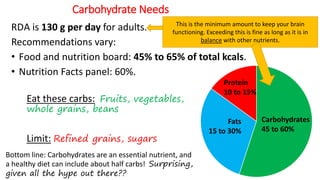
Carbohydrate Needs
RDA is 130 g per day for adults.
Recommendations vary:
• Food and nutrition board: 45% to 65% of total kcals.
• Nutrition Facts panel: 60%.
Eat these carbs: Fruits, vegetables,
whole grains, beans
Limit: Refined grains, sugars
Fats
15 to 30%
Carbohydrates
45 to 60%
Protein
10 to 15%
This is the minimum amount to keep your brain
functioning. Exceeding this is fine as long as it is in
balance with other nutrients.
Bottom line: Carbohydrates are an essential nutrient, and
a healthy diet can include about half carbs! Surprising,
given all the hype out there??
Bottom line:
Carbohydrates are an essential nutrient, and a
healthy diet can include about half carbs.
Are you surprised, given all the carbohydrate-avoidance hype out
there??
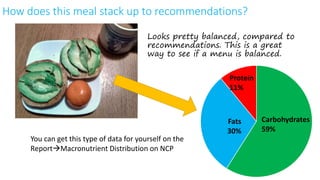
How does this meal stack up to recommendations?
Looks pretty balanced, compared to
recommendations. This is a great
way to see if a menu is balanced.
Fats
30%
Carbohydrates
59%
Protein
11%
You can get this type of data for yourself on the
ReportMacronutrient Distribution on NCP
How Much Sugar Is Too Much?
Diet quality declines when sugar intake is excessive.
Upper limit of 25% of total kcal intake from added
sugars has been set by FNB.
Diets above upper limit are likely to be deficient in
vitamins and minerals.
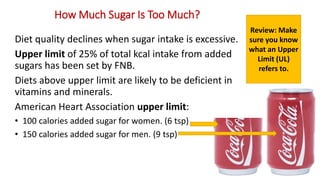
American Heart Association upper limit:
• 100 calories added sugar for women. (6 tsp)
• 150 calories added sugar for men. (9 tsp)
Review: Make
sure you know
what an Upper
Limit (UL)
refers to.
How Much Fiber Do We Need?
AI is ________per day for women.
AI is ________per day for men.
Goal of ________ per 1000 kcal.
DV is 25 grams for 2000 kcal dietary pattern.
Average U.S. intake: 17 grams per day.
©Nancy R. Cohen/Getty Images
Fun facts
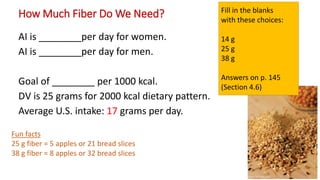
25 g fiber = 5 apples or 21 bread slices
38 g fiber = 8 apples or 32 bread slices
Fill in the blanks
with these choices:
14 g
25 g
38 g
Answers on p. 145
(Section 4.6)
Case study
Amalia discovered the joy of juicing! She didn’t always enjoy eating
fruits and vegetables, but she found it fun and delicious to run them
through her juicer and drink the colorful results, while avoiding the less-
tasty pulp.
• How might Amalia’s juice-drinking habit improve her nutrition?
• What are some possible nutritional
drawbacks?
Submit your answers in the ICA quiz!

Carbohydrates: how much do we need?

  • 1.
  • 2.
    Carbohydrate Needs RDA is130 g per day for adults. Recommendations vary: • Food and nutrition board: 45% to 65% of total kcals. • Nutrition Facts panel: 60%. Eat these carbs: Fruits, vegetables, whole grains, beans Limit: Refined grains, sugars Fats 15 to 30% Carbohydrates 45 to 60% Protein 10 to 15% This is the minimum amount to keep your brain functioning. Exceeding this is fine as long as it is in balance with other nutrients. Bottom line: Carbohydrates are an essential nutrient, and a healthy diet can include about half carbs! Surprising, given all the hype out there??
  • 3.
    Bottom line: Carbohydrates arean essential nutrient, and a healthy diet can include about half carbs. Are you surprised, given all the carbohydrate-avoidance hype out there??
  • 4.
    How does thismeal stack up to recommendations? Looks pretty balanced, compared to recommendations. This is a great way to see if a menu is balanced. Fats 30% Carbohydrates 59% Protein 11% You can get this type of data for yourself on the ReportMacronutrient Distribution on NCP
  • 5.
    How Much SugarIs Too Much? Diet quality declines when sugar intake is excessive. Upper limit of 25% of total kcal intake from added sugars has been set by FNB. Diets above upper limit are likely to be deficient in vitamins and minerals. American Heart Association upper limit: • 100 calories added sugar for women. (6 tsp) • 150 calories added sugar for men. (9 tsp) Review: Make sure you know what an Upper Limit (UL) refers to.
  • 6.
    How Much FiberDo We Need? AI is ________per day for women. AI is ________per day for men. Goal of ________ per 1000 kcal. DV is 25 grams for 2000 kcal dietary pattern. Average U.S. intake: 17 grams per day. ©Nancy R. Cohen/Getty Images Fun facts 25 g fiber = 5 apples or 21 bread slices 38 g fiber = 8 apples or 32 bread slices Fill in the blanks with these choices: 14 g 25 g 38 g Answers on p. 145 (Section 4.6)
  • 7.
    Case study Amalia discoveredthe joy of juicing! She didn’t always enjoy eating fruits and vegetables, but she found it fun and delicious to run them through her juicer and drink the colorful results, while avoiding the less- tasty pulp. • How might Amalia’s juice-drinking habit improve her nutrition? • What are some possible nutritional drawbacks? Submit your answers in the ICA quiz!

Editor's Notes

  • #3 R D A is 130 grams per day for adults. Recommendations vary. F N B: 45% to 65% of total kcals. Nutrition Facts panel: 60%. Base intake primarily on: Fruits, vegetables, whole grain breads and cereals, and beans. Limit refined grains, potatoes, and sugars.
  • #7 Why the men/women difference? Body size only. Should be “largeish” and “smallish” people A I is 25 grams per day for women. (AI reduces risk of disease) A I is 38 grams per day for men. Goal of 14 grams per 1000 kcal. D V is 25 grams for 2000 kcal dietary pattern. Average U.S. intake: 17 grams per day. Women eating 5 apples women, men eating 7.5 apples (5 g fiber in large apple) - Women eating 21 slices of whole wheat bread; men eating 32 slices of whole wheat bread (1.2 g fiber in whole wheat bread) - Men would have to eat bout 2 large cheese pizzas! (20g fiber in large pizza)
  • #8 Vitamins, minerals, phytochemicals are good Better than buying pre-made juice Natural fiber is lost, could increase overall calories because you don’t feel as full without the fiber.