CHAPTER 14
Election Health Record System: US: Federal
Initiatives and Public/Private Partnerships
In April 2004 ,the president of the United States
issued an executive order that called for action
put HER‟s in place for most Americans in 10
years.(White House 2004) This order gave new
momentum to efforts across the health care
community to use HIT to improve health care. For
over a decade, the institute of Medicine (10) has
been calling for the use of information
technology (IT) to improve the efficiency, safety,
and quality of the health care Americans receive
in a series of groundbreaking report ( Disk,
Steen, and Detiner , 1991, 1997;Kohn, ( arrigan,
and Donaldson, 200;( arrigan, Donaldson, and
Kohn,2001;
The involvement of nurses is critical to
such effort. Responsible for care
condition and promotion of
wellness, nurses are often the
patients primary contacts and the final
point in health care delivery where
medical errors and other unintended
action can be caught and corrected .
As the largest human resource in
health care , nurses are delivery
system in organizational planning and
process reengineering to improve the
health delivery system. Increasingly
, nurses and nurse managers are
turning to nurse informatics for
leaderships as their profession works
to bring IT application into the health
care environment.
OVERVIEW:
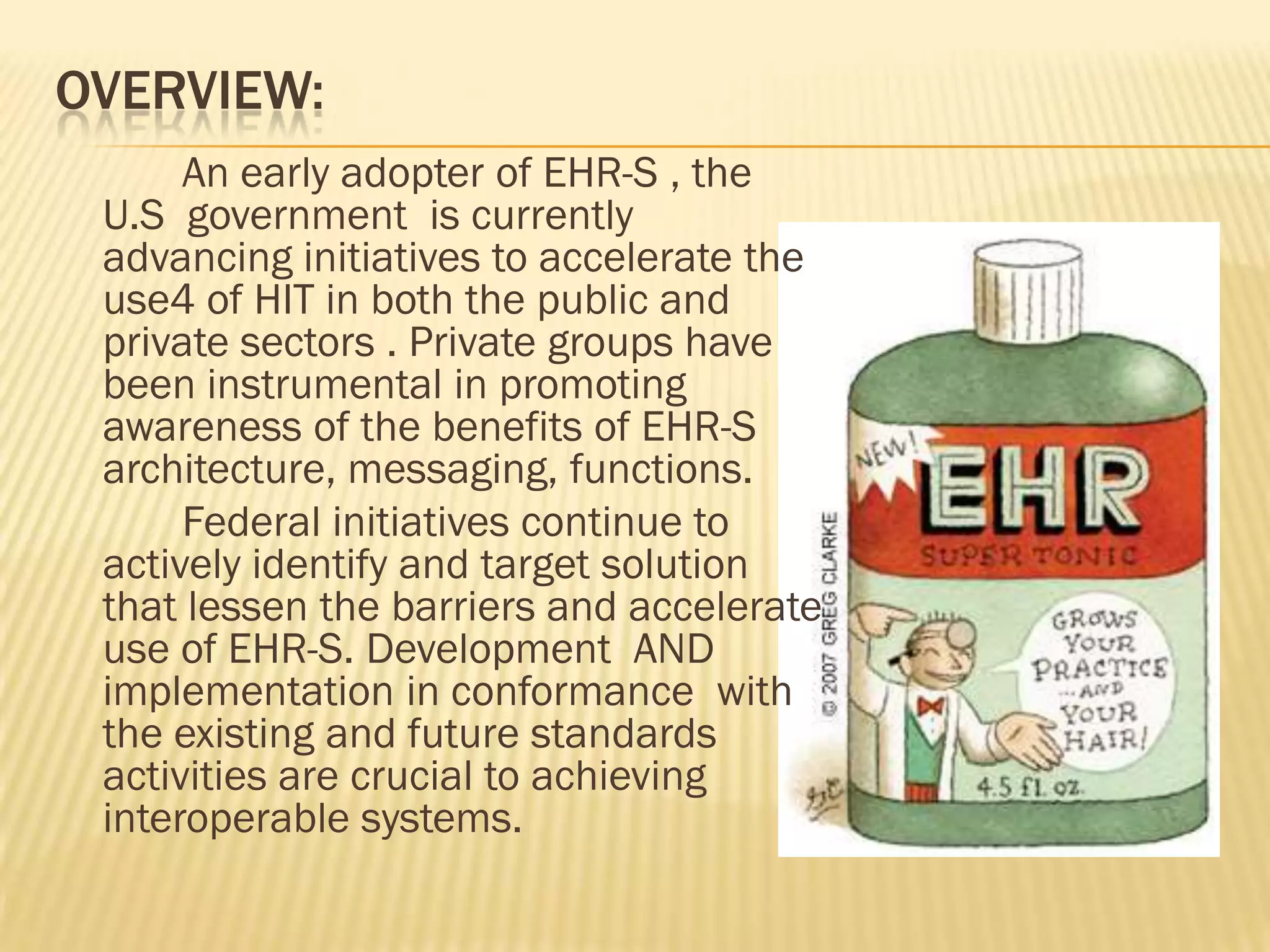
An early adopter of EHR-S , the
U.S government is currently
advancing initiatives to accelerate the
use4 of HIT in both the public and
private sectors . Private groups have
been instrumental in promoting
awareness of the benefits of EHR-S
architecture, messaging, functions.
Federal initiatives continue to
actively identify and target solution
that lessen the barriers and accelerate
use of EHR-S. Development AND
implementation in conformance with
the existing and future standards
activities are crucial to achieving
interoperable systems.
DEFINING ELECTRONICS HEALTH RECORD
SYSTEM

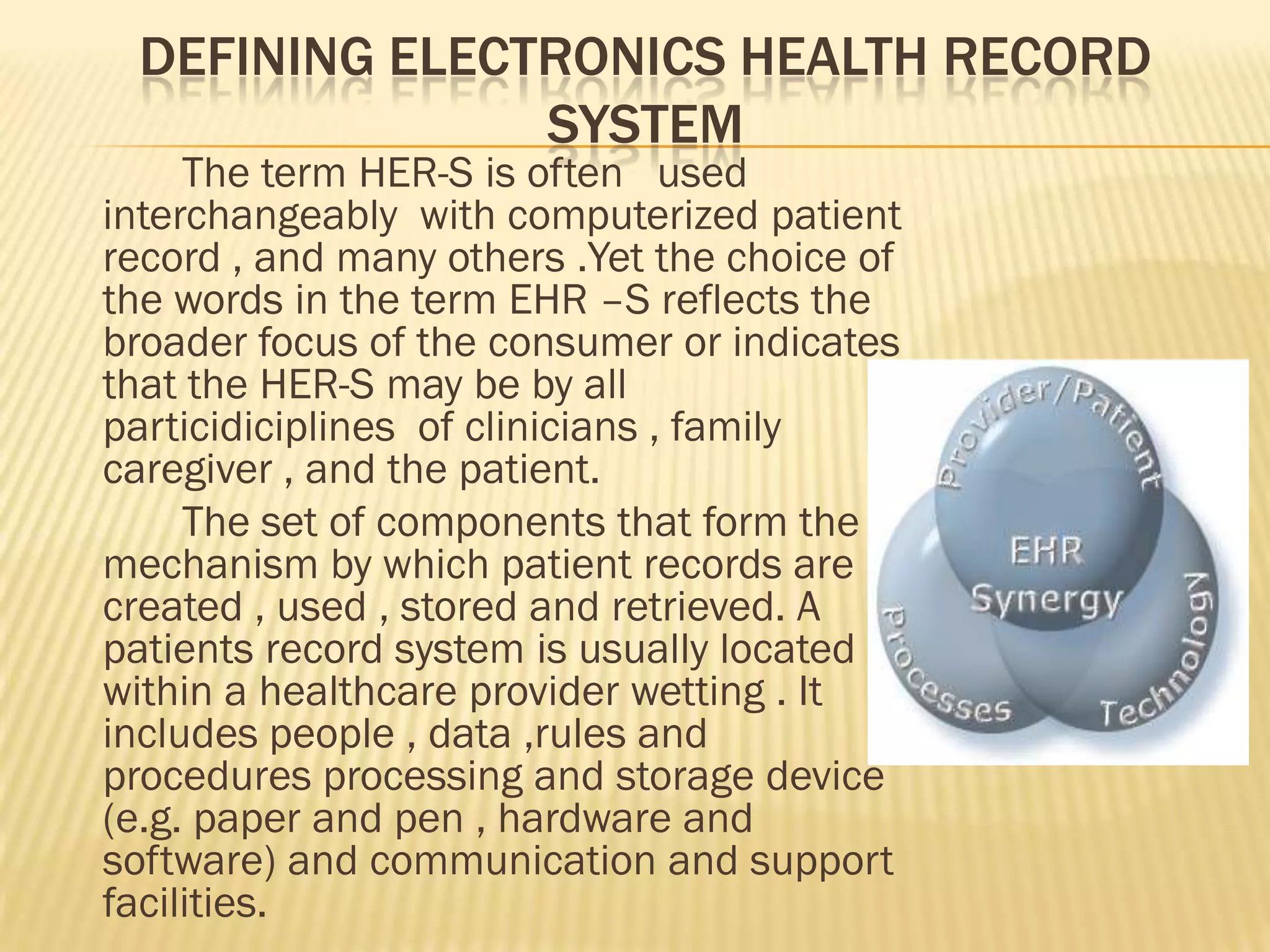
The term HER-S is often used
interchangeably with computerized patient
record , and many others .Yet the choice of
the words in the term EHR –S reflects the
broader focus of the consumer or indicates
that the HER-S may be by all
particidiciplines of clinicians , family
caregiver , and the patient.
The set of components that form the
mechanism by which patient records are
created , used , stored and retrieved. A
patients record system is usually located
within a healthcare provider wetting . It
includes people , data ,rules and
procedures processing and storage device
(e.g. paper and pen , hardware and
software) and communication and support
facilities.


In its used of the word system .
the IDM drew a visionary distinction
between a dynamic system and a
stratic record. Recently , the IDM
modified this definition in its report
, Key Capabilities of an electronic
Health Record System
(2003), reiterating the new
definition in a report on patient
safety (Asp0den et. al., 2004)
1.

2.

3.

4.
5.

Longitudinal collection of election health information
for and about persons where health information is
defined as information pertaining to the health of an
individual or healthcare provided to an individual;
Immediate electronics access to person – and
population level information by authorized and only
authorized , users;
Provision of knowledge and decision support that
enchances the quality, safety and efficiency of patient
care ; and
Support of efficient processes for healthcare delivery
GOVERNMENT AS PROVIDER AND EARL ADOPTER
GOVERNMENT AS PROVIDER AND EARL
ADOPTER


Federal agencies that provide direct are have
been early adopter of EHR-S .The veterans
Affairs (VA) and the general institutes of health
(HIN) in the department
DEPARTMENT OF VETERANS AFFAIRS


All aspects of a patient‟s
record are integrated,
including active problems
allergies , current medication ,
laboratory results ,vital sign ,
hospitalization, and out
patient clinic history .All
electronics record are
password protected to
quarantee patient privacy.









A checking system that alerts clinicians if an order they are entering
could cause a problem.
A notification system that immediately alerts clinicians to clinical
significant event
A visual posting system that alerts healthcare provider to issues
specifically related to the opening of the patients electronics charts
including crisis notes, adverse reaction and advance directives.
A template system that allows the healthcare provider to
automatically create reports .
A clinical remainder system that electronically alerts clinicians when
certain action , such as examination , immunizations, patient
education , and laboratory test , need to be performed.
Remote data viewing to allow clinicians to see the patient‟s medical
history at all the VA facilities where the patient was seen.
OFFICE OF THE NATIONAL COORDINATOR FOR
HEALTH INFORMATION TECHNOLOGY


The executes order of April 2004, mentioned
earlier in the chapter , created for ONCHIT to
coordinates HIT in the federal sector and to
collaborate with the private sector in driving HIT
adoption across the healthcare system , David
Brailer , MD ,PHD was named to fill the sub
cabinet – level.
THE NATIONAL COMMITTEE ON VITAL AND
HEALTH STATISTICS


In the resulting report, information for health
, NCVHS (2002) presented the concept of an
infrastructure that emphasizes health oriented
interaction and information sharing among
individuals and institutions rather simply the
physical , technical and data system that mage
those interaction possible.
GOAL 1
Inform Clinical practice: Informing clinical
practice is fundamental to improving care and
making healthcare delivery more efficiency.
 Three strategies for realizing this goal are :
 Strategy 1: Incentive EHR adoption
 Strategy 2: Reduce risk of HER investment
 Strategy 3:Promote HER diffusion I rural and
under nergued areas.

GOAL 2






Interconnect Clinicians : Interconnecting clinicians
will allow information to be portable and to move with
consumer from one point of care to another.This will
required an interoperable infracture to help clinicians
get access to critical healthcare information when their
clinical and / or treatment decisions are being made.
Strategy 1: Foster regional collaboration
Strategy 2: Develop a national health information
network
Strategy 3: Coordinate federal health information
systems
GOAL 3
Personalized Care: Consumer – centric
information helps individuals manage thiers
own wellness and assists with their personal
health decision:
 Strategy 1: Encourage use of personal health
record
 Strategy 2: Enhance informed consumer choice
 Strategy 3: Promote use of teleheath systems

GOAL 4


A number of collaborative efforts are focused
on the use of EGR-S and HIT to improve care
.Among these private sector organizations are
those formed specifically to address issues of
connection ,HIT , and standards development.
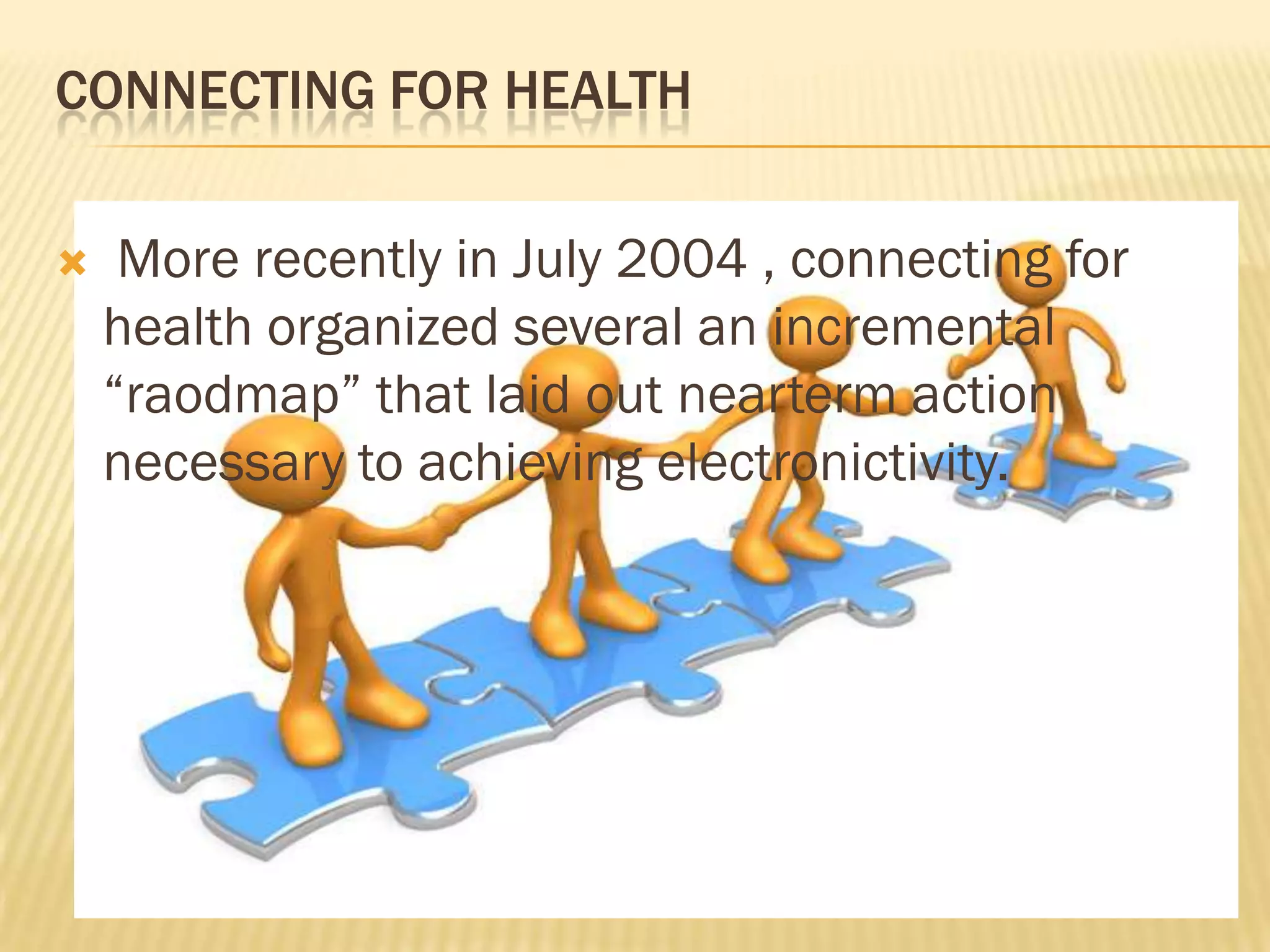
CONNECTING FOR HEALTH


More recently in July 2004 , connecting for
health organized several an incremental
“raodmap” that laid out nearterm action
necessary to achieving electronictivity.
CERTIFICATION COMMISION FOR HEALTH
INFORMATION TECHNOLOGY


The health information and management
system Americans Health Information
Management Association and National Alliance
for health information technology have joined
together to establish the certification
commission of health information.
HEALTH LEVEL SEVEN
Supported by public and
private groups, the HLf‟s HER
technical committee
developed draft standard for
trial use , known as a
DSTU, for HER and made it
available for public comment
prior to being as a standard.
 Table 14.2 developing a use
profile with the draft standard
for trial use:

STEP 1


With help of a nurse
informaticist , a small group of
clinical subject matter experts
generates a definition of the
environment in which the HER-S
is to be used.
STEP 2


The clinical experts review the list of function
and prioritize each function as essential now.
Essential future, optional, or Non applicable to
each function.
STEP 3


Using the list , the nurse
informaticist prepares a “story
board” that shows the work
flows and clinical function to
be performed within the work
flow and marks the clinical
function with the function
identifier from the eHr-S DSTU
STEP 4


The nurse informaticist present the story board
to a larger group of clinicians who validate that
it is comprehensive and accurately portrays the
activities of the clinical environment.
STEP 5


The final validated story board
is used as a tool to
communicate the work clinical
work flow integrated with EHR-S
function needed to support the
clinical environment or compare
to a product profile for the
selection of a product that is
able to support the clinical
environment.
CHAPTER 15
DEPENDABLE SYSTEMS FOR QUALITY
CARE
Introduction:
*the healthcare industry is undergoing a dramatic
transformation from todays inefficient, castly,manually
intensive, crisi-driven model of care delivery to a more
efficient , consumer-centric, science-based model that
proactively focuses on health management. This
transformation is driven by several factors , most
prominently the skyrocketing cost of healthcare delivery, the
exposure of patient safety problems, and an aging
“babyboom” population that recognizes the potential for
information technology (IT) to dramatically reduce the cost
and improve the quality of care. Some of the key
technologies that will enable this transformation yo occur
are identified in.


*The electronic health record (HER) will form the foundation
for pervasive personalized, and science base care. Other key
applications are clinical information system (CIS) with
integrated, outcomes-based decision support, clinical
knowledge-based computerized physician order entry
(CPOE),electronic prescribing, consumer knowledge bases
and decision support and supply chain automation. The
technologies that enable to transformation are largely state
of the art and include enterprize application integration (EAI)
wireless communications: handheld and tablet
computers, continuous speech recognition; new
interpretation;electronic;sensor technology;radio frequently
identification (RFID) tagging, and robotics.


* the internatonal council of nurses (icn) code
of ethies for nurses affirms that the nurse
”holds in confidence personal information and
ensures that use of technology..compatible with
the safety ,dignity and rights of the people‟
(ICN), 2000. Fulfilling these ethical obligations
is the individual responsibility of the nurse, who
presumably that has ability and authority to
ensure that personal information is protected
and that technology is safe.
WHEN THINGS GO WRONG


The computers, network, and software are as
dependable as our toasters and telephones,
unfortunately that is not the care, and stories that have
appeared in trade journals have documented his fact a
catastrophic failure in the network infrastructure that
supported care group, one of the most prestigious
healthcare organization in the United States , the failure
resulted in a 4 hour closure of the emergency room, a
complete shutdown of the network, and 2 days of paper
based clinical operations a true „ retro experience for
many of the physician who had never pracriced without
computers.
GUIDELINES OF DEPENDABLE SYSTEM


All computer system are vulnerable to both
human – created threate, such as malicious
code attacks and software bugs
GUIDELINES 1: ANTICIPATE FOR
DEPENDABILITY




Architecture is that an enterprise system –
architecture should be developed from the
bottom up so that no critical component is
independent on component less trustworthy
that itself. At the bottom of illustration are the
physical and logical networks that support the
enterprise and provides the “pipes” that data
from system to system.
GUIDELINES 2: ANTICIPATE FAILURES


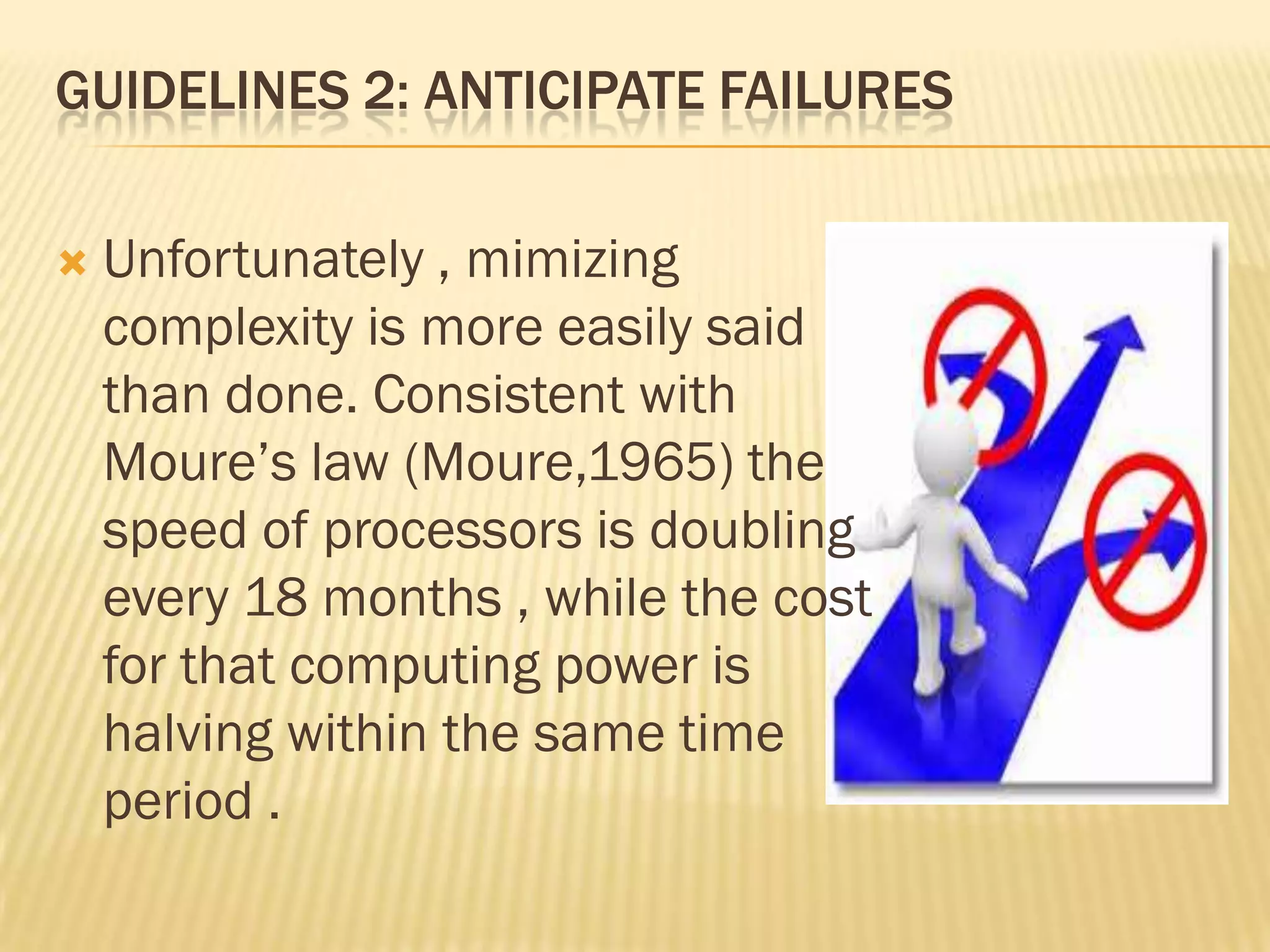
Unfortunately , mimizing
complexity is more easily said
than done. Consistent with
Moure‟s law (Moure,1965) the
speed of processors is doubling
every 18 months , while the cost
for that computing power is
halving within the same time
period .
GUIDELINES 3: ANTICIPATE SUCCESS


The system planning process should anticipate
business success and the consequential need
for larger networks , more systems, new
applications and addition integration. Modeling
of use-case sensation that anticipate hospital
and clinics mergers, acquitions, and a growing
patients / costumer base will enable the
system designer o visualize the data flows.
GUIDELINES 4: METICULOS MANAGER


Managing and keeping complex networks and
integrated system available and responsive
require meticulous over gees – individuals
who know that failures will occur and accept
that failure are most likely to occur when they
are least expected.
GUIDELINES 5: DON’T BE ADVENTUROUS


Imagine that a small start-up company called
cute chutes has announced the available of a
new parachute unit that promises to
revolutionize the sport of sky diving.





ASSESSING THE HEALTHCARE INDUSTRY
Health care clearly has a need for dependable system both
now and after the transformation, as the industry becomes
increasingly dependent on IT in the delivery of patient care.
Architect for dependability “ the clinical care provide
community get a barely passing grade of “D” Healthcare
organization build – or perhaps “compose” – their system
from the top down rather than from bottom up. Creating
further their complexity are the merger and consolidation
of healthcare enterprises, each bringing into the merger its
own software application.










Security management , including security analysis and risk
management
Assigned awareness responsibility
Information access management, including the isolation of cleaning
house functions from other clinical function
Security awareness and training
Security incident procedures , including response and reporting
Contingency planning, including data backup panning disaster ,
recovery planning for emergency mode operations.
Evaluation
Business associate controls that locks in the obligation of business
partners in protecting health information to which they may have
access


The five specified physical safeguards also
contribute to system dependability by requiring
that facilities , work-station, devices, and
media be protected.
Access control , including unique user
identification and emergency access procedure
 Audit controls
 Data integrity protection
 Person or entity authentication
 Transmission security



A security plays a critical role achieving system
dependability. However , security within clinical
environment is very different from environment
that seek to tightly restrict access to
information , system , and services
ANTICIPATING FAILURES




For adherence to the second guidelines “expect
failures” the clinical care provider community gets
another grade of “D” Medical technology and
prescription drugs , as well a clinical treatments
protocols , are required to undergo extensive
validation before they can be used in clinical
practice , application , computer system and
networks .
The architectural complexity discussed above
increased the opportunities for failures to occur.
PC‟s that connect to the enterprise network from
outside , laptops with wireless modern ,
Smartphone‟s, and PD‟s that synchronize with
enterprise system.
ANTICIPATING SUCCESS


The third guidelines “expert success” the
clinical care provider community has earned a
mediocre grade of “G” .Healthcare
organization definitely expect their software
application , computer system , and networks
to work.
IT MANAGEMENT


For the fourth guidelines “hire meticulous
manager ” the clinical care provider
community has been designed a mediocre
grade “C”.
ADVENTURE TECHNOLOGY IN HEALTHCARE
The fifth and final guidelines “ don‟t be
adventurous ” is the most definitely to access
for healthcare.

Healthcare clinicians , including nurses ,
historically and typically are very resistant to
change.

CHAPTER 16
NURSING MINIMUM SET SYSTEM
INTRODUCTION:
-Clinical nursing visibility from National to International
Context
-The empetus to access to and use of nursing data and
information has never been stronger. The identification of
NMDS visionary works begun in the United States in 1980s
by werley and long (1988), has indeed spurred activity
extended national develop similar data sets around the
world. This chapter provides a synthesis of historical, current
and future NMDS system with can increase nursing data and
information capacity to drive knowledge building for the
decipline and profession to contribute to the standard
supportive of the electronic health record.
NMDS HISTORICAL SUMMARY


-The NMDS identifies essential, common, and core data
elements to be collected for all patients/clients receiving
nursing care. The NMDS is standardized approach that
facilities the abstract of this minimum, common, essential
core data elements to describe nursing practice (Werley
and Lang) from both paper and electronic records. The
NMDS was conceptualize though a small group work at the
nursing information system. The University of Illinois
Colledge of Nursing. Werley and collegues took the NMDS
In 1985 held at the University of WINCONSON –
mIlwaukee school of nursing 64 conference participants
and formalized. The NMDS includes three board categories
of elements ,nursing care patient or client demography
service elements . The aim of the NMDS to be redundant
of other data sets , but rather to identify what are the
minimal data to be collected from records of patients
receiving nursing care.
1.Access to comfortable, minimum nursing
care, and resources data on
local, regional, national and international levels.
 2.Enchance documentation of nursing care
provide.
 3.Identification of trends related to patients or
clients problems and nursing care provided.
 4.Impetus to improve costing of nursing service.
 5.Improved data for quality assurance evaluation.

NATIONAL NURSING MINIMUM DATA SETS


-The seven countries have identify NMDS
system , including Australia
,Canada, Belgium, Iceland, the
Netherlands, Switzerland, and Thailand.
EMERGENT NMDSS


-General countries across most
continents beyong north American
are exploring development of NMDS
system World Health Organization
has been concern variables
including nursing care, personal
data, medical diagnosis, and service
data.
CHAPTER 17
THEORIES , MODELS, AND FRAMEWORKS
INTRODUCTION:

-Lifelong learning is base on the
recognition of patterns and variance, build on
previos experience and knowledge, and
involves the use of analogies . Recognition of
principles proves invaluable for those exploring
or already engaged in nursing informatics
practice because the nurse in this specialty role
is always learning and always teaching.

FOUNDATIONAL DOCUMENTS GUIDE NURSING
INFORMATICS PRATICES


The nursing process a delinated pathway and
process for decision-making. First , assessment
or data collection begins the nursing process.
Outcome identifying is third step, followed by
planning as the fourth step. The collection of
data bout a client or about a
management, education or research situation
is guided by a nurse‟s knowledge built on
formal or informal educational
preparation, research and previous expectance.
NURSING INFORMATICS


The ANA modified the Graves of Corcoran
definition with the development of the first
scope of practices as the specialty that
integrates nursing information
science, computer, science and information
science in identifying, collecting, processing
and managing data and information support
nursing practices, administration, education
and research.
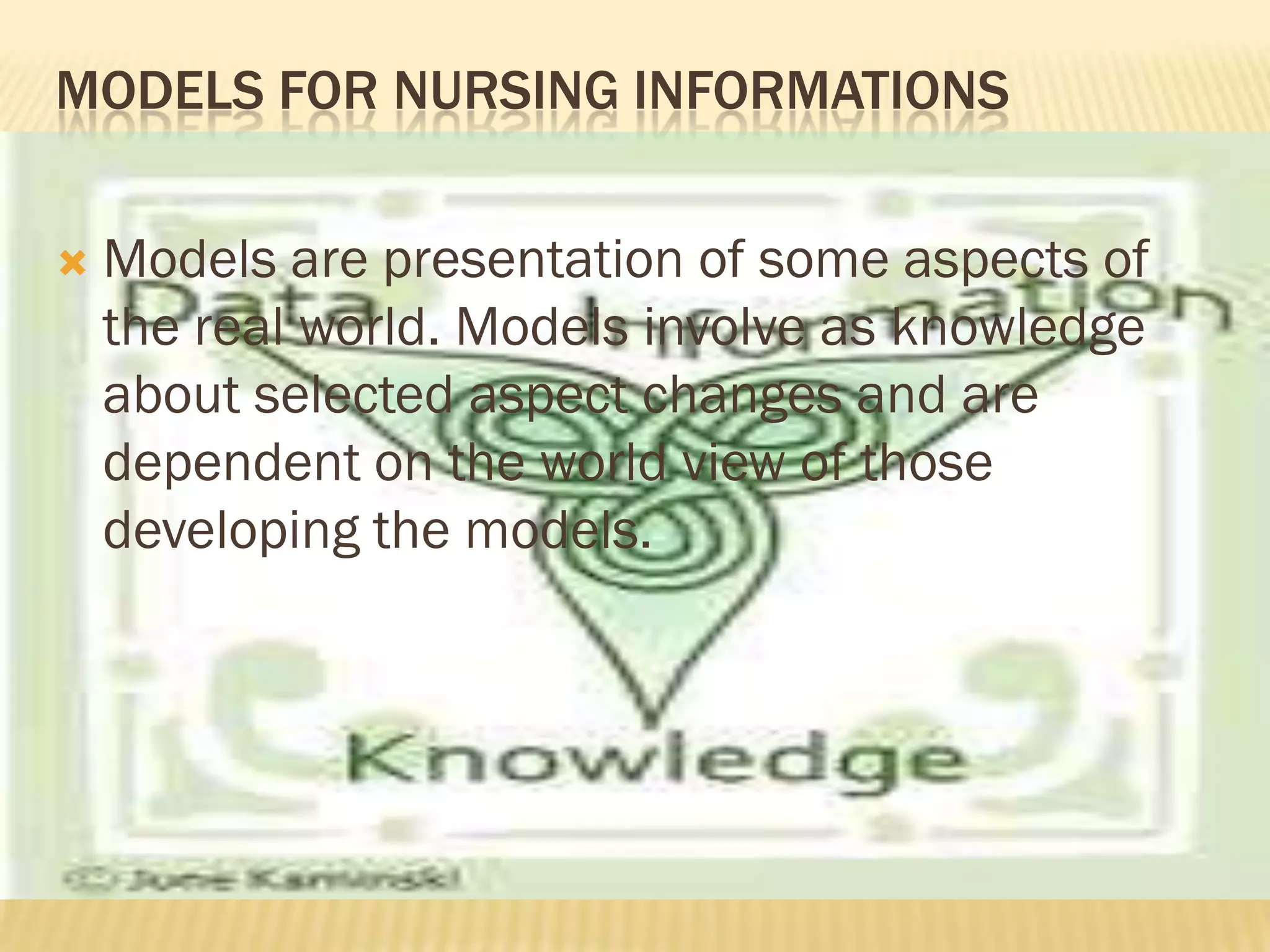
MODELS FOR NURSING INFORMATIONS


Models are presentation of some aspects of
the real world. Models involve as knowledge
about selected aspect changes and are
dependent on the world view of those
developing the models.
DATA INFORMATION AND KNOWLEDGE
Are “describe objectively without interpretation” and
would include value assigned to variable.
REGITERED NURSES AS KNOWLEDGE WORKERS
Knowledge work is the exercises of specialist
knowledge and competencies a nation of knowledge
workers.
Registered are nurse are consummate twenty-first
century knowledge worker. Their skill in assessment,
planning critical thinking, and evaluation are
transferable to many different setting but are most
exquisite employed in nursing practice.
ELECTRONIC HEALTH RECORD
American Society for Testing and Material (ASTM)
standard E defines the HER as “any information
related to the past, present, or future physical
health/mental health or condition of an individual.
 There are many reasons for health data and
information documentation. These include
compliance with law and regulation,
communication with other providing healthcare to
the client, conduct of research and clinical trials.

TERMINOLOGIES
To convey important data and information to
others the communication must be understood by
the listener and be interpreted as having meaning.
 Most of these data elements, except for the
nursing care elements in the unique identifier for
the primary registered nurse, have along been
captured in the health care information system.
 Nursing terminologies offer systematic, standard
ways of describing nursing practices and include
data sets taxonomies, nomelatures, and
classification system.

NANDA


NANDA- I has evolved from an alphabetical
listing in the 1980‟s to a conceptual system
that guide the classification of nursing
diagnoses in a taxonomy and includes
definitions and defining characteristics.
Nursing informatic'spresentation

Nursing informatic'spresentation

  • 2.
    CHAPTER 14 Election HealthRecord System: US: Federal Initiatives and Public/Private Partnerships In April 2004 ,the president of the United States issued an executive order that called for action put HER‟s in place for most Americans in 10 years.(White House 2004) This order gave new momentum to efforts across the health care community to use HIT to improve health care. For over a decade, the institute of Medicine (10) has been calling for the use of information technology (IT) to improve the efficiency, safety, and quality of the health care Americans receive in a series of groundbreaking report ( Disk, Steen, and Detiner , 1991, 1997;Kohn, ( arrigan, and Donaldson, 200;( arrigan, Donaldson, and Kohn,2001;
  • 3.
    The involvement ofnurses is critical to such effort. Responsible for care condition and promotion of wellness, nurses are often the patients primary contacts and the final point in health care delivery where medical errors and other unintended action can be caught and corrected . As the largest human resource in health care , nurses are delivery system in organizational planning and process reengineering to improve the health delivery system. Increasingly , nurses and nurse managers are turning to nurse informatics for leaderships as their profession works to bring IT application into the health care environment.
  • 4.
    OVERVIEW: An early adopterof EHR-S , the U.S government is currently advancing initiatives to accelerate the use4 of HIT in both the public and private sectors . Private groups have been instrumental in promoting awareness of the benefits of EHR-S architecture, messaging, functions. Federal initiatives continue to actively identify and target solution that lessen the barriers and accelerate use of EHR-S. Development AND implementation in conformance with the existing and future standards activities are crucial to achieving interoperable systems.
  • 5.
    DEFINING ELECTRONICS HEALTHRECORD SYSTEM The term HER-S is often used interchangeably with computerized patient record , and many others .Yet the choice of the words in the term EHR –S reflects the broader focus of the consumer or indicates that the HER-S may be by all particidiciplines of clinicians , family caregiver , and the patient. The set of components that form the mechanism by which patient records are created , used , stored and retrieved. A patients record system is usually located within a healthcare provider wetting . It includes people , data ,rules and procedures processing and storage device (e.g. paper and pen , hardware and software) and communication and support facilities.
  • 6.
     In its usedof the word system . the IDM drew a visionary distinction between a dynamic system and a stratic record. Recently , the IDM modified this definition in its report , Key Capabilities of an electronic Health Record System (2003), reiterating the new definition in a report on patient safety (Asp0den et. al., 2004)
  • 7.
    1. 2. 3. 4. 5. Longitudinal collection ofelection health information for and about persons where health information is defined as information pertaining to the health of an individual or healthcare provided to an individual; Immediate electronics access to person – and population level information by authorized and only authorized , users; Provision of knowledge and decision support that enchances the quality, safety and efficiency of patient care ; and Support of efficient processes for healthcare delivery GOVERNMENT AS PROVIDER AND EARL ADOPTER
  • 8.
    GOVERNMENT AS PROVIDERAND EARL ADOPTER  Federal agencies that provide direct are have been early adopter of EHR-S .The veterans Affairs (VA) and the general institutes of health (HIN) in the department
  • 9.
    DEPARTMENT OF VETERANSAFFAIRS  All aspects of a patient‟s record are integrated, including active problems allergies , current medication , laboratory results ,vital sign , hospitalization, and out patient clinic history .All electronics record are password protected to quarantee patient privacy.
  • 10.
          A checking systemthat alerts clinicians if an order they are entering could cause a problem. A notification system that immediately alerts clinicians to clinical significant event A visual posting system that alerts healthcare provider to issues specifically related to the opening of the patients electronics charts including crisis notes, adverse reaction and advance directives. A template system that allows the healthcare provider to automatically create reports . A clinical remainder system that electronically alerts clinicians when certain action , such as examination , immunizations, patient education , and laboratory test , need to be performed. Remote data viewing to allow clinicians to see the patient‟s medical history at all the VA facilities where the patient was seen.
  • 11.
    OFFICE OF THENATIONAL COORDINATOR FOR HEALTH INFORMATION TECHNOLOGY  The executes order of April 2004, mentioned earlier in the chapter , created for ONCHIT to coordinates HIT in the federal sector and to collaborate with the private sector in driving HIT adoption across the healthcare system , David Brailer , MD ,PHD was named to fill the sub cabinet – level.
  • 12.
    THE NATIONAL COMMITTEEON VITAL AND HEALTH STATISTICS  In the resulting report, information for health , NCVHS (2002) presented the concept of an infrastructure that emphasizes health oriented interaction and information sharing among individuals and institutions rather simply the physical , technical and data system that mage those interaction possible.
  • 13.
    GOAL 1 Inform Clinicalpractice: Informing clinical practice is fundamental to improving care and making healthcare delivery more efficiency.  Three strategies for realizing this goal are :  Strategy 1: Incentive EHR adoption  Strategy 2: Reduce risk of HER investment  Strategy 3:Promote HER diffusion I rural and under nergued areas. 
  • 14.
    GOAL 2     Interconnect Clinicians: Interconnecting clinicians will allow information to be portable and to move with consumer from one point of care to another.This will required an interoperable infracture to help clinicians get access to critical healthcare information when their clinical and / or treatment decisions are being made. Strategy 1: Foster regional collaboration Strategy 2: Develop a national health information network Strategy 3: Coordinate federal health information systems
  • 15.
    GOAL 3 Personalized Care:Consumer – centric information helps individuals manage thiers own wellness and assists with their personal health decision:  Strategy 1: Encourage use of personal health record  Strategy 2: Enhance informed consumer choice  Strategy 3: Promote use of teleheath systems 
  • 16.
    GOAL 4  A numberof collaborative efforts are focused on the use of EGR-S and HIT to improve care .Among these private sector organizations are those formed specifically to address issues of connection ,HIT , and standards development.
  • 17.
    CONNECTING FOR HEALTH  Morerecently in July 2004 , connecting for health organized several an incremental “raodmap” that laid out nearterm action necessary to achieving electronictivity.
  • 18.
    CERTIFICATION COMMISION FORHEALTH INFORMATION TECHNOLOGY  The health information and management system Americans Health Information Management Association and National Alliance for health information technology have joined together to establish the certification commission of health information.
  • 19.
    HEALTH LEVEL SEVEN Supportedby public and private groups, the HLf‟s HER technical committee developed draft standard for trial use , known as a DSTU, for HER and made it available for public comment prior to being as a standard.  Table 14.2 developing a use profile with the draft standard for trial use: 
  • 20.
    STEP 1  With helpof a nurse informaticist , a small group of clinical subject matter experts generates a definition of the environment in which the HER-S is to be used.
  • 21.
    STEP 2  The clinicalexperts review the list of function and prioritize each function as essential now. Essential future, optional, or Non applicable to each function.
  • 22.
    STEP 3  Using thelist , the nurse informaticist prepares a “story board” that shows the work flows and clinical function to be performed within the work flow and marks the clinical function with the function identifier from the eHr-S DSTU
  • 23.
    STEP 4  The nurseinformaticist present the story board to a larger group of clinicians who validate that it is comprehensive and accurately portrays the activities of the clinical environment.
  • 24.
    STEP 5  The finalvalidated story board is used as a tool to communicate the work clinical work flow integrated with EHR-S function needed to support the clinical environment or compare to a product profile for the selection of a product that is able to support the clinical environment.
  • 25.
    CHAPTER 15 DEPENDABLE SYSTEMSFOR QUALITY CARE Introduction: *the healthcare industry is undergoing a dramatic transformation from todays inefficient, castly,manually intensive, crisi-driven model of care delivery to a more efficient , consumer-centric, science-based model that proactively focuses on health management. This transformation is driven by several factors , most prominently the skyrocketing cost of healthcare delivery, the exposure of patient safety problems, and an aging “babyboom” population that recognizes the potential for information technology (IT) to dramatically reduce the cost and improve the quality of care. Some of the key technologies that will enable this transformation yo occur are identified in.
  • 26.
     *The electronic healthrecord (HER) will form the foundation for pervasive personalized, and science base care. Other key applications are clinical information system (CIS) with integrated, outcomes-based decision support, clinical knowledge-based computerized physician order entry (CPOE),electronic prescribing, consumer knowledge bases and decision support and supply chain automation. The technologies that enable to transformation are largely state of the art and include enterprize application integration (EAI) wireless communications: handheld and tablet computers, continuous speech recognition; new interpretation;electronic;sensor technology;radio frequently identification (RFID) tagging, and robotics.
  • 27.
     * the internatonalcouncil of nurses (icn) code of ethies for nurses affirms that the nurse ”holds in confidence personal information and ensures that use of technology..compatible with the safety ,dignity and rights of the people‟ (ICN), 2000. Fulfilling these ethical obligations is the individual responsibility of the nurse, who presumably that has ability and authority to ensure that personal information is protected and that technology is safe.
  • 28.
    WHEN THINGS GOWRONG  The computers, network, and software are as dependable as our toasters and telephones, unfortunately that is not the care, and stories that have appeared in trade journals have documented his fact a catastrophic failure in the network infrastructure that supported care group, one of the most prestigious healthcare organization in the United States , the failure resulted in a 4 hour closure of the emergency room, a complete shutdown of the network, and 2 days of paper based clinical operations a true „ retro experience for many of the physician who had never pracriced without computers.
  • 29.
    GUIDELINES OF DEPENDABLESYSTEM  All computer system are vulnerable to both human – created threate, such as malicious code attacks and software bugs
  • 30.
    GUIDELINES 1: ANTICIPATEFOR DEPENDABILITY   Architecture is that an enterprise system – architecture should be developed from the bottom up so that no critical component is independent on component less trustworthy that itself. At the bottom of illustration are the physical and logical networks that support the enterprise and provides the “pipes” that data from system to system.
  • 31.
    GUIDELINES 2: ANTICIPATEFAILURES  Unfortunately , mimizing complexity is more easily said than done. Consistent with Moure‟s law (Moure,1965) the speed of processors is doubling every 18 months , while the cost for that computing power is halving within the same time period .
  • 32.
    GUIDELINES 3: ANTICIPATESUCCESS  The system planning process should anticipate business success and the consequential need for larger networks , more systems, new applications and addition integration. Modeling of use-case sensation that anticipate hospital and clinics mergers, acquitions, and a growing patients / costumer base will enable the system designer o visualize the data flows.
  • 33.
    GUIDELINES 4: METICULOSMANAGER  Managing and keeping complex networks and integrated system available and responsive require meticulous over gees – individuals who know that failures will occur and accept that failure are most likely to occur when they are least expected.
  • 34.
    GUIDELINES 5: DON’TBE ADVENTUROUS  Imagine that a small start-up company called cute chutes has announced the available of a new parachute unit that promises to revolutionize the sport of sky diving.
  • 35.
       ASSESSING THE HEALTHCAREINDUSTRY Health care clearly has a need for dependable system both now and after the transformation, as the industry becomes increasingly dependent on IT in the delivery of patient care. Architect for dependability “ the clinical care provide community get a barely passing grade of “D” Healthcare organization build – or perhaps “compose” – their system from the top down rather than from bottom up. Creating further their complexity are the merger and consolidation of healthcare enterprises, each bringing into the merger its own software application.
  • 36.
            Security management ,including security analysis and risk management Assigned awareness responsibility Information access management, including the isolation of cleaning house functions from other clinical function Security awareness and training Security incident procedures , including response and reporting Contingency planning, including data backup panning disaster , recovery planning for emergency mode operations. Evaluation Business associate controls that locks in the obligation of business partners in protecting health information to which they may have access
  • 37.
     The five specifiedphysical safeguards also contribute to system dependability by requiring that facilities , work-station, devices, and media be protected.
  • 38.
    Access control ,including unique user identification and emergency access procedure  Audit controls  Data integrity protection  Person or entity authentication  Transmission security 
  • 39.
     A security playsa critical role achieving system dependability. However , security within clinical environment is very different from environment that seek to tightly restrict access to information , system , and services
  • 40.
    ANTICIPATING FAILURES   For adherenceto the second guidelines “expect failures” the clinical care provider community gets another grade of “D” Medical technology and prescription drugs , as well a clinical treatments protocols , are required to undergo extensive validation before they can be used in clinical practice , application , computer system and networks . The architectural complexity discussed above increased the opportunities for failures to occur. PC‟s that connect to the enterprise network from outside , laptops with wireless modern , Smartphone‟s, and PD‟s that synchronize with enterprise system.
  • 41.
    ANTICIPATING SUCCESS  The thirdguidelines “expert success” the clinical care provider community has earned a mediocre grade of “G” .Healthcare organization definitely expect their software application , computer system , and networks to work.
  • 42.
    IT MANAGEMENT  For thefourth guidelines “hire meticulous manager ” the clinical care provider community has been designed a mediocre grade “C”.
  • 43.
    ADVENTURE TECHNOLOGY INHEALTHCARE The fifth and final guidelines “ don‟t be adventurous ” is the most definitely to access for healthcare.  Healthcare clinicians , including nurses , historically and typically are very resistant to change. 
  • 44.
    CHAPTER 16 NURSING MINIMUMSET SYSTEM INTRODUCTION: -Clinical nursing visibility from National to International Context -The empetus to access to and use of nursing data and information has never been stronger. The identification of NMDS visionary works begun in the United States in 1980s by werley and long (1988), has indeed spurred activity extended national develop similar data sets around the world. This chapter provides a synthesis of historical, current and future NMDS system with can increase nursing data and information capacity to drive knowledge building for the decipline and profession to contribute to the standard supportive of the electronic health record.
  • 45.
    NMDS HISTORICAL SUMMARY  -TheNMDS identifies essential, common, and core data elements to be collected for all patients/clients receiving nursing care. The NMDS is standardized approach that facilities the abstract of this minimum, common, essential core data elements to describe nursing practice (Werley and Lang) from both paper and electronic records. The NMDS was conceptualize though a small group work at the nursing information system. The University of Illinois Colledge of Nursing. Werley and collegues took the NMDS In 1985 held at the University of WINCONSON – mIlwaukee school of nursing 64 conference participants and formalized. The NMDS includes three board categories of elements ,nursing care patient or client demography service elements . The aim of the NMDS to be redundant of other data sets , but rather to identify what are the minimal data to be collected from records of patients receiving nursing care.
  • 46.
    1.Access to comfortable,minimum nursing care, and resources data on local, regional, national and international levels.  2.Enchance documentation of nursing care provide.  3.Identification of trends related to patients or clients problems and nursing care provided.  4.Impetus to improve costing of nursing service.  5.Improved data for quality assurance evaluation. 
  • 47.
    NATIONAL NURSING MINIMUMDATA SETS  -The seven countries have identify NMDS system , including Australia ,Canada, Belgium, Iceland, the Netherlands, Switzerland, and Thailand.
  • 48.
    EMERGENT NMDSS  -General countriesacross most continents beyong north American are exploring development of NMDS system World Health Organization has been concern variables including nursing care, personal data, medical diagnosis, and service data.
  • 49.
    CHAPTER 17 THEORIES ,MODELS, AND FRAMEWORKS INTRODUCTION:  -Lifelong learning is base on the recognition of patterns and variance, build on previos experience and knowledge, and involves the use of analogies . Recognition of principles proves invaluable for those exploring or already engaged in nursing informatics practice because the nurse in this specialty role is always learning and always teaching. 
  • 50.
    FOUNDATIONAL DOCUMENTS GUIDENURSING INFORMATICS PRATICES  The nursing process a delinated pathway and process for decision-making. First , assessment or data collection begins the nursing process. Outcome identifying is third step, followed by planning as the fourth step. The collection of data bout a client or about a management, education or research situation is guided by a nurse‟s knowledge built on formal or informal educational preparation, research and previous expectance.
  • 51.
    NURSING INFORMATICS  The ANAmodified the Graves of Corcoran definition with the development of the first scope of practices as the specialty that integrates nursing information science, computer, science and information science in identifying, collecting, processing and managing data and information support nursing practices, administration, education and research.
  • 52.
    MODELS FOR NURSINGINFORMATIONS  Models are presentation of some aspects of the real world. Models involve as knowledge about selected aspect changes and are dependent on the world view of those developing the models.
  • 53.
    DATA INFORMATION ANDKNOWLEDGE Are “describe objectively without interpretation” and would include value assigned to variable. REGITERED NURSES AS KNOWLEDGE WORKERS Knowledge work is the exercises of specialist knowledge and competencies a nation of knowledge workers. Registered are nurse are consummate twenty-first century knowledge worker. Their skill in assessment, planning critical thinking, and evaluation are transferable to many different setting but are most exquisite employed in nursing practice.
  • 54.
    ELECTRONIC HEALTH RECORD AmericanSociety for Testing and Material (ASTM) standard E defines the HER as “any information related to the past, present, or future physical health/mental health or condition of an individual.  There are many reasons for health data and information documentation. These include compliance with law and regulation, communication with other providing healthcare to the client, conduct of research and clinical trials. 
  • 55.
    TERMINOLOGIES To convey importantdata and information to others the communication must be understood by the listener and be interpreted as having meaning.  Most of these data elements, except for the nursing care elements in the unique identifier for the primary registered nurse, have along been captured in the health care information system.  Nursing terminologies offer systematic, standard ways of describing nursing practices and include data sets taxonomies, nomelatures, and classification system. 
  • 56.
    NANDA  NANDA- I hasevolved from an alphabetical listing in the 1980‟s to a conceptual system that guide the classification of nursing diagnoses in a taxonomy and includes definitions and defining characteristics.