1
Fundamental of Nursing
Healthcare delivery system
Dr; mosa alfageh
Learning outcomes
Define Health care delivery system
Health system requirement
Classification of hospitals
Explain the level of health care
Explain the level of prevention
Health team members
2
3
The health-care delivery system provides a variety of services
across various settings to meet the health-related needs of the
members of society.
Definition of Health care delivery system
Is totality of services offered
by all health disciplines
Health care delivery system
4
1. Distribution and Coverage &
Staffing.
2. Hospitals
3. Health centers & Basic Health
Units
4. finance
5
According to ownership or control:
1. Government (public).
2. Non-government (private).
According to specialty or service provided.
1. General, medical surgical etc.
2. Special, psychiatric, pediatric, Maternity, Orthopedic. etc.
111- Acute or chronic:
1. Acute for short-term
2. Chronic for long-term
A primary characteristic of hospital care is its focus on the current problem,
rapid assessment, stabilization or treatment, and then discharge to home
care or to long-term care.
Classification of hospitals
Two terms used frequently to describe today’s modern
hospital services are:
1. Inpatient care: Individuals are termed "inpatient" when they
have been admitted for the purpose of staying more than 24
hours .
2. Outpatient care: The "outpatient" comes to the hospital for
services but is expected to stay less than 24 hours.
6
7
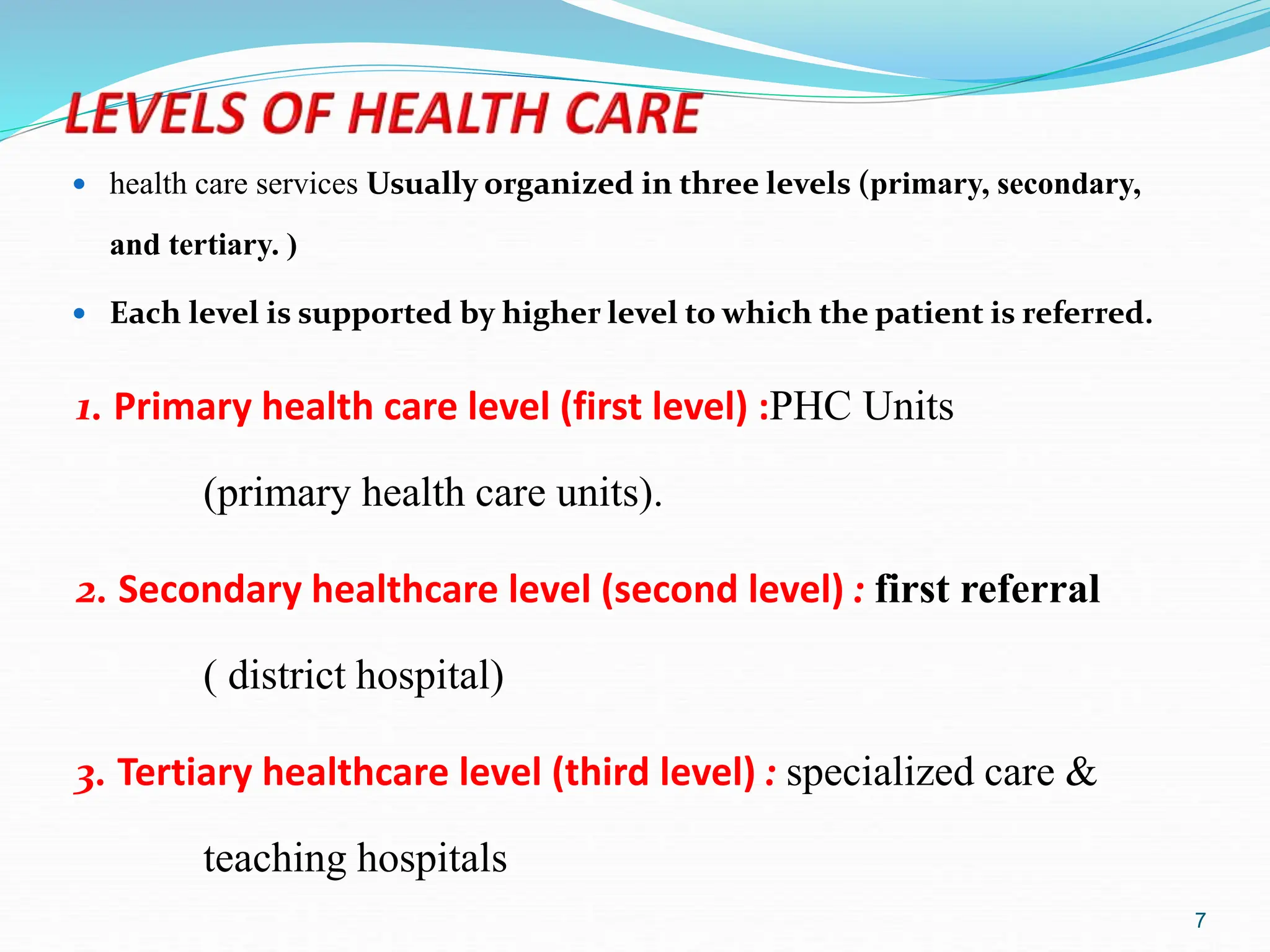
1. Primary health care level (first level) :PHC Units
(primary health care units).
2. Secondary healthcare level (second level) : first referral
( district hospital)
3. Tertiary healthcare level (third level) : specialized care &
teaching hospitals
 health care services Usually organized in three levels (primary, secondary,
and tertiary. )
 Each level is supported by higher level to which the patient is referred.
A. Primary health care level (first level):
The first level of contact between the individual and the health system
 It refers to points at which the individuals , the family , and community normally
make the first contact with the health services where most of their health problems
can be deal with and resolved
 In rural area it may be a health center , in urban area it could be a medical clinic
, health center , or the out patient department of a hospital
8
B. Secondary healthcare level (second level) : (Frist
referral) General hospitals , rural (district hospitals)
 At this level the more difficult cases are dealt with and detailed evaluation , with more skilled care are
given .
 Comprises curative services
 The first referral level
9
C. Tertiary healthcare level (third level) : specialized
hospitals & centers
This is a more specialized level than the secondary care level and required specific
facilities and highly specialized health workers. It is provided by regional or central level
institutions , specialized hospitals and centers
 Offers super specialist care
 Provided training programs
10
11
Levels of Prevention:
1. Primary prevention
2. Secondary prevention
3. Tertiary prevention
12
13
Levels of Prevention :
1. Primary prevention : those preventive measures that prevent
the onset of illness or injury before the disease process begins.
Examples include diet, immunization and taking regular exercise.
Aims to prevent disease or injury before it ever occurs
This is done by:
 Preventing exposure to hazards that cause disease or injury
 Altering unhealthy or unsafe behaviors that can lead to disease or injury
 Reducing exposure to disease causing agents and
 Increasing resistance to disease or injury should exposure occur
14
2. Secondary prevention (those preventive measures that
lead to early diagnosis and prompt)
 Secondary prevention Aims to reduce the impact of a disease or injury that has
already occurred
 This is done by detecting and treating disease or injury at an early stage to halt
or slow its progress , such as by screening , takes place during the preclinical
phase of an illness , that is after the disease has developed , but before clinical
signs and symptoms have appeared
 This is encouraging personal strategies to prevent reinjury or recurrence, and
implementing programs to return people to their original health and function
to prevent long term problems
Levels of Prevention :
15
2. Secondary prevention
Examples include
 Regular exams and screening test to detect disease in its earliest stages (e.g.
mammograms to detect breast cancer , human immunodeficiency virus testing,
blood pressure and cholesterol testing)
 screening for high blood pressure and breast self-examination. Screenings,
mammograms, family counseling.
 Daily, low dose aspirins and or diet and exercise programs to prevent further
heart attacks or strokes
Levels of Prevention:
3. Tertiary prevention
Aim to soften the impact of an ongoing illness or injury that has lasting effects
This is done by helping people manage long term,
often complex health problems and injuries ( e.g. chronic diseases , permanent
impairments ) in order to improve as much as possible their ability to function ,
to expectancy to prevent complications of the illness , including death of the
patient
Examples include
 Disability limitation (prevention of delayed consequences , treatment
and prevention of complication)
 Rehabilitation (physical , mental , social and occupational) 16
Levels of Prevention :
Health Team Members:
Patient needs are multifaceted, complex, and require a multitude of people
from a variety of health- care disciplines with specific expertise to assist
patients to meet these needs. Nurses must know the members of the health
team and the services they provide to perform the role of coordinator
effectively. Although the nurse is the coordinator of the health team, the patient
is the center of the health team
17
A. The Patient.
 The patient is the center of the health team.
 All members of the health team lend their expertise to assist the patient in
meeting health-care goals.
B . Nurse.
A nurse is a caregiver for patients and helps to manage physical needs, prevent
illness, and treat health conditions.
 The role of the nurse varies with the need of the situation. Nursing skills
should include:
1. Nurse administrators.
2. Clinical nurse specialist (CNS).
3. Registered nurse (RN).
4. Unlicensed assistive personnel (UAP).
18
1. Nurse administrators.
a. Establish and manage achievement of organizational goals, particularly
those of the department of nursing and other related agency departments.
b. Examples ; nursing supervisor, and nurse manager.
2. Clinical nurse specialist (CNS).
a. Functions as a resource to nurses caring for patients with complex nursing
needs.
b. Requires advanced education in a specific field.
c. Examples include infection control nurse, and medical-surgical nurse
19
3. Registered nurse (RN).
a. Coordinates services provided by members of the health-care team.
b. Provides direct nursing care.
c. Supervises unlicensed nursing personnel.
20
4. Unlicensed assistive personnel (UAP).
A. Provides direct nursing care delegated by an RN.
B. Performs activities generally related to assisting patients with activities of
daily living and providing noncomplex tasks.
C. Other Professional Team Members:
1. Physician
A person who is licensed to practice medicine. Responsible for diagnosis of
illness & medical or surgical treatment. prescribing medications.
interpreting the results of laboratory & diagnostic test. performing procedure &
surgery
21
2. Physical therapist or physiotherapist (PT).
Seeks to restore function or prevent further disability in patient after injury or illness.
PTs use various techniques to treat patients, including: Massage, Heat, Cold, Water,
Sonar waves, exercise & electrical stimulation.
3. Respiratory therapist (RT).
(RT) is trained in techniques that improve pulmonary (lung) function &
oxygenation & administering a variety of tests that measure lung function &
educating the patient.
4.Occupational therapist (OT).
OT assist physically challenged patients to adapt to limitations. OTs a variety
of adaptive device & strategies to aid patient in carrying out the activities of
daily living.
22
5. Speech therapist (ST).
(ST) is trained to help hearing impaired patient speak more clearly, and to assist patients who
have had a stroke to relearn how to speak,
& to correct or modify a variety of speech disturbances in children & adults. Also diagnosed &
treated swallowing problems in patients who have head injury or stroke.
6.Dietitian.
Registered dietitian (RD) manages & plans for dietary needs of patients based on knowledge
about aspect of nutrition & supervise the dietary services of an entire facility.
7. Pharmacist is licensed to formulate and dispense medication.
23
8. A social worker counsels patient & family members,
social worker are involved in many activities such as counseling, reporting suspected drug
addiction or abuse, placing patient in long-term care.
9. Unlicensed assistive personnel (UAPs).
LAPS help nurses provide direct care to patient; UAPS may have the title of certified nursing
assistants, orderlies, attendant, or technicians.
10. Paramedical technology.
Paramedical means having some connection with medicine and include the following:
Laboratory technology. Radiologic technology . Nuclear technology.
24

healthcare delivery system.ppt

  • 1.
    1 Fundamental of Nursing Healthcaredelivery system Dr; mosa alfageh
  • 2.
    Learning outcomes Define Healthcare delivery system Health system requirement Classification of hospitals Explain the level of health care Explain the level of prevention Health team members 2
  • 3.
    3 The health-care deliverysystem provides a variety of services across various settings to meet the health-related needs of the members of society. Definition of Health care delivery system Is totality of services offered by all health disciplines Health care delivery system
  • 4.
    4 1. Distribution andCoverage & Staffing. 2. Hospitals 3. Health centers & Basic Health Units 4. finance
  • 5.
    5 According to ownershipor control: 1. Government (public). 2. Non-government (private). According to specialty or service provided. 1. General, medical surgical etc. 2. Special, psychiatric, pediatric, Maternity, Orthopedic. etc. 111- Acute or chronic: 1. Acute for short-term 2. Chronic for long-term A primary characteristic of hospital care is its focus on the current problem, rapid assessment, stabilization or treatment, and then discharge to home care or to long-term care. Classification of hospitals
  • 6.
    Two terms usedfrequently to describe today’s modern hospital services are: 1. Inpatient care: Individuals are termed "inpatient" when they have been admitted for the purpose of staying more than 24 hours . 2. Outpatient care: The "outpatient" comes to the hospital for services but is expected to stay less than 24 hours. 6
  • 7.
    7 1. Primary healthcare level (first level) :PHC Units (primary health care units). 2. Secondary healthcare level (second level) : first referral ( district hospital) 3. Tertiary healthcare level (third level) : specialized care & teaching hospitals  health care services Usually organized in three levels (primary, secondary, and tertiary. )  Each level is supported by higher level to which the patient is referred.
  • 8.
    A. Primary healthcare level (first level): The first level of contact between the individual and the health system  It refers to points at which the individuals , the family , and community normally make the first contact with the health services where most of their health problems can be deal with and resolved  In rural area it may be a health center , in urban area it could be a medical clinic , health center , or the out patient department of a hospital 8
  • 9.
    B. Secondary healthcarelevel (second level) : (Frist referral) General hospitals , rural (district hospitals)  At this level the more difficult cases are dealt with and detailed evaluation , with more skilled care are given .  Comprises curative services  The first referral level 9
  • 10.
    C. Tertiary healthcarelevel (third level) : specialized hospitals & centers This is a more specialized level than the secondary care level and required specific facilities and highly specialized health workers. It is provided by regional or central level institutions , specialized hospitals and centers  Offers super specialist care  Provided training programs 10
  • 11.
  • 12.
    Levels of Prevention: 1.Primary prevention 2. Secondary prevention 3. Tertiary prevention 12
  • 13.
    13 Levels of Prevention: 1. Primary prevention : those preventive measures that prevent the onset of illness or injury before the disease process begins. Examples include diet, immunization and taking regular exercise. Aims to prevent disease or injury before it ever occurs This is done by:  Preventing exposure to hazards that cause disease or injury  Altering unhealthy or unsafe behaviors that can lead to disease or injury  Reducing exposure to disease causing agents and  Increasing resistance to disease or injury should exposure occur
  • 14.
    14 2. Secondary prevention(those preventive measures that lead to early diagnosis and prompt)  Secondary prevention Aims to reduce the impact of a disease or injury that has already occurred  This is done by detecting and treating disease or injury at an early stage to halt or slow its progress , such as by screening , takes place during the preclinical phase of an illness , that is after the disease has developed , but before clinical signs and symptoms have appeared  This is encouraging personal strategies to prevent reinjury or recurrence, and implementing programs to return people to their original health and function to prevent long term problems Levels of Prevention :
  • 15.
    15 2. Secondary prevention Examplesinclude  Regular exams and screening test to detect disease in its earliest stages (e.g. mammograms to detect breast cancer , human immunodeficiency virus testing, blood pressure and cholesterol testing)  screening for high blood pressure and breast self-examination. Screenings, mammograms, family counseling.  Daily, low dose aspirins and or diet and exercise programs to prevent further heart attacks or strokes Levels of Prevention:
  • 16.
    3. Tertiary prevention Aimto soften the impact of an ongoing illness or injury that has lasting effects This is done by helping people manage long term, often complex health problems and injuries ( e.g. chronic diseases , permanent impairments ) in order to improve as much as possible their ability to function , to expectancy to prevent complications of the illness , including death of the patient Examples include  Disability limitation (prevention of delayed consequences , treatment and prevention of complication)  Rehabilitation (physical , mental , social and occupational) 16 Levels of Prevention :
  • 17.
    Health Team Members: Patientneeds are multifaceted, complex, and require a multitude of people from a variety of health- care disciplines with specific expertise to assist patients to meet these needs. Nurses must know the members of the health team and the services they provide to perform the role of coordinator effectively. Although the nurse is the coordinator of the health team, the patient is the center of the health team 17 A. The Patient.  The patient is the center of the health team.  All members of the health team lend their expertise to assist the patient in meeting health-care goals.
  • 18.
    B . Nurse. Anurse is a caregiver for patients and helps to manage physical needs, prevent illness, and treat health conditions.  The role of the nurse varies with the need of the situation. Nursing skills should include: 1. Nurse administrators. 2. Clinical nurse specialist (CNS). 3. Registered nurse (RN). 4. Unlicensed assistive personnel (UAP). 18
  • 19.
    1. Nurse administrators. a.Establish and manage achievement of organizational goals, particularly those of the department of nursing and other related agency departments. b. Examples ; nursing supervisor, and nurse manager. 2. Clinical nurse specialist (CNS). a. Functions as a resource to nurses caring for patients with complex nursing needs. b. Requires advanced education in a specific field. c. Examples include infection control nurse, and medical-surgical nurse 19
  • 20.
    3. Registered nurse(RN). a. Coordinates services provided by members of the health-care team. b. Provides direct nursing care. c. Supervises unlicensed nursing personnel. 20 4. Unlicensed assistive personnel (UAP). A. Provides direct nursing care delegated by an RN. B. Performs activities generally related to assisting patients with activities of daily living and providing noncomplex tasks.
  • 21.
    C. Other ProfessionalTeam Members: 1. Physician A person who is licensed to practice medicine. Responsible for diagnosis of illness & medical or surgical treatment. prescribing medications. interpreting the results of laboratory & diagnostic test. performing procedure & surgery 21 2. Physical therapist or physiotherapist (PT). Seeks to restore function or prevent further disability in patient after injury or illness. PTs use various techniques to treat patients, including: Massage, Heat, Cold, Water, Sonar waves, exercise & electrical stimulation.
  • 22.
    3. Respiratory therapist(RT). (RT) is trained in techniques that improve pulmonary (lung) function & oxygenation & administering a variety of tests that measure lung function & educating the patient. 4.Occupational therapist (OT). OT assist physically challenged patients to adapt to limitations. OTs a variety of adaptive device & strategies to aid patient in carrying out the activities of daily living. 22
  • 23.
    5. Speech therapist(ST). (ST) is trained to help hearing impaired patient speak more clearly, and to assist patients who have had a stroke to relearn how to speak, & to correct or modify a variety of speech disturbances in children & adults. Also diagnosed & treated swallowing problems in patients who have head injury or stroke. 6.Dietitian. Registered dietitian (RD) manages & plans for dietary needs of patients based on knowledge about aspect of nutrition & supervise the dietary services of an entire facility. 7. Pharmacist is licensed to formulate and dispense medication. 23
  • 24.
    8. A socialworker counsels patient & family members, social worker are involved in many activities such as counseling, reporting suspected drug addiction or abuse, placing patient in long-term care. 9. Unlicensed assistive personnel (UAPs). LAPS help nurses provide direct care to patient; UAPS may have the title of certified nursing assistants, orderlies, attendant, or technicians. 10. Paramedical technology. Paramedical means having some connection with medicine and include the following: Laboratory technology. Radiologic technology . Nuclear technology. 24

Editor's Notes

  • #4 يقدم النظام الصحي مجموعه متنوعه من الخدمات الصحية عبر مختلف جهاتها لتلبية الاحتياجات المتعلقة ب الصحة ل افراد المجتمع هو مجمل الخدمات التي تقدمها جميع القطاعات الصحية
  • #5 AIMS The purpose is promoting, maintaining, monitoring or restoring health. Prerequisites : staff, organization or setting, administration structure and finance The Ultimate Objective The final aim is to serve people in terms of diagnosis, helping, cure, education and rehabilitation.
  • #9 Cost Responsibility Referral 80%
  • #10 More complex problems are deal with 15%
  • #11 5%
  • #17 those preventive measures aimed at rehabilitation following significant illness. At this level health services workers can work to retrain, re-educate and rehabilitate people who have already developed an impairment or disability. e.g.. medications, surgical treatment, rehabilitation Focuses on restoring function, maximizing results of treatment, and providing palliative care, such as supporting comfort and quality of life. Focuses on maximizing abilities in light of chronic or irreversible conditions. Activities include education and rehabilitation e.g., learning how to use a wheelchair, learning to engage in activities of daily living to live independently, and making environmental modifications, such as installing grab bars and ramps and widening doorways in the home.
  • #18 احتياجات المرضى متعددة الاوجة و معقدة وتتطلب عددا كبيرا من الأشخاص من مجموعه من التخصصات الرعايه الطبية مع خبرة محددة لمساعدة المرضى لتلبة احتياجاتهم يجب ان يعرف الممرض بيقية التيم لانه يعتبر زي المنسق المريض هو مركز الفريق الصحي
  • #19 الممرض هو مقدم الرعايه للمرضى يساعد في إدارة الاحتياجات الجسدية و الوقايه من المرض و العلاج يختلف دور الممرض حسب حاجة الحالة مدير التمريض اخصائي تمريض سرري ممرض مسجل اختبر مزاولة مساعد ممرض
  • #20 انشاء اهداف و ادارتها الذي تحقق من اهداف المستشفى ب الخصوص الخاصة بقسم التمريض او الأقسام ذات الصله نائب مدير التمريض المدير المساعد للتمريض مساعد مدير التمريض مشرف التمريض منسق التمريض مدير التمريض
  • #21 r.N ينسق الخدمات المقدمة من قبل الدكتور رعايه تمريضية مباشرة يشرف ع مساعد التمريض يوفر رعاية تمريضية مباشرة مفوضة من قبل r.n يقوم ب النشطة المتعلقة عموما بمساعدة المرضى في أنشطة الحياة اليومية و تقديم مهام غير معقدة
  • #22 موجات السونار و الرياضة و التحفيز الكهربائي
  • #23 O.T يساعد المرضى ذو الإعاقة الجسدية ع التكيف مع القيود مجموعه متنوعه من الأجهزة و الاستراتيجيات لمساعدة المريض في القيام بأنشطة الحياه اليومية
  • #24 مساعدة المرضى الذين يعانون من ضعف السمع ع التحدث ST اخصائي التغذية المرخص ب بناء ةو تخطيط التحتياجات الغذائية للمرضى بناء ع المعرفة حول جوانب التغذية يشرف ع النظام الغذائي ف المستشفى كامل الصيدلي مرخص له بتركيب الادويه وصرفها
  • #25 يقوم الاخصائي الاجتماعي بتقديم المشورة للمرضى و افراد اسرة تقديم المشورة ويعالج الناس المدمنين