2015 Health Services
Tax Conference
May 18-19, 2015
The Drake Hotel
Chicago, IL
PwC
Welcome and opening remarks
Rob Friz
US Health Services Tax Leader, PwC
Kelvin Ault
US Investor-owned Health Services Tax Leader, PwC
www.pwc.com
Ceci Connolly
Managing Director
PwC Health Research Institute
Introducing the New
Health Economy and the
Shift Towards the
Consumer
Health Services Tax Conference
May 19, 2015
PwC Health Research Institute
Would you be comfortable with using a mobile
device to check for ear infections?
4
One in four US clinicians
surveyed by HRI said they
would be comfortable
prescribing based on data from
such a device.
PwC Health Research Institute
Have you been to a medical clinic in a retail store
or pharmacy in the past 12 months?
In 2013, 35% of
survey respondents
told HRI they had
visited a retail clinic
in the past year
5
In 2007, that number
was just 10%.
PwC Health Research Institute
Do you own a wearable device and do you wear it
everyday?
6
By the end of 2014, wearable
companies will have shipped a
projected 7.6 million units
within the US, up 200% from
2013.
PwC Health Research Institute
The New Health EconomyTM
: Where are we
heading?
7
PwC Health Research Institute
Consumers are ready to abandon traditional care
models for convenient alternatives
8
…threatening $64 billion of traditional provider revenue
36.7%
Have at-home
chemotherapy
Get an MRI at a retail clinic or
pharmacy
34.4%
Ah
Send a digital photo of a
rash/skin problem to a
dermatologist
Use an at-home strep test
54.8%
58.6%
Have stitches or staples
removed at a retail clinic or
pharmacy
Check for an ear infection
using a device attached to
your phone
46.9%
48.3%
PwC Health Research Institute
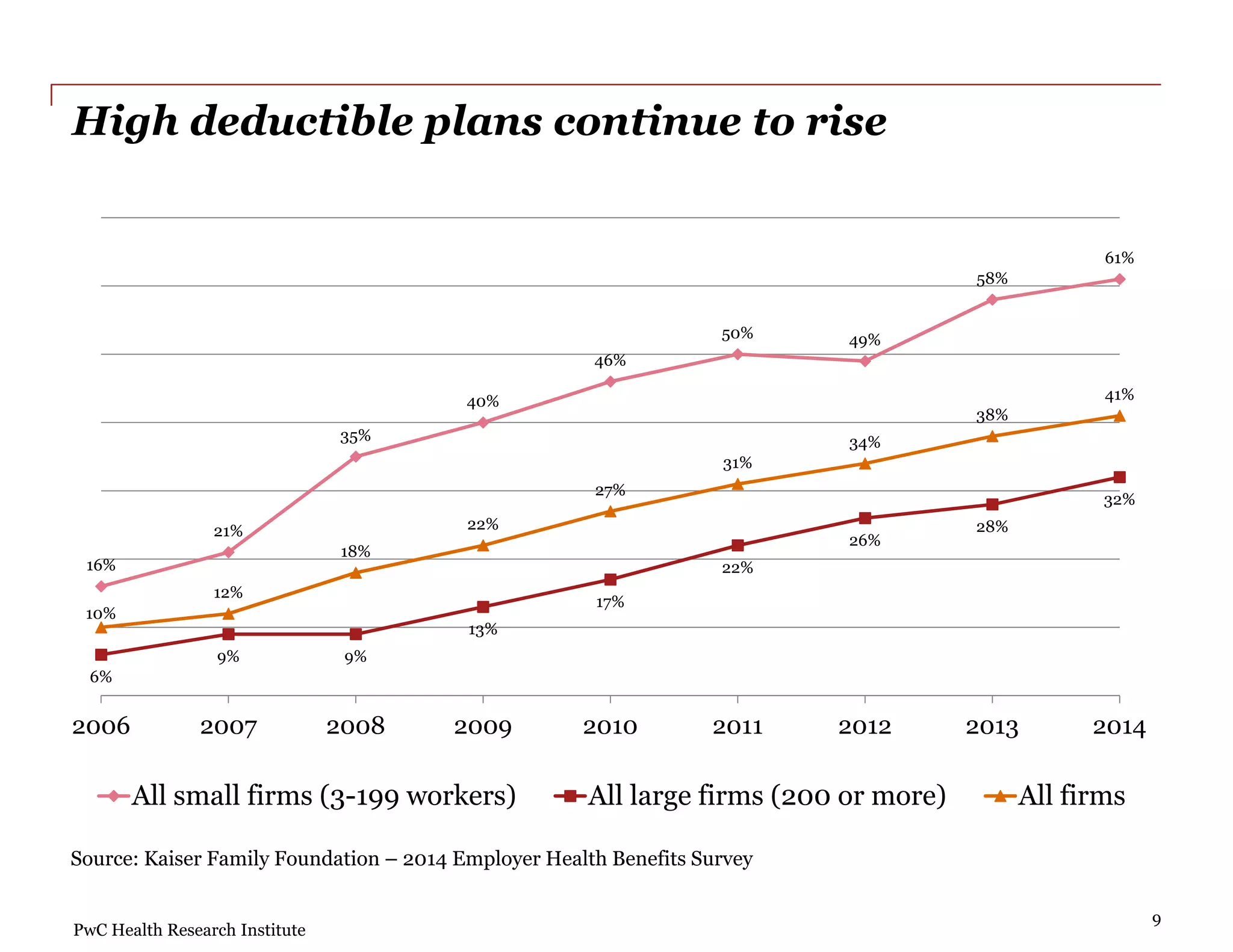
High deductible plans continue to rise
Source: Kaiser Family Foundation – 2014 Employer Health Benefits Survey
16%
21%
35%
40%
46%
50% 49%
58%
61%
6%
9% 9%
13%
17%
22%
26%
28%
32%
10%
12%
18%
22%
27%
31%
34%
38%
41%
2006 2007 2008 2009 2010 2011 2012 2013 2014
All small firms (3-199 workers) All large firms (200 or more) All firms
9
PwC Health Research Institute
Healthcare follows other industries
Standardized marketing
and inventory
Limited travel
agency availability
Limited teller hours
Customized and data-
driven
Online booking
24/7 ATMs and mobile
banking
Past Present
1980s - 2010
Blockbuster drug
model
Limited hours and
standardized
treatment plans
Personalized medicines
Personalization of
treatments and protocols
Present Future
Ongoing shift
10
PwC Health Research Institute
The transformation taking place in health
11
New Health Economy
Value over volume
Sophisticated customer segmentation
Fueled by
technology
Built on
analytics
2
PwC Health Research Institute
Healthcare’s new entrants: Who will be the
industry’s Amazon.com?
12
PwC Health Research Institute
Nearly half of Fortune 50 companies are healthcare
new entrants
“Our goal is to be the number
one healthcare provider in
the US,” - Retail company
“Our goal is to become a global
leader as a healthcare
company,” - Consumer
Electronics company
“We can own the wellness
space,” - Grocery company
13
PwC Health Research Institute
How New Entrants are disrupting the health sector
Democratization of
care
Accessible healthcare
through technology
New business
models
Non-traditional
players disrupt
status quo
Addressing the
void
New entrants are
meeting an
unfulfilled need in
the delivery system
Wellness and
fitness
Viable entry point to
participate in health
14
PwC Health Research Institute
Consumer use of retail clinics on the rise
In 2007,
proportion of
survey
respondents
who had
visited a
retail clinic:
In 2013,
proportion of
respondents who
had visited a
retail clinic in
the last
12 months:
9.7% 35%
15
PwC Health Research Institute
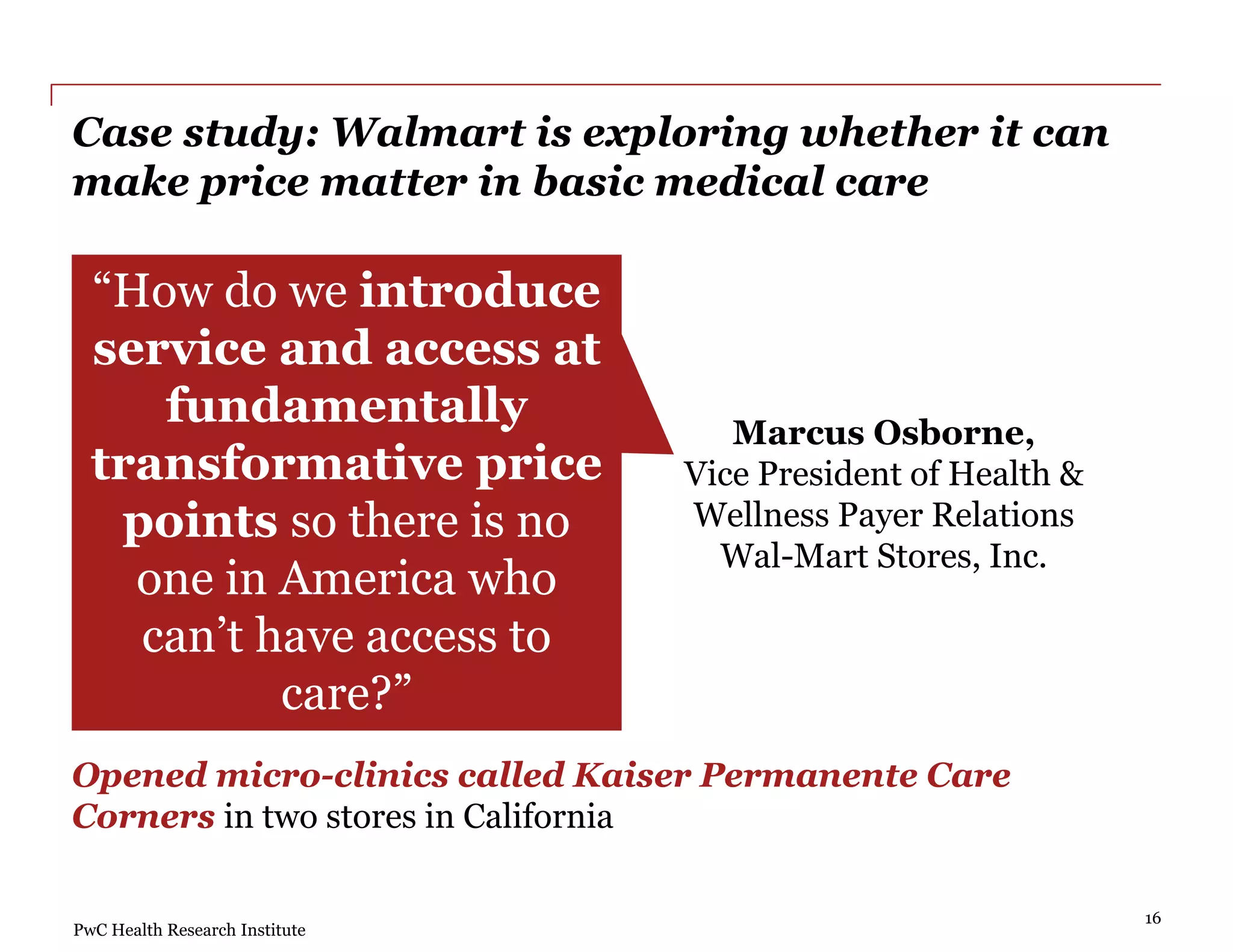
Case study: Walmart is exploring whether it can
make price matter in basic medical care
“How do we introduce
service and access at
fundamentally
transformative price
points so there is no
one in America who
can’t have access to
care?”
Marcus Osborne,
Vice President of Health &
Wellness Payer Relations
Wal-Mart Stores, Inc.
Opened micro-clinics called Kaiser Permanente Care
Corners in two stores in California
16
PwC Health Research Institute
Care innovation via remote technology
Provider tools Consumer tools
17
PwC Health Research Institute
…creating new models to deliver health
18
PwC Health Research Institute
An example: Global emergence of apps formulary
Apps Formulary
AliveCor Cardiac
Withings Blood Pressure
bant Diabetes
Pain Squad Pain Mgmt
MyIBD Crohn’s Disease
19
PwC Health Research Institute
A glance towards the future
20
PwC Health Research Institute
Healthcare spending shifts toward preventive care
5% 7%
12%
15%
17%
21%
70% 65% 51%
10% 11%
16%
0%
10%
20%
30%
40%
50%
60%
70%
80%
90%
100%
2007 2012 2025F
Prevention Diagnosis Treatment Prognosis
Preventive Healthcare Market: Healthcare
Spending by segment, U.S. 2007-2025
Global
consumers spent
$9.6 trillion on
wellness
21
PwC Health Research Institute
Where are consumers spending on wellness?
$45.40B
Natural &
organic
food
$30.40B
Vitamins
and
nutritional
supplements
$1.02B
Nutrition
and energy
bars
$16.80B
Functional
beverages
$59.20B
for sporting
goods
$61.6B
for
alternative
healthcare
$11.25B
for weight
loss
$40.33B
for fitness
$1.30B
for mobile
health apps
$93.62B
for
nutrition
Wellness market
$267B
US Healthcare system
$2.8T
US total healthcare cost $3T
$25.27B
Gym
membership
$7.31B
Personal
trainer
$6.85B
Pilates &
yoga
studios
$0.64B
Boxing
gyms
& clubs
$0.26B
Fitness
DVD
production
22
PwC Health Research Institute
U.S. consumers have high hopes for wearables
23
PwC Health Research Institute
Clinician use of mobile devices is on the rise
24
PwC Health Research Institute
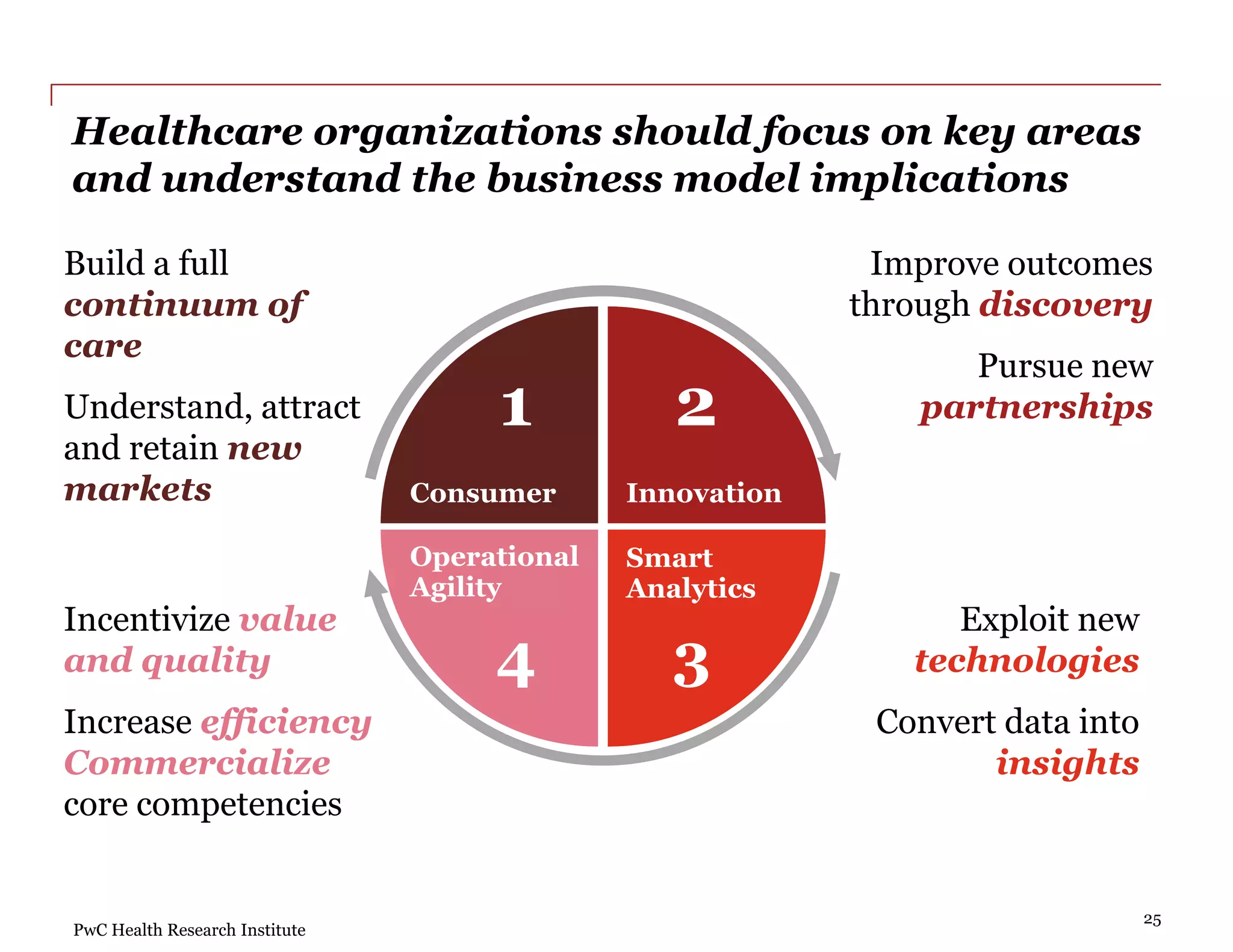
Healthcare organizations should focus on key areas
and understand the business model implications
Consumer Innovation
Smart
Analytics
Operational
Agility
Build a full
continuum of
care
Understand, attract
and retain new
markets
Incentivize value
and quality
Increase efficiency
Commercialize
core competencies
Improve outcomes
through discovery
Pursue new
partnerships
Exploit new
technologies
Convert data into
insights
1 2
34
25
PwC Health Research Institute
For more information
www.pwc.com/hri
Ceci Connolly
Health Research Institute, Leader
(202) 312 7910
ceci.connolly@us.pwc.com
Twitter: @CeciConnolly
26
PwC Health Research Institute
This publication has been prepared for general guidance on matters of interest only,
and does not constitute professional advice or a contract for services. You should not
act upon the information contained in this publication without obtaining specific
professional advice. No representation or warranty (express or implied) is given as to
the accuracy or completeness of the information contained in this publication, and, to
the extent permitted by law.
PricewaterhouseCoopers LLP, its members, employees and agents do not accept or
assume any liability, responsibility or duty of care for any consequences of you or
anyone else acting, or refraining to act, in reliance on the information contained in this
publication or for any decision based on it.
© 2015 PricewaterhouseCoopers LLP, a Delaware limited liability partnership. All
rights reserved. PwC refers to the US member firm, and may sometimes refer to the
PwC network. Each member firm is a separate legal entity. Please see
www.pwc.com/structure for further details.
This content is for general information purposes only, and should Not be used as a
substitute for consultation with professional advisors.
27
Keynote General Session
Philip Bredesen
Governor of Tennessee from 2003-2011
2015 Health Services
Tax Conference
May 18-19, 2015
The Drake Hotel
Chicago, IL
Breakout Session
2a. ACA Tax Considerations -
Information Reporting and
Section 6055/6056
www.pwc.com
Sandi Hunt
Steve Chapman
PwC
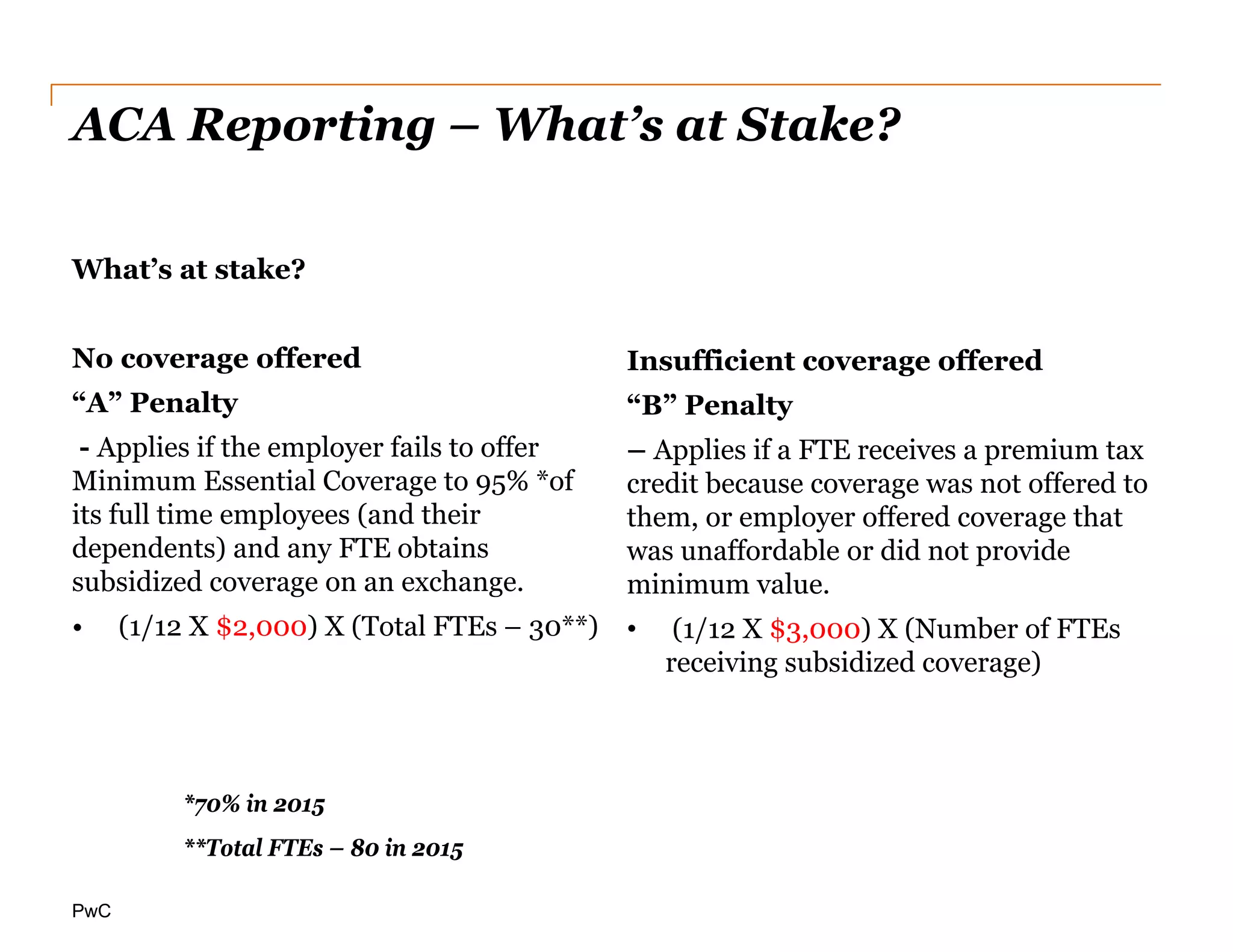
ACA Reporting – What’s at Stake?
What’s at stake?
No coverage offered
“A” Penalty
- Applies if the employer fails to offer
Minimum Essential Coverage to 95% *of
its full time employees (and their
dependents) and any FTE obtains
subsidized coverage on an exchange.
• (1/12 X $2,000) X (Total FTEs – 30**)
Insufficient coverage offered
“B” Penalty
– Applies if a FTE receives a premium tax
credit because coverage was not offered to
them, or employer offered coverage that
was unaffordable or did not provide
minimum value.
• (1/12 X $3,000) X (Number of FTEs
receiving subsidized coverage)
*70% in 2015
**Total FTEs – 80 in 2015
PwC
ACA Reporting – 2015 Overview
32
• New reporting process under the ACA:
– Large employers must report monthly information regarding affordable
healthcare both to full-time employees and the IRS starting for 2015 (reporting to
be completed in early 2016) via Form 1095-C and 1094-C
– Self-insured employers must also report on minimum essential coverage provided
to employees, retirees, and others
– Reporting is by each FEIN, including “disregarded entities”
– Reporting obligation created to support the ACA’s individual and employer
mandates and to support imposition of employer penalties
• New reporting requirements’ data elements include:
– Identify all full-time employees (working 30+ hours per week, per ACA)
– Coverage offered and employee cost
– Employee and dependent social security numbers
– Applicable safe harbors, transition rule
– Actual coverage provided to employees, dependents, retirees, COBRA beneficiaries
– Full-time and total employee countsACA reporting to IRS and employees is the latest and
one of the most challenging ACA-related developments
PwC 33
ACA Reporting – Overview of Requirements
Minimum Essential Coverage Employer Shared Responsibility
Responsible • Self-insured employers and insurers
• Employers with 50 or more full-time employees
during the prior calendar year
Reporting
Contents
• Months of minimum essential coverage for
all covered individuals
• Months during which coverage was offered and
type of coverage
• Employee’s share of lowest-cost self-only
coverage offering minimum value during each
month
• Employer’s use of any safe harbors and
transition relief
Reporting
Recipients
• All covered individuals and IRS • All full-time employees and IRS
Timing
• Full-time employees and covered individuals – by January 31, 2016 for 2015
• IRS –by March 31, 2016 for 2015
Allowable
Distribution
Methods
• To covered individuals – by first-class mail or electronically with participant consent
• To IRS – mandatory electronic filing
Reason for
Reporting
• Enforcement of individual mandate
• Evaluation of individual eligibility for
public exchange subsidies
• Enforcement of employer shared responsibility
mandate
• Evaluation of individual eligibility for public
exchange subsidies
PwC
ACA Reporting – Illustrative Timeline
34
January 2015
Employer shared responsibility
requirement begins for employers with
100+ FTEs
(reporting/payment in 2016)
January 2016
Reporting for 2015 coverage
year begins (sections 6055 and
6056)
By January 31st
Employers distribute Forms 1095-C
to employees
By March 31st
Employers electronically submit
Forms 1094-C (and copies of all
1095-Cs) to IRS
Information must be collected and
tracked to ensure readiness for 2016
reporting.
January-December 2015
Develop implementation plan
including project milestones
and deadlines
March 31
January
31, 2016
PwC
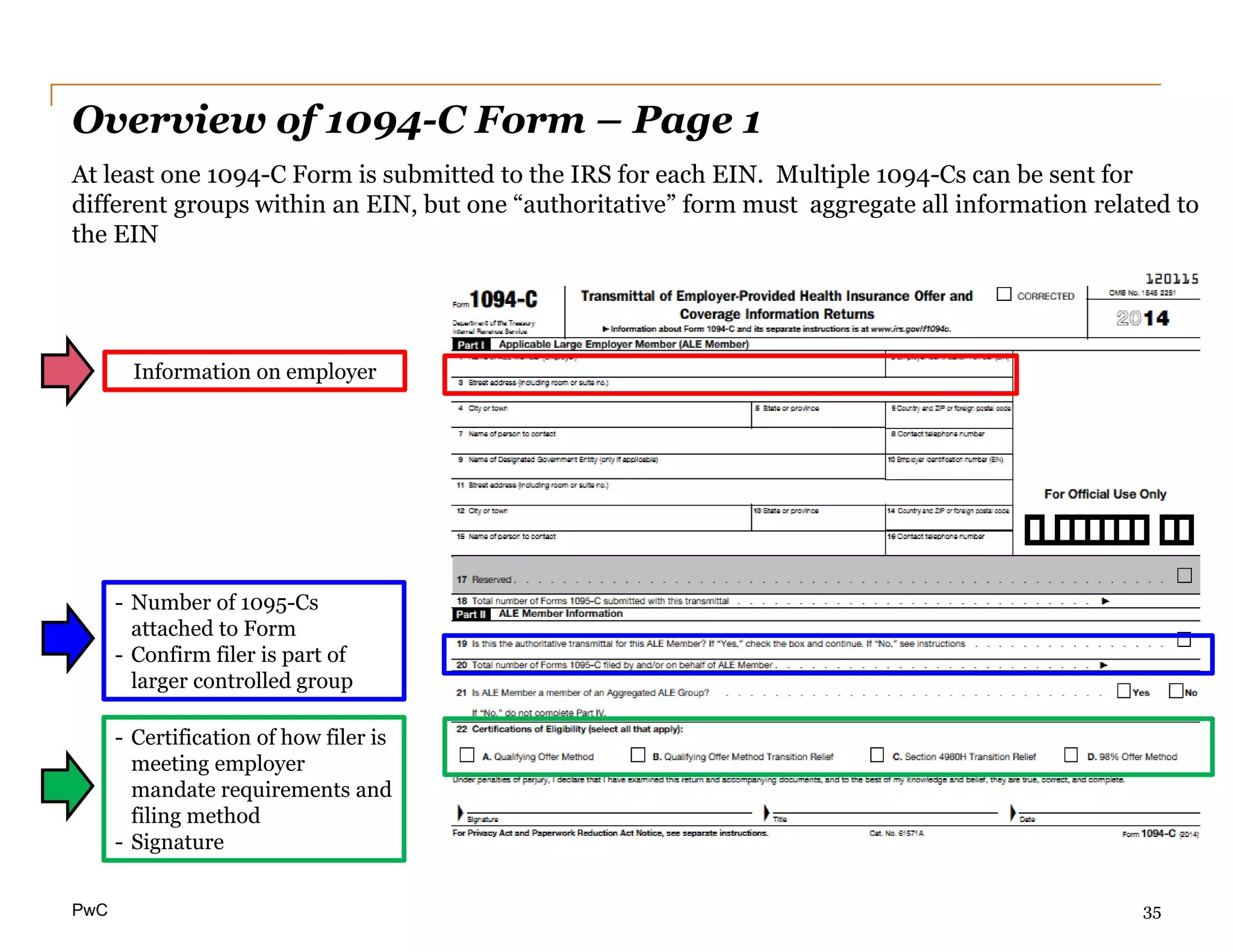
Overview of 1094-C Form – Page 1
At least one 1094-C Form is submitted to the IRS for each EIN. Multiple 1094-Cs can be sent for
different groups within an EIN, but one “authoritative” form must aggregate all information related to
the EIN
Information on employer
- Number of 1095-Cs
attached to Form
- Confirm filer is part of
larger controlled group
- Certification of how filer is
meeting employer
mandate requirements and
filing method
- Signature
35
PwC
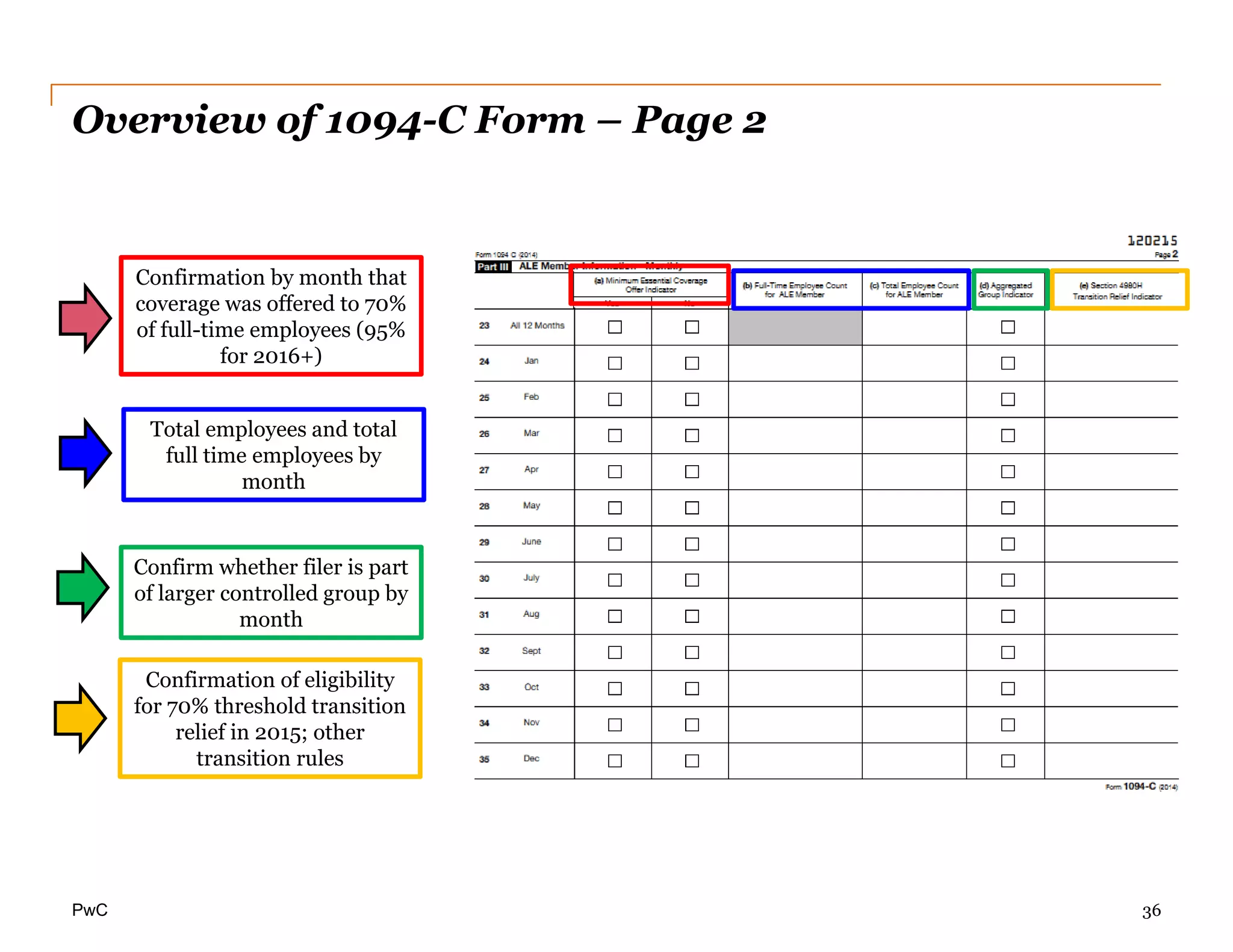
Overview of 1094-C Form – Page 2
Confirmation by month that
coverage was offered to 70%
of full-time employees (95%
for 2016+)
Total employees and total
full time employees by
month
Confirm whether filer is part
of larger controlled group by
month
Confirmation of eligibility
for 70% threshold transition
relief in 2015; other
transition rules
36
PwC
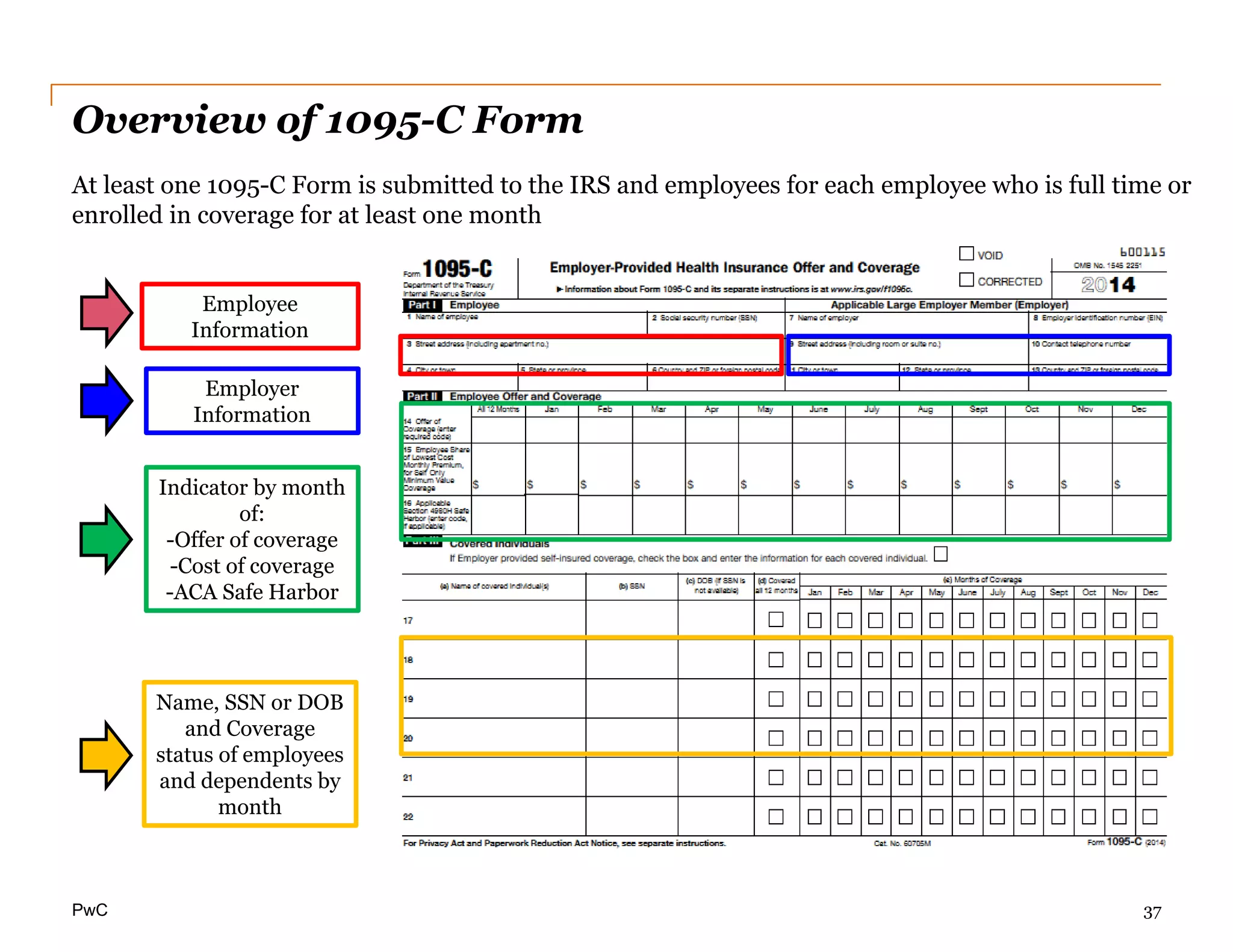
Overview of 1095-C Form
Employee
Information
Employer
Information
Indicator by month
of:
-Offer of coverage
-Cost of coverage
-ACA Safe Harbor
Name, SSN or DOB
and Coverage
status of employees
and dependents by
month
At least one 1095-C Form is submitted to the IRS and employees for each employee who is full time or
enrolled in coverage for at least one month
37
PwC
ACA Reporting – Practical Challenges
In addition to the technical and data challenges that exist under the ACA, there
are also a number of reporting challenges that employers will need to
understand for notices
And, don’t forget the reporting…
• Administrative burdens surrounding a large scale filing obligation with
employees and the IRS need to be considered.
• Delivery of forms to employees – electronic delivery is permitted, but
only if employees affirmatively elect to receive electronically.
• Exchange notifications will be coming – need to develop a plan for
working through those notices.
• In addition to the exchanges, the IRS will likely have a separate process
for examination and/or notices that will need to be separately managed.
38
PwC
ACA Reporting – Data Considerations
February 4, 2015
The ACA reporting process is dependent on the data available as of the filing
date. Much of the data required for ACA reporting has not previously been
needed for tax filings, which are signed under penalties of perjury.
Some important considerations with respect to data are:
• Your data is not getting cleaner on its own…don’t let data quality issues stop
you from getting started
• Identifying important factors such as special unpaid leave or
reclassifications will be difficult to incorporate retroactively
• Establish clear ownership and accountability for data points – internal or
external
• Identify what data is missing, and develop a plan to gather quickly –
dependent SSNs are a common example
PwC
Thank you!
Sandi Hunt
Principal
sandra.s.hunt@us.pwc.com
415.498.4635
Steve Chapman
Partner
steve.chapman@us.pwc.com
646.471.5809
40
Breakout Session
2b. M&A update focusing on vertical
and horizontal consideration
www.pwc.com
Chris Monte, LifePoint Hospitals
Bryan Mello, Fresenius
Pat Pellervo, PwC
Jennifer Wyatt, PwC
PwC
M&A activity*
• Healthcare provider-sector deals for 2015 Q1 reflect a 46% increase over
2014 Q1.
• Hospitals, insurers, and private equity firms are acquiring medical practices
– 41 private equity deals in 2015 Q1.
• Private equity typically exits a portfolio investment in approximately 5 years,
so M&A activity will continue for the foreseeable future.
* Source: Modern Healthcare, April 18, 2015
PwC
Tax due diligence considerations
• Affordable Care Act compliance
• Highly compensated employees of health insurance providers (Section
162(m)(6))
• Section 501(r) requirements for hospitals
• Tax treatment of professional corporations and similar entities, and
potential effect on acquiring group
PwC
Professional Corporations (“PCs”) &
Professional LLCs (“PLLCs”)
PwC
PwC
Restrictions on “Corporate Practice of Medicine” (“CPOM”)
Many states impose restrictions on corporations or LLCs providing medical (or
other professional) services.
• As it relates to medical providers, PCs and PLLCs generally must be legally
owned by licensed providers (e.g., physicians).
• Certain states also refer to “beneficial ownership.”
PwC
Affiliated groups & controlled groups
Section 1504(a): Affiliation
• Prerequisite for consolidated return election
• Group member(s) must directly own at least 80% of voting power and value
• Section 1504(a) ownership threshold also applies for other purposes,
including sections 332, 338, and 165(g)(3)
Section 1563: Controlled groups
• Generally requires ownership of at least 80% of voting power or value
• Certain applications reduce the threshold to more than 50% of voting power
or value
• Ownership attribution rules apply
• Includes foreign entities
• Application is mandatory
PwC
Consolidated groups
• Current offset of income/losses of group members
• Deferral of intercompany transactions between group members
• Stock basis adjustments to reflect income/loss
• Tier-up of E&P (including deficits)
• Unified Loss Rule (“ULR”) and Excess Loss Account (“ELA”) rules apply to
many dispositions/deconsolidations
PwC
Controlled groups
• Deferral of intragroup losses (but not gains)
• Single employer for benefit plans
• Single application of graduated rates
• Treated as a single corporation for purposes of determining eligibility for
cash method of accounting
PwC
“Friendly PC” example
Medical Director Agreement: Dr. X oversees and coordinates Sub’s business objectives for PC, including
clinical decisions. May be terminated by Sub without cause. Dr. X may be an employee of Parent or Sub.
Support Services Agreement: Sub performs all administrative services for PC (e.g., billing), managing PC to
the extent its management does not constitute the practice of medicine (e.g., decisions affecting clinical care).
Stock Transfer Restriction Agreement: Restricts Dr. X’s ability to transfer shares of the PC or to cause the
PC to take certain actions (e.g., prohibited to declare a dividend, issue equity, merge/liquidate, etc.). Upon the
occurrence of a “Transfer Event,” the PC shares will be transferred for nominal consideration to another
shareholder of Sub’s choosing (e.g., another physician in its employ); such transferee is required to enter into a
similar agreement. Transfer Events include Dr. X’s termination as Medical Director.
Sub
Parent
PC
Dr. X
Support Services
Agreement
(Sub & PC)
Stock Transfer
Restriction Agreement
(Dr., Sub & PC)
Medical Director
Agreement
(Dr. and Sub)
PwC
IRS guidance
• Private Letter Ruling 201451009
- IRS ruled that PC was a member of Parent’s affiliated (and thus permitted
to join its
consolidated) group.
- Holding premised upon the legal enforceability of the arrangements under
applicable state law.
• But also see PLR 9752025, revoking PLR 9605015
- FSA 199926014 explained that under applicable state law, an attempt to
transfer beneficial ownership to a non-physician would be void, thus
defeating affiliation.
PwC
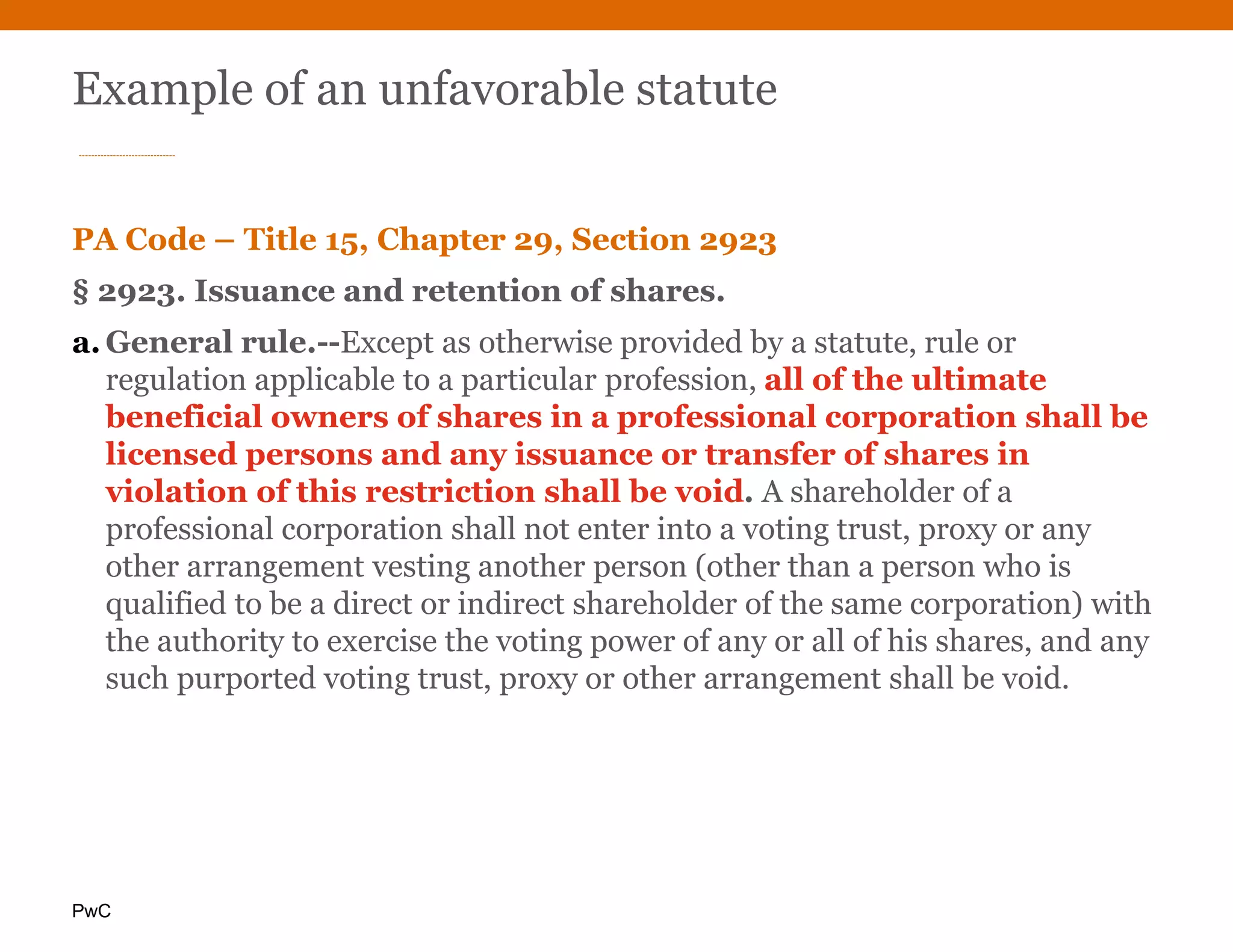
Example of an unfavorable statute
PA Code – Title 15, Chapter 29, Section 2923
§ 2923. Issuance and retention of shares.
a. General rule.--Except as otherwise provided by a statute, rule or
regulation applicable to a particular profession, all of the ultimate
beneficial owners of shares in a professional corporation shall be
licensed persons and any issuance or transfer of shares in
violation of this restriction shall be void. A shareholder of a
professional corporation shall not enter into a voting trust, proxy or any
other arrangement vesting another person (other than a person who is
qualified to be a direct or indirect shareholder of the same corporation) with
the authority to exercise the voting power of any or all of his shares, and any
such purported voting trust, proxy or other arrangement shall be void.
PwC
Not-for-profit affiliation
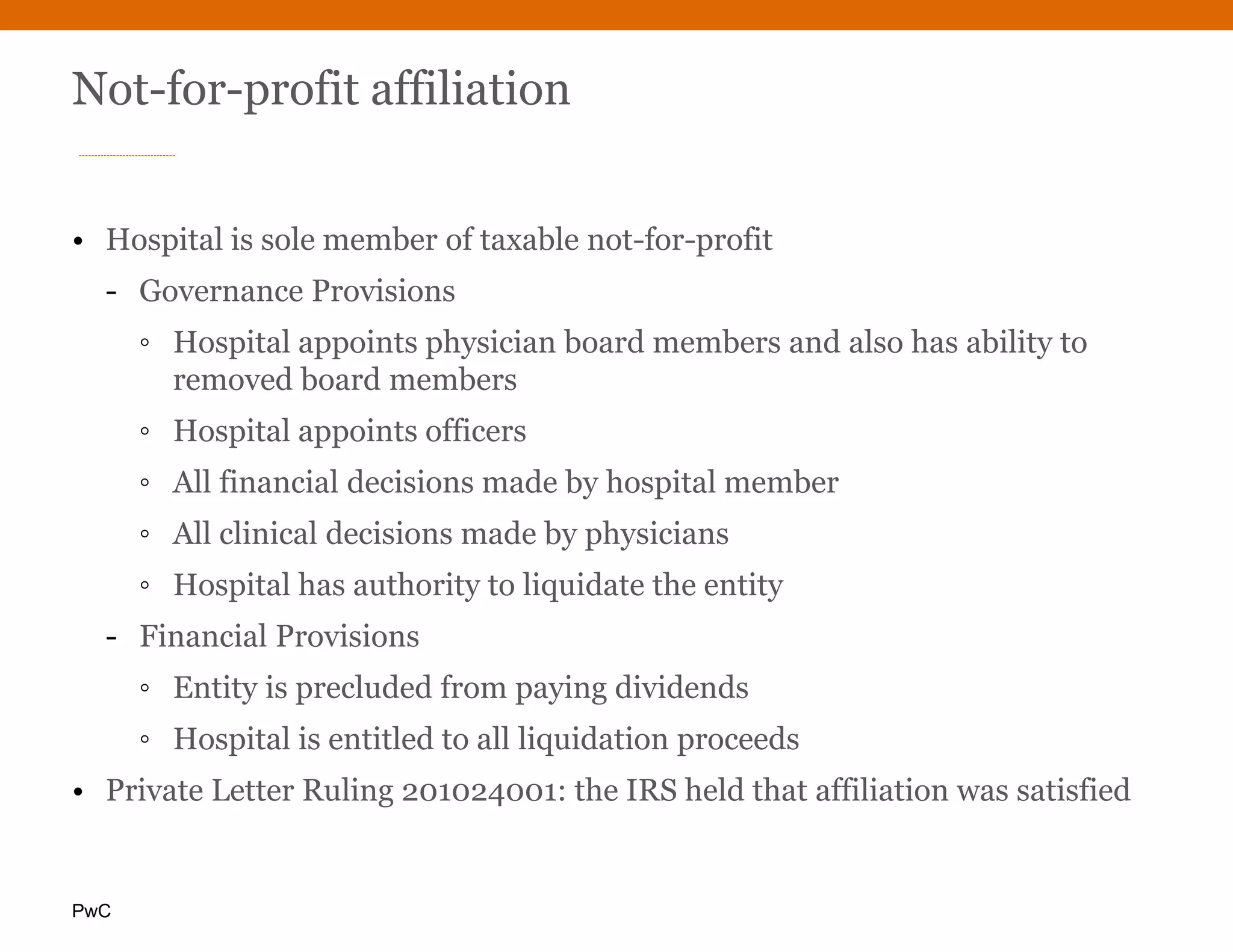
• Hospital is sole member of taxable not-for-profit
- Governance Provisions
◦ Hospital appoints physician board members and also has ability to
removed board members
◦ Hospital appoints officers
◦ All financial decisions made by hospital member
◦ All clinical decisions made by physicians
◦ Hospital has authority to liquidate the entity
- Financial Provisions
◦ Entity is precluded from paying dividends
◦ Hospital is entitled to all liquidation proceeds
• Private Letter Ruling 201024001: the IRS held that affiliation was satisfied
PwC
A few of the unanswered questions
• How far do these rulings extend?
- For example, are stock basis adjustments made to “sub” stock that legally
is not owned by a group member? If so, if an ELA is created with respect
to nonexistent stock, what is the trigger mechanism?
- Does PC’s E&P (or deficit) “tier-up” to Parent?
• If a consolidated return election is in place for Parent’s group, is inclusion of
PC mandatory in the absence of a PLR?
• If consolidation is not desired/elected, do controlled group rules
nevertheless apply?
• If the PC was instead a PLLC, is its default classification a single member
LLC (i.e., disregarded) or a partnership (due to the physician’s nominal
interest)?
- Consider Luna and Culbertson cases
- Who has rights to benefits and burdens of ownership?
PwC
Joint Ventures (“JVs”)
PwC
PwC
Common JVs
• Hospital forms a joint venture with a group of physicians
• The assets and business of a nonprofit are contributed to a newly created
joint venture, and a partner organization (generally for-profit) contributes
capital sufficient to provide it with a majority ownership interest in the joint
venture
- Day-to-day operations of the joint venture often are managed by the for-
profit entity pursuant to a management contract
- Nonprofit provides clinical and physician development services to the
joint venture
PwC
Capital structure of JVs
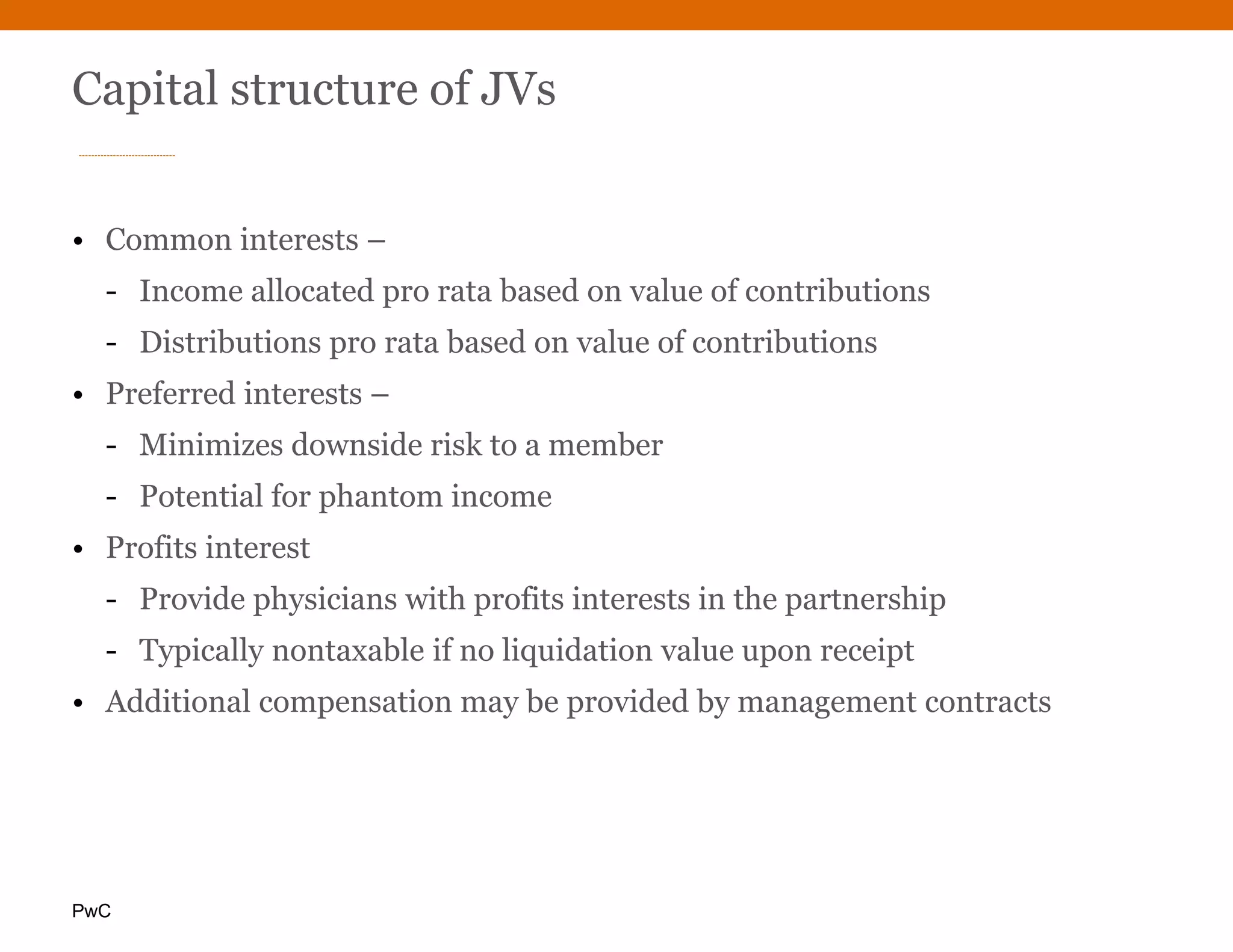
• Common interests –
- Income allocated pro rata based on value of contributions
- Distributions pro rata based on value of contributions
• Preferred interests –
- Minimizes downside risk to a member
- Potential for phantom income
• Profits interest
- Provide physicians with profits interests in the partnership
- Typically nontaxable if no liquidation value upon receipt
• Additional compensation may be provided by management contracts
PwC
JV considerations
• Form a new LLC
- Contribution of property and brand names
◦ Negotiating section 704(c) method for allocating income, gain, loss and
deductions from contributed built-in gain property
◦ Potential to allocate income in excess of ownership percentage to
contributing partner
◦ Determine whether property contributed is amortizable
- Disguised sale rules
◦ Cash distributions within two years of contribution unless an exception
› Reimbursement of preformation expenditures
› Debt-financed distribution
› Operating cash flow
◦ Assumption of nonqualified liabilities
PwC
JV considerations (continued)
• Buy into existing LLC
- Step-up to FMV tax basis under section 743(b) with a valid section 754
election in place
- Benefit of amortization deductions allocated only to buying partner
• Divesting a group of clinics to partners
- Leverage partnership prior to divesting interest
- Consider disguised sale rules
Breakout Session
2c. Tax planning for executive an
physician compensation and
benefit arrangements
Bruce Clouser, PwC
Travis Patton, PwC
MaryAnn Piccolo, University of Pennsylvania
PwC
Tax planning for executive and physician compensation and
benefit arrangements
Deferred Compensation Planning
• Techniques
• Reporting Considerations
• Other Items
PwCPwC
Deferred compensation planning –
Techniques
PwC
PwC
Deferred compensation planning – Techniques
Overview
• Goals of a Deferred Comp Program
• Types of Deferred Comp Arrangements
- Qualified Plans/Section 403(b) Plans
- Section 457(b) Plans
- Section 457(f) Plans
- Section 409A
- Split Dollar Life Insurance
PwC
Deferred compensation planning – Techniques (continued)
Qualified Plans/Section 403(b) plans
• Defined Contribution vs. Defined Benefit Plans
• Advantages
- Tax-deferred accumulation until distribution (or later if rolled into IRA)
- Benefits are secure from creditors
• Disadvantages
- Contributions/benefits subject to limits and non-discrimination testing
(governmental plans generally exempt from non-discrimination testing)
- Compliance requirements may be complex
PwC
Deferred compensation planning – Techniques (continued)
Section 457(b) Plans
• Availability/Funding Rules
• Advantages
- Amounts may be fully vested without tax
- Permits additional wealth accumulation on tax-deferred basis
• Disadvantages
- Relatively low contribution limits ($18,000 for 2015)
- Can’t be rolled over (unless governmental plan)
- Not secure from creditors (unless governmental plan)
PwC
Deferred compensation planning – Techniques (continued)
Section 457(f) Plans
• Availability/Funding Rules
• Advantages
- Unlimited deferral opportunity
- Limited compliance requirements
• Disadvantages
- Must be at risk of loss to avoid premature taxation
- Not exempt from section 409A
PwC
Deferred compensation planning – Techniques (continued)
Section 409A
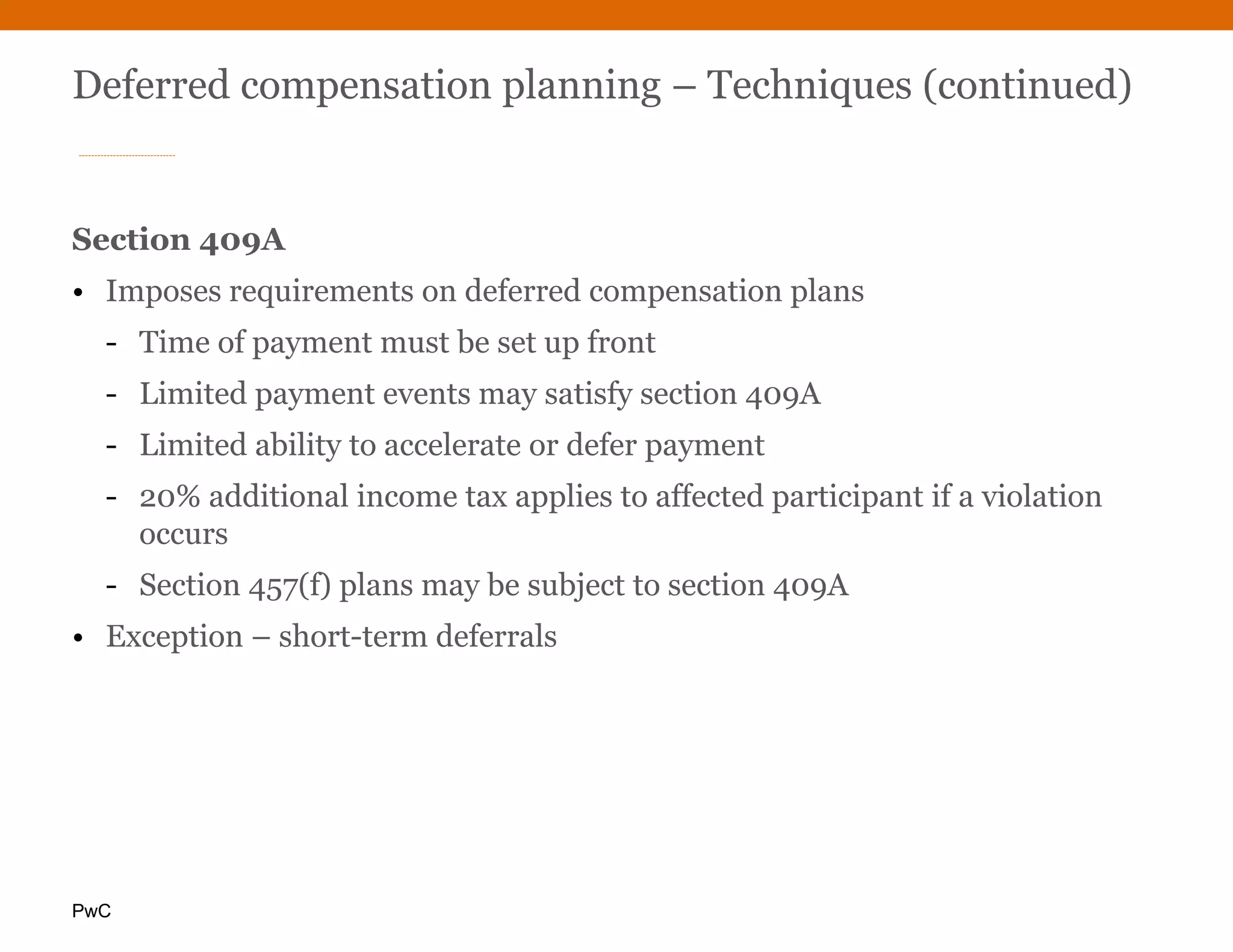
• Imposes requirements on deferred compensation plans
- Time of payment must be set up front
- Limited payment events may satisfy section 409A
- Limited ability to accelerate or defer payment
- 20% additional income tax applies to affected participant if a violation
occurs
- Section 457(f) plans may be subject to section 409A
• Exception – short-term deferrals
PwC
Deferred compensation planning – Techniques (continued)
Split dollar life insurance
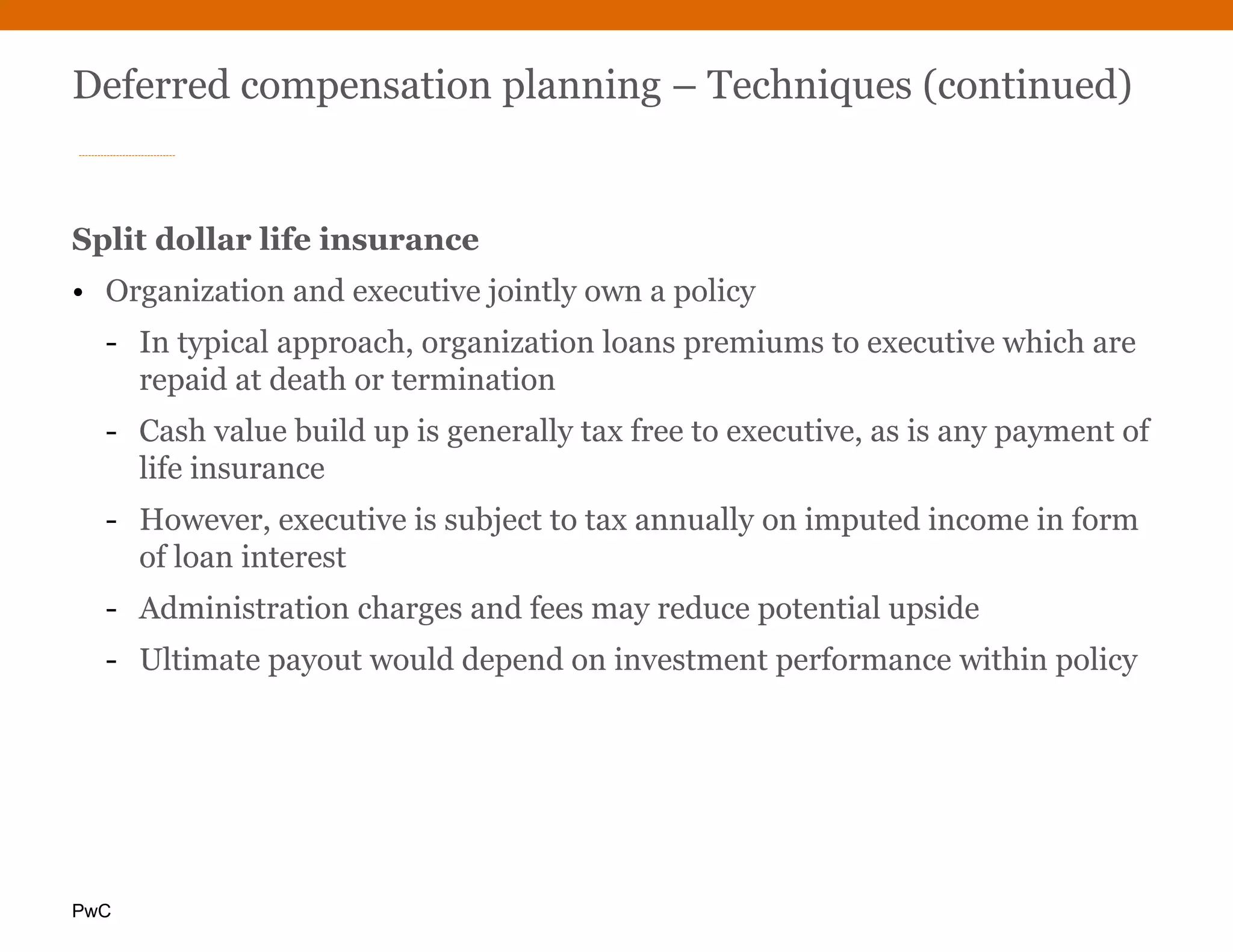
• Organization and executive jointly own a policy
- In typical approach, organization loans premiums to executive which are
repaid at death or termination
- Cash value build up is generally tax free to executive, as is any payment of
life insurance
- However, executive is subject to tax annually on imputed income in form
of loan interest
- Administration charges and fees may reduce potential upside
- Ultimate payout would depend on investment performance within policy
PwC
Deferred compensation planning – Techniques (continued)
Summary of Deferral Opportunities
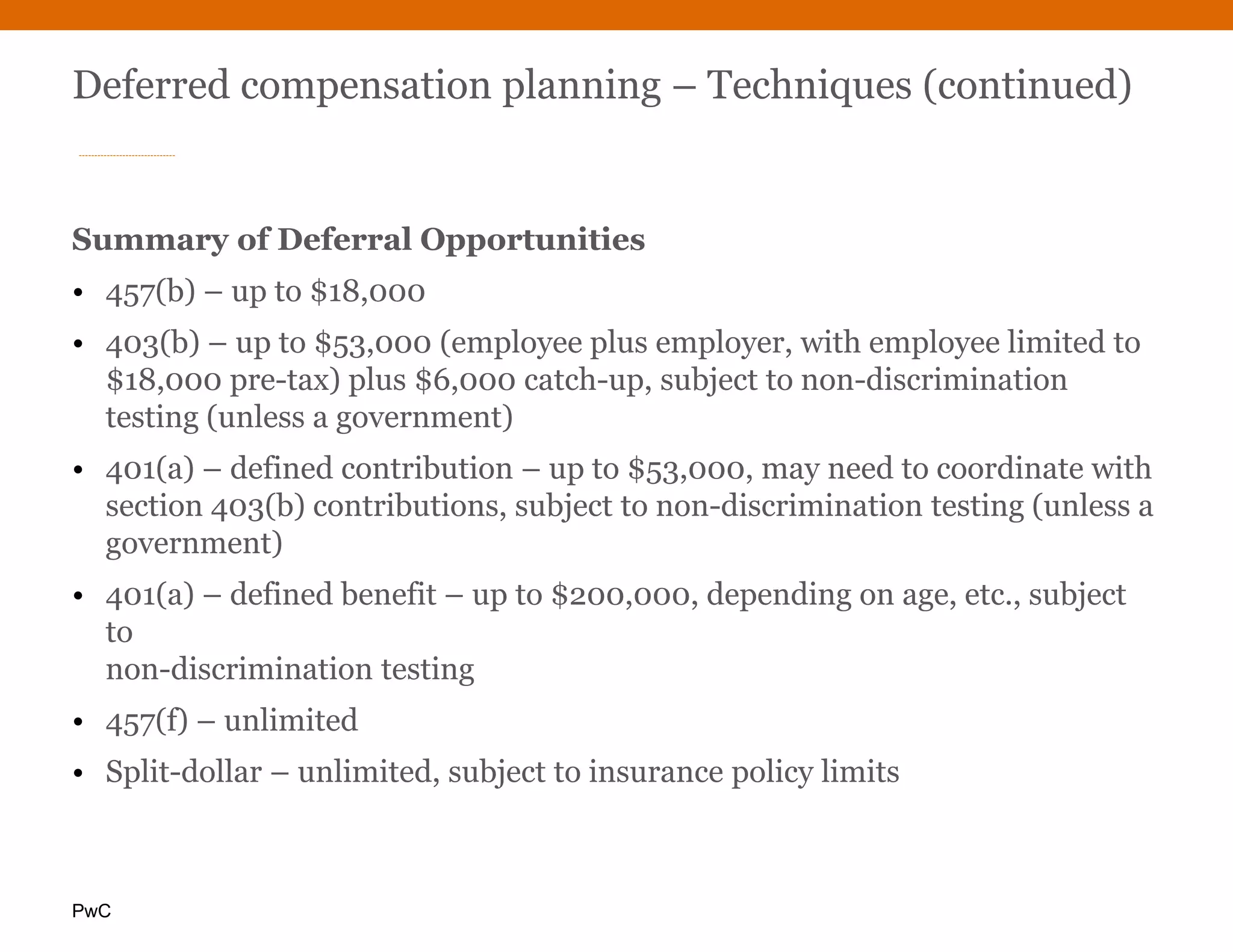
• 457(b) – up to $18,000
• 403(b) – up to $53,000 (employee plus employer, with employee limited to
$18,000 pre-tax) plus $6,000 catch-up, subject to non-discrimination
testing (unless a government)
• 401(a) – defined contribution – up to $53,000, may need to coordinate with
section 403(b) contributions, subject to non-discrimination testing (unless a
government)
• 401(a) – defined benefit – up to $200,000, depending on age, etc., subject
to
non-discrimination testing
• 457(f) – unlimited
• Split-dollar – unlimited, subject to insurance policy limits
PwCPwC
Deferred compensation planning –
Reporting considerations
PwC
PwC
Deferred compensation planning – Reporting
Considerations
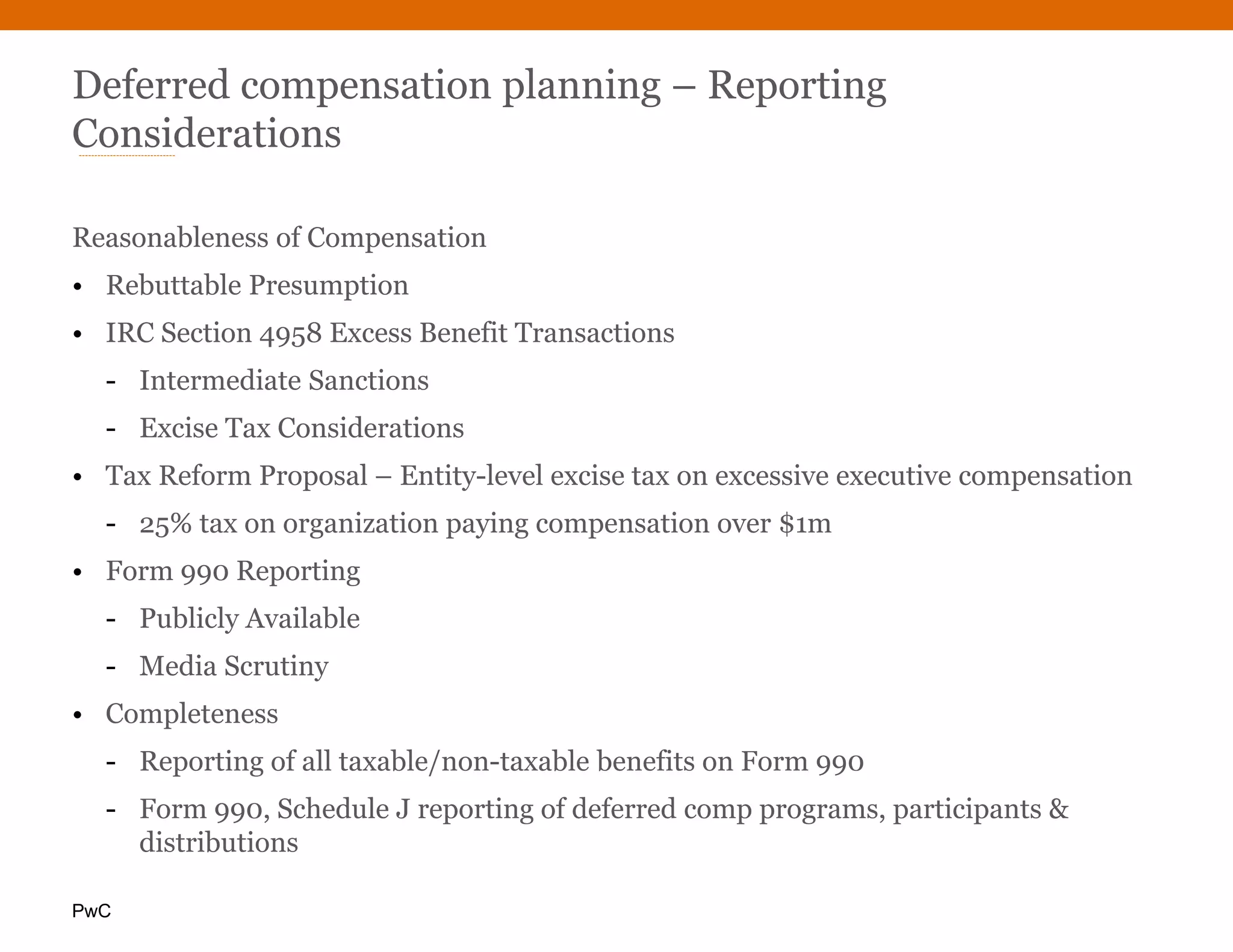
Reasonableness of Compensation
• Rebuttable Presumption
• IRC Section 4958 Excess Benefit Transactions
- Intermediate Sanctions
- Excise Tax Considerations
• Tax Reform Proposal – Entity-level excise tax on excessive executive compensation
- 25% tax on organization paying compensation over $1m
• Form 990 Reporting
- Publicly Available
- Media Scrutiny
• Completeness
- Reporting of all taxable/non-taxable benefits on Form 990
- Form 990, Schedule J reporting of deferred comp programs, participants &
distributions
PwC
Deferred compensation planning – Reporting
Considerations (continued)
Reasonableness of Compensation
• State Reporting Implications
- Form 990 typically must be attached to annual state solicitation
registration filings
- Compensation practices may need to be disclosed for sales tax exemption
renewal purposes
(PA-as example)
PwCPwC
Deferred compensation planning –
Other items
PwC
PwC
Deferred compensation planning – Other items
• Joint Venture Relationships
• Revenue Sharing Arrangements
• Licensing Fees
• Other Items
PwC
Questions?
MaryAnn Q. Piccolo
Associate Comptroller –
Tax & Int’l Operations,
University of Pennsylvania
(215) 898-8967
mpiccolo@upenn.edu
Bruce E. Clouser
Partner, PwC LLP
(267) 330-3194
bruce.e.clouser@us.pwc.com
Travis L. Patton
Partner, PwC LLP
(202) 414-1042
travis.patton@us.pwc.com
PwC
Tax Function
of the Future
Redesign, redefine, and
redeploy tax to be a
strategic business asset
PwC
• Introductions
• Background
• Tax function of the future: Predictions
• Tax operations
• Data
Agenda
PwC
Tax function of the future
Background
PwC
Background
Tax Function Evolution
• Since adoption of Sarbanes Oxley, Tax functions have been under increased
pressure both internally & externally (cost pressures, PCAOB, auditors, etc.)
• Some Tax functions began implementing systems in an attempt to improve their
efficiency and effectiveness
• Others, stuck with what worked for them, even if not efficient or optimal, because of the
perceived complexity of their processes/structure.
• In the past several years, Tax technology has improved such that tax functions are able to
utilize enabling technologies for key areas:
• Tax sensitization of data
• Storage of data
• Management of tax provision and return process
• Forecasting and modeling
• Management of tax controversies
PwC
Background
Tax Function Trends
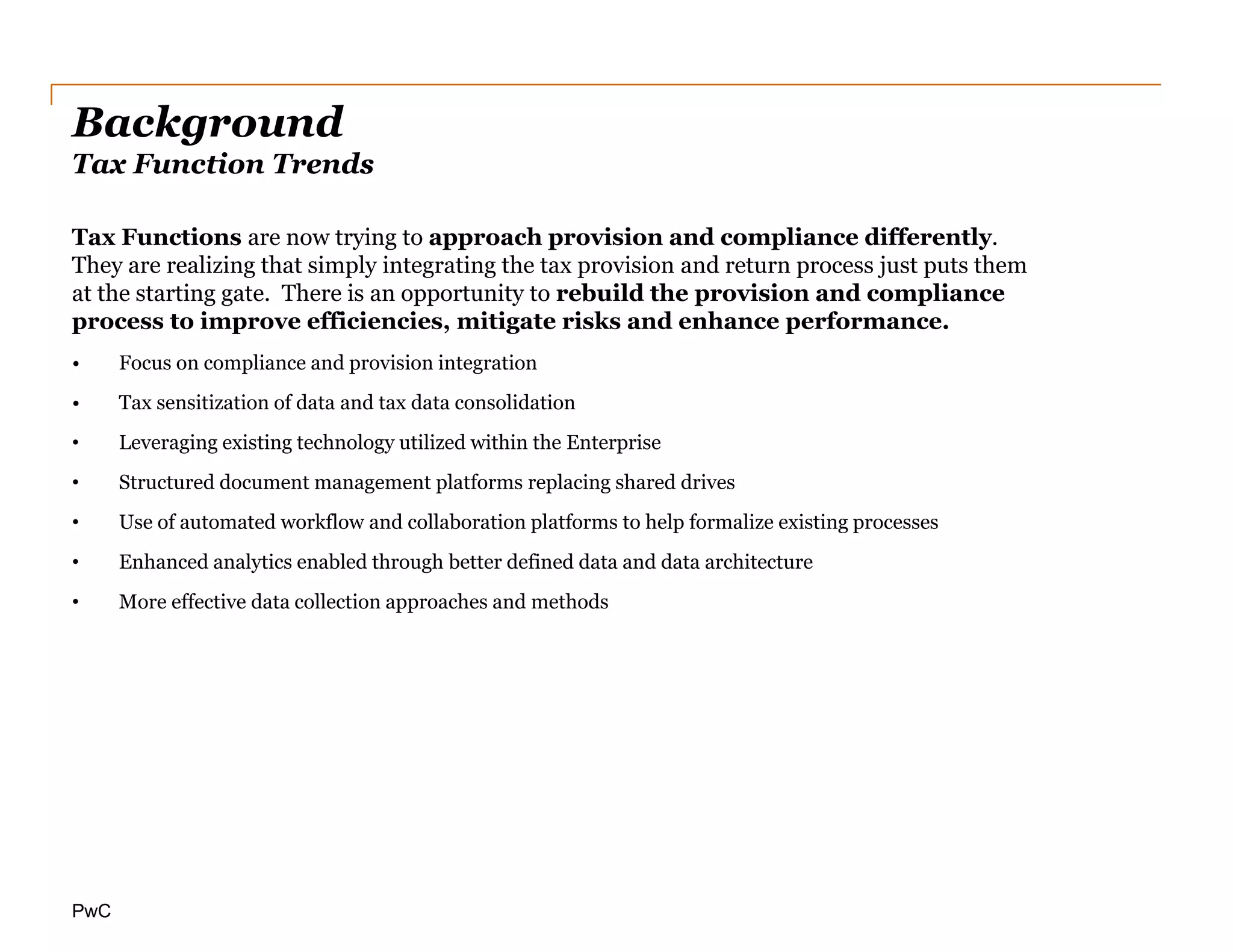
Tax Functions are now trying to approach provision and compliance differently.
They are realizing that simply integrating the tax provision and return process just puts them
at the starting gate. There is an opportunity to rebuild the provision and compliance
process to improve efficiencies, mitigate risks and enhance performance.
• Focus on compliance and provision integration
• Tax sensitization of data and tax data consolidation
• Leveraging existing technology utilized within the Enterprise
• Structured document management platforms replacing shared drives
• Use of automated workflow and collaboration platforms to help formalize existing processes
• Enhanced analytics enabled through better defined data and data architecture
• More effective data collection approaches and methods
PwC
Need to change
Megatrends and the impact to organizations
Staff is more
decentralized with
growing skill gaps.
Demographic
shifts
Trade and investment
is shifting to developing
countries increasing
risk and complexity.
Shift in global
economic
power
Governments are competing
for business and requiring
greater transparency.
Accelerating
urbanization
Technology vendors are
developing new capabilities
and new market entrants
are emerging.
Technological
breakthroughs
Organizations continue to
demand higher quality
analysis while staffing levels
are holding steady or falling.
Operational
optimization
Global Megatrends
Demographic
shifts
Shift in global
economic
power
Accelerating
urbanization
Technological
breakthroughs
Climate
change &
resource
scarcity
PwC
Tax function of the future
Predictions
PwC
Legislative/regulatory
• Global tax information reporting requirements
(e.g., BEPS and similar transparency initiatives) will
grow exponentially and will have a material impact on
the operations and related budget allocations of
Tax functions.
• Global markets will demand complete transparency
and information sharing among stakeholders and
taxing jurisdictions, resulting in an increase in overall
tax liabilities.
• The majority of taxing jurisdictions, in both developed
and emerging markets, will have systems and data-
mining capabilities to conduct global audits which will
reconcile income and expense across jurisdictions.
PwC
Risk & governance
• Many jurisdictions will legislatively require the
adoption of a tax control framework which follows
guidelines similar to Sarbanes-Oxley and COSO
(Committee of Sponsoring Organizations of the
Treadway Commission).
• Enhanced stakeholder scrutiny and reputational risk
will force companies to continuously re-evaluate their
tax decisions.
• Strategic focus on jurisdictional reporting and
documentation of business activities, including transfer
pricing, will be critical to managing the increased tax
controversy resulting from transparency initiatives.
PwC
Data
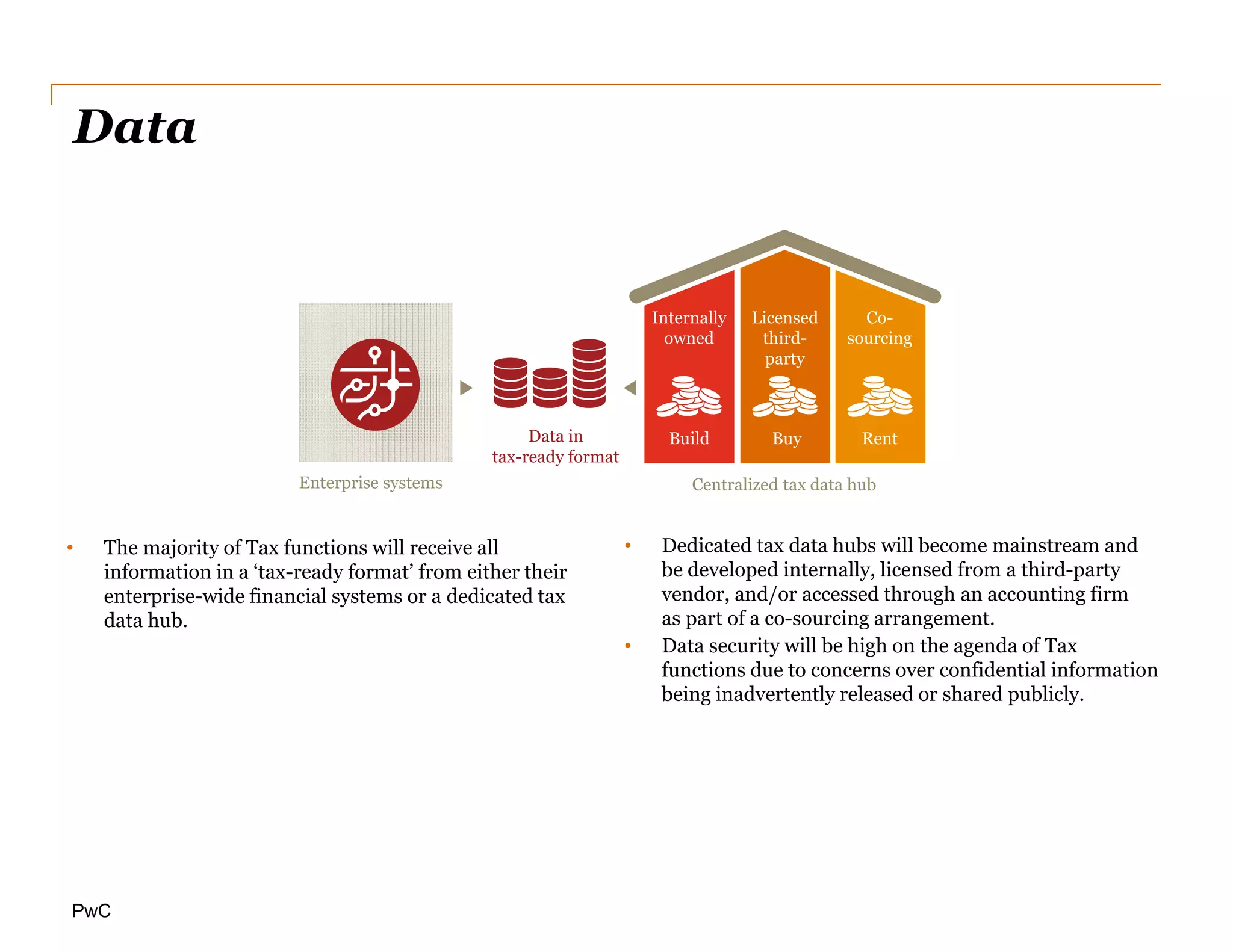
• The majority of Tax functions will receive all
information in a ‘tax-ready format’ from either their
enterprise-wide financial systems or a dedicated tax
data hub.
• Dedicated tax data hubs will become mainstream and
be developed internally, licensed from a third-party
vendor, and/or accessed through an accounting firm
as part of a co-sourcing arrangement.
• Data security will be high on the agenda of Tax
functions due to concerns over confidential information
being inadvertently released or shared publicly.
Data in
tax-ready format
Licensed
third-
party
Internally
owned
Co-
sourcing
BuyBuild Rent
Centralized tax data hubEnterprise systems
PwC
Technology
• The vast majority of Tax functions will rely on
professional data analysis tools to assist in the decision-
making process in areas such as detection of risk,
opportunity identification, projections and scenario
planning, and overall business support.
• More companies will use their enterprise-wide financial
systems to prepare tax calculations (e.g., income tax
accounting and indirect taxes), thereby replacing
spreadsheets and/or traditional tax technology
solutions.
New technology
Reduce global
tax rate
Identify risks
Projections
and predictive
analytics
SpreadsheetsSpreadsheets
Better decision
making and
enhanced
strategic planning
Enterprise systems
PwC
Process
• Tax functions will use real-time collaboration tools to
automate their workflow, document management,
calendaring, and internal controls.
• Most global tax preparatory compliance and reporting
activities, including data collection and reconciliations,
will be performed within the company’s shared service
center or will be co-sourced with a third party.
On-line collaboration tools
Workpaper
creation
Data
collection
Analysis Workflow
Shared service
center
Tasks and
processes
Tax function
Co-source Greater efficiency
Improved controls
Reduced costs
PwC
People
• Tax functions will employ dedicated tax IT, data and
project management specialists who will develop,
champion, and execute the tax technology and
transformation strategies.
• A successful tax professional of the future will be highly
proficient in data analysis, statistics, and technology, as
well as process improvement and change management.
TechnologySoft skills
Technical skills Leadership skills
Data analysis Statistics
PwC
Tax function of the future
Tax Operations Ecosystem
PwC
The future state ecosystem
Tax Finance Third parties
Key
deliverables
Business intelligence
and analytics
Tax data
hub
Tax
applications
Tax
sensitization
Tax data
management
Tax data
mapping
s
Enterprise
systems
Document management
Process management
and workflow CalendarData collection
Tax operations management
PwC
Tax function of the future
Data
PwC
Federal & State Tax Analytics – sample
PwC
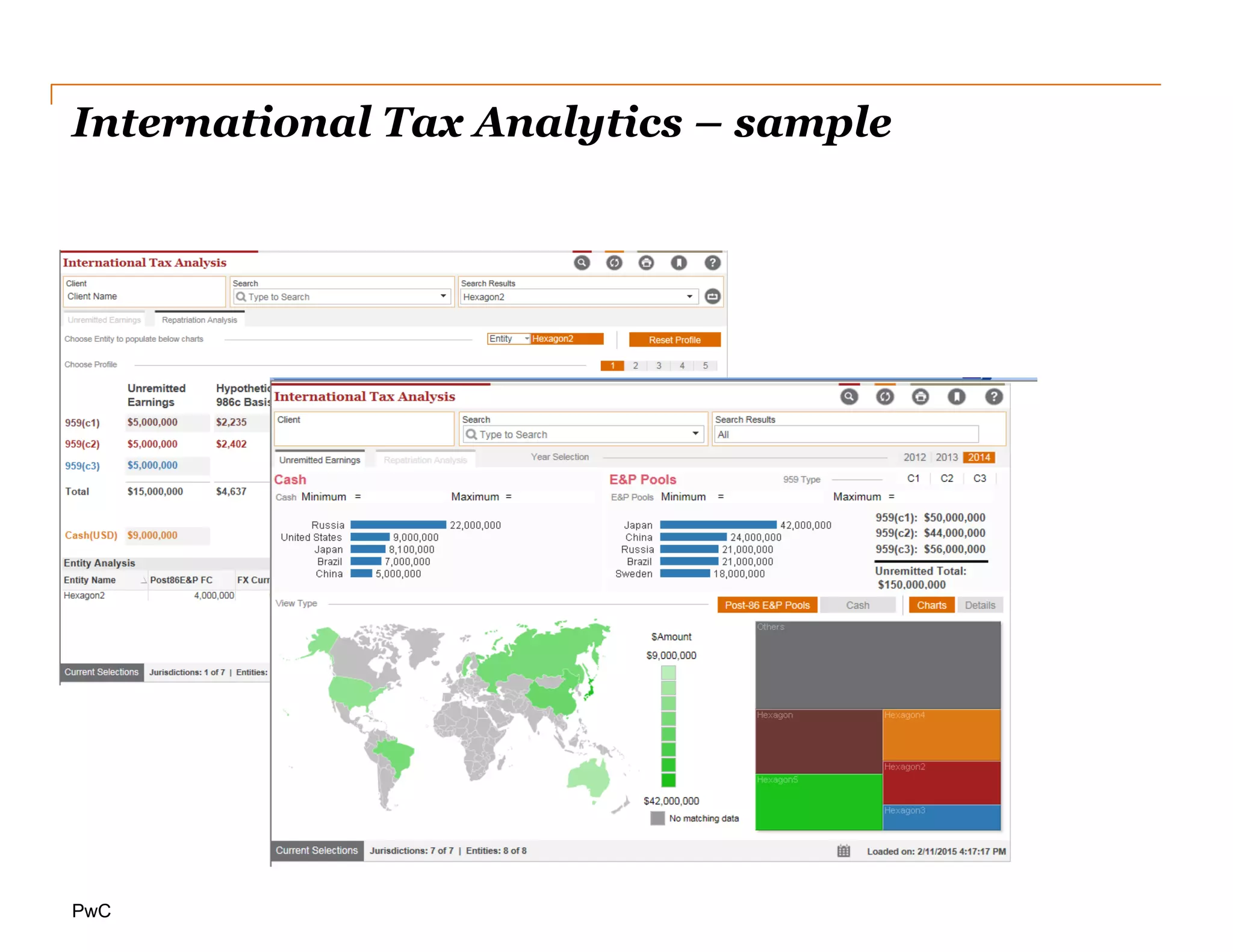
International Tax Analytics – sample
© 2015 PricewaterhouseCoopers LLP, a Delaware limited liability partnership. All rights reserved.
PwC refers to the United States member firm, and may sometimes refer to the PwC network. Each member firm is a separate legal
entity.
Please see www.pwc.com/structure for further details. This content is for general information purposes only, and should not be used as
a substitute for consultation with professional advisors.
Thank you!
Breakout Session
3b. State and local tax update
www.pwc.com
Troy Deason, HCA
Doug Jacobs, Steward Health
Maureen Pechacek, PwC
Edward Bringhurst, PwC
George Famalett, PwC
PwC
State tax panel
Maureen Pechacek – Partner, PwC, Moderator
Troy Deason – Director, State Income & Franchise Tax, HCA
Doug Jacobs – Director, Corporate Tax, Steward Health Care
Edward Bringhurst – Director, PwC
George Famalett – Partner, PwC
PwC
Refund of California sales tax on medical supplies for
medicare patients
• Many medical supplies are subject to sales tax in California unless an exemption applies.
• The historical position in California has been Healthcare providers (both For Profits and
Not For Profits) are considered “consumers” rather than retailers of medical supplies
which means healthcare providers are responsible for the sales tax on medical supplies
purchases.
• A position has been developed by PwC to classify Healthcare providers as retailers on
medical supplies utilized by healthcare providers who provide services to certain
medicare patients.
• The theory here is the U.S. government is financially responsible for services provided to
medicare patients which is an exempt transaction as a sale to the U.S. government.
• What is the benefit for healthcare providers? Example – Healthcare provider has 200
million of annual medical supplies that relate to the care of certain medicare patients. If
25% of these purchases (e.g., 25% of 200 million or 50 million) are subject to sales tax, a
refund of 4.25 million per year is available to a healthcare provider (50M 8.50%).
• A detailed data model must be built to support sales tax refunds relating to medical
supplier or medicare patients. This data model needs to determine the medicare usage
percentage by department (they are different) with appropriate audit documentation); a
methodology for bulk purchases, medicare revenue tie out (In patient vs. out patient) to
name a few issues.
PwC
Cloud Computing: Evolving the IT Stack
Cloud LayersTraditional IT Stack
0
0
Data Center Facilities
Networking
Servers and Storage
Operating Systems
Applications
Application Development &
Deployment
Infrastructure Software
(VM, Database, IT Mgmt)
Software as a
Service (SaaS)
Platform as a
Service (PaaS)
Infrastructure as
a Service (IaaS)
Traditional IT Stack
• Corporate IT hosted on-premise
• Each component linked, and built to satisfy
future capacity
• Riddled with complexity, high management
costs, lack of efficiency, unused capacity
Cloud IT
• Can be hosted on-premise, off premise or
hybrid
• Components are no longer linked, and can
be provisioned as a service in whatever
combination needed
• Built for most effective utilization
• Degree of complexity, management costs
decrease, much more efficient use of
resources
PwC
State and Local Indirect Tax Considerations for Cloud
Computing
• Classification of Service Offerings
• Sourcing
• Billing and Multiple Points of Use
• Risks
PwC
Classification
One of the main struggles in taxing cloud computing services is how to classify
the transaction—to answer the question “What are you selling?”
• Is it software?
• Is it information services?
• Is it data processing services?
• Are you leasing tangible personal property?
• None of the above?
PwC
Classification of SaaS
States are taking different approaches to cloud computing, mainly SaaS at this point.
• Electronically delivered software
• Non-taxable information or data processing service
• Taxable information or data processing service
• Nothing: state does not tax electronically delivered software or information/data
processing services
PwC
Classification of IaaS and PaaS
States are beginning to take a closer look at the classification of hosting services.
• Some ITFA grandfathered states that tax Internet access are taxing hosting
services as related Internet access services if sourced to that state
• Most classify it as a computer service, taxable or not taxable depending on the
state
• Some can’t make up their mind
PwC
Sourcing
The next issue that arises once a service offering has been classified is to which
state you source the revenue.
• By server location
• By user location
• By billing address or headquarters
If the service is deemed to be the sale or lease of tangible personal property, the
revenue would be sourced to the server if the provider can identify which
server was being used. If multiple servers are used, the issue becomes more
complex.
PwC
Billing and MPU Issues
Compliance:
• Customers may need detailed user or server location information in order
to determine their own sales tax exposures and for providers to correctly
apportion revenue.
• Customers may want sales tax collected based on user location (MPU
issues). Is there an industry standard?
• Can the suppliers automate the collection of sales and use taxes for
multiple user locations?
PwC
Sales/Use tax
Conversion of not-for-profit system to for profit
• Identification of Services Performed
(i.e. parking, lodging, sales of personal property, cafeteria and non-patient
meals, food court,
gift shop, etc.)
• Sales/use tax applicability to medical supplies & devices as well as ALL non-
medical
items purchased
• Sales/use tax applicability to assets
• Purchasing Department – Sales/use tax awareness and training
• Systems and IT – Turning on the tax flags; changing the tax flags
• Registering with taxing authorities; Reporting to taxing authorities; record
retention for
audit support
• Other Indirect Taxes – Local business taxes; recordation taxes; registered and
titled property
PwC
Texas margins tax – Industry issues
• Overview: Computation – The lower of the Following:
- Total Revenue minus COGS
- Total Revenue minus compensation
- 70% of Total Revenue
• Exclusions from Revenue
- Health Care Institutions
◦ 50% of revenues from Medicaid, Medicare, CHIP, TRICARE,
Workers Compensation claims, cost of uncompensated care
- Health Care Providers:
◦ 100% of Revenues from Medicaid, Medicare, CHIP, TRICARE,
Workers Compensation claims, costs of uncompensated care
PwC
Texas margins tax – Industry issues (continued)
• Uncompensated Care valuation
• Interplay on bad debt deduction and excluded uncompensated care
• Treatment of Co-Pays and deductibles
• Expenses related to excluded revenue
• Treatment of partial payments and the uncompensated care exclusion
• Treatment of expenses attributable to uncompensated care
• Treatment of partnerships
• Deduction for certain flow-through funds
• Recent TX ruling regarding reimbursements
PwC
Multistate income tax issues
• Pending GAAP change to revenue recognition rules
• Treatment of rebates
• Sourcing:
- Market-based sourcing and COP state challenges
- Pennsylvania, Florida, Indiana, New York, others
• Transfer Pricing Issues
- Recent litigation in DC
- MTC Proposed Changes
- Audit Activity
PwC
District of Columbia – Transfer pricing
Hess Corp. v. OTR, No. 2012-OTR-00027 (November 14, 2014); Exxon Mobil
Oil Corp. v. OTR, No. 2012-OTR-00049 (November 14, 2014); Shell Oil Co. v.
OTR, No. 2011-OTR-00047 (November 14, 2014)
• Three orders of the Office of Administrative Hearings reversed District of
Columbia Office of Tax and Revenue (OTR) proposed franchise tax
assessments based on transfer pricing analyses prepared by OTR’s third-
party contractor, Chainbridge Software LLC.
• Taxpayers argued that non-mutual offensive collateral estoppel should be
preclude OTR from relitigating whether the Chainbridge methodology can
be utilized to assess franchise taxes.
• The Administrative Law Judge (ALJ) reviewed several ‘fairness’ factors and
determined that applying estoppel against OTR would not be unfair.
PwC
Other multistate income/franchise tax & other unique
issues/opportunities
• Move to Unitary Combined Reporting
• Treatment of Foreign Income
• Franchise Taxes – LLC’s – Louisiana
• Credits & Incentives
• New Markets Tax Credit
• Purchasing Companies
PwC
Healthcare provider taxes
Where Provider Taxes Exist?
49 States and the District of Columbia have imposed Healthcare Provider
Taxes of some sort.
Why Provider Taxes Exist?
Provider taxes to help ease the State burden associated with
Medicare/Medicaid
Who do Provider Taxes Apply?
Federal requirements allow states to impose provider taxes on 19 classes of
healthcare providers, but most typically:
• Nursing Facilities
• Hospitals
• Intermediate Care Facilities
• Managed Care Organizations
PwC
Healthcare provider taxes – Overview
CMS reimbursement
Hospitals
State Government
Federal Government
Center for Medicare &
Medicaid Services (CMS)
$302.9 mm
Healthcare
Provider
Taxes
$248.7 mm State
Contribution
$341.4 mm
Federal
Contribution
$590.2 mm
Supplemental
Payments
Federal Contribution
based on state
per capita income
$590.2 mm
CMS Disbursement
PwC
Healthcare provider taxes
New Hampshire – April 2014
Catholic Medical Center et al v. N.H. Department of Revenue
• Equal Protection argument
- Hospitals were subject to tax, clinics were not
- Hospitals and clinics provided several of the same services
- Parties must be treated equally unless the “rational basis test” is
satisfied
PwC
Healthcare provider taxes
New Hampshire – April 2014 (continued)
Catholic Medical Center et al v. N.H. Department of Revenue
• Rational Basis Test
- Hospital tax was imposed to balance state budget by taxing and
returning tax to hospital, but receiving Federal matching
- CMS fought these policies beginning in 2011, and obtained a Federal
prohibition against guaranteeing a hospital is “held harmless” by a tax.
- Since hospitals were no longer acting as a conduit to balancing the
budget, the “rational basis” was destroyed for the New Hampshire tax
- Medicaid Enhancement Tax (MET) struck down
PwC
Healthcare provider taxes
Kentucky – April 2015
Saint Joseph Health Systems, Inc – KY Board of Tax Appeals
• Statutory Construction – HB 380
- Hospital provider tax collections for FY 2006-2007 and 2007-2008
shall not be less than $180,000,000. Notwithstanding the tax shall not
exceed the amount of the aggregate provide taxes paid by hospitals in
FY 2005-2006
- Issue was whether it was taxes original paid and/or amounts paid after
refunds of overpaid tax. BOTA held it was original tax paid
PwC
Healthcare provider taxes
Kentucky – April 2015 (continued)
Saint Joseph Health Systems, Inc – KY Board of Tax Appeals
• Federal Preemption
- “No tax or fee or other monetary payment may be imposed directly or
indirectly on a carrier… with respect to any payment made under the
fund” 5 U.S.C Section 8908(f)(1)
- Taxpayer argues that tax is “indirectly” on the carrier because they pass
it on through higher medical costs. In addition, the department believes
the original position on granting refunds in 2005-2006 years was
incorrect. The Board held that they would follow the West Virginia case
and “the mere fact that a provider may opt to pass through the cost it
bears to carriers, including FEHB carriers, dot not transform the
provider tax into an illicit indirect imposition of a state tax upon the
FEHB fund”
PwC
Healthcare provider taxes
Kentucky – April 2015 (continued)
Conclusion
• Evaluate potential CA opportunity
• Evaluate flow through exemptions related to Medicare
• Significant sales tax issues related to conversion of Not-for-Profit to For-
Profit – evaluate and understand issues & increased costs
• Evaluate Texas Margins Tax for potential opportunities
• Understand changes related to new GAAP revenue recognition rules
• Keep Transfer Pricing reports current
• Evaluate purchasing companies
• Healthcare provider taxes – Additional litigation is expected
PwC
Thank you
2015 Health Services
Tax Conference
3c. Unrelated Business
Income
Moderator: Gwen Spencer, Tax Partner
Panelists: Michael Walton, Vice President,
Tax Services at Kaiser Permanente
Amity Ollis, Tax Manager,
Dartmouth- Hitchcock
PwC
Agenda
• Background
• New business operations
• Investments
• Accountable Care Organizations (ACOs)
• International transactions – beyond captive insurance
PwC
UBI – New business operations
Telemedicine, Virtual Care, E-Medicine
The use of telecommunication and information technologies in order to provide clinic
health care at a distance. Telemedicine helps eliminate barriers and can improve access
to medical services that would often not be consistently available in distant and/or rural
communications. It is also used in critical care and emergency situations.
• HUB = Hospital, clinic, or other healthcare provider that is providing the clinical
services.
• SPOKE = Hospital, doctor’s office, clinic, etc. that is receiving the services or serves
as an intermediary and point of access for patients.
Medical Directorships and Clinic Support
• Individuals employed by one particular hospital are provided to unrelated hospitals
in return for a fee.
• Hospital staffing clinics in retail chains (Walmart, Walgreens, etc.) and corporations.
PwC
UBI – New business operations
Mercy set to open ‘virtual care center’ to reduce variation in care delivery
http://medcitynews.com/2015/05/mercy-set-open-virtual-care-center-reduce-
variation-ca
Texas votes to limit telemedicine solely to in-state practices
http://www.nytimes.com/2015/04/11/us/texas-medical-panel-votes-to-limit-
telemedicine-practices-in-state.html?_r=0re-delivery/
NY telemedicine reimbursement legislation
http://www.natlawreview.com/article/new-york-passes-telemedicine-reimbursement-
legislation
Partnerships of exempt hospitals/health systems with telemedicine
technology companies to expand care markets
http://finance.yahoo.com/news/carena-partnerships-expand-telemedicine-solutions-
130000560.html
Kaiser Permanente joins forces with Target Corp on in-store clinics
http://www.latimes.com/business/la-fi-kaiser-target-clinics-20141118-story.html
Wal-Mart partners with hospitals to rapidly expand in-store clinics
http://www.amednews.com/article/20080225/business/302259998/1/
PwC
UBI – New business operations – Tax considerations
• Definition of Patient?
- Are they a patient of the Hub? Are they registered with the Hub?
- What is the patient billing/registrations structure?
- Who is being billed for the service (the Spoke or the patient)?
- Are the services being provided to communities where the services are not otherwise
available/provided?
- Does the provider interact with the patient? Or, does he or she rely solely on records, images,
and other healthcare providers?
• Does the activity further the organization’s charitable purpose?
• How does the shift in capacity impact the analysis?
• Who is the nfp providing the service for? For-profit?
• Private benefit concerns
• Future Concerns
- Loss activity now, but what about the future?
- Joint venture rules come into play
- The impact on TE status when engaging with for-profits to grow their business
• State reporting obligations
• International operations
PwC
UBI – Investments
Background:
• Certain investments of the organization generate UBI – Federal and State
• Activities of LPs/LLCs are attributed to the tax-exempt partner – IRC
section 512(c)
Tax Considerations:
• UBI – Federal and State
• Federal & State Filings
• Domestic Filings to Report Foreign Activities
• Reportable Transactions
• Foreign Bank Account Reporting
• Boycott filings
• Form 5471
PwC
UBI – Investments
Things to consider:
• Healthcare systems may not be as experienced as others in understanding
compliance requirements arising from investments by a nfp organization
• Process improvement - how does your organization approach the process?
• Communication/education of Treasury/CIOs
• Inventory – what was entered and what was exited - Secure all the k-1s (IRS
now often asks for a list of K-1s in audit process)
• Pre-investment consultation with tax
- Considering blocked v. unblocked
- Use of existing NOLs – Federal and State
• Foreign investments – direct or indirect
• Direct communication with investment contacts
PwC
UBI – Accountable Care Organizations (ACOs)
Background:
• A group of physicians, hospitals, and other health care providers that come together
to provide coordinated care to patients for whom they have a collective responsibility
for their health needs.
Tax Considerations:
• Whether the arrangement furthers a charitable purpose;
• Whether the exempt organization has ceded control over a substantial portion of its
activities or has retained sufficient control to avoid inappropriate benefit to the non-
exempt partners;
• Whether the non-exempt partners participate on terms that are consistent with fair
market value (i.e., no private benefit or inurement).
Considerations:
• ACOs - more to come?
• ACO – beyond MSSP?
PwC
UBI – Accountable Care Organizations (ACOs)
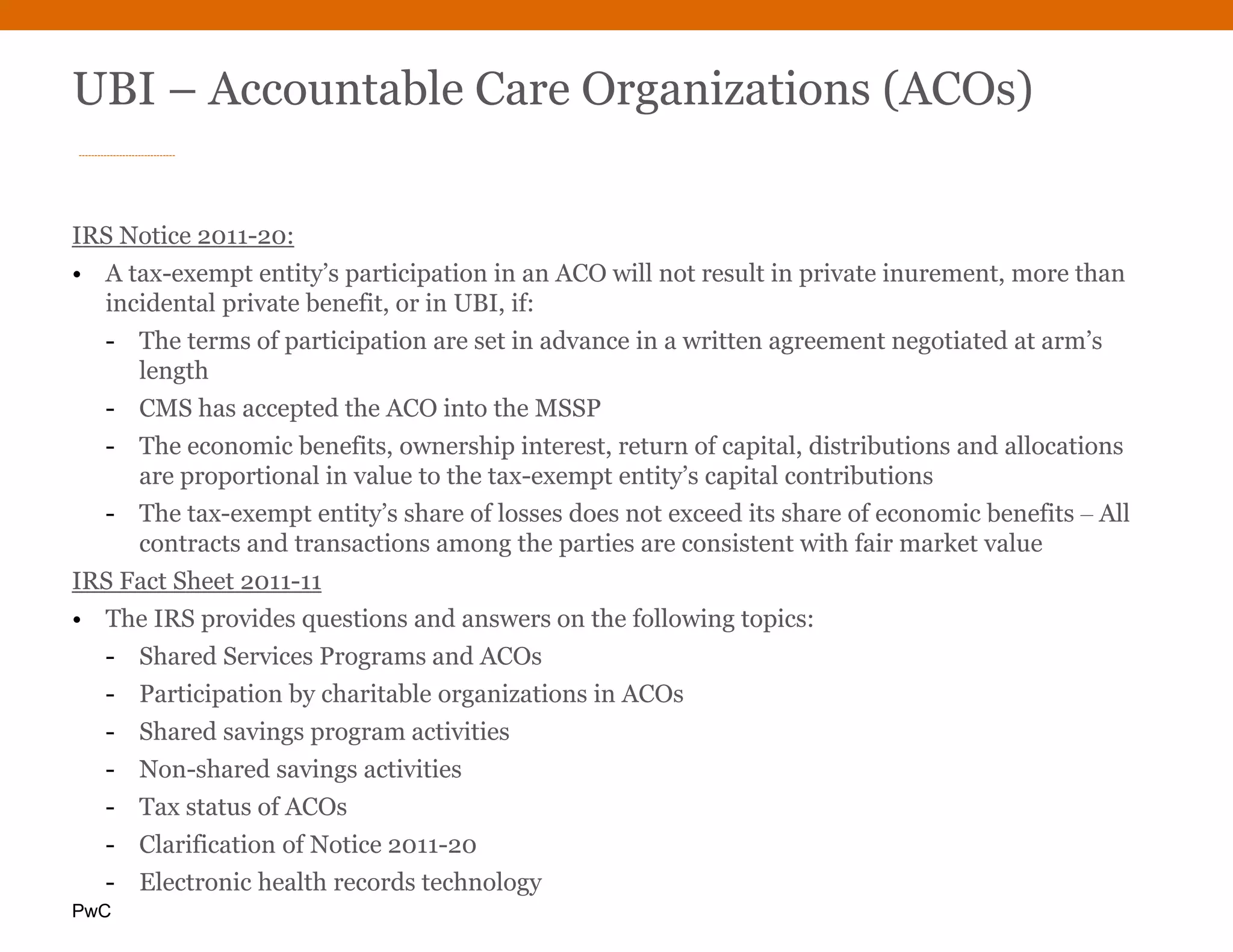
IRS Notice 2011-20:
• A tax-exempt entity’s participation in an ACO will not result in private inurement, more than
incidental private benefit, or in UBI, if:
- The terms of participation are set in advance in a written agreement negotiated at arm’s
length
- CMS has accepted the ACO into the MSSP
- The economic benefits, ownership interest, return of capital, distributions and allocations
are proportional in value to the tax-exempt entity’s capital contributions
- The tax-exempt entity’s share of losses does not exceed its share of economic benefits ‒ All
contracts and transactions among the parties are consistent with fair market value
IRS Fact Sheet 2011-11
• The IRS provides questions and answers on the following topics:
- Shared Services Programs and ACOs
- Participation by charitable organizations in ACOs
- Shared savings program activities
- Non-shared savings activities
- Tax status of ACOs
- Clarification of Notice 2011-20
- Electronic health records technology
PwC
UBI – International transactions – Beyond captive insurance
Tax Considerations
• Permanent establishment (“PE”) risk
• Registration/licensing/permitting/withholding
• Payroll/personnel considerations
• Foreign exchange risk
• Structuring considerations
- Joint Ventures
- Partnerships with Foreign healthcare entities (virtual and physical presence)
- Controls around expenditures abroad
• Completeness of Form 990, Schedule F reporting
• Intellectual property/capital risks
• Transfer pricing considerations
• FBAR reporting
• Reputational/headline risks
PwC
UBI – International transactions – Beyond captive insurance
International patients
http://www.bostonglobe.com/business/2014/12/31/international-patients-boost-
profits-children-hospital/eKD4tUTt6CsbBXoumYvrTL/story.html
How US hospitals are helping US trade policy
http://foreignpolicyblogs.com/2014/03/25/how-hospitals-are-helping-u-s-trade-
policy/
UPMC overseas growth (2010)
http://www.post-gazette.com/local/city/2010/05/30/How-UPMC-s-overseas-
operations-blossomed-in-14-years/stories/201005300208
America’s top hospitals go global (2008)
http://www.forbes.com/2008/08/25/american-hospitals-expand-forbeslife-
cx_avd_0825health.html
US Providers enter variety of collaborations (2012)
http://www.modernhealthcare.com/article/20120609/MAGAZINE/306099941
PwC
Thank you!
Michael Walton (510) 271-6385 michael.p.walton@kp.org
Amity Ollis amity.l.ollis@hitchcock.org
Gwen Spencer (617) 530-4120 gwen.spencer@us.pwc.com
2015 Health Services
Tax Conference
May 18-19, 2015
The Drake Hotel
Chicago, IL
Health Services
Tax Conference
Responses to Health
Reform
Amy Bergner
PwCPwC
Health care reform – five years after ACA
Payers EmployersHospital Systems
.
PwC
Responses to health care reform
Consideration of private exchanges
Shift to high deductible health plans
Interest in direct contracting, new delivery models, value based payments
New markets – direct to consumer, private and public exchanges
Clinical improvements
Value based payments
Purchase of provider organizations
New markets
New entrants
New payment models
Convergence with payers
PwCPwC
Everyone in the pool!
PwC
Paying for reform – tax perspectives
Health Insurance Provider Fee/HIT tax
MLR
Reinsurance contributions
PCORI
Shift to retail and consumer model
Bearing risk
Impact of convergence and becoming subject to payer taxes
Reinsurance contributions
PCORI
Employer mandate
Cadillac tax
PwC
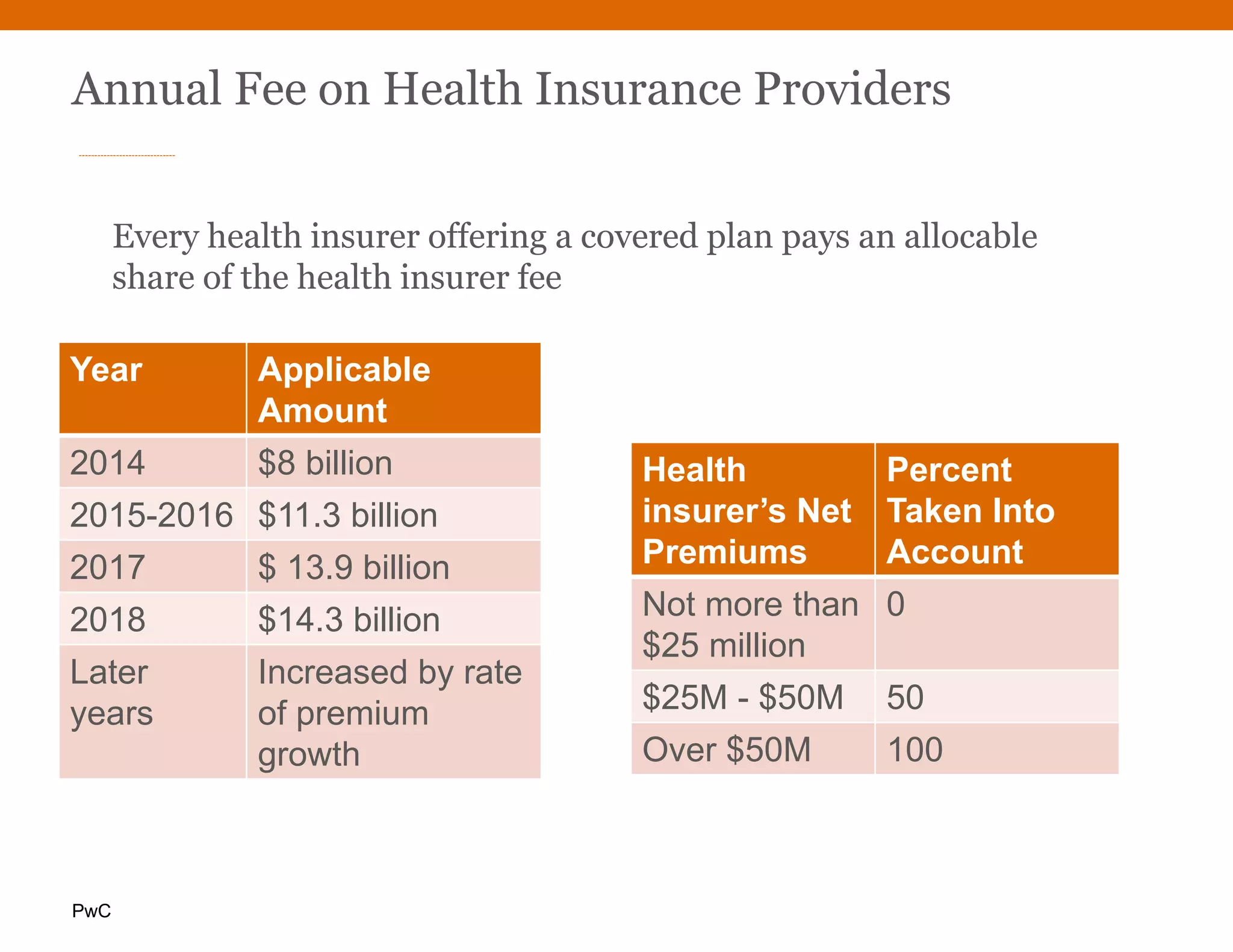
Annual Fee on Health Insurance Providers
Health
insurer’s Net
Premiums
Percent
Taken Into
Account
Not more than
$25 million
0
$25M - $50M 50
Over $50M 100
Every health insurer offering a covered plan pays an allocable
share of the health insurer fee
Year Applicable
Amount
2014 $8 billion
2015-2016 $11.3 billion
2017 $ 13.9 billion
2018 $14.3 billion
Later
years
Increased by rate
of premium
growth
PwC
Data year begins
January 2016
File Form 8963 with IRS
Deadline for
paying fee
Premium information must be
collected and tracked to ensure
readiness for 2015 reporting.
January-December 2014
April 15,
2015
June 15
IRS preliminary
fee calculation
Sept 30Aug 31
Notification of
final fee amount
Corrected form deadline
July 15
HIT Timeline
PwC
Annual Fee on Health Insurance Providers
What are
penalties for
understatem
ent?
Are there
other
penalties?
Do I have
revenues
attributable
to certain
exempt
activities?
What’s
excluded in
premium
revenue?
What’s
included in
premium
revenue?
What’s a
health
insurance
issuer?
Am I a
covered
entity?
PwC
Polling question
Is your department involved in the Annual Health Insurance
Provider Fee?
1. Yes, we are responsible for preparing, filing and addressing
error corrections
2. Yes, others prepare the form, we are responsible for reviewing
and we are responsible for filing
3. No, we are not involved
4. Our organization is not subject to the Health Insurance
Provider Fee
PwC
Payers and employers contribute to additional ACA programs
PCORI fees T Transitional
reinsurance
• Started in 2013
• Applies to insured policies and self-
insured health plans
• $2.08 per covered life for 2015, then
indexed through 2018
• Based on average number of covered
lives; alternative methods available to
determine covered lives
• Reported on IRS Form 720, generally
due by July 31 of following year
• Assessed on calendar year basis
2014-2016
• Requires payments from insurers
and employers on behalf of self-
insured medical plans for major
medical coverage
• $63 per covered life for 2014; $44
per covered life for 2015
• Covered lives first reported to
HHS in November 2014, with fee
paid in one or two installments in
2015 using pay.gov
• 2015/16 exemption for self-insured
and self administered group plans
PwC
Polling question
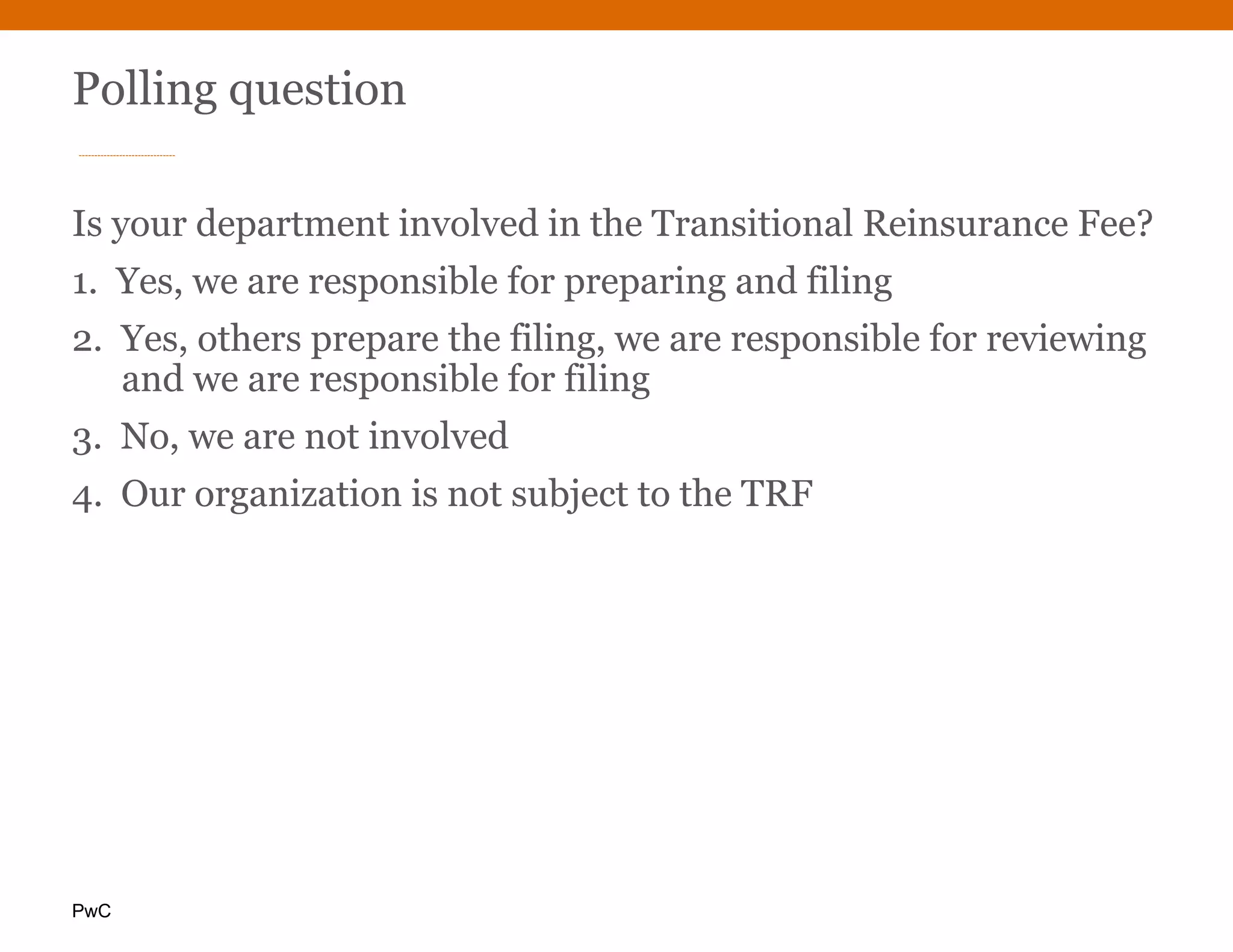
Is your department involved in the Transitional Reinsurance Fee?
1. Yes, we are responsible for preparing and filing
2. Yes, others prepare the filing, we are responsible for reviewing
and we are responsible for filing
3. No, we are not involved
4. Our organization is not subject to the TRF
PwC
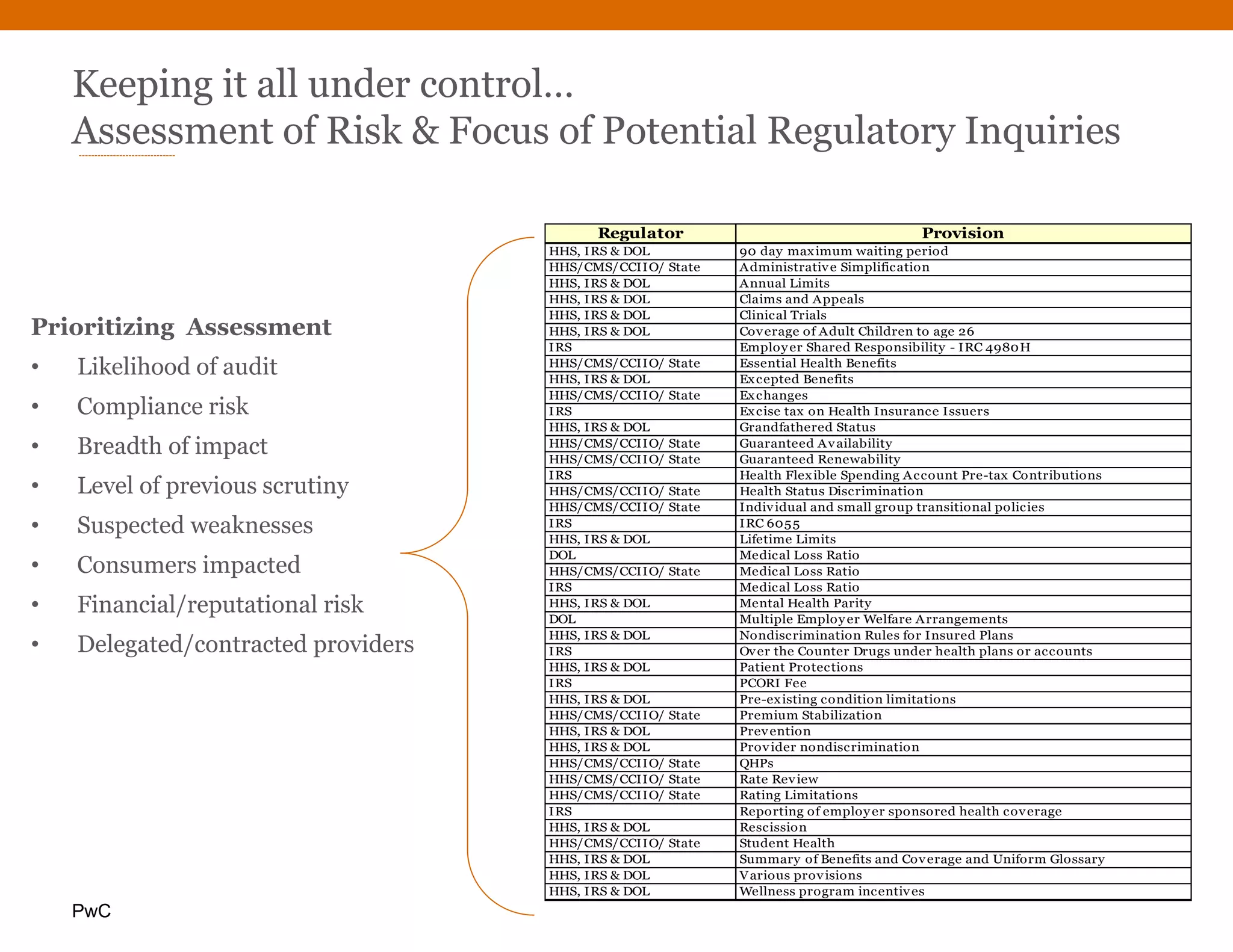
Keeping it all under control…
Assessment of Risk & Focus of Potential Regulatory Inquiries
Regulator Provision
HHS, IRS & DOL 90 day maximum waiting period
HHS/CMS/CCIIO/ State Administrative Simplification
HHS, IRS & DOL Annual Limits
HHS, IRS & DOL Claims and Appeals
HHS, IRS & DOL Clinical Trials
HHS, IRS & DOL Coverage of Adult Children to age 26
IRS Employer Shared Responsibility - IRC 4980H
HHS/CMS/CCIIO/ State Essential Health Benefits
HHS, IRS & DOL Excepted Benefits
HHS/CMS/CCIIO/ State Exchanges
IRS Excise tax on Health Insurance Issuers
HHS, IRS & DOL Grandfathered Status
HHS/CMS/CCIIO/ State Guaranteed Availability
HHS/CMS/CCIIO/ State Guaranteed Renewability
IRS Health Flexible Spending Account Pre-tax Contributions
HHS/CMS/CCIIO/ State Health Status Discrimination
HHS/CMS/CCIIO/ State Individual and small group transitional policies
IRS IRC 6055
HHS, IRS & DOL Lifetime Limits
DOL Medical Loss Ratio
HHS/CMS/CCIIO/ State Medical Loss Ratio
IRS Medical Loss Ratio
HHS, IRS & DOL Mental Health Parity
DOL Multiple Employer Welfare Arrangements
HHS, IRS & DOL Nondiscrimination Rules for Insured Plans
IRS Over the Counter Drugs under health plans or accounts
HHS, IRS & DOL Patient Protections
IRS PCORI Fee
HHS, IRS & DOL Pre-existing condition limitations
HHS/CMS/CCIIO/ State Premium Stabilization
HHS, IRS & DOL Prevention
HHS, IRS & DOL Provider nondiscrimination
HHS/CMS/CCIIO/ State QHPs
HHS/CMS/CCIIO/ State Rate Review
HHS/CMS/CCIIO/ State Rating Limitations
IRS Reporting of employer sponsored health coverage
HHS, IRS & DOL Rescission
HHS/CMS/CCIIO/ State Student Health
HHS, IRS & DOL Summary of Benefits and Coverage and Uniform Glossary
HHS, IRS & DOL Various provisions
HHS, IRS & DOL Wellness program incentives
Prioritizing Assessment
• Likelihood of audit
• Compliance risk
• Breadth of impact
• Level of previous scrutiny
• Suspected weaknesses
• Consumers impacted
• Financial/reputational risk
• Delegated/contracted providers
PwCPwC
Employer ACA issues
PwC
PwC
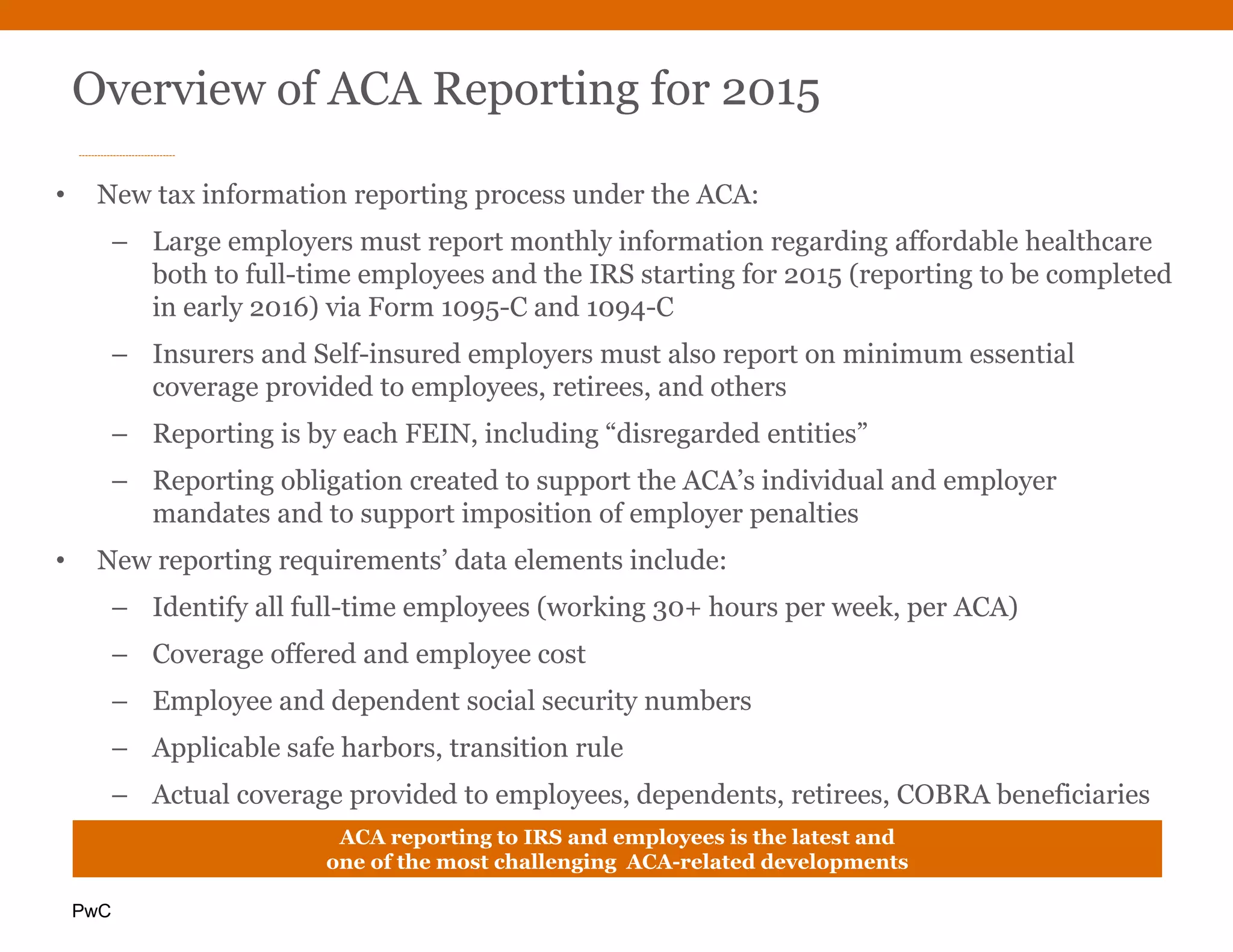
• New tax information reporting process under the ACA:
– Large employers must report monthly information regarding affordable healthcare
both to full-time employees and the IRS starting for 2015 (reporting to be completed
in early 2016) via Form 1095-C and 1094-C
– Insurers and Self-insured employers must also report on minimum essential
coverage provided to employees, retirees, and others
– Reporting is by each FEIN, including “disregarded entities”
– Reporting obligation created to support the ACA’s individual and employer
mandates and to support imposition of employer penalties
• New reporting requirements’ data elements include:
– Identify all full-time employees (working 30+ hours per week, per ACA)
– Coverage offered and employee cost
– Employee and dependent social security numbers
– Applicable safe harbors, transition rule
– Actual coverage provided to employees, dependents, retirees, COBRA beneficiaries
– Full-time and total employee countsACA reporting to IRS and employees is the latest and
one of the most challenging ACA-related developments
Overview of ACA Reporting for 2015
PwC
IRS progress
Affordable Care Act Information Returns (Forms 1094-B, 1095-B, 1094-C and
1095-C) must be filed using “AIR” (Affordable Care Act Information Return
System) – ACA Information Returns may not be filed using FIRE.
• Acceptable Format for Transmission is XML (Returns will not be accepted
electronically in any other format).
• Each transmission is limited to 100MB, transmissions larger than 100MB
must be split.
• Testing for Calendar Year 2014 returns (voluntary year) will begin July 2015
and Calendar Year 2014 returns may be filed beginning October 2015.
• Returns for Calendar Year 2015 must be filed with the IRS by February 28,
2016 (paper) or March 31, 2016 (electronic) .
PwC
PwC
PwC
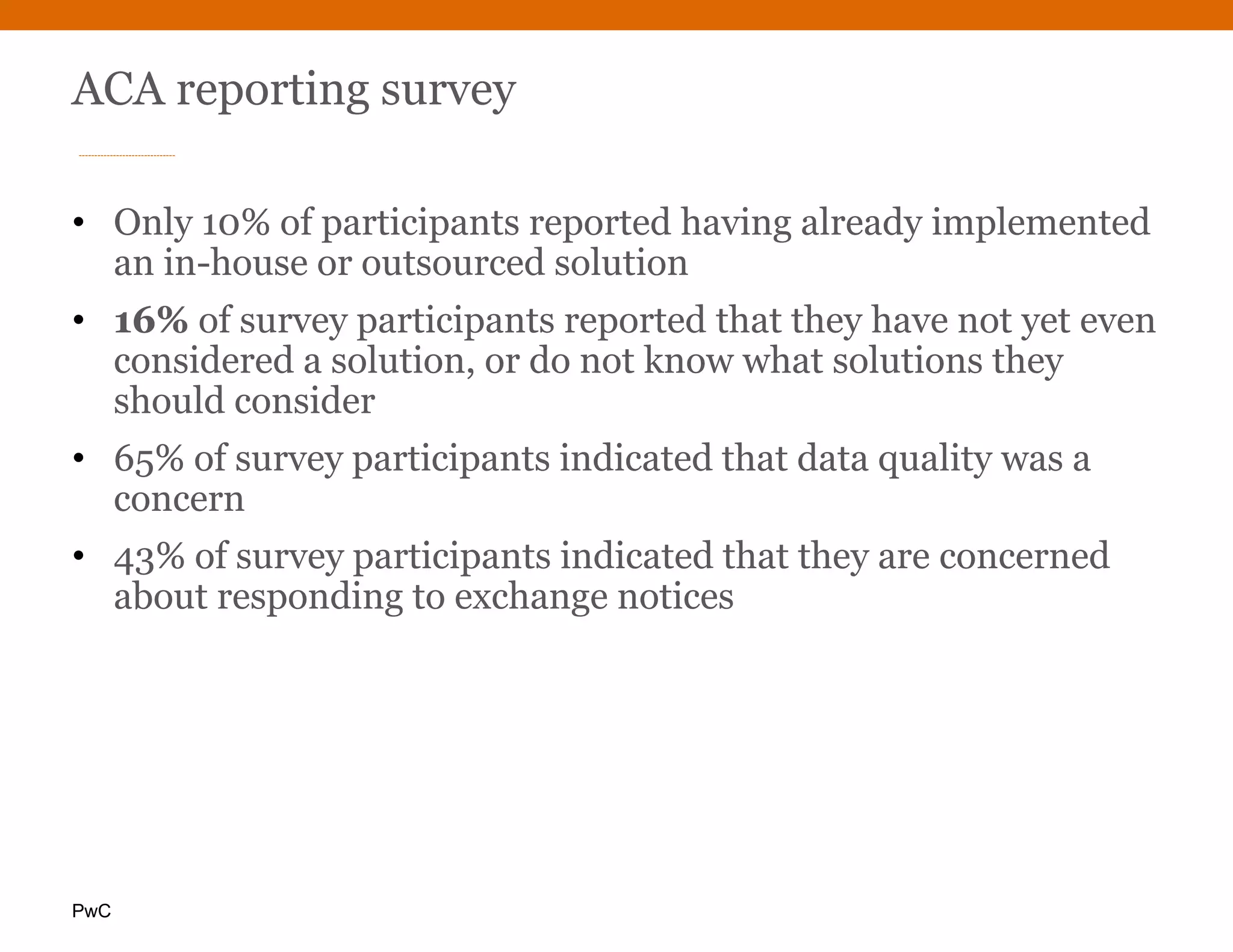
ACA reporting survey
• Only 10% of participants reported having already implemented
an in-house or outsourced solution
• 16% of survey participants reported that they have not yet even
considered a solution, or do not know what solutions they
should consider
• 65% of survey participants indicated that data quality was a
concern
• 43% of survey participants indicated that they are concerned
about responding to exchange notices
PwC
Polling question
FOR YOUR ORGANIZATION’S ACA REPORTING AS AN
EMPLOYER
1. We will do ACA reporting in-house with no assistance from an
outside vendor
2. We are considering an outsourced vendor
3. We are working with an existing vendor already
4. We have not decided what to do
PwC
Who is responsible?
82% of survey participants indicated that the human
resources/benefits department is leading the ACA reporting
compliance effort
• 5% indicated that the department leading the effort is still
undecided
62% of survey participants reported that the human resource
department is responsible for determining whether an
individual is properly treated as an independent contractor
• 12% of participating employers did not know who would be
responsible for this determination
PwC
Employer concerns
Concerns <1,000 EEs 1,000 – 5,000 EEs 5,000+ EEs
Data quality 55% 63% 72%
Responding to
exchange notices
40% 35% 54%
Understanding different
reporting options
70% 58% 51%
Determining different
reporting entities within the
controlled group
24% 26% 25%
Expense of reporting 43% 42% 46%
Data security 25% 31% 35%
Other 6% 6% 6%
PwC
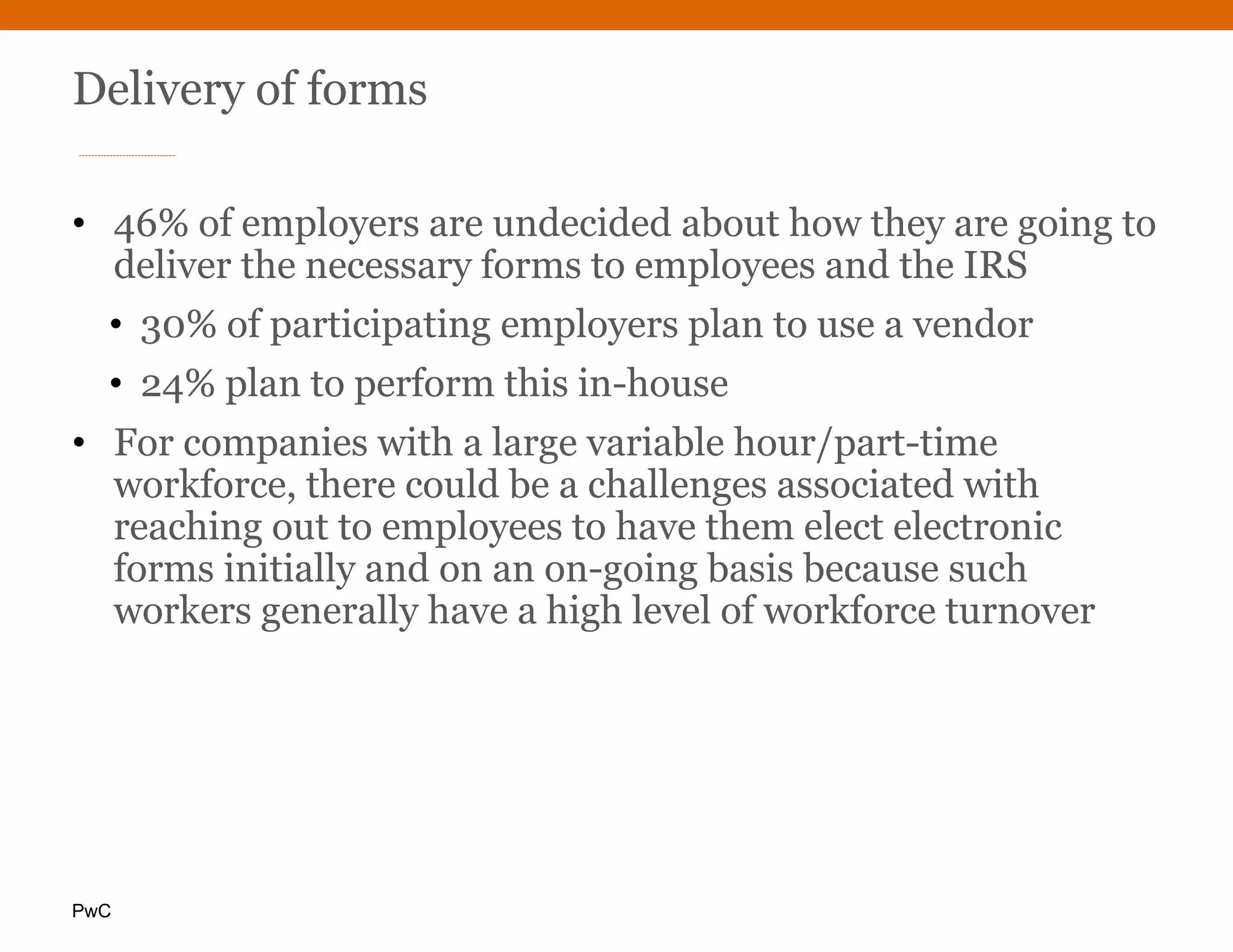
Delivery of forms
• 46% of employers are undecided about how they are going to
deliver the necessary forms to employees and the IRS
• 30% of participating employers plan to use a vendor
• 24% plan to perform this in-house
• For companies with a large variable hour/part-time
workforce, there could be a challenges associated with
reaching out to employees to have them elect electronic
forms initially and on an on-going basis because such
workers generally have a high level of workforce turnover
PwC
Hour tracking
• 79% of employers have already begun tracking employee
hours of service for purposes of determining full-time
employee status in 2015
• The manufacturing (67%) and health industries (72%)
employers are less prepared in terms of tracking hours
than the retail & consumer industry (92%)
• With a larger variable hour/part-time workforce, the
retail & consumer industry generally has had to track
employee hours to determine medical plan eligibility for
a longer period of time than other industries
PwC
Reactions to ACA provisions
0% 10% 20% 30% 40% 50% 60% 70% 80% 90% 100%
Drop coverage for part-time employees
Consider changing workflow mix of part-time and full-time employees
Evaluate covering employees through state-run health insurance exchange(s)
Significantly change/eliminate company subsidies for employee medical coverage
Evaluate direct contracting with providers or ACOs
Provide coverage to part-time employees
Significantly change/eliminate company subsidies for dependent medical coverage
Drop spousal coverage if the spouse is eligible for coverage elsewhere
Evaluate covering employees through the use of private exchange
Move to a defined contribution approach to healthcare
Make changes to your company's benefits to offset costs associated with ACA
Re-evaluate your overall benefits strategy
Increase your company's efforts related to wellness & health management
Very likely Somewhat likely Unlikely
• The vast majority (87%) of employers are likely to increase their efforts related to wellness & health
management
• 84% of employers are likely to re-evaluate their overall benefits strategy, of which 41% are very likely to
do so
Source: 2015 PwC Touchstone Survey
PwC
Financial impact
0% 10% 20% 30% 40% 50% 60% 70% 80% 90% 100%
$2,000 penalty per FTE
Limit of 90 days on eligibility waiting period
$3,000 penalty per FTE
Excise tax on high cost plans
("Cadillac Tax")
Reporting of minimum essential coverage (MEC)
Large employer reporting for employer shared responsibility
Additional fees and taxes
(PCORI and reinsurance)
Reporting and compliance requirements
Significant impact Slight impact No impact
• 64% of employers in 2015 indicated that they will be financially impacted by the excise tax on high cost
plans as compared to 60% in 2014
• 88% of employers will be impacted by the new reporting requirements
Source: 2015 PwC Touchstone Survey
PwC
Reactions to ACA provisions
When access is granted in the public exchange
for active full-time employees, employers are
considering:
<1,000
employees
1,000 - 5,000
employees
5,000+
employees
2015 total
Moving employees to public exchange as individuals
with a subsidy
3% 4% 2% 3%
Moving employees to public exchange as individuals
without subsidy
0% 1% 0% 0%
Moving group to a public exchange when available 2% 3% 1% 2%
Continuing to offer traditional employer plans 73% 80% 85% 78%
Do not know 25% 16% 13% 19%
More than one option was allowed to be selected
• 78% of employers plan to continue offering traditional benefit plans compared to 72% in 2014
• Nearly a fifth (19%) of employers will take the “wait and see” approach before deciding upon a
strategy
• 85% of large employers plan to offer traditional benefit plans, while 3% are considering moving active
employees to the public exchange
• Interest in public exchanges has decreased within the large employers with only 3% considering
moving active employees to the public exchange compared to 6% in 2014
Source: 2015 PwC Touchstone Survey
PwC
What’s ahead?
2018 Cadillac tax
• Excise tax imposed if the aggregate value of employer-sponsored health
insurance coverage for an employee exceeds a threshold amount
- Coverage includes health & supplemental coverage, but not separate
dental or vision coverage
- Includes both employer and employee share
• The tax is equal to 40% of the excess value over the threshold
- The 2018 threshold is:
◦ $10,200 for individual coverage
◦ $27,500 for family coverage
- Indexed at CPI+1% for 2018, CPI thereafter
- Assessed on individual basis (but not based on individual claims)
- The tax is non-deductible
PwC
Cadillac tax strategies – not too soon to start planning
SCALING BACK PLANS
• High-deductible plans
• Move to voluntary employee after-tax coverages
• Once “plan” is further defined, consider options to
consolidate or combine
• Collectively bargained plans
SCALING BACK ELIGIBILITY
• Spouses
• Dependents
PwC
Thank you!
Amy Bergner
Managing Director
202 312 7598
amy.b.bergner@us.pwc.com
2015 Health Services
Tax Conference
May 18-19, 2015
The Drake Hotel
Chicago, IL
Breakout Session
4a. 3R’s and Tax Implications
www.pwc.com
Jinn-Feng Lin
Michael F Callan
PwC
Content
• Introduction
• ACA Premium stabilization program – 3Rs
• 3Rs – Current approaches and latest development
- Reinsurance
- Risk adjustment
- Risk corridor
• 3Rs and MLR interaction
• Potential tax implications
PwC
ACA Premium stabilization
program – 3Rs
PwC
PwC
Health exchanges – ACA premium stabilization (“3Rs”)
Reinsurance Risk CorridorsRisk Adjustment
Cost
>103%
of
Target
Cost
<97% of
Target
Costs
>97% to
<103% of
Target
Plan pays
portion to
HHS
No payments
or charges
HHS pays
plan for
portion of loss
Individual Member’s
Claims ($)
attachment
ptPayer Covers
Reinsurance
covers portion
(coins %)
Premium Rate for
Average Risk
Rates adjusted up for
individuals with
diagnoses requiring
more care
Rates adjusted down
for individuals with
diagnoses requiring
less care
cap
claim amt
Reinsurance Risk adjustment Risk corridors
Program
goals
• Protects against high cost of outliers
and anti-selection
• Provides funding to plans that
enroll high-cost individuals
• Budget neutral
• Protects against adverse selection
• Transfers funds from lowest-risk plans to
highest-risk plans
• Budget neutral
• Protects against inaccurate rate setting
• Limits issuer loss (& gains)
• May not be budget neutral
Market
segment
affected
Individual market plans (inside and
outside of the Exchange)
Individual and small-group market plans (inside
and outside of the Exchange)
Only Qualified Health Plans (QHPs)
Funding Assessment on all insurance issuers and
TPAs (for self-insured plans)
Revenue re-distribution Direct settlement between carriers and HHS
Coverage
period
2014 - 2016 only 2014 and beyond 2014 - 2016 only
PwC
Health exchanges – Risks & mitigation
• ACA established a Premium Stabilization Program – known as the “3Rs” – to mitigate the impact of
adverse selection and stabilize premiums in the individual and small group markets:
- Transitional Reinsurance
- Risk Adjustment
- Risk Corridors
• While it does provide some protection, in some instances the 3Rs program actually increases
risk and still leaves carriers with significant risk exposure
Risks (non-3Rs) Mitigation strategies
Many “Unknowns” in Exchange pricing may result in adverse
2014 experience (e.g., demographics, health status, pre-ex conditions)
• Outside of 3Rs, consider private reinsurance to cover claims in
excess
of $250,000
• Encourage initial PCP visit for new members, to capture diagnoses
early for risk score
Very little experience data is available for 2015 pricing esp.
due to extended 2014 open enrollment
• Develop and test process to collect experience and demographic
data (e.g., systems interface to data warehouse)
Regulators may not approve necessary rate increases could
be particularly damaging for plans which captured significant
Exchange
market share
• Set up processes for data reconciliation and validation prior to rate
filling submission
• Review high-increase rates with senior management to confirm
long-term strategy
Potential for compliance issues across separate Exchange/
government entities
• Establish PMO to address ongoing reporting
• Conduct periodic audits of compliance processes
PwC
ACA Premium stabilization – Considerations
Reinsurance Risk adjustment Risk corridors
Difficult to estimate potential
reinsurance recovery on
unpaid claims (no specific
information available)
Educate providers regarding importance of
proper claims coding (diagnosis, co-
morbidities)
Calculations may require
additional allocation to the
state/market level that issuers are
not currently performing
Potential for reinsurance
benefits to be impacted due
to:
• Review process may lead to
denial of some filed claims
• Limited availability of
funds
• Currently the coinsurance
is projected to be over 80%
due to overfunding
Effective internal quality assurance and
audit
program, including:
• Monitoring
• Data analytics
• Personal review of claims and diagnoses
reported
• An audit plan, to ensure data reported is
accurate and in compliance with
program requirements
Accrual calculation is relatively
complex, needs to integrate with
other items such as reinsurance
and risk adjustment settlements
Issuers will be recording an
accrual at December 31 for
year’s reinsurance recovery,
may impact year-over-year
comparability of financial
statements
Ensure that those (potentially third parties)
providing coding review services are
qualified and have been properly engaged
Calculation is not symmetrical –
positive experience in one cell
does not necessarily offset
negative experience in another cell
PwC
3Rs – Current approaches and
latest development
PwC
PwC
Current approaches to transitional reinsurance accrual estimation
Transitional reinsurance mechanism is designed to protect issuers in the individual
market by reimbursing 80% of claims between $45,000 and $250,000 for a given
individual in 2014. Settlement to occur by June 30 of the following year, so an accrual
would need to be estimated at year-end
• All observed industry carriers are booking accrual for paid to date 2014 reinsurance
recoveries. Some use higher reinsurance percentage than prescribed formula
above. A few carriers indicated less than expected reinsurance receivables were
calculated from Edge Server.
• Majority of plans also booked additional amounts for the expected reduction in
IBNR due to reinsurance recoverable amount to date based on the projected
recoverable annual amount. Year to date amounts adjusted for the seasonality and
claim payments patterns.
• Projected 2014 ultimate reinsurance recoveries are based on the group and/or
individual experience with attention to the historical large claims payment patterns
and range from 16 to 20% of
incurred claims.
PwC
Reinsurance program parameters considerations
Parameters 2014 Current
regulation
2015 Current
regulation
Considerations
Attachment
Point/CAP
• a$45,000/$250
,000
• $45,000/$250,00
0
• No changes are expected after
already implementation of the
reduction to the attachment
point in 2014. Reduced the
attachment point from
$75,000 to $45,000 in 2015.
Coinsurance
Rate
• 80% • 50% • Potential Increase. There are
carriers which use higher than
prescribed amount in the
accrual calculation.
Funding
Contribution
• $63 PMPY • $44 PMPY • No changes are expected.
Funding • $10 Billion • $6 Billion • Projected collected amounts
and lower market place
enrollment increase portion of
reinsurance claims.
PwC
Current approaches to risk adjustment accrual estimation
Permanent risk adjustment program is designed to reimburse or charge carriers
based on the relative risk in the state’s non-grandfathered individual and small group
markets. Settlement to occur by June 30 of the following year, so an accrual would be
estimated at year-end.
• Current approaches in the accrual setting in the market place differ by size, region,
market share, filling requirements, and available resources.
• Carriers that we observed estimate ultimate receivable positon by year-end but
books conservative accrual estimate of $0.
• Methodologies observed include use of: pricing assumptions, market modeling
based on publicly available data(on and off exchange enrollment demographics,
consultant studies) and own experience, consultant studies based on historical
experience, consultant market assessment and internal modeling.
PwC
Current approaches to risk adjustment accrual estimation –
Other considerations
• Readiness of carriers for Edge Server submission.
• Data quality issues in the Edge Server submissions and potential record
rejections.
• Availability of preliminary results from CMS that can be used for year-end
estimation.
• Modeling Concerns:
- New uninsured population
- Timing of the open enrollment period and renewals
- Competitive posito
- Own and competitors approach to the transitional markets
- Coding efficiency
PwC
Current approaches to risk corridor accrual estimation
Transitional risk corridors applied at the plan level, but with the “target” claims cost set as a pro-rata
allocation from the applicable state/market cell.
• Intended to be a budget neutral but CMS might fund short fall from next year fund collections*.
There are carriers that are not recording full amounts of estimated accrual due uncertainty with
fund available and tax allocation methodology.
• Risk corridor payable/receivable formula includes reinsurance and risk adjustment amounts adding
complexity to the accrual estimation.
• Carriers use already developed process such as MLR calculation for the formula inputs and
identification of the administrative expenses and administrative expenses considered as
claim expense.
• Use of aggregate approach is common, not all of carriers currently estimating accruals at the
plan level.
• Observed carriers are booking receivables with risk corridor formula loss ratios in range of 120%
to 140% range.
• Tax allocation at the plan level is a very important issue in all of the plans due to very
limited guidance.
* CMS Risk Corridors and Budget Neutrality Memo, April 11, 2014
PwC
Risk corridor – Funding issues
Based on an S&P analysis, the ACA risk-corridor pool is significantly underfunded for
2014 if its funding is limited only to insurers' risk corridor payments
• The analysis found that the aggregate risk-corridor payables recorded by U.S.
insurers for 2014 are less than 10% of the aggregate risk-corridor receivables
booked by insurers for the same year.
• Additionally, several insurers that may be eligible for corridor payments were
conservative and did not record any receivable or only partially booked them on
their balance sheets in 2014. It indicates that the actual aggregate payments due to
insurers from the corridor are likely even higher.
• Uncertainty of payment due to underfunding can cause volatility in the market for
all participants.
* CMS Risk Corridors and Budget Neutrality Memo, April 11, 2014
PwC
3Rs and MLR interaction
PwC
PwC
Medical loss ratio – Interaction with 3Rs
June 1st (Pre 3Rs Implementation)
July 31st (Post 3Rs Implementation)
August 1st (Pre 3Rs Implementation)
September 30th (Post 3Rs Implementation)
• To reflect the need to incorporate the premium stabilization program amounts into
the MLR calculations and rebate distributions, the 2014, 2015 and 2016 deadlines
have been delayed.
Revised MLR timing due to 3Rs
• MLR filing deadline
• Rebate disbursement deadline
PwC
Medical loss ratio – Interaction with 3Rs
• Statutory assessments to defray operating expenses of any State or Federal department,
transitional reinsurance contributions assessed, and examination fees in lieu of premium
taxes as specified by State law.
• The State and Federal Exchange user fees.
• The risk adjustment user fees of $0.08 per month.
• Data validation systems expenditures are not allowed to be deducted.
Certain fees resulting from 3Rs can be counted as Taxes, Licensing and Regulatory Fees
• Section 1342(c) of the Affordable Care Act requires that risk corridor calculations treat
reinsurance and risk adjustment payments as adjustments to allowable cost.
- The final regulation stated that that risk adjustment amounts, risk corridors amounts, and
reinsurance payments would have a net impact on the MLR numerator.
- One exception is the reinsurance contribution amount which is to be included in fees and
assessments, having a net impact on the MLR denominator.
3Rs inclusion in the MLR formula
PwC
Medical loss ratio – Interaction with 3Rs
MLR = (MLR Numerator/MLR Denominator) + Credibility Adjustment
MLR Numerator = (incurred claims + QIA - reinsurance receipt + risk corridor
payment + risk adjustment payment - risk corridor receipts – risk adjustment
receipts)
MLR Denominator = (Earned Premium – taxes & assessments – regulatory fees –
reinsurance contributions)
MLR Formula with 3Rs
PwC
Medical loss ratio – Interaction with 3Rs
Implications of 3Rs with MLR:
• Each one of the 3Rs impacts the MLR formula and the possibility of having to pay a MLR refund. The
process to estimate potential rebates are complicated by the need to estimate additional assets and/or
liabilities attributable to the 3Rs after January 2014.
• The MLR liability estimate has to be modified to take into consideration the reinsurance, risk
corridors and risk adjustment asset or liability estimates. The order of calculations becomes
very important.
• Risk Adjustment and Transitional Reinsurance should be the first calculations performed. Next would
be the risk corridors (reflecting both reinsurance and risk adjustment results).
• The MLR rebate calculations will not be able to be performed until all the other three risk mitigation
programs have been completed. Estimating the impact of these other three programs for financial
statement purposes will be complex, since they are interrelated and depend upon not only the specific
carrier’s experience, but its experience relative to all other carriers within the market.
MLR
Transitional
Reinsurance
Risk Adjustment
Transitional Risk
Corridor
PwC
Tax implications
PwC
PwC
Income tax allocation for MLR reporting
Statute indicates that MLR denominator is premium revenue, “excluding Federal and State taxes and
licensing and regulatory fees”. “Federal and State taxes” includes income taxes, except income taxes on
investment income and capital gains
There is a need to allocate income taxes across lines of business for MLR reporting purpose into the
following categories:
• Rebate-eligible blocks (individual, small group, large group, Medicare, mini-med, and expat)
• Rebate-ineligible blocks (ASO, Medicaid, Specialty Block…etc.)
• Investment income
Income Tax Allocations
• For the MLR reporting, carriers generally use a consistent approach based on generally accepted
accounting method
• Allocate income taxes to the LOB based on pre-rebate underwriting gain; avoid potential circular
interaction between rebates and taxes
• With the rebate liability being within the scope of actuarial opinion, the valuation actuary who
provides actuarial opinion and memorandum needs to have a good understanding and be
comfortable with the company’s approach to allocating income taxes
PwC
Federal income tax allocation for MLR reporting
• Taxes incurred should be consistent with the reported statutory annual statement
amounts based on SSAP 101 and allocated to all Lines of Business (LOB) including
large group, small group, individual, and other business segments
- Excludes taxes on investment income and capital gains
- Excludes taxes on rebate per NAIC regulations Section 3C and avoid circular tax
calc
• In general, for LOBs in an underwriting loss position, a tax benefit would be
calculated. On the other hand, LOBs in a profitable position would result in tax
expenses
• Amounts by segment should reconcile on an entity basis to the reported annual
statement
incurred taxes
• SHCE and HHS reported tax items are expected to be the same unless
reconciliation/documentation provided to discuss rationale for the differences
PwC
State and other taxes allocation for MLR reporting
State taxes incurred
• Employment taxes (payroll and Social Security)
• State premium taxes (allocate to LOBs based on written vs. earned premiums)
• State disability funds
• State unemployment taxes
• Regulatory fees and assessments
• Community benefit expenditures
Federal, State and local non-income taxes
• Allocations depend on specific facts for each entity and tax/assessment item
• Allocate to states that impose income tax based on respective portion of individual state
applicable state rate to total entity state rate
• Allocate to LOB within state based on respective portion of pre-tax income within that
State
PwC
Tax allocation for MLR vs Risk corridor
Tax allocation for Risk Corridor is an important issue in all of the carriers due to very
limited guidance.
ACA requires that MLR and Risk Corridor be closely related in definition
and consistent in calculation
MLR
Federal and State income taxes should
be allocated to each LOB based on
pre-tax income
Risk Corridor
Based on recent FAQ by REGTAP and
CMS, allocation for each QHP should be
based on the earned premium
• Larger Tax Dollars/Higher Effective Tax Rates
- Lead to unreasonable results for MLR/Risk Corridor
• Underwriting Gain Approach to Rebate and Percentage of Premiums for Risk
Corridor may not meet “Consistent” standard
• Percentage of Premium Revenue method to reflect Non-Revenue lines or small
revenue lines could be problematic
PwC
Tax allocation by gain/loss
Risk Corridor (Plan 1)
Claims = $430,000
Premium = $450,000
Admin = $35,000
Profit = ($15,000)
Tax = ($450,000/900,000)
x 17,500 = $8,750
Risk Corridor % = 109.4%
RC Receipt/(Payment) =
$14,263
Risk Corridor (Plan 2)
Claims = $350,000
Premium = $450,000
Admin = $35,000
Profit = $65,000
Tax = ($450,000/900,000)
x 17,500 = $8,750
Risk Corridor % = 99.2%
RC Receipt/(Payment) = $0
Non-QHP Plan
Claims = $80,000
Premium = $100,000
Admin = $10,000
Profit = $10,000
Tax = 35% x (10,000) =
$3,500
All LOB
Claims = $860,000
Premium = $1,000,000
Admin = $80,000
Profit = $60,000
Tax = 35% x (60,000) = $21,000
PwC
Tax allocation by premium
Risk Corridor (Plan 1)
Claims = $430,000
Premium = $450,000
Admin = $35,000
Profit = ($15,000)
Tax = ($450,000/900,000)
x 18,900 = $9,450
Risk Corridor % = 109.6%
RC Receipt/(Payment) =
$14,832
Risk Corridor (Plan 2)
Claims = $350,000
Premium = $450,000
Admin = $35,000
Profit = $65,000
Tax = ($450,000/900,000)
x 18,900 = $9,450
Risk Corridor % = 99.3%
RC Receipt/(Payment) = $0
Non-QHP Plan
Claims = $80,000
Premium = $100,000
Admin = $10,000
Profit = $10,000
Tax = ($100,000/1,000,000)
x 21,000= $2,100
All LOB
Claims = $860,000
Premium = $1,000,000
Admin = $80,000
Profit = $60,000
Tax = 35% x (60,000) = $21,000
PwC
Tax allocation for MLR vs Risk corridor
MLR
	3 	
	 	
MLR
, 	 	 	 	 ,
, , 	 	 , 	
= 89.30% MLR
, 	 	 	 	 ,
, , 	 	 , 	
= 89.36%
Risk Corridor
(QHP)
Claims = $780,000
Premium =
$900,000
Tax = $17,500
RC
Receipt/(Payment)
= $14,263
Non-QHP Plan
Claims = $80,000
Premium =
$100,000
Tax = $3,500
Gain/Loss
Non-QHP Plan
Claims = $80,000
Premium =
$100,000
Tax = $2,100
Risk Corridor
(QHP)
Claims = $780,000
Premium =
$900,000
Tax = $18,900
RC
Receipt/(Payment)
= $14,832
Premium
PwC
Thank you!
Jinn-Feng Lin
PwC | Principal
Office: 1-312-298-3792 | Mobile: 1-847-476-9220
Email: jinn-feng.lin@us.pwc.com
Michael F Callan
PwC | Partner
Office: 1- 213 -356 -6039 | Mobile: 1-661 -645 -7319
Email: michael.f.callan@us.pwc.com
Breakout Session
4b. Regulatory Update; PCAOB,
SEC and IRS Practice & Procedure
www.pwc.com
Mike Kurowski, Community Health Systems
Rob McCallum, HealthSouth
Beth Tucker, PwC
Dave Wiseman, PwC
PwC
Agenda
• SEC Update
• PCAOB inspection trends and themes
• Standard setting update
PwC
SEC update
PwC
PwC
Insights from 2014 AICPA national conference on current SEC
and PCAOB developments
Annual conference hosted by representatives of regulatory and standard setting bodies along with
auditors, users, preparers, and industry experts.
Key messages conveyed by SEC:
• Streamlining disclosures, eliminating boiler plate language
• Income Tax Disclosures in MD&A
- MD&A disclosure of material trends and uncertainties is critical
- Focus on quality and transparency of key disclosures
- Specific to company’s facts and circumstances
- Expect continued inquiries about valuation allowances/realizability of deferred tax assets, and
indefinite reinvestment
PwC
Insights from 2014 AICPA national conference on current SEC
and PCAOB developments (continued)
• Expected increase in number of questions and requests for enhanced disclosures around:
- Effective tax rates
◦ Explaining fluctuations in the effective tax rate from the statutory rate
◦ Volatility in the effective tax rate
◦ Effective tax rates that do not change because of material changes in components are offsetting
◦ More insight from qualitative disclosures above and beyond what is in the
quantitative disclosures
- Foreign earnings and the associated taxes
◦ Source and extent
◦ Pushback on boilerplate language regarding rate being impacted by mix of foreign earnings
PwC
SEC’s areas of focus in 2015
• Valuation allowances
• Realizability of deferred tax assets
• Indefinite reinvestment assertions
• Income tax expense, in particular when tax rates appear unusual relative to the expected statutory
rate, effective tax rates are volatile, or effective tax rates do not change because material changes in
components are offsetting
• Income tax disclosures in MD&A
PwC
SEC comment letters
• Valuation allowances
- Sources of taxable income
- Positive and negative evidence considered
- Timing
• Uncertain tax positions
- Transparent disclosure of unrecognized tax benefits
- Timing of changes in assessment
PwC
SEC comment letters (continued)
Valuation allowances
We note that you reversed $187.5 million of the deferred tax asset valuation allowance
during the second quarter of fiscal year 2013 based on five consecutive quarters of
earnings, the expectation of your continued profitability, and signs of recovery in the
housing market. In your fiscal year 2012 Form 10-K, you noted “…the inability to carry
back its current net operating losses and [your] recent earnings history are significant
evidence of the need for a valuation allowance against [your] net deferred tax assets.”
Considering the reversal of the valuation allowance materially impacted net income, it
is unclear how your current disclosures sufficiently explain to investors the
material positive and negative evidence you considered when arriving at the
conclusion that the majority of the valuation allowance for your net deferred tax assets
should be reversed.
Please substantially revise your disclosure in future filings to provide
investors with quantitative and qualitative information of the material
positive and negative factors that you considered when arriving at your conclusion
that it is more likely than not that the deferred tax assets will be realized. Please refer to
ASC 740-10-30-16 — 30-25 for guidance. Please provide us with the disclosures you
would have included in this Form 10-Q in response to this comment.
PwC
SEC comment letters (continued)
Uncertain tax positions
Given the material impact that the unfavorable tax court decision had upon your
income from continuing operations for the three and six months ended June 30, 2014
as well as the impact it will have upon your liquidity when payment becomes due,
please tell us the following:
1. Describe in greater detail how the specific tax position(s) taken by the Company
regarding the federal taxation of foreign income of certain foreign subsidiaries
differed from the factors considered by the tax court in reaching their decision;
2. Tell us how you historically contemplated the possibility that the IRS
could reach a different conclusion based upon the same facts and
circumstances and how that possibility was reflected in your accounting
for income tax liabilities as of December 31, 2013 and March 31, 2014; and
3. Explain the factors you historically relied upon to support your
assessment that it was more likely than not that the position you had
taken would be sustained upon examination.
PwC
SEC comment letters (continued)
• Effective tax rate
- Netting of items in presentation lines (e.g., foreign/state rate differentials)
- Other reconciling items
• Indefinite reinvestment of foreign earnings
- Focus on the accounting and disclosure requirements
- Cumulative amount of temporary differences related to indefinitely reinvested foreign earnings
- Impracticability of deferred tax liability quantification
PwC
SEC comment letters (continued)
Effective tax rate reconciliation
We note that your reconciliation between the actual and expected income tax includes a
significant line item for foreign tax rate differentials. In order to provide investors with greater
insight into this item that affects your income taxes, please expand your disclosure in future filings.
For example, discuss how the tax rate differential is determined and identify the significant components
of these items. Also, discuss what countries contribute to this tax rate differential and whether there are
any known uncertainties or trends in the lower tax jurisdictions that could affect your income taxes in
future periods. Refer to item 303(a) of Regulation S-K. Provide us with a sample of your proposed revised
disclosure.
PwC
SEC comment letters (continued)
Effective tax rate reconciliation
1. We note the significant impact of “foreign tax effect” on your effective tax rate. Please provide us with
a breakdown of the components included in this line item of your effective tax rate reconciliation for
each period presented, and tell us what consideration was given to providing further quantitative
breakdown of this line item in your disclosures. Refer to Rule 4-08(h)(2) of Regulation S-X.
2. We note your response to our prior comment where you indicate that it is most appropriate to present
foreign items together on a single line of the rate reconciliation. Please quantify for us each of the
separate items for the periods presented and to the extent any item exceeds five percent of the
amount computed by multiplying the income before tax by the applicable statutory federal income tax
rate, revise to disclose the item separately. In this regard, we note that tax rate differential,
tax credits and the effect of exchange rates, although all related to your foreign operations,
appear to be dissimilar in nature.
PwC
SEC comment letters (continued)
Indefinite reinvestment assertion – The initial comment
We note your disclosure on page F-23 that it is not practical to determine the amount of income or
withholding tax that would be payable upon the remittance of these foreign earnings. Please tell us why it
is not practical to determine the amount of tax that would be payable. Describe the complexities
involved that make determination of the amount difficult. Alternatively, revise future filings to quantify
the effect that repatriation of foreign earnings would have.
PwC
SEC comment letters (continued)
Indefinite reinvestment assertion – The company’s response
“The Company advises the Staff that determination of the potential deferred income tax liability on these
undistributed earnings is not practicable because such liability, if any, is dependent on circumstances that
exist if and when remittance occurs. The circumstances that would affect the calculations include the
source location and amount of the distribution, the underlying tax rate already paid on the earnings,
foreign withholding taxes and the opportunity to use foreign tax credits.”
PwC
SEC comment letters (continued)
Indefinite reinvestment assertion – The SEC staff’s response
We note your response describing why you believe it is impractical to determine the amount of tax that
would be payable. We note the factors you cite appear to relate to potential future events that could
impact the ultimate amount of tax that would be payable. Please revise future filings to disclose an
estimate of the amount of tax that would be payable upon the remittance of foreign earnings based
on current facts and circumstances. In this regard, we would not object if you also disclosed that the
amount of tax that would be payable could be further impacted by the factors that you cite in
your response.
PwC
PCAOB inspection trends
and themes
PwC
PwC
Insights from 2014 AICPA national conference on current SEC
and PCAOB developments
• The most common deficiencies relate to audits of internal control, assessing and responding to risk
of material misstatement, audits of fair value measurements and estimates and testing of data
and reports.
• It is critical for the auditor to understand an issuer's operations, including how transactions flow and
the controls in place to detect a risk of material misstatement.
• Taxes expected to be an area of interest in upcoming year.
PwC
PCAOB inspection trends and themes
Recent Areas of Focus:Documentation of significant audit areas, including:
• Assessment and testing of review controls (common ones include valuation allowance, uncertain
tax positions)
• Significant estimates
• Likely sources of potential misstatement
PwC
PCAOB inspection trends and themes (continued)
Assessment and testing of review controls
• Understanding the objective of the control?
• Who performs and its frequency?
• The specific procedures performed?
• The process the reviewer follows?
• Threshold of review?
• How variances or irregularities are followed up on and what constitutes resolution?
• What drives consistent execution?
• What evidence is retained that the control executed?
• What data, systems, and reports are used?
PwC
PCAOB inspection trends and themes (continued)
Significant estimates
Documenting the audit of all aspects of significant estimates
Estimate
DataAssumptions
Risks and
Controls
Risks and
Controls
“Model”
UTPs Tax Planning
Valuation
Allowances
Indefinite
Reinvestment
Assertion
PwC
Risk and control environment
Likely Sources of Potential Misstatement
Illustration of LSPM Concept: “Your important trip”
Leave home
Travel to
airport
Check-in/
Security
Flight
Travel to
event
• Consider this situation
- You have signed up to attend an event 300 miles from home on a fixed date and
time in the future
- What is the source of the likely and potential risks that could cause your trip to go
awry?
Note: For financial reporting purposes, your risks for what could go awry are the likely
sources of potential misstatement
PwC
Risk and control environment (continued)
“Your important trip”
Leave
home
• Packed at
last minute
• Oversleep
• Interrupted
by phone
when
leaving
house
• Want to
wait to see
the end of a
close
sporting
event
Travel to
airport
• Car service
is late
• Traffic
• Car
breaks
down
• Get lost
• Need to
stop for gas
Check-
in/Securit
y
• Long lines
to check
bag
• Forgot
Photo ID
• Additional
screening
required
• > 3oz.
of liquids
• Forgot to
take
firearm out
of luggage
from prior
trip
Flight
• Plane
serving as
your
aircraft has
not arrived
• Flight crew
is delayed
or times out
• Bad
weather
• Traffic
on tarmac
Travel to
event
• Luggage is
lost
• Car service
is late
• Traffic
• Car
breaks
down
• Get lost
PwC
Risk and control environment (continued)
Internal control design
• An organization’s controls should be adequately designed to mitigate the identified likely sources of
potential misstatement
• The PCAOB comments and scrutiny in this area have increased
• The identification of the likely sources of potential misstatement represents the basis of a “risk-based”
review and allows management to focus attention on what matters
PwC
Risk and control environment (continued)
What are examples of the likely sources of potential misstatement in the development of a
complex estimate and judgment?
• Assumptions used may not be based upon best available information
• Data used is not complete and accurate or fit for purpose
• Highly manual process resulting in a higher risk of computational or other errors in the determination
of the estimate
• Misapplication of US GAAP/Misuse of facts
PwC
Standard setting update
PwC
PwC
FASB project agenda topics
Exposure draft
On January 22, 2015, the FASB issued an exposure draft on the following:
• Elimination of the exception for recognizing deferred taxes on certain intercompany transactions
under ASC 740-10-25-3(e)
• Classification of all deferred tax assets and liabilities as non-current
- Modified retrospective transition for the intercompany transactions topic and prospective
transition for the classification topic
- Effective after December 15, 2016 for public companies and after December 15, 2017 (interim
periods in the following year) for private companies
The comment period for the exposure draft will end on May 29, 2015
PwC
FASB project agenda topics (continued)
Proposed exposure draft
On February 4, 2015, the FASB agreed to issue an exposure draft on tax accounting for stock
compensation, including the following revisions to the current guidance:
• Recognition of all excess tax benefits ("windfalls") and deficiencies ('shortfalls") within income tax
expense and elimination of the requirement that cash taxes payable be reduced in order to record a
windfall tax benefit
• Elimination of the requirement to display the gross amount of windfalls as an operating outflow and
financing inflow in the statement of cash flows
The exposure draft is expected to be issued in May 2015. Stakeholders will have the opportunity to
provide feedback during a 60-day comment letter period
PwC
FASB projects – Disclosure framework project
Foreign earnings
On February 11, 2015, the FASB reviewed income tax disclosures in relation to foreign earnings and
tentatively decided that the following disclosures should be required:
• Earnings disaggregated between domestic and foreign earnings for public and non-public entities
• Foreign earnings would be further disaggregated for any country that is significant to total earnings
• Domestic tax expense recognized in the period for taxes on foreign earnings
• Undistributed foreign earnings that are no longer asserted to be indefinitely reinvested during the
current period and an explanation of reasoning. Separate disclosure for any country that is significant
• Disaggregation of the current requirement to disclose the cumulative amount of indefinitely
reinvested foreign earnings if any country represents at least 10 percent of the disclosed amount
PwC
FASB projects – Disclosure framework project (continued)
Undistributed foreign earnings
The Board tentatively decided that the following disclosures would not be required:
• Disaggregation of deferred tax liabilities recorded for unremitted foreign earnings by country
• An estimate of the unrecognized DTL on the basis of simplified assumptions
• Past events or current conditions that have changed management’s plans for undistributed
foreign earnings
PwC
IRS Tax Controversy Update
PwC
PwC
Overview – IRS hot topics
Current State of IRS
LB&I Goals
Recent Developments
PwC
Current state of IRS
Recent leadership changes
• Significant leadership changes and challenges
Budget challenges
• FY 2015 budget of $10.9B is down $1.2 B from FY 2010
• Staffing down…100,000 in 2010 to 87,000 in 2014 (LB&I revenue agent staffing down by 1,000
since 2011)
• Hiring and training challenges
• Limitations on hiring external experts (i.e. industry experts, economists)
• Significant challenges ahead to fully implement ACA tax provisions and FATCA (unfunded mandates
being absorbed out of budget base)
PwC
IRS funding levels have dropped amid
Congressional opposition to increased funding
11,523
12,146 12,122
11,817
11,199
11
10.9
0
10,800
11,000
11,200
11,400
11,600
11,800
12,000
12,200
12,400
12,600
2009 2010 2011 2012 2013 2014 2015
Dollars (in millions)
IRS appropriations
Source: GAO analysis of fiscal years 2009 through 2015 congressional justifications for IRS.
$
a b
Fiscal year
PwC
Declining IRS personnel resources
LB&I technical staff FY - 2012 FY - 2013 FY - 2014 YOY
decrease
Revenue Agents 3353 2980 2814 16%
International Examiners 508 535 436 14%
All 4946 4626 4345 12%
FY 2010 FY 2011 FY 2012 FY 2013 FY 2014
Appeals
Staffing
2173 2111 1981 1830 <1750
• Appeals staffing has fallen by approximately 20% since 2010
• Cycle time in CIC cases is roughly 800 days (> 2 years)
PwC
LB&I priorities – “Do more with Less”
• Number of audits and revenue from audits declining
• Focus on streamlining corporate audits with issue focused approach
• Move more taxpayers into Compliance Assurance Process
• Increase mid-market audit coverage
• Increase audits of flow-through entities
• 190,000 of 260,000 LB&I taxpayers are flow-through entities
• Increased international issue focus
• Expanded reliance on IPGs/IPNs
PwC
LB&I recent developments
• LB&I Reorganization
• Issue-Focused Exam Initiatives
• Quality Exam Process
- Use of Alternative Dispute Resolution
• Appeals Process
- Return to a quasi-judicial approach
PwC
Alternative dispute resolution – Health sector best practices
• Compliance Assurance Process (CAP)
- Benefits:
◦ Reduce taxpayer burden and uncertainty
◦ Accuracy of returns prior to filing
◦ Reduce/eliminate need for post-filing extensions and amended state
returns
◦ Impact on Financial Statement (reserves)
• “Pre-Filing Agreements”
• Accelerated Issue Resolution
• Fast Track Settlement
PwC
Trends in appeals
• July 18, 2013: Appeals issued its Appeals Judicial Approach and Culture
memorandum, indicating that IRM will be updated
• Purpose – Return Appeals to a quasi-judicial approach
• New policy – Appeals will not raise new issues nor will it open closed issues
on which Exam and taxpayer agree
• Appeals may, however, consider alternative or new legal arguments, but will
only use the evidence in the case file
• Appeals will attempt to settle case on factual hazards when case submitted
by Exam is not fully developed and taxpayer presents no new information or
evidence
• Clarifies that Appeals should not assist Exam with case development
PwC
Thank you!
Mike Kurowski
Rob McCallum
Beth Tucker
Dave Wiseman
Breakout Session
4c. Section 501(r) and the final
regulations with an open session for
a moderated dialogue and Q&A on
Section 501(r) and other hot topics
www.pwc.com
Rob Friz, PwC
Robert Waitkus, Cleveland Clinic
Ron Schultz, PwC
PwC
Agenda
Introductions
Final regulations §501(r)
Organizational approach to compliance with §501(r)
Question & answer on §501(r)
Other hot topics
PwC
Welcome
Rob Friz, Partner and US Health Services Tax Leader
Ron Schultz, Managing Director
Bob Waitkus, Senior Director Taxation and Compliance at The Cleveland
Clinic Foundation
PwCPwC
Final Regulations §501(r)
PwC
PwC
IRC Section 501(r)
Section Requirement Effective date
501(r)(3) Community Health Needs Assessment – Each tax
exempt hospital must conduct a CHNA at least once
every three years and adopt an “implementation
strategy” to meet the needs identified by the
assessment.
Taxable years
beginning after
March 23, 2012
501(r)(4) Financial Assistance Policy – Each tax exempt
hospital must establish, implement, and make widely
available written policies regarding financial assistance
and emergency medical care.
Taxable years
beginning after
March 23, 2010
501(r)(5) Limitation on Charges – Each tax exempt hospital
must limit the amount it charges for emergency or other
medically necessary care provided to patients eligible
for financial assistance to not more than the lowest
amounts charged to insured patients.
Taxable years
beginning after
March 23, 2010
501(r)(6) Billing and Collections – A tax exempt hospital
cannot take “extraordinary collection actions” (lawsuits,
arrests, liens, or other similar actions) until it has made
“reasonable efforts” to determine whether a patient is
eligible for financial assistance.
Taxable years
beginning after
March 23, 2010
PwC
Final regulations 501(r)
Overview
• Preamble provides significant commentary and analysis
• Requirements cut across various aspects of a facility’s operations
• Compliance with state law ≠ compliance with 501(r)
• Generally, effective for taxable years beginning after December 29, 2015
• Pre-2016 years can rely on reasonable, good faith interpretation of the
statute
- May rely on proposed regulations, final regulations, or any reasonable
good-faith interpretation.
• Failure to comply with the requirements of 501(r) could result in significant
taxes and penalties and/or the loss of the organization’s tax exempt status
PwC
Final regulations 501(r)
Scope
• Definition of “hospital facility” keys off of state license and “hospital
organization” keys off of
501(c)(3) status
• Requirements applied on a facility-by-facility basis
• Proper identification of separate facilities is critical
• Taxpayers must be in compliance with final regulations beginning in 2016 –
Planning is key
• Compliance implementation plan cuts across all hospital operations
• All violations need to be corrected, some may need to be disclosed
• Monetary penalties and threats to exempt status also possible
PwCPwC
Organizational approach to
compliance with §501(r)
PwC
PwC
Organizational approach
Bob Waitkus, Senior Director Taxation and Compliance at
The Cleveland Clinic Foundation
PwCPwC
Question & Answer on §501(r)
PwC
PwC
Scope and general applicability
• Definition of facility
• Definition of substantially related entity
• Provision/Location of care
• Medically necessary care
PwC
Financial Assistance Policy – “FAP”
• Specificity of descriptions
- Eligibility criteria
- Benefits offered
• AGB information sheet
• Provider list
• Need to amend/re-adopt
PwC
Community Health Needs Assessment – “CHNA”
• Explanation of actions taken
• Written public comments
• Definition of community served
• Overlapping communities
PwC
Amounts Generally Billed – “AGB”
• Safe harbor
• Application to underinsured – e.g., high deductible plans
PwC
Extraordinary Collection Actions – “ECAs”
• Special emergency room rule
• Instances where no completed application is received
PwC
Transparency, disclosure and reporting
• Level of specificity in Schedule H reporting
• Errors or omissions not required to be reported on Schedule H
• Translation requirements
• Web site requirements
PwCPwC
Other hot topics
PwC
PwC
Other hot topics
1. Potential impact on exemption standard
2. Potential impact on accountability to the public
PwC
SpotMe app
This presentation, and additional reference materials are provided to you in
your SpotMe Application.
PwC
Thank you
Rob Friz
robert.w.friz@us.pwc.com
(267) 330-6248
Ron Schultz
ronald.j.schultz@us.pwc.com
(202) 346-5096
Bob Waitkus
waitkur@ccf.org
(216) 445-2526
General Session and
Wrap Up – Ask the Experts
Rob Friz, PwC
Kelvin Ault, PwC

Health Services Tax Conference Day Two

  • 1.
    2015 Health Services TaxConference May 18-19, 2015 The Drake Hotel Chicago, IL
  • 2.
    PwC Welcome and openingremarks Rob Friz US Health Services Tax Leader, PwC Kelvin Ault US Investor-owned Health Services Tax Leader, PwC
  • 3.
    www.pwc.com Ceci Connolly Managing Director PwCHealth Research Institute Introducing the New Health Economy and the Shift Towards the Consumer Health Services Tax Conference May 19, 2015
  • 4.
    PwC Health ResearchInstitute Would you be comfortable with using a mobile device to check for ear infections? 4 One in four US clinicians surveyed by HRI said they would be comfortable prescribing based on data from such a device.
  • 5.
    PwC Health ResearchInstitute Have you been to a medical clinic in a retail store or pharmacy in the past 12 months? In 2013, 35% of survey respondents told HRI they had visited a retail clinic in the past year 5 In 2007, that number was just 10%.
  • 6.
    PwC Health ResearchInstitute Do you own a wearable device and do you wear it everyday? 6 By the end of 2014, wearable companies will have shipped a projected 7.6 million units within the US, up 200% from 2013.
  • 7.
    PwC Health ResearchInstitute The New Health EconomyTM : Where are we heading? 7
  • 8.
    PwC Health ResearchInstitute Consumers are ready to abandon traditional care models for convenient alternatives 8 …threatening $64 billion of traditional provider revenue 36.7% Have at-home chemotherapy Get an MRI at a retail clinic or pharmacy 34.4% Ah Send a digital photo of a rash/skin problem to a dermatologist Use an at-home strep test 54.8% 58.6% Have stitches or staples removed at a retail clinic or pharmacy Check for an ear infection using a device attached to your phone 46.9% 48.3%
  • 9.
    PwC Health ResearchInstitute High deductible plans continue to rise Source: Kaiser Family Foundation – 2014 Employer Health Benefits Survey 16% 21% 35% 40% 46% 50% 49% 58% 61% 6% 9% 9% 13% 17% 22% 26% 28% 32% 10% 12% 18% 22% 27% 31% 34% 38% 41% 2006 2007 2008 2009 2010 2011 2012 2013 2014 All small firms (3-199 workers) All large firms (200 or more) All firms 9
  • 10.
    PwC Health ResearchInstitute Healthcare follows other industries Standardized marketing and inventory Limited travel agency availability Limited teller hours Customized and data- driven Online booking 24/7 ATMs and mobile banking Past Present 1980s - 2010 Blockbuster drug model Limited hours and standardized treatment plans Personalized medicines Personalization of treatments and protocols Present Future Ongoing shift 10
  • 11.
    PwC Health ResearchInstitute The transformation taking place in health 11 New Health Economy Value over volume Sophisticated customer segmentation Fueled by technology Built on analytics 2
  • 12.
    PwC Health ResearchInstitute Healthcare’s new entrants: Who will be the industry’s Amazon.com? 12
  • 13.
    PwC Health ResearchInstitute Nearly half of Fortune 50 companies are healthcare new entrants “Our goal is to be the number one healthcare provider in the US,” - Retail company “Our goal is to become a global leader as a healthcare company,” - Consumer Electronics company “We can own the wellness space,” - Grocery company 13
  • 14.
    PwC Health ResearchInstitute How New Entrants are disrupting the health sector Democratization of care Accessible healthcare through technology New business models Non-traditional players disrupt status quo Addressing the void New entrants are meeting an unfulfilled need in the delivery system Wellness and fitness Viable entry point to participate in health 14
  • 15.
    PwC Health ResearchInstitute Consumer use of retail clinics on the rise In 2007, proportion of survey respondents who had visited a retail clinic: In 2013, proportion of respondents who had visited a retail clinic in the last 12 months: 9.7% 35% 15
  • 16.
    PwC Health ResearchInstitute Case study: Walmart is exploring whether it can make price matter in basic medical care “How do we introduce service and access at fundamentally transformative price points so there is no one in America who can’t have access to care?” Marcus Osborne, Vice President of Health & Wellness Payer Relations Wal-Mart Stores, Inc. Opened micro-clinics called Kaiser Permanente Care Corners in two stores in California 16
  • 17.
    PwC Health ResearchInstitute Care innovation via remote technology Provider tools Consumer tools 17
  • 18.
    PwC Health ResearchInstitute …creating new models to deliver health 18
  • 19.
    PwC Health ResearchInstitute An example: Global emergence of apps formulary Apps Formulary AliveCor Cardiac Withings Blood Pressure bant Diabetes Pain Squad Pain Mgmt MyIBD Crohn’s Disease 19
  • 20.
    PwC Health ResearchInstitute A glance towards the future 20
  • 21.
    PwC Health ResearchInstitute Healthcare spending shifts toward preventive care 5% 7% 12% 15% 17% 21% 70% 65% 51% 10% 11% 16% 0% 10% 20% 30% 40% 50% 60% 70% 80% 90% 100% 2007 2012 2025F Prevention Diagnosis Treatment Prognosis Preventive Healthcare Market: Healthcare Spending by segment, U.S. 2007-2025 Global consumers spent $9.6 trillion on wellness 21
  • 22.
    PwC Health ResearchInstitute Where are consumers spending on wellness? $45.40B Natural & organic food $30.40B Vitamins and nutritional supplements $1.02B Nutrition and energy bars $16.80B Functional beverages $59.20B for sporting goods $61.6B for alternative healthcare $11.25B for weight loss $40.33B for fitness $1.30B for mobile health apps $93.62B for nutrition Wellness market $267B US Healthcare system $2.8T US total healthcare cost $3T $25.27B Gym membership $7.31B Personal trainer $6.85B Pilates & yoga studios $0.64B Boxing gyms & clubs $0.26B Fitness DVD production 22
  • 23.
    PwC Health ResearchInstitute U.S. consumers have high hopes for wearables 23
  • 24.
    PwC Health ResearchInstitute Clinician use of mobile devices is on the rise 24
  • 25.
    PwC Health ResearchInstitute Healthcare organizations should focus on key areas and understand the business model implications Consumer Innovation Smart Analytics Operational Agility Build a full continuum of care Understand, attract and retain new markets Incentivize value and quality Increase efficiency Commercialize core competencies Improve outcomes through discovery Pursue new partnerships Exploit new technologies Convert data into insights 1 2 34 25
  • 26.
    PwC Health ResearchInstitute For more information www.pwc.com/hri Ceci Connolly Health Research Institute, Leader (202) 312 7910 ceci.connolly@us.pwc.com Twitter: @CeciConnolly 26
  • 27.
    PwC Health ResearchInstitute This publication has been prepared for general guidance on matters of interest only, and does not constitute professional advice or a contract for services. You should not act upon the information contained in this publication without obtaining specific professional advice. No representation or warranty (express or implied) is given as to the accuracy or completeness of the information contained in this publication, and, to the extent permitted by law. PricewaterhouseCoopers LLP, its members, employees and agents do not accept or assume any liability, responsibility or duty of care for any consequences of you or anyone else acting, or refraining to act, in reliance on the information contained in this publication or for any decision based on it. © 2015 PricewaterhouseCoopers LLP, a Delaware limited liability partnership. All rights reserved. PwC refers to the US member firm, and may sometimes refer to the PwC network. Each member firm is a separate legal entity. Please see www.pwc.com/structure for further details. This content is for general information purposes only, and should Not be used as a substitute for consultation with professional advisors. 27
  • 28.
    Keynote General Session PhilipBredesen Governor of Tennessee from 2003-2011
  • 29.
    2015 Health Services TaxConference May 18-19, 2015 The Drake Hotel Chicago, IL
  • 30.
    Breakout Session 2a. ACATax Considerations - Information Reporting and Section 6055/6056 www.pwc.com Sandi Hunt Steve Chapman
  • 31.
    PwC ACA Reporting –What’s at Stake? What’s at stake? No coverage offered “A” Penalty - Applies if the employer fails to offer Minimum Essential Coverage to 95% *of its full time employees (and their dependents) and any FTE obtains subsidized coverage on an exchange. • (1/12 X $2,000) X (Total FTEs – 30**) Insufficient coverage offered “B” Penalty – Applies if a FTE receives a premium tax credit because coverage was not offered to them, or employer offered coverage that was unaffordable or did not provide minimum value. • (1/12 X $3,000) X (Number of FTEs receiving subsidized coverage) *70% in 2015 **Total FTEs – 80 in 2015
  • 32.
    PwC ACA Reporting –2015 Overview 32 • New reporting process under the ACA: – Large employers must report monthly information regarding affordable healthcare both to full-time employees and the IRS starting for 2015 (reporting to be completed in early 2016) via Form 1095-C and 1094-C – Self-insured employers must also report on minimum essential coverage provided to employees, retirees, and others – Reporting is by each FEIN, including “disregarded entities” – Reporting obligation created to support the ACA’s individual and employer mandates and to support imposition of employer penalties • New reporting requirements’ data elements include: – Identify all full-time employees (working 30+ hours per week, per ACA) – Coverage offered and employee cost – Employee and dependent social security numbers – Applicable safe harbors, transition rule – Actual coverage provided to employees, dependents, retirees, COBRA beneficiaries – Full-time and total employee countsACA reporting to IRS and employees is the latest and one of the most challenging ACA-related developments
  • 33.
    PwC 33 ACA Reporting– Overview of Requirements Minimum Essential Coverage Employer Shared Responsibility Responsible • Self-insured employers and insurers • Employers with 50 or more full-time employees during the prior calendar year Reporting Contents • Months of minimum essential coverage for all covered individuals • Months during which coverage was offered and type of coverage • Employee’s share of lowest-cost self-only coverage offering minimum value during each month • Employer’s use of any safe harbors and transition relief Reporting Recipients • All covered individuals and IRS • All full-time employees and IRS Timing • Full-time employees and covered individuals – by January 31, 2016 for 2015 • IRS –by March 31, 2016 for 2015 Allowable Distribution Methods • To covered individuals – by first-class mail or electronically with participant consent • To IRS – mandatory electronic filing Reason for Reporting • Enforcement of individual mandate • Evaluation of individual eligibility for public exchange subsidies • Enforcement of employer shared responsibility mandate • Evaluation of individual eligibility for public exchange subsidies
  • 34.
    PwC ACA Reporting –Illustrative Timeline 34 January 2015 Employer shared responsibility requirement begins for employers with 100+ FTEs (reporting/payment in 2016) January 2016 Reporting for 2015 coverage year begins (sections 6055 and 6056) By January 31st Employers distribute Forms 1095-C to employees By March 31st Employers electronically submit Forms 1094-C (and copies of all 1095-Cs) to IRS Information must be collected and tracked to ensure readiness for 2016 reporting. January-December 2015 Develop implementation plan including project milestones and deadlines March 31 January 31, 2016
  • 35.
    PwC Overview of 1094-CForm – Page 1 At least one 1094-C Form is submitted to the IRS for each EIN. Multiple 1094-Cs can be sent for different groups within an EIN, but one “authoritative” form must aggregate all information related to the EIN Information on employer - Number of 1095-Cs attached to Form - Confirm filer is part of larger controlled group - Certification of how filer is meeting employer mandate requirements and filing method - Signature 35
  • 36.
    PwC Overview of 1094-CForm – Page 2 Confirmation by month that coverage was offered to 70% of full-time employees (95% for 2016+) Total employees and total full time employees by month Confirm whether filer is part of larger controlled group by month Confirmation of eligibility for 70% threshold transition relief in 2015; other transition rules 36
  • 37.
    PwC Overview of 1095-CForm Employee Information Employer Information Indicator by month of: -Offer of coverage -Cost of coverage -ACA Safe Harbor Name, SSN or DOB and Coverage status of employees and dependents by month At least one 1095-C Form is submitted to the IRS and employees for each employee who is full time or enrolled in coverage for at least one month 37
  • 38.
    PwC ACA Reporting –Practical Challenges In addition to the technical and data challenges that exist under the ACA, there are also a number of reporting challenges that employers will need to understand for notices And, don’t forget the reporting… • Administrative burdens surrounding a large scale filing obligation with employees and the IRS need to be considered. • Delivery of forms to employees – electronic delivery is permitted, but only if employees affirmatively elect to receive electronically. • Exchange notifications will be coming – need to develop a plan for working through those notices. • In addition to the exchanges, the IRS will likely have a separate process for examination and/or notices that will need to be separately managed. 38
  • 39.
    PwC ACA Reporting –Data Considerations February 4, 2015 The ACA reporting process is dependent on the data available as of the filing date. Much of the data required for ACA reporting has not previously been needed for tax filings, which are signed under penalties of perjury. Some important considerations with respect to data are: • Your data is not getting cleaner on its own…don’t let data quality issues stop you from getting started • Identifying important factors such as special unpaid leave or reclassifications will be difficult to incorporate retroactively • Establish clear ownership and accountability for data points – internal or external • Identify what data is missing, and develop a plan to gather quickly – dependent SSNs are a common example
  • 40.
    PwC Thank you! Sandi Hunt Principal sandra.s.hunt@us.pwc.com 415.498.4635 SteveChapman Partner steve.chapman@us.pwc.com 646.471.5809 40
  • 41.
    Breakout Session 2b. M&Aupdate focusing on vertical and horizontal consideration www.pwc.com Chris Monte, LifePoint Hospitals Bryan Mello, Fresenius Pat Pellervo, PwC Jennifer Wyatt, PwC
  • 42.
    PwC M&A activity* • Healthcareprovider-sector deals for 2015 Q1 reflect a 46% increase over 2014 Q1. • Hospitals, insurers, and private equity firms are acquiring medical practices – 41 private equity deals in 2015 Q1. • Private equity typically exits a portfolio investment in approximately 5 years, so M&A activity will continue for the foreseeable future. * Source: Modern Healthcare, April 18, 2015
  • 43.
    PwC Tax due diligenceconsiderations • Affordable Care Act compliance • Highly compensated employees of health insurance providers (Section 162(m)(6)) • Section 501(r) requirements for hospitals • Tax treatment of professional corporations and similar entities, and potential effect on acquiring group
  • 44.
    PwC Professional Corporations (“PCs”)& Professional LLCs (“PLLCs”) PwC
  • 45.
    PwC Restrictions on “CorporatePractice of Medicine” (“CPOM”) Many states impose restrictions on corporations or LLCs providing medical (or other professional) services. • As it relates to medical providers, PCs and PLLCs generally must be legally owned by licensed providers (e.g., physicians). • Certain states also refer to “beneficial ownership.”
  • 46.
    PwC Affiliated groups &controlled groups Section 1504(a): Affiliation • Prerequisite for consolidated return election • Group member(s) must directly own at least 80% of voting power and value • Section 1504(a) ownership threshold also applies for other purposes, including sections 332, 338, and 165(g)(3) Section 1563: Controlled groups • Generally requires ownership of at least 80% of voting power or value • Certain applications reduce the threshold to more than 50% of voting power or value • Ownership attribution rules apply • Includes foreign entities • Application is mandatory
  • 47.
    PwC Consolidated groups • Currentoffset of income/losses of group members • Deferral of intercompany transactions between group members • Stock basis adjustments to reflect income/loss • Tier-up of E&P (including deficits) • Unified Loss Rule (“ULR”) and Excess Loss Account (“ELA”) rules apply to many dispositions/deconsolidations
  • 48.
    PwC Controlled groups • Deferralof intragroup losses (but not gains) • Single employer for benefit plans • Single application of graduated rates • Treated as a single corporation for purposes of determining eligibility for cash method of accounting
  • 49.
    PwC “Friendly PC” example MedicalDirector Agreement: Dr. X oversees and coordinates Sub’s business objectives for PC, including clinical decisions. May be terminated by Sub without cause. Dr. X may be an employee of Parent or Sub. Support Services Agreement: Sub performs all administrative services for PC (e.g., billing), managing PC to the extent its management does not constitute the practice of medicine (e.g., decisions affecting clinical care). Stock Transfer Restriction Agreement: Restricts Dr. X’s ability to transfer shares of the PC or to cause the PC to take certain actions (e.g., prohibited to declare a dividend, issue equity, merge/liquidate, etc.). Upon the occurrence of a “Transfer Event,” the PC shares will be transferred for nominal consideration to another shareholder of Sub’s choosing (e.g., another physician in its employ); such transferee is required to enter into a similar agreement. Transfer Events include Dr. X’s termination as Medical Director. Sub Parent PC Dr. X Support Services Agreement (Sub & PC) Stock Transfer Restriction Agreement (Dr., Sub & PC) Medical Director Agreement (Dr. and Sub)
  • 50.
    PwC IRS guidance • PrivateLetter Ruling 201451009 - IRS ruled that PC was a member of Parent’s affiliated (and thus permitted to join its consolidated) group. - Holding premised upon the legal enforceability of the arrangements under applicable state law. • But also see PLR 9752025, revoking PLR 9605015 - FSA 199926014 explained that under applicable state law, an attempt to transfer beneficial ownership to a non-physician would be void, thus defeating affiliation.
  • 51.
    PwC Example of anunfavorable statute PA Code – Title 15, Chapter 29, Section 2923 § 2923. Issuance and retention of shares. a. General rule.--Except as otherwise provided by a statute, rule or regulation applicable to a particular profession, all of the ultimate beneficial owners of shares in a professional corporation shall be licensed persons and any issuance or transfer of shares in violation of this restriction shall be void. A shareholder of a professional corporation shall not enter into a voting trust, proxy or any other arrangement vesting another person (other than a person who is qualified to be a direct or indirect shareholder of the same corporation) with the authority to exercise the voting power of any or all of his shares, and any such purported voting trust, proxy or other arrangement shall be void.
  • 52.
    PwC Not-for-profit affiliation • Hospitalis sole member of taxable not-for-profit - Governance Provisions ◦ Hospital appoints physician board members and also has ability to removed board members ◦ Hospital appoints officers ◦ All financial decisions made by hospital member ◦ All clinical decisions made by physicians ◦ Hospital has authority to liquidate the entity - Financial Provisions ◦ Entity is precluded from paying dividends ◦ Hospital is entitled to all liquidation proceeds • Private Letter Ruling 201024001: the IRS held that affiliation was satisfied
  • 53.
    PwC A few ofthe unanswered questions • How far do these rulings extend? - For example, are stock basis adjustments made to “sub” stock that legally is not owned by a group member? If so, if an ELA is created with respect to nonexistent stock, what is the trigger mechanism? - Does PC’s E&P (or deficit) “tier-up” to Parent? • If a consolidated return election is in place for Parent’s group, is inclusion of PC mandatory in the absence of a PLR? • If consolidation is not desired/elected, do controlled group rules nevertheless apply? • If the PC was instead a PLLC, is its default classification a single member LLC (i.e., disregarded) or a partnership (due to the physician’s nominal interest)? - Consider Luna and Culbertson cases - Who has rights to benefits and burdens of ownership?
  • 54.
  • 55.
    PwC Common JVs • Hospitalforms a joint venture with a group of physicians • The assets and business of a nonprofit are contributed to a newly created joint venture, and a partner organization (generally for-profit) contributes capital sufficient to provide it with a majority ownership interest in the joint venture - Day-to-day operations of the joint venture often are managed by the for- profit entity pursuant to a management contract - Nonprofit provides clinical and physician development services to the joint venture
  • 56.
    PwC Capital structure ofJVs • Common interests – - Income allocated pro rata based on value of contributions - Distributions pro rata based on value of contributions • Preferred interests – - Minimizes downside risk to a member - Potential for phantom income • Profits interest - Provide physicians with profits interests in the partnership - Typically nontaxable if no liquidation value upon receipt • Additional compensation may be provided by management contracts
  • 57.
    PwC JV considerations • Forma new LLC - Contribution of property and brand names ◦ Negotiating section 704(c) method for allocating income, gain, loss and deductions from contributed built-in gain property ◦ Potential to allocate income in excess of ownership percentage to contributing partner ◦ Determine whether property contributed is amortizable - Disguised sale rules ◦ Cash distributions within two years of contribution unless an exception › Reimbursement of preformation expenditures › Debt-financed distribution › Operating cash flow ◦ Assumption of nonqualified liabilities
  • 58.
    PwC JV considerations (continued) •Buy into existing LLC - Step-up to FMV tax basis under section 743(b) with a valid section 754 election in place - Benefit of amortization deductions allocated only to buying partner • Divesting a group of clinics to partners - Leverage partnership prior to divesting interest - Consider disguised sale rules
  • 59.
    Breakout Session 2c. Taxplanning for executive an physician compensation and benefit arrangements Bruce Clouser, PwC Travis Patton, PwC MaryAnn Piccolo, University of Pennsylvania
  • 60.
    PwC Tax planning forexecutive and physician compensation and benefit arrangements Deferred Compensation Planning • Techniques • Reporting Considerations • Other Items
  • 61.
  • 62.
    PwC Deferred compensation planning– Techniques Overview • Goals of a Deferred Comp Program • Types of Deferred Comp Arrangements - Qualified Plans/Section 403(b) Plans - Section 457(b) Plans - Section 457(f) Plans - Section 409A - Split Dollar Life Insurance
  • 63.
    PwC Deferred compensation planning– Techniques (continued) Qualified Plans/Section 403(b) plans • Defined Contribution vs. Defined Benefit Plans • Advantages - Tax-deferred accumulation until distribution (or later if rolled into IRA) - Benefits are secure from creditors • Disadvantages - Contributions/benefits subject to limits and non-discrimination testing (governmental plans generally exempt from non-discrimination testing) - Compliance requirements may be complex
  • 64.
    PwC Deferred compensation planning– Techniques (continued) Section 457(b) Plans • Availability/Funding Rules • Advantages - Amounts may be fully vested without tax - Permits additional wealth accumulation on tax-deferred basis • Disadvantages - Relatively low contribution limits ($18,000 for 2015) - Can’t be rolled over (unless governmental plan) - Not secure from creditors (unless governmental plan)
  • 65.
    PwC Deferred compensation planning– Techniques (continued) Section 457(f) Plans • Availability/Funding Rules • Advantages - Unlimited deferral opportunity - Limited compliance requirements • Disadvantages - Must be at risk of loss to avoid premature taxation - Not exempt from section 409A
  • 66.
    PwC Deferred compensation planning– Techniques (continued) Section 409A • Imposes requirements on deferred compensation plans - Time of payment must be set up front - Limited payment events may satisfy section 409A - Limited ability to accelerate or defer payment - 20% additional income tax applies to affected participant if a violation occurs - Section 457(f) plans may be subject to section 409A • Exception – short-term deferrals
  • 67.
    PwC Deferred compensation planning– Techniques (continued) Split dollar life insurance • Organization and executive jointly own a policy - In typical approach, organization loans premiums to executive which are repaid at death or termination - Cash value build up is generally tax free to executive, as is any payment of life insurance - However, executive is subject to tax annually on imputed income in form of loan interest - Administration charges and fees may reduce potential upside - Ultimate payout would depend on investment performance within policy
  • 68.
    PwC Deferred compensation planning– Techniques (continued) Summary of Deferral Opportunities • 457(b) – up to $18,000 • 403(b) – up to $53,000 (employee plus employer, with employee limited to $18,000 pre-tax) plus $6,000 catch-up, subject to non-discrimination testing (unless a government) • 401(a) – defined contribution – up to $53,000, may need to coordinate with section 403(b) contributions, subject to non-discrimination testing (unless a government) • 401(a) – defined benefit – up to $200,000, depending on age, etc., subject to non-discrimination testing • 457(f) – unlimited • Split-dollar – unlimited, subject to insurance policy limits
  • 69.
    PwCPwC Deferred compensation planning– Reporting considerations PwC
  • 70.
    PwC Deferred compensation planning– Reporting Considerations Reasonableness of Compensation • Rebuttable Presumption • IRC Section 4958 Excess Benefit Transactions - Intermediate Sanctions - Excise Tax Considerations • Tax Reform Proposal – Entity-level excise tax on excessive executive compensation - 25% tax on organization paying compensation over $1m • Form 990 Reporting - Publicly Available - Media Scrutiny • Completeness - Reporting of all taxable/non-taxable benefits on Form 990 - Form 990, Schedule J reporting of deferred comp programs, participants & distributions
  • 71.
    PwC Deferred compensation planning– Reporting Considerations (continued) Reasonableness of Compensation • State Reporting Implications - Form 990 typically must be attached to annual state solicitation registration filings - Compensation practices may need to be disclosed for sales tax exemption renewal purposes (PA-as example)
  • 72.
  • 73.
    PwC Deferred compensation planning– Other items • Joint Venture Relationships • Revenue Sharing Arrangements • Licensing Fees • Other Items
  • 74.
    PwC Questions? MaryAnn Q. Piccolo AssociateComptroller – Tax & Int’l Operations, University of Pennsylvania (215) 898-8967 mpiccolo@upenn.edu Bruce E. Clouser Partner, PwC LLP (267) 330-3194 bruce.e.clouser@us.pwc.com Travis L. Patton Partner, PwC LLP (202) 414-1042 travis.patton@us.pwc.com
  • 75.
    PwC Tax Function of theFuture Redesign, redefine, and redeploy tax to be a strategic business asset
  • 76.
    PwC • Introductions • Background •Tax function of the future: Predictions • Tax operations • Data Agenda
  • 77.
    PwC Tax function ofthe future Background
  • 78.
    PwC Background Tax Function Evolution •Since adoption of Sarbanes Oxley, Tax functions have been under increased pressure both internally & externally (cost pressures, PCAOB, auditors, etc.) • Some Tax functions began implementing systems in an attempt to improve their efficiency and effectiveness • Others, stuck with what worked for them, even if not efficient or optimal, because of the perceived complexity of their processes/structure. • In the past several years, Tax technology has improved such that tax functions are able to utilize enabling technologies for key areas: • Tax sensitization of data • Storage of data • Management of tax provision and return process • Forecasting and modeling • Management of tax controversies
  • 79.
    PwC Background Tax Function Trends TaxFunctions are now trying to approach provision and compliance differently. They are realizing that simply integrating the tax provision and return process just puts them at the starting gate. There is an opportunity to rebuild the provision and compliance process to improve efficiencies, mitigate risks and enhance performance. • Focus on compliance and provision integration • Tax sensitization of data and tax data consolidation • Leveraging existing technology utilized within the Enterprise • Structured document management platforms replacing shared drives • Use of automated workflow and collaboration platforms to help formalize existing processes • Enhanced analytics enabled through better defined data and data architecture • More effective data collection approaches and methods
  • 80.
    PwC Need to change Megatrendsand the impact to organizations Staff is more decentralized with growing skill gaps. Demographic shifts Trade and investment is shifting to developing countries increasing risk and complexity. Shift in global economic power Governments are competing for business and requiring greater transparency. Accelerating urbanization Technology vendors are developing new capabilities and new market entrants are emerging. Technological breakthroughs Organizations continue to demand higher quality analysis while staffing levels are holding steady or falling. Operational optimization Global Megatrends Demographic shifts Shift in global economic power Accelerating urbanization Technological breakthroughs Climate change & resource scarcity
  • 81.
    PwC Tax function ofthe future Predictions
  • 82.
    PwC Legislative/regulatory • Global taxinformation reporting requirements (e.g., BEPS and similar transparency initiatives) will grow exponentially and will have a material impact on the operations and related budget allocations of Tax functions. • Global markets will demand complete transparency and information sharing among stakeholders and taxing jurisdictions, resulting in an increase in overall tax liabilities. • The majority of taxing jurisdictions, in both developed and emerging markets, will have systems and data- mining capabilities to conduct global audits which will reconcile income and expense across jurisdictions.
  • 83.
    PwC Risk & governance •Many jurisdictions will legislatively require the adoption of a tax control framework which follows guidelines similar to Sarbanes-Oxley and COSO (Committee of Sponsoring Organizations of the Treadway Commission). • Enhanced stakeholder scrutiny and reputational risk will force companies to continuously re-evaluate their tax decisions. • Strategic focus on jurisdictional reporting and documentation of business activities, including transfer pricing, will be critical to managing the increased tax controversy resulting from transparency initiatives.
  • 84.
    PwC Data • The majorityof Tax functions will receive all information in a ‘tax-ready format’ from either their enterprise-wide financial systems or a dedicated tax data hub. • Dedicated tax data hubs will become mainstream and be developed internally, licensed from a third-party vendor, and/or accessed through an accounting firm as part of a co-sourcing arrangement. • Data security will be high on the agenda of Tax functions due to concerns over confidential information being inadvertently released or shared publicly. Data in tax-ready format Licensed third- party Internally owned Co- sourcing BuyBuild Rent Centralized tax data hubEnterprise systems
  • 85.
    PwC Technology • The vastmajority of Tax functions will rely on professional data analysis tools to assist in the decision- making process in areas such as detection of risk, opportunity identification, projections and scenario planning, and overall business support. • More companies will use their enterprise-wide financial systems to prepare tax calculations (e.g., income tax accounting and indirect taxes), thereby replacing spreadsheets and/or traditional tax technology solutions. New technology Reduce global tax rate Identify risks Projections and predictive analytics SpreadsheetsSpreadsheets Better decision making and enhanced strategic planning Enterprise systems
  • 86.
    PwC Process • Tax functionswill use real-time collaboration tools to automate their workflow, document management, calendaring, and internal controls. • Most global tax preparatory compliance and reporting activities, including data collection and reconciliations, will be performed within the company’s shared service center or will be co-sourced with a third party. On-line collaboration tools Workpaper creation Data collection Analysis Workflow Shared service center Tasks and processes Tax function Co-source Greater efficiency Improved controls Reduced costs
  • 87.
    PwC People • Tax functionswill employ dedicated tax IT, data and project management specialists who will develop, champion, and execute the tax technology and transformation strategies. • A successful tax professional of the future will be highly proficient in data analysis, statistics, and technology, as well as process improvement and change management. TechnologySoft skills Technical skills Leadership skills Data analysis Statistics
  • 88.
    PwC Tax function ofthe future Tax Operations Ecosystem
  • 89.
    PwC The future stateecosystem Tax Finance Third parties Key deliverables Business intelligence and analytics Tax data hub Tax applications Tax sensitization Tax data management Tax data mapping s Enterprise systems Document management Process management and workflow CalendarData collection Tax operations management
  • 90.
    PwC Tax function ofthe future Data
  • 91.
    PwC Federal & StateTax Analytics – sample
  • 92.
  • 93.
    © 2015 PricewaterhouseCoopersLLP, a Delaware limited liability partnership. All rights reserved. PwC refers to the United States member firm, and may sometimes refer to the PwC network. Each member firm is a separate legal entity. Please see www.pwc.com/structure for further details. This content is for general information purposes only, and should not be used as a substitute for consultation with professional advisors. Thank you!
  • 94.
    Breakout Session 3b. Stateand local tax update www.pwc.com Troy Deason, HCA Doug Jacobs, Steward Health Maureen Pechacek, PwC Edward Bringhurst, PwC George Famalett, PwC
  • 95.
    PwC State tax panel MaureenPechacek – Partner, PwC, Moderator Troy Deason – Director, State Income & Franchise Tax, HCA Doug Jacobs – Director, Corporate Tax, Steward Health Care Edward Bringhurst – Director, PwC George Famalett – Partner, PwC
  • 96.
    PwC Refund of Californiasales tax on medical supplies for medicare patients • Many medical supplies are subject to sales tax in California unless an exemption applies. • The historical position in California has been Healthcare providers (both For Profits and Not For Profits) are considered “consumers” rather than retailers of medical supplies which means healthcare providers are responsible for the sales tax on medical supplies purchases. • A position has been developed by PwC to classify Healthcare providers as retailers on medical supplies utilized by healthcare providers who provide services to certain medicare patients. • The theory here is the U.S. government is financially responsible for services provided to medicare patients which is an exempt transaction as a sale to the U.S. government. • What is the benefit for healthcare providers? Example – Healthcare provider has 200 million of annual medical supplies that relate to the care of certain medicare patients. If 25% of these purchases (e.g., 25% of 200 million or 50 million) are subject to sales tax, a refund of 4.25 million per year is available to a healthcare provider (50M 8.50%). • A detailed data model must be built to support sales tax refunds relating to medical supplier or medicare patients. This data model needs to determine the medicare usage percentage by department (they are different) with appropriate audit documentation); a methodology for bulk purchases, medicare revenue tie out (In patient vs. out patient) to name a few issues.
  • 97.
    PwC Cloud Computing: Evolvingthe IT Stack Cloud LayersTraditional IT Stack 0 0 Data Center Facilities Networking Servers and Storage Operating Systems Applications Application Development & Deployment Infrastructure Software (VM, Database, IT Mgmt) Software as a Service (SaaS) Platform as a Service (PaaS) Infrastructure as a Service (IaaS) Traditional IT Stack • Corporate IT hosted on-premise • Each component linked, and built to satisfy future capacity • Riddled with complexity, high management costs, lack of efficiency, unused capacity Cloud IT • Can be hosted on-premise, off premise or hybrid • Components are no longer linked, and can be provisioned as a service in whatever combination needed • Built for most effective utilization • Degree of complexity, management costs decrease, much more efficient use of resources
  • 98.
    PwC State and LocalIndirect Tax Considerations for Cloud Computing • Classification of Service Offerings • Sourcing • Billing and Multiple Points of Use • Risks
  • 99.
    PwC Classification One of themain struggles in taxing cloud computing services is how to classify the transaction—to answer the question “What are you selling?” • Is it software? • Is it information services? • Is it data processing services? • Are you leasing tangible personal property? • None of the above?
  • 100.
    PwC Classification of SaaS Statesare taking different approaches to cloud computing, mainly SaaS at this point. • Electronically delivered software • Non-taxable information or data processing service • Taxable information or data processing service • Nothing: state does not tax electronically delivered software or information/data processing services
  • 101.
    PwC Classification of IaaSand PaaS States are beginning to take a closer look at the classification of hosting services. • Some ITFA grandfathered states that tax Internet access are taxing hosting services as related Internet access services if sourced to that state • Most classify it as a computer service, taxable or not taxable depending on the state • Some can’t make up their mind
  • 102.
    PwC Sourcing The next issuethat arises once a service offering has been classified is to which state you source the revenue. • By server location • By user location • By billing address or headquarters If the service is deemed to be the sale or lease of tangible personal property, the revenue would be sourced to the server if the provider can identify which server was being used. If multiple servers are used, the issue becomes more complex.
  • 103.
    PwC Billing and MPUIssues Compliance: • Customers may need detailed user or server location information in order to determine their own sales tax exposures and for providers to correctly apportion revenue. • Customers may want sales tax collected based on user location (MPU issues). Is there an industry standard? • Can the suppliers automate the collection of sales and use taxes for multiple user locations?
  • 104.
    PwC Sales/Use tax Conversion ofnot-for-profit system to for profit • Identification of Services Performed (i.e. parking, lodging, sales of personal property, cafeteria and non-patient meals, food court, gift shop, etc.) • Sales/use tax applicability to medical supplies & devices as well as ALL non- medical items purchased • Sales/use tax applicability to assets • Purchasing Department – Sales/use tax awareness and training • Systems and IT – Turning on the tax flags; changing the tax flags • Registering with taxing authorities; Reporting to taxing authorities; record retention for audit support • Other Indirect Taxes – Local business taxes; recordation taxes; registered and titled property
  • 105.
    PwC Texas margins tax– Industry issues • Overview: Computation – The lower of the Following: - Total Revenue minus COGS - Total Revenue minus compensation - 70% of Total Revenue • Exclusions from Revenue - Health Care Institutions ◦ 50% of revenues from Medicaid, Medicare, CHIP, TRICARE, Workers Compensation claims, cost of uncompensated care - Health Care Providers: ◦ 100% of Revenues from Medicaid, Medicare, CHIP, TRICARE, Workers Compensation claims, costs of uncompensated care
  • 106.
    PwC Texas margins tax– Industry issues (continued) • Uncompensated Care valuation • Interplay on bad debt deduction and excluded uncompensated care • Treatment of Co-Pays and deductibles • Expenses related to excluded revenue • Treatment of partial payments and the uncompensated care exclusion • Treatment of expenses attributable to uncompensated care • Treatment of partnerships • Deduction for certain flow-through funds • Recent TX ruling regarding reimbursements
  • 107.
    PwC Multistate income taxissues • Pending GAAP change to revenue recognition rules • Treatment of rebates • Sourcing: - Market-based sourcing and COP state challenges - Pennsylvania, Florida, Indiana, New York, others • Transfer Pricing Issues - Recent litigation in DC - MTC Proposed Changes - Audit Activity
  • 108.
    PwC District of Columbia– Transfer pricing Hess Corp. v. OTR, No. 2012-OTR-00027 (November 14, 2014); Exxon Mobil Oil Corp. v. OTR, No. 2012-OTR-00049 (November 14, 2014); Shell Oil Co. v. OTR, No. 2011-OTR-00047 (November 14, 2014) • Three orders of the Office of Administrative Hearings reversed District of Columbia Office of Tax and Revenue (OTR) proposed franchise tax assessments based on transfer pricing analyses prepared by OTR’s third- party contractor, Chainbridge Software LLC. • Taxpayers argued that non-mutual offensive collateral estoppel should be preclude OTR from relitigating whether the Chainbridge methodology can be utilized to assess franchise taxes. • The Administrative Law Judge (ALJ) reviewed several ‘fairness’ factors and determined that applying estoppel against OTR would not be unfair.
  • 109.
    PwC Other multistate income/franchisetax & other unique issues/opportunities • Move to Unitary Combined Reporting • Treatment of Foreign Income • Franchise Taxes – LLC’s – Louisiana • Credits & Incentives • New Markets Tax Credit • Purchasing Companies
  • 110.
    PwC Healthcare provider taxes WhereProvider Taxes Exist? 49 States and the District of Columbia have imposed Healthcare Provider Taxes of some sort. Why Provider Taxes Exist? Provider taxes to help ease the State burden associated with Medicare/Medicaid Who do Provider Taxes Apply? Federal requirements allow states to impose provider taxes on 19 classes of healthcare providers, but most typically: • Nursing Facilities • Hospitals • Intermediate Care Facilities • Managed Care Organizations
  • 111.
    PwC Healthcare provider taxes– Overview CMS reimbursement Hospitals State Government Federal Government Center for Medicare & Medicaid Services (CMS) $302.9 mm Healthcare Provider Taxes $248.7 mm State Contribution $341.4 mm Federal Contribution $590.2 mm Supplemental Payments Federal Contribution based on state per capita income $590.2 mm CMS Disbursement
  • 112.
    PwC Healthcare provider taxes NewHampshire – April 2014 Catholic Medical Center et al v. N.H. Department of Revenue • Equal Protection argument - Hospitals were subject to tax, clinics were not - Hospitals and clinics provided several of the same services - Parties must be treated equally unless the “rational basis test” is satisfied
  • 113.
    PwC Healthcare provider taxes NewHampshire – April 2014 (continued) Catholic Medical Center et al v. N.H. Department of Revenue • Rational Basis Test - Hospital tax was imposed to balance state budget by taxing and returning tax to hospital, but receiving Federal matching - CMS fought these policies beginning in 2011, and obtained a Federal prohibition against guaranteeing a hospital is “held harmless” by a tax. - Since hospitals were no longer acting as a conduit to balancing the budget, the “rational basis” was destroyed for the New Hampshire tax - Medicaid Enhancement Tax (MET) struck down
  • 114.
    PwC Healthcare provider taxes Kentucky– April 2015 Saint Joseph Health Systems, Inc – KY Board of Tax Appeals • Statutory Construction – HB 380 - Hospital provider tax collections for FY 2006-2007 and 2007-2008 shall not be less than $180,000,000. Notwithstanding the tax shall not exceed the amount of the aggregate provide taxes paid by hospitals in FY 2005-2006 - Issue was whether it was taxes original paid and/or amounts paid after refunds of overpaid tax. BOTA held it was original tax paid
  • 115.
    PwC Healthcare provider taxes Kentucky– April 2015 (continued) Saint Joseph Health Systems, Inc – KY Board of Tax Appeals • Federal Preemption - “No tax or fee or other monetary payment may be imposed directly or indirectly on a carrier… with respect to any payment made under the fund” 5 U.S.C Section 8908(f)(1) - Taxpayer argues that tax is “indirectly” on the carrier because they pass it on through higher medical costs. In addition, the department believes the original position on granting refunds in 2005-2006 years was incorrect. The Board held that they would follow the West Virginia case and “the mere fact that a provider may opt to pass through the cost it bears to carriers, including FEHB carriers, dot not transform the provider tax into an illicit indirect imposition of a state tax upon the FEHB fund”
  • 116.
    PwC Healthcare provider taxes Kentucky– April 2015 (continued) Conclusion • Evaluate potential CA opportunity • Evaluate flow through exemptions related to Medicare • Significant sales tax issues related to conversion of Not-for-Profit to For- Profit – evaluate and understand issues & increased costs • Evaluate Texas Margins Tax for potential opportunities • Understand changes related to new GAAP revenue recognition rules • Keep Transfer Pricing reports current • Evaluate purchasing companies • Healthcare provider taxes – Additional litigation is expected
  • 117.
  • 118.
    2015 Health Services TaxConference 3c. Unrelated Business Income Moderator: Gwen Spencer, Tax Partner Panelists: Michael Walton, Vice President, Tax Services at Kaiser Permanente Amity Ollis, Tax Manager, Dartmouth- Hitchcock
  • 119.
    PwC Agenda • Background • Newbusiness operations • Investments • Accountable Care Organizations (ACOs) • International transactions – beyond captive insurance
  • 120.
    PwC UBI – Newbusiness operations Telemedicine, Virtual Care, E-Medicine The use of telecommunication and information technologies in order to provide clinic health care at a distance. Telemedicine helps eliminate barriers and can improve access to medical services that would often not be consistently available in distant and/or rural communications. It is also used in critical care and emergency situations. • HUB = Hospital, clinic, or other healthcare provider that is providing the clinical services. • SPOKE = Hospital, doctor’s office, clinic, etc. that is receiving the services or serves as an intermediary and point of access for patients. Medical Directorships and Clinic Support • Individuals employed by one particular hospital are provided to unrelated hospitals in return for a fee. • Hospital staffing clinics in retail chains (Walmart, Walgreens, etc.) and corporations.
  • 121.
    PwC UBI – Newbusiness operations Mercy set to open ‘virtual care center’ to reduce variation in care delivery http://medcitynews.com/2015/05/mercy-set-open-virtual-care-center-reduce- variation-ca Texas votes to limit telemedicine solely to in-state practices http://www.nytimes.com/2015/04/11/us/texas-medical-panel-votes-to-limit- telemedicine-practices-in-state.html?_r=0re-delivery/ NY telemedicine reimbursement legislation http://www.natlawreview.com/article/new-york-passes-telemedicine-reimbursement- legislation Partnerships of exempt hospitals/health systems with telemedicine technology companies to expand care markets http://finance.yahoo.com/news/carena-partnerships-expand-telemedicine-solutions- 130000560.html Kaiser Permanente joins forces with Target Corp on in-store clinics http://www.latimes.com/business/la-fi-kaiser-target-clinics-20141118-story.html Wal-Mart partners with hospitals to rapidly expand in-store clinics http://www.amednews.com/article/20080225/business/302259998/1/
  • 122.
    PwC UBI – Newbusiness operations – Tax considerations • Definition of Patient? - Are they a patient of the Hub? Are they registered with the Hub? - What is the patient billing/registrations structure? - Who is being billed for the service (the Spoke or the patient)? - Are the services being provided to communities where the services are not otherwise available/provided? - Does the provider interact with the patient? Or, does he or she rely solely on records, images, and other healthcare providers? • Does the activity further the organization’s charitable purpose? • How does the shift in capacity impact the analysis? • Who is the nfp providing the service for? For-profit? • Private benefit concerns • Future Concerns - Loss activity now, but what about the future? - Joint venture rules come into play - The impact on TE status when engaging with for-profits to grow their business • State reporting obligations • International operations
  • 123.
    PwC UBI – Investments Background: •Certain investments of the organization generate UBI – Federal and State • Activities of LPs/LLCs are attributed to the tax-exempt partner – IRC section 512(c) Tax Considerations: • UBI – Federal and State • Federal & State Filings • Domestic Filings to Report Foreign Activities • Reportable Transactions • Foreign Bank Account Reporting • Boycott filings • Form 5471
  • 124.
    PwC UBI – Investments Thingsto consider: • Healthcare systems may not be as experienced as others in understanding compliance requirements arising from investments by a nfp organization • Process improvement - how does your organization approach the process? • Communication/education of Treasury/CIOs • Inventory – what was entered and what was exited - Secure all the k-1s (IRS now often asks for a list of K-1s in audit process) • Pre-investment consultation with tax - Considering blocked v. unblocked - Use of existing NOLs – Federal and State • Foreign investments – direct or indirect • Direct communication with investment contacts
  • 125.
    PwC UBI – AccountableCare Organizations (ACOs) Background: • A group of physicians, hospitals, and other health care providers that come together to provide coordinated care to patients for whom they have a collective responsibility for their health needs. Tax Considerations: • Whether the arrangement furthers a charitable purpose; • Whether the exempt organization has ceded control over a substantial portion of its activities or has retained sufficient control to avoid inappropriate benefit to the non- exempt partners; • Whether the non-exempt partners participate on terms that are consistent with fair market value (i.e., no private benefit or inurement). Considerations: • ACOs - more to come? • ACO – beyond MSSP?
  • 126.
    PwC UBI – AccountableCare Organizations (ACOs) IRS Notice 2011-20: • A tax-exempt entity’s participation in an ACO will not result in private inurement, more than incidental private benefit, or in UBI, if: - The terms of participation are set in advance in a written agreement negotiated at arm’s length - CMS has accepted the ACO into the MSSP - The economic benefits, ownership interest, return of capital, distributions and allocations are proportional in value to the tax-exempt entity’s capital contributions - The tax-exempt entity’s share of losses does not exceed its share of economic benefits ‒ All contracts and transactions among the parties are consistent with fair market value IRS Fact Sheet 2011-11 • The IRS provides questions and answers on the following topics: - Shared Services Programs and ACOs - Participation by charitable organizations in ACOs - Shared savings program activities - Non-shared savings activities - Tax status of ACOs - Clarification of Notice 2011-20 - Electronic health records technology
  • 127.
    PwC UBI – Internationaltransactions – Beyond captive insurance Tax Considerations • Permanent establishment (“PE”) risk • Registration/licensing/permitting/withholding • Payroll/personnel considerations • Foreign exchange risk • Structuring considerations - Joint Ventures - Partnerships with Foreign healthcare entities (virtual and physical presence) - Controls around expenditures abroad • Completeness of Form 990, Schedule F reporting • Intellectual property/capital risks • Transfer pricing considerations • FBAR reporting • Reputational/headline risks
  • 128.
    PwC UBI – Internationaltransactions – Beyond captive insurance International patients http://www.bostonglobe.com/business/2014/12/31/international-patients-boost- profits-children-hospital/eKD4tUTt6CsbBXoumYvrTL/story.html How US hospitals are helping US trade policy http://foreignpolicyblogs.com/2014/03/25/how-hospitals-are-helping-u-s-trade- policy/ UPMC overseas growth (2010) http://www.post-gazette.com/local/city/2010/05/30/How-UPMC-s-overseas- operations-blossomed-in-14-years/stories/201005300208 America’s top hospitals go global (2008) http://www.forbes.com/2008/08/25/american-hospitals-expand-forbeslife- cx_avd_0825health.html US Providers enter variety of collaborations (2012) http://www.modernhealthcare.com/article/20120609/MAGAZINE/306099941
  • 129.
    PwC Thank you! Michael Walton(510) 271-6385 michael.p.walton@kp.org Amity Ollis amity.l.ollis@hitchcock.org Gwen Spencer (617) 530-4120 gwen.spencer@us.pwc.com
  • 130.
    2015 Health Services TaxConference May 18-19, 2015 The Drake Hotel Chicago, IL
  • 131.
    Health Services Tax Conference Responsesto Health Reform Amy Bergner
  • 132.
    PwCPwC Health care reform– five years after ACA Payers EmployersHospital Systems .
  • 133.
    PwC Responses to healthcare reform Consideration of private exchanges Shift to high deductible health plans Interest in direct contracting, new delivery models, value based payments New markets – direct to consumer, private and public exchanges Clinical improvements Value based payments Purchase of provider organizations New markets New entrants New payment models Convergence with payers
  • 134.
  • 135.
    PwC Paying for reform– tax perspectives Health Insurance Provider Fee/HIT tax MLR Reinsurance contributions PCORI Shift to retail and consumer model Bearing risk Impact of convergence and becoming subject to payer taxes Reinsurance contributions PCORI Employer mandate Cadillac tax
  • 136.
    PwC Annual Fee onHealth Insurance Providers Health insurer’s Net Premiums Percent Taken Into Account Not more than $25 million 0 $25M - $50M 50 Over $50M 100 Every health insurer offering a covered plan pays an allocable share of the health insurer fee Year Applicable Amount 2014 $8 billion 2015-2016 $11.3 billion 2017 $ 13.9 billion 2018 $14.3 billion Later years Increased by rate of premium growth
  • 137.
    PwC Data year begins January2016 File Form 8963 with IRS Deadline for paying fee Premium information must be collected and tracked to ensure readiness for 2015 reporting. January-December 2014 April 15, 2015 June 15 IRS preliminary fee calculation Sept 30Aug 31 Notification of final fee amount Corrected form deadline July 15 HIT Timeline
  • 138.
    PwC Annual Fee onHealth Insurance Providers What are penalties for understatem ent? Are there other penalties? Do I have revenues attributable to certain exempt activities? What’s excluded in premium revenue? What’s included in premium revenue? What’s a health insurance issuer? Am I a covered entity?
  • 139.
    PwC Polling question Is yourdepartment involved in the Annual Health Insurance Provider Fee? 1. Yes, we are responsible for preparing, filing and addressing error corrections 2. Yes, others prepare the form, we are responsible for reviewing and we are responsible for filing 3. No, we are not involved 4. Our organization is not subject to the Health Insurance Provider Fee
  • 140.
    PwC Payers and employerscontribute to additional ACA programs PCORI fees T Transitional reinsurance • Started in 2013 • Applies to insured policies and self- insured health plans • $2.08 per covered life for 2015, then indexed through 2018 • Based on average number of covered lives; alternative methods available to determine covered lives • Reported on IRS Form 720, generally due by July 31 of following year • Assessed on calendar year basis 2014-2016 • Requires payments from insurers and employers on behalf of self- insured medical plans for major medical coverage • $63 per covered life for 2014; $44 per covered life for 2015 • Covered lives first reported to HHS in November 2014, with fee paid in one or two installments in 2015 using pay.gov • 2015/16 exemption for self-insured and self administered group plans
  • 141.
    PwC Polling question Is yourdepartment involved in the Transitional Reinsurance Fee? 1. Yes, we are responsible for preparing and filing 2. Yes, others prepare the filing, we are responsible for reviewing and we are responsible for filing 3. No, we are not involved 4. Our organization is not subject to the TRF
  • 142.
    PwC Keeping it allunder control… Assessment of Risk & Focus of Potential Regulatory Inquiries Regulator Provision HHS, IRS & DOL 90 day maximum waiting period HHS/CMS/CCIIO/ State Administrative Simplification HHS, IRS & DOL Annual Limits HHS, IRS & DOL Claims and Appeals HHS, IRS & DOL Clinical Trials HHS, IRS & DOL Coverage of Adult Children to age 26 IRS Employer Shared Responsibility - IRC 4980H HHS/CMS/CCIIO/ State Essential Health Benefits HHS, IRS & DOL Excepted Benefits HHS/CMS/CCIIO/ State Exchanges IRS Excise tax on Health Insurance Issuers HHS, IRS & DOL Grandfathered Status HHS/CMS/CCIIO/ State Guaranteed Availability HHS/CMS/CCIIO/ State Guaranteed Renewability IRS Health Flexible Spending Account Pre-tax Contributions HHS/CMS/CCIIO/ State Health Status Discrimination HHS/CMS/CCIIO/ State Individual and small group transitional policies IRS IRC 6055 HHS, IRS & DOL Lifetime Limits DOL Medical Loss Ratio HHS/CMS/CCIIO/ State Medical Loss Ratio IRS Medical Loss Ratio HHS, IRS & DOL Mental Health Parity DOL Multiple Employer Welfare Arrangements HHS, IRS & DOL Nondiscrimination Rules for Insured Plans IRS Over the Counter Drugs under health plans or accounts HHS, IRS & DOL Patient Protections IRS PCORI Fee HHS, IRS & DOL Pre-existing condition limitations HHS/CMS/CCIIO/ State Premium Stabilization HHS, IRS & DOL Prevention HHS, IRS & DOL Provider nondiscrimination HHS/CMS/CCIIO/ State QHPs HHS/CMS/CCIIO/ State Rate Review HHS/CMS/CCIIO/ State Rating Limitations IRS Reporting of employer sponsored health coverage HHS, IRS & DOL Rescission HHS/CMS/CCIIO/ State Student Health HHS, IRS & DOL Summary of Benefits and Coverage and Uniform Glossary HHS, IRS & DOL Various provisions HHS, IRS & DOL Wellness program incentives Prioritizing Assessment • Likelihood of audit • Compliance risk • Breadth of impact • Level of previous scrutiny • Suspected weaknesses • Consumers impacted • Financial/reputational risk • Delegated/contracted providers
  • 143.
  • 144.
    PwC • New taxinformation reporting process under the ACA: – Large employers must report monthly information regarding affordable healthcare both to full-time employees and the IRS starting for 2015 (reporting to be completed in early 2016) via Form 1095-C and 1094-C – Insurers and Self-insured employers must also report on minimum essential coverage provided to employees, retirees, and others – Reporting is by each FEIN, including “disregarded entities” – Reporting obligation created to support the ACA’s individual and employer mandates and to support imposition of employer penalties • New reporting requirements’ data elements include: – Identify all full-time employees (working 30+ hours per week, per ACA) – Coverage offered and employee cost – Employee and dependent social security numbers – Applicable safe harbors, transition rule – Actual coverage provided to employees, dependents, retirees, COBRA beneficiaries – Full-time and total employee countsACA reporting to IRS and employees is the latest and one of the most challenging ACA-related developments Overview of ACA Reporting for 2015
  • 145.
    PwC IRS progress Affordable CareAct Information Returns (Forms 1094-B, 1095-B, 1094-C and 1095-C) must be filed using “AIR” (Affordable Care Act Information Return System) – ACA Information Returns may not be filed using FIRE. • Acceptable Format for Transmission is XML (Returns will not be accepted electronically in any other format). • Each transmission is limited to 100MB, transmissions larger than 100MB must be split. • Testing for Calendar Year 2014 returns (voluntary year) will begin July 2015 and Calendar Year 2014 returns may be filed beginning October 2015. • Returns for Calendar Year 2015 must be filed with the IRS by February 28, 2016 (paper) or March 31, 2016 (electronic) .
  • 146.
  • 147.
  • 148.
    PwC ACA reporting survey •Only 10% of participants reported having already implemented an in-house or outsourced solution • 16% of survey participants reported that they have not yet even considered a solution, or do not know what solutions they should consider • 65% of survey participants indicated that data quality was a concern • 43% of survey participants indicated that they are concerned about responding to exchange notices
  • 149.
    PwC Polling question FOR YOURORGANIZATION’S ACA REPORTING AS AN EMPLOYER 1. We will do ACA reporting in-house with no assistance from an outside vendor 2. We are considering an outsourced vendor 3. We are working with an existing vendor already 4. We have not decided what to do
  • 150.
    PwC Who is responsible? 82%of survey participants indicated that the human resources/benefits department is leading the ACA reporting compliance effort • 5% indicated that the department leading the effort is still undecided 62% of survey participants reported that the human resource department is responsible for determining whether an individual is properly treated as an independent contractor • 12% of participating employers did not know who would be responsible for this determination
  • 151.
    PwC Employer concerns Concerns <1,000EEs 1,000 – 5,000 EEs 5,000+ EEs Data quality 55% 63% 72% Responding to exchange notices 40% 35% 54% Understanding different reporting options 70% 58% 51% Determining different reporting entities within the controlled group 24% 26% 25% Expense of reporting 43% 42% 46% Data security 25% 31% 35% Other 6% 6% 6%
  • 152.
    PwC Delivery of forms •46% of employers are undecided about how they are going to deliver the necessary forms to employees and the IRS • 30% of participating employers plan to use a vendor • 24% plan to perform this in-house • For companies with a large variable hour/part-time workforce, there could be a challenges associated with reaching out to employees to have them elect electronic forms initially and on an on-going basis because such workers generally have a high level of workforce turnover
  • 153.
    PwC Hour tracking • 79%of employers have already begun tracking employee hours of service for purposes of determining full-time employee status in 2015 • The manufacturing (67%) and health industries (72%) employers are less prepared in terms of tracking hours than the retail & consumer industry (92%) • With a larger variable hour/part-time workforce, the retail & consumer industry generally has had to track employee hours to determine medical plan eligibility for a longer period of time than other industries
  • 154.
    PwC Reactions to ACAprovisions 0% 10% 20% 30% 40% 50% 60% 70% 80% 90% 100% Drop coverage for part-time employees Consider changing workflow mix of part-time and full-time employees Evaluate covering employees through state-run health insurance exchange(s) Significantly change/eliminate company subsidies for employee medical coverage Evaluate direct contracting with providers or ACOs Provide coverage to part-time employees Significantly change/eliminate company subsidies for dependent medical coverage Drop spousal coverage if the spouse is eligible for coverage elsewhere Evaluate covering employees through the use of private exchange Move to a defined contribution approach to healthcare Make changes to your company's benefits to offset costs associated with ACA Re-evaluate your overall benefits strategy Increase your company's efforts related to wellness & health management Very likely Somewhat likely Unlikely • The vast majority (87%) of employers are likely to increase their efforts related to wellness & health management • 84% of employers are likely to re-evaluate their overall benefits strategy, of which 41% are very likely to do so Source: 2015 PwC Touchstone Survey
  • 155.
    PwC Financial impact 0% 10%20% 30% 40% 50% 60% 70% 80% 90% 100% $2,000 penalty per FTE Limit of 90 days on eligibility waiting period $3,000 penalty per FTE Excise tax on high cost plans ("Cadillac Tax") Reporting of minimum essential coverage (MEC) Large employer reporting for employer shared responsibility Additional fees and taxes (PCORI and reinsurance) Reporting and compliance requirements Significant impact Slight impact No impact • 64% of employers in 2015 indicated that they will be financially impacted by the excise tax on high cost plans as compared to 60% in 2014 • 88% of employers will be impacted by the new reporting requirements Source: 2015 PwC Touchstone Survey
  • 156.
    PwC Reactions to ACAprovisions When access is granted in the public exchange for active full-time employees, employers are considering: <1,000 employees 1,000 - 5,000 employees 5,000+ employees 2015 total Moving employees to public exchange as individuals with a subsidy 3% 4% 2% 3% Moving employees to public exchange as individuals without subsidy 0% 1% 0% 0% Moving group to a public exchange when available 2% 3% 1% 2% Continuing to offer traditional employer plans 73% 80% 85% 78% Do not know 25% 16% 13% 19% More than one option was allowed to be selected • 78% of employers plan to continue offering traditional benefit plans compared to 72% in 2014 • Nearly a fifth (19%) of employers will take the “wait and see” approach before deciding upon a strategy • 85% of large employers plan to offer traditional benefit plans, while 3% are considering moving active employees to the public exchange • Interest in public exchanges has decreased within the large employers with only 3% considering moving active employees to the public exchange compared to 6% in 2014 Source: 2015 PwC Touchstone Survey
  • 157.
    PwC What’s ahead? 2018 Cadillactax • Excise tax imposed if the aggregate value of employer-sponsored health insurance coverage for an employee exceeds a threshold amount - Coverage includes health & supplemental coverage, but not separate dental or vision coverage - Includes both employer and employee share • The tax is equal to 40% of the excess value over the threshold - The 2018 threshold is: ◦ $10,200 for individual coverage ◦ $27,500 for family coverage - Indexed at CPI+1% for 2018, CPI thereafter - Assessed on individual basis (but not based on individual claims) - The tax is non-deductible
  • 158.
    PwC Cadillac tax strategies– not too soon to start planning SCALING BACK PLANS • High-deductible plans • Move to voluntary employee after-tax coverages • Once “plan” is further defined, consider options to consolidate or combine • Collectively bargained plans SCALING BACK ELIGIBILITY • Spouses • Dependents
  • 159.
    PwC Thank you! Amy Bergner ManagingDirector 202 312 7598 amy.b.bergner@us.pwc.com
  • 160.
    2015 Health Services TaxConference May 18-19, 2015 The Drake Hotel Chicago, IL
  • 161.
    Breakout Session 4a. 3R’sand Tax Implications www.pwc.com Jinn-Feng Lin Michael F Callan
  • 162.
    PwC Content • Introduction • ACAPremium stabilization program – 3Rs • 3Rs – Current approaches and latest development - Reinsurance - Risk adjustment - Risk corridor • 3Rs and MLR interaction • Potential tax implications
  • 163.
  • 164.
    PwC Health exchanges –ACA premium stabilization (“3Rs”) Reinsurance Risk CorridorsRisk Adjustment Cost >103% of Target Cost <97% of Target Costs >97% to <103% of Target Plan pays portion to HHS No payments or charges HHS pays plan for portion of loss Individual Member’s Claims ($) attachment ptPayer Covers Reinsurance covers portion (coins %) Premium Rate for Average Risk Rates adjusted up for individuals with diagnoses requiring more care Rates adjusted down for individuals with diagnoses requiring less care cap claim amt Reinsurance Risk adjustment Risk corridors Program goals • Protects against high cost of outliers and anti-selection • Provides funding to plans that enroll high-cost individuals • Budget neutral • Protects against adverse selection • Transfers funds from lowest-risk plans to highest-risk plans • Budget neutral • Protects against inaccurate rate setting • Limits issuer loss (& gains) • May not be budget neutral Market segment affected Individual market plans (inside and outside of the Exchange) Individual and small-group market plans (inside and outside of the Exchange) Only Qualified Health Plans (QHPs) Funding Assessment on all insurance issuers and TPAs (for self-insured plans) Revenue re-distribution Direct settlement between carriers and HHS Coverage period 2014 - 2016 only 2014 and beyond 2014 - 2016 only
  • 165.
    PwC Health exchanges –Risks & mitigation • ACA established a Premium Stabilization Program – known as the “3Rs” – to mitigate the impact of adverse selection and stabilize premiums in the individual and small group markets: - Transitional Reinsurance - Risk Adjustment - Risk Corridors • While it does provide some protection, in some instances the 3Rs program actually increases risk and still leaves carriers with significant risk exposure Risks (non-3Rs) Mitigation strategies Many “Unknowns” in Exchange pricing may result in adverse 2014 experience (e.g., demographics, health status, pre-ex conditions) • Outside of 3Rs, consider private reinsurance to cover claims in excess of $250,000 • Encourage initial PCP visit for new members, to capture diagnoses early for risk score Very little experience data is available for 2015 pricing esp. due to extended 2014 open enrollment • Develop and test process to collect experience and demographic data (e.g., systems interface to data warehouse) Regulators may not approve necessary rate increases could be particularly damaging for plans which captured significant Exchange market share • Set up processes for data reconciliation and validation prior to rate filling submission • Review high-increase rates with senior management to confirm long-term strategy Potential for compliance issues across separate Exchange/ government entities • Establish PMO to address ongoing reporting • Conduct periodic audits of compliance processes
  • 166.
    PwC ACA Premium stabilization– Considerations Reinsurance Risk adjustment Risk corridors Difficult to estimate potential reinsurance recovery on unpaid claims (no specific information available) Educate providers regarding importance of proper claims coding (diagnosis, co- morbidities) Calculations may require additional allocation to the state/market level that issuers are not currently performing Potential for reinsurance benefits to be impacted due to: • Review process may lead to denial of some filed claims • Limited availability of funds • Currently the coinsurance is projected to be over 80% due to overfunding Effective internal quality assurance and audit program, including: • Monitoring • Data analytics • Personal review of claims and diagnoses reported • An audit plan, to ensure data reported is accurate and in compliance with program requirements Accrual calculation is relatively complex, needs to integrate with other items such as reinsurance and risk adjustment settlements Issuers will be recording an accrual at December 31 for year’s reinsurance recovery, may impact year-over-year comparability of financial statements Ensure that those (potentially third parties) providing coding review services are qualified and have been properly engaged Calculation is not symmetrical – positive experience in one cell does not necessarily offset negative experience in another cell
  • 167.
    PwC 3Rs – Currentapproaches and latest development PwC
  • 168.
    PwC Current approaches totransitional reinsurance accrual estimation Transitional reinsurance mechanism is designed to protect issuers in the individual market by reimbursing 80% of claims between $45,000 and $250,000 for a given individual in 2014. Settlement to occur by June 30 of the following year, so an accrual would need to be estimated at year-end • All observed industry carriers are booking accrual for paid to date 2014 reinsurance recoveries. Some use higher reinsurance percentage than prescribed formula above. A few carriers indicated less than expected reinsurance receivables were calculated from Edge Server. • Majority of plans also booked additional amounts for the expected reduction in IBNR due to reinsurance recoverable amount to date based on the projected recoverable annual amount. Year to date amounts adjusted for the seasonality and claim payments patterns. • Projected 2014 ultimate reinsurance recoveries are based on the group and/or individual experience with attention to the historical large claims payment patterns and range from 16 to 20% of incurred claims.
  • 169.
    PwC Reinsurance program parametersconsiderations Parameters 2014 Current regulation 2015 Current regulation Considerations Attachment Point/CAP • a$45,000/$250 ,000 • $45,000/$250,00 0 • No changes are expected after already implementation of the reduction to the attachment point in 2014. Reduced the attachment point from $75,000 to $45,000 in 2015. Coinsurance Rate • 80% • 50% • Potential Increase. There are carriers which use higher than prescribed amount in the accrual calculation. Funding Contribution • $63 PMPY • $44 PMPY • No changes are expected. Funding • $10 Billion • $6 Billion • Projected collected amounts and lower market place enrollment increase portion of reinsurance claims.
  • 170.
    PwC Current approaches torisk adjustment accrual estimation Permanent risk adjustment program is designed to reimburse or charge carriers based on the relative risk in the state’s non-grandfathered individual and small group markets. Settlement to occur by June 30 of the following year, so an accrual would be estimated at year-end. • Current approaches in the accrual setting in the market place differ by size, region, market share, filling requirements, and available resources. • Carriers that we observed estimate ultimate receivable positon by year-end but books conservative accrual estimate of $0. • Methodologies observed include use of: pricing assumptions, market modeling based on publicly available data(on and off exchange enrollment demographics, consultant studies) and own experience, consultant studies based on historical experience, consultant market assessment and internal modeling.
  • 171.
    PwC Current approaches torisk adjustment accrual estimation – Other considerations • Readiness of carriers for Edge Server submission. • Data quality issues in the Edge Server submissions and potential record rejections. • Availability of preliminary results from CMS that can be used for year-end estimation. • Modeling Concerns: - New uninsured population - Timing of the open enrollment period and renewals - Competitive posito - Own and competitors approach to the transitional markets - Coding efficiency
  • 172.
    PwC Current approaches torisk corridor accrual estimation Transitional risk corridors applied at the plan level, but with the “target” claims cost set as a pro-rata allocation from the applicable state/market cell. • Intended to be a budget neutral but CMS might fund short fall from next year fund collections*. There are carriers that are not recording full amounts of estimated accrual due uncertainty with fund available and tax allocation methodology. • Risk corridor payable/receivable formula includes reinsurance and risk adjustment amounts adding complexity to the accrual estimation. • Carriers use already developed process such as MLR calculation for the formula inputs and identification of the administrative expenses and administrative expenses considered as claim expense. • Use of aggregate approach is common, not all of carriers currently estimating accruals at the plan level. • Observed carriers are booking receivables with risk corridor formula loss ratios in range of 120% to 140% range. • Tax allocation at the plan level is a very important issue in all of the plans due to very limited guidance. * CMS Risk Corridors and Budget Neutrality Memo, April 11, 2014
  • 173.
    PwC Risk corridor –Funding issues Based on an S&P analysis, the ACA risk-corridor pool is significantly underfunded for 2014 if its funding is limited only to insurers' risk corridor payments • The analysis found that the aggregate risk-corridor payables recorded by U.S. insurers for 2014 are less than 10% of the aggregate risk-corridor receivables booked by insurers for the same year. • Additionally, several insurers that may be eligible for corridor payments were conservative and did not record any receivable or only partially booked them on their balance sheets in 2014. It indicates that the actual aggregate payments due to insurers from the corridor are likely even higher. • Uncertainty of payment due to underfunding can cause volatility in the market for all participants. * CMS Risk Corridors and Budget Neutrality Memo, April 11, 2014
  • 174.
    PwC 3Rs and MLRinteraction PwC
  • 175.
    PwC Medical loss ratio– Interaction with 3Rs June 1st (Pre 3Rs Implementation) July 31st (Post 3Rs Implementation) August 1st (Pre 3Rs Implementation) September 30th (Post 3Rs Implementation) • To reflect the need to incorporate the premium stabilization program amounts into the MLR calculations and rebate distributions, the 2014, 2015 and 2016 deadlines have been delayed. Revised MLR timing due to 3Rs • MLR filing deadline • Rebate disbursement deadline
  • 176.
    PwC Medical loss ratio– Interaction with 3Rs • Statutory assessments to defray operating expenses of any State or Federal department, transitional reinsurance contributions assessed, and examination fees in lieu of premium taxes as specified by State law. • The State and Federal Exchange user fees. • The risk adjustment user fees of $0.08 per month. • Data validation systems expenditures are not allowed to be deducted. Certain fees resulting from 3Rs can be counted as Taxes, Licensing and Regulatory Fees • Section 1342(c) of the Affordable Care Act requires that risk corridor calculations treat reinsurance and risk adjustment payments as adjustments to allowable cost. - The final regulation stated that that risk adjustment amounts, risk corridors amounts, and reinsurance payments would have a net impact on the MLR numerator. - One exception is the reinsurance contribution amount which is to be included in fees and assessments, having a net impact on the MLR denominator. 3Rs inclusion in the MLR formula
  • 177.
    PwC Medical loss ratio– Interaction with 3Rs MLR = (MLR Numerator/MLR Denominator) + Credibility Adjustment MLR Numerator = (incurred claims + QIA - reinsurance receipt + risk corridor payment + risk adjustment payment - risk corridor receipts – risk adjustment receipts) MLR Denominator = (Earned Premium – taxes & assessments – regulatory fees – reinsurance contributions) MLR Formula with 3Rs
  • 178.
    PwC Medical loss ratio– Interaction with 3Rs Implications of 3Rs with MLR: • Each one of the 3Rs impacts the MLR formula and the possibility of having to pay a MLR refund. The process to estimate potential rebates are complicated by the need to estimate additional assets and/or liabilities attributable to the 3Rs after January 2014. • The MLR liability estimate has to be modified to take into consideration the reinsurance, risk corridors and risk adjustment asset or liability estimates. The order of calculations becomes very important. • Risk Adjustment and Transitional Reinsurance should be the first calculations performed. Next would be the risk corridors (reflecting both reinsurance and risk adjustment results). • The MLR rebate calculations will not be able to be performed until all the other three risk mitigation programs have been completed. Estimating the impact of these other three programs for financial statement purposes will be complex, since they are interrelated and depend upon not only the specific carrier’s experience, but its experience relative to all other carriers within the market. MLR Transitional Reinsurance Risk Adjustment Transitional Risk Corridor
  • 179.
  • 180.
    PwC Income tax allocationfor MLR reporting Statute indicates that MLR denominator is premium revenue, “excluding Federal and State taxes and licensing and regulatory fees”. “Federal and State taxes” includes income taxes, except income taxes on investment income and capital gains There is a need to allocate income taxes across lines of business for MLR reporting purpose into the following categories: • Rebate-eligible blocks (individual, small group, large group, Medicare, mini-med, and expat) • Rebate-ineligible blocks (ASO, Medicaid, Specialty Block…etc.) • Investment income Income Tax Allocations • For the MLR reporting, carriers generally use a consistent approach based on generally accepted accounting method • Allocate income taxes to the LOB based on pre-rebate underwriting gain; avoid potential circular interaction between rebates and taxes • With the rebate liability being within the scope of actuarial opinion, the valuation actuary who provides actuarial opinion and memorandum needs to have a good understanding and be comfortable with the company’s approach to allocating income taxes
  • 181.
    PwC Federal income taxallocation for MLR reporting • Taxes incurred should be consistent with the reported statutory annual statement amounts based on SSAP 101 and allocated to all Lines of Business (LOB) including large group, small group, individual, and other business segments - Excludes taxes on investment income and capital gains - Excludes taxes on rebate per NAIC regulations Section 3C and avoid circular tax calc • In general, for LOBs in an underwriting loss position, a tax benefit would be calculated. On the other hand, LOBs in a profitable position would result in tax expenses • Amounts by segment should reconcile on an entity basis to the reported annual statement incurred taxes • SHCE and HHS reported tax items are expected to be the same unless reconciliation/documentation provided to discuss rationale for the differences
  • 182.
    PwC State and othertaxes allocation for MLR reporting State taxes incurred • Employment taxes (payroll and Social Security) • State premium taxes (allocate to LOBs based on written vs. earned premiums) • State disability funds • State unemployment taxes • Regulatory fees and assessments • Community benefit expenditures Federal, State and local non-income taxes • Allocations depend on specific facts for each entity and tax/assessment item • Allocate to states that impose income tax based on respective portion of individual state applicable state rate to total entity state rate • Allocate to LOB within state based on respective portion of pre-tax income within that State
  • 183.
    PwC Tax allocation forMLR vs Risk corridor Tax allocation for Risk Corridor is an important issue in all of the carriers due to very limited guidance. ACA requires that MLR and Risk Corridor be closely related in definition and consistent in calculation MLR Federal and State income taxes should be allocated to each LOB based on pre-tax income Risk Corridor Based on recent FAQ by REGTAP and CMS, allocation for each QHP should be based on the earned premium • Larger Tax Dollars/Higher Effective Tax Rates - Lead to unreasonable results for MLR/Risk Corridor • Underwriting Gain Approach to Rebate and Percentage of Premiums for Risk Corridor may not meet “Consistent” standard • Percentage of Premium Revenue method to reflect Non-Revenue lines or small revenue lines could be problematic
  • 184.
    PwC Tax allocation bygain/loss Risk Corridor (Plan 1) Claims = $430,000 Premium = $450,000 Admin = $35,000 Profit = ($15,000) Tax = ($450,000/900,000) x 17,500 = $8,750 Risk Corridor % = 109.4% RC Receipt/(Payment) = $14,263 Risk Corridor (Plan 2) Claims = $350,000 Premium = $450,000 Admin = $35,000 Profit = $65,000 Tax = ($450,000/900,000) x 17,500 = $8,750 Risk Corridor % = 99.2% RC Receipt/(Payment) = $0 Non-QHP Plan Claims = $80,000 Premium = $100,000 Admin = $10,000 Profit = $10,000 Tax = 35% x (10,000) = $3,500 All LOB Claims = $860,000 Premium = $1,000,000 Admin = $80,000 Profit = $60,000 Tax = 35% x (60,000) = $21,000
  • 185.
    PwC Tax allocation bypremium Risk Corridor (Plan 1) Claims = $430,000 Premium = $450,000 Admin = $35,000 Profit = ($15,000) Tax = ($450,000/900,000) x 18,900 = $9,450 Risk Corridor % = 109.6% RC Receipt/(Payment) = $14,832 Risk Corridor (Plan 2) Claims = $350,000 Premium = $450,000 Admin = $35,000 Profit = $65,000 Tax = ($450,000/900,000) x 18,900 = $9,450 Risk Corridor % = 99.3% RC Receipt/(Payment) = $0 Non-QHP Plan Claims = $80,000 Premium = $100,000 Admin = $10,000 Profit = $10,000 Tax = ($100,000/1,000,000) x 21,000= $2,100 All LOB Claims = $860,000 Premium = $1,000,000 Admin = $80,000 Profit = $60,000 Tax = 35% x (60,000) = $21,000
  • 186.
    PwC Tax allocation forMLR vs Risk corridor MLR 3 MLR , , , , , = 89.30% MLR , , , , , = 89.36% Risk Corridor (QHP) Claims = $780,000 Premium = $900,000 Tax = $17,500 RC Receipt/(Payment) = $14,263 Non-QHP Plan Claims = $80,000 Premium = $100,000 Tax = $3,500 Gain/Loss Non-QHP Plan Claims = $80,000 Premium = $100,000 Tax = $2,100 Risk Corridor (QHP) Claims = $780,000 Premium = $900,000 Tax = $18,900 RC Receipt/(Payment) = $14,832 Premium
  • 187.
    PwC Thank you! Jinn-Feng Lin PwC| Principal Office: 1-312-298-3792 | Mobile: 1-847-476-9220 Email: jinn-feng.lin@us.pwc.com Michael F Callan PwC | Partner Office: 1- 213 -356 -6039 | Mobile: 1-661 -645 -7319 Email: michael.f.callan@us.pwc.com
  • 188.
    Breakout Session 4b. RegulatoryUpdate; PCAOB, SEC and IRS Practice & Procedure www.pwc.com Mike Kurowski, Community Health Systems Rob McCallum, HealthSouth Beth Tucker, PwC Dave Wiseman, PwC
  • 189.
    PwC Agenda • SEC Update •PCAOB inspection trends and themes • Standard setting update
  • 190.
  • 191.
    PwC Insights from 2014AICPA national conference on current SEC and PCAOB developments Annual conference hosted by representatives of regulatory and standard setting bodies along with auditors, users, preparers, and industry experts. Key messages conveyed by SEC: • Streamlining disclosures, eliminating boiler plate language • Income Tax Disclosures in MD&A - MD&A disclosure of material trends and uncertainties is critical - Focus on quality and transparency of key disclosures - Specific to company’s facts and circumstances - Expect continued inquiries about valuation allowances/realizability of deferred tax assets, and indefinite reinvestment
  • 192.
    PwC Insights from 2014AICPA national conference on current SEC and PCAOB developments (continued) • Expected increase in number of questions and requests for enhanced disclosures around: - Effective tax rates ◦ Explaining fluctuations in the effective tax rate from the statutory rate ◦ Volatility in the effective tax rate ◦ Effective tax rates that do not change because of material changes in components are offsetting ◦ More insight from qualitative disclosures above and beyond what is in the quantitative disclosures - Foreign earnings and the associated taxes ◦ Source and extent ◦ Pushback on boilerplate language regarding rate being impacted by mix of foreign earnings
  • 193.
    PwC SEC’s areas offocus in 2015 • Valuation allowances • Realizability of deferred tax assets • Indefinite reinvestment assertions • Income tax expense, in particular when tax rates appear unusual relative to the expected statutory rate, effective tax rates are volatile, or effective tax rates do not change because material changes in components are offsetting • Income tax disclosures in MD&A
  • 194.
    PwC SEC comment letters •Valuation allowances - Sources of taxable income - Positive and negative evidence considered - Timing • Uncertain tax positions - Transparent disclosure of unrecognized tax benefits - Timing of changes in assessment
  • 195.
    PwC SEC comment letters(continued) Valuation allowances We note that you reversed $187.5 million of the deferred tax asset valuation allowance during the second quarter of fiscal year 2013 based on five consecutive quarters of earnings, the expectation of your continued profitability, and signs of recovery in the housing market. In your fiscal year 2012 Form 10-K, you noted “…the inability to carry back its current net operating losses and [your] recent earnings history are significant evidence of the need for a valuation allowance against [your] net deferred tax assets.” Considering the reversal of the valuation allowance materially impacted net income, it is unclear how your current disclosures sufficiently explain to investors the material positive and negative evidence you considered when arriving at the conclusion that the majority of the valuation allowance for your net deferred tax assets should be reversed. Please substantially revise your disclosure in future filings to provide investors with quantitative and qualitative information of the material positive and negative factors that you considered when arriving at your conclusion that it is more likely than not that the deferred tax assets will be realized. Please refer to ASC 740-10-30-16 — 30-25 for guidance. Please provide us with the disclosures you would have included in this Form 10-Q in response to this comment.
  • 196.
    PwC SEC comment letters(continued) Uncertain tax positions Given the material impact that the unfavorable tax court decision had upon your income from continuing operations for the three and six months ended June 30, 2014 as well as the impact it will have upon your liquidity when payment becomes due, please tell us the following: 1. Describe in greater detail how the specific tax position(s) taken by the Company regarding the federal taxation of foreign income of certain foreign subsidiaries differed from the factors considered by the tax court in reaching their decision; 2. Tell us how you historically contemplated the possibility that the IRS could reach a different conclusion based upon the same facts and circumstances and how that possibility was reflected in your accounting for income tax liabilities as of December 31, 2013 and March 31, 2014; and 3. Explain the factors you historically relied upon to support your assessment that it was more likely than not that the position you had taken would be sustained upon examination.
  • 197.
    PwC SEC comment letters(continued) • Effective tax rate - Netting of items in presentation lines (e.g., foreign/state rate differentials) - Other reconciling items • Indefinite reinvestment of foreign earnings - Focus on the accounting and disclosure requirements - Cumulative amount of temporary differences related to indefinitely reinvested foreign earnings - Impracticability of deferred tax liability quantification
  • 198.
    PwC SEC comment letters(continued) Effective tax rate reconciliation We note that your reconciliation between the actual and expected income tax includes a significant line item for foreign tax rate differentials. In order to provide investors with greater insight into this item that affects your income taxes, please expand your disclosure in future filings. For example, discuss how the tax rate differential is determined and identify the significant components of these items. Also, discuss what countries contribute to this tax rate differential and whether there are any known uncertainties or trends in the lower tax jurisdictions that could affect your income taxes in future periods. Refer to item 303(a) of Regulation S-K. Provide us with a sample of your proposed revised disclosure.
  • 199.
    PwC SEC comment letters(continued) Effective tax rate reconciliation 1. We note the significant impact of “foreign tax effect” on your effective tax rate. Please provide us with a breakdown of the components included in this line item of your effective tax rate reconciliation for each period presented, and tell us what consideration was given to providing further quantitative breakdown of this line item in your disclosures. Refer to Rule 4-08(h)(2) of Regulation S-X. 2. We note your response to our prior comment where you indicate that it is most appropriate to present foreign items together on a single line of the rate reconciliation. Please quantify for us each of the separate items for the periods presented and to the extent any item exceeds five percent of the amount computed by multiplying the income before tax by the applicable statutory federal income tax rate, revise to disclose the item separately. In this regard, we note that tax rate differential, tax credits and the effect of exchange rates, although all related to your foreign operations, appear to be dissimilar in nature.
  • 200.
    PwC SEC comment letters(continued) Indefinite reinvestment assertion – The initial comment We note your disclosure on page F-23 that it is not practical to determine the amount of income or withholding tax that would be payable upon the remittance of these foreign earnings. Please tell us why it is not practical to determine the amount of tax that would be payable. Describe the complexities involved that make determination of the amount difficult. Alternatively, revise future filings to quantify the effect that repatriation of foreign earnings would have.
  • 201.
    PwC SEC comment letters(continued) Indefinite reinvestment assertion – The company’s response “The Company advises the Staff that determination of the potential deferred income tax liability on these undistributed earnings is not practicable because such liability, if any, is dependent on circumstances that exist if and when remittance occurs. The circumstances that would affect the calculations include the source location and amount of the distribution, the underlying tax rate already paid on the earnings, foreign withholding taxes and the opportunity to use foreign tax credits.”
  • 202.
    PwC SEC comment letters(continued) Indefinite reinvestment assertion – The SEC staff’s response We note your response describing why you believe it is impractical to determine the amount of tax that would be payable. We note the factors you cite appear to relate to potential future events that could impact the ultimate amount of tax that would be payable. Please revise future filings to disclose an estimate of the amount of tax that would be payable upon the remittance of foreign earnings based on current facts and circumstances. In this regard, we would not object if you also disclosed that the amount of tax that would be payable could be further impacted by the factors that you cite in your response.
  • 203.
  • 204.
    PwC Insights from 2014AICPA national conference on current SEC and PCAOB developments • The most common deficiencies relate to audits of internal control, assessing and responding to risk of material misstatement, audits of fair value measurements and estimates and testing of data and reports. • It is critical for the auditor to understand an issuer's operations, including how transactions flow and the controls in place to detect a risk of material misstatement. • Taxes expected to be an area of interest in upcoming year.
  • 205.
    PwC PCAOB inspection trendsand themes Recent Areas of Focus:Documentation of significant audit areas, including: • Assessment and testing of review controls (common ones include valuation allowance, uncertain tax positions) • Significant estimates • Likely sources of potential misstatement
  • 206.
    PwC PCAOB inspection trendsand themes (continued) Assessment and testing of review controls • Understanding the objective of the control? • Who performs and its frequency? • The specific procedures performed? • The process the reviewer follows? • Threshold of review? • How variances or irregularities are followed up on and what constitutes resolution? • What drives consistent execution? • What evidence is retained that the control executed? • What data, systems, and reports are used?
  • 207.
    PwC PCAOB inspection trendsand themes (continued) Significant estimates Documenting the audit of all aspects of significant estimates Estimate DataAssumptions Risks and Controls Risks and Controls “Model” UTPs Tax Planning Valuation Allowances Indefinite Reinvestment Assertion
  • 208.
    PwC Risk and controlenvironment Likely Sources of Potential Misstatement Illustration of LSPM Concept: “Your important trip” Leave home Travel to airport Check-in/ Security Flight Travel to event • Consider this situation - You have signed up to attend an event 300 miles from home on a fixed date and time in the future - What is the source of the likely and potential risks that could cause your trip to go awry? Note: For financial reporting purposes, your risks for what could go awry are the likely sources of potential misstatement
  • 209.
    PwC Risk and controlenvironment (continued) “Your important trip” Leave home • Packed at last minute • Oversleep • Interrupted by phone when leaving house • Want to wait to see the end of a close sporting event Travel to airport • Car service is late • Traffic • Car breaks down • Get lost • Need to stop for gas Check- in/Securit y • Long lines to check bag • Forgot Photo ID • Additional screening required • > 3oz. of liquids • Forgot to take firearm out of luggage from prior trip Flight • Plane serving as your aircraft has not arrived • Flight crew is delayed or times out • Bad weather • Traffic on tarmac Travel to event • Luggage is lost • Car service is late • Traffic • Car breaks down • Get lost
  • 210.
    PwC Risk and controlenvironment (continued) Internal control design • An organization’s controls should be adequately designed to mitigate the identified likely sources of potential misstatement • The PCAOB comments and scrutiny in this area have increased • The identification of the likely sources of potential misstatement represents the basis of a “risk-based” review and allows management to focus attention on what matters
  • 211.
    PwC Risk and controlenvironment (continued) What are examples of the likely sources of potential misstatement in the development of a complex estimate and judgment? • Assumptions used may not be based upon best available information • Data used is not complete and accurate or fit for purpose • Highly manual process resulting in a higher risk of computational or other errors in the determination of the estimate • Misapplication of US GAAP/Misuse of facts
  • 212.
  • 213.
    PwC FASB project agendatopics Exposure draft On January 22, 2015, the FASB issued an exposure draft on the following: • Elimination of the exception for recognizing deferred taxes on certain intercompany transactions under ASC 740-10-25-3(e) • Classification of all deferred tax assets and liabilities as non-current - Modified retrospective transition for the intercompany transactions topic and prospective transition for the classification topic - Effective after December 15, 2016 for public companies and after December 15, 2017 (interim periods in the following year) for private companies The comment period for the exposure draft will end on May 29, 2015
  • 214.
    PwC FASB project agendatopics (continued) Proposed exposure draft On February 4, 2015, the FASB agreed to issue an exposure draft on tax accounting for stock compensation, including the following revisions to the current guidance: • Recognition of all excess tax benefits ("windfalls") and deficiencies ('shortfalls") within income tax expense and elimination of the requirement that cash taxes payable be reduced in order to record a windfall tax benefit • Elimination of the requirement to display the gross amount of windfalls as an operating outflow and financing inflow in the statement of cash flows The exposure draft is expected to be issued in May 2015. Stakeholders will have the opportunity to provide feedback during a 60-day comment letter period
  • 215.
    PwC FASB projects –Disclosure framework project Foreign earnings On February 11, 2015, the FASB reviewed income tax disclosures in relation to foreign earnings and tentatively decided that the following disclosures should be required: • Earnings disaggregated between domestic and foreign earnings for public and non-public entities • Foreign earnings would be further disaggregated for any country that is significant to total earnings • Domestic tax expense recognized in the period for taxes on foreign earnings • Undistributed foreign earnings that are no longer asserted to be indefinitely reinvested during the current period and an explanation of reasoning. Separate disclosure for any country that is significant • Disaggregation of the current requirement to disclose the cumulative amount of indefinitely reinvested foreign earnings if any country represents at least 10 percent of the disclosed amount
  • 216.
    PwC FASB projects –Disclosure framework project (continued) Undistributed foreign earnings The Board tentatively decided that the following disclosures would not be required: • Disaggregation of deferred tax liabilities recorded for unremitted foreign earnings by country • An estimate of the unrecognized DTL on the basis of simplified assumptions • Past events or current conditions that have changed management’s plans for undistributed foreign earnings
  • 217.
  • 218.
    PwC Overview – IRShot topics Current State of IRS LB&I Goals Recent Developments
  • 219.
    PwC Current state ofIRS Recent leadership changes • Significant leadership changes and challenges Budget challenges • FY 2015 budget of $10.9B is down $1.2 B from FY 2010 • Staffing down…100,000 in 2010 to 87,000 in 2014 (LB&I revenue agent staffing down by 1,000 since 2011) • Hiring and training challenges • Limitations on hiring external experts (i.e. industry experts, economists) • Significant challenges ahead to fully implement ACA tax provisions and FATCA (unfunded mandates being absorbed out of budget base)
  • 220.
    PwC IRS funding levelshave dropped amid Congressional opposition to increased funding 11,523 12,146 12,122 11,817 11,199 11 10.9 0 10,800 11,000 11,200 11,400 11,600 11,800 12,000 12,200 12,400 12,600 2009 2010 2011 2012 2013 2014 2015 Dollars (in millions) IRS appropriations Source: GAO analysis of fiscal years 2009 through 2015 congressional justifications for IRS. $ a b Fiscal year
  • 221.
    PwC Declining IRS personnelresources LB&I technical staff FY - 2012 FY - 2013 FY - 2014 YOY decrease Revenue Agents 3353 2980 2814 16% International Examiners 508 535 436 14% All 4946 4626 4345 12% FY 2010 FY 2011 FY 2012 FY 2013 FY 2014 Appeals Staffing 2173 2111 1981 1830 <1750 • Appeals staffing has fallen by approximately 20% since 2010 • Cycle time in CIC cases is roughly 800 days (> 2 years)
  • 222.
    PwC LB&I priorities –“Do more with Less” • Number of audits and revenue from audits declining • Focus on streamlining corporate audits with issue focused approach • Move more taxpayers into Compliance Assurance Process • Increase mid-market audit coverage • Increase audits of flow-through entities • 190,000 of 260,000 LB&I taxpayers are flow-through entities • Increased international issue focus • Expanded reliance on IPGs/IPNs
  • 223.
    PwC LB&I recent developments •LB&I Reorganization • Issue-Focused Exam Initiatives • Quality Exam Process - Use of Alternative Dispute Resolution • Appeals Process - Return to a quasi-judicial approach
  • 224.
    PwC Alternative dispute resolution– Health sector best practices • Compliance Assurance Process (CAP) - Benefits: ◦ Reduce taxpayer burden and uncertainty ◦ Accuracy of returns prior to filing ◦ Reduce/eliminate need for post-filing extensions and amended state returns ◦ Impact on Financial Statement (reserves) • “Pre-Filing Agreements” • Accelerated Issue Resolution • Fast Track Settlement
  • 225.
    PwC Trends in appeals •July 18, 2013: Appeals issued its Appeals Judicial Approach and Culture memorandum, indicating that IRM will be updated • Purpose – Return Appeals to a quasi-judicial approach • New policy – Appeals will not raise new issues nor will it open closed issues on which Exam and taxpayer agree • Appeals may, however, consider alternative or new legal arguments, but will only use the evidence in the case file • Appeals will attempt to settle case on factual hazards when case submitted by Exam is not fully developed and taxpayer presents no new information or evidence • Clarifies that Appeals should not assist Exam with case development
  • 226.
    PwC Thank you! Mike Kurowski RobMcCallum Beth Tucker Dave Wiseman
  • 227.
    Breakout Session 4c. Section501(r) and the final regulations with an open session for a moderated dialogue and Q&A on Section 501(r) and other hot topics www.pwc.com Rob Friz, PwC Robert Waitkus, Cleveland Clinic Ron Schultz, PwC
  • 228.
    PwC Agenda Introductions Final regulations §501(r) Organizationalapproach to compliance with §501(r) Question & answer on §501(r) Other hot topics
  • 229.
    PwC Welcome Rob Friz, Partnerand US Health Services Tax Leader Ron Schultz, Managing Director Bob Waitkus, Senior Director Taxation and Compliance at The Cleveland Clinic Foundation
  • 230.
  • 231.
    PwC IRC Section 501(r) SectionRequirement Effective date 501(r)(3) Community Health Needs Assessment – Each tax exempt hospital must conduct a CHNA at least once every three years and adopt an “implementation strategy” to meet the needs identified by the assessment. Taxable years beginning after March 23, 2012 501(r)(4) Financial Assistance Policy – Each tax exempt hospital must establish, implement, and make widely available written policies regarding financial assistance and emergency medical care. Taxable years beginning after March 23, 2010 501(r)(5) Limitation on Charges – Each tax exempt hospital must limit the amount it charges for emergency or other medically necessary care provided to patients eligible for financial assistance to not more than the lowest amounts charged to insured patients. Taxable years beginning after March 23, 2010 501(r)(6) Billing and Collections – A tax exempt hospital cannot take “extraordinary collection actions” (lawsuits, arrests, liens, or other similar actions) until it has made “reasonable efforts” to determine whether a patient is eligible for financial assistance. Taxable years beginning after March 23, 2010
  • 232.
    PwC Final regulations 501(r) Overview •Preamble provides significant commentary and analysis • Requirements cut across various aspects of a facility’s operations • Compliance with state law ≠ compliance with 501(r) • Generally, effective for taxable years beginning after December 29, 2015 • Pre-2016 years can rely on reasonable, good faith interpretation of the statute - May rely on proposed regulations, final regulations, or any reasonable good-faith interpretation. • Failure to comply with the requirements of 501(r) could result in significant taxes and penalties and/or the loss of the organization’s tax exempt status
  • 233.
    PwC Final regulations 501(r) Scope •Definition of “hospital facility” keys off of state license and “hospital organization” keys off of 501(c)(3) status • Requirements applied on a facility-by-facility basis • Proper identification of separate facilities is critical • Taxpayers must be in compliance with final regulations beginning in 2016 – Planning is key • Compliance implementation plan cuts across all hospital operations • All violations need to be corrected, some may need to be disclosed • Monetary penalties and threats to exempt status also possible
  • 234.
  • 235.
    PwC Organizational approach Bob Waitkus,Senior Director Taxation and Compliance at The Cleveland Clinic Foundation
  • 236.
    PwCPwC Question & Answeron §501(r) PwC
  • 237.
    PwC Scope and generalapplicability • Definition of facility • Definition of substantially related entity • Provision/Location of care • Medically necessary care
  • 238.
    PwC Financial Assistance Policy– “FAP” • Specificity of descriptions - Eligibility criteria - Benefits offered • AGB information sheet • Provider list • Need to amend/re-adopt
  • 239.
    PwC Community Health NeedsAssessment – “CHNA” • Explanation of actions taken • Written public comments • Definition of community served • Overlapping communities
  • 240.
    PwC Amounts Generally Billed– “AGB” • Safe harbor • Application to underinsured – e.g., high deductible plans
  • 241.
    PwC Extraordinary Collection Actions– “ECAs” • Special emergency room rule • Instances where no completed application is received
  • 242.
    PwC Transparency, disclosure andreporting • Level of specificity in Schedule H reporting • Errors or omissions not required to be reported on Schedule H • Translation requirements • Web site requirements
  • 243.
  • 244.
    PwC Other hot topics 1.Potential impact on exemption standard 2. Potential impact on accountability to the public
  • 245.
    PwC SpotMe app This presentation,and additional reference materials are provided to you in your SpotMe Application.
  • 246.
    PwC Thank you Rob Friz robert.w.friz@us.pwc.com (267)330-6248 Ron Schultz ronald.j.schultz@us.pwc.com (202) 346-5096 Bob Waitkus waitkur@ccf.org (216) 445-2526
  • 247.
    General Session and WrapUp – Ask the Experts Rob Friz, PwC Kelvin Ault, PwC