Finding the Right Care for the Right Price, Right Quality, Right Cost and Right Provider(s) Lessons From Health Plans Deploying Transparency for Consumers Geof Baker, Principal Venture Advisory Services
Agenda What is the State of Public Reporting? National Context Next Generation Lessons Learned Viewpoints
Public Reporting = Improved Performance “  Hospitals engaged in  both public reporting and pay for performance  achieved modestly greater improvements in quality than did hospitals engaged only in public reporting.” NEJM,  “ Public Reporting and Pay for Performance in Hospital Quality Improvement”, Feb 2007 Providers should publicly report and participate as soon as possible (reporting, then improvement and excellence) -  IOM Report:  Rewarding Provider Performance Recommendations Slide Source:  J. Benjamin, NCQA Reporting Best Approaches & Best Practices
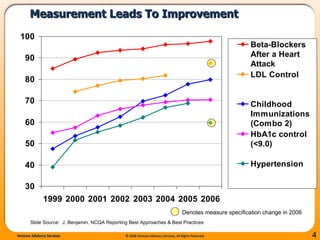
Measurement Leads To Improvement  Denotes measure specification change in 2006 Slide Source:  J. Benjamin, NCQA Reporting Best Approaches & Best Practices
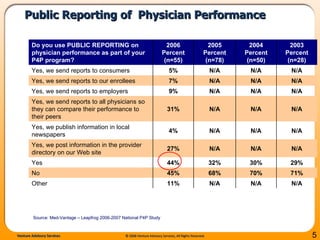
Public Reporting of  Physician Performance Source: Med-Vantage – Leapfrog 2006-2007 National P4P Study Do you use PUBLIC REPORTING on physician performance as part of your P4P program?   2006 Percent (n=55) 2005 Percent (n=78) 2004 Percent (n=50) 2003 Percent (n=28) Yes, we send reports to consumers 5% N/A N/A N/A Yes, we send reports to our enrollees 7% N/A N/A N/A Yes, we send reports to employers 9% N/A N/A N/A Yes, we send reports to all physicians so they can compare their performance to their peers 31% N/A N/A N/A Yes, we publish information in local newspapers 4% N/A N/A N/A Yes, we post information in the provider directory on our Web site 27% N/A N/A N/A Yes 44% 32% 30% 29% No 45% 68% 70% 71% Other 11% N/A N/A N/A
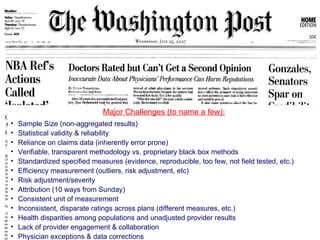
Major Challenges (to name a few): Sample Size (non-aggregated results) Statistical validity & reliability Reliance on claims data (inherently error prone) Verifiable, transparent methodology vs. proprietary black box methods Standardized specified measures (evidence, reproducible, too few, not field tested, etc.) Efficiency measurement (outliers, risk adjustment, etc) Risk adjustment/severity Attribution (10 ways from Sunday) Consistent unit of measurement Inconsistent, disparate ratings across plans (different measures, etc.)  Health disparities among populations and unadjusted provider results Lack of provider engagement & collaboration Physician exceptions & data corrections
The Road to Transparency…Where Do We Go From Here? We are missing a significant opportunity to shape the consumer decision process  before  patients seek treatment
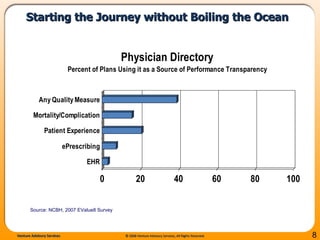
Starting the Journey without Boiling the Ocean  Source: NCBH, 2007 EValue8 Survey
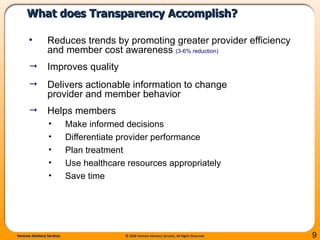
What does Transparency Accomplish?  Reduces trends by promoting greater provider efficiency and member cost awareness  (3-6% reduction) Improves quality Delivers actionable information to change  provider and member behavior  Helps members  Make informed decisions Differentiate provider performance Plan treatment Use healthcare resources appropriately Save time
Minimal provider comparability Unsatisfactory user interface design  Piecemeal integration / Siloed content Unfamiliar terms & concepts  Questionable Trust (Single source of truth)  Cost & quality confusion  Lacking Patient experience  Low value features & capability  Information overload  Competing entry points  Summary Usability Testing Findings So Far
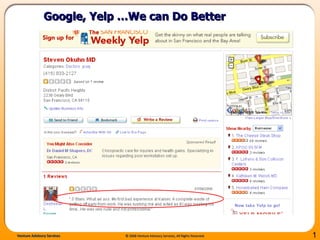
Google, Yelp …We can Do Better
Design Approach to Better EPD Usability  Summary entry point that integrates multiple search options with content (MD/Facility/Dental/Ancillary) Summary-level provider comparison capability  Drill–down functionality supports interpretation  Navigation 3 click rule  (e.g., short time to answer) Multiple releases to evolve capability and maintain differentiation with market Source:  Forrester evaluation of health plan cost comparison tools (April, 2005), Med-Vantage 2005-2007 survey interviews (n=85)
Desired Outcomes to Expect from an EPD  relevant to the consumer? readily understandable? readily accessible? trusted and robust (sound enough for members to use)? Is the health action information…..  influence a treatment selection decision? motivate action?  encourage behavior change? Does the health action information…..
Next Generation Enhanced Provider Directories  Sophisticated search & mapping taxonomy Content Intelligence “Guided Analytics” Personalized provider ratings (competition on condition, surgery & procedure) Treatment detail (claims history) Actual patient liability Tighter integration with facility performance True comparison shopping (facility, outpatient, physician office, free standing) Improved display rates (data aggregation – CMS, BHI, CFP, State initiatives other) Patient experience Actionable patient steps (what to expect, health education & questions)
Build trust in content (use national standards and specialty designations) Strong science, large sample size, methodological backbone required for public reporting P4P vs. Transparency Clinical measure results must be actionable, reliable and valid Physician engagement and comment Provider exception reporting and appeal Expect significant communication with providers Leverage strength/breath of provider relationships Leverage existing data elements and provider-accepted measures to minimize provider conflict Work in collaboration with medical specialty societies Publicly available data, where appropriate/available EPD Deployment Lessons
Viewpoints (Supplement)
Transparency Tipping Point Public Policy Retail transformation Apoplectic employers (“Aim-fire-ready”) Consumers want better tools for informed decision-making  Media attention on published performance Race to build enhanced provider directories  Standardized national measures
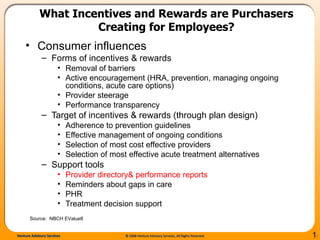
What Incentives and Rewards are Purchasers Creating for Employees? Consumer influences Forms of incentives & rewards Removal of barriers Active encouragement (HRA, prevention, managing ongoing conditions, acute care options) Provider steerage Performance transparency Target of incentives & rewards (through plan design) Adherence to prevention guidelines Effective management of ongoing conditions Selection of most cost effective providers Selection of most effective acute treatment alternatives Support tools Provider directory& performance reports Reminders about gaps in care PHR Treatment decision support Source:  NBCH EValue8
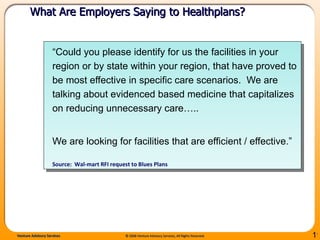
“ Could you please identify for us the facilities in your region or by state within your region, that have proved to be most effective in specific care scenarios.  We are talking about evidenced based medicine that capitalizes on reducing unnecessary care…..  We are looking for facilities that are efficient / effective.”  Source:  Wal-mart RFI request to Blues Plans What Are Employers Saying to Healthplans?
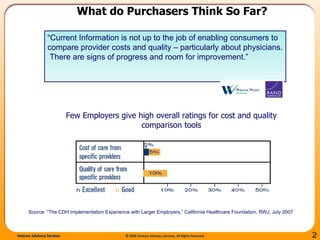
What do Purchasers Think So Far? “ Current Information is not up to the job of enabling consumers to compare provider costs and quality – particularly about physicians.  There are signs of progress and room for improvement.” Source: “The CDH Implementation Experience with Larger Employers,” California Healthcare Foundation, RWJ, July 2007 Few Employers give high overall ratings for cost and quality comparison tools
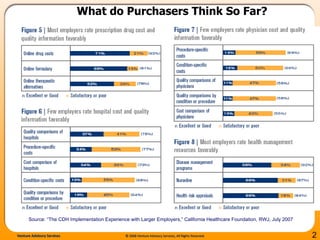
What do Purchasers Think So Far? Source: “The CDH Implementation Experience with Larger Employers,” California Healthcare Foundation, RWJ, July 2007
What Are Health Plan CEOs Saying? Consumers do not have access to comprehensive cost and quality information Prices vary widely from provider to provider in the same market for the same service Higher prices do not always reflect higher quality and vice versa   Source:  Charlie Baker, CEO, Harvard Pilgrim Health Plan
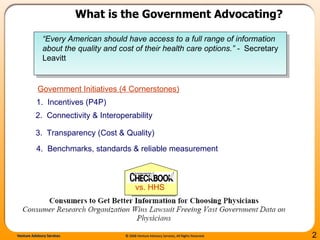
What is the Government Advocating? “ Every American should have access to a full range of information about the quality and cost of their health care options.” -  Secretary Leavitt 2.  Connectivity & Interoperability 1.  Incentives (P4P)  4.  Benchmarks, standards & reliable measurement 3.  Transparency (Cost & Quality) Government Initiatives (4 Cornerstones) vs. HHS
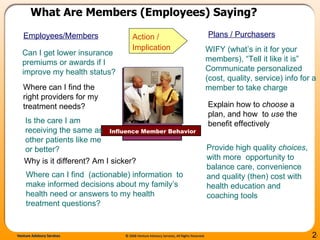
What Are Members (Employees) Saying?   WIFY (what’s in it for your members), “Tell it like it is” Communicate personalized (cost, quality, service) info for a member to take charge  Provide high quality  choices , with more  opportunity to balance care, convenience and quality (then) cost with health education and coaching tools Can I get lower insurance premiums or awards if I improve my health status?  Where can I find  (actionable) information  to make informed decisions about my family’s health need or answers to my health treatment questions? Explain how to  choose  a plan, and how  to  use  the benefit effectively Influence Member Behavior Employees/Members Plans / Purchasers Action /  Implication Is the care I am receiving the same as other patients like me or better?  Where can I find the right providers for my treatment needs?  Why is it different? Am I sicker?
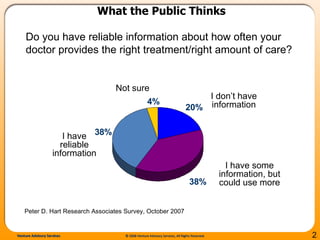
What the Public Thinks Peter D. Hart Research Associates Survey, October 2007 Do you have reliable information about how often your doctor provides the right treatment/right amount of care? I don’t have information I have some information, but could use more I have reliable information Not sure
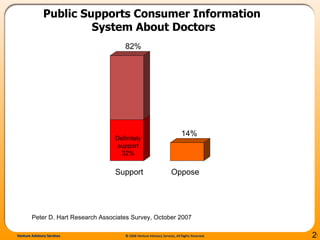
Public Supports Consumer Information  System About Doctors Support Oppose Definitely support 32% 82% 14% Peter D. Hart Research Associates Survey, October 2007
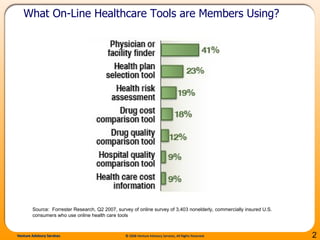
Source:  Forrester Research, Q2 2007, survey of online survey of 3,403 nonelderly, commercially insured U.S. consumers who use online health care tools  What On-Line Healthcare Tools are Members Using?
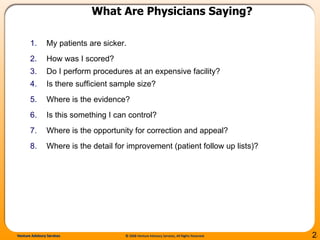
What Are Physicians Saying? My patients are sicker. How was I scored? Do I perform procedures at an expensive facility? Is there sufficient sample size? Where is the evidence? Is this something I can control? Where is the opportunity for correction and appeal? Where is the detail for improvement (patient follow up lists)?

Finding the Right Care for the Right Price, Cost and Quality (Geof Baker)

  • 1.
    Finding the RightCare for the Right Price, Right Quality, Right Cost and Right Provider(s) Lessons From Health Plans Deploying Transparency for Consumers Geof Baker, Principal Venture Advisory Services
  • 2.
    Agenda What isthe State of Public Reporting? National Context Next Generation Lessons Learned Viewpoints
  • 3.
    Public Reporting =Improved Performance “ Hospitals engaged in both public reporting and pay for performance achieved modestly greater improvements in quality than did hospitals engaged only in public reporting.” NEJM, “ Public Reporting and Pay for Performance in Hospital Quality Improvement”, Feb 2007 Providers should publicly report and participate as soon as possible (reporting, then improvement and excellence) - IOM Report: Rewarding Provider Performance Recommendations Slide Source: J. Benjamin, NCQA Reporting Best Approaches & Best Practices
  • 4.
    Measurement Leads ToImprovement Denotes measure specification change in 2006 Slide Source: J. Benjamin, NCQA Reporting Best Approaches & Best Practices
  • 5.
    Public Reporting of Physician Performance Source: Med-Vantage – Leapfrog 2006-2007 National P4P Study Do you use PUBLIC REPORTING on physician performance as part of your P4P program?   2006 Percent (n=55) 2005 Percent (n=78) 2004 Percent (n=50) 2003 Percent (n=28) Yes, we send reports to consumers 5% N/A N/A N/A Yes, we send reports to our enrollees 7% N/A N/A N/A Yes, we send reports to employers 9% N/A N/A N/A Yes, we send reports to all physicians so they can compare their performance to their peers 31% N/A N/A N/A Yes, we publish information in local newspapers 4% N/A N/A N/A Yes, we post information in the provider directory on our Web site 27% N/A N/A N/A Yes 44% 32% 30% 29% No 45% 68% 70% 71% Other 11% N/A N/A N/A
  • 6.
    Major Challenges (toname a few): Sample Size (non-aggregated results) Statistical validity & reliability Reliance on claims data (inherently error prone) Verifiable, transparent methodology vs. proprietary black box methods Standardized specified measures (evidence, reproducible, too few, not field tested, etc.) Efficiency measurement (outliers, risk adjustment, etc) Risk adjustment/severity Attribution (10 ways from Sunday) Consistent unit of measurement Inconsistent, disparate ratings across plans (different measures, etc.) Health disparities among populations and unadjusted provider results Lack of provider engagement & collaboration Physician exceptions & data corrections
  • 7.
    The Road toTransparency…Where Do We Go From Here? We are missing a significant opportunity to shape the consumer decision process before patients seek treatment
  • 8.
    Starting the Journeywithout Boiling the Ocean Source: NCBH, 2007 EValue8 Survey
  • 9.
    What does TransparencyAccomplish? Reduces trends by promoting greater provider efficiency and member cost awareness (3-6% reduction) Improves quality Delivers actionable information to change provider and member behavior Helps members Make informed decisions Differentiate provider performance Plan treatment Use healthcare resources appropriately Save time
  • 10.
    Minimal provider comparabilityUnsatisfactory user interface design Piecemeal integration / Siloed content Unfamiliar terms & concepts Questionable Trust (Single source of truth) Cost & quality confusion Lacking Patient experience Low value features & capability Information overload Competing entry points Summary Usability Testing Findings So Far
  • 11.
    Google, Yelp …Wecan Do Better
  • 12.
    Design Approach toBetter EPD Usability Summary entry point that integrates multiple search options with content (MD/Facility/Dental/Ancillary) Summary-level provider comparison capability Drill–down functionality supports interpretation Navigation 3 click rule (e.g., short time to answer) Multiple releases to evolve capability and maintain differentiation with market Source: Forrester evaluation of health plan cost comparison tools (April, 2005), Med-Vantage 2005-2007 survey interviews (n=85)
  • 13.
    Desired Outcomes toExpect from an EPD relevant to the consumer? readily understandable? readily accessible? trusted and robust (sound enough for members to use)? Is the health action information….. influence a treatment selection decision? motivate action? encourage behavior change? Does the health action information…..
  • 14.
    Next Generation EnhancedProvider Directories Sophisticated search & mapping taxonomy Content Intelligence “Guided Analytics” Personalized provider ratings (competition on condition, surgery & procedure) Treatment detail (claims history) Actual patient liability Tighter integration with facility performance True comparison shopping (facility, outpatient, physician office, free standing) Improved display rates (data aggregation – CMS, BHI, CFP, State initiatives other) Patient experience Actionable patient steps (what to expect, health education & questions)
  • 15.
    Build trust incontent (use national standards and specialty designations) Strong science, large sample size, methodological backbone required for public reporting P4P vs. Transparency Clinical measure results must be actionable, reliable and valid Physician engagement and comment Provider exception reporting and appeal Expect significant communication with providers Leverage strength/breath of provider relationships Leverage existing data elements and provider-accepted measures to minimize provider conflict Work in collaboration with medical specialty societies Publicly available data, where appropriate/available EPD Deployment Lessons
  • 16.
  • 17.
    Transparency Tipping PointPublic Policy Retail transformation Apoplectic employers (“Aim-fire-ready”) Consumers want better tools for informed decision-making Media attention on published performance Race to build enhanced provider directories Standardized national measures
  • 18.
    What Incentives andRewards are Purchasers Creating for Employees? Consumer influences Forms of incentives & rewards Removal of barriers Active encouragement (HRA, prevention, managing ongoing conditions, acute care options) Provider steerage Performance transparency Target of incentives & rewards (through plan design) Adherence to prevention guidelines Effective management of ongoing conditions Selection of most cost effective providers Selection of most effective acute treatment alternatives Support tools Provider directory& performance reports Reminders about gaps in care PHR Treatment decision support Source: NBCH EValue8
  • 19.
    “ Could youplease identify for us the facilities in your region or by state within your region, that have proved to be most effective in specific care scenarios. We are talking about evidenced based medicine that capitalizes on reducing unnecessary care….. We are looking for facilities that are efficient / effective.” Source: Wal-mart RFI request to Blues Plans What Are Employers Saying to Healthplans?
  • 20.
    What do PurchasersThink So Far? “ Current Information is not up to the job of enabling consumers to compare provider costs and quality – particularly about physicians. There are signs of progress and room for improvement.” Source: “The CDH Implementation Experience with Larger Employers,” California Healthcare Foundation, RWJ, July 2007 Few Employers give high overall ratings for cost and quality comparison tools
  • 21.
    What do PurchasersThink So Far? Source: “The CDH Implementation Experience with Larger Employers,” California Healthcare Foundation, RWJ, July 2007
  • 22.
    What Are HealthPlan CEOs Saying? Consumers do not have access to comprehensive cost and quality information Prices vary widely from provider to provider in the same market for the same service Higher prices do not always reflect higher quality and vice versa Source: Charlie Baker, CEO, Harvard Pilgrim Health Plan
  • 23.
    What is theGovernment Advocating? “ Every American should have access to a full range of information about the quality and cost of their health care options.” - Secretary Leavitt 2. Connectivity & Interoperability 1. Incentives (P4P) 4. Benchmarks, standards & reliable measurement 3. Transparency (Cost & Quality) Government Initiatives (4 Cornerstones) vs. HHS
  • 24.
    What Are Members(Employees) Saying? WIFY (what’s in it for your members), “Tell it like it is” Communicate personalized (cost, quality, service) info for a member to take charge Provide high quality choices , with more opportunity to balance care, convenience and quality (then) cost with health education and coaching tools Can I get lower insurance premiums or awards if I improve my health status? Where can I find (actionable) information to make informed decisions about my family’s health need or answers to my health treatment questions? Explain how to choose a plan, and how to use the benefit effectively Influence Member Behavior Employees/Members Plans / Purchasers Action / Implication Is the care I am receiving the same as other patients like me or better? Where can I find the right providers for my treatment needs? Why is it different? Am I sicker?
  • 25.
    What the PublicThinks Peter D. Hart Research Associates Survey, October 2007 Do you have reliable information about how often your doctor provides the right treatment/right amount of care? I don’t have information I have some information, but could use more I have reliable information Not sure
  • 26.
    Public Supports ConsumerInformation System About Doctors Support Oppose Definitely support 32% 82% 14% Peter D. Hart Research Associates Survey, October 2007
  • 27.
    Source: ForresterResearch, Q2 2007, survey of online survey of 3,403 nonelderly, commercially insured U.S. consumers who use online health care tools What On-Line Healthcare Tools are Members Using?
  • 28.
    What Are PhysiciansSaying? My patients are sicker. How was I scored? Do I perform procedures at an expensive facility? Is there sufficient sample size? Where is the evidence? Is this something I can control? Where is the opportunity for correction and appeal? Where is the detail for improvement (patient follow up lists)?