


Office of the
  National
Coordinator
 for Health
Information
Technology
   (ONC)

Federal Health
 Information
 Technology
Strategic Plan

 2011 – 2015
Introduction                                                    3

Table of   Federal Health IT Vision and Mission                            6
           Federal Health IT Principles                                    7
Contents   Goal I: Achieve Adoption and Information Exchange through
           Meaningful Use of Health IT                                     8
           Goal II: Improve Care, Improve Population Health, and Reduce
           Health Care Costs through the Use of Health IT                 21
           Goal III: Inspire Confidence and Trust in Health IT            28
           Goal IV: Empower Individuals with Health IT to Improve their
           Health and the Health Care System                              36
           Goal V: Achieve Rapid Learning and Technological Advancement 43
           Appendix A: Performance Measures                               49
           Appendix B: Programs, Initiatives, and Federal Engagement      51
           Appendix C: HIT Standards and HIT Policy Committees
           Information Flow                                               65
           Appendix E: Statutes and Regulations                           67
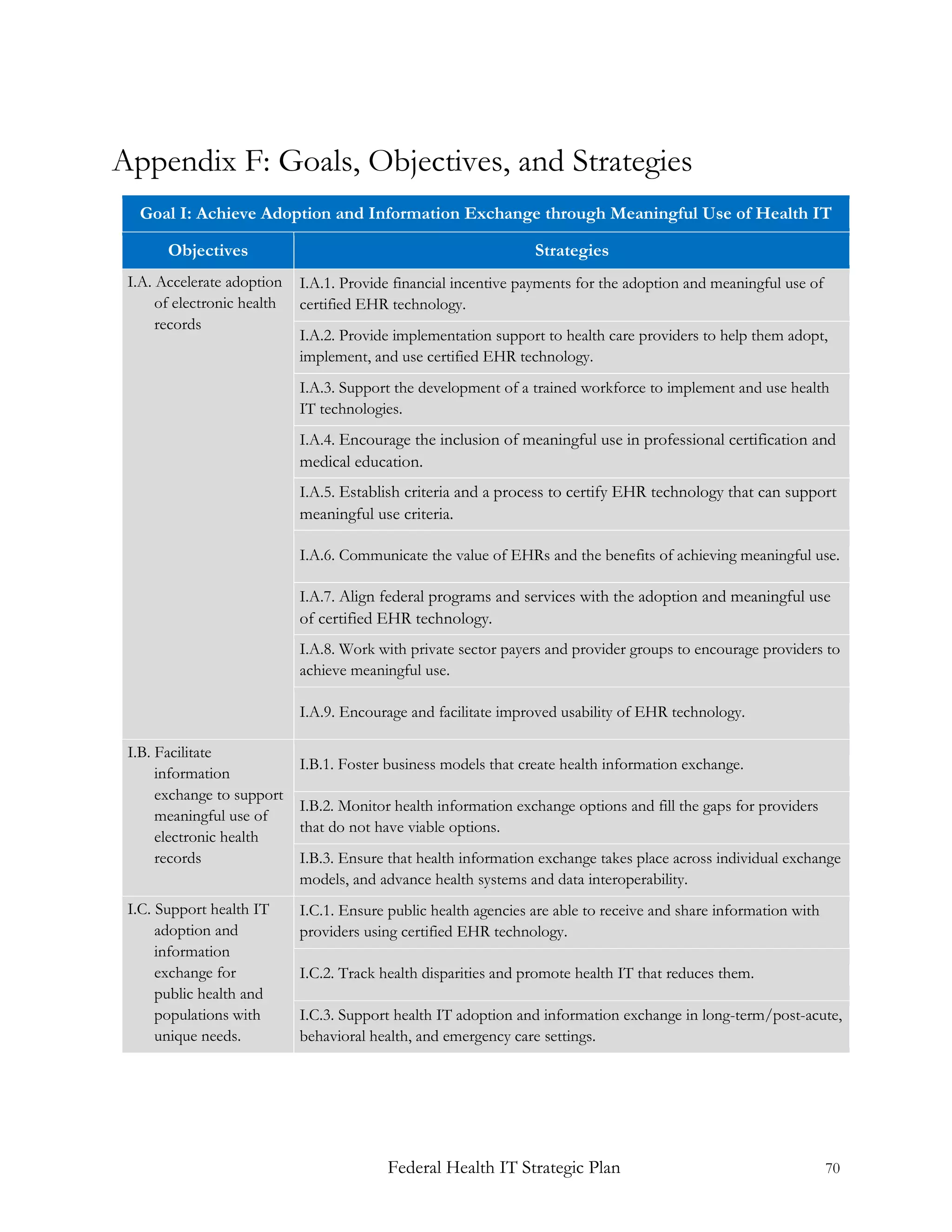
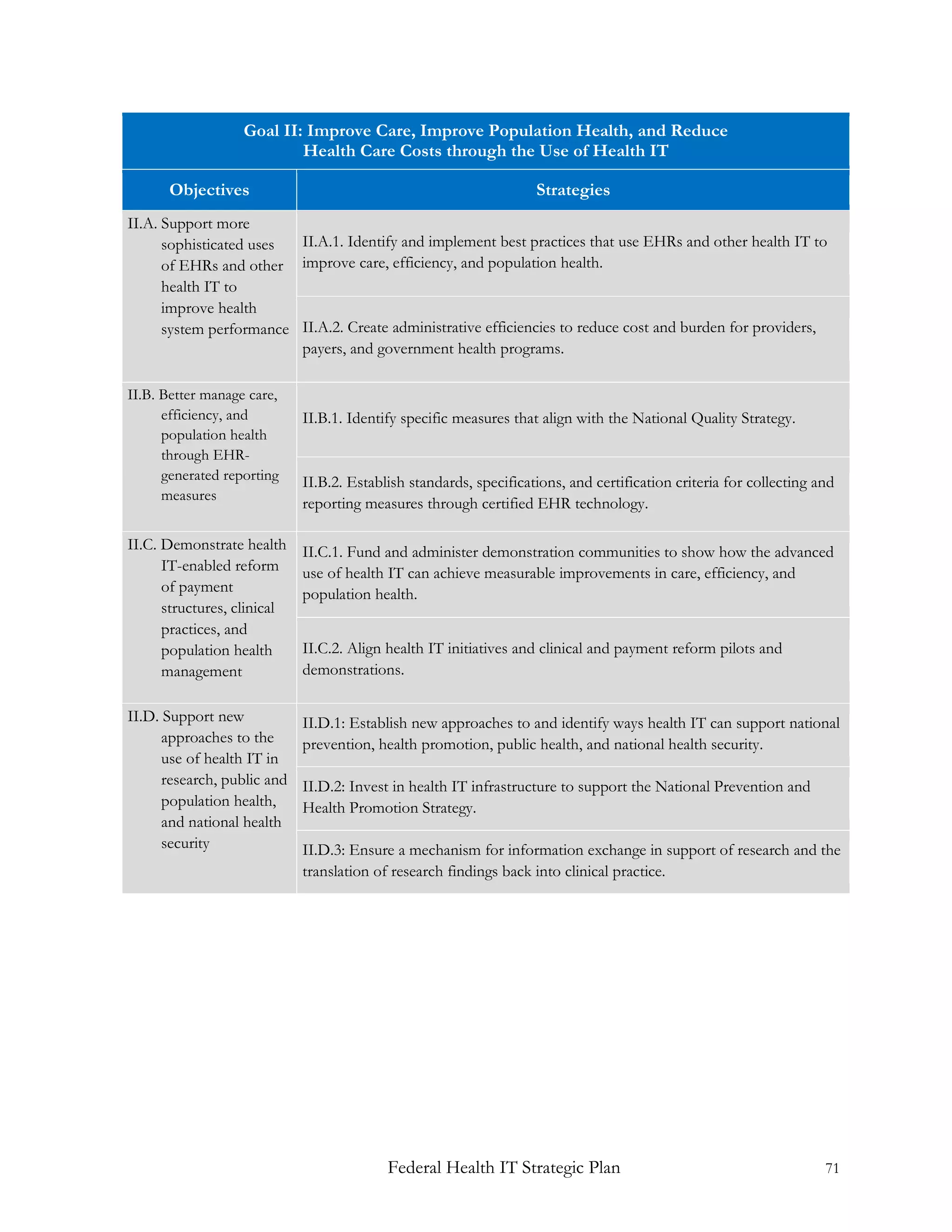
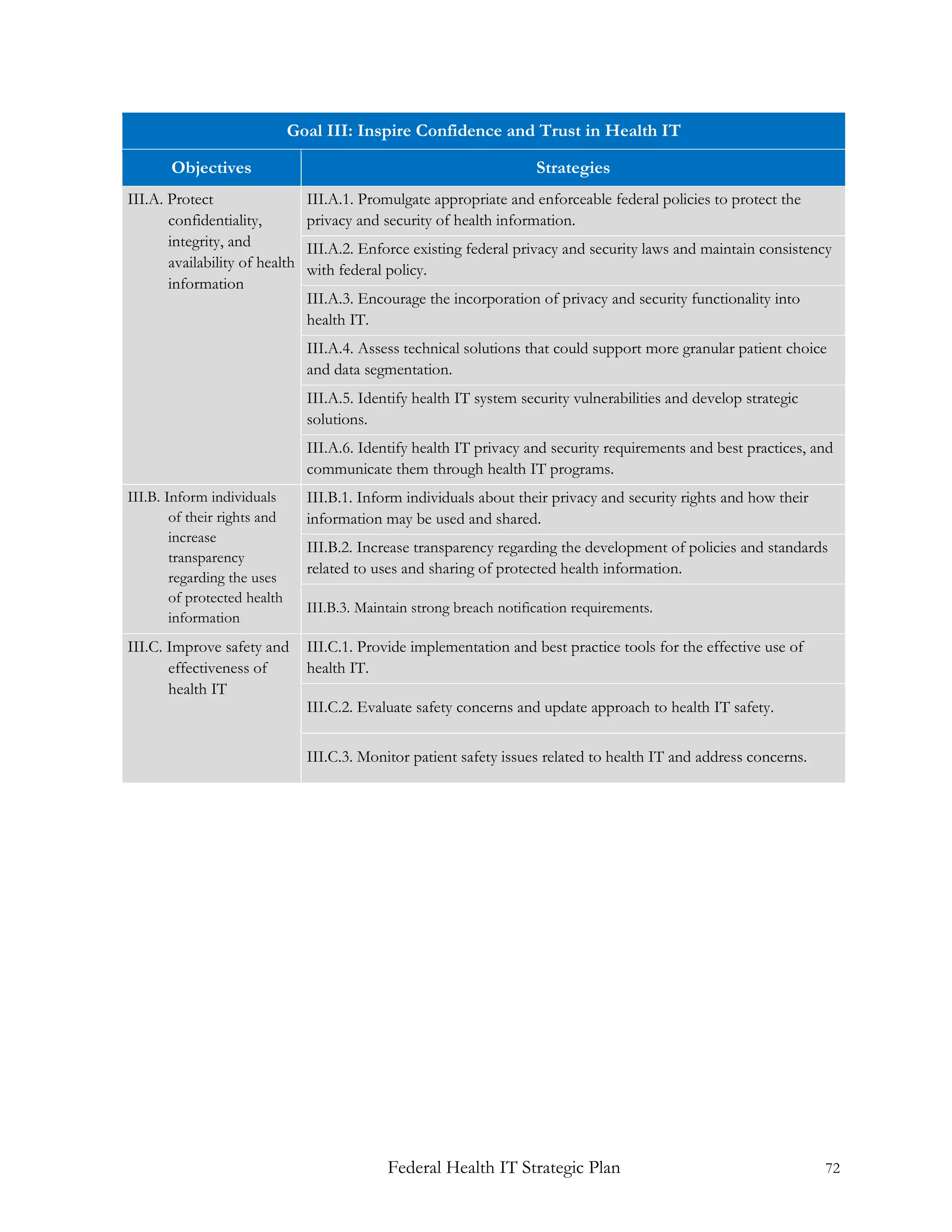
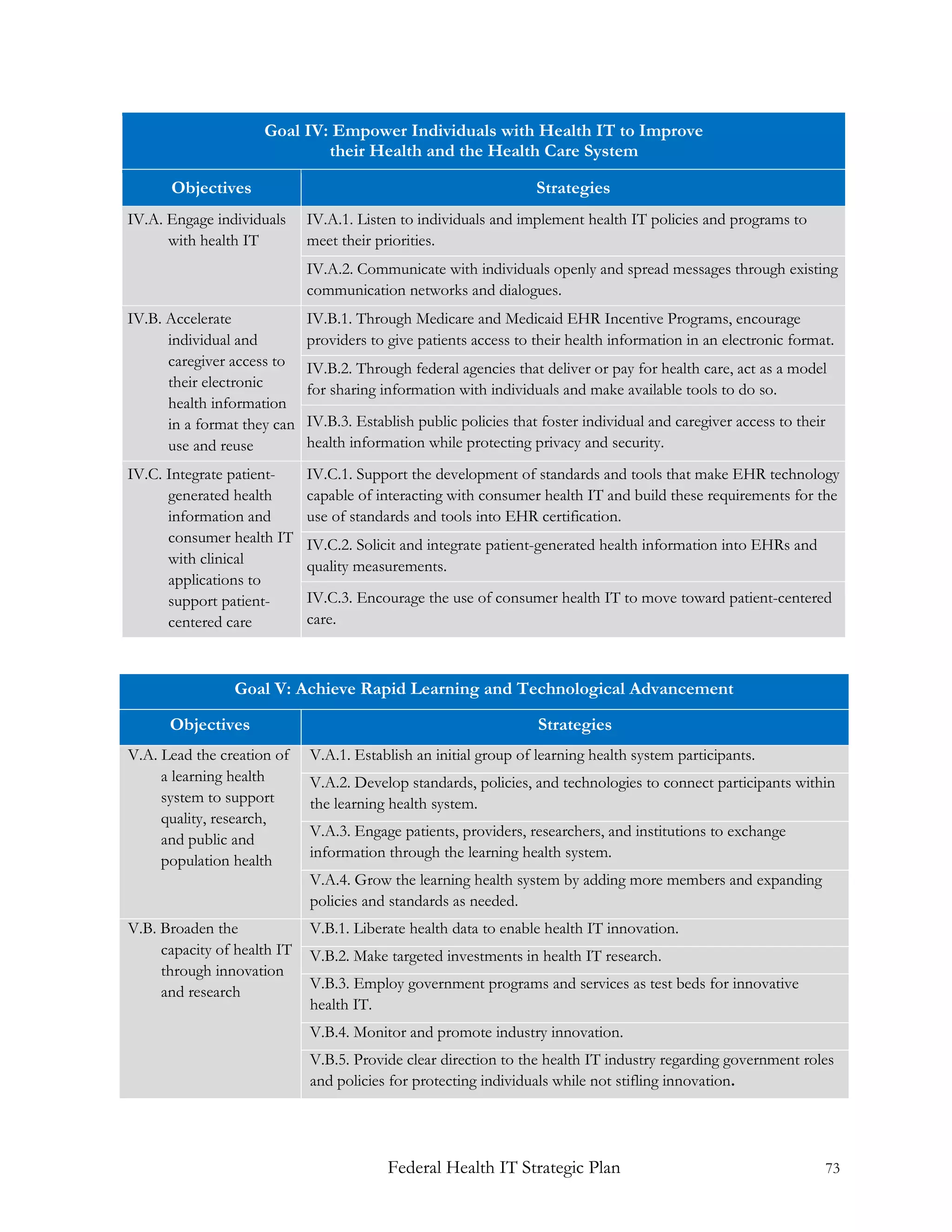
           Appendix F: Goals, Objectives, and Strategies                  70
           Appendix G: Acronyms                                           74
           ONC                                                            77
           Acknowledgements                                               77
           Notes                                                          78
Federal Health IT Strategic Plan   3
Introduction

T
         he technologies collectively known as health       Public Health Service Act, as added by the HITECH
         information technology (health IT) share a         Act, requires the National Coordinator to update
         common attribute: they enable the secure           and republish the Plan. This Plan updates the
         collection and exchange of vast amounts of         previous version to take into account the rapidly
health data about individuals. The collection and           changing landscape of health IT and health IT
movement of this data will power the health care of         policy. In order to update the Plan, ONC leveraged
the future. Health IT has the potential to empower          the strategic framework put forth by the HIT Policy
individuals and increase transparency; enhance the          Committee and obtained additional input by
ability to study care delivery and payment systems;         conducting interviews with representatives from
and ultimately achieve improvements in care,                federal agencies/offices and the private sector.
efficiency, and population health.                          ONC also engaged its federal partners, the private
                                                            sector and members of the public to provide
However, these technologies – including electronic
                                                            comments on multiple versions of the Plan.
health records (EHRs), personal health records
(PHRs), telehealth devices, remote monitoring               Goal I, “Achieve Adoption and Information
technologies, and mobile health applications – are          Exchange through Meaningful Use of Health IT”
remarkably underutilized today. In 2010, only 25            discusses the centerpiece of the government’s health
percent of physician offices and 15 percent of acute        IT strategy over the next five years. “Meaningful
care hospitals took advantage of EHRs. i Even fewer         use” is aimed at widespread adoption and
used remote monitoring and telehealth technologies.         information exchange in its first two stages, and will
While many consumers access their banking                   then build to improve health outcomes in the third
information online daily, only 7 percent have used          stage. Activities are focused on two areas: defining
the web to access their personal health information. ii     the meaningful use of certified EHR technology; and
                                                            encouraging the achievement of meaningful use
Recent legislation has established an agenda and
                                                            through the CMS administered Medicare and
committed significant resources for health IT. The
                                                            Medicaid EHR Incentive Programs and the support
Health Information Technology for Economic and
                                                            of meaningful use through grant programs, including
Clinical Health (HITECH) Act, passed as part of the
                                                            information exchange with public health
American Recovery and Reinvestment Act of 2009,
                                                            departments and laboratories.
allocated billions of dollars for the health care system
to adopt and meaningfully use health IT to improve          Goal II, “Improve Care, Improve Population Health,
health. The Patient Protection and Affordable Care          and Reduce Health Care Costs through the Use of
Act of 2010, as amended by the Health Care and              Health IT,” discusses the specific ways health IT is
Education Reconciliation Act of 2010, (referred to          contributing to the goals of health care reform:
collectively as the Affordable Care Act) builds on the      improved care, improved population health, and
HITECH Act and recognizes health IT as a critical           reduced per capita costs of health care. Widespread
enabler to broad transformations in health care. This       adoption of EHRs, information exchange, quality
document is the Federal Health IT Strategic Plan,           improvement initiatives, and health care reform
developed under the leadership of the Office of the         pilots are required to implement the Affordable Care
National Coordinator for Health Information                 Act. As part of each of these activities, the
Technology (ONC) and in close collaboration with            government is investing in and leveraging health IT
other federal partners, for working with the private        to transform the health care system.
and public sectors to realize Congress and the
                                                            Goal III, “Inspire Confidence and Trust in Health
Administration’s health IT agenda.
                                                            IT,” focuses on government efforts to update its
The first Federal Health IT Strategic Plan was              approach to privacy and security issues related to
published in June 2008. Section 3001(c)(3) of the           health IT, and build greater confidence and trust in


                                             Federal Health IT Strategic Plan                                   4
EHRs and health information exchange among               improve knowledge about health care across
providers and the public. The digitization of health     populations. In the long run, the government is
records will create a new set of challenges for          pursuing a vision of a learning health system, in
protecting the privacy and security of health            which a vast array of health care data can be
information, but it will also open new opportunities     appropriately aggregated, analyzed, and leveraged
for improving safeguards.                                using real-time algorithms and functions. iii This
                                                         future will require technical innovation to build on
Goal IV, “Empower Individuals with Health IT to
                                                         the foundation of meaningful use, as well as finding
Improve their Health and the Health Care System,”
                                                         new ways to use that foundation in the practice of
discusses how the government is designing health IT
                                                         health care.
policies and programs to meet individual needs and
expectations, provide individuals with access to their   ONC will track national progress towards achieving
information, help facilitate a strong consumer health    the goals laid out in this Plan.            Ongoing
IT market, and better integrate individuals’ and         collaboration with federal agencies, states and
clinicians’ communications through health IT. A          providers will be necessary in order to realize these
public that has a voice in designing national health     goals. The Plan is meant to be a living document
IT policies and programs and is empowered with           that will be updated based on experience with stage
access to its health information through useful tools    one meaningful use and the implementation of a
can be a powerful driver in moving toward patient-       robust evaluation program.
centered health care.
Goal V, “Achieve Rapid Learning and Technological
Advancement,” focuses on demonstrating ways
health IT and meaningful use can enable innovation
and appropriate use of health information to


                                          Federal Health IT Strategic Plan
                                  Figure 1; Federal Health IT Strategy Map                                  5
Federal Health IT Vision and Mission

Vision

A health system that uses information to empower individuals and
to improve the health of the population.


Mission

To improve health and health care for all Americans through the
use of information and technology.


                        Federal Health IT Strategic Plan           6
Federal Health IT Principles
In developing and executing the federal health IT strategy, the government strives to
 Put individuals and their interests first. In order to enhance the health and well-being of all Americans, the
  government must meet the needs and protect the rights of each individual.
 Be a worthy steward of the country’s money and trust. The government seeks to use its resources
  judiciously. This means relying to the extent possible on private markets to accomplish important societal
  objectives, and acting to correct market failures when necessary. It also means developing governmental policies
  through open and transparent processes.
 Support health IT benefits for all. All Americans should have equal access to quality health care. This includes
  the benefits conferred by health IT. The government will endeavor to assure that underserved and at-risk
  individuals enjoy these benefits to the same extent as all other citizens.
 Focus on outcomes. Federal health IT policy will constantly focus on improving the outcomes of care, so as to
  advance the health of Americans and the performance of their health care system.
 Build boldly on what works. The government will set ambitious goals and then work methodically to achieve
  them, monitoring health IT successes, and looking for ways to expand upon programs that work. It will seek to
  be nimble and action-oriented: evaluating existing government activities, learning from experience, and changing
  course if necessary.
 Encourage innovation. The government is working to create an environment of testing, learning, and
  improving, thereby fostering breakthroughs that quickly and radically transform health care. The government
  will support innovation in health IT.


                                           Federal Health IT Strategic Plan                                     7
Goal I: Achieve Adoption and Information Exchange
through Meaningful Use of Health IT

T
         he first priority in realizing the benefits of     the adoption and use of EHRs over the next five
         health IT is to achieve nationwide adoption        years. Stage one objectives focus on adopting EHRs
         of EHRs and widespread information                 and beginning to take advantage of basic electronic
         exchange. As patients and providers                data capture, medication ordering, and decision-
experience the benefits of EHRs, they will demand           support tools. We expect future stages to become
nothing less from their health care practices. The          more rigorous, for example, by requiring providers
Medicare and Medicaid EHR Incentive Programs                not only to adopt the technology but to use it to
accelerate the realization of this future by offering       exchange health information and – ultimately – to
financial incentives to hundreds of thousands of            achieve improvements in care, efficiency, and
eligible professionals, eligible hospitals and critical     population health (see Goal II). We anticipate that
access hospitals for incorporating certified EHR            future stages of meaningful use will be aligned to
technology into their practices. “Meaningful use” is        support advancing nationwide-wide health goals, as
much more than just adoption – these providers will         defined in the HHS Strategic Plan, and the priority
also be required to maintain data confidentiality,          areas identified in the National Quality Strategy.
share information securely with each other, engage
                                                            In addition to incentive payments, the HITECH Act
patients with their electronic health information, and
                                                            programs provide significant support for providers
improve care.
                                                            to achieve adoption and meaningful use, including
There are a few well-defined barriers that have             implementation support, workforce training, and
slowed acceptance of EHRs and widespread                    information exchange support. Programs are
information exchange. Small- and medium-sized               focused on the providers that need the most help –
providers often do not have sufficient capital to           solo and small group practices, community health
implement EHR systems. There is a lack of skilled           centers, critical access hospitals, and providers
health IT professionals to support providers as they        located in rural and underserved areas. In 2010, HHS
transition from paper records to EHRs. Using EHRs           issued rules establishing the requirements of the
may alter current provider workflows, and many              first stage of meaningful use. HHS expects to
providers struggle to select systems, use them in           articulate two further stages through rulemaking
ways that will improve care, and make the necessary         over the next five years. Participation in the
changes to their processes. Finally, information            Medicare and Medicaid EHR Incentive Programs is
exchange, which is central to realizing the benefits of     voluntary, but beginning in 2015, eligible
EHRs, is not fully possible today – there is no             professionals and hospitals under the Medicare EHR
interoperable infrastructure to securely exchange           Incentive Programs will face payment reductions if
health information nationwide among providers,              they do not meet the meaningful use requirements.
between providers and patients, and between
                                                            In implementing the Medicare and Medicaid EHR
providers and public health agencies (see Objectives
                                                            Incentive Programs, the government is taking
I.B and I.C).
                                                            advantage of the experience of federal agencies that
Through the HITECH Act, the Department of                   deliver health care (Department of Veterans Affairs,
Health and Human Services (HHS) created a set of            Department of Defense, and Indian Health Service)
far-reaching programs to help providers overcome            that have already-developed EHR systems which
such barriers. For the Medicare and Medicaid EHR            have been in place for over a decade. These agencies’
Incentive Programs, the three progressive stages of         experiences in using EHRs can offer important
meaningful use will define what eligible professionals      insights and best practices for the nationwide
and hospitals can and should accomplish through             adoption of EHRs.


                                             Federal Health IT Strategic Plan                                  8
It is the government’s goal that such a large-scale                                   Medicare and Medicaid EHR Incentive Programs (for
movement will create a tipping point – that the                                       example, long-term and post-acute care facilities,
adoption and meaningful use of EHRs will become                                       community mental health centers, and some behavioral
ubiquitous across the nation. To this end, the                                        health providers), the government is developing
government is seeking to encourage meaningful use                                     technology and policy solutions that will build on the
through other mechanisms in addition to HITECH                                        Department’s meaningful use efforts and fit their
Act programs. This includes supporting the above-                                     unique needs (see Strategy I.C.3).
mentioned federal agencies that deliver health care and
                                                                                      The government’s objectives to “Achieve Adoption
federal grant recipients (critical access hospitals,
                                                                                      and Information Exchange through Meaningful Use
community health centers, etc.) in meeting meaningful
                                                                                      of Health IT” are:
use requirements. We expect that medical societies and
professional licensing and certifying bodies will also                                      A. Accelerate adoption of electronic health
help to encourage meaningful use among their                                                   records
members. Some private insurers are already mirroring                                        B. Facilitate information exchange to support
the Medicare and Medicaid EHR Incentive Programs                                               meaningful use of electronic health records
and providing incentives for the achievement of                                             C. Support health IT adoption and
meaningful use among their provider communities. For                                           information exchange for public health and
providers ineligible for incentive payments under the                                          populations with unique needs


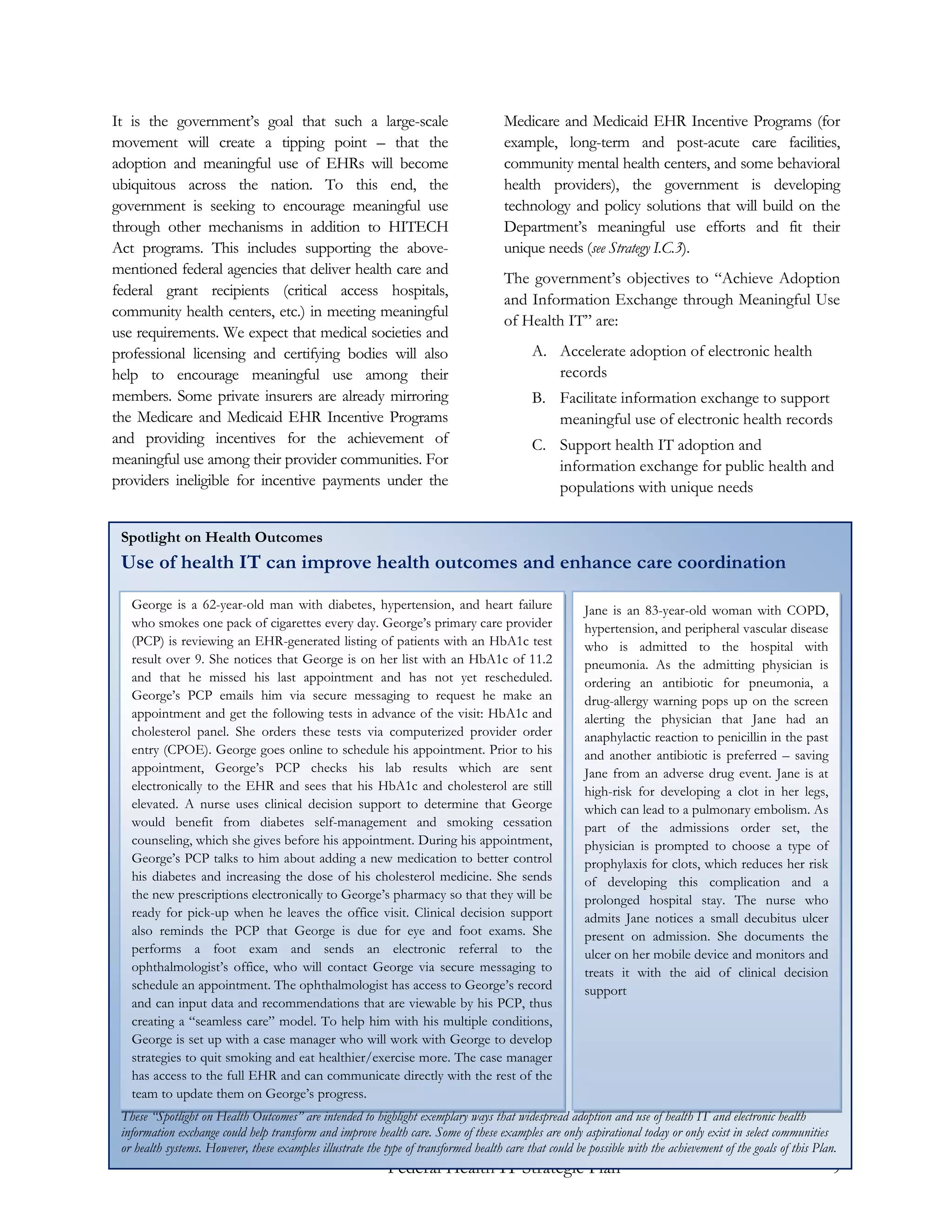
 Spotlight on Health Outcomes
 Use of health IT can improve health outcomes and enhance care coordination

   George is a 62-year-old man with diabetes, hypertension, and heart failure                           Jane is an 83-year-old woman with COPD,
   who smokes one pack of cigarettes every day. George’s primary care provider                          hypertension, and peripheral vascular disease
   (PCP) is reviewing an EHR-generated listing of patients with an HbA1c test                           who is admitted to the hospital with
   result over 9. She notices that George is on her list with an HbA1c of 11.2                          pneumonia. As the admitting physician is
   and that he missed his last appointment and has not yet rescheduled.                                 ordering an antibiotic for pneumonia, a
   George’s PCP emails him via secure messaging to request he make an                                   drug-allergy warning pops up on the screen
   appointment and get the following tests in advance of the visit: HbA1c and                           alerting the physician that Jane had an
   cholesterol panel. She orders these tests via computerized provider order                            anaphylactic reaction to penicillin in the past
   entry (CPOE). George goes online to schedule his appointment. Prior to his                           and another antibiotic is preferred – saving
   appointment, George’s PCP checks his lab results which are sent                                      Jane from an adverse drug event. Jane is at
   electronically to the EHR and sees that his HbA1c and cholesterol are still                          high-risk for developing a clot in her legs,
   elevated. A nurse uses clinical decision support to determine that George                            which can lead to a pulmonary embolism. As
   would benefit from diabetes self-management and smoking cessation                                    part of the admissions order set, the
   counseling, which she gives before his appointment. During his appointment,                          physician is prompted to choose a type of
   George’s PCP talks to him about adding a new medication to better control                            prophylaxis for clots, which reduces her risk
   his diabetes and increasing the dose of his cholesterol medicine. She sends                          of developing this complication and a
   the new prescriptions electronically to George’s pharmacy so that they will be                       prolonged hospital stay. The nurse who
   ready for pick-up when he leaves the office visit. Clinical decision support                         admits Jane notices a small decubitus ulcer
   also reminds the PCP that George is due for eye and foot exams. She                                  present on admission. She documents the
   performs a foot exam and sends an electronic referral to the                                         ulcer on her mobile device and monitors and
   ophthalmologist’s office, who will contact George via secure messaging to                            treats it with the aid of clinical decision
   schedule an appointment. The ophthalmologist has access to George’s record                           support
   and can input data and recommendations that are viewable by his PCP, thus
   creating a “seamless care” model. To help him with his multiple conditions,
   George is set up with a case manager who will work with George to develop
   strategies to quit smoking and eat healthier/exercise more. The case manager
   has access to the full EHR and can communicate directly with the rest of the
   team to update them on George’s progress.
 These “Spotlight on Health Outcomes” are intended to highlight exemplary ways that widespread adoption and use of health IT and electronic health
 information exchange could help transform and improve health care. Some of these examples are only aspirational today or only exist in select communities
 or health systems. However, these examples illustrate the type of transformed health care that could be possible with the achievement of the goals of this Plan.
                                                            Federal Health IT Strategic Plan                                                                    9
OBJECTIVE A                                               transition gradually away from further process
                                                          requirements like those included in stage one, to
Accelerate adoption of electronic                         requirements for improvement in outcomes and
health records                                            quality of care. Any such improvement measures will
                                                          be in line with nationwide health goals as laid out in
Strategy I.A.1: Provide financial incentive               the HHS Strategic Plan and with the national
payments for the adoption and meaningful                  priorities identified in the National Quality Strategy. v
use of certified EHR technology.                          In order to receive incentive payments, eligible
Central to the HITECH Act is the establishment of         providers must demonstrate that they can use
the Medicare and Medicaid EHR Incentive                   certified EHR technology to incorporate more
Programs, which makes available incentive payments        sophisticated uses of health IT, such as clinical
that could total an estimated $27 billion over 10         decision support (CDS), patient registries, reminder
years, to encourage eligible professionals and            systems, and changes to workflow and clinical care
hospitals to adopt and meaningfully use certified         redesign into their practices (see Goal II).
EHR technology. iv The programs generally require         Strategy I.A.2: Provide  implementation
providers to do the following:adopt EHRs that are         support to health care providers to help
certified according to standards, implementation          them adopt, implement, and use certified
specifications, and certification criteria adopted by
                                                          EHR technology.
the Secretary, and meet certain objectives and
measures using certified EHR technology established       The Regional Extension Center (REC) Program,
for progressive stages of meaningful use as defined       established through the HITECH Act with more
in CMS rules. CMS’ final rule for stage one               than $720 million in grants over a four-year project
meaningful use was published in July 2010. Stage          period, has set up 62 centers across the nation with
one meaningful use objectives include:                    staff and resources dedicated to helping providers
                                                          implement and become meaningful users of certified
 Recording patient information into EHRs, such as
                                                          EHR technology. Additionally, HRSA’s Health
  gender, race, preferred language, height, weight,
                                                          Center Controlled Network (HCCN) Program
  smoking status, and blood pressure
                                                          provides resources to community health centers to
 Using a software application to inform clinical         implement health IT, including EHRs. Further
  decisions                                               support is provided by the Health Information
                                                          Technology Research Center (HITRC), which will
 Entering medical prescriptions electronically
                                                          work to gather relevant information on effective
 Providing patients with a timely electronic copy of     practices and help the RECs collaborate with one
  their health information                                another and with relevant stakeholders to identify
                                                          and share best practices in EHR adoption,
 Securing EHRs to protect the privacy of patient
                                                          meaningful use, and provider support. Through its
  data
                                                          regional offices and other outlets, CMS offers
Future stages of meaningful use are likely to include     support to states to encourage adoption of EHR
a combination of new objectives, some of which            technology.
may require new EHR functionality, changes to
existing objectives, such as an increase in the           Strategy I.A.3: Support the development of a
threshold or broadening of the definition. In the         trained workforce to implement and use
future stages of the Medicare and Medicaid EHR            health IT technologies.
Incentive Programs, the government expects to             To meet the anticipated growth in demand for
reward improvement against predetermined                  health IT professionals, HITECH made available
thresholds that are associated with the adoption and      $118 million to support the training and
use of EHRs. Stages two and three are anticipated to      development of more than 50,000 new health IT


                                           Federal Health IT Strategic Plan                                     10
professionals. Four grant programs will prepare             specifications and certification criteria, as well as a
qualified individuals to serve in 12 high priority roles    process for EHR technology to gain certification.
related to the implementation and maintenance of            These programs aid providers in selecting certified
EHR systems.                                                EHR technologies that support them in becoming
                                                            meaningful users. ONC collaborated extensively
Three grant programs work together to prepare a
                                                            with the National Institute of Standards and
workforce in six of these priority roles for which
                                                            Technology (NIST) to establish the certification
community colleges are the natural home for
                                                            processes.
training: Community College Consortia to Educate
Health Information Technology Professionals;                Established through rulemaking in 2010 and 2011,
Curriculum Development Centers; and Competency              ONC’s certification programs specify how
Examination for Individuals Completing Non-                 organizations can become authorized by the
Degree Training. A fourth program, Assistance for           National Coordinator to certify EHR technology as
University-Based Training, will prepare students for        being compliant with the standards, implementation
six different roles, for which universities are the         specifications, and certification criteria adopted by
natural home for training. vi                               the HHS Secretary.
Strategy I.A.4: Encourage the inclusion of                  ONC published the Initial Set of Standards,
meaningful use in professional certification                Implementation Specifications, and Certification
and medical education.                                      Criteria interim final rule in January 2010 and a final
                                                            rule in July 2010. The certification criteria establish
The federal government will encourage meaningful            the     required     capabilities,   standards,    and
use to be incorporated into the U.S. medical                implementation specifications in EHR technology
education and accreditation processes. To this end,         that supports the achievement of meaningful use
ONC and CMS are collaborating with various                  stage one. The certification criteria will continue to
professional certification and medical education            evolve with future rulemakings, as further stages of
organizations to assist providers in adopting and           meaningful use are established.
becoming meaningful users and to incorporate
meaningful use into the professional certification          ONC, with its federal partners, will consider whether
and medical education organizations’ professional           to adopt certification criteria for health IT that is
requirements. The American Board of Medical                 used by non-eligible providers (such as long-term
Specialties, a professional certification body, has         and post-acute care facilities), and whether the
taken steps to assist and encourage physicians in the       availability of certification for specific types of health
adoption and meaningful use of EHRs, with the               IT would be beneficial.
ultimate goal that such EHR use and competencies            Strategy I.A.6: Communicate the value of
should become an element of professional                    EHRs and the benefits of achieving
certification.
                                                            meaningful use.
Strategy I.A.5: Establish criteria and a                    HHS is conducting outreach to providers to increase
process to certify EHR technology that can                  awareness of the HITECH Act programs that are
support meaningful use criteria.                            available to support efforts to attain meaningful use
In order for eligible providers, eligible hospitals, and    and to share evidence and best practices on the use
critical access hospitals to qualify for the Medicare       of health IT to improve health. Primary care
and Medicaid EHR Incentive Programs, they must              providers are a primary audience for this strategy
first adopt certified EHR technology that meets             (see Strategies III.B.1 and IV.A.2 for outreach
established criteria, which are aligned with the            directed at individuals). The strategy will have four
Medicare and Medicaid EHR Incentive Programs                aims:
meaningful use requirements. The HHS Secretary
has adopted EHR standards, implementation


                                             Federal Health IT Strategic Plan                                      11
 Raise awareness among providers about the                 health care systems to align with meaningful use.
  availability and benefits of EHRs and other health        Similarly, the Health Resources and Services
  IT                                                        Administration      (HRSA)       and  the    Federal
                                                            Communications Commission (FCC) are developing
 Educate providers about privacy and security
                                                            plans to encourage their grantees and subsidy
  protections as they relate to EHRs and other
                                                            recipients, respectively, to become meaningful users.
  health IT
                                                            The Substance Abuse and Mental Health Services
 Encourage providers to participate in HITECH              Administration (SAMHSA) is working to foster
  Act programs and other federal initiatives (e.g.,         adoption and implementation of certified EHRs
  Medicare and Medicaid EHR Incentive Programs,             among its providers that are ineligible for the
  grants, contracts) in order to take full advantage of     Medicare and Medicaid EHR Incentive Programs,
  EHRs and other health IT                                  including community mental health centers and
                                                            substance use disorder treatment facilities. Finally,
 Increase provider understanding of health IT
                                                            the Office of Personnel Management (OPM) is
  products and services, so that they may make
                                                            developing a strategy to encourage health plans that
  informed decisions and take full advantage of the
                                                            provide coverage through the Federal Employee
  technologies’ benefits
                                                            Health Benefits (FEHB) Program to support EHR
The education and outreach strategy is being                adoption and meaningful use among their networks
developed by ONC, CMS, and the Office for Civil             of providers.
Rights (OCR), and will be implemented over the
next two years.                                             Strategy I.A.8: Work with private sector
                                                            payers and provider groups to encourage
Strategy I.A.7: Align federal programs and                  providers to achieve meaningful use.
services with the adoption and meaningful
                                                            The federal government will support the efforts of
use of certified EHR technology.
                                                            private payers and private provider groups to
HHS is committed to encouraging providers that are          encourage their networks of providers to achieve
not eligible for the Medicare and Medicaid EHR              meaningful use. Some major payers have begun to
Incentive Programs to use EHR technologies to               implement incentive programs that will work in
improve the care they provide to patients. For future       parallel with the Medicare and Medicaid EHR
stages of meaningful use, HHS plans to propose              Incentive Programs and utilize meaningful use
more rigorous health information exchange                   objectives. These programs have the potential to
requirements which may encourage providers that             play a role in expanding the number of providers
are not eligible for the incentive programs (e.g., long-    who achieve meaningful use, and may also provide
term and post-acute care facilities, community              incentives for providers who are not eligible for the
mental health centers or substance use disorder             Medicare and Medicaid EHR Incentive Programs. In
treatment providers) to adopt health IT and                 addition, some private sector payers are
participate in health information exchange. The             implementing new payment models that increasingly
Federal Health IT Taskforce, vii consisting of the          rely on collaboration among health care providers to
National Coordinator for Health IT, administration          coordinate patient care and achieve efficiencies.
officials, and other federal agency leads for health        These new payment models are helping to create a
IT, is the key federal committee responsible for            business case for providers not eligible for incentives
coordinating federal health IT investments and              under the Medicare and Medicaid EHR Incentive
aligning programs to support meaningful use of              Programs to adopt health IT and participate in
certified EHR technology.                                   health information exchange.
Specifically, the Department of Defense (DoD),              Strategy I.A.9: Encourage and facilitate
Department of Veterans Affairs (VA), and Indian             improved usability of EHR technology.
Health Service (IHS) are developing plans for their


                                             Federal Health IT Strategic Plan                                   12
The government is collaborating with industry and          OBJECTIVE B
researchers to improve the usability of EHRs. The
usability of EHRs is considered a key barrier to           Facilitate information exchange to
adopting health IT and achieving meaningful use.           support meaningful use of electronic
NIST is conducting ongoing research and advancing          health records
the development of standards and test methods that
can be used to evaluate and improve the usability of       For future stages of meaningful use, the plan is to
EHRs. It has released a Common Industry Format             propose health information exchange and
(CIF), a standard for developers to report usability       interoperability requirements that are more rigorous,
test findings and demonstrate evidence of usability in     so that patient information follows patients to the
their products in a format that allows for                 point of care and informs critical health decisions.
independent evaluation of a single product and             This will require overcoming barriers across
comparison across multiple products. NIST is also          geographies and stakeholders (i.e. providers,
developing guidance and tools for RECs and                 laboratories, hospitals, pharmacies, behavioral health
professional societies on available tools and              clinics, and patients), including insufficient demand
resources to incorporate concepts of usability in          for electronic health information, lack of a business
selecting and implementing EHR systems. The Food           model for facilitating exchange, and disparate
and Drug Administration (FDA), in collaboration            federal, state, and local policies that hinder exchange.
with NIST and the Agency for Healthcare Research           It will also require more rigorous standards to
and Quality (AHRQ), will develop best practices to         support interoperability so that the data that is
address systematic evaluation of usability with regard     exchanged can be used for multiple purposes.
to patient safety to ultimately improve patient care.
                                                           Historically there have been significant barriers to
AHRQ is developing toolkits that medical practices
                                                           the adoption and use of EHRs to exchange
can use to assess the usability of EHR systems and
                                                           information, including their cost, low provider
assess the redesign workflow. In addition, AHRQ is
                                                           demand, the perceived lack of financial return for
conducting research and convening industry
                                                           investing in them, and the technical and logistical
workgroups that provide perspectives on what
                                                           challenges involved in installing, maintaining and
constitutes usability and how to systematically
                                                           updating them. viii But the Medicare and Medicaid
improve the usability of EHRs.
                                                           EHR Incentive Programs and the Affordable Care
ONC will explore ways to improve the ability of            Act payment reforms are sparking a paradigm shift
providers to select or change EHR products by              in the collection and use of health care data that
improving data portability. Reducing the cost              addresses some of these challenges head on. First,
associated with switching products while increasing        the Medicare and Medicaid EHR Incentive
data fluidity and choice can help drive market             Programs reward eligible professionals and hospitals
competition to improve the usability of EHR                who digitize health care information. We anticipate
products.                                                  that the requirements for sharing information
                                                           electronically across provider settings will grow
ONC has directed one of its four Strategic Health IT
                                                           stronger in future stages. Second, ongoing payment
Advanced Research Projects (SHARP) (see Strategy
                                                           reforms initiated by the Affordable Care Act –
V.B.2) to further EHR usability through the
                                                           including accountable care organizations, medical
identification and development of better cognitive
                                                           home models, and bundled payments – are an even
and user-centered design. In addition, ONC is
                                                           more important potential driver of provider
working with private sector groups to encourage the
                                                           motivation to exchange information. Private sector
collection of usability information and its
                                                           payers may also adopt similar payment reforms to
dissemination to vendors and consumers through
                                                           align with Medicare and Medicaid. To prepare for
mechanisms they can trust.
                                                           such reforms, hospitals are already reaching out to
                                                           their surrounding community providers to share


                                            Federal Health IT Strategic Plan                                    13
information and EHR systems. Eventually, as digital         prescription companies are offering services that
health information becomes more widely available,           enable exchange of specific pieces of health
exchanging it will be more natural and incentives will      information for providers able to pay for them. The
become less relevant. Several challenges also exist to      Nationwide Health Information Network standards,
creating a national infrastructure whereby business         services, and policies – including the Nationwide
networks can connect to one another, including but          Health Information Exchange and Direct protocols
not limited to the development of consistent                – are being used by many health care organizations
standards to ensure interoperability and privacy and        as the preferred solution to exchanging information
security protocols to ensure trust that the network         across organizational and geographic boundaries.
will handle information appropriately. Health               Protocols such as Blue Button (see Strategy IV.B.2)
information exchanges (HIEs) must be designed to            provide a method to electronically exchange health
address legal, organizational, and technical challenges     information between providers and consumers. The
that might otherwise impede their sustainability.           Blue Button is an initiative at DoD, VA, and CMS
                                                            that enables individuals to access a web-based portal
With demand increasing, the government is helping
                                                            to download their personal health information and
to ensure that exchange standards and infrastructure
                                                            share this information with health care providers,
are in place to meet it. This does not mean
                                                            caregivers, and others they trust.
constructing significant new national infrastructure
from scratch. Rather, the federal government, in            For as many providers as possible, the first priority is
close collaboration with state governments, is              finding the right combination of already-available
helping evolve the various current exchange models,         exchange models that will enable them to
so that – taken together – they may serve every             electronically exchange lab results, patient care
health care provider and meet a broader set of health       summaries, and medication histories. State-level
care needs. There are many examples of information          grantees in the State HIE Cooperative Agreement
sharing that are already occurring in the health care       Program are identifying, articulating, and promoting
system, and the government will foster the growth           adoption pathways that will help providers do just
and development of these models. Where there are            that. RECs will work with individual providers to
gaps in exchange options, the government will               identify and implement the right pathway.
identify the specific barriers to exchange and develop
                                                            ONC is also making it easier, faster, more secure,
plans to address them. Finally, so that
                                                            and less expensive to transport health information.
communication and information sharing can take
                                                            The Direct project at ONC enables a simple, secure,
place across various information exchange models –
                                                            scalable, standards-based way to send authenticated,
both public and private – the government will
                                                            encrypted information directly to known, trusted
advance national adoption of key exchange
                                                            recipients over the Internet. Direct helps some
standards.
                                                            providers satisfy the stage one meaningful use
Strategy I.B.1: Foster business models that                 requirements by allowing a secure method of
create health information exchange.                         pushing content from a sender to a receiver. For
                                                            example, by leveraging Direct, a primary care
Many sustainable exchange options already exist for         physician can send a secure email with a clinical
certain providers and certain types of health               summary of a patient to a referring specialist. Direct
information. Some hospital networks and group               is a national solution to health information exchange
provider practices have found a business case for           that can rapidly lower the cost and complexity of
investing in information exchange within their              local interfaces between providers, laboratories,
networks. Vendors of EHR systems are developing             hospitals, pharmacies, and patients, in turn
“information networks” for their customers.                 substantially lowering the cost of providing
Communities are creating health information                 information exchange services. In some cases this
networks to facilitate information sharing among            could make it possible for a small provider to
providers. Diagnostic lab companies and electronic


                                             Federal Health IT Strategic Plan                                    14
connect to a lab company or a health information            authors of the President’s Council of Advisors on
exchange organization, where it may have been cost          Science and Technology (PCAST) December 8, 2010
prohibitive for them to do so otherwise. Federal            report, Realizing the Full Potential of Health Information
partners that provide health care services, including       Technology To Improve Healthcare for Americans: The Path
the VA, are implementing Direct as a consistent,            Forward and many health information thought
national solution for directed exchange in local            leaders.
communities. The RECs will promote EHRs that
                                                            In addition to the exchange of health information
already have the Nationwide Health Information
                                                            between providers, the exchange of information that
Network Direct interfaces built in, lowering the cost
                                                            engages individuals and gives them access to their
of exchange for small providers. Continuing work to
                                                            health data is a top priority of the Medicare and
simplify and extend the Nationwide Health
                                                            Medicaid EHR Incentive Programs. The best way to
Information Network will continue to focus on
                                                            empower individuals and reorient the health care
lowering the cost of exchange and improving the
                                                            system to be more patient-centered is to give
interoperability of EHR systems.
                                                            patients access to their personal health information.
ONC continues to work with the private sector and           Information exchange protocols such as the Blue
federal health care organizations to further refine the     Button format that was developed and adopted by
standards, services, and policies for securely              the VA, DoD, and CMS, is one way to put patients
exchanging authorized health information between            at the center and give them control of their
providers through the Nationwide Health                     information. ONC supports the exchange of
Information Network Exchange protocols. For                 information with consumers and the re-use of such
example, the query/response protocols provide a             information for themselves and with providers.
method of exchanging information, when
                                                            This portfolio of exchange mechanisms is part of a
authorized, between a provider and another
                                                            broad national strategy to have an interconnected
authenticated entity that may have information on a
                                                            health system through the Nationwide Health
patient that is necessary for care. In this case, a
                                                            Information Network. The Nationwide Health
query is sent to providers with an authorization and
                                                            Information Network is being developed by ONC to
responses are sent with the needed information.
                                                            provide the building blocks for a secure, nationwide,
This model provides a high level of information
                                                            interoperable health information infrastructure that
exchange potential and capability. It also requires a
                                                            can connect providers, consumers, and others
robust electronic health record system and
                                                            involved in the health care system. Exchange, Direct
investment. Currently, the Nationwide Health
                                                            and evolving methods of health information
Information Network Exchange is primarily used by
                                                            exchange create an infrastructure that is critical to
a group of federal agencies and private organizations
                                                            enabling health information to follow a patient and
that have come together to securely exchange
                                                            be available for clinical decision making and uses
electronic health information and are demonstrating
                                                            beyond patient care, such as measuring quality.
the capabilities of information exchange. Today,
select participants in the Nationwide Health                Finally, the government will also seek to remove
Information Network Exchange are: exchanging                unnecessary regulatory barriers to sustainable
summary patient records for Social Security                 exchange options, helping them to develop. In
Administration (SSA) disability determination               collaboration with the State HIE Cooperative
purposes; exchanging summary patient records for            Agreement Program, for instance, state governments
the Virtual Lifetime Electronic Health Record               will look for ways to align Medicaid policies to health
(VLER); and participating in bio-surveillance and           information exchange requirements.
case reporting with CDC. The Exchange protocols
                                                            Strategy I.B.2: Monitor health information
and the pilot programs that are using them will help
                                                            exchange options and fill the gaps for
pave the way for broader adoption of
query/response exchanges as envisioned by the
                                                            providers that do not have viable options.


                                             Federal Health IT Strategic Plan                                      15
Many providers – particularly those in areas with low       information with them to the point of care. See Goal
hospital and provider density – are not currently           IV for more detail on how the government will
supported by sustainable information exchange               accelerate consumers’ and caregivers’ access to their
models. A main focus of the State HIE Cooperative           electronic health information in a format they can
Agreement Program is expanding existing networks            use and reuse.
to help these providers. The program is investing
                                                            Strategy I.B.3: Ensure that health
over $500 million in supporting state-level initiatives
to expand capacity for exchanging health
                                                            information exchange takes place across
information both within and across states. It               individual exchange models, and advance
encourages states to develop statewide HIE plans            health systems and data interoperability.
which will align with the nationally recognized             Electronic health information can be a critical
standards and services and state Medicaid initiatives.      element in the implementation of business models,
States will support providers by building on existing       such as bundled payments and accountable care
exchange activities, providing critical shared services     organizations being implemented through the
and infrastructure such as provider directories,            Affordable Care Act. These delivery system reform
record locator services, and master patient indices,        models will rely on richer and more timely
increasing the use of standards, services, and policies     information to better align payments with the actual
needed for widespread information sharing, and              costs of providing efficient care. These efforts, as
enhancing the information exchange capabilities of          well as future proposals for subsequent stages of
key trading partners including clinical laboratories,       meaningful use, will rely on these emerging models
pharmacies, and public health agencies.                     for sustainable information exchange and will likely
In order to exchange health information                     require greater capacity for connecting the various
electronically, providers must have broadband               models – so that providers may securely send health
Internet access. The FCC’s Rural Healthcare                 information to any other authorized provider
Program subsidizes broadband access for health care         through the Internet. HHS recognizes that the
providers that are disadvantaged in meeting this            government has a duty to help ensure that health
requirement. The program is authorized to spend up          information can flow where needed and follow
to $400 million per year to ease the burden of costly       patients where they go, consistent with patient
telecommunications services for rural health care           preferences. CMS recently reinforced this policy in
providers. The program is divided into two different        its proposed regulations on accountable care
components: one that subsidizes ongoing monthly             organizations ix. ONC is putting in place the
costs, and one that helps providers build new               standards, services, and policies to support the
infrastructure where the existing infrastructure is         infrastructure needed to connect these emerging
insufficient. In addition, the U.S. Department of           models for exchange.
Agriculture (USDA)’s Broadband Technologies                 Nationally, the government is developing a standards
Opportunities Program (BTOP) and Department of              and interoperability framework (S&I framework) to
Commerce’s Broadband Initiatives Program (BIP)              harmonize existing standards and improve sharing of
were collectively funded by over $4 billion through         standards across different organizations and federal
the Recovery Act to support broadband grants                agencies, making it easier to broaden interoperability
around the country. Health care was one of the              through shared standards for data and services. In
strategic priorities of these grant programs.               order to support exchange and advance
The government will also encourage consumers to             interoperability, there are three types of standards
gather and exchange their own individual health             that the S&I framework will support.
information. Informed and engaged consumers who             First, the S&I framework will focus on identifying
have access to their own interoperable health records       transport standards. These standards enable one
can be a powerful force for bringing that                   provider to exchange data with another provider, or


                                             Federal Health IT Strategic Plan                                  16
one system to another system, securely. A second            ONC, and its federal partners, will continue to use
type of standards is necessary for the data to be           the HIT Policy and HIT Standards Committees
interoperable between different providers, or               (ONC’s federal advisory committees) to provide
systems. These are known as content standards,              recommendations on priorities for standards. ONC,
which allow data to be packaged or “read” in a way          and its partners, will promote the adoption of
that is useful for the provider. For example, the           standards through the Medicare and Medicaid
Medicare and Medicaid Incentive Programs’ stage             Incentive Programs and other federal programs.
one criteria require that an eligible professional
                                                            In establishing and maintaining the S&I framework,
generate and transmit prescriptions electronically.
                                                            ONC will leverage the National Information
The S&I framework ensures that standards are
                                                            Exchange Model (NIEM) processes. NIEM is a
available that enable certified EHR technology to
                                                            government collaborative of the U.S. Department of
view data in a way that is usable to the provider in
                                                            Justice, the U.S. Department of Homeland Security,
ordering the prescription and usable to the
                                                            and HHS designed to develop, disseminate, and
pharmacist receiving the prescription. Lastly, the
                                                            support enterprise-wide information exchange
S&I framework will identify vocabulary and
                                                            standards and processes to enable jurisdictions to
terminology standards and value sets in order to
                                                            effectively share critical information. NIEM
achieve semantic interoperability at the level of
                                                            processes will help ensure that existing applicable
individual data elements. ONC will work to reduce
                                                            standards are re-used when possible, creating
variability in vocabulary and terminology standards
                                                            efficiencies in the government standards work. ONC
which will help to reduce costs and to move toward
                                                            will work with its federal partners to leverage the
more semantically interoperable health information
                                                            NIEM processes where possible and add to it as
exchange. ONC will work with its federal partners
                                                            necessary.
and standards development organizations to
harmonize the existing standards and vocabularies           This strategy recognizes the experience and
they produce to create the building blocks and              leadership of federal agencies and offices – including
implementation packages in support of national              National Institutes of Health/National Library of
priorities, including meaningful use.                       Medicine (NIH/NLM), Centers for Disease Control
                                                            and Prevention (CDC), CMS, AHRQ, FDA, and the
The S&I framework is intended to be flexible, so
                                                            Office of the Assistant Secretary for Planning and
that it can be used to establish meta-data standards,
                                                            Evaluation (ASPE) – and private sector standards
or “data about data,” that include additional
                                                            development organizations and aims to leverage
information about the context in which the data has
                                                            existing standards and standards development
been collected. The S&I framework will provide
                                                            processes where possible. The federal government
tools, data and meta-data standards, value sets, and
                                                            has a role in ensuring that standards designated for
service descriptions in an integrated and harmonized
                                                            U.S. health information exchange are readily
way to support meaningful use and interoperability,
                                                            available and are regularly maintained and enhanced
and focus these efforts on the highest priority kinds
                                                            in response to feedback from implementers and
of information exchange. ONC is leading this effort
                                                            users. Federal agencies encourage the adoption and
in close collaboration with other federal agencies.
                                                            use of standards, participate and coordinate actively
The S&I framework will support not only existing
                                                            in standards development organizations, and direct
specifications for the Nationwide Health
                                                            and support specific standards development projects
Information Network, but also support new meta-
                                                            to address implementation problems and fill gaps. In
data tagged approaches recommended by the
                                                            the case of some terminologies and code sets, federal
President’s Council of Advisors on Science and
                                                            agencies, including NIH, CDC, CMS, and FDA,
Technology (PCAST) December 8, 2010 report,
                                                            support the development and ongoing maintenance
Realizing the Full Potential of Health Information
                                                            and free dissemination of designated standards and
Technology To Improve Healthcare for Americans: The Path
Forward.


                                             Federal Health IT Strategic Plan                                  17
promote their use across the spectrum of health           health and populations with unique
care, public health, and research.
                                                          needs
Using the integrated set of specifications developed
in the S&I framework and shared services and              Strategy I.C.1: Ensure   public    health
infrastructure (e.g., provider directories, record        agencies are able to receive and share
locator services, and master patient indices), the        information with providers using certified
Nationwide Health Information Network will be the         EHR technology.
preferred solution to securely exchange information
nationwide to support meaningful use. Health care         CDC, CMS, FDA, NIH, HRSA, the Assistant
organizations using the Nationwide Health                 Secretary for Preparedness and Response (ASPR),
Information Network to share health information           and ONC are working together to ensure that
can serve as innovators, creating a pathway to more       meaningful use of certified EHR technology
advanced health information exchange and                  supports the needs of public health agencies.
interoperability.                                         Meaningful use stage one currently includes an
                                                          objective on the menu set to submit electronic
In order to engender trust and interoperability and       syndromic surveillance data, immunization registries,
facilitate broad participation in the Nationwide          and electronic lab reporting to public health
Health Information Network, ONC will establish a          agencies. This will pave the way for EHRs to
governance mechanism through rulemaking that              exchange information with local, state, and federal
seeks to include accountability and oversight of          public health agencies and will set the stage for two-
nationwide information exchange. The Nationwide           way communication between providers and these
Health Information Network governance rules will          public health agencies prior to, during, and after an
be established as a voluntary solution to health          incident. Eventually, information exchange between
information exchange. The government will pursue          providers and public health entities can be expanded.
various options to encourage participation in this        It can include routine and emergency public health
preferred solution to nationwide information              preparedness and response, and many-ways
exchange.                                                 exchange of information (i.e., between different
In carrying out its assigned duties, ONC is tracking      providers, public health agencies at different
standards activities in other countries and learning      jurisdictions, and public health reference
from their experiences with health IT and health          laboratories) for immunizations, public health case
information exchange. Currently, ONC is working to        reports, and situational awareness reports. CDC is
identify whether there are internationally recognized     helping local and state public health agencies prepare
standards that should be endorsed for use in the          their systems and processes for such changes.
United States. To further this effort, ONC intends to     Through the State HIE Cooperative Agreement
participate in international efforts to identify          Program, state governments and state Medicaid
interoperability standards and implementation             agencies will play a key role in building the public
specifications for EHR technologies that will             health infrastructure to support meaningful use. As
facilitate data and systems integration. ONC’s input      with clinical data, public health departments require
into these international standards activities should      public health standards to effectively exchange
ensure that U.S. standards will work with the             information. CDC’s Public Health Informatics and
international community in the event of global            Technology Program Office (PHITPO) at the Office
public health emergencies.                                of Surveillance, Epidemiology and Laboratory
                                                          Services (OSELS) is leading the development of
OBJECTIVE C                                               public health standards in coordination with FDA,
Support health IT adoption and                            NIH and other agencies, that align with certified
                                                          EHR technology.
information exchange for public


                                           Federal Health IT Strategic Plan                                  18
Strategy I.C.2: Track health disparities and                standards developed to support meaningful use will
promote health IT that reduces them.                        strengthen data collection and quality measurement,
                                                            enabling quality improvement efforts that reduce
In order to achieve nationwide adoption and                 health disparities.
meaningful use of certified EHRs, it is critical that
providers who face unequal challenges in adopting           Existing health IT applications such as telehealth can
and using EHRs be included in the government’s              be used to address gaps in access and quality of
initiatives. The RECs are providing outreach and            health care services. Telehealth uses electronic
technical assistance to support providers who serve         information and telecommunications technologies
underserved communities and resource-poor                   such      as    videoconferencing     and     wireless
settings, including small practice settings, rural          communication to support long-distance care. The
hospitals/clinics, community health centers, and            HRSA Health Disparities Collaboratives (HDC)
Critical Access Hospitals. The RECs will work               were created to assist in the transformation of
through community-based organizations and will              primary health care practices in order to improve the
develop tailored solutions and best practices to reach      care provided to everyone and to eliminate health
these providers. RECs will also collaborate with            disparities. HDC now continues as a private
groups representing underserved and minority                endeavor. HRSA’s Telehealth Network Grant
providers on the national and local levels.                 Program supports established telehealth networks
                                                            that are looking to expand the number of sites that
ONC is also investing in better ways to monitor and         are receiving clinical services. HRSA’s Telehealth
identify disparities in health IT adoption. This effort     Resource Program funds Centers of Excellence,
can enable ONC to measure health IT adoption                which provide technical assistance on telehealth to
disparities and focus resources on areas of greatest        any HRSA grantee in the country. In addition, IHS,
need to mitigate disparities.                               VA, CMS, and USDA all take advantage of
HHS is evaluating approaches for using health IT to         telehealth technologies to meet the needs of
collect and analyze data about disparities (on the          disparate populations. In order to improve access to
bases of race, ethnicity, gender, primary language,         quality health care services through telehealth, ONC
and disability status) in health and health care            is working with states to increase medical licensure
provision, and using this data to improve the care of       portability by streamlining licensure application and
underserved populations. Beacon Community                   credentials verification processes so providers can
grantees are acting as test sites for using health IT       more easily apply for a license in multiple states.
for this purpose. RECs will disseminate best                ONC is also working with HRSA on developing a
practices identified by Beacon Communities to               report to Congress for the use of health information
providers and other organizations serving                   technology in underserved communities.
underserved communities. NIST will provide
                                                            Strategy I.C.3: Support health IT adoption
technical guidance for EHR design and
                                                            and information exchange in long-term/
development, in order to help prevent the creation
or exacerbation of health care disparities with the         post-acute,     behavioral    health, and
adoption and utilization of EHRs.                           emergency care settings.

Through efforts underway related to the Medicare            Providers working in long-term and post-acute care
and Medicaid EHR Incentive Programs, the                    (LTPAC) and behavioral health settings are essential
Children’s       Health     Insurance     Program           partners in patient care coordination. ONC, CMS,
Reauthorization Act (CHIPRA) of 2009, and other             and ASPE will collaborate to address quality
initiatives authorized by the Affordable Care Act,          measures and evolving clinical decision support
HHS is developing electronic clinical quality               opportunities that will promote appropriate
measures that enable providers and hospitals to             exchange of health information in LTPAC and
gauge the health status of their communities. Also,         behavioral health care settings for optimal
                                                            coordination of care.


                                             Federal Health IT Strategic Plan                                  19
HHS will build on meaningful use to adopt                  ONC is working with SAMHSA and HRSA to
electronic standards for the exchange of clinical data     address the policies and standards concerning the
among facilities and community-based LTPAC                 unique needs of behavioral health IT adoption and
settings, including, where available, standards for        information exchange. This includes work on data
messaging and nomenclature. ONC will leverage the          and meta-data standards that can provide additional
State HIE and Beacon Community grant programs              clinical context such as patient preferences and
in demonstrating methods for which the electronic          sources of data to help enable data segmentation and
exchange of information with LTPAC entities can            secure exchange of sensitive health information. The
improve care coordination. In addition, HHS will           ability to integrate mental health data into the
identify opportunities in the Affordable Care Act to       primary care and related safety net system is essential
support the use of health information exchange             for coordinating care.
technologies by LTPAC and behavioral health
                                                           Recognizing that emergency care settings are
providers to improve quality of care and care
                                                           essential places for patient care coordination, ONC
coordination.
                                                           and ASPR will explore ways to address the need for
SAMHSA, in collaboration with ONC, will explore            clinical data to be available in emergency care
approaches to support adoption of certified EHR            situations and identify policies and standards that are
technology within the behavioral health community.         necessary to support these needs.


                                            Federal Health IT Strategic Plan                                   20
Goal II: Improve Care, Improve Population Health, and
Reduce Health Care Costs through the Use of Health IT

T        he recently passed Affordable Care Act will       and reporting of health data. E-measures will
         transform American health care from a             support federal and state quality improvement
         system that emphasizes transactions to a          efforts and enable providers to assess their own
         system that emphasizes improved care,             performance with their patients.
improved population health, and reduced per capita
                                                           Central to both the HITECH Act and the
costs of health care. The widespread adoption and
                                                           Affordable Care Act is fostering and learning from
meaningful use of certified EHR technology is a
                                                           breakthrough examples of health care delivery
necessary interim step in this transformation. It will
                                                           system change, which can then serve as models for
be essential to build upon this health IT
                                                           more widespread changes. The Beacon Community
infrastructure and use the information made
                                                           grants from the HITECH Act have created 17
available by EHRs in order to move toward HHS’
                                                           demonstration communities in which clinicians,
three overarching aims. But while health IT is
                                                           hospitals, payers, and patients will show how
necessary to affect such changes, technology by itself
                                                           advanced uses of health IT can achieve
is insufficient. For this reason, federal health IT
                                                           improvement goals in care, efficiency, and
investments are being made in lockstep with other
                                                           population health. The new CMS Center for
reform efforts, many of which were initiated and
                                                           Medicare and Medicaid Innovation will test a range
funded by the Affordable Care Act.
                                                           of innovative payment and service delivery models,
Programs underway at ONC and AHRQ are looking              many of which will require advanced uses of health
at ways to combine more sophisticated uses of              IT to achieve their objectives. These examples may
health IT and clinical care redesign to achieve better     employ the latest health IT – remote monitoring,
health outcomes and improve health system                  telehealth, mobile health (mHealth) applications, and
performance. The HITRC and REC programs will               the most advanced means of information exchange –
make these best practices – such as using clinical         and could become achievable, sustainable, and
decision support tools, patient registries, and            replicable examples of how the government can
reminder systems – available to providers                  build upon the nationwide adoption and meaningful
throughout the country. The CHIPRA Quality                 use of EHRs.
Demonstration grants are also expected to                  Finally, the Affordable Care Act directs HHS to
demonstrate promising new ways that health IT can          develop a national strategy for prevention and health
be used to improve pediatric health care. CMS              promotion. Health IT will play a fundamental role in
expects that for future stages of meaningful use, the      supporting this national strategy, providing the
financial incentives will encourage providers to use       necessary infrastructure for disease prevention, early
more sophisticated health IT to achieve higher level       detection, and condition management before an
improvement measures. HHS will leverage both the           illness becomes severe. CDC, in collaboration with
Medicare and Medicaid EHR Incentive Programs               state, local, and other federal public health agencies,
and the implementation of administrative                   leads federal efforts to provide and improve the core
simplification requirements under Section 1104 of          capacities of the public health IT infrastructure.
the Affordable Care Act to create cost savings             Health IT facilitates coordination across public
through increased standardization and automation of        health entities and other organizations, improves
health care administrative functions.                      identification of at-risk populations and their
A key part of the Affordable Care Act is the               adherence to public health guidelines, expedites
development of quality and outcome measures. E-            responses to threats, notifiable conditions, and
measures can facilitate the electronic capture, reuse      adverse population events, and promotes consumer


                                            Federal Health IT Strategic Plan                                   21
participation in public health by encouraging healthy                                B. Better manage care, efficiency, and
behaviors and behaviors that screen for, detect, and                                    population health through EHR-generated
effectively manage disease.                                                             reporting measures
The government has four objectives to “Improve                                       C. Demonstrate health IT-enabled reform of
Care, Improve Population Health, and Reduce                                             payment structures, clinical practices, and
Health Care Costs through the Use of Health IT”:                                        population health management
                                                                                     D. Support new approaches to the use of
A. Support more sophisticated uses of EHRs and
                                                                                        health IT in research, public and population
   other health IT to improve health system
                                                                                        health, and national health security
   performance


Spotlight on Health Outcomes
Health IT and information sharing can improve medical decision-making
  Meaningful use of EHRs can result in more effective                         While in the hospital, Jane’s physician notices she is slurring
  management of the risk factors associated with heart disease.               her speech and exhibiting some slight right arm weakness. He
  George’s PCP works within a patient-centered medical home                   believes she is having a stroke and instructs the care team to
  model that provides the organizational infrastructure and                   start the appropriate treatment protocol. To confirm the
  support so that she can best manage George’s care. This                     diagnosis, Jane’s phycian consults her health record that is
  model helps to improve coordination of George’s care by                     shared by all the providers on her care team. He notices that
  enabling any specialists George sees and PCP to                             in a visit with her PCP last week, there is no indication of a
  electronically access and share critical information to make                problem with Jane’s speech or strength in either arm, which
  better informed, appropriate and timely care decisions.                     suggests these symptoms are new. The physician discusses
  Through electronic information exchange, all the providers                  with Jane and her family that she is likely having a stroke.
  on George’s care team are able to seamlessly review George’s                With the patient’s and her family’s consent, the medical team
  most recent blood pressure reading, smoking status, labs,                   performs a CT scan of Jane’s head and starts medication
  diagnostic tests, and clinic visit notes. George’s cardiologist is          immediately to break up the clot and save Jane from a
  able to make recommendations using information in real                      potentially debilitating stroke. Without the shared
  time, and his PCP can view the care plan in the EHR. All of                 information on hand, Jane’s symptoms may not have been
  these providers can share in the reward for providing better                noticed.
  value health care and keeping George healthy.


These “Spotlight on Health Outcomes” are intended to highlight exemplary ways that widespread adoption and use of health IT and electronic health
information exchange could help transform and improve health care. Some of these examples are only aspirational today or only exist in select
communities or health systems. However, these examples illustrate the type of transformed health care that could be possible with the achievement of
the goals of this Plan. See endnotes for citations.


                                                       Federal Health IT Strategic Plan                                                          22
OBJECTIVE A                                                 information, supply them with performance reports
                                                            against quality measures, and assist them with
Support more sophisticated uses of                          diagnoses.
EHRs and other health IT to improve                         AHRQ and CDC will continue their critical role in
health system performance                                   assessing and promoting best practices related to
                                                            how health IT can be utilized to improve quality of
Strategy II.A.1: Identify and implement best                care, patient engagement in self-care, management of
practices that use EHRs and other health                    chronic diseases, and management of public and
IT to improve care, efficiency, and                         population health.
population health.
                                                            Promising practices and lessons learned from the
Goal I of this plan describes the Medicare and              CMS CHIPRA Quality Demonstrations will be
Medicaid EHR Incentive Programs’ payments                   communicated on a regular basis to State Medicaid
available to providers who become meaningful users          and CHIP programs to further promote successful
– the centerpiece of the government’s health IT             HIT and EHR initiatives important to vulnerable
strategy. The success of the meaningful use program         populations.
will create the fundamental health IT adoption
                                                            With the establishment of the REC program, the
within the health system necessary to support the
                                                            government now has a way to disseminate tools and
health reform efforts outlined in the Affordable Care
                                                            best practices to providers that need the most help
Act. The Medicare and Medicaid EHR Incentive
                                                            in implementing them into their practices. The RECs
Programs, as established by the HITECH Act,
                                                            will build on their existing relationships with these
represent a significant step in enhancing the
                                                            providers to help them achieve improved health
performance of the health system. The Medicare and
                                                            outcomes through more sophisticated uses of EHRs
Medicaid EHR Incentive Programs also create a
                                                            and other health IT.
basic health IT and information exchange
foundation that can support further improvement             Strategy II.A.2: Create administrative
interventions that are either not possible or too           efficiencies to reduce cost and burden for
difficult and burdensome on providers without this          providers, payers, and government health
foundation.                                                 programs.
The HITRC program makes tools and best practices            For future stages of meaningful use, HHS expects to
available to providers as they implement clinical care      propose measures that simplify administrative
redesign and more sophisticated health IT into their        processes and help lower costs in the clinical setting.
offices. HITRC will identify ways to build on EHR
use by changing clinical workflows and integrating          In January 2009, HHS adopted modifications to two
EHR software, patient registries, and medication            HIPAA Administrative Simplification medical data
reminder systems. The use of these tools can                code set standards for medical diagnosis and
support better decision-making at the point of care         inpatient procedure coding. Under these regulations,
and increased adherence to treatment regimens,              covered entities will be required to transition from
helping move health care from a reactive system to          using the International Classification of Diseases,
one that focuses on prevention and improved care            Ninth Revision, Clinical Modification (ICD-9-CM)
management.                                                 in HIPAA-covered transactions to using the
                                                            International Classification of Diseases, Tenth
Clinical decision support (CDS) systems are tools           Revision, Clinical Modification (ICD-10-CM/PCS),
that leverage EHRs to improve clinical processes.           Procedure Coding System in October 2013. ICD-10-
Broadly, these software systems build off of EHRs,          CM/PCS code sets will enable a more granular
giving providers helpful information and analytical         understanding of health care treatments and
support at the point of care. Various clinical decision     outcomes, and more complete analyses of treatment
support rules can help providers analyze patient


                                             Federal Health IT Strategic Plan                                   23
costs, ultimately allowing for better disease               In March 2011, HHS established the National
management and more efficient health care delivery.         Quality Strategy, as required by the Affordable Care
                                                            Act. The Plan initially focuses on six priorities that
In expanding coverage to as many as 32 million new
                                                            have great potential for rapidly improving health
Americans, the Affordable Care Act called for some
                                                            outcomes and increasing the effectiveness of care for
specific technology-enabled improvements in the
                                                            all populations. As the National Quality Strategy is
government’s administration of health care. These
                                                            implemented in 2011 and beyond, HHS will work
include: standards and protocols for streamlining
                                                            with stakeholders to create specific quantitative goals
eligibility and enrollment into federal and state health
                                                            and measures for each of these priorities. A part of
and human services programs; a consumer portal for
                                                            these activities will be the development of e-
accessing health insurance information online; and
                                                            measures that can collect and report data through
the creation of new health insurance exchanges by
                                                            EHRs. HHS agencies will work together to ensure
2014. To fulfill the requirement under Section 1561
                                                            the development of e-measures that are aligned
of the Affordable Care Act to develop interoperable
                                                            across reporting programs to reduce the burden on
and secure standards and protocols to facilitate
                                                            providers and that can be supported by the
enrollment of individuals in federal and state health
                                                            implementation of the Medicare and Medicaid EHR
and human services programs, ONC organized a
                                                            Incentive Programs.
workgroup, under the auspices of the HIT Policy
Committee and HIT Standards Committee, that                 Strategy II.B.2: Establish standards,
produced recommendations to those committees,               specifications, and certification criteria for
which were approved by the full committees to               collecting and reporting measures through
facilitate more seamless enrollment processes. The          certified EHR technology.
government will incorporate standards and criteria as
a condition for receiving federal grant funding for         Based on the measures defined in II.B.1, ONC, in
these systems, and will employ other mechanisms to          collaboration with others in HHS, VA, and DoD will
further the development of efficient eligibility and        establish standards, specifications, and certification
enrollment systems. ONC will support the                    criteria for EHRs that facilitate the collection and
implementation of these health information                  reporting of e-measures. Using the S&I framework,
technology improvements where mandated by law,              these e-measures will be harmonized with other
and in all cases will ensure that the Affordable Care       standards used to support data collection and
Act technology implementation efforts are                   information exchange. The development of e-
synchronized with federal priorities for meaningful         measures will lead to more cost efficient and timely
use and health IT privacy and security. HHS will also       assessments of health care performance.
reduce the burden for providers when reporting              Building e-measures into EHRs will allow providers
required data to federal agencies through use of data       to assess and monitor their health care performance.
standards and efficient and effective information           ONC will make available open source tools that help
exchange planning and design.                               providers submit quality measures to government
                                                            agencies, better understand their patient populations,
OBJECTIVE B
                                                            and identify opportunities for improving the health
Better manage care, efficiency, and                         of their patients.
population health through EHR-
generated reporting measures
Strategy II.B.1: Identify specific measures
that align with the National Quality
Strategy.


                                             Federal Health IT Strategic Plan                                   24
OBJECTIVE C                                                Outside of ONC and CMS, there are many other
                                                           examples of health IT-enabled reform being
Demonstrate health IT-enabled reform                       implemented today. Private sector technology
of payment structures, clinical                            companies, provider networks, payers, and public
practices, and population health                           providers such as VA, IHS, and DoD, are funding a
                                                           wide range of initiatives that experiment with health
management                                                 IT in clinical settings, including the expanded
                                                           potential for open source electronic health record
Strategy II.C.1: Fund and administer
                                                           systems that will complement private sector
demonstration communities to show how
                                                           proprietary systems. These initiatives offer an
the advanced use of health IT can achieve                  important opportunity for capturing best practices
measurable      improvements       in care,                and applying them to the wider health care system.
efficiency, and population health.                         The federal government will monitor and study such
ONC is funding 17 Beacon Communities with the              efforts around the country and seek to expand on
specific mission to identify and show improvement          already-successful programs.
on care, efficiency, and population health outcomes
                                                           OBJECTIVE D
through the use of health IT. VA and HRSA are
partnering with ONC to support these Beacon                Support new approaches to the use of
Communities. By 2014, Beacon communities are               health IT in research, public and
expected to demonstrate that their advanced uses of
health IT, and associated outcome improvements,
                                                           population health, and national health
are both possible and replicable. By 2015, they are        security
anticipated to show how these efforts can be
expanded to other communities and how they can
                                                           Strategy II.D.1: Establish new approaches
be sustained over time. Key findings from these            to and identify ways health IT can support
communities will be incorporated into guidance for         national prevention, health promotion,
RECs, State HIE programs, and meaningful use               public health, and national health security.
proposed objectives, and thus, will be expanded to a       The Affordable Care Act included significant
national scale.                                            resources for improving public health and
Strategy II.C.2: Align health IT initiatives               prevention. These new strategies will influence the
and clinical and payment reform pilots and                 way public health is administered across the country
demonstrations.                                            and health IT will be a fundamental part of that
                                                           change. Public health IT infrastructure investments,
The Affordable Care Act authorized a wide range of         such as those discussed in Strategy II.D.2 below, will
innovative programs using payment reforms to               be updated and aligned with these approaches to
promote quality, efficiency, and equity of care. These     public and population health.
include bundled payment pilots, medical home
pilots, and others. CMS will have the charge to            The Prevention and Public Health Fund has
quickly and effectively translate knowledge from           supported a new program entitled Strengthening
these innovative programs into wider CMS policy.           Public Health Infrastructure for Improved Health
Health IT will be an important tool to support many        Outcomes, to increase the performance management
of these demonstration projects. The federal               capacity of public health departments and ensure
government will work to assure that, when                  that public health goals are being met. Health IT and
appropriate, health IT is properly leveraged for these     communications infrastructure is one of the four
innovative programs, and that proven outcomes              areas of improvement sought through the program.
associated with defined uses of health IT are              In FY 2010, CDC awarded a total of $42.5 million to
encouraged in the wider health care community.


                                            Federal Health IT Strategic Plan                                  25
projects at state       and    local   public   health      and human exposure and health effect surveillance
departments. x                                              into a network of standardized electronic data
                                                            systems. Continued investments in these and other
Health IT is critical in supporting new approaches to
                                                            programs will support the National Prevention and
national health security. The use of health IT during
                                                            Health Promotion Strategy.
a public health emergency can facilitate continuity of
care for the impacted population by enabling                Strategy II.D.3: Ensure a mechanism for
electronic health information to flow for emergency         information exchange in support of research
care. In the event of a natural disaster, having health     and the translation of research findings
records in an electronic form can help avoid the            back into clinical practice.
impact of destroyed paper records and ensure that
the affected population’s health information can be         In order to support information exchange vital for
accessed in the event of displacement.                      research, information in an EHR, with the
                                                            appropriate privacy protections, should be accessible
Strategy II.D.2: Invest in health IT                        by researchers, research systems, biorepositories,
infrastructure to support the National                      registries, and other types of research databases. In
Prevention and Health Promotion Strategy.                   turn, adopted health IT interoperability standards
                                                            should be used in research studies – and enhanced to
CDC, in collaboration with public health agencies at
                                                            cover unique research needs – in order to facilitate
the federal, state, and local levels, will invest in
public health IT infrastructure to improve a number         both the use of health care data in research and the
                                                            translation of research results into clinical practice.
of the public health agencies’ core capacities. These
                                                            This two-way interaction between research and
capacities include:
                                                            clinical care, facilitated by health IT, has the potential
 Anticipating, preventing, and responding to health        to accelerate the generation of important new
  threats, reportable diseases, and adverse                 information on medical interventions, personalized
  population events                                         treatments and public health initiatives utilizing
 Identifying populations with specific health care         population-based knowledge as well as the
  needs (e.g. at risk populations, children, etc.) and      development of new tools for medicine, such as
  promoting their adherence to public health                computerized decision support systems. For
  guidelines                                                example, the Electronic Medical Records and
                                                            Genomics (eMERGE) Network has developed and
 Preparing for and responding to emergencies               applied approaches to research that combine DNA
 Communicating with consumers and encouraging              biorepositories with EHR systems for large-scale,
  their participation in public health                      high-throughput genetic research such as genome-
                                                            wide association studies on a variety of diseases. The
For instance, CDC programs support information              consortia, like the NIH-supported Clinical and
exchange across jurisdictional boundaries by                Translational Science Award (CTSA) programs, are
integrating with the Nationwide Health Information          maximizing the ability of researchers to leverage the
Network, and provide agencies with common tools             wealth of existing data to strengthen knowledge
for disease detection, monitoring, and real-time            building and evidence creation, and ultimately
situational awareness. The National Electronic              improve clinical and preventive care through a more
Disease Surveillance System (NEDSS) advances the            rapid progression of knowledge from the laboratory
transition to standards-based electronic data               to clinical care implementation. Another example is
exchange for reportable disease surveillance,               The Cancer Biomedical Informatics Grid (caBIG),
improving agencies’ capabilities in detecting and           an information network sponsored by the National
responding to reportable diseases. The National             Cancer Institute (NCI), which provides tools, data,
Environmental Public Health Tracking Network                and services to enable researchers, providers, and
melds data from environmental hazard monitoring


                                             Federal Health IT Strategic Plan                                      26
patients throughout the oncology community to              personalized treatments. These efforts will be
collaborate and share expertise and data.                  consistent with the privacy and security activities
                                                           outlined in Goal III of this Plan. Using EHRs may
Meaningful use of certified EHR technology in
                                                           eliminate redundant data entry, thus improving data
clinical research presents an opportunity to use data
                                                           quality and processing speed; may stimulate a
collected through routine operations in a clinical
                                                           learning health system in which the translation of
practice to generate and test hypotheses about the
                                                           research findings into clinical care supports continual
relationships among patients, diseases, therapies,
                                                           improvement in knowledge, treatment and health;
prevention, treatment and recovery, and clinical
                                                           and may increase opportunities for patients to
outcomes. It can improve the understanding of the
                                                           participate in research, particularly in underserved
correlations between genotypes and phenotypes and
                                                           communities and public health settings.
genomic       and    epigenetic interactions and
interrelationships, improve the identification and         The efficient collection and exchange of EHR data
tracking of medical events such as epidemics and           for research purposes, coupled with the use of
adverse events related to treatment, and facilitate        applicable EHR interoperability standards in
surveys of the health of the public at speeds              research studies, would also ensure that key findings
approaching real time. Data from EHRs are crucial          that lead to improvements in population and
for patient-centered research and can provide              individual health are rapidly translated back into
insights for researchers and benefits for patients and     clinical practice. This will help to create the learning
providers in terms of improved care and                    health system envisioned in Goal V of this Plan.


                                            Federal Health IT Strategic Plan                                    27
Goal III: Inspire Confidence and Trust in Health IT

P         rotecting the privacy and security of health
          care information, and ensuring the safe use
          of health technology, have long been core
responsibilities of the government. These
responsibilities have needed to evolve constantly
                                                              other federal entities, ONC is working to enhance
                                                              privacy and security features in EHRs and to work
                                                              with HITECH grantees to make sure appropriate
                                                              privacy and security strategies are in place.
                                                              ONC is collaborating with OCR on a
with the development of new technologies and the
                                                              comprehensive communications plan to reach out to
adoption of new health care practices. Health IT –
                                                              providers, consumers, and other stakeholders to
with its potentially dramatic impact on the practice
                                                              educate and inform them of the importance of
of medicine – requires the government to further
                                                              health IT security and ways they can help to keep
evaluate and update policies and programs in privacy
                                                              protected health information secure.
and security areas over the next five years. In
evaluating and updating its policies and programs,            In addition to added privacy and security
the government will rely on the Fair Information              protections, ONC and OCR recognize the
Practice Principles xi and the Nationwide Privacy and         importance of increasing efforts to inform
Security Framework for Electronic Exchange of Individually    individuals and providers of patients’ rights with
Identifiable Health Information. xii                          regard to their protected health information and to
                                                              increase public transparency regarding the potential
EHRs and other health IT will enhance the quality             uses of protected health information. Individuals
and value of health care, but only if there are
                                                              must understand their rights, be aware of the federal
appropriate protections in place to keep health
                                                              government’s efforts to protect those rights, and be
information private and secure. Privacy and security
                                                              notified of any breaches of unsecured protected
are the bedrock of building trust, a must-have                health information that occur.
component that is essential to achieving meaningful
use and realizing the value of health IT. Patients and        In addition to the HIPAA Privacy and Security
providers must feel confident that laws, policies, and        Rules, which provide a set of national standards for
processes are in place to keep their health                   the protection of certain health information, other
information private and secure, and that they will be         federal laws afford additional protections for
enforced when violations occur.                               information which may be particularly sensitive, such
                                                              as that related to individuals who are treated for
To that end, the HHS Office for Civil Rights (OCR)
                                                              alcohol and/or drug abuse. SAMHSA, working with
is fulfilling new obligations under the HITECH Act
                                                              ONC and OCR will address issues of behavioral
to modify the Privacy and Security Rules under the            health privacy and confidentiality in the health IT
Health Insurance Portability and Accountability Act           environment.
of 1996 (HIPAA) to strengthen the privacy and
security protections for health information and the           EHRs and other health IT offer tremendous
enforcement of and penalties for violating the                potential to improve patient safety and to help health
HIPAA rules.                                                  care providers practice safer and more effective care.
                                                              ONC took a key first step toward thoroughly
These added privacy and security protections are an           assessing health IT patient safety concerns through
integral piece of the government’s increased efforts
                                                              the commission of a report by the Institute of
to broaden the use of IT in health care. ONC is also
                                                              Medicine (IOM). In addition, ONC is engaged in an
exploring areas beyond HIPAA that are necessary to
                                                              ongoing effort to disseminate best practice resources
ensure trust in widespread health information                 to providers to help equip them with the latest
exchange, including governance of the Nationwide              information, so as to avoid common challenges to
Health Information Network. Through the health IT
                                                              safe and effective implementation and use of EHRs
certification program and ONC’s partnership with
                                                              and other health IT.


                                               Federal Health IT Strategic Plan                                  28
The government’s objectives to “Inspire Confidence                                   C. Improve safety and effectiveness of health
and Trust in Health IT” are:                                                            IT
A. Protect confidentiality, integrity, and availability
   of health information
     B. Inform individuals of their rights and
        increase transparency regarding the uses of
        protected health information


Spotlight on Health Outcomes

Use of health IT can enhance patient trust and care management

  Three years ago, George’s PCP’s practice was flooded during                When Jane has concerns about her ability to manage her
  a hurricane. Fortunately, George’s provider had an EHR                     COPD and especially when she is concerned about
  system that backed up all of George’s medical information on               developing an infection, she is able to exchange secure
  a remote, secure server. When George was displaced after the               messages with her PCP to get feedback without requiring a
  storm, his new PCP was able to retrieve his entire medical                 trip to the provider’s office. When Jane describes to her
  record, rather than George having to reconstruct his medical               provider some early warning signs of an infection, her
  history from memory. George’s provider was able to see                     provider electronically prescribes antibiotics that she is able
  what medications, allergies, coexisting conditions, and risks              to take immediately to stem the possibility of an infection.
  she must manage to ensure that George’s care is continued.                 Jane enjoys being able to log into her online portal and show
                                                                             her children that she is indeed managing her blood pressure
                                                                             well and can answer their questions regarding what
                                                                             medications she is taking and her latest lab test results. Jane’s
                                                                             PCP is able to proactively address Jane’s questions about the
                                                                             correct dosage of her medications in real time and without
                                                                             the added delay of having to wait until her next appointment.

These “Spotlight on Health Outcomes” are intended to highlight exemplary ways that widespread adoption and use of health IT and electronic health
information exchange could help transform and improve health care. Some of these examples are only aspirational today or only exist in select
communities or health systems. However, these examples illustrate the type of transformed health care that could be possible with the achievement of
the goals of this Plan.


                                                       Federal Health IT Strategic Plan                                                          29
OBJECTIVE A                                                 cases the media, of breaches of unsecured protected
                                                            health information.
Protect confidentiality, integrity, and
                                                            HHS has commenced the process of exploring
availability of health information                          broader privacy and security policies that may be
Strategy III.A.1: Promulgate appropriate                    necessary to ensure trust in electronic health
and enforceable federal policies to protect                 information exchange. In exploring these topics,
                                                            ONC will be guided by the Nationwide Privacy and
the privacy and security of health
                                                            Security Framework for Electronic Exchange of Individually
information.
                                                            Identifiable Health Information, a set of privacy and
It is HHS’ policy that the privacy and security of          security principles grounded in the fair information
individually identifiable health information should be      practice principles (FIPPs) released in 2008. The
protected wherever it is electronically transmitted,        process of updating HHS’s approach to privacy and
maintained, or received. While the HIPAA Privacy            security policies begins with input from ONC’s
and Security Rules are key safeguards, they are not         federal advisory committees – the HIT Policy
the only means available for affording this                 Committee and HIT Standards Committee – which
protection. HHS will work with other federal                identify, assess and recommend solutions to evolving
agencies, states and other stakeholders to ensure that      privacy and security issues. These recommendations
appropriate policies are in place.                          are considered by ONC in light of other policies and
                                                            activities and are brought by ONC to an HHS Inter-
The means for collecting, managing, storing, and
                                                            Division Task Force that is charged with establishing
transmitting electronic health information are rapidly
                                                            policy direction in this area. ONC then gathers
advancing. ONC, along with its federal partners, will
                                                            broader Federal feedback through the Federal
strive to ensure that federal privacy and security
                                                            Health IT Task Force. The goal is to resolve federal
policies, including regulations and guidance, keep
                                                            policy direction on this first set of privacy and
pace with this evolving field.
                                                            security issues by the end of 2011.
As a first step, OCR is crafting rules to implement
                                                            HHS will address, at a minimum, the following key
the modifications to the HIPAA Privacy and
                                                            policy areas:
Security Rules as required by the HITECH Act.
Among other changes, these rules will:                       Individual choice to         participate    in   health
                                                              information exchange
 Impose direct liability on business associates for
  compliance with certain provisions of the HIPAA            Access limitations and transparency for electronic
  Privacy and Security Rules                                  health information exchange
 Establish new restrictions on the sale of protected        Security, including provider and patient
  health information                                          authentication and de-identification of personal
                                                              health information
 Establish stronger restrictions on disclosing health
  information for marketing and fundraising                  Integrity of health information
  purposes
                                                             Secondary uses of health information for the
 Provide increased transparency regarding how                purposes of quality improvement, public health,
  health information is shared                                and research
 Strengthen individuals’ rights to access their health      In consultation with the Federal Trade
  information electronically                                  Commission (FTC), potential regulation models
                                                              with respect to personal health records (PHRs)
OCR has also issued rules required by the HITECH
Act that specify the conditions under which covered         There are a number of potential levers for instituting
entities must notify individuals, HHS, and in some          any new privacy and security policies that develop


                                             Federal Health IT Strategic Plan                                      30
out of this process, including formal rulemaking           noncompliance, and conducting periodic audits – to
where authorized, which would provide the                  improve compliance with the Privacy and Security
opportunity for public comment. It is expected that        Rules.
privacy and security will be components of ONC’s
                                                           Strategy      III.A.3:     Encourage the
anticipated regulations to establish a governance
mechanism for the Nationwide Health Information
                                                           incorporation of privacy and security
Network. Concerns with exchanging digital                  functionality into health IT.
information over the Internet are not confined to          The use of appropriate technology can greatly
the health care sphere. ONC is collaborating with          enhance the privacy and security of health
other federal agencies to learn from and implement         information. ONC, working with NIST and other
consistent approaches to privacy and security. For         federal partners, will encourage the incorporation of
example, ONC is working with the Presidential              privacy and security functions into EHRs and other
workgroup formulating the National Strategy for            health IT. ONC and OCR seek to ensure that
Trusted Identities in Cyberspace. In addition, as a        certified EHRs facilitate health care providers’
participant in the National Science and Technology         compliance with the requirements of the HIPAA
Committee’s Subcommittee on Privacy and Internet           Security Rule. ONC’s Final Rule on Standards and
Policy, ONC is working with other agencies to              Certification Criteria for EHRs, issued in
address privacy issues arising from the evolving           conjunction with the Medicare and Medicaid EHR
means of collecting and analyzing data, including          Incentive Programs’ stage one meaningful use
health information, as it flows over the Internet.         requirements, requires that certified EHRs be
Strategy III.A.2: Enforce existing federal                 capable of:
privacy and security laws and maintain                      Encrypting health information to keep it secure
consistency with federal policy.                            Establishing access controls that permit only
In order for providers and patients to have trust in         authorized users to access the system
health IT and information exchange, they must be
                                                            Generating audit logs to record certain actions
confident that privacy and security laws are in place
                                                             related to electronic health information
and will be enforced. OCR is charged with civil
enforcement of the HIPAA Privacy, Security, and             Automatically logging off a user after a set time of
Breach Notification Rules, the primary federal               inactivity
regulations protecting health information. The             ONC will continue to identify additional security
HITECH Act strengthens OCR’s civil enforcement             features that may be incorporated into EHR
of the HIPAA Rules by establishing four categories         certification and standards in future stages of
of violations that reflect increasing levels of            meaningful use.
culpability; four corresponding tiers of penalty
amounts that significantly increase the minimum            Strategy III.A.4: Assess technical solutions
penalty amount for each violation; and a maximum           that could support more granular patient
penalty amount of $1.5 million for all violations of       choice and data segmentation.
an identical provision during a calendar year. OCR
                                                           Some individuals may want to give consent for
also plans to conduct periodic audits that will assess
                                                           some, but not all, of their personal health
covered entities’ and business associates’ compliance
                                                           information to be exchanged (often called “data
with the HIPAA Privacy and Security Rules. OCR
                                                           segmentation”). For example, an individual may not
will employ all of its enforcement tools – including
                                                           want information about his/her substance abuse
imposing the increased penalty amounts for HIPAA
                                                           treatment shared, but may still want to take
violations, conducting compliance reviews, entering
                                                           advantage of the benefits of sharing the remainder of
resolution agreements that are satisfactory to HHS
                                                           his/her health information electronically. Today,
for     informally     resolving    indications     of
                                                           many EHR systems do not have the capability to


                                            Federal Health IT Strategic Plan                                   31
support more granular patient consent and data              CMS and VA, should have a major impact on
segmentation. In accordance with the HITECH                 reducing medical identity theft and fraud. In
Act, ONC is investigating, through research and             addition, ONC will support the efforts of other
potential demonstration projects, innovative means          federal agencies, including CMS and OIG, to explore
for protecting the privacy of health information,           a variety of options to improve efforts to combat
such as data segmentation and consent management            fraud.
tools. ONC will work closely with its SHARP
                                                            Strategy III.A.6: Identify health IT privacy
grantee that is conducting research in this area.
                                                            and security requirements and best
In addition, ONC and SAMHSA are pilot testing the           practices, and communicate them through
development of service specifications and reference         health IT programs.
models that can segment personal, electronic health
care records into more or less sensitive parts and          ONC, OCR, and SAMHSA will seek to ensure that
share sensitive parts only with appropriate                 privacy and security policies and recommended best
authorization. This pilot will be broadly applicable,       practices remain aligned with advancements in
but particularly useful in the context of exchanging        technology. Privacy and security requirements and
behavioral health information.                              priorities will be identified based on analyses of
                                                            security incidents and vulnerabilities, and best
Strategy III.A.5: Identify health IT system                 practices will be developed and disseminated. Where
security vulnerabilities and develop strategic              necessary, OCR will update guidance to reflect
solutions.                                                  evolving privacy and security threats, for example
ONC will conduct analysis and research to identify          the 2006 guidance on securing remote and mobile
the security vulnerabilities of existing and emerging       access, which has its basis in OMB memorandum
health IT systems in order to identify where to best        M-06-16. ONC will work with OCR and SAMHSA
target its resources. As part of this effort, ONC will      to develop educational and guidance materials on
analyze health information breaches that are                privacy and security best practices for organizations
reported to HHS in order to identify the most likely        implementing health IT. OCR will continue to issue
sources of vulnerability. In addition, ONC will             guidance on complying with the HIPAA Privacy and
participate in the President’s cybersecurity initiative     Security Rules, and SAMHSA will continue to issue
and work with other federal partners, including the         guidance on complying with 42 CFR Part 2.
Federal CIO Council, to identify large-scale security       Additionally, State HIE Cooperative Agreements,
threats and to develop strategic solutions. ONC will        Beacon Communities grants, and SHARP grants will
also conduct research to identify best practices for        demonstrate how privacy and security best practices
ensuring electronic health information remains              can be identified, implemented, and brought to scale.
available in the event of a system failure, cyber-          Similarly, information on these privacy and security
attack, or other emergency event.                           requirements and best practices will be channeled
                                                            through the HITRC and the RECs, which offer
ONC is aware of the potential for the use of EHRs           opportunities to disseminate best practices to
to facilitate fraud and will consider how to address        providers working to achieve meaningful use.
the potential for fraud through its existing policies
and programs. For example, ONC, following the               Some stakeholders have identified the variance in
leadership of the White House, is developing a              state health privacy laws as an impediment to
national framework for high assurance physician             exchanging health information among states. ONC
identity management. The framework is intended to           will work with state governments and State HIE
provide a simple but highly trustworthy means of            grantees to identify and develop best practices to
assuring that physicians are who they claim to be in        exchange health information electronically among
health information exchange. This framework, which          states with varying privacy laws. In addition, ONC is
will be piloted by key federal stakeholders such as         exploring      technology      solutions     to   aid
                                                            implementation in a computable format of patient


                                             Federal Health IT Strategic Plan                                 32
consent and to enable information exchange among           will also inform individuals about best practices that
states.                                                    they can use to protect the privacy of health data
                                                           they generate or maintain in consumer health IT
State HIE grantees are required to incorporate
                                                           tools. In order to accommodate the needs of non-
privacy and security strategies into their
                                                           English speaking individuals, these campaign
implementation plans. ONC will work with the
                                                           materials will be available in multiple languages.
grantees to ensure that these privacy and security
strategies are strong as part of its evaluation of the     In an effort to help individuals easily access
states’ overall implementation plans. This work will       information about existing HHS privacy efforts
be further informed by VA and DoD’s experience             and the policies supporting them, HHS launched
with the VLER program, that facilitates information        an online resource center. The site provides
exchange of a Veteran’s health record among                transparency about HHS policies on the
different systems and states that may have differing       collection, use, and exchange of personally
privacy laws.                                              identifiable health information, and the privacy
Privacy and security are key components in ONC’s           and security requirements for entities that collect
workforce education program as well as the materials       and maintain health information.
being produced by the workforce curriculum
                                                           Strategy III.B.2: Increase transparency
development centers. ONC will review and evaluate
these materials to help ensure that future health IT
                                                           regarding the development of policies and
professionals are well educated on privacy and             standards related to uses and sharing of
security requirements and best practices to ensure         protected health information.
compliance with these policies.                            ONC will engage with a wide range of consumer
                                                           organizations and diverse communities in an effort
OBJECTIVE B
                                                           to increase transparency of privacy and security
Inform individuals of their rights and                     issues and to develop policies and standards to
increase transparency regarding the                        address the consumer organizations and diverse
                                                           communities’ interests. The HIT Policy Committee
uses of protected health information                       and the HIT Standards Committee each have a
Strategy III.B.1: Inform individuals about                 Privacy and Security Workgroup that holds public
their privacy and security rights and how                  meetings and makes recommendations to its parent
                                                           federal advisory committee (FACA) related to
their information may be used and shared.
                                                           privacy and security requirements, which in turn
As part of its health IT education and outreach            considers the workgroup’s advice and may submit
strategy, HHS will inform providers and individuals        related recommendations to the National
about the privacy and security rights and protections      Coordinator. To date, these federal advisory
that are in place to safeguard their electronic health     committees have made recommendations on various
information. See Strategies I.A.6 and IV.A.2 for a         privacy and security issues, including meaningful use
more detailed discussion of this strategy. To support      criteria, certification criteria, individual consent,
the goals of the HITECH Act (Sec. 13403(b),                provider authentication, patient identification and
Education on Health Information Privacy), OCR              use of intermediaries or third party service providers
and ONC are working in partnership to execute this         in arrangements to exchange individually identifiable
education and outreach strategy over a two-year            health information. The Committees will explore
period in order to inform individuals about how            new issues as they arise. ONC will actively seek
their information is safeguarded, how their                public input into the development of these policies
information may be used and shared, and how                and standards through its federal advisory
individuals can exercise their rights under the            committees.
HIPAA Privacy Rule. This education and outreach


                                            Federal Health IT Strategic Plan                                  33
Strategy III.B.3: Maintain strong breach                  programs are developing best practice resources
notification requirements.                                related to issues such as workflow redesign, the need
                                                          for ongoing maintenance and upgrades, and legal
To maintain consumer trust in EHRs and other              concerns related to vendor contract clauses. There
health IT, individuals must be adequately informed        are important legal issues that providers should be
of the use and sharing of their health information        aware of when entering into agreements with EHR
and appropriately notified when their personal health     and other health IT vendors. ONC will work to
information has been compromised. OCR has                 equip providers with information and help address
issued an interim final regulation on breach              potential barriers they may face in achieving
notification that improves transparency and acts as       meaningful use, including improved usability of
an incentive to the health care industry to improve       EHR technology (see Strategy I.A.9). ONC and RECs
privacy and security by requiring HIPAA-covered           will ensure that appropriate best practice resources
entities to promptly notify affected individuals, the     about these issues are distributed to the providers
HHS Secretary, and, in some cases, the media, of a        that need them.
breach of unsecured protected health information, as
well as requiring business associates to notify           Strategy III.C.2: Evaluate safety concerns
covered entities of a breach of unsecured protected       and update approach to health IT safety.
health information. OCR is in the process of issuing
                                                          ONC has commissioned the Institute of Medicine
a final breach notification regulation that responds
                                                          (IOM) to conduct a formal study of health IT
to comments on the interim final breach notification
                                                          patient safety concerns and to recommend additional
rule. Similar breach notification provisions
                                                          actions and strategies to address those concerns, as
implemented and enforced by the FTC apply to
                                                          well as to define the role of public and private
non-HIPAA covered entities, such as vendors of
                                                          sectors in ensuring safety of health IT-assisted health
certain PHRs and their third party service providers.
                                                          care services.
OBJECTIVE C                                               Strategy III.C.3: Monitor patient safety
Improve safety and effectiveness of                       issues related to health IT and address
health IT                                                 concerns.
                                                          While developing an updated overall approach to
Strategy III.C.1: Provide implementation
                                                          health IT safety, HHS agencies are monitoring
and best practice tools for the effective use             patient safety issues and addressing immediate
of health IT.                                             concerns. ONC is exploring mechanisms to improve
AHRQ’s Health IT Portfolio supports health                data integrity, including an assessment of existing
services research grants and contracts that create        and emerging technologies that may allow for
new knowledge, synthesize and disseminate best            automated resolution of inaccurate or questionable
evidence and provide tools for implementation             data in EHRs and PHRs.
addressing health IT’s impact on the quality of           AHRQ, in conjunction with FDA and ONC,
health care. Current initiatives address clinical         developed a new protocol for reporting patient
decision support, patient safety, patient centered        safety events involving HIT devices. This protocol
care, quality measurement, and usability and              was developed as part of the AHRQ Common
workflow issues. In addition, ONC is actively             Formats for reporting patient safety events and is
working to make resources available to providers          available on the AHRQ Web site. AHRQ and FDA
that allow them to maximize the value of using            collaborated in order to harmonize HIT event
health IT by avoiding common challenges and legal         reporting not only with Common Formats for other
issues associated with adoption, implementation, and      event types but also with FDA’s MedSun system for
use of EHRs and other health IT. Professional             reporting adverse events associated with devices. It
societies, licensing boards, and continuing education     is the goal of AHRQ, FDA, and ONC that providers


                                           Federal Health IT Strategic Plan                                   34
experiencing adverse events involving HIT will be       events efficiently, information can be aggregated,
able to report such events once and have the            learning accelerated, and care made safer.
information flow to those interested in and
authorized to receive it, e.g., Patient Safety
Organizations, state reporting systems, accrediting
bodies, and the FDA. It is expected that by
providing standardized Formats for reporting HIT


                                         Federal Health IT Strategic Plan                              35
Goal IV: Empower Individuals with Health IT to
Improve their Health and the Health Care System

I   ndividual participation is a critical, yet currently
    underutilized, component in improving health
    and the overall health care system. Health care,
which often means initiating medical solutions after
                                                            However, only 7 percent of Americans have used a
                                                            web site to access their health information online. xiv
                                                            Even fewer have used mobile health (mHealth)
                                                            applications and remote monitoring technologies.
something has gone wrong, can only go so far in             These low rates are the result of multiple dynamics:
improving health. Individuals’ behaviors, and the           most consumers are not aware of nor able to afford
ways in which communities foster healthy behaviors,         the technologies, do not have access to their health
are much more powerful forces for improving                 information, or do not expect to take as active a role
population health. But medical solutions, too, can          in their health and health care as they might in other
become more centered on the individual: by arming           aspects of their lives. As a result, they have not
people with knowledge and by giving them and their          created a robust marketplace for technology
loved ones greater control over their own care. xiii        innovation. To truly empower consumers and move
                                                            the health care system to become more patient-
Health IT, which encompasses a broad category of
                                                            centered, the government will need to help change
tools and services, is critical in both empowering
                                                            these dynamics.
individuals to manage their health and shifting care
to be more patient-centered so patients can be more         For individuals to become empowered they need to
active in health decisions and treatments. Existing         be included in the policymaking process. This means
and emerging technologies allow data to flow                both understanding the government’s approach to
directly to and from the individual, wherever the           health IT and being able to shape the direction of
individual may be. As a result, patient interactions        policies and programs. An HHS-led health IT
with the health care system are no longer confined          education and outreach strategy will seek to engage
by the walls of the clinical setting and may occur          the public in dialogue about health IT and provide
frequently in between visits. PHRs allow patients to        an opportunity to shape its future and the public’s
capture their own health observations and in some           own expectations.
instances, to access their health information from
                                                            The single biggest lever to individual empowerment
providers. Mobile phones with glucometers allow
                                                            is access to data. Individual access to data can
individuals to track their blood sugar levels through
                                                            augment        and      improve      patient-provider
their mobile devices. Mobile phones and related
                                                            communications. It is not meant to replace this
applications are also being used to send reminders to
                                                            relationship, but rather to enhance it. Such data
take medications or to send free health tips to help
                                                            liquidity will make health IT meaningful for
during a pregnancy. In mental health, mobile apps
                                                            individuals, promote technological innovation, move
are being utilized to track moods and provide
                                                            care to center more on the individual, and ultimately
therapeutic     interventions    with     personalized
                                                            have a direct effect on population health. Right now,
messages, exercises, and coaching. Using these tools
                                                            there are too many barriers to individual and
and others, individuals can become more attuned to
                                                            caregiver access to personal health care information.
healthy behaviors, monitor their health, make
                                                            Engaging individuals with health data is a top
informed personal health decisions, and receive
                                                            priority of the Medicare and Medicaid EHR
preventative care. Patients managing illnesses or
                                                            Incentive Programs. Other policies and regulations,
other ailments can use health IT to connect with
                                                            such as the HIPAA Privacy Rule, will work in
other patients that share a similar condition, keep
                                                            concert with meaningful use efforts to facilitate
better track of their health care, receive health care
                                                            improved individual access to data. And the
solutions remotely, and participate in their care
                                                            government intends to continue to develop tools
coordination.


                                             Federal Health IT Strategic Plan                                   36
and serve as a model for exchanging data with               As consumer technologies evolve and become more
individuals, as reflected in the Blue Button initiative     prevalent, and as individuals grow more accustomed
at VA, DoD and CMS (see strategy IV.B.2 below for           to interacting with their health information using
more information).                                          health IT, there will be a need to better integrate
                                                            clinical practices with individual use of health IT
Consumer health IT is an emerging industry – it is
                                                            outside of the care environment. Through ONC’s
new, fast-growing, and on the cutting edge of
                                                            EHR certification program, the government will
technology innovation. While the government will
                                                            facilitate the creation of clinical EHR systems that
not lead the innovation that is likely to take place
                                                            can accept information from consumer applications.
over the next five years – that is the role of the
                                                            The government will also help clinicians empower
private sector – it will remain an active partner to
                                                            individuals with technology, and will encourage
address a number of key steps to collaborate with
                                                            clinical practices to take advantage of consumer-
the industry and foster health IT research and
                                                            generated health information, both of which are
innovation. If the government makes more of the
                                                            steps in achieving the ultimate aim of moving to
data it collects available—as well as encouraging
                                                            more patient-centric care.
others to do the same--technology companies can
develop applications and business models that make          The government’s objectives to “Empower
the information relevant and marketable to                  Individuals with Health IT to Improve their Health
individuals. NIH and other government institutions          and the Health Care System” are:
directly fund research and development. HHS
                                                            A. Engage individuals with health IT
launches contests and challenge grants to focus
innovation on specific areas that will benefit health       B. Accelerate individual and caregiver access to their
care and the public good. These strategies to                  electronic health information in a format they can
promote health IT innovation are discussed in more             use and reuse
detail in Goal V Objective B, “Broaden the capacity         C. Integrate patient-generated health information
of health IT through innovation and research.”                 and consumer health IT with clinical applications
                                                               to support patient-centered care


                                             Federal Health IT Strategic Plan                                  37
Spotlight on Health Outcomes
Empowering patients with health IT can improve care management and quality of life
  The ability to easily access health information electronically                After her hospitalization, Jane’s family decides they would
  has spurred innovation in the development of mobile                           like to take care of her at home and are equipped by the
  technology applications and other tools that can help patients                hospital with a remote monitoring system. Remote
  better manage chronic diseases and stay healthy. After                        monitoring systems may reduce medical complications and
  George is diagnosed with chronic heart failure, he and his                    hospitalizations by giving providers more frequent data
  PCP decide to use a new mobile health device to help him                      readings on their patients. When used by homebound,
  track his health status. Using sensors and an easy-to-use                     chronically ill patients, these systems could be linked to
  interface on his Smartphone, the device records his exercise                  EHRs to alert providers of a problem and allow the provider
  patterns, heart rate, weight and diet. This information is                    to react more quickly to adjust a medication or troubleshoot
  uploaded to an online site where George sets goals, tracks                    the problem. Jane’s particular device allows her to do weekly
  progress, and engages in contests with other individuals                      remote visits with a nurse, instead of returning to a medical
  managing CHF. Periodically, over the course of a year,                        facility for these visits. The nurse is able to take readings on
  George notices abnormalities in his trends and logs onto his                  Jane’s blood pressure, glucose levels, and weight, while
  personal health portal: a site where his personal health                      interacting with her over video conference to check in on
  information is stored and both he and his provider have                       symptoms and see how Jane is doing with her medications.
  access to this electronic health information. There he uploads                Using this device, the nurse is able to answer Jane’s questions
  data from his mobile app, and sends a secure email to his                     without needing an in-person office visit, and to identify
  provider to ask questions about what he is viewing in the                     major problems before they require an emergency room visit.
  portal. Without having to wait until the next appointment,                    Jane’s quality of life is greatly improved, and she has been
  the provider is able to tell George that everything looks fine                able to reduce the number of times she and her family have
  and to encourage him to keep up the good work. When                           needed to go to the hospital and spend time in waiting
  George does have his regular in-person visit a year later, his                rooms. These remote monitoring systems have also enabled
  blood pressure is under control at 128/88 and his LDL is 70.                  Jane from needing to live in an assisted living environment.
  These results, which George anticipated after noticing
  positive trends in his data and feeling better, indicate a
  significant improvement in George’s cardiovascular health
  and a dramatic decrease in risk of a heart attack.

These “Spotlight on Health Outcomes” are intended to highlight exemplary ways that widespread adoption and use of health IT and electronic health
information exchange could help transform and improve health care. Some of these examples are only aspirational today or only exist in select
communities or health systems. However, these examples illustrate the type of transformed health care that could be possible with the achievement of the
goals of this Plan.


                                                       Federal Health IT Strategic Plan                                                           38
OBJECTIVE A                                                The HHS-led education and outreach strategy
                                                           discussed in strategies I.A.6 and III.B.1 will engage
Engage individuals with health IT                          consumers as an important audience. Education and
Strategy IV.A.1: Listen to individuals and                 outreach efforts will be aimed at helping people
                                                           understand the transition to EHRs, the value of
implement health IT policies and programs
                                                           health IT more broadly and how health IT can be
to meet their priorities.
                                                           leveraged to make informed choices and support
The benefits of health IT can only be realized if          behavioral change related to their physical and
individuals are fully involved in the development of       behavioral health and care. In order to effectively
health IT policy and confident that electronic health      reach millions of Americans, HHS intends to
information is kept private and secure. When               collaborate whenever possible with communication
including individuals in the health IT policymaking        networks that already exist (such as health care
process, the government cannot expect them to              advocacy groups, faith-based groups, groups aimed
come to Washington, D.C. or to seek out rulemaking         at supporting specific demographics, etc.) and to
processes. To truly be representative, ONC will seek       take advantage of social media (such as blogs and
to participate in on-going public conversations about      online social forums).
health IT. These conversations are already taking
                                                           ONC has already reached out to numerous
place, whether it is in online forums serving specific
                                                           consumer        organizations,  including     those
demographics, community-based faith groups, or
                                                           representing individuals with disabilities, non-
chronic disease advocacy groups. ONC will
                                                           English speaking populations, and people with lower
participate in these public dialogues with the aim of
                                                           literacy levels, to involve them in discussions to
learning how health IT policy and programs can
                                                           shape ONC’s programs and activities.
support individual empowerment.
These efforts will be complemented by the primary          OBJECTIVE B
formal mechanism established by the HITECH Act             Accelerate individual and caregiver
for public input into health IT policy: the federal
                                                           access to their electronic health
advisory committees. As mentioned previously, there
are two committees – the HIT Policy Committee              information in a format they can use
(HITPC) and the HIT Standards Committee                    and reuse
(HITSC) – and several “sub-committees,” or
workgroups. The HITPC and HITSC make                       Strategy IV.B.1: Through Medicare and
recommendations to the National Coordinator on             Medicaid EHR Incentive Programs,
crucial policy and program decisions on an ongoing         encourage providers to give patients access
basis. While individuals and consumer advocates            to their health information in an electronic
have been represented on some of the Committees            format.
already, the federal government will strengthen that
representation going forward.                              A primary barrier to individual access to information
                                                           is the lack of a business case for providers to share
ONC will also reach out to consumer organizations          that information. Providers record and store patient
directly, both to engage them in its own work and to       health data in a health record; for them to also share
encourage them to reach out to their constituents in       that information with patients has historically caused
the context of their own efforts as well.                  additional administrative burden and cost. While
Strategy IV.A.2:    Communicate with                       individuals have a right to access their health
individuals openly and spread messages                     information under the HIPAA Privacy Rule, there
                                                           has been little financial incentive for providers to
through existing communication networks
                                                           proactively share a copy of the medical record with
and dialogues.
                                                           the patient or to minimize the burden for the patient


                                            Federal Health IT Strategic Plan                                  39
to obtain a copy of the medical record. EHRs,               advanced features of health information sharing with
however, reduce this additional burden and                  individuals,    including     data     subscriptions,
meaningful use incentive payments help make a               standardized code sets, standards for consumer
business case for doing so. The first stage of              health IT applications, and applications that enable
meaningful use requires providers to send patients a        information to be exchanged through mobile
clinical summary of each office visit and an                devices.
electronic copy of their health information within
                                                            The Nationwide Health Information Network has
three days of their request, and includes a menu set
                                                            already demonstrated sharing of patient-health
item to identify and provide patient-specific
                                                            information between the VA, DoD, SSA, and many
education resources to patients. We expect that
                                                            private sector partners. Extending the Nationwide
future stages of meaningful use will build on these
                                                            Health Information Network specifications with
requirements.
                                                            additional building blocks such as the Direct
ONC is exploring ways to encourage EHR vendors              specifications will include protocols for provider-
to add features that would allow patients to access         patient secure messaging, which is a major step
and download their health information through               towards patient-centered care.
consumer e-health tools, such as PHRs and secure
                                                            The Federal Health IT Taskforce has recognized
mHealth application on smart phones and other
                                                            individual access to data as a primary objective. As
mobile devices. It is important that personal health
                                                            done with the Blue Button initiative, it will continue
data be not only downloadable, but also available in
                                                            to seek ways to align government investments with
a format that can be re-used by other applications
                                                            methods for giving individuals useful and reusable
and support interactions between EHRs and external
                                                            copies of their own data.
sources of patient-specific education resources, such
as those available through NIH/NLM’s MedlinePlus            Strategy IV.B.3: Establish public policies
Connect interface.                                          that foster individual and caregiver access to
Strategy IV.B.2: Through federal agencies                   their health information while protecting
that deliver or pay for health care, act as a               privacy and security.
model for sharing information with                          While the Medicare and Medicaid EHR Incentive
individuals and make available tools to                     Programs provide incentives for individual and
do so.                                                      caregiver access to health information, there remain
                                                            policy opportunities and barriers that the
Beyond simple access, better tools and processes are        government will address outside of this program.
necessary to make information more useful to                For instance, CMS and OCR are looking at ways to
individuals and their caregivers. The government will       enable individuals to request access to their test
be a leader in providing information to individuals.        results directly from laboratories. CMS has also
For example, the Blue Button is a web-based feature         issued guidance to laboratories to clarify this issue.
through which patients may easily download a copy           OCR has proposed to revise the HIPAA regulations
of their health information and share it with health        such that a covered entity health plan would be
care providers, caregivers, and others they trust. This     required to provide an enrollee access to the
feature is available on the DoD, VA, and CMS                enrollee’s electronic claims data in the electronic
websites for their respective beneficiaries to use.         form and format requested by the enrollee, if it is
This model is a key step forward in privately and           readily producible in such form and format. These
securely sharing information with individuals, which        policy issues may evolve over the next five years, but
will be enhanced over time. Using the Blue Button in        HHS will support approaches that:
combination with PHRs and other consumer health
IT, individuals will be able to collect, aggregate, and      Feature a transparent, understandable, and easy to
analyze their health care information. Over the next          use online process that enables consumers to
five years, the government will consider more                 download and reuse their data


                                             Federal Health IT Strategic Plan                                  40
 Accommodate the range of user capabilities,              Strategy IV.C.2: Solicit and integrate
  languages and access considerations, including           patient-generated health information into
  effective strategies for ensuring accessibility and      EHRs and quality measurements.
  usability of electronic health information for
  people with disabilities and meaningful access to        There are two main types of patient-generated health
  such information for individuals with limited            information - both of which could help achieve the
  English proficiency                                      goal of improved care, improved population health,
                                                           and reduced per capita costs of health care:
 Provide strong privacy and security protections
                                                           1. “Patient-generated insights” are individual’s
Some of HHS’ priority policy work related to                  observations and perceptions about their own
individual access to information has been discussed           health or care. These observations of daily living
in Goal III, including: modifications to HIPAA as             could come in the form of surveys, health journal
stipulated in the HITECH Act, individual consent to           entries, online blog entries, or any number of
participate in health information exchange, and               other media
authorization and authentication.
                                                           2. “Device-generated data” is data captured by
OBJECTIVE C                                                   medical devices or other consumer health IT.
Integrate patient-generated health                         While we acknowledge there are policy questions
information and consumer health IT                         that need to be examined related to the integration
                                                           of patient-generated health information into EHRs,
with clinical applications to support                      this information can be valuable to providers in
patient-centered care                                      adjusting treatment regimens, valuable to individuals
                                                           in understanding and improving their health choices,
Strategy IV.C.1: Support the development of                and valuable to the health system in measuring and
standards and tools that make EHR                          rewarding for health care quality. As part of its
technology capable of interacting with                     health care quality activities, HHS is studying
consumer health IT and build these                         opportunities to encourage providers to solicit and
requirements for the use of standards and                  report patient-generated information on physical and
tools into EHR certification.                              behavioral health. This includes ensuring that this
                                                           information could be captured and integrated into
There are a number of compelling examples of               EHRs as part of meaningful use, and exploring
technologies that enable individuals to manage their       standards and specifications that will enable that
own health and care, and capture more complete             integration.
information about themselves. EHRs should be able
to interact with these devices, so that a provider can     Strategy IV.C.3: Encourage the use of
access information that a patient using health IT          consumer health IT to move toward patient-
chooses to share with him or her. ONC, in                  centered care.
partnership with FDA and other federal agencies,
                                                           Today, eighty percent of people on the Internet use
will promote standards to enable integration,
                                                           it to search for health information. xv Online
including standards for devices and EHR
                                                           resources, including advice from peers, are a
interoperability, standards for data integration, such
                                                           significant source of health information. Many
as glucometer measurements and unique device
                                                           people use the Internet to seek advice and to share
identifiers (UDI), for identifying the source of the
                                                           their experience, but far fewer have gone online to
device generated data. Through the adoption of
                                                           review test results, used a PHR, or emailed their
certification criteria, ONC could encourage the use
                                                           doctor. xvi Consumers have expressed interest in the
of these standards and tools that may enable EHRs
                                                           use of health IT tools to make sure their health
to receive information from any consumer health IT
                                                           record is correct, review test results, email providers,
device that also uses similar standards and tools.


                                            Federal Health IT Strategic Plan                                    41
schedule     appointments        online,  and   refill     1. Self-management/activation refers to
prescriptions online, all of which lend themselves to         measures of quality improvement that assess the
more patient-centered care. xvii                              degree to which patients understand the role they
                                                              are meant to play in their care process, and the
To further the use of consumer health IT, ONC and
                                                              degree to which patients have the knowledge,
CDC are working with two Beacon communities to
                                                              skills, confidence, and self management
design tools that aim to help patients better manage
                                                              resources/support to move forward in this role.
their diabetes. This program is modeled after
Text4Baby, a free text messaging service for               2. Honoring patient preferences and shared
pregnant women and new moms that delivers timely              decision making refers to measures of quality
and practical tips customized for each stage of a             improvement that assess the degree to which
woman’s pregnancy or her baby’s age. Text4Baby is             patients have the knowledge to make informed
the result of a public-private partnership with HHS,          decisions about their care. It also encompasses
the White House Office of Science and Technology              measures that assess the quality of decision
Policy and many private sector partners.                      making, patient connectedness to resources,
                                                              patient preferences, and care provider adherence
For care to truly become more patient-centered,
                                                              to patient preferences.
providers will need to adopt new processes and uses
of health IT that empower individuals in                   3. Patient health outcomes refers to measures of
understanding and directing their care. HHS’                  quality improvement that assess the degree to
primary approach to encouraging changes in                    which the care provided affects disease/disability,
provider behavior is through the implementation of            health risk, and functional health status at the
quality measures and the attachment of incentives or          individual patient and population level.
penalties to improving on these measures. To this
                                                           4. Community resources coordination /
end, the National Quality Strategy, the National
                                                              connection refers to measures of quality
Prevention and Health Promotion Strategy and the
                                                              improvement that assess if, and to what extent,
Medicare and Medicaid EHR Incentive Programs
                                                              patients are connected to community resources.
will work in concert to promote the integration of
consumer technologies and patient provided health          Certain consumer health IT applications, when used
information into clinical workflows to improve             by consumers and providers in concert, enable
physical and behavioral health and care.                   improvement in these domains. Future quality
                                                           measures and meaningful use requirements will help
There are four domains of quality improvement that
                                                           to realize these benefits.
can help lead to patient-centered care:


                                            Federal Health IT Strategic Plan                                  42
Goal V: Achieve Rapid Learning and Technological
Advancement

M           eaningful use of certified EHR
            technology will help the health care
            system “catch up” with proven
technology and process changes that have been
available for years. Technology is not in stasis – it is
                                                            computable form, and represented using defined
                                                            standards. Developing effective privacy policies and
                                                            technologies that can de-identify personally
                                                            identifiable health information will be challenging,
                                                            yet is essential to ensuring public trust and
a dynamic industry prone to innovation which,               safeguarding sensitive information. Through
though at times disruptive, can yield enormous              carefully designed and trusted mechanisms, this data
benefits. There are two areas where the government          will be able to flow securely from the system that
is working in concert with the framework of                 collected it to other systems, such as research
meaningful use and the Affordable Care Act to               consortia, registries, and biorepositories, with an
prepare for a future that is hard to predict:               authorized use for it. The secondary use and
1) enabling health IT innovation and research, and          population level analysis of this information holds
2) leading the creation of a learning health system.        great promise for many forms of biomedical
                                                            research, public and population health, such as
Health IT Innovation and Research
                                                            tracking and management of epidemics, and
The future of health IT rests in innovation. The            improving quality and efficiency of prevention and
government will embrace ongoing technology                  care.
advancements whether they are incremental or
                                                            The government’s vision for realizing the value of
fundamental. This means both adapting government
                                                            this information is a learning health system – an
strategy to advances in technology, and continuing
                                                            environment where a vast array of health care data
to encourage rapid industry innovation.
                                                            can be appropriately aggregated and analyzed,
Though there have been great leaps in health IT in          turning data into knowledge that can be put to
the past few years, the most remarkable gains are           immediate use. A learning health system can shorten
likely still ahead of us. Possibilities include new ways    the gap between the creation of new knowledge and
of engaging individuals with their health                   its widespread adoption in health care from the
information, new ways of aggregating and analyzing          often-quoted 17 years to 17 months, or even 17
data, new ways of connecting the clinical setting           weeks. Through a learning health system, the right
more directly with individuals’ everyday lives, and         information will be available to support a given
new ways of protecting privacy and ensuring the             decision, whether it is about the efficacy of a
security of health information. The government’s            treatment or medication for an individual patient,
first step to enabling innovation is liberating data        predicting a national pandemic, or deciding whether
that is useful to consumers, providers, and                 to proceed with the research and development for a
innovators. But the government will also invest             potential new treatment. xviii
directly in research and development, use
                                                            The learning health system will benefit from the
government mechanisms as levers for fostering
                                                            potential of Medicare and Medicaid EHR Incentive
adoption of innovative technology, and encourage
                                                            Programs payments and payment reforms initiated
collaboration and targeted innovation in the health
                                                            by the Affordable Care Act to motivate demand for
IT industry.
                                                            health care information, and to create the policies
The Learning Health System                                  and infrastructure for information exchange. The
                                                            government’s strategy to promote health
A nation of providers who are meaningful users of
                                                            information exchange is described in Goal I, and
health IT will create very large amounts of clinical
                                                            focuses on fostering exchange at the local level
information that is captured and stored in electronic,


                                             Federal Health IT Strategic Plan                                43
where there are existing business models for                                   these workshops series describes how lessons from
information exchange. We expect future stages of                               current smaller-scale examples of learning health
meaningful use to require more rigorous information                            care systems, can be put into a policy framework that
exchange requirements and will work in concert with                            could be implemented on a national scale. xix
the Affordable Care Act to create demand for health
                                                                               After soliciting input from the private sector, ONC
care information throughout the health care system.
                                                                               will work with federal partners to establish an initial
Drivers for information exchange will be coupled
                                                                               group to ascertain how to structure a learning health
with federal leadership on national standards, privacy
                                                                               system. Initial efforts will focus on creating a
and security requirements, and infrastructure that
                                                                               federated model for the learning health system that
supports information exchange.
                                                                               bridges disparate systems. Additional efforts will
The learning health system will use the policies,                              focus on expanding the learning health system to
requirements, and infrastructure created to support                            include additional public and private sector entities.
meaningful use of certified EHRs, and will build on
                                                                               The government’s objectives to “Achieve Rapid
them to support more sophisticated modes of
                                                                               Learning and Technological Advancement” are:
information exchange necessary for a system that
can “learn.” ONC commissioned the Institute of                                 A. Lead the creation of a learning health system to
Medicine (IOM) to convene national private and                                    support quality, research, and public and
public sector leaders in health care for a workshop                               population health
series on The Electronic Infrastructure to Support a                           B. Broaden the capacity of health IT through
Learning Healthcare System. The report resulting from                             innovation and research


 Spotlight on Health Outcomes
 A learning health system can lead to earlier detection and better risk management
   The use of health IT can enable a learning health                  The nationwide adoption and meaningful use of EHRs could
   system to help prevent and monitor adverse events                  facilitate the collection of clinical and research data from disparate
   caused by new drugs. As George begins therapy                      sources including hospital systems, provider offices, laboratories,
   using a new drug, information about his health can                 biorepositories, registries, and other research databases. Some
   be captured in the EHR and findings may be                         stakeholders within the health care industry – such as researchers –
   automatically transmitted from the EHRs in which                   are currently on the cutting edge of analyzing EHR-generated data
   they are collected and reported in aggregate via a                 to identify patient populations that are at-risk for preventable
   standard format to oversight agencies, such as the                 hospitalizations. EHR-generated data combined with analytical
   FDA, or to the company which manufactures the                      systems can be a boon to predictive modeling and knowledge
   drug. By making this information available quickly in              generation. As an elderly woman with multiple medical conditions,
   the learning health system, population-level data                  Jane is part of an at-risk population. As these populations are
   could be aggregated for earlier signaling of possible              identified earlier and risk factors are better understood, the learning
   adverse reactions to new drugs. If a potential adverse             health system could also enable resources, such as disease
   reaction is identified, EHRs can serve another role in             management and case management, to be deployed earlier to help
   helping providers to quickly identify each of their                avoid preventable hospitalizations. Currently, good clinical
   patients taking a certain medication and notify the                information regarding patient-centered outcomes on the best
   patients via their preferred communication channel                 treatment options for patients with multiple diagnoses is lacking.
   about the potential risks.                                         In the long-term, EHR-generated data could be used to translate
                                                                      research findings to better inform preventive approaches, establish
                                                                      correlations, identify risks, and develop a deeper understanding of
                                                                      disease in patients with multiple conditions.


 These “Spotlight on Health Outcomes” are intended to highlight exemplary ways that widespread adoption and use of health IT and electronic health
 information exchange could help transform and improve health care. Some of these examples are only aspirational today or only exist in select
 communities or health systems. However, these examples illustrate the type of transformed health care that could be possible with the achievement of
 the goals of this Plan.

                                                       Federal Health IT Strategic Plan                                                          44
OBJECTIVE A                                                 In order to make the learning health system a reality
                                                            on a national scale, standards, policies, and mutually
Lead the creation of a learning health                      reinforcing technologies must be put in place to
system to support quality, research,                        ensure that data collected at the point of care can be
and public and population health                            de-identified, aggregated, queried and analyzed for
                                                            population health studies and quality improvement.
Strategy V.A.1: Establish an initial group of               Data used in these studies must be represented
learning health system participants.                        compatibly across participating organizations. Many
                                                            of these can be built upon already-existing standards,
The learning health system’s success will depend in         policies, and technologies stemming from
part on the participation of a select number of             meaningful use and the State HIE, Beacon
institutions that collect and use large amounts of          Community and SHARP grantees, but new
health care data. ONC recognizes this initial group         standards, policies and technologies will also be
of participants is only a sub-set of a broader set of       needed.
activities occurring in the public and private sectors,
and plans to engage both sectors early in the process       To begin identifying specific standards, policies, and
and expand participation in the learning health             technologies needed for the learning health system,
system over time (see Strategy V.A.4).                      the Institute of Medicine (IOM) convened, with
                                                            ONC support, an Electronic Infrastructure to Support a
Several federal organizations are already fostering         Learning Healthcare System workshop series in 2010.
learning health systems scaled to their own agencies,       The report stemming from the workshop series,
and some of these agencies will be key initial              Digital Infrastructure for the Learning Health System: The
members of this group. The efforts of these agencies        Foundation for Continuous Improvement in Health and
provide a base of experience on which to build the          Health Care – Workshop Series Summary, xx takes lessons
system at a larger scale. FDA’s Sentinel Initiative is a    from current examples of learning health care
national electronic system that is currently being          systems, including those in the private sector, and
designed to enhance FDA’s ability to track the safety       broadens them to propose technologies and policies
of drugs, vaccines, biologics, and medical devices          that could be implemented on a national scale. It
after they reach the market. CDC’s programs are             provides the federal government a path forward to
supporting a national surveillance network through          implement such a framework, and makes
which health care organizations, public health              recommendations to address the policy and technical
entities, health information exchanges, and others          barriers that will need to be addressed. xxi ONC is
are able to contribute to the picture of the health of      working to ensure that its ongoing efforts related to
the nation. Its goal is to be able to provide               standards, certification, and governance of
nationwide and regional situational awareness for all-      nationwide health information exchange will align
hazard health-related threats and to support national,      with the vision for a learning health system.
state, and local responses to those threats. CDC also
has the National Environmental Public Health                Strategy V.A.3: Engage patients, providers,
Tracking Network, which integrates health,                  researchers, and institutions to exchange
exposure, and hazard data from a variety of national,       information through the learning health
state, and local sources. It offers new understanding       system.
of how hazardous substances can contribute to
illness and potentially be prevented.                       The learning health system will only be as valuable as
                                                            the information that is exchanged. As more
Strategy V.A.2: Develop standards, policies,                organizations and members participate in the
and technologies to connect participants                    learning health system, more knowledge will reach
within the learning health system.                          more entities to make a positive impact on clinical
                                                            and research practices. ONC will engage the sources
                                                            of critical information – patients and providers – so


                                             Federal Health IT Strategic Plan                                      45
that they understand the learning health system, its        OBJECTIVE B
relation to and interaction with research, and the
benefits of such research to inform the learning            Broaden the capacity of health IT
health system. Increasing the engagement and                through innovation and research
understanding of patients and providers may
increase their willingness to participate in                Strategy V.B.1: Liberate health data to
information sharing that they trust and that is private     enable health IT innovation.
and secure, including for secondary uses of EHR             Facilitating access to health data, in accordance with
data in research. Consumers stand to directly benefit       privacy and security protections, is a key mechanism
from more information flowing into the learning             of the government to encourage innovation in the
health system which would allow for a better                industry and demonstrate to the public the value of
understanding of which subgroups may respond                health IT. Rich and high quality data are the starting
better to certain medications or treatments.                point for building applications that provide value to
Consumers are also likely to benefit from the               individuals and care providers. For instance, PHRs
availability of population level data in interacting        become much more interesting if they can use the
with their clinicians about what treatment is right for     patient’s entire medical history to provide advice on
them. Work to engage patients and providers will be         how to reach personal health goals. Huge quantities
done directly and through representative consumer           of data exist already, but in forms that are not easily
and provider groups, as well as in public health            usable for those that could benefit from the data.
settings in underserved communities.                        The government is working on multiple fronts to
Strategy V.A.4: Grow the learning health                    correct this.
system by adding more members and                           The first priority is giving individuals timely access to
expanding policies and standards as                         their electronic personal health information. The
needed.                                                     government is working to facilitate the ability for
                                                            users to successfully access, retrieve, process, and act
The government will seek to expand participation in
                                                            on the data easily and efficiently. This approach is
the learning health system early in the process,
                                                            discussed at length in Goal IV Objective B. In
beyond the initial group of federal partners, to add
                                                            addition, the government is also seeking innovative
private sector partners. Future participants could
                                                            means for protecting users’ personal health
include public and private provider groups, Health
                                                            information, including effective techniques to de-
Information Exchanges, payers, small community
                                                            identify and segment data, and to facilitate informed
medical and behavioral health practices, registries
                                                            choice. As individuals become empowered with their
and additional federal agencies. Incentives to join
                                                            health data, demand for consumer health IT
this group will include the positive results of the
                                                            applications will likely accelerate.
initial exchange activities and the possibility of
reciprocal benefit. The private sector is already           Outside of individual health information, the
coming together to share data and knowledge via             government is a leading generator of health care
various consortiums, and ONC will continue to               data. HHS maintains valuable information about the
coordinate and learn from these efforts. As                 health care system’s performance (e.g., the safety and
standards and policies are expanded to support              efficacy of treatments, disease surveillance).
system growth, the learning health system will              Although much of this data is already public, it has
engage the private sector and will also support             historically been stored in disparate datasets that are
government efforts at the state, local, and tribal          largely inaccessible or unusable for developers. HHS
levels. Over the next five years, the government will       is now taking an active role in getting this data in the
expand on the findings of the IOM study (see                hands of developers to activate innovation. This
strategy V.A.2) and continue evolving the federal           includes the launch of HHS.gov/Open, a website
plan for the learning health system.                        tailored to providing the public more transparency


                                             Federal Health IT Strategic Plan                                     46
into HHS’ administration, and the Community              important        opportunities       for      technology
Health Data Initiative (CHDI), a public-private          breakthroughs through coordinated inter-agency
partnership committed to innovation through the          initiatives possible, and will ensure that programs of
use of public data. CHDI is making many large data       different agencies are non-redundant and mutually
sets, and tools that make those data sets useful,        reinforcing. In December 2010, PCAST issued a
readily downloadable from the CHDI website. It has       report on all NITRD activities called Designing a
also organized contests and challenges to ignite         Digital Future: Federally Funded Research and Development
innovation using this data, such as the Health 2.0       in Networking and Information Technology, which
Developer Challenge. In that ongoing contest,            emphasizes the importance of research to improve
anyone interested in submitting a challenge can do       health IT. xxii
so. Technology companies, health care companies,
                                                         Strategy V.B.3: Employ government
and government agencies work together to both
identify specific market needs, and develop software
                                                         programs and services as test beds for
solutions using data to meet those needs. Dozens of      innovative health IT.
compelling applications have already been built as a     Government agencies are leaders in adopting
result of this challenge.                                innovative health IT into provider and payer
Strategy V.B.2: Make targeted investments                settings. Applying advanced health IT to the
                                                         government’s own health care practices and payment
in health IT research.
                                                         administration creates a large market for
The federal government is committed to investing         technologies, helps to prove their value, and creates
directly in health IT research and development in        best practices for wider adoption.
areas that hold great promise for improving the
                                                         VA’s Care Coordination Services uses health
health of individuals and populations. NIH and
                                                         informatics, e-care, and disease management
ARHQ, in particular, are funding dozens of research
                                                         technologies to avoid unnecessary admission to
projects related to the development of health IT.
                                                         long-term institutional care facilities. Technologies
Through the HITECH Act, ONC established the
                                                         include videophones, messaging devices, biometric
Strategic Health IT Advanced Research Projects
                                                         devices, digital cameras, and remote monitoring
(SHARP) Program, a four-year program funding
                                                         devices. VHA also has an award-winning PHR, “My
research in health IT security, patient-centered
                                                         HealtheVet,” which gives its patients access to their
cognitive support, health care applications and
                                                         health information along with other VA information
network platform architectures, and secondary use
                                                         and services. DoD’s MiCare portal enables its
of EHR data. The progress made by grantees will
                                                         patients to manage their medical information
assist in developing best practices which can be
                                                         through a PHR of their choice. IHS is in the process
applied nationwide, possibly through meaningful use
                                                         of developing a PHR for its patients which will
requirements. AHRQ sponsors projects focused on
                                                         support meaningful use requirements.
best practices and integration of health IT into the
practice of medicine. Focus topics include usability     CMS is piloting free PHR options for Medicare
of EHRs, clinical decision support, consumer health      recipients. “Medicare PHR Choice” gives people
IT, health information exchanges, and telehealth.        living in Arizona and Utah a choice among four
                                                         vendors’ PHRs, and automatically updates their
The Networking and Information Technology
                                                         online record with Part A and Part B claims. “My
Research and Development (NITRD) Program
                                                         Personal Health Record South Carolina” allows
coordinates federal research and development
                                                         participants to see their medical history based on the
investments in computing, networking, and software.
                                                         past two years of claims. Additional information can
As required under the HITECH Act, NITRD is
                                                         be added manually, and the PHR provides helpful
developing a program and strategic plan to
                                                         resources to understand diagnoses, conditions, and
coordinate research and development relating to
                                                         procedures.
health IT. This work will make the pursuit of


                                          Federal Health IT Strategic Plan                                     47
Strategy V.B.4: Monitor           and     promote        Strategy V.B.5: Provide clear direction to the
industry innovation.                                     health IT industry regarding government
The government facilitates and monitors the health       roles and policies for protecting individuals
IT industry and stays abreast of innovation’s impact     while not stifling innovation.
on federal policies and programs in order to further     ONC commissioned the Institute of Medicine
promote innovation within the industry. Such             (IOM) to thoroughly evaluate health IT patient
activity is conducted primarily through panels,          safety concerns and to recommend additional
conferences, white papers, and similar outreach          actions and strategies to address those concerns, as
efforts. The government also plans to promote            well as to define the role of public and private
innovation through open innovation prizes and            sectors in ensuring the safety of health IT-assisted
challenge grants focused on specific health IT           health care services. Over the next two years, ONC,
problems. Potential focus areas include helping to       in collaboration with federal partners, will develop a
ensure privacy and security in the digital health        consistent approach to health IT that protects
infrastructure, increasing the usability of health       individuals without stifling innovation. The
information systems to enhance provider                  government is committed to being as open and
interactions, the creation of new analytical             transparent as possible in formulating its approach.
techniques to inform improved care, and the
development of more efficient methods of data
compression and communication through modalities
such as mobile health.


                                          Federal Health IT Strategic Plan                                  48
Appendix A: Performance Measures
The performance measures below reflect key aspects of progress towards achieving the goals in this Federal Health
IT Strategic Plan for 2011-2015, and the overarching goal that all Americans will benefit from EHRs. These
performance measures are not intended to be a complete set, but a subset of key indicators in assessing progress.
Supporting information for these performance measures is contained in ONC’s Annual Performance Plan and
Report, which is integrated into the annual Congressional Budget Justification, which is available on the HHS
website. The most recent assessment about the status of meeting each goal is also included to provide a baseline
from which ONC aims to improve performance.

                                                            Most Recent
                                                            Assessment of
       Goal               Performance Measures              Performance                  Data Sources
I. Achieve             Increase the percentage of          N/A                 Centers for Medicare &
   Adoption and         eligible professionals receiving     Baseline TBD         Medicaid Services (CMS)
   Information          Medicare and Medicaid EHR           (FY 2011)             Meaningful Use Registration
   Exchange             Incentive Programs payments                               and Attestation System
   through            Better performance in hospitals:
   Meaningful Use
                       Increase the percentage of          N/A                 CMS Meaningful Use
   of Health IT
                        eligible hospitals receiving         Baseline TBD         Registration and Attestation
                        Medicare and Medicaid EHR            (FY 2011)            System
                        Incentive Programs payments
                       Increase the percentage of          12% (CY 2009)       American Hospital Association
                        hospitals that have adopted                               (AHA) Annual Survey of
                        electronic health records                                 Hospitals, IT Supplement
                      Better performance for physicians:
                       Increase the percentage of          N/A Baseline        CMS Meaningful Use
                        eligible primary care                TBD (FY 2011)        Registration and Attestation
                        professionals receiving                                   System
                        meaningful use incentive
                        payments
                       Increase the percentage of          N/A Baseline        TBD
                        Federally Qualified Health           TBD (FY 2011)
                        Centers (FQHCs) that are
                        affiliated with providers that
                        receive Medicare and Medicaid
                        EHR Incentive Programs
                        payments
                       Increase the percentage of          21% (CY 2009)       CDC National Ambulatory
                        office-based physicians who                               Medical Care Survey, IT
                        have adopted electronic health                            Supplement
                        records
                       Increase the percentage of          20% (CY 2009)       Centers for Disease Control
                        office-based primary care                                 and Prevention (CDC),
                        physicians who have adopted                               National Ambulatory Medical


                                           Federal Health IT Strategic Plan                                      49
Most Recent
                                                             Assessment of
        Goal              Performance Measures               Performance               Data Sources
                         electronic health records                               Care Survey, IT Supplement
                        Increase the percentage of          85% (CY 2009)     Surescripts National Progress
                         community pharmacies in the                             Report on E-Prescribing
                         U.S. that are capable of
                         exchanging health information
                         electronically
II. Improve Care,       Proportion of eligible providers    N/A               ONC Office of State and
    Improve              in Beacon Communities that           Baseline TBD       Community Programs,
    Population           receive Medicare and Medicaid        (FY 2011)          Beacon Division
    Health, and          EHR Incentive Programs
    Reduce Health        payments
    Care Costs
                        Number of providers                 N/A               ONC Office of State and
    through the Use
                         participating in Beacon              Baseline TBD       Community Programs,
    of Health IT
                         Community interventions              (FY 2011)          Beacon Division
III.Inspire             Decrease the percentage of          N/A               ONC Privacy and Security
    Confidence           Americans who are very               Baseline TBD       Attitudes Survey
    and Trust in         concerned about the security of      (FY 2011)
    Health IT            electronic health records

IV. Empower             Increase the percentage of          N/A               ONC Privacy and Security
    Individuals with     Americans who have been given        Baseline TBD       Attitudes Survey
    Health IT to         electronic access to any part of     (FY 2011)
    Improve their        their health care record
    Health and the
    Health Care
    System
V. Achieve Rapid        Measure TBD                         N/A               Data Source TBD
   Learning and                                               Baseline TBD
   Technological
   Advancement


                                            Federal Health IT Strategic Plan                                50
Appendix B: Programs, Initiatives, and Federal
Engagement
 Department of Agriculture (USDA) improves agricultural productivity and competitiveness and contributes
  to the national economy and the public health. The Recovery Act appropriated funds to the Department of
  Agriculture’s Rural Utilities Service (RUS) and the Department of Commerce’s National Telecommunications
  Information Administration (NTIA) to expand broadband access and adoption in communities across the U.S.,
  to increase jobs, spur investments in technology and infrastructure, and provide long-term economic benefits.
 Department of Commerce (DoC) has cross-cutting responsibilities in the areas of trade, technology,
  entrepreneurship, economic development, environmental stewardship, statistical research, and analysis. Its
  involvement with health IT has been evident through one of its agencies, the National Institute for Standards
  and Technology.
        – National Institute of Standards and Technology (NIST) is a non-regulatory federal agency whose
          mission is to promote U.S. innovation and industrial competitiveness by advancing measurement
          science, standards, and technology in ways that enhance economic security and improve quality of life.
                  NIST collaborates with HHS/ONC in realizing the health IT goals of the Administration and
                   Congress. This relationship allows ONC to draw upon NIST expertise in applying IT to health
                   care through standards, conformance measurement, prototype implementation, security, and
                   usability, and in consulting on the Nationwide Health Information Network, standards, and
                   certification processes.
                  NIST has funded a grant on the “Relationship Between Health IT Usability and Patient Safety:
                   A Human Factors Engineering Framework for Action.” This grant will develop a framework
                   explaining how the multiple facets of usability may be linked to different aspects of patient
                   safety.
 Department of Defense (DoD) provides health care to all U.S. military personnel worldwide through the
  Military Health System (MHS) and is supported by a robust EHR system.
        – Armed Forces Health Longitudinal Technology Application, (AHLTA) the military’s EHR, is an
          enterprise-wide medical and dental information management system that provides secure online access
          to Military Health System (MHS) beneficiaries’ records. It is used by medical clinicians in all fixed and
          deployed Military Treatment Facilities (MTFs) worldwide. This centralized EHR allows health care
          personnel worldwide to access complete, accurate health data to make informed patient care decisions.
        – Virtual Lifetime Electronic Record, (VLER) will permit information vital to health care, benefits
          and services to be available to the DoD and the VA from the moment a service member enters the
          military until the death of the service member or veteran. Both the DoD and VA have begun to work
          together to define and build a seamless system of integration that will provide a framework to ensure
          that health care providers have all the information they need to deliver high-quality health care, while
          reducing medical errors. VLER is intended to be a lifetime, personal record that ensures a seamless
          continuum of care and benefits. VLER leverages the work of CONNECT and the Nationwide Health
          Information Network in service to military and veteran personnel.
        – Electronic Health Record (EHR) Way Ahead is a proposed Major Automated Information System
          (MAIS) program designed to replace/sunset the current portfolio of systems providing initial EHR
          capability, primarily AHLTA and Composite Health Care System (CHCS). EHR Way Ahead will


                                          Federal Health IT Strategic Plan                                      51
establish a comprehensive, longitudinal, electronic health record that is available anytime and anywhere
          for the lifetime of every patient. This longitudinal electronic health record will support a virtual lifetime
          electronic record (VLER) for a service member by being a source system for health care information to
          be shared via VLER.
        – “Blue Button” is a web-based portal enabling individuals to download their personal health
          information and share this information with health care providers, caregivers, and others they trust. It
          provides consumers with a standardized and reusable copy of their health information through a simple
          download function on DoD, VA and CMS’ websites.
 Department of Health and Human Services (HHS) is the principal agency responsible for protecting the
  health of all Americans and has many agencies and initiatives that work towards advancing health IT within the
  U.S. and implementing various aspects of the Affordable Care Act and the HITECH Act.
        – Text4Baby is a free mobile information service designed to promote maternal and child health by
          connecting women to prenatal and infant care services, as well as providing tips on what women need
          to know during pregnancy and the baby’s first year. Text4baby is made possible through a broad,
          public-private partnership that includes government agencies, corporations, academic institutions,
          professional associations and non-profit organizations.
        – Section 2041 of the Affordable Care Act authorizes the Secretary of HHS to make grants to long-term
          care facilities for the purpose of assisting such entities in offsetting the costs related to the purchasing,
          leasing, developing, and implementing of certified EHR technology.
        – Agency for Healthcare Research and Quality (AHRQ) is the lead federal agency charged with
          improving the quality, safety, efficiency, and effectiveness of health care for all Americans. AHRQ
          supports health services research that seeks to continuously improve the quality of health care and
          promote evidence-based decision-making.
                  AHRQ’s Health IT Portfolio has supported health services research grants and contracts that
                   create new knowledge, synthesize and disseminate best evidence and provide tools for
                   implementation addressing health IT’s impact on the quality of health care since 2004. Current
                   initiatives address clinical decision support, patient safety, patient centered care, quality
                   measurement, and usability and workflow issues. Examples like treating chronic illness in an
                   effective and efficient manner using telemedicine through Project ECHO in New Mexico,
                   texting diabetic patients in Colorado to incorporate their blood sugar readings into an EHR, or
                   using health IT to reduce the incidence and impact of pressure ulcers in long term care
                   facilities in Utah, demonstrate the power of health IT to revolutionize the health care system.
                   In this portfolio, AHRQ has developed a publically available web site, United States Health
                   Information Knowledgebase (USHIK.ahrq.gov) where information (metadata: such as name,
                   definition, how they are represented) about the data elements from the HHS Secretary’s
                   National Interoperability Standards (HIPAA transactions, Consolidated Health Informatics,
                   Health Information Technology Standards Panel, and others) is related to the data elements’
                   use cases and the standards from which they come. This site promotes understandable health
                   information exchange and the uniformity of data used for health research and decision-making.
                  AHRQ’s Patient-Centered Health Research/Effective Health Care Portfolio supports projects
                   that develop the information infrastructure needed to conduct patient--centered health
                   research and enable a learning health care system. Current initiatives are supporting
                   infrastructure development projects, EHC distributed data research networks and enhanced
                   clinical registries, and methods work to support them. The Portfolio includes efforts like the


                                            Federal Health IT Strategic Plan                                        52
Safe Surgery Project at the University of Washington, which has implemented a standardized
          surgical checklist statewide to improve safety.
– Assistant Secretary for Preparedness and Response (ASPR) serves as the Secretary’s principal
  advisor on matters related to bioterrorism and other public heath emergencies.
         ASPR is looking to health IT, EHRs, and Joint Patient Tracking Systems (JPTS) to assist in
          addressing various functions, including Identifying at Risk Individuals, Strategic National
          Stockpiling, City Readiness Initiative, Medical Reserve Corps coordination, Emergency System
          Management for Advance Registration of Volunteer Health Professionals, Hospital
          Preparedness, and National Disaster Medical Management.
– Assistant Secretary for Planning and Evaluation (ASPE) is the principal advisor to the HHS
  Secretary on policy development, and is responsible for major activities in policy coordination,
  legislation development, strategic planning, policy research, evaluation, and economic analysis and is
  currently building a multi-payer, multi-claim database to support patient-centered research using
  Medicare, Medicaid, and private payer claims data.
         ASPE is leading the Department’s research initiatives and focus on health IT adoption by post-
          acute and long-term care providers, including identifying health IT standards to advance
          interoperable health information by post-acute and long-term care providers, and producing
          the HITECH required Report to Congress in which the Secretary is to determine the extent to
          which and manner in which incentives and other funding for using certified EHRs should be
          made available to providers who are not eligible for incentives or other funding for such
          purposes.
– Centers for Disease Control and Prevention (CDC) collaborates to create the expertise,
  information, and tools that people and communities need to protect their health – through health
  promotion, prevention of disease, injury and disability, and preparedness for new health threats.
         The Public Health Information Network (PHIN) is a national initiative to increase the
          capacity of public health to exchange data and information electronically across organizational
          and jurisdictional boundaries by promoting the use of standards and defining functional and
          technical requirements. PHIN strives to improve public health by enhancing research and
          practice through best practices related to efficient, effective, and interoperable public health
          information systems.
         The National Healthcare Safety Network (NHSN) is a voluntary, secure, Internet-based
          surveillance system that integrates patient and health care personnel safety surveillance systems
          and has the capacity for health care facilities to share data in a timely manner between health
          care facilities and with other entities.
         The National Electronic Disease Surveillance System (NEDSS), a major component of
          PHIN, advances the transition to standards-based electronic data exchange for reportable
          disease surveillance to improve local/state/territorial capacity to detect and respond to
          reportable diseases and the nation’s ability to support the revised International Health
          Regulations.
         BioSense is a national program to improve capabilities for rapid disease detection, monitoring,
          and real-time situational awareness through access to existing data from health care
          organizations. BioSense enables local and state public health departments to share and access


                                  Federal Health IT Strategic Plan                                      53
data, providing a more complete picture of potential and actual health events both locally and
          across jurisdictional boundaries.
         The National Environmental Public Health Tracking Network integrates health,
          exposure, and hazard data from a variety of national, state, and city sources and offers a new
          understanding of how hazardous substances can contribute to illness.
         National Center for Health Statistics, as the Nation’s principal health statistics agency,
          provides statistical information that will guide actions and policies to improve the health of the
          American people. NCHS collects data from birth and death records, medical records, interview
          surveys, and through direct physical exams and laboratory testing. NCHS is a key element of
          the national public health infrastructure, providing important surveillance information that
          helps identify and address critical health problems.
         “Strengthening Public Health Infrastructure for Improved Health Outcomes” is funded
          within the Prevention and Public Health Fund under the Affordable Care Act and is designed
          to advance any or all of the key areas for infrastructure investment and to help ensure
          successful implementation of the Affordable Care Act, specifically by: improving the public
          health workforce, developing information systems to support adoption and implementation of
          rules and regulations, reengineering of infrastructure to improve networking and coordination,
          implementing best health care practices and impact evaluation, improving information and
          data system capacity, and improving organizational capacity. The new program is seeking to
          increase the performance management capacity of public health departments and ensure that
          public health goals are being met.
         CDC’s Public Health Informatics and Technology Program Office (PHITPO) at the Office of
          Surveillance, Epidemiology and Laboratory Services (OSELS) is leading the development of
          public health standards that align with certified EHR technology. As with clinical data, public
          health departments require public health standards and may benefit from certified public
          health information systems to effectively exchange information.
– Centers for Medicare & Medicaid Services (CMS) is the federal agency that oversees the Medicare
  and Medicaid EHR Incentive Programs, thus playing a key role in the overall direction of the health
  care system. The HITECH Act established the incentive programs to provide payments for the
  meaningful use of certified EHR technology. The Medicare and Medicaid EHR Incentive Programs
  provide payments to eligible professionals and hospitals who meet meaningful use requirements. These
  incentive programs are designed to instill the use of EHRs in a meaningful way to support the nation in
  improving care, efficiency, and population health.
         The Center for Medicare and Medicaid Innovation (Center for Innovation or CMMI)
          was established to test innovative payment and service delivery models to reduce program
          expenditures under the applicable titles while preserving or enhancing the quality of care.
         My Personal Health Record South Carolina (MYPRSC) is a Personal Health Record
          (PHR) pilot conducted by CMS that provides an online PHR to Medicare beneficiaries who
          reside in South Carolina and have original (fee-for-service) Medicare.
         Medicare PHR Choice, a PHR pilot conducted by CMS, for people with original (fee-for-
          service) Medicare residing in Utah and Arizona.
         Under the Children’s Health Insurance Program Reauthorization Act of 2009
          (CHIPRA), CMS has awarded ten Quality Demonstration grants in a total of 18 States to


                                  Federal Health IT Strategic Plan                                       54
implement and evaluate provider performance measures, utilize health information
          technologies such as pediatric electronic health records, and test the effectiveness of provider
          delivery models such as medical homes.
         The Affordable Care Act also provides $300 million dollars for the development and
          implementation of a voluntary Medicaid Adult Health Quality Measures Program -
          including quality measures that can be collected via electronic health records.
         “Blue Button” is a web-based portal enabling individuals to manage their personal health
          information and provide access to health care providers, caregivers, and others they trust. The
          Blue Button feature allows individuals to access and download information into a text file (or
          an enhanced PDF) that can be read, printed, or saved on any computer. The download can be
          broken out by data class or data range. Blue Button allows control of information without
          special software – and enables individuals the ability to share data with their health care
          providers, caregivers, or people they trust. It provides consumers with a standardized and
          reusable copy of their health information through a simple download function on DoD, VA
          and CMS’ websites.
– Food and Drug Administration (FDA) is the primary federal agency responsible for protecting the
  public health by assuring the safety, efficacy, and security of human and veterinary drugs, biological
  products, and medical devices, and providing oversight of the nation’s food supply, cosmetics, products
  that emit radiation, and tobacco products. FDA also promotes the public health by promptly and
  efficiently reviewing clinical research and taking timely and appropriate action on the marketing of
  regulated products. The agency’s actions support innovations that make medical products more
  effective and safer. FDA also helps the public obtain the accurate, science-based information they need
  to use medical products and appropriately consume foods to improve their health. FDA’s Center for
  Devices and Radiological Health (CDRH) is responsible for assuring the safety and effectiveness of
  medical devices. CDRH will continue to monitor health IT patient safety concerns using its existing
  programs and initiatives.
         Medwatch-Plus provides electronic capability for receiving adverse event data, processing,
          storing and analyzing adverse event reports and other safety information for human drugs,
          medical devices, vaccines and other biologics, dietary supplements, and cosmetics. Alerts
          issued based on this data contain useful information.
         FDA Adverse Event Reporting System (FAERS) is a program within MedWatch Plus.
          FAERS will provide a back-end database for processing, storing and analyzing post-market
          adverse event reports and other safety information for FDA-regulated drug, biologic, and
          medical device products.
         The Sentinel Initiative is building a national electronic system, the Sentinel System, to
          enhance FDA’s ability to track the safety of drugs, vaccines, biologics, and medical devices
          once they reach the market. The Sentinel Initiative aims to develop and implement an active
          surveillance system that will augment existing systems that the FDA has in place to track
          reports of adverse events linked to the use of its regulated products.
         Structured Product Labeling (SPL) is an electronic document markup standard approved
          by Health Level Seven (HL7) and adopted by FDA as a mechanism for exchanging product
          information. SPL is also used by FDA and NLM DailyMed initiative, which provides
          information on human drugs and biologics in electronic format in an effort to improve
          patient safety.


                                  Federal Health IT Strategic Plan                                     55
– Health Resources and Services Administration (HRSA) is the primary federal agency for
  improving access to health care services for people who are uninsured, isolated or medically vulnerable.
  In an effort to use health IT to extend access to health care, HRSA is working to identify, disseminate
  and provide technical assistance to health centers and other HRSA grantees in adopting model practices
  and technologies. HRSA is also working collaboratively with foundations, national organizations, the
  private sector, and other government agencies to help HRSA grantees adopt health IT.
         The HRSA Health Disparities Collaborative (HDC) was created to assist in the
          transformation of primary health care practices to improve the health care provided to
          everyone and to eliminate health disparities. This initiative was originally funded by HRSA but
          now continues as a public-private endeavor.
         HRSA’s Telehealth Network Grant Program supports established telehealth networks that
          are looking to expand the number of sites receiving clinical services.
         HRSA’s Telehealth Resource Program funds Centers of Excellence that provide technical
          assistance on telehealth to any HRSA grantee in the country.
         Telehealth Services for Children and Youth with Epilepsy grants fund initiatives to
          demonstrate ways to improve the system of services for children and youth with epilepsy
          through the use of telehealth/telemedicine.
         Health Center Controlled Networks (HCCNs) improve operational effectiveness and
          clinical quality in health centers through the provision of management, financial, technology
          and clinical support services. An overwhelming number of community health centers who
          have signed on with an HCCN have successfully adopted an EHR system.
         Health IT Toolboxes provide a compilation of resources to help community health centers,
          safety net providers and ambulatory care providers implement health IT and better understand
          meaningful use.
         The National Health Service Corps (NHSC), through scholarship and loan repayment
          programs, helps Health Professional Shortage Areas (HPSAs) in the U.S. get the medical,
          dental, and mental health providers they need to meet their tremendous need for health care.
         The Rural Health Network Development Planning Grant Program (Network Planning)
          expands access to, coordinates and improves the quality of essential health care services and
          enhances the delivery of health care, in rural areas. The program provides one-year grants to
          rural entities to plan and develop a formal health care network.
         HRSA Pediatric Primary Care Electronic Health Record (EHR) Network for
          Comparative Effectiveness Research (CER). The CER study is testing, via a cluster
          randomized trial, a point-of-care clinical decision support system linked to electronic health
          records in improving the quality of care for a chronic pediatric condition.
         The Community Health Applied Research Network (CHARN) is a consortia of
          researchers based at community health centers funded under the 2009 Recovery Act. The
          CHARN will demonstrate that a well conceived and fully operational data infrastructure can be
          put in place to support patient-centered outcomes research (PCOR) on diverse populations
          and patient subgroups that are often underrepresented in health outcomes research. The
          CHARN will actively disseminate research results to patients and clinicians in safety net
          treatment settings.


                                  Federal Health IT Strategic Plan                                     56
 Integrating Child Health Information Systems through health information exchange funds
          allows states to develop an interoperable system of collecting and exchanging information
          including immunizations, vital statistics, and newborn screening. States and public health
          departments are implementing systems that enhance communication and facilitate the
          exchange of information between multiple partners including clinicians, laboratorians, public
          health agencies, researchers and various community support services.
– Indian Health Service (IHS) is responsible for providing federal health services to American Indians
  and Alaska Natives. The IHS is the principal federal health care provider and health advocate for Indian
  people and its goal is to raise their health status to the highest possible level. The IHS provides a
  comprehensive health service delivery system for approximately 1.9 million American Indians and
  Alaska Natives who belong to 564 federally recognized tribes in 35 states. The IHS has long leveraged
  health IT to serve its populations, some of whom are located in the most remote areas of the country.
  Indian Health Service, along with its Tribal and Urban Program partners, have developed and deployed
  a comprehensive suite of software applications to support the provision of quality services and the
  secure management of health information.
         IHS Resource and Patient Management System (RPMS) is the suite of health IT
          applications that support health care delivery throughout the IHS. The RPMS includes an
          EHR, population management tools, clinical decision support, quality reporting, integrated
          behavioral health, electronic dental record, practice management, patient registration and
          management, and other integrated applications. In April 2011, IHS became the first federal
          agency to have part of its health information system certified for stage one meaningful use.
          The IHS RPMS Suite is certified as a Complete EHR for both inpatient and ambulatory
          settings. Part of the EHR system development included creation of a personal health record
          (PHR) portal to support meaningful use requirements related to engaging patients and their
          families in their health care.
         IHS Population Health Management (iCare) is the IHS’ population management tool that
          enables providers to easily identify groups of patients (populations) that share similar
          characteristics. It presents diverse patient data in a user-friendly view by retrieving patient
          information from the various underlying components of the RPMS database and bringing it
          together under a single interface. User-defined patient lists (panels) are easily created, sorted
          and filtered in a variety of ways to form the core functionality of iCare. The Care Management
          Event Tracking (CMET) electronically tracks and manages certain pre-defined events related to
          breast, cervical, colon, and skeletal health from screening through completion. “Anonymous
          Community Alerts” related to CDC Nationally Notifiable Diseases and Suicidal Behavior are
          mined on a nightly basis and displayed in a variety of locations to promote early awareness and
          allow for prompt intervention.
         IHS Patient Wellness Handout (PWH) is a paper-based report for patients that combines
          information from their medical records along with an explanation of their results. It can be
          used to provide patients with a listing of the recommended health maintenance services that
          are due, serve as a tool to promote health communication, or as a portable record of selected
          health information. The PWH can be generated on demand by anyone who is providing care
          services to the patient.
         IHS National Patient Information Reporting System (NPIRS) is the national data
          warehouse for the IHS. The NPIRS maintains historical data from RPMS and other sources to


                                  Federal Health IT Strategic Plan                                      57
provide information on health trends, cost and quality reporting, and individual data marts for
          specific chronic health care challenges, such as diabetes.
         IHS Infrastructure, Office Automation, and Telecommunications (IOAT) is the
          foundational network of hardware, software and services that support RPMS, NPIRS and the
          operations of the IHS. The IOAT enables information exchange for RPMS and security for all
          IHS operations.
– The Office of Minority Health (OMH) has developed and supports the National Health Information
  Technology (NHIT) Collaborative that works to bridge gaps between coordinating and implementing
  health IT within underserved communities, helping to educate health care providers and advocate
  within these communities concerning the use and application of health IT, and advising other federal,
  state and local agencies of how to best coordinate the use of health IT within underserved communities
  of color.
– National Institutes of Health (NIH) is the primary federal agency for the support and conduct of
  biomedical and behavioral research. Its mission is to seek fundamental knowledge about the nature and
  behavior of living systems and apply it to enhance health, lengthen life, and reduce the burdens of
  illness and disability. In terms of health IT, NIH supports and conducts research and standards
  development to advance the meaningful use of certified EHR technology in research and clinical
  practice. Given the unprecedented opportunities to answer new and important research questions using
  the information contained in EHRs, NIH is working assiduously to facilitate appropriate access and
  exchange of data for research purposes. Health IT is of interest and relevance to all of the NIH
  Institutes and Centers. A few examples of relevant NIH activities include the following:
         The National Library of Medicine (NLM) has a lead role in federal health IT policy as the
          central coordinating body for clinical terminology standards within HHS. NLM supports,
          develops, and disseminates key health data standards that are designated to enable certain users
          to achieve meaningful use of the certified EHRs. NLM supports and conducts research and
          development related to health IT, including clinical terminologies, clinical decision support,
          personally controlled EHRs, health information exchange, syndrome surveillance, anatomical
          image databases, natural language processing, information retrieval, advanced
          telecommunications, and information infrastructure for emergency response. NLM also
          manages the ClinicalTrials.gov databank which contains public information and data on clinical
          trials. NLM also supports the training of health IT professionals through academic biomedical
          informatics research training centers.
         Cancer Biomedical Informatics Grid (caBIG®) is an information network supported by
          the National Cancer Institute (NCI) enabling members of the cancer community – researchers,
          providers, and patients – to collect, manage, and analyze large volumes of biomedical and
          clinical data. The components of caBIG® are widely applicable beyond cancer as well.
         The Electronic Medical Records and Genomics (eMERGE) Network, an initiative of the
          National Human Genome Research Institute (NHGRI), is developing, disseminating, and
          applying approaches to research that combine DNA biorepositories with electronic medical
          record (EMR) systems for large-scale, high-throughput genetic research.
         NHGRI and NCI have collaborated with the Office of the Surgeon General and the Office of
          the Secretary to develop standards and tools for the collection, storage and dissemination of
          family history information. The U.S. Surgeon General’s My Family Health Portrait (MFHP)
          has been a centerpiece of these activities to date. It is a free web-based tool for family history


                                  Federal Health IT Strategic Plan                                       58
collection that is standards-based and potentially interoperable with EHR systems. Recently an
           inter-agency NIH working group has been established to address future governance of MFHP.
           Future activities include the development of clinical decision support tools for common
           heritable conditions that are compatible with MFHP.
         The National Institute of Biomedical Imaging and Bioengineering’s Radiological
          Society of North America RadLex Ontology Project provides uniform terms and concepts
          for indexing and retrieving imaging research databases, educational materials, and clinical
          imaging reports in an EHR. The project develops and deploys radiology reporting templates
          for EHR software.
         The NIH Clinical Center, in association with a number of NIH Institutes, developed the
          Biomedical Translational Research Information System (BTRIS), a repository of clinical
          research data that facilitates the conduct of intramural clinical trials. BTRIS is also addressing
          important questions related to the standardization and aggregation of EHR data that will be
          relevant to other national efforts involving EHR data reuse.
– Office for Civil Rights (OCR) administers and enforces four key privacy and security laws: 1) the
  HIPAA Privacy Rule, which protects the privacy of individually identifiable health information; 2) the
  HIPAA Security Rule, which sets national standards for the security of electronic health information;
  and 3) the HIPAA Breach Notification Rule, which requires HIPAA covered entities to notify
  individuals, HHS, and in some cases the media of impermissible uses and disclosures of health
  information that compromise the privacy and security of such information; and 4) the confidentiality
  provisions of the Patient Safety Rule, which protect identifiable information being used to analyze
  patient safety events and improve patient safety. Together, ONC and OCR are the lead HHS offices for
  health-IT-related privacy and security policy.
         OCR also enforces federal civil rights laws protecting individuals from discrimination on the
          basis of race, color, national origin, gender, age, and disability and works with ONC to ensure
          that health information technology benefits all individuals, including those who are protected
          by these laws.
– Office of the National Coordinator for Health IT (ONC) is at the forefront of the administration’s
  health IT efforts and is a resource to the entire health system to support the adoption of health IT and
  the promotion of nationwide health information exchange. ONC is the principal federal entity charged
  with coordinating nationwide efforts to implement and advance the use of health IT and promote the
  electronic exchange of health information.
         The Health Information Technology Extension Program (Regional Extension Centers
          or RECs) offers technical assistance, guidance and information on best practices to support
          and accelerate health care providers’ efforts to become meaningful users of certified EHR
          technology.
         The Health Information Technology Research Center (HITRC) helps support the RECs
          by gathering information on effective practices and helping the RECs collaborate with one
          another and with relevant stakeholders to identify and share best practices in EHR adoption,
          meaningful use, and provider support.
         The State Health Information Exchange Cooperative Agreement Program supports
          states or state designated entities in building health information exchange capacity for
          exchanging health information electronically across the health care system both within and
          across states.


                                  Federal Health IT Strategic Plan                                       59
 The Beacon Community Cooperative Agreement Program supports communities at the
          cutting edge of EHR adoption and health information exchange to build and strengthen their
          health IT infrastructure and exchange capabilities to push them to achieve new levels of
          sustainable health care quality and efficiency. These communities will focus on demonstrating
          measurable improvements in care, efficiency, and population health.
         The Health IT Workforce Development Program focuses on several key resources needed
          to rapidly expand the availability of skilled health IT professionals who will support broad
          adoption and use of health IT in the provider community.
         The Strategic Health IT Advanced Research Projects (SHARP) Program funds research
          focused on achieving breakthrough advances to address well-documented problems that have
          impeded adoption of health IT. The knowledge generated from this program will help
          accelerate progress towards meaningful use of health IT and a high performing, adaptive,
          nationwide health care system.
         The Nationwide Health Information Network is a set of standards, services and policies
          that enable secure health information exchange over the Internet. The Nationwide Health
          Information Network will provide a foundation for the exchange of health information across
          diverse entities, within communities, and across the country.
         The Federal Health Architecture (FHA) is an E-Government Line of Business initiative
          managed by the Office of the National Coordinator for Health Information Technology. FHA
          was formed to coordinate health IT activities among federal agencies that provide health and
          health care services to citizens.
         The CONNECT project is an E-government initiative managed by ONC. CONNECT was
          formed as a consortium of interested federal agencies to develop software based on the
          Nationwide Health Information Network specifications to support standards-based exchange.
          The CONNECT software is available through an open source license and is used by both
          federal and private sector organizations.
– Substance Abuse and Mental Health Services Administration (SAMHSA) is the lead agency
  within the Department of Health and Human Services charged with Behavioral Health Services
  integration into community and existing provider-based prevention and treatment systems at
  community, State and national levels. The role of health IT in SAMHSA is incorporated into a broad
  range of activities that include but are not limited to:
         Working with the VA and DOD on Suicide Prevention National Lifeline activities to expand
          and strengthen use of the VA model for EHR with a “flag” protocol to identify and coordinate
          interventions and services for those at high risk of suicide, or with a past history of attempts.
         Working with the VA’s Virtual Lifetime Electronic Record (VLER) initiative to demonstrate
          privacy protected exchange of sensitive clinical records between community-based behavioral
          health programs and VA health centers.
         Working with several State behavioral health and Medicaid agencies to develop open source
          EHRs and HIE services that integrate behavioral health within community-based health
          homes and State Health and Human Service programs.
         Testing the usability and feasibility of smartphone-based applications and patient links to
          clinical services, including, but not limited to a recovery tool called Addiction
          Comprehensive Health Enhancement Support System (A-Chess) – an online peer


                                  Federal Health IT Strategic Plan                                      60
support group and clinical counselors, a GPS feature that sends an alert when the user gets
  near an area of previous drug or alcohol activity, real-time video counseling, and a “panic
  button” that allows the user to place an immediate call for help with cravings or triggers.
 Open Behavioral Health Information Technology Architecture (OBHITA) supports the
  creation of a behavioral health EHR reference model information technology architecture.
  OBHITA will also build on privacy protection standards developed over the past five years.
 The SAMHSA Health Information Network (SHIN) includes the National Clearinghouse
  for Alcohol and Drug Information (NCADI) and the National Mental Health Information
  Center (NMHIC). SHIN connects the behavioral health workforce and the general public to
  the latest information on the prevention and treatment of mental and substance use disorders.
  The NMHIC was developed to provide information about organizations dedicated to treating
  and preventing medical illness, as well as information about federal grants, conferences, and
  events.
 Exploring the use of pharmacy and medical provider information from individual State
  Prescription Drug Monitoring Programs and the National All Schedules Prescription
  Electronic Reporting Act, or NASPER, to inform state and community treatment and
  prevention programs, including community coalitions that will be using the Strategic Planning
  Framework to identify and provide local, real time information regarding questionable
  prescription drug abuse.
 Providing Grants to Expand Substance Abuse Treatment in Targeted Areas of Need -
  Technology Assisted Care (TCE - TAC). The purpose of this program is to enhance and/or
  expand the capacity of substance abuse treatment providers to serve clients who have been
  underserved because of lack of access to treatment in their immediate community due to
  transportation concerns, an inadequate number of substance abuse treatment providers in their
  community, and/or financial constraints, through the use of therapeutic techniques that
  involve innovative, creative and cost-effective advanced technology. This approach includes
  the use of various technological modalities such as Internet, tele-behavioral health, chatlines,
  videocams, etc.
 Regulating 1230 opioid treatment programs that dispense the treatment medications
  methadone and buprenorphine to 288,824 patients nationwide. Through an interactive online
  “Extranet,” providers extract patient health information from medical records, and submit an
  electronic form that is evaluated concurrently by Federal and State regulatory authorities. The
  system addresses exemptions from certain Federal and State regulatory requirements.
 Working with the field to develop a digital access to medication (DAT-M) system. This Web-
  based system would concentrate selected patient health information, including dose levels, into
  an interoperable data base that could be securely accessed by providers throughout the
  country. DAT-M is being developed to address opioid dependent patients to continue care
  after being displaced by various disasters.
 Providing U.S. public health statistics on the use of alcohol, illegal drugs, prescription drugs
  and mental health issues through the Center for Behavioral Health Statistics and Quality. This
  Center also provides information on substance use disorder treatment episodes. It also
  publishes brief reports based on the National Survey on Drug Use and Health, the Drug
  Abuse Warning Network, and the Treatment Episode Data set.


                          Federal Health IT Strategic Plan                                     61
 Request for Application (RFA) for Supplemental Funds for Health IT Infrastructure
                  Development. Two new RFAs were announced that are specifically designed for the following
                  entities: 1) current Primary and Behavioral Health Care Integration (PBHCI) grantees ($11.2
                  million); and 2) State-Designated-Entities (SDEs), including for technical assistance to States
                  and grantees ($3.8 million). The purpose of the PBHCI program is to improve the physical
                  health status of people with serious mental illnesses, including individuals with co-occurring
                  substance use disorders, by supporting communities to coordinate and integrate primary care
                  services into publicly funded community mental health and other community-based behavioral
                  health settings. The overarching goal for the supplemental funding for HIT is to integrate care
                  across and among providers via the appropriate use of certified EHR technology.
 Department of Veterans Affairs (VA) provides Veterans with health benefits and uses EHR systems to better
  their service and accelerate consumer use.
        – Veterans Health Information Systems and Technology Architecture (VistA) is an enterprise-wide
          information system built around an EHR, used throughout the VA medical system which is known as
          the Veterans Health Administration (VHA). VistA is one of the most widely used EHRs in the world.
        – Virtual Lifetime Electronic Record, (VLER) will permit information vital to health care, benefits
          and services to be available to the DoD and the VA from the moment a service member enters the
          military until the service member or veteran’s death. Both the DoD and VA have begun to work
          together to define and build a seamless system of integration that will provide a framework to ensure
          that health care providers have the information they need to deliver high-quality health care, while
          reducing medical errors. VLER is intended to be a lifetime, personal record that ensures a seamless
          continuum of care and benefits. VLER leverages the work of CONNECT and the Nationwide Health
          Information Network in service to military and veteran personnel.
        – “Blue Button” is a web-based portal enabling individuals to manage their personal health information
          and provide access to health care providers, caregivers, and others they trust. It provides consumers
          with a standardized and reusable copy of their health information through a simple download function
          on DoD, VA and CMS’ websites.
        – My Healthe Vet is VA’s e–health website, which offers Veterans, active duty service members, their
          dependents, and caregivers access anywhere, anytime via the Internet to VA health care information
          and services. My HealtheVet is a free, online PHR that empowers Veterans to become informed
          partners in their health care by allowing access to trusted, secure, and current health and benefits
          information, as well as the ability to record, track and store important health and military history
          information.
        – Care Coordination/Home Telehealth (CCHT) is the national program the VHA uses to coordinate
          the care of veteran patients with chronic conditions. CCHT involves the systematic use of health
          informatics, e-care, and disease management technologies to avoid unnecessary admission to long-term
          institutional care facilities. Technologies include videophones, messaging devices, biometric devices,
          digital cameras, and remote monitoring devices. E-care is an appropriate and cost-effective way to
          manage chronic care patients in urban and rural settings and enables patients to live independently at
          home.
        – Healthcare Associated Infection & Influenza Surveillance System, (HAIISS) is a national VA IT
          initiative that will allow VA healthcare providers to detect the development of healthcare acquired
          infections in near real time; perform syndromic surveillance and track microbiological organisms of
          epidemiologic significance, including automated reporting of infectious diseases to local public health


                                          Federal Health IT Strategic Plan                                    62
agencies and CDC; and provide tools for tracking multidrug resistant organisms and monitoring
           antimicrobial utilization in VA medical centers to improve the quality of care for Veterans. VA and
           DoD are also working together to build a bi-directional biosurveillance system that will provide
           improved situational awareness for public health related events.
 Federal advisory committees are established or authorized by statute to provide advice or recommendations
  to federal officials on issues or policies that are within the purview of the federal government. These committees
  include groups from outside the federal government that afford an expertise or perspective not available within
  the Department of other federal agencies. They provide a mechanism for public input into health IT policy.
        – National Committee on Vital and Health Statistics (NCVHS) advises the HHS Secretary in the
          area of health data, statistics, and national health information policy and the Department’s strategy to
          best address those issues.
        – HIT Policy Committee (HITPC) was created by the HITECH Act to make recommendations to the
          National Coordinator for Health IT on a policy framework for the development and adoption of a
          nationwide health information infrastructure, including standards for the electronic exchange and use of
          patient medical information.
        – HIT Standards Committee (HITSC) was created by the HITECH Act to make recommendations to
          the National Coordinator for Health IT on standards, implementation specifications, and certification
          criteria for the electronic exchange and use of health information.
 Federal Communications Commission (FCC) is the federal agency responsible for regulating interstate and
  international communications, and is actively involved in efforts to build the communications infrastructure
  necessary to facilitate information exchange. FCC’s investments are helping to connect rural health communities
  and improve access to health IT for more Americans.
        – The Rural Health Care Pilot Program facilitated the creation of a nationwide broadband network
          dedicated to health care and connecting public and private non-profit health care providers in rural and
          urban locations.
        – The Expanding Investment in Broadband Health Care Technology program will invest $400
          million annually to enable doctors, nurses, hospitals and clinics to deliver, through communications
          technology, world-class health care to patients no matter where they live. It is one of four programs in
          the Universal Service Fund administered by the FCC.
 Federal Health IT Taskforce serves as the overall government coordination body for policy development,
  coordination and implementation of federal health IT activities. This Taskforce also aims to improve
  transparency of federal government activities related to health IT and communication among federal agencies as
  they execute federal health IT policy. The Taskforce is chaired by the National Coordinator, with OMB’s Health
  Program Associate Director and the federal government’s Chief Information Officer and Chief Technology
  Officer serving as vice chairs. Agency participants include senior policy officials from HHS (and its relevant
  offices and operating divisions), DoD, VA, SSA, USDA, OPM, and Commerce.
 Federal Trade Commission (FTC) advances consumers’ interests by sharing its expertise with federal and
  state legislatures and U.S. and international government agencies. The Commission has been actively involved in
  enforcing competition in health care markets. Alongside ONC and OCR, the FTC continues to analyze and
  update breach notification policies and procedures to ensure they protect individuals’ rights and meet their
  needs.


                                           Federal Health IT Strategic Plan                                      63
 Office of Personnel Management (OPM) provides comprehensive human resource services to all federal
  agencies and employees. It continues to develop plans to encourage health insurance plans purchased by the
  government to support meaningful use among their network of providers.
 Social Security Administration (SSA) administers the Social Security Act, which provides benefits for
  retirement, disabilities, and survivors. SSA is an important partner and early adopter of the Nationwide Health
  Information Network. In partnership with MedVirginia, SSA uses the Nationwide Health Information Network
  to obtain electronic medical records in disability cases, and is working with ONC and other Nationwide Health
  Information Network cooperative members to expand this effort.
 White House Office of Science and Technology Policy (OSTP) leads interagency efforts to develop and
  implement sound science and technology policies and to work with the private sector, state and local
  governments, the science and higher education communities, and other nations toward this end.


                                          Federal Health IT Strategic Plan                                    64
Appendix C: HIT Standards and HIT Policy Committees
Information Flow


Figure 2; Flow of recommendations through the HIT Policy and Standards Committees, ONC, and
the HHS Secretary


                                  Federal Health IT Strategic Plan                       65
Appendix D: Process Approach
In creating the Federal Health IT Strategic Plan, several methods and key sources were utilized and incorporated in
order to achieve the final document. The process for obtaining input included working collaboratively with both
the public and private sectors, as well as gathering input from current policy and regulations.
At its core, the plan leverages the work of the Strategic Plan workgroup of the HIT Policy Committee. Beginning
in January 2010, the workgroup met regularly to devise a strategic plan framework that was submitted to the
Health IT Policy Committee which in turn submitted its recommended approach for consideration to the National
Coordinator. This framework served as a key input for consideration as ONC wrote the Federal Health IT
Strategic Plan. The framework was developed by members of the Workgroup which included health IT leaders
from across both the public and private sectors, and also incorporated feedback from the public gathered during
public meetings and a listening session.
Due to the diverse scope and multi-agency nature of the plan, it was essential to engage the federal health
community in various ways during the plan’s development and refinement. ONC conducted interviews and
conversations with representatives from key federal agencies and offices in order to create a cohesive and
integrated health IT plan across the federal government. After the meetings and discussions were held, ONC
looked to these federal agencies and leaders for valuable feedback on drafts of the plan, and intends to continue
this collaboration as the plan advances in the future.
ONC actively sought public input into the plan via its Health IT Blog and hosted a consumer working group
discussion with health IT leaders in the public and private sectors to gather input in developing its consumer
strategy (Goal IV).
The Federal Health IT Strategic Plan was developed with the crucial understanding that several policies and
regulations have critical implications pertaining to the current and future state of health IT (See Appendix E). The
Plan has also undergone a public comment period and has been updated to reflect input gathered from the public
during this process.


                                           Federal Health IT Strategic Plan                                      66
Appendix E: Statutes and Regulations
Statutes
American Recovery and Reinvestment Act of 2009 (The Recovery Act)
On February 17, 2009, the President signed the Recovery Act. This statute includes the Health Information
Technology for Economic and Clinical Health Act (the HITECH Act) (see below) which establishes the Medicare
and Medicaid EHR Incentive Programs that encourage meaningful use of certified EHRs and other health
information technology (IT) to improve quality of care.
Health Information Technology for Economic and Clinical Health Act of 2009
(The HITECH Act)
The Health Information Technology for Economic and Clinical Health (HITECH) Act, passed as part of the
Recovery Act, allocated billions of dollars for the health care system to adopt and meaningfully use health IT to
improve health. A number of provisions in the HITECH Act strengthen the privacy and security protections for
health information established under the Health Insurance Portability and Accountability Act of 1996 (HIPAA).
Health Insurance Portability and Accountability Act of 1996 (HIPAA)
HIPAA called for the establishment of standards and requirements for transmitting certain health information to
improve the efficiency and effectiveness of the health care system while protecting patient privacy. The
Administrative Simplification Regulations have been developed to implement the Administrative Simplification
provisions of HIPAA.
The Patient Protection and Affordable Care Act of 2010 (the Affordable Care Act)
On March 23, 2010, the President signed the Patient Protection and Affordable Care Act of 2010, later amended
by the Health Care and Education Reconciliation Act of 2010 (collectively, the Affordable Care Act), which,
among other things, is estimated to expand health care coverage to 32 million currently uninsured Americans by
2019. The Affordable Care Act builds on the HITECH Act and recognizes health IT as a critical enabler to broad
transformations in health care.
Regulations
Medicare and Medicaid Programs: Electronic Health Record Incentive Programs Final Rule
This rule implements the Recovery Act provisions that provide incentive payments to eligible professionals and
eligible hospitals that adopt and use certified EHR technology in a meaningful way. The programs seek to help
improve care, efficiency, and population health. This rule also specifies the initial criteria that eligible providers
must meet to qualify for the Medicare and Medicaid EHR incentive payments, and it includes other incentive
programs participation requirements.
Health Information Technology: Initial Set of Standards, Implementation Specifications, and
Certification Criteria for Electronic Health Record Technology Interim Final and Final Rules
Under these rules, the Secretary has adopted the initial set of standards, implementation specifications and
certification criteria that are required for the certification of EHR technology. These rules have been aligned to
support the achievement of meaningful use stage one by eligible professionals, eligible hospitals, and critical access
hospitals under the Medicare and Medicaid EHR Incentive Programs.


                                            Federal Health IT Strategic Plan                                       67
Establishment of the Temporary Certification Program for Health Information Technology
Final Rule
This final rule establishes a temporary certification program for the purposes of testing and certifying health IT,
thereby ensuring the availability of Certified EHR Technology for eligible health care providers seeking incentive
payments available under the Medicare and Medicaid EHR Incentive Programs. This final rule is issued under the
authority granted to the National Coordinator by section 3001(c)(5) of the Public Health Service Act (PHSA), as
added by the HITECH Act. Under the temporary certification program, the National Coordinator will authorize
qualified organizations that meet specified requirements to conduct the testing and certification of Complete
EHRs and/or EHR Modules.
Establishment of the Permanent Certification Program for Health Information Technology
Final Rule
This final rule establishes a permanent certification program for the purpose of certifying health IT. This final rule
is issued pursuant to the authority granted to the National Coordinator for Health Information Technology (the
National Coordinator) by section 3001(c)(5) of the PHSA, as added by the HITECH Act. The permanent
certification program will eventually replace the temporary certification program that was previously established by
a final rule. The National Coordinator will use the permanent certification program to authorize qualified
organizations to certify certain types of EHR technology, such as Complete EHRs and/or EHR Modules. The
permanent certification program could also be expanded to include the certification of other types of health IT.
Breach Notification for Unsecured Protected Health Information Interim Final Rule
This rule implemented section 13402 of the HITECH Act by requiring HIPAA covered entities to provide
notification following a breach of unsecured protected health information to individuals, HHS, and in some
cases the media. This rule also requires business associates to notify covered entities following a breach of
unsecured protected health information.
HIPAA Privacy and Security Rules
The HIPAA Privacy Rule provides federal protections for individually identifiable health information held by
covered entities and gives patients an array of rights with respect to that information. At the same time, the Privacy
Rule is balanced so that it permits the disclosure of protected health information needed for patient care and other
important purposes. The HIPAA Security Rule specifies a series of administrative, physical, and technical
safeguards for covered entities to implement to assure the confidentiality, integrity, and availability of electronic
protected health information.
Modifications to the HIPAA Privacy, Security, and Enforcement Rules Under the HITECH Act
Proposed Rule
This rule proposes a number of provisions that would implement certain parts of the HITECH Act that are
designed to strengthen the privacy and security protections for health information established under HIPAA. In
addition to seeking to implement these HITECH Act provisions, this rule proposes a number of modifications to
improve the HIPAA Rules, which are not mandated in the HITECH Act. The Department issued this proposed
rule in 2010 and expects to finalize it in 2011.
HIPAA Privacy Rule Accounting of Disclosures Under the HITECH Act Proposed Rule
This rule proposes modifications to the HIPAA standard for accounting of disclosures of protected health
information. The modifications in part would implement the statutory requirement under the HITECH Act to
require covered entities and business associates to account for disclosures of protected health information to carry
out treatment, payment, and health care operations if such disclosures are through an electronic health record. The


                                            Federal Health IT Strategic Plan                                       68
rule also proposes to expand the accounting provision to provide individuals with the right to receive an access
report indicating who has accessed electronic protected health information in a designated record set.


                                          Federal Health IT Strategic Plan                                   69
Appendix F: Goals, Objectives, and Strategies
  Goal I: Achieve Adoption and Information Exchange through Meaningful Use of Health IT

       Objectives                                                 Strategies
 I.A. Accelerate adoption    I.A.1. Provide financial incentive payments for the adoption and meaningful use of
      of electronic health   certified EHR technology.
      records
                             I.A.2. Provide implementation support to health care providers to help them adopt,
                             implement, and use certified EHR technology.
                             I.A.3. Support the development of a trained workforce to implement and use health
                             IT technologies.
                             I.A.4. Encourage the inclusion of meaningful use in professional certification and
                             medical education.
                             I.A.5. Establish criteria and a process to certify EHR technology that can support
                             meaningful use criteria.

                             I.A.6. Communicate the value of EHRs and the benefits of achieving meaningful use.

                             I.A.7. Align federal programs and services with the adoption and meaningful use
                             of certified EHR technology.
                             I.A.8. Work with private sector payers and provider groups to encourage providers to
                             achieve meaningful use.

                             I.A.9. Encourage and facilitate improved usability of EHR technology.

 I.B. Facilitate
                             I.B.1. Foster business models that create health information exchange.
      information
      exchange to support
                             I.B.2. Monitor health information exchange options and fill the gaps for providers
      meaningful use of
                             that do not have viable options.
      electronic health
      records                I.B.3. Ensure that health information exchange takes place across individual exchange
                             models, and advance health systems and data interoperability.
 I.C. Support health IT      I.C.1. Ensure public health agencies are able to receive and share information with
      adoption and           providers using certified EHR technology.
      information
      exchange for           I.C.2. Track health disparities and promote health IT that reduces them.
      public health and
      populations with       I.C.3. Support health IT adoption and information exchange in long-term/post-acute,
      unique needs.          behavioral health, and emergency care settings.


                                           Federal Health IT Strategic Plan                                        70
Goal II: Improve Care, Improve Population Health, and Reduce
                           Health Care Costs through the Use of Health IT

      Objectives                                                    Strategies
II.A. Support more
      sophisticated uses II.A.1. Identify and implement best practices that use EHRs and other health IT to
      of EHRs and other improve care, efficiency, and population health.
      health IT to
      improve health
      system performance II.A.2. Create administrative efficiencies to reduce cost and burden for providers,
                         payers, and government health programs.

II.B. Better manage care,
      efficiency, and        II.B.1. Identify specific measures that align with the National Quality Strategy.
      population health
      through EHR-
      generated reporting    II.B.2. Establish standards, specifications, and certification criteria for collecting and
      measures
                             reporting measures through certified EHR technology.

II.C. Demonstrate health     II.C.1. Fund and administer demonstration communities to show how the advanced
      IT-enabled reform      use of health IT can achieve measurable improvements in care, efficiency, and
      of payment             population health.
      structures, clinical
      practices, and
      population health      II.C.2. Align health IT initiatives and clinical and payment reform pilots and
      management             demonstrations.

II.D. Support new            II.D.1: Establish new approaches to and identify ways health IT can support national
      approaches to the      prevention, health promotion, public health, and national health security.
      use of health IT in
      research, public and   II.D.2: Invest in health IT infrastructure to support the National Prevention and
      population health,     Health Promotion Strategy.
      and national health
      security               II.D.3: Ensure a mechanism for information exchange in support of research and the
                             translation of research findings back into clinical practice.


                                           Federal Health IT Strategic Plan                                          71
Goal III: Inspire Confidence and Trust in Health IT

       Objectives                                                     Strategies
III.A. Protect                  III.A.1. Promulgate appropriate and enforceable federal policies to protect the
       confidentiality,         privacy and security of health information.
       integrity, and           III.A.2. Enforce existing federal privacy and security laws and maintain consistency
       availability of health   with federal policy.
       information
                                III.A.3. Encourage the incorporation of privacy and security functionality into
                                health IT.
                                III.A.4. Assess technical solutions that could support more granular patient choice
                                and data segmentation.
                                III.A.5. Identify health IT system security vulnerabilities and develop strategic
                                solutions.
                                III.A.6. Identify health IT privacy and security requirements and best practices, and
                                communicate them through health IT programs.
III.B. Inform individuals       III.B.1. Inform individuals about their privacy and security rights and how their
        of their rights and     information may be used and shared.
        increase
                                III.B.2. Increase transparency regarding the development of policies and standards
        transparency
                                related to uses and sharing of protected health information.
        regarding the uses
        of protected health
                                III.B.3. Maintain strong breach notification requirements.
        information
III.C. Improve safety and       III.C.1. Provide implementation and best practice tools for the effective use of
       effectiveness of         health IT.
       health IT
                                III.C.2. Evaluate safety concerns and update approach to health IT safety.


                                III.C.3. Monitor patient safety issues related to health IT and address concerns.


                                             Federal Health IT Strategic Plan                                       72
Goal IV: Empower Individuals with Health IT to Improve
                             their Health and the Health Care System

      Objectives                                                   Strategies
IV.A. Engage individuals     IV.A.1. Listen to individuals and implement health IT policies and programs to
      with health IT         meet their priorities.
                             IV.A.2. Communicate with individuals openly and spread messages through existing
                             communication networks and dialogues.
IV.B. Accelerate             IV.B.1. Through Medicare and Medicaid EHR Incentive Programs, encourage
      individual and         providers to give patients access to their health information in an electronic format.
      caregiver access to    IV.B.2. Through federal agencies that deliver or pay for health care, act as a model
      their electronic       for sharing information with individuals and make available tools to do so.
      health information
      in a format they can   IV.B.3. Establish public policies that foster individual and caregiver access to their
      use and reuse          health information while protecting privacy and security.
IV.C. Integrate patient-     IV.C.1. Support the development of standards and tools that make EHR technology
      generated health       capable of interacting with consumer health IT and build these requirements for the
      information and        use of standards and tools into EHR certification.
      consumer health IT     IV.C.2. Solicit and integrate patient-generated health information into EHRs and
      with clinical          quality measurements.
      applications to
      support patient-       IV.C.3. Encourage the use of consumer health IT to move toward patient-centered
      centered care          care.


                Goal V: Achieve Rapid Learning and Technological Advancement

      Objectives                                                   Strategies
V.A. Lead the creation of    V.A.1. Establish an initial group of learning health system participants.
     a learning health       V.A.2. Develop standards, policies, and technologies to connect participants within
     system to support       the learning health system.
     quality, research,
                             V.A.3. Engage patients, providers, researchers, and institutions to exchange
     and public and
                             information through the learning health system.
     population health
                             V.A.4. Grow the learning health system by adding more members and expanding
                             policies and standards as needed.
V.B. Broaden the             V.B.1. Liberate health data to enable health IT innovation.
     capacity of health IT   V.B.2. Make targeted investments in health IT research.
     through innovation
                             V.B.3. Employ government programs and services as test beds for innovative
     and research
                             health IT.
                             V.B.4. Monitor and promote industry innovation.
                             V.B.5. Provide clear direction to the health IT industry regarding government roles
                             and policies for protecting individuals while not stifling innovation.


                                          Federal Health IT Strategic Plan                                            73
Appendix G: Acronyms
  Term/Acronym                                      Description
AHLTA            Armed Forces Health Longitudinal Technology Application
AHRQ             Agency for Healthcare Research and Quality
ASPE             Office of the Assistant Secretary for Planning and Evaluation (HHS)
ASPR             Office of the Assistant Secretary for Preparedness and Response (HHS)
caBIG®           The Cancer Biomedical Informatics Grid

caGrid           Infrastructure that supports caBIG
CDC              Centers for Disease Control and Prevention
CDS              Clinical Decision Support
CHDI             Community Health Data Initiative
CMS              Centers for Medicare & Medicaid Services
DHS              U.S. Department of Homeland Security
DoD              U.S. Department of Defense
DoEd             U.S. Department of Education
DoL              U.S. Department of Labor
DURSA            Data Use and Reciprocal Support Agreement
EHR              Electronic Health Record
FACA             Federal Advisory Committee Act
FCC              Federal Communications Commission
FDA              U.S. Food and Drug Administration
FHA              Federal Health Architecture
FTC              Federal Trade Commission
HDC              Health Disparities Collaborative (HRSA)
Health IT        Health Information Technology
HHS              U.S. Department of Health and Human Services
HHS/OS           U.S. Department of Health and Human Services, Office of the Secretary
HIE              Health Information Exchange
HIPAA            Health Insurance Portability and Accountability Act of 1996
HITECH ACT       Health Information Technology for Economic and Clinical Health Act
HITPC            HIT Policy Committee
HITRC            Health Information Technology Research Center


                               Federal Health IT Strategic Plan                          74
Term/Acronym                                     Description
HITSC            HIT Standards Committee
HITSP            Healthcare Information Technology Standards Panel
HRSA             Health Resources and Services Administration
IHS              Indian Health Service
IOM              Institute of Medicine
LTPAC            Long-term and post-acute care
mHealth          Mobile health
NAMS             National Ambulatory Medical Survey
NEDSS            National Electronic Disease Surveillance System
NIH              National Institutes of Health
NIST             National Institute of Standards and Technology
NITRD            Networking and Information Technology Research and Development Program
NLM              National Library of Medicine
NPRM             Notice of Proposed Rulemaking
NQF              National Quality Forum
NRC              The National Resource Center for Health Information Technology
OCR              Office for Civil Rights
OGC              Office of the General Counsel
OPM              Office of Personnel Management
ONC-ATCB         Office of the National Coordinator for Health IT – Authorized Testing and
                 Certification Body
ONC              Office of the National Coordinator for Health Information Technology
OPP              ONC’s Office of Policy and Planning
OSI              ONC’s Office of Standards and Interoperability
OSTP             The White House Office of Science and Technology Policy
PCAST            President’s Council of Advisors on Science and Technology
PHR              Personal Health Record
REC              Regional Extension Center
RPMS             Resource and Patient Management System (Indian Health Service’s Electronic
                 Health Record)
SAMHSA           Substance Abuse and Mental Health Services Administration
SDO              Standards Development Organizations
SSA              U.S. Social Security Administration


                                 Federal Health IT Strategic Plan                             75
Term/Acronym                                    Description
State HIE           State Health Information Exchange Cooperative Agreement Program
SHARP               Strategic Health IT Advanced Research Projects
S&I                 Standards and Interoperability
USDA                U.S. Department of Agriculture
VA                  U.S. Department of Veterans Affairs
VHA                 Veterans Health Administration
VistA               Veterans Health Information Systems and Technology Architecture
                    (VA’s Electronic Health Record)


                                  Federal Health IT Strategic Plan                    76
ONC
Office of the National Coordinator for Health Information Technology
200 Independence Avenue SW
Washington, DC 20201


Acknowledgements
The Office of the National Coordinator is deeply grateful to the leaders and key staff from each federal agency
involved with the development of this document.
Development of this plan was supported under contract HHSP23320095633WC by professional staff from
Deloitte Consulting LLP. The Office of the National Coordinator gratefully acknowledges Deloitte’s contributions
to this document.


                                          Federal Health IT Strategic Plan                                   77
Notes


i
  The National Ambulatory Medical Care Survey (NAMCS). American Hospital Association IT Supplement 2010.
http://www.hhs.gov/news/press/2011pres/01/20110113a.html. These estimates refer to the proportion of office-based physicians and non-
federal acute care hospitals that have achieved a “basic” level of electronic health record adoption. For more information about these measures, visit
http://healthit.hhs.gov/budget and view the Online Performance Appendix to the Fiscal Year 2012 President’s Budget Request to Congressional
Appropriations Committees.
 Consumers and Health Information Technology: A National Survey; April 2010, California HealthCare Foundation.
ii

http://www.chcf.org/publications/2010/04/consumers-and-health-information-technology-a-national-survey.
iii
 Friedman, Charles P., Adam K. Wong, and David Blumenthal. "Achieving a Nationwide Learning Health System." Science Translational Medicine,
10 Nov. 2010. Vol 2.
iv    The “Meaningful Use” Regulation of Electronic Health Records. David Blumenthal and Marilyn Tavenner, August 5, 2010, New England
Journal of Medicine. http://www.nejm.org/doi/full/10.1056/NEJMp1006114.
v
  HHS Strategic Plan FY 2010-2015. US Department of Health and Human Services.
http://www.hhs.gov/secretary/about/priorities/priorities.html and the National Strategy for Quality Improvement in Health Care. US
Department of Health and Human Services, May 2011. http://www.healthcare.gov/center/reports/quality03212011a.html
vi
       Health IT Workforce Development Program. http://healthit.hhs.gov/portal/server.pt?open=512&objID=1432&mode=2.
vii    HHS/OMB Memorandum: Federal Agency Coordination on Health Information Technology (HIT), February 19, 2010.
http://www.whitehouse.gov/sites/default/files/omb/assets/memoranda_2010/m10-10.pdf.
viii
   Stimulating the Adoption of Health Information Technology. David Blumenthal, M.D., M.P.P. N Engl J Med 2009; 360:1477-1479. April 9,
2009. http://www.nejm.org/doi/full/10.1056/NEJMp0901592 .
ix Medicare Shared Savings Program: Accountable Care Organizations Proposed Rule published in the Federal Register on April 7, 2011
(76 FR 19528, 19652)
xSebelius Announces $42.5 Million for Public Health Improvement Programs through the Affordable Care Act.
http://www.cdc.gov/media/pressrel/2010/r100920.htm.
xi
       Fair Information Practice Principles; Federal Trade Commission, June 25, 2007. http://www.ftc.gov/reports/privacy3/fairinfo.shtm.
xii
    Nationwide Privacy and Security Framework for Electronic Exchange of Individually Identifiable Health Information; December 15,
2008. http://healthit.hhs.gov/portal/server.pt/community/healthit_hhs_gov__privacy___security_framework/1173.
   Accelerating Health Care Innovation to Achieve System-Wide Impact; Donald Berwick at the Brookings Institutions, October 18, 2010.
xiii

http://www.brookings.edu/~/media/Files/events/2010/1018_health_innovation/20101018_health_innovation_keynote.pdf.
xivConsumers and Health Information Technology: A National Survey; April 2010, California HealthCare Foundation.
http://www.chcf.org/publications/2010/04/consumers-and-health-information-technology-a-national-survey.
xv The Social Life of Health Information, 2011. Susannah Fox. Pew Research Center, May 2011,
http://www.pewinternet.org/Reports/2011/Social-Life-of-Health-Info.aspx
xvi Consumers and Health Information Technology: A National Survey; April 2010, California HealthCare Foundation.
http://www.chcf.org/publications/2010/04/consumers-and-health-information-technology-a-national-survey.
   Consumers and Health Information Technology: A National Survey, California Healthcare Foundation, April 2010.
xvii

http://www.chcf.org/publications/2010/04/consumers-and-health-information-technology-a-national-survey.
  Achieving a Nationwide Learning Health System; Charles Friedman, Adam Wong, and David Blumenthal, Science Translational Medicine,
xviii

November 2010.
 The Digital Infrastructure for a Learning Health System: Foundation for Continuous Improvement in Health and Health Care -
xix

Workshop Summary, Institute of Medicine, December 20, 2010.
xxGrossman Claudia, Powers, Brian and McGinnis J. Michael, Digital Infrastructure for the Learning Health System the Foundation for Continuous Improvement in
Health and Health Care Series Summary, Roundtable on Values and Science-Driven Health Care, The Institute of Medicine’s Board on Studies under the
IOM Executive Office, Released May 23, 2011


                                                           Federal Health IT Strategic Plan                                                                78
The Digital Infrastructure for a Learning Health System: Foundation for Continuous Improvement in Health and Health Care -
xxi

Workshop Summary, Institute of Medicine, December 20, 2010.
   Designing a Digital Future: Federally Funded Research and Development Networking and Information Technology, President’s Council
xxii

of Advisors on Science and Technology, December 2010.


“Spotlight on Health Outcomes” Citations
Goal I: Use of EHRs provides information that can contribute to reducing heart attacks
       1. Persell SD, Kho AN, Thompson JA, Baker DW. Improving hypertension quality measurement using electronic health records. Med Care.
          2009 Apr;47(4):388-94.
       2. Persell SD, Dunne AP, Lloyd-Jones DM, Baker DW. Electronic health record-based cardiac risk assessment and identification of unmet
          preventive needs. Med Care. 2009 Apr;47(4):418-24.

Goal I: Use of EHRs to perform medication reconciliation can contribute to reducing preventable hospitalizations
       1. Brownstein JS, Murphy SN, Goldfine AB, Grant RW, Sordo M, Gainer V, Colecchi JA, Dubey A, Nathan DM, Glaser JP, Kohane
          IS.Brownstein, et. al. Rapid Identification. Rapid identification of myocardial infarction risk associated with diabetes medications using
          electronic medical records. Diabetes Care. 2010 Mar;33(3):526-31. Epub 2009 Dec 15.

Goal II: Health IT can help enable information sharing to contribute to improving care coordination and reducing heart attacks
       1. Persell SD, Kaiser D, Dolan NC, Andrews B, Levi S, Khandekar J, Gavagan T, Thompson JA, Friesema EM, Baker DW. Changes in
          Performance After Implementation of a Multifaceted Electronic-Health-Record-Based Quality Improvement System.Persell Article. Med
          Care. 2011 Feb;49(2):117-125.

Goal II: Health IT can help provide information to enhance clinical decision making and can contribute to reducing preventable
hospitalizations
       1. Bertoni AG, Bonds DE, Chen H, Hogan P, Crago L, Rosenberger E, Barham AH, Clinch CR, Goff DC Jr. Impact of a multifaceted
          intervention on cholesterol management in primary care practices: guideline adherence for heart health randomized trial. Arch Intern Med.
          2009 Apr 13;169(7):678-86.
       2. Amarasingham R, et al. An automated model to identify heart failure patients at risk for 30-day readmission or death using electronic medical
          record data. Med Care. 2010 Nov;48(11):981-8.

Goal IV: Empowering patients with health IT can contribute to reducing heart attacks
       1. Scalvini S, Capomolla S, Zanelli E, Benigno M, Domenighini D, Paletta L, Glisenti F, Giordano A. Effect of home-based telecardiology on
          chronic heart failure: costs and outcomes. J Telemed Telecare. 2005;11 Suppl 1:16-8.

Goal IV: Empowering patients with health IT can contribute to reducing preventable hospitalizations
       1. Scalvini S, Capomolla S, Zanelli E, Benigno M, Domenighini D, Paletta L, Glisenti F, Giordano A. Effect of home-based telecardiology on
          chronic heart failure: costs and outcomes. J Telemed Telecare. 2005;11 Suppl 1:16-8.
       2. Crossley GH, Boyle A, Vitense H, Chang Y, Mead RH; CONNECT Investigators. The CONNECT (Clinical Evaluation of Remote
          Notification to Reduce Time to Clinical Decision) Trial The Value of Wireless Remote Monitoring With Automatic Clinician Alerts. J Am
          Coll Cardiol. 2011 Jan 14.

Goal V: A “learning health system” can contribute to reducing heart attacks
       1. Coloma PM, Schuemie MJ, Trifirò G, Gini R, Herings R, Hippisley-Cox J, Mazzaglia G, Giaquinto C, Corrao G, Pedersen L, van der Lei J,
          Sturkenboom M; EU-ADR Consortium. Combining electronic healthcare databases in Europe to allow for large-scale drug safety monitoring:
          the EU-ADR Project. Pharmacoepidemiol Drug Saf. 2011 Jan;20(1):1-11. doi: 10.1002/pds.2053. Epub 2010 Nov 8.

Goal V: A “learning health system” can contribute to reducing preventable hospitalizations
       1.   Amarasingham R, et al. An automated model to identify heart failure patients at risk for 30-day readmission or death using electronic medical
            record data. Med Care. 2010 Nov;48(11):981-8.


                                                           Federal Health IT Strategic Plan                                                            79
2. Friedman, Charles P., Adam K. Wong, and David Blumenthal. "Achieving a Nationwide Learning Health System." Science Translational
    Medicine, 10 Nov. 2010. Vol 2.


                                               Federal Health IT Strategic Plan                                                       80

Final Federal IT Health Plan

  • 1.
    Office of the National Coordinator for Health Information Technology (ONC) Federal Health Information Technology Strategic Plan 2011 – 2015
  • 2.
    Introduction 3 Table of Federal Health IT Vision and Mission 6 Federal Health IT Principles 7 Contents Goal I: Achieve Adoption and Information Exchange through Meaningful Use of Health IT 8 Goal II: Improve Care, Improve Population Health, and Reduce Health Care Costs through the Use of Health IT 21 Goal III: Inspire Confidence and Trust in Health IT 28 Goal IV: Empower Individuals with Health IT to Improve their Health and the Health Care System 36 Goal V: Achieve Rapid Learning and Technological Advancement 43 Appendix A: Performance Measures 49 Appendix B: Programs, Initiatives, and Federal Engagement 51 Appendix C: HIT Standards and HIT Policy Committees Information Flow 65 Appendix E: Statutes and Regulations 67 Appendix F: Goals, Objectives, and Strategies 70 Appendix G: Acronyms 74 ONC 77 Acknowledgements 77 Notes 78
  • 3.
    Federal Health ITStrategic Plan 3
  • 4.
    Introduction T he technologies collectively known as health Public Health Service Act, as added by the HITECH information technology (health IT) share a Act, requires the National Coordinator to update common attribute: they enable the secure and republish the Plan. This Plan updates the collection and exchange of vast amounts of previous version to take into account the rapidly health data about individuals. The collection and changing landscape of health IT and health IT movement of this data will power the health care of policy. In order to update the Plan, ONC leveraged the future. Health IT has the potential to empower the strategic framework put forth by the HIT Policy individuals and increase transparency; enhance the Committee and obtained additional input by ability to study care delivery and payment systems; conducting interviews with representatives from and ultimately achieve improvements in care, federal agencies/offices and the private sector. efficiency, and population health. ONC also engaged its federal partners, the private sector and members of the public to provide However, these technologies – including electronic comments on multiple versions of the Plan. health records (EHRs), personal health records (PHRs), telehealth devices, remote monitoring Goal I, “Achieve Adoption and Information technologies, and mobile health applications – are Exchange through Meaningful Use of Health IT” remarkably underutilized today. In 2010, only 25 discusses the centerpiece of the government’s health percent of physician offices and 15 percent of acute IT strategy over the next five years. “Meaningful care hospitals took advantage of EHRs. i Even fewer use” is aimed at widespread adoption and used remote monitoring and telehealth technologies. information exchange in its first two stages, and will While many consumers access their banking then build to improve health outcomes in the third information online daily, only 7 percent have used stage. Activities are focused on two areas: defining the web to access their personal health information. ii the meaningful use of certified EHR technology; and encouraging the achievement of meaningful use Recent legislation has established an agenda and through the CMS administered Medicare and committed significant resources for health IT. The Medicaid EHR Incentive Programs and the support Health Information Technology for Economic and of meaningful use through grant programs, including Clinical Health (HITECH) Act, passed as part of the information exchange with public health American Recovery and Reinvestment Act of 2009, departments and laboratories. allocated billions of dollars for the health care system to adopt and meaningfully use health IT to improve Goal II, “Improve Care, Improve Population Health, health. The Patient Protection and Affordable Care and Reduce Health Care Costs through the Use of Act of 2010, as amended by the Health Care and Health IT,” discusses the specific ways health IT is Education Reconciliation Act of 2010, (referred to contributing to the goals of health care reform: collectively as the Affordable Care Act) builds on the improved care, improved population health, and HITECH Act and recognizes health IT as a critical reduced per capita costs of health care. Widespread enabler to broad transformations in health care. This adoption of EHRs, information exchange, quality document is the Federal Health IT Strategic Plan, improvement initiatives, and health care reform developed under the leadership of the Office of the pilots are required to implement the Affordable Care National Coordinator for Health Information Act. As part of each of these activities, the Technology (ONC) and in close collaboration with government is investing in and leveraging health IT other federal partners, for working with the private to transform the health care system. and public sectors to realize Congress and the Goal III, “Inspire Confidence and Trust in Health Administration’s health IT agenda. IT,” focuses on government efforts to update its The first Federal Health IT Strategic Plan was approach to privacy and security issues related to published in June 2008. Section 3001(c)(3) of the health IT, and build greater confidence and trust in Federal Health IT Strategic Plan 4
  • 5.
    EHRs and healthinformation exchange among improve knowledge about health care across providers and the public. The digitization of health populations. In the long run, the government is records will create a new set of challenges for pursuing a vision of a learning health system, in protecting the privacy and security of health which a vast array of health care data can be information, but it will also open new opportunities appropriately aggregated, analyzed, and leveraged for improving safeguards. using real-time algorithms and functions. iii This future will require technical innovation to build on Goal IV, “Empower Individuals with Health IT to the foundation of meaningful use, as well as finding Improve their Health and the Health Care System,” new ways to use that foundation in the practice of discusses how the government is designing health IT health care. policies and programs to meet individual needs and expectations, provide individuals with access to their ONC will track national progress towards achieving information, help facilitate a strong consumer health the goals laid out in this Plan. Ongoing IT market, and better integrate individuals’ and collaboration with federal agencies, states and clinicians’ communications through health IT. A providers will be necessary in order to realize these public that has a voice in designing national health goals. The Plan is meant to be a living document IT policies and programs and is empowered with that will be updated based on experience with stage access to its health information through useful tools one meaningful use and the implementation of a can be a powerful driver in moving toward patient- robust evaluation program. centered health care. Goal V, “Achieve Rapid Learning and Technological Advancement,” focuses on demonstrating ways health IT and meaningful use can enable innovation and appropriate use of health information to Federal Health IT Strategic Plan Figure 1; Federal Health IT Strategy Map 5
  • 6.
    Federal Health ITVision and Mission Vision A health system that uses information to empower individuals and to improve the health of the population. Mission To improve health and health care for all Americans through the use of information and technology. Federal Health IT Strategic Plan 6
  • 7.
    Federal Health ITPrinciples In developing and executing the federal health IT strategy, the government strives to  Put individuals and their interests first. In order to enhance the health and well-being of all Americans, the government must meet the needs and protect the rights of each individual.  Be a worthy steward of the country’s money and trust. The government seeks to use its resources judiciously. This means relying to the extent possible on private markets to accomplish important societal objectives, and acting to correct market failures when necessary. It also means developing governmental policies through open and transparent processes.  Support health IT benefits for all. All Americans should have equal access to quality health care. This includes the benefits conferred by health IT. The government will endeavor to assure that underserved and at-risk individuals enjoy these benefits to the same extent as all other citizens.  Focus on outcomes. Federal health IT policy will constantly focus on improving the outcomes of care, so as to advance the health of Americans and the performance of their health care system.  Build boldly on what works. The government will set ambitious goals and then work methodically to achieve them, monitoring health IT successes, and looking for ways to expand upon programs that work. It will seek to be nimble and action-oriented: evaluating existing government activities, learning from experience, and changing course if necessary.  Encourage innovation. The government is working to create an environment of testing, learning, and improving, thereby fostering breakthroughs that quickly and radically transform health care. The government will support innovation in health IT. Federal Health IT Strategic Plan 7
  • 8.
    Goal I: AchieveAdoption and Information Exchange through Meaningful Use of Health IT T he first priority in realizing the benefits of the adoption and use of EHRs over the next five health IT is to achieve nationwide adoption years. Stage one objectives focus on adopting EHRs of EHRs and widespread information and beginning to take advantage of basic electronic exchange. As patients and providers data capture, medication ordering, and decision- experience the benefits of EHRs, they will demand support tools. We expect future stages to become nothing less from their health care practices. The more rigorous, for example, by requiring providers Medicare and Medicaid EHR Incentive Programs not only to adopt the technology but to use it to accelerate the realization of this future by offering exchange health information and – ultimately – to financial incentives to hundreds of thousands of achieve improvements in care, efficiency, and eligible professionals, eligible hospitals and critical population health (see Goal II). We anticipate that access hospitals for incorporating certified EHR future stages of meaningful use will be aligned to technology into their practices. “Meaningful use” is support advancing nationwide-wide health goals, as much more than just adoption – these providers will defined in the HHS Strategic Plan, and the priority also be required to maintain data confidentiality, areas identified in the National Quality Strategy. share information securely with each other, engage In addition to incentive payments, the HITECH Act patients with their electronic health information, and programs provide significant support for providers improve care. to achieve adoption and meaningful use, including There are a few well-defined barriers that have implementation support, workforce training, and slowed acceptance of EHRs and widespread information exchange support. Programs are information exchange. Small- and medium-sized focused on the providers that need the most help – providers often do not have sufficient capital to solo and small group practices, community health implement EHR systems. There is a lack of skilled centers, critical access hospitals, and providers health IT professionals to support providers as they located in rural and underserved areas. In 2010, HHS transition from paper records to EHRs. Using EHRs issued rules establishing the requirements of the may alter current provider workflows, and many first stage of meaningful use. HHS expects to providers struggle to select systems, use them in articulate two further stages through rulemaking ways that will improve care, and make the necessary over the next five years. Participation in the changes to their processes. Finally, information Medicare and Medicaid EHR Incentive Programs is exchange, which is central to realizing the benefits of voluntary, but beginning in 2015, eligible EHRs, is not fully possible today – there is no professionals and hospitals under the Medicare EHR interoperable infrastructure to securely exchange Incentive Programs will face payment reductions if health information nationwide among providers, they do not meet the meaningful use requirements. between providers and patients, and between In implementing the Medicare and Medicaid EHR providers and public health agencies (see Objectives Incentive Programs, the government is taking I.B and I.C). advantage of the experience of federal agencies that Through the HITECH Act, the Department of deliver health care (Department of Veterans Affairs, Health and Human Services (HHS) created a set of Department of Defense, and Indian Health Service) far-reaching programs to help providers overcome that have already-developed EHR systems which such barriers. For the Medicare and Medicaid EHR have been in place for over a decade. These agencies’ Incentive Programs, the three progressive stages of experiences in using EHRs can offer important meaningful use will define what eligible professionals insights and best practices for the nationwide and hospitals can and should accomplish through adoption of EHRs. Federal Health IT Strategic Plan 8
  • 9.
    It is thegovernment’s goal that such a large-scale Medicare and Medicaid EHR Incentive Programs (for movement will create a tipping point – that the example, long-term and post-acute care facilities, adoption and meaningful use of EHRs will become community mental health centers, and some behavioral ubiquitous across the nation. To this end, the health providers), the government is developing government is seeking to encourage meaningful use technology and policy solutions that will build on the through other mechanisms in addition to HITECH Department’s meaningful use efforts and fit their Act programs. This includes supporting the above- unique needs (see Strategy I.C.3). mentioned federal agencies that deliver health care and The government’s objectives to “Achieve Adoption federal grant recipients (critical access hospitals, and Information Exchange through Meaningful Use community health centers, etc.) in meeting meaningful of Health IT” are: use requirements. We expect that medical societies and professional licensing and certifying bodies will also A. Accelerate adoption of electronic health help to encourage meaningful use among their records members. Some private insurers are already mirroring B. Facilitate information exchange to support the Medicare and Medicaid EHR Incentive Programs meaningful use of electronic health records and providing incentives for the achievement of C. Support health IT adoption and meaningful use among their provider communities. For information exchange for public health and providers ineligible for incentive payments under the populations with unique needs Spotlight on Health Outcomes Use of health IT can improve health outcomes and enhance care coordination George is a 62-year-old man with diabetes, hypertension, and heart failure Jane is an 83-year-old woman with COPD, who smokes one pack of cigarettes every day. George’s primary care provider hypertension, and peripheral vascular disease (PCP) is reviewing an EHR-generated listing of patients with an HbA1c test who is admitted to the hospital with result over 9. She notices that George is on her list with an HbA1c of 11.2 pneumonia. As the admitting physician is and that he missed his last appointment and has not yet rescheduled. ordering an antibiotic for pneumonia, a George’s PCP emails him via secure messaging to request he make an drug-allergy warning pops up on the screen appointment and get the following tests in advance of the visit: HbA1c and alerting the physician that Jane had an cholesterol panel. She orders these tests via computerized provider order anaphylactic reaction to penicillin in the past entry (CPOE). George goes online to schedule his appointment. Prior to his and another antibiotic is preferred – saving appointment, George’s PCP checks his lab results which are sent Jane from an adverse drug event. Jane is at electronically to the EHR and sees that his HbA1c and cholesterol are still high-risk for developing a clot in her legs, elevated. A nurse uses clinical decision support to determine that George which can lead to a pulmonary embolism. As would benefit from diabetes self-management and smoking cessation part of the admissions order set, the counseling, which she gives before his appointment. During his appointment, physician is prompted to choose a type of George’s PCP talks to him about adding a new medication to better control prophylaxis for clots, which reduces her risk his diabetes and increasing the dose of his cholesterol medicine. She sends of developing this complication and a the new prescriptions electronically to George’s pharmacy so that they will be prolonged hospital stay. The nurse who ready for pick-up when he leaves the office visit. Clinical decision support admits Jane notices a small decubitus ulcer also reminds the PCP that George is due for eye and foot exams. She present on admission. She documents the performs a foot exam and sends an electronic referral to the ulcer on her mobile device and monitors and ophthalmologist’s office, who will contact George via secure messaging to treats it with the aid of clinical decision schedule an appointment. The ophthalmologist has access to George’s record support and can input data and recommendations that are viewable by his PCP, thus creating a “seamless care” model. To help him with his multiple conditions, George is set up with a case manager who will work with George to develop strategies to quit smoking and eat healthier/exercise more. The case manager has access to the full EHR and can communicate directly with the rest of the team to update them on George’s progress. These “Spotlight on Health Outcomes” are intended to highlight exemplary ways that widespread adoption and use of health IT and electronic health information exchange could help transform and improve health care. Some of these examples are only aspirational today or only exist in select communities or health systems. However, these examples illustrate the type of transformed health care that could be possible with the achievement of the goals of this Plan. Federal Health IT Strategic Plan 9
  • 10.
    OBJECTIVE A transition gradually away from further process requirements like those included in stage one, to Accelerate adoption of electronic requirements for improvement in outcomes and health records quality of care. Any such improvement measures will be in line with nationwide health goals as laid out in Strategy I.A.1: Provide financial incentive the HHS Strategic Plan and with the national payments for the adoption and meaningful priorities identified in the National Quality Strategy. v use of certified EHR technology. In order to receive incentive payments, eligible Central to the HITECH Act is the establishment of providers must demonstrate that they can use the Medicare and Medicaid EHR Incentive certified EHR technology to incorporate more Programs, which makes available incentive payments sophisticated uses of health IT, such as clinical that could total an estimated $27 billion over 10 decision support (CDS), patient registries, reminder years, to encourage eligible professionals and systems, and changes to workflow and clinical care hospitals to adopt and meaningfully use certified redesign into their practices (see Goal II). EHR technology. iv The programs generally require Strategy I.A.2: Provide implementation providers to do the following:adopt EHRs that are support to health care providers to help certified according to standards, implementation them adopt, implement, and use certified specifications, and certification criteria adopted by EHR technology. the Secretary, and meet certain objectives and measures using certified EHR technology established The Regional Extension Center (REC) Program, for progressive stages of meaningful use as defined established through the HITECH Act with more in CMS rules. CMS’ final rule for stage one than $720 million in grants over a four-year project meaningful use was published in July 2010. Stage period, has set up 62 centers across the nation with one meaningful use objectives include: staff and resources dedicated to helping providers implement and become meaningful users of certified  Recording patient information into EHRs, such as EHR technology. Additionally, HRSA’s Health gender, race, preferred language, height, weight, Center Controlled Network (HCCN) Program smoking status, and blood pressure provides resources to community health centers to  Using a software application to inform clinical implement health IT, including EHRs. Further decisions support is provided by the Health Information Technology Research Center (HITRC), which will  Entering medical prescriptions electronically work to gather relevant information on effective  Providing patients with a timely electronic copy of practices and help the RECs collaborate with one their health information another and with relevant stakeholders to identify and share best practices in EHR adoption,  Securing EHRs to protect the privacy of patient meaningful use, and provider support. Through its data regional offices and other outlets, CMS offers Future stages of meaningful use are likely to include support to states to encourage adoption of EHR a combination of new objectives, some of which technology. may require new EHR functionality, changes to existing objectives, such as an increase in the Strategy I.A.3: Support the development of a threshold or broadening of the definition. In the trained workforce to implement and use future stages of the Medicare and Medicaid EHR health IT technologies. Incentive Programs, the government expects to To meet the anticipated growth in demand for reward improvement against predetermined health IT professionals, HITECH made available thresholds that are associated with the adoption and $118 million to support the training and use of EHRs. Stages two and three are anticipated to development of more than 50,000 new health IT Federal Health IT Strategic Plan 10
  • 11.
    professionals. Four grantprograms will prepare specifications and certification criteria, as well as a qualified individuals to serve in 12 high priority roles process for EHR technology to gain certification. related to the implementation and maintenance of These programs aid providers in selecting certified EHR systems. EHR technologies that support them in becoming meaningful users. ONC collaborated extensively Three grant programs work together to prepare a with the National Institute of Standards and workforce in six of these priority roles for which Technology (NIST) to establish the certification community colleges are the natural home for processes. training: Community College Consortia to Educate Health Information Technology Professionals; Established through rulemaking in 2010 and 2011, Curriculum Development Centers; and Competency ONC’s certification programs specify how Examination for Individuals Completing Non- organizations can become authorized by the Degree Training. A fourth program, Assistance for National Coordinator to certify EHR technology as University-Based Training, will prepare students for being compliant with the standards, implementation six different roles, for which universities are the specifications, and certification criteria adopted by natural home for training. vi the HHS Secretary. Strategy I.A.4: Encourage the inclusion of ONC published the Initial Set of Standards, meaningful use in professional certification Implementation Specifications, and Certification and medical education. Criteria interim final rule in January 2010 and a final rule in July 2010. The certification criteria establish The federal government will encourage meaningful the required capabilities, standards, and use to be incorporated into the U.S. medical implementation specifications in EHR technology education and accreditation processes. To this end, that supports the achievement of meaningful use ONC and CMS are collaborating with various stage one. The certification criteria will continue to professional certification and medical education evolve with future rulemakings, as further stages of organizations to assist providers in adopting and meaningful use are established. becoming meaningful users and to incorporate meaningful use into the professional certification ONC, with its federal partners, will consider whether and medical education organizations’ professional to adopt certification criteria for health IT that is requirements. The American Board of Medical used by non-eligible providers (such as long-term Specialties, a professional certification body, has and post-acute care facilities), and whether the taken steps to assist and encourage physicians in the availability of certification for specific types of health adoption and meaningful use of EHRs, with the IT would be beneficial. ultimate goal that such EHR use and competencies Strategy I.A.6: Communicate the value of should become an element of professional EHRs and the benefits of achieving certification. meaningful use. Strategy I.A.5: Establish criteria and a HHS is conducting outreach to providers to increase process to certify EHR technology that can awareness of the HITECH Act programs that are support meaningful use criteria. available to support efforts to attain meaningful use In order for eligible providers, eligible hospitals, and and to share evidence and best practices on the use critical access hospitals to qualify for the Medicare of health IT to improve health. Primary care and Medicaid EHR Incentive Programs, they must providers are a primary audience for this strategy first adopt certified EHR technology that meets (see Strategies III.B.1 and IV.A.2 for outreach established criteria, which are aligned with the directed at individuals). The strategy will have four Medicare and Medicaid EHR Incentive Programs aims: meaningful use requirements. The HHS Secretary has adopted EHR standards, implementation Federal Health IT Strategic Plan 11
  • 12.
     Raise awarenessamong providers about the health care systems to align with meaningful use. availability and benefits of EHRs and other health Similarly, the Health Resources and Services IT Administration (HRSA) and the Federal Communications Commission (FCC) are developing  Educate providers about privacy and security plans to encourage their grantees and subsidy protections as they relate to EHRs and other recipients, respectively, to become meaningful users. health IT The Substance Abuse and Mental Health Services  Encourage providers to participate in HITECH Administration (SAMHSA) is working to foster Act programs and other federal initiatives (e.g., adoption and implementation of certified EHRs Medicare and Medicaid EHR Incentive Programs, among its providers that are ineligible for the grants, contracts) in order to take full advantage of Medicare and Medicaid EHR Incentive Programs, EHRs and other health IT including community mental health centers and substance use disorder treatment facilities. Finally,  Increase provider understanding of health IT the Office of Personnel Management (OPM) is products and services, so that they may make developing a strategy to encourage health plans that informed decisions and take full advantage of the provide coverage through the Federal Employee technologies’ benefits Health Benefits (FEHB) Program to support EHR The education and outreach strategy is being adoption and meaningful use among their networks developed by ONC, CMS, and the Office for Civil of providers. Rights (OCR), and will be implemented over the next two years. Strategy I.A.8: Work with private sector payers and provider groups to encourage Strategy I.A.7: Align federal programs and providers to achieve meaningful use. services with the adoption and meaningful The federal government will support the efforts of use of certified EHR technology. private payers and private provider groups to HHS is committed to encouraging providers that are encourage their networks of providers to achieve not eligible for the Medicare and Medicaid EHR meaningful use. Some major payers have begun to Incentive Programs to use EHR technologies to implement incentive programs that will work in improve the care they provide to patients. For future parallel with the Medicare and Medicaid EHR stages of meaningful use, HHS plans to propose Incentive Programs and utilize meaningful use more rigorous health information exchange objectives. These programs have the potential to requirements which may encourage providers that play a role in expanding the number of providers are not eligible for the incentive programs (e.g., long- who achieve meaningful use, and may also provide term and post-acute care facilities, community incentives for providers who are not eligible for the mental health centers or substance use disorder Medicare and Medicaid EHR Incentive Programs. In treatment providers) to adopt health IT and addition, some private sector payers are participate in health information exchange. The implementing new payment models that increasingly Federal Health IT Taskforce, vii consisting of the rely on collaboration among health care providers to National Coordinator for Health IT, administration coordinate patient care and achieve efficiencies. officials, and other federal agency leads for health These new payment models are helping to create a IT, is the key federal committee responsible for business case for providers not eligible for incentives coordinating federal health IT investments and under the Medicare and Medicaid EHR Incentive aligning programs to support meaningful use of Programs to adopt health IT and participate in certified EHR technology. health information exchange. Specifically, the Department of Defense (DoD), Strategy I.A.9: Encourage and facilitate Department of Veterans Affairs (VA), and Indian improved usability of EHR technology. Health Service (IHS) are developing plans for their Federal Health IT Strategic Plan 12
  • 13.
    The government iscollaborating with industry and OBJECTIVE B researchers to improve the usability of EHRs. The usability of EHRs is considered a key barrier to Facilitate information exchange to adopting health IT and achieving meaningful use. support meaningful use of electronic NIST is conducting ongoing research and advancing health records the development of standards and test methods that can be used to evaluate and improve the usability of For future stages of meaningful use, the plan is to EHRs. It has released a Common Industry Format propose health information exchange and (CIF), a standard for developers to report usability interoperability requirements that are more rigorous, test findings and demonstrate evidence of usability in so that patient information follows patients to the their products in a format that allows for point of care and informs critical health decisions. independent evaluation of a single product and This will require overcoming barriers across comparison across multiple products. NIST is also geographies and stakeholders (i.e. providers, developing guidance and tools for RECs and laboratories, hospitals, pharmacies, behavioral health professional societies on available tools and clinics, and patients), including insufficient demand resources to incorporate concepts of usability in for electronic health information, lack of a business selecting and implementing EHR systems. The Food model for facilitating exchange, and disparate and Drug Administration (FDA), in collaboration federal, state, and local policies that hinder exchange. with NIST and the Agency for Healthcare Research It will also require more rigorous standards to and Quality (AHRQ), will develop best practices to support interoperability so that the data that is address systematic evaluation of usability with regard exchanged can be used for multiple purposes. to patient safety to ultimately improve patient care. Historically there have been significant barriers to AHRQ is developing toolkits that medical practices the adoption and use of EHRs to exchange can use to assess the usability of EHR systems and information, including their cost, low provider assess the redesign workflow. In addition, AHRQ is demand, the perceived lack of financial return for conducting research and convening industry investing in them, and the technical and logistical workgroups that provide perspectives on what challenges involved in installing, maintaining and constitutes usability and how to systematically updating them. viii But the Medicare and Medicaid improve the usability of EHRs. EHR Incentive Programs and the Affordable Care ONC will explore ways to improve the ability of Act payment reforms are sparking a paradigm shift providers to select or change EHR products by in the collection and use of health care data that improving data portability. Reducing the cost addresses some of these challenges head on. First, associated with switching products while increasing the Medicare and Medicaid EHR Incentive data fluidity and choice can help drive market Programs reward eligible professionals and hospitals competition to improve the usability of EHR who digitize health care information. We anticipate products. that the requirements for sharing information electronically across provider settings will grow ONC has directed one of its four Strategic Health IT stronger in future stages. Second, ongoing payment Advanced Research Projects (SHARP) (see Strategy reforms initiated by the Affordable Care Act – V.B.2) to further EHR usability through the including accountable care organizations, medical identification and development of better cognitive home models, and bundled payments – are an even and user-centered design. In addition, ONC is more important potential driver of provider working with private sector groups to encourage the motivation to exchange information. Private sector collection of usability information and its payers may also adopt similar payment reforms to dissemination to vendors and consumers through align with Medicare and Medicaid. To prepare for mechanisms they can trust. such reforms, hospitals are already reaching out to their surrounding community providers to share Federal Health IT Strategic Plan 13
  • 14.
    information and EHRsystems. Eventually, as digital prescription companies are offering services that health information becomes more widely available, enable exchange of specific pieces of health exchanging it will be more natural and incentives will information for providers able to pay for them. The become less relevant. Several challenges also exist to Nationwide Health Information Network standards, creating a national infrastructure whereby business services, and policies – including the Nationwide networks can connect to one another, including but Health Information Exchange and Direct protocols not limited to the development of consistent – are being used by many health care organizations standards to ensure interoperability and privacy and as the preferred solution to exchanging information security protocols to ensure trust that the network across organizational and geographic boundaries. will handle information appropriately. Health Protocols such as Blue Button (see Strategy IV.B.2) information exchanges (HIEs) must be designed to provide a method to electronically exchange health address legal, organizational, and technical challenges information between providers and consumers. The that might otherwise impede their sustainability. Blue Button is an initiative at DoD, VA, and CMS that enables individuals to access a web-based portal With demand increasing, the government is helping to download their personal health information and to ensure that exchange standards and infrastructure share this information with health care providers, are in place to meet it. This does not mean caregivers, and others they trust. constructing significant new national infrastructure from scratch. Rather, the federal government, in For as many providers as possible, the first priority is close collaboration with state governments, is finding the right combination of already-available helping evolve the various current exchange models, exchange models that will enable them to so that – taken together – they may serve every electronically exchange lab results, patient care health care provider and meet a broader set of health summaries, and medication histories. State-level care needs. There are many examples of information grantees in the State HIE Cooperative Agreement sharing that are already occurring in the health care Program are identifying, articulating, and promoting system, and the government will foster the growth adoption pathways that will help providers do just and development of these models. Where there are that. RECs will work with individual providers to gaps in exchange options, the government will identify and implement the right pathway. identify the specific barriers to exchange and develop ONC is also making it easier, faster, more secure, plans to address them. Finally, so that and less expensive to transport health information. communication and information sharing can take The Direct project at ONC enables a simple, secure, place across various information exchange models – scalable, standards-based way to send authenticated, both public and private – the government will encrypted information directly to known, trusted advance national adoption of key exchange recipients over the Internet. Direct helps some standards. providers satisfy the stage one meaningful use Strategy I.B.1: Foster business models that requirements by allowing a secure method of create health information exchange. pushing content from a sender to a receiver. For example, by leveraging Direct, a primary care Many sustainable exchange options already exist for physician can send a secure email with a clinical certain providers and certain types of health summary of a patient to a referring specialist. Direct information. Some hospital networks and group is a national solution to health information exchange provider practices have found a business case for that can rapidly lower the cost and complexity of investing in information exchange within their local interfaces between providers, laboratories, networks. Vendors of EHR systems are developing hospitals, pharmacies, and patients, in turn “information networks” for their customers. substantially lowering the cost of providing Communities are creating health information information exchange services. In some cases this networks to facilitate information sharing among could make it possible for a small provider to providers. Diagnostic lab companies and electronic Federal Health IT Strategic Plan 14
  • 15.
    connect to alab company or a health information authors of the President’s Council of Advisors on exchange organization, where it may have been cost Science and Technology (PCAST) December 8, 2010 prohibitive for them to do so otherwise. Federal report, Realizing the Full Potential of Health Information partners that provide health care services, including Technology To Improve Healthcare for Americans: The Path the VA, are implementing Direct as a consistent, Forward and many health information thought national solution for directed exchange in local leaders. communities. The RECs will promote EHRs that In addition to the exchange of health information already have the Nationwide Health Information between providers, the exchange of information that Network Direct interfaces built in, lowering the cost engages individuals and gives them access to their of exchange for small providers. Continuing work to health data is a top priority of the Medicare and simplify and extend the Nationwide Health Medicaid EHR Incentive Programs. The best way to Information Network will continue to focus on empower individuals and reorient the health care lowering the cost of exchange and improving the system to be more patient-centered is to give interoperability of EHR systems. patients access to their personal health information. ONC continues to work with the private sector and Information exchange protocols such as the Blue federal health care organizations to further refine the Button format that was developed and adopted by standards, services, and policies for securely the VA, DoD, and CMS, is one way to put patients exchanging authorized health information between at the center and give them control of their providers through the Nationwide Health information. ONC supports the exchange of Information Network Exchange protocols. For information with consumers and the re-use of such example, the query/response protocols provide a information for themselves and with providers. method of exchanging information, when This portfolio of exchange mechanisms is part of a authorized, between a provider and another broad national strategy to have an interconnected authenticated entity that may have information on a health system through the Nationwide Health patient that is necessary for care. In this case, a Information Network. The Nationwide Health query is sent to providers with an authorization and Information Network is being developed by ONC to responses are sent with the needed information. provide the building blocks for a secure, nationwide, This model provides a high level of information interoperable health information infrastructure that exchange potential and capability. It also requires a can connect providers, consumers, and others robust electronic health record system and involved in the health care system. Exchange, Direct investment. Currently, the Nationwide Health and evolving methods of health information Information Network Exchange is primarily used by exchange create an infrastructure that is critical to a group of federal agencies and private organizations enabling health information to follow a patient and that have come together to securely exchange be available for clinical decision making and uses electronic health information and are demonstrating beyond patient care, such as measuring quality. the capabilities of information exchange. Today, select participants in the Nationwide Health Finally, the government will also seek to remove Information Network Exchange are: exchanging unnecessary regulatory barriers to sustainable summary patient records for Social Security exchange options, helping them to develop. In Administration (SSA) disability determination collaboration with the State HIE Cooperative purposes; exchanging summary patient records for Agreement Program, for instance, state governments the Virtual Lifetime Electronic Health Record will look for ways to align Medicaid policies to health (VLER); and participating in bio-surveillance and information exchange requirements. case reporting with CDC. The Exchange protocols Strategy I.B.2: Monitor health information and the pilot programs that are using them will help exchange options and fill the gaps for pave the way for broader adoption of query/response exchanges as envisioned by the providers that do not have viable options. Federal Health IT Strategic Plan 15
  • 16.
    Many providers –particularly those in areas with low information with them to the point of care. See Goal hospital and provider density – are not currently IV for more detail on how the government will supported by sustainable information exchange accelerate consumers’ and caregivers’ access to their models. A main focus of the State HIE Cooperative electronic health information in a format they can Agreement Program is expanding existing networks use and reuse. to help these providers. The program is investing Strategy I.B.3: Ensure that health over $500 million in supporting state-level initiatives to expand capacity for exchanging health information exchange takes place across information both within and across states. It individual exchange models, and advance encourages states to develop statewide HIE plans health systems and data interoperability. which will align with the nationally recognized Electronic health information can be a critical standards and services and state Medicaid initiatives. element in the implementation of business models, States will support providers by building on existing such as bundled payments and accountable care exchange activities, providing critical shared services organizations being implemented through the and infrastructure such as provider directories, Affordable Care Act. These delivery system reform record locator services, and master patient indices, models will rely on richer and more timely increasing the use of standards, services, and policies information to better align payments with the actual needed for widespread information sharing, and costs of providing efficient care. These efforts, as enhancing the information exchange capabilities of well as future proposals for subsequent stages of key trading partners including clinical laboratories, meaningful use, will rely on these emerging models pharmacies, and public health agencies. for sustainable information exchange and will likely In order to exchange health information require greater capacity for connecting the various electronically, providers must have broadband models – so that providers may securely send health Internet access. The FCC’s Rural Healthcare information to any other authorized provider Program subsidizes broadband access for health care through the Internet. HHS recognizes that the providers that are disadvantaged in meeting this government has a duty to help ensure that health requirement. The program is authorized to spend up information can flow where needed and follow to $400 million per year to ease the burden of costly patients where they go, consistent with patient telecommunications services for rural health care preferences. CMS recently reinforced this policy in providers. The program is divided into two different its proposed regulations on accountable care components: one that subsidizes ongoing monthly organizations ix. ONC is putting in place the costs, and one that helps providers build new standards, services, and policies to support the infrastructure where the existing infrastructure is infrastructure needed to connect these emerging insufficient. In addition, the U.S. Department of models for exchange. Agriculture (USDA)’s Broadband Technologies Nationally, the government is developing a standards Opportunities Program (BTOP) and Department of and interoperability framework (S&I framework) to Commerce’s Broadband Initiatives Program (BIP) harmonize existing standards and improve sharing of were collectively funded by over $4 billion through standards across different organizations and federal the Recovery Act to support broadband grants agencies, making it easier to broaden interoperability around the country. Health care was one of the through shared standards for data and services. In strategic priorities of these grant programs. order to support exchange and advance The government will also encourage consumers to interoperability, there are three types of standards gather and exchange their own individual health that the S&I framework will support. information. Informed and engaged consumers who First, the S&I framework will focus on identifying have access to their own interoperable health records transport standards. These standards enable one can be a powerful force for bringing that provider to exchange data with another provider, or Federal Health IT Strategic Plan 16
  • 17.
    one system toanother system, securely. A second ONC, and its federal partners, will continue to use type of standards is necessary for the data to be the HIT Policy and HIT Standards Committees interoperable between different providers, or (ONC’s federal advisory committees) to provide systems. These are known as content standards, recommendations on priorities for standards. ONC, which allow data to be packaged or “read” in a way and its partners, will promote the adoption of that is useful for the provider. For example, the standards through the Medicare and Medicaid Medicare and Medicaid Incentive Programs’ stage Incentive Programs and other federal programs. one criteria require that an eligible professional In establishing and maintaining the S&I framework, generate and transmit prescriptions electronically. ONC will leverage the National Information The S&I framework ensures that standards are Exchange Model (NIEM) processes. NIEM is a available that enable certified EHR technology to government collaborative of the U.S. Department of view data in a way that is usable to the provider in Justice, the U.S. Department of Homeland Security, ordering the prescription and usable to the and HHS designed to develop, disseminate, and pharmacist receiving the prescription. Lastly, the support enterprise-wide information exchange S&I framework will identify vocabulary and standards and processes to enable jurisdictions to terminology standards and value sets in order to effectively share critical information. NIEM achieve semantic interoperability at the level of processes will help ensure that existing applicable individual data elements. ONC will work to reduce standards are re-used when possible, creating variability in vocabulary and terminology standards efficiencies in the government standards work. ONC which will help to reduce costs and to move toward will work with its federal partners to leverage the more semantically interoperable health information NIEM processes where possible and add to it as exchange. ONC will work with its federal partners necessary. and standards development organizations to harmonize the existing standards and vocabularies This strategy recognizes the experience and they produce to create the building blocks and leadership of federal agencies and offices – including implementation packages in support of national National Institutes of Health/National Library of priorities, including meaningful use. Medicine (NIH/NLM), Centers for Disease Control and Prevention (CDC), CMS, AHRQ, FDA, and the The S&I framework is intended to be flexible, so Office of the Assistant Secretary for Planning and that it can be used to establish meta-data standards, Evaluation (ASPE) – and private sector standards or “data about data,” that include additional development organizations and aims to leverage information about the context in which the data has existing standards and standards development been collected. The S&I framework will provide processes where possible. The federal government tools, data and meta-data standards, value sets, and has a role in ensuring that standards designated for service descriptions in an integrated and harmonized U.S. health information exchange are readily way to support meaningful use and interoperability, available and are regularly maintained and enhanced and focus these efforts on the highest priority kinds in response to feedback from implementers and of information exchange. ONC is leading this effort users. Federal agencies encourage the adoption and in close collaboration with other federal agencies. use of standards, participate and coordinate actively The S&I framework will support not only existing in standards development organizations, and direct specifications for the Nationwide Health and support specific standards development projects Information Network, but also support new meta- to address implementation problems and fill gaps. In data tagged approaches recommended by the the case of some terminologies and code sets, federal President’s Council of Advisors on Science and agencies, including NIH, CDC, CMS, and FDA, Technology (PCAST) December 8, 2010 report, support the development and ongoing maintenance Realizing the Full Potential of Health Information and free dissemination of designated standards and Technology To Improve Healthcare for Americans: The Path Forward. Federal Health IT Strategic Plan 17
  • 18.
    promote their useacross the spectrum of health health and populations with unique care, public health, and research. needs Using the integrated set of specifications developed in the S&I framework and shared services and Strategy I.C.1: Ensure public health infrastructure (e.g., provider directories, record agencies are able to receive and share locator services, and master patient indices), the information with providers using certified Nationwide Health Information Network will be the EHR technology. preferred solution to securely exchange information nationwide to support meaningful use. Health care CDC, CMS, FDA, NIH, HRSA, the Assistant organizations using the Nationwide Health Secretary for Preparedness and Response (ASPR), Information Network to share health information and ONC are working together to ensure that can serve as innovators, creating a pathway to more meaningful use of certified EHR technology advanced health information exchange and supports the needs of public health agencies. interoperability. Meaningful use stage one currently includes an objective on the menu set to submit electronic In order to engender trust and interoperability and syndromic surveillance data, immunization registries, facilitate broad participation in the Nationwide and electronic lab reporting to public health Health Information Network, ONC will establish a agencies. This will pave the way for EHRs to governance mechanism through rulemaking that exchange information with local, state, and federal seeks to include accountability and oversight of public health agencies and will set the stage for two- nationwide information exchange. The Nationwide way communication between providers and these Health Information Network governance rules will public health agencies prior to, during, and after an be established as a voluntary solution to health incident. Eventually, information exchange between information exchange. The government will pursue providers and public health entities can be expanded. various options to encourage participation in this It can include routine and emergency public health preferred solution to nationwide information preparedness and response, and many-ways exchange. exchange of information (i.e., between different In carrying out its assigned duties, ONC is tracking providers, public health agencies at different standards activities in other countries and learning jurisdictions, and public health reference from their experiences with health IT and health laboratories) for immunizations, public health case information exchange. Currently, ONC is working to reports, and situational awareness reports. CDC is identify whether there are internationally recognized helping local and state public health agencies prepare standards that should be endorsed for use in the their systems and processes for such changes. United States. To further this effort, ONC intends to Through the State HIE Cooperative Agreement participate in international efforts to identify Program, state governments and state Medicaid interoperability standards and implementation agencies will play a key role in building the public specifications for EHR technologies that will health infrastructure to support meaningful use. As facilitate data and systems integration. ONC’s input with clinical data, public health departments require into these international standards activities should public health standards to effectively exchange ensure that U.S. standards will work with the information. CDC’s Public Health Informatics and international community in the event of global Technology Program Office (PHITPO) at the Office public health emergencies. of Surveillance, Epidemiology and Laboratory Services (OSELS) is leading the development of OBJECTIVE C public health standards in coordination with FDA, Support health IT adoption and NIH and other agencies, that align with certified EHR technology. information exchange for public Federal Health IT Strategic Plan 18
  • 19.
    Strategy I.C.2: Trackhealth disparities and standards developed to support meaningful use will promote health IT that reduces them. strengthen data collection and quality measurement, enabling quality improvement efforts that reduce In order to achieve nationwide adoption and health disparities. meaningful use of certified EHRs, it is critical that providers who face unequal challenges in adopting Existing health IT applications such as telehealth can and using EHRs be included in the government’s be used to address gaps in access and quality of initiatives. The RECs are providing outreach and health care services. Telehealth uses electronic technical assistance to support providers who serve information and telecommunications technologies underserved communities and resource-poor such as videoconferencing and wireless settings, including small practice settings, rural communication to support long-distance care. The hospitals/clinics, community health centers, and HRSA Health Disparities Collaboratives (HDC) Critical Access Hospitals. The RECs will work were created to assist in the transformation of through community-based organizations and will primary health care practices in order to improve the develop tailored solutions and best practices to reach care provided to everyone and to eliminate health these providers. RECs will also collaborate with disparities. HDC now continues as a private groups representing underserved and minority endeavor. HRSA’s Telehealth Network Grant providers on the national and local levels. Program supports established telehealth networks that are looking to expand the number of sites that ONC is also investing in better ways to monitor and are receiving clinical services. HRSA’s Telehealth identify disparities in health IT adoption. This effort Resource Program funds Centers of Excellence, can enable ONC to measure health IT adoption which provide technical assistance on telehealth to disparities and focus resources on areas of greatest any HRSA grantee in the country. In addition, IHS, need to mitigate disparities. VA, CMS, and USDA all take advantage of HHS is evaluating approaches for using health IT to telehealth technologies to meet the needs of collect and analyze data about disparities (on the disparate populations. In order to improve access to bases of race, ethnicity, gender, primary language, quality health care services through telehealth, ONC and disability status) in health and health care is working with states to increase medical licensure provision, and using this data to improve the care of portability by streamlining licensure application and underserved populations. Beacon Community credentials verification processes so providers can grantees are acting as test sites for using health IT more easily apply for a license in multiple states. for this purpose. RECs will disseminate best ONC is also working with HRSA on developing a practices identified by Beacon Communities to report to Congress for the use of health information providers and other organizations serving technology in underserved communities. underserved communities. NIST will provide Strategy I.C.3: Support health IT adoption technical guidance for EHR design and and information exchange in long-term/ development, in order to help prevent the creation or exacerbation of health care disparities with the post-acute, behavioral health, and adoption and utilization of EHRs. emergency care settings. Through efforts underway related to the Medicare Providers working in long-term and post-acute care and Medicaid EHR Incentive Programs, the (LTPAC) and behavioral health settings are essential Children’s Health Insurance Program partners in patient care coordination. ONC, CMS, Reauthorization Act (CHIPRA) of 2009, and other and ASPE will collaborate to address quality initiatives authorized by the Affordable Care Act, measures and evolving clinical decision support HHS is developing electronic clinical quality opportunities that will promote appropriate measures that enable providers and hospitals to exchange of health information in LTPAC and gauge the health status of their communities. Also, behavioral health care settings for optimal coordination of care. Federal Health IT Strategic Plan 19
  • 20.
    HHS will buildon meaningful use to adopt ONC is working with SAMHSA and HRSA to electronic standards for the exchange of clinical data address the policies and standards concerning the among facilities and community-based LTPAC unique needs of behavioral health IT adoption and settings, including, where available, standards for information exchange. This includes work on data messaging and nomenclature. ONC will leverage the and meta-data standards that can provide additional State HIE and Beacon Community grant programs clinical context such as patient preferences and in demonstrating methods for which the electronic sources of data to help enable data segmentation and exchange of information with LTPAC entities can secure exchange of sensitive health information. The improve care coordination. In addition, HHS will ability to integrate mental health data into the identify opportunities in the Affordable Care Act to primary care and related safety net system is essential support the use of health information exchange for coordinating care. technologies by LTPAC and behavioral health Recognizing that emergency care settings are providers to improve quality of care and care essential places for patient care coordination, ONC coordination. and ASPR will explore ways to address the need for SAMHSA, in collaboration with ONC, will explore clinical data to be available in emergency care approaches to support adoption of certified EHR situations and identify policies and standards that are technology within the behavioral health community. necessary to support these needs. Federal Health IT Strategic Plan 20
  • 21.
    Goal II: ImproveCare, Improve Population Health, and Reduce Health Care Costs through the Use of Health IT T he recently passed Affordable Care Act will and reporting of health data. E-measures will transform American health care from a support federal and state quality improvement system that emphasizes transactions to a efforts and enable providers to assess their own system that emphasizes improved care, performance with their patients. improved population health, and reduced per capita Central to both the HITECH Act and the costs of health care. The widespread adoption and Affordable Care Act is fostering and learning from meaningful use of certified EHR technology is a breakthrough examples of health care delivery necessary interim step in this transformation. It will system change, which can then serve as models for be essential to build upon this health IT more widespread changes. The Beacon Community infrastructure and use the information made grants from the HITECH Act have created 17 available by EHRs in order to move toward HHS’ demonstration communities in which clinicians, three overarching aims. But while health IT is hospitals, payers, and patients will show how necessary to affect such changes, technology by itself advanced uses of health IT can achieve is insufficient. For this reason, federal health IT improvement goals in care, efficiency, and investments are being made in lockstep with other population health. The new CMS Center for reform efforts, many of which were initiated and Medicare and Medicaid Innovation will test a range funded by the Affordable Care Act. of innovative payment and service delivery models, Programs underway at ONC and AHRQ are looking many of which will require advanced uses of health at ways to combine more sophisticated uses of IT to achieve their objectives. These examples may health IT and clinical care redesign to achieve better employ the latest health IT – remote monitoring, health outcomes and improve health system telehealth, mobile health (mHealth) applications, and performance. The HITRC and REC programs will the most advanced means of information exchange – make these best practices – such as using clinical and could become achievable, sustainable, and decision support tools, patient registries, and replicable examples of how the government can reminder systems – available to providers build upon the nationwide adoption and meaningful throughout the country. The CHIPRA Quality use of EHRs. Demonstration grants are also expected to Finally, the Affordable Care Act directs HHS to demonstrate promising new ways that health IT can develop a national strategy for prevention and health be used to improve pediatric health care. CMS promotion. Health IT will play a fundamental role in expects that for future stages of meaningful use, the supporting this national strategy, providing the financial incentives will encourage providers to use necessary infrastructure for disease prevention, early more sophisticated health IT to achieve higher level detection, and condition management before an improvement measures. HHS will leverage both the illness becomes severe. CDC, in collaboration with Medicare and Medicaid EHR Incentive Programs state, local, and other federal public health agencies, and the implementation of administrative leads federal efforts to provide and improve the core simplification requirements under Section 1104 of capacities of the public health IT infrastructure. the Affordable Care Act to create cost savings Health IT facilitates coordination across public through increased standardization and automation of health entities and other organizations, improves health care administrative functions. identification of at-risk populations and their A key part of the Affordable Care Act is the adherence to public health guidelines, expedites development of quality and outcome measures. E- responses to threats, notifiable conditions, and measures can facilitate the electronic capture, reuse adverse population events, and promotes consumer Federal Health IT Strategic Plan 21
  • 22.
    participation in publichealth by encouraging healthy B. Better manage care, efficiency, and behaviors and behaviors that screen for, detect, and population health through EHR-generated effectively manage disease. reporting measures The government has four objectives to “Improve C. Demonstrate health IT-enabled reform of Care, Improve Population Health, and Reduce payment structures, clinical practices, and Health Care Costs through the Use of Health IT”: population health management D. Support new approaches to the use of A. Support more sophisticated uses of EHRs and health IT in research, public and population other health IT to improve health system health, and national health security performance Spotlight on Health Outcomes Health IT and information sharing can improve medical decision-making Meaningful use of EHRs can result in more effective While in the hospital, Jane’s physician notices she is slurring management of the risk factors associated with heart disease. her speech and exhibiting some slight right arm weakness. He George’s PCP works within a patient-centered medical home believes she is having a stroke and instructs the care team to model that provides the organizational infrastructure and start the appropriate treatment protocol. To confirm the support so that she can best manage George’s care. This diagnosis, Jane’s phycian consults her health record that is model helps to improve coordination of George’s care by shared by all the providers on her care team. He notices that enabling any specialists George sees and PCP to in a visit with her PCP last week, there is no indication of a electronically access and share critical information to make problem with Jane’s speech or strength in either arm, which better informed, appropriate and timely care decisions. suggests these symptoms are new. The physician discusses Through electronic information exchange, all the providers with Jane and her family that she is likely having a stroke. on George’s care team are able to seamlessly review George’s With the patient’s and her family’s consent, the medical team most recent blood pressure reading, smoking status, labs, performs a CT scan of Jane’s head and starts medication diagnostic tests, and clinic visit notes. George’s cardiologist is immediately to break up the clot and save Jane from a able to make recommendations using information in real potentially debilitating stroke. Without the shared time, and his PCP can view the care plan in the EHR. All of information on hand, Jane’s symptoms may not have been these providers can share in the reward for providing better noticed. value health care and keeping George healthy. These “Spotlight on Health Outcomes” are intended to highlight exemplary ways that widespread adoption and use of health IT and electronic health information exchange could help transform and improve health care. Some of these examples are only aspirational today or only exist in select communities or health systems. However, these examples illustrate the type of transformed health care that could be possible with the achievement of the goals of this Plan. See endnotes for citations. Federal Health IT Strategic Plan 22
  • 23.
    OBJECTIVE A information, supply them with performance reports against quality measures, and assist them with Support more sophisticated uses of diagnoses. EHRs and other health IT to improve AHRQ and CDC will continue their critical role in health system performance assessing and promoting best practices related to how health IT can be utilized to improve quality of Strategy II.A.1: Identify and implement best care, patient engagement in self-care, management of practices that use EHRs and other health chronic diseases, and management of public and IT to improve care, efficiency, and population health. population health. Promising practices and lessons learned from the Goal I of this plan describes the Medicare and CMS CHIPRA Quality Demonstrations will be Medicaid EHR Incentive Programs’ payments communicated on a regular basis to State Medicaid available to providers who become meaningful users and CHIP programs to further promote successful – the centerpiece of the government’s health IT HIT and EHR initiatives important to vulnerable strategy. The success of the meaningful use program populations. will create the fundamental health IT adoption With the establishment of the REC program, the within the health system necessary to support the government now has a way to disseminate tools and health reform efforts outlined in the Affordable Care best practices to providers that need the most help Act. The Medicare and Medicaid EHR Incentive in implementing them into their practices. The RECs Programs, as established by the HITECH Act, will build on their existing relationships with these represent a significant step in enhancing the providers to help them achieve improved health performance of the health system. The Medicare and outcomes through more sophisticated uses of EHRs Medicaid EHR Incentive Programs also create a and other health IT. basic health IT and information exchange foundation that can support further improvement Strategy II.A.2: Create administrative interventions that are either not possible or too efficiencies to reduce cost and burden for difficult and burdensome on providers without this providers, payers, and government health foundation. programs. The HITRC program makes tools and best practices For future stages of meaningful use, HHS expects to available to providers as they implement clinical care propose measures that simplify administrative redesign and more sophisticated health IT into their processes and help lower costs in the clinical setting. offices. HITRC will identify ways to build on EHR use by changing clinical workflows and integrating In January 2009, HHS adopted modifications to two EHR software, patient registries, and medication HIPAA Administrative Simplification medical data reminder systems. The use of these tools can code set standards for medical diagnosis and support better decision-making at the point of care inpatient procedure coding. Under these regulations, and increased adherence to treatment regimens, covered entities will be required to transition from helping move health care from a reactive system to using the International Classification of Diseases, one that focuses on prevention and improved care Ninth Revision, Clinical Modification (ICD-9-CM) management. in HIPAA-covered transactions to using the International Classification of Diseases, Tenth Clinical decision support (CDS) systems are tools Revision, Clinical Modification (ICD-10-CM/PCS), that leverage EHRs to improve clinical processes. Procedure Coding System in October 2013. ICD-10- Broadly, these software systems build off of EHRs, CM/PCS code sets will enable a more granular giving providers helpful information and analytical understanding of health care treatments and support at the point of care. Various clinical decision outcomes, and more complete analyses of treatment support rules can help providers analyze patient Federal Health IT Strategic Plan 23
  • 24.
    costs, ultimately allowingfor better disease In March 2011, HHS established the National management and more efficient health care delivery. Quality Strategy, as required by the Affordable Care Act. The Plan initially focuses on six priorities that In expanding coverage to as many as 32 million new have great potential for rapidly improving health Americans, the Affordable Care Act called for some outcomes and increasing the effectiveness of care for specific technology-enabled improvements in the all populations. As the National Quality Strategy is government’s administration of health care. These implemented in 2011 and beyond, HHS will work include: standards and protocols for streamlining with stakeholders to create specific quantitative goals eligibility and enrollment into federal and state health and measures for each of these priorities. A part of and human services programs; a consumer portal for these activities will be the development of e- accessing health insurance information online; and measures that can collect and report data through the creation of new health insurance exchanges by EHRs. HHS agencies will work together to ensure 2014. To fulfill the requirement under Section 1561 the development of e-measures that are aligned of the Affordable Care Act to develop interoperable across reporting programs to reduce the burden on and secure standards and protocols to facilitate providers and that can be supported by the enrollment of individuals in federal and state health implementation of the Medicare and Medicaid EHR and human services programs, ONC organized a Incentive Programs. workgroup, under the auspices of the HIT Policy Committee and HIT Standards Committee, that Strategy II.B.2: Establish standards, produced recommendations to those committees, specifications, and certification criteria for which were approved by the full committees to collecting and reporting measures through facilitate more seamless enrollment processes. The certified EHR technology. government will incorporate standards and criteria as a condition for receiving federal grant funding for Based on the measures defined in II.B.1, ONC, in these systems, and will employ other mechanisms to collaboration with others in HHS, VA, and DoD will further the development of efficient eligibility and establish standards, specifications, and certification enrollment systems. ONC will support the criteria for EHRs that facilitate the collection and implementation of these health information reporting of e-measures. Using the S&I framework, technology improvements where mandated by law, these e-measures will be harmonized with other and in all cases will ensure that the Affordable Care standards used to support data collection and Act technology implementation efforts are information exchange. The development of e- synchronized with federal priorities for meaningful measures will lead to more cost efficient and timely use and health IT privacy and security. HHS will also assessments of health care performance. reduce the burden for providers when reporting Building e-measures into EHRs will allow providers required data to federal agencies through use of data to assess and monitor their health care performance. standards and efficient and effective information ONC will make available open source tools that help exchange planning and design. providers submit quality measures to government agencies, better understand their patient populations, OBJECTIVE B and identify opportunities for improving the health Better manage care, efficiency, and of their patients. population health through EHR- generated reporting measures Strategy II.B.1: Identify specific measures that align with the National Quality Strategy. Federal Health IT Strategic Plan 24
  • 25.
    OBJECTIVE C Outside of ONC and CMS, there are many other examples of health IT-enabled reform being Demonstrate health IT-enabled reform implemented today. Private sector technology of payment structures, clinical companies, provider networks, payers, and public practices, and population health providers such as VA, IHS, and DoD, are funding a wide range of initiatives that experiment with health management IT in clinical settings, including the expanded potential for open source electronic health record Strategy II.C.1: Fund and administer systems that will complement private sector demonstration communities to show how proprietary systems. These initiatives offer an the advanced use of health IT can achieve important opportunity for capturing best practices measurable improvements in care, and applying them to the wider health care system. efficiency, and population health. The federal government will monitor and study such ONC is funding 17 Beacon Communities with the efforts around the country and seek to expand on specific mission to identify and show improvement already-successful programs. on care, efficiency, and population health outcomes OBJECTIVE D through the use of health IT. VA and HRSA are partnering with ONC to support these Beacon Support new approaches to the use of Communities. By 2014, Beacon communities are health IT in research, public and expected to demonstrate that their advanced uses of health IT, and associated outcome improvements, population health, and national health are both possible and replicable. By 2015, they are security anticipated to show how these efforts can be expanded to other communities and how they can Strategy II.D.1: Establish new approaches be sustained over time. Key findings from these to and identify ways health IT can support communities will be incorporated into guidance for national prevention, health promotion, RECs, State HIE programs, and meaningful use public health, and national health security. proposed objectives, and thus, will be expanded to a The Affordable Care Act included significant national scale. resources for improving public health and Strategy II.C.2: Align health IT initiatives prevention. These new strategies will influence the and clinical and payment reform pilots and way public health is administered across the country demonstrations. and health IT will be a fundamental part of that change. Public health IT infrastructure investments, The Affordable Care Act authorized a wide range of such as those discussed in Strategy II.D.2 below, will innovative programs using payment reforms to be updated and aligned with these approaches to promote quality, efficiency, and equity of care. These public and population health. include bundled payment pilots, medical home pilots, and others. CMS will have the charge to The Prevention and Public Health Fund has quickly and effectively translate knowledge from supported a new program entitled Strengthening these innovative programs into wider CMS policy. Public Health Infrastructure for Improved Health Health IT will be an important tool to support many Outcomes, to increase the performance management of these demonstration projects. The federal capacity of public health departments and ensure government will work to assure that, when that public health goals are being met. Health IT and appropriate, health IT is properly leveraged for these communications infrastructure is one of the four innovative programs, and that proven outcomes areas of improvement sought through the program. associated with defined uses of health IT are In FY 2010, CDC awarded a total of $42.5 million to encouraged in the wider health care community. Federal Health IT Strategic Plan 25
  • 26.
    projects at state and local public health and human exposure and health effect surveillance departments. x into a network of standardized electronic data systems. Continued investments in these and other Health IT is critical in supporting new approaches to programs will support the National Prevention and national health security. The use of health IT during Health Promotion Strategy. a public health emergency can facilitate continuity of care for the impacted population by enabling Strategy II.D.3: Ensure a mechanism for electronic health information to flow for emergency information exchange in support of research care. In the event of a natural disaster, having health and the translation of research findings records in an electronic form can help avoid the back into clinical practice. impact of destroyed paper records and ensure that the affected population’s health information can be In order to support information exchange vital for accessed in the event of displacement. research, information in an EHR, with the appropriate privacy protections, should be accessible Strategy II.D.2: Invest in health IT by researchers, research systems, biorepositories, infrastructure to support the National registries, and other types of research databases. In Prevention and Health Promotion Strategy. turn, adopted health IT interoperability standards should be used in research studies – and enhanced to CDC, in collaboration with public health agencies at cover unique research needs – in order to facilitate the federal, state, and local levels, will invest in public health IT infrastructure to improve a number both the use of health care data in research and the translation of research results into clinical practice. of the public health agencies’ core capacities. These This two-way interaction between research and capacities include: clinical care, facilitated by health IT, has the potential  Anticipating, preventing, and responding to health to accelerate the generation of important new threats, reportable diseases, and adverse information on medical interventions, personalized population events treatments and public health initiatives utilizing  Identifying populations with specific health care population-based knowledge as well as the needs (e.g. at risk populations, children, etc.) and development of new tools for medicine, such as promoting their adherence to public health computerized decision support systems. For guidelines example, the Electronic Medical Records and Genomics (eMERGE) Network has developed and  Preparing for and responding to emergencies applied approaches to research that combine DNA  Communicating with consumers and encouraging biorepositories with EHR systems for large-scale, their participation in public health high-throughput genetic research such as genome- wide association studies on a variety of diseases. The For instance, CDC programs support information consortia, like the NIH-supported Clinical and exchange across jurisdictional boundaries by Translational Science Award (CTSA) programs, are integrating with the Nationwide Health Information maximizing the ability of researchers to leverage the Network, and provide agencies with common tools wealth of existing data to strengthen knowledge for disease detection, monitoring, and real-time building and evidence creation, and ultimately situational awareness. The National Electronic improve clinical and preventive care through a more Disease Surveillance System (NEDSS) advances the rapid progression of knowledge from the laboratory transition to standards-based electronic data to clinical care implementation. Another example is exchange for reportable disease surveillance, The Cancer Biomedical Informatics Grid (caBIG), improving agencies’ capabilities in detecting and an information network sponsored by the National responding to reportable diseases. The National Cancer Institute (NCI), which provides tools, data, Environmental Public Health Tracking Network and services to enable researchers, providers, and melds data from environmental hazard monitoring Federal Health IT Strategic Plan 26
  • 27.
    patients throughout theoncology community to personalized treatments. These efforts will be collaborate and share expertise and data. consistent with the privacy and security activities outlined in Goal III of this Plan. Using EHRs may Meaningful use of certified EHR technology in eliminate redundant data entry, thus improving data clinical research presents an opportunity to use data quality and processing speed; may stimulate a collected through routine operations in a clinical learning health system in which the translation of practice to generate and test hypotheses about the research findings into clinical care supports continual relationships among patients, diseases, therapies, improvement in knowledge, treatment and health; prevention, treatment and recovery, and clinical and may increase opportunities for patients to outcomes. It can improve the understanding of the participate in research, particularly in underserved correlations between genotypes and phenotypes and communities and public health settings. genomic and epigenetic interactions and interrelationships, improve the identification and The efficient collection and exchange of EHR data tracking of medical events such as epidemics and for research purposes, coupled with the use of adverse events related to treatment, and facilitate applicable EHR interoperability standards in surveys of the health of the public at speeds research studies, would also ensure that key findings approaching real time. Data from EHRs are crucial that lead to improvements in population and for patient-centered research and can provide individual health are rapidly translated back into insights for researchers and benefits for patients and clinical practice. This will help to create the learning providers in terms of improved care and health system envisioned in Goal V of this Plan. Federal Health IT Strategic Plan 27
  • 28.
    Goal III: InspireConfidence and Trust in Health IT P rotecting the privacy and security of health care information, and ensuring the safe use of health technology, have long been core responsibilities of the government. These responsibilities have needed to evolve constantly other federal entities, ONC is working to enhance privacy and security features in EHRs and to work with HITECH grantees to make sure appropriate privacy and security strategies are in place. ONC is collaborating with OCR on a with the development of new technologies and the comprehensive communications plan to reach out to adoption of new health care practices. Health IT – providers, consumers, and other stakeholders to with its potentially dramatic impact on the practice educate and inform them of the importance of of medicine – requires the government to further health IT security and ways they can help to keep evaluate and update policies and programs in privacy protected health information secure. and security areas over the next five years. In evaluating and updating its policies and programs, In addition to added privacy and security the government will rely on the Fair Information protections, ONC and OCR recognize the Practice Principles xi and the Nationwide Privacy and importance of increasing efforts to inform Security Framework for Electronic Exchange of Individually individuals and providers of patients’ rights with Identifiable Health Information. xii regard to their protected health information and to increase public transparency regarding the potential EHRs and other health IT will enhance the quality uses of protected health information. Individuals and value of health care, but only if there are must understand their rights, be aware of the federal appropriate protections in place to keep health government’s efforts to protect those rights, and be information private and secure. Privacy and security notified of any breaches of unsecured protected are the bedrock of building trust, a must-have health information that occur. component that is essential to achieving meaningful use and realizing the value of health IT. Patients and In addition to the HIPAA Privacy and Security providers must feel confident that laws, policies, and Rules, which provide a set of national standards for processes are in place to keep their health the protection of certain health information, other information private and secure, and that they will be federal laws afford additional protections for enforced when violations occur. information which may be particularly sensitive, such as that related to individuals who are treated for To that end, the HHS Office for Civil Rights (OCR) alcohol and/or drug abuse. SAMHSA, working with is fulfilling new obligations under the HITECH Act ONC and OCR will address issues of behavioral to modify the Privacy and Security Rules under the health privacy and confidentiality in the health IT Health Insurance Portability and Accountability Act environment. of 1996 (HIPAA) to strengthen the privacy and security protections for health information and the EHRs and other health IT offer tremendous enforcement of and penalties for violating the potential to improve patient safety and to help health HIPAA rules. care providers practice safer and more effective care. ONC took a key first step toward thoroughly These added privacy and security protections are an assessing health IT patient safety concerns through integral piece of the government’s increased efforts the commission of a report by the Institute of to broaden the use of IT in health care. ONC is also Medicine (IOM). In addition, ONC is engaged in an exploring areas beyond HIPAA that are necessary to ongoing effort to disseminate best practice resources ensure trust in widespread health information to providers to help equip them with the latest exchange, including governance of the Nationwide information, so as to avoid common challenges to Health Information Network. Through the health IT safe and effective implementation and use of EHRs certification program and ONC’s partnership with and other health IT. Federal Health IT Strategic Plan 28
  • 29.
    The government’s objectivesto “Inspire Confidence C. Improve safety and effectiveness of health and Trust in Health IT” are: IT A. Protect confidentiality, integrity, and availability of health information B. Inform individuals of their rights and increase transparency regarding the uses of protected health information Spotlight on Health Outcomes Use of health IT can enhance patient trust and care management Three years ago, George’s PCP’s practice was flooded during When Jane has concerns about her ability to manage her a hurricane. Fortunately, George’s provider had an EHR COPD and especially when she is concerned about system that backed up all of George’s medical information on developing an infection, she is able to exchange secure a remote, secure server. When George was displaced after the messages with her PCP to get feedback without requiring a storm, his new PCP was able to retrieve his entire medical trip to the provider’s office. When Jane describes to her record, rather than George having to reconstruct his medical provider some early warning signs of an infection, her history from memory. George’s provider was able to see provider electronically prescribes antibiotics that she is able what medications, allergies, coexisting conditions, and risks to take immediately to stem the possibility of an infection. she must manage to ensure that George’s care is continued. Jane enjoys being able to log into her online portal and show her children that she is indeed managing her blood pressure well and can answer their questions regarding what medications she is taking and her latest lab test results. Jane’s PCP is able to proactively address Jane’s questions about the correct dosage of her medications in real time and without the added delay of having to wait until her next appointment. These “Spotlight on Health Outcomes” are intended to highlight exemplary ways that widespread adoption and use of health IT and electronic health information exchange could help transform and improve health care. Some of these examples are only aspirational today or only exist in select communities or health systems. However, these examples illustrate the type of transformed health care that could be possible with the achievement of the goals of this Plan. Federal Health IT Strategic Plan 29
  • 30.
    OBJECTIVE A cases the media, of breaches of unsecured protected health information. Protect confidentiality, integrity, and HHS has commenced the process of exploring availability of health information broader privacy and security policies that may be Strategy III.A.1: Promulgate appropriate necessary to ensure trust in electronic health and enforceable federal policies to protect information exchange. In exploring these topics, ONC will be guided by the Nationwide Privacy and the privacy and security of health Security Framework for Electronic Exchange of Individually information. Identifiable Health Information, a set of privacy and It is HHS’ policy that the privacy and security of security principles grounded in the fair information individually identifiable health information should be practice principles (FIPPs) released in 2008. The protected wherever it is electronically transmitted, process of updating HHS’s approach to privacy and maintained, or received. While the HIPAA Privacy security policies begins with input from ONC’s and Security Rules are key safeguards, they are not federal advisory committees – the HIT Policy the only means available for affording this Committee and HIT Standards Committee – which protection. HHS will work with other federal identify, assess and recommend solutions to evolving agencies, states and other stakeholders to ensure that privacy and security issues. These recommendations appropriate policies are in place. are considered by ONC in light of other policies and activities and are brought by ONC to an HHS Inter- The means for collecting, managing, storing, and Division Task Force that is charged with establishing transmitting electronic health information are rapidly policy direction in this area. ONC then gathers advancing. ONC, along with its federal partners, will broader Federal feedback through the Federal strive to ensure that federal privacy and security Health IT Task Force. The goal is to resolve federal policies, including regulations and guidance, keep policy direction on this first set of privacy and pace with this evolving field. security issues by the end of 2011. As a first step, OCR is crafting rules to implement HHS will address, at a minimum, the following key the modifications to the HIPAA Privacy and policy areas: Security Rules as required by the HITECH Act. Among other changes, these rules will:  Individual choice to participate in health information exchange  Impose direct liability on business associates for compliance with certain provisions of the HIPAA  Access limitations and transparency for electronic Privacy and Security Rules health information exchange  Establish new restrictions on the sale of protected  Security, including provider and patient health information authentication and de-identification of personal health information  Establish stronger restrictions on disclosing health information for marketing and fundraising  Integrity of health information purposes  Secondary uses of health information for the  Provide increased transparency regarding how purposes of quality improvement, public health, health information is shared and research  Strengthen individuals’ rights to access their health  In consultation with the Federal Trade information electronically Commission (FTC), potential regulation models with respect to personal health records (PHRs) OCR has also issued rules required by the HITECH Act that specify the conditions under which covered There are a number of potential levers for instituting entities must notify individuals, HHS, and in some any new privacy and security policies that develop Federal Health IT Strategic Plan 30
  • 31.
    out of thisprocess, including formal rulemaking noncompliance, and conducting periodic audits – to where authorized, which would provide the improve compliance with the Privacy and Security opportunity for public comment. It is expected that Rules. privacy and security will be components of ONC’s Strategy III.A.3: Encourage the anticipated regulations to establish a governance mechanism for the Nationwide Health Information incorporation of privacy and security Network. Concerns with exchanging digital functionality into health IT. information over the Internet are not confined to The use of appropriate technology can greatly the health care sphere. ONC is collaborating with enhance the privacy and security of health other federal agencies to learn from and implement information. ONC, working with NIST and other consistent approaches to privacy and security. For federal partners, will encourage the incorporation of example, ONC is working with the Presidential privacy and security functions into EHRs and other workgroup formulating the National Strategy for health IT. ONC and OCR seek to ensure that Trusted Identities in Cyberspace. In addition, as a certified EHRs facilitate health care providers’ participant in the National Science and Technology compliance with the requirements of the HIPAA Committee’s Subcommittee on Privacy and Internet Security Rule. ONC’s Final Rule on Standards and Policy, ONC is working with other agencies to Certification Criteria for EHRs, issued in address privacy issues arising from the evolving conjunction with the Medicare and Medicaid EHR means of collecting and analyzing data, including Incentive Programs’ stage one meaningful use health information, as it flows over the Internet. requirements, requires that certified EHRs be Strategy III.A.2: Enforce existing federal capable of: privacy and security laws and maintain  Encrypting health information to keep it secure consistency with federal policy.  Establishing access controls that permit only In order for providers and patients to have trust in authorized users to access the system health IT and information exchange, they must be  Generating audit logs to record certain actions confident that privacy and security laws are in place related to electronic health information and will be enforced. OCR is charged with civil enforcement of the HIPAA Privacy, Security, and  Automatically logging off a user after a set time of Breach Notification Rules, the primary federal inactivity regulations protecting health information. The ONC will continue to identify additional security HITECH Act strengthens OCR’s civil enforcement features that may be incorporated into EHR of the HIPAA Rules by establishing four categories certification and standards in future stages of of violations that reflect increasing levels of meaningful use. culpability; four corresponding tiers of penalty amounts that significantly increase the minimum Strategy III.A.4: Assess technical solutions penalty amount for each violation; and a maximum that could support more granular patient penalty amount of $1.5 million for all violations of choice and data segmentation. an identical provision during a calendar year. OCR Some individuals may want to give consent for also plans to conduct periodic audits that will assess some, but not all, of their personal health covered entities’ and business associates’ compliance information to be exchanged (often called “data with the HIPAA Privacy and Security Rules. OCR segmentation”). For example, an individual may not will employ all of its enforcement tools – including want information about his/her substance abuse imposing the increased penalty amounts for HIPAA treatment shared, but may still want to take violations, conducting compliance reviews, entering advantage of the benefits of sharing the remainder of resolution agreements that are satisfactory to HHS his/her health information electronically. Today, for informally resolving indications of many EHR systems do not have the capability to Federal Health IT Strategic Plan 31
  • 32.
    support more granularpatient consent and data CMS and VA, should have a major impact on segmentation. In accordance with the HITECH reducing medical identity theft and fraud. In Act, ONC is investigating, through research and addition, ONC will support the efforts of other potential demonstration projects, innovative means federal agencies, including CMS and OIG, to explore for protecting the privacy of health information, a variety of options to improve efforts to combat such as data segmentation and consent management fraud. tools. ONC will work closely with its SHARP Strategy III.A.6: Identify health IT privacy grantee that is conducting research in this area. and security requirements and best In addition, ONC and SAMHSA are pilot testing the practices, and communicate them through development of service specifications and reference health IT programs. models that can segment personal, electronic health care records into more or less sensitive parts and ONC, OCR, and SAMHSA will seek to ensure that share sensitive parts only with appropriate privacy and security policies and recommended best authorization. This pilot will be broadly applicable, practices remain aligned with advancements in but particularly useful in the context of exchanging technology. Privacy and security requirements and behavioral health information. priorities will be identified based on analyses of security incidents and vulnerabilities, and best Strategy III.A.5: Identify health IT system practices will be developed and disseminated. Where security vulnerabilities and develop strategic necessary, OCR will update guidance to reflect solutions. evolving privacy and security threats, for example ONC will conduct analysis and research to identify the 2006 guidance on securing remote and mobile the security vulnerabilities of existing and emerging access, which has its basis in OMB memorandum health IT systems in order to identify where to best M-06-16. ONC will work with OCR and SAMHSA target its resources. As part of this effort, ONC will to develop educational and guidance materials on analyze health information breaches that are privacy and security best practices for organizations reported to HHS in order to identify the most likely implementing health IT. OCR will continue to issue sources of vulnerability. In addition, ONC will guidance on complying with the HIPAA Privacy and participate in the President’s cybersecurity initiative Security Rules, and SAMHSA will continue to issue and work with other federal partners, including the guidance on complying with 42 CFR Part 2. Federal CIO Council, to identify large-scale security Additionally, State HIE Cooperative Agreements, threats and to develop strategic solutions. ONC will Beacon Communities grants, and SHARP grants will also conduct research to identify best practices for demonstrate how privacy and security best practices ensuring electronic health information remains can be identified, implemented, and brought to scale. available in the event of a system failure, cyber- Similarly, information on these privacy and security attack, or other emergency event. requirements and best practices will be channeled through the HITRC and the RECs, which offer ONC is aware of the potential for the use of EHRs opportunities to disseminate best practices to to facilitate fraud and will consider how to address providers working to achieve meaningful use. the potential for fraud through its existing policies and programs. For example, ONC, following the Some stakeholders have identified the variance in leadership of the White House, is developing a state health privacy laws as an impediment to national framework for high assurance physician exchanging health information among states. ONC identity management. The framework is intended to will work with state governments and State HIE provide a simple but highly trustworthy means of grantees to identify and develop best practices to assuring that physicians are who they claim to be in exchange health information electronically among health information exchange. This framework, which states with varying privacy laws. In addition, ONC is will be piloted by key federal stakeholders such as exploring technology solutions to aid implementation in a computable format of patient Federal Health IT Strategic Plan 32
  • 33.
    consent and toenable information exchange among will also inform individuals about best practices that states. they can use to protect the privacy of health data they generate or maintain in consumer health IT State HIE grantees are required to incorporate tools. In order to accommodate the needs of non- privacy and security strategies into their English speaking individuals, these campaign implementation plans. ONC will work with the materials will be available in multiple languages. grantees to ensure that these privacy and security strategies are strong as part of its evaluation of the In an effort to help individuals easily access states’ overall implementation plans. This work will information about existing HHS privacy efforts be further informed by VA and DoD’s experience and the policies supporting them, HHS launched with the VLER program, that facilitates information an online resource center. The site provides exchange of a Veteran’s health record among transparency about HHS policies on the different systems and states that may have differing collection, use, and exchange of personally privacy laws. identifiable health information, and the privacy Privacy and security are key components in ONC’s and security requirements for entities that collect workforce education program as well as the materials and maintain health information. being produced by the workforce curriculum Strategy III.B.2: Increase transparency development centers. ONC will review and evaluate these materials to help ensure that future health IT regarding the development of policies and professionals are well educated on privacy and standards related to uses and sharing of security requirements and best practices to ensure protected health information. compliance with these policies. ONC will engage with a wide range of consumer organizations and diverse communities in an effort OBJECTIVE B to increase transparency of privacy and security Inform individuals of their rights and issues and to develop policies and standards to increase transparency regarding the address the consumer organizations and diverse communities’ interests. The HIT Policy Committee uses of protected health information and the HIT Standards Committee each have a Strategy III.B.1: Inform individuals about Privacy and Security Workgroup that holds public their privacy and security rights and how meetings and makes recommendations to its parent federal advisory committee (FACA) related to their information may be used and shared. privacy and security requirements, which in turn As part of its health IT education and outreach considers the workgroup’s advice and may submit strategy, HHS will inform providers and individuals related recommendations to the National about the privacy and security rights and protections Coordinator. To date, these federal advisory that are in place to safeguard their electronic health committees have made recommendations on various information. See Strategies I.A.6 and IV.A.2 for a privacy and security issues, including meaningful use more detailed discussion of this strategy. To support criteria, certification criteria, individual consent, the goals of the HITECH Act (Sec. 13403(b), provider authentication, patient identification and Education on Health Information Privacy), OCR use of intermediaries or third party service providers and ONC are working in partnership to execute this in arrangements to exchange individually identifiable education and outreach strategy over a two-year health information. The Committees will explore period in order to inform individuals about how new issues as they arise. ONC will actively seek their information is safeguarded, how their public input into the development of these policies information may be used and shared, and how and standards through its federal advisory individuals can exercise their rights under the committees. HIPAA Privacy Rule. This education and outreach Federal Health IT Strategic Plan 33
  • 34.
    Strategy III.B.3: Maintainstrong breach programs are developing best practice resources notification requirements. related to issues such as workflow redesign, the need for ongoing maintenance and upgrades, and legal To maintain consumer trust in EHRs and other concerns related to vendor contract clauses. There health IT, individuals must be adequately informed are important legal issues that providers should be of the use and sharing of their health information aware of when entering into agreements with EHR and appropriately notified when their personal health and other health IT vendors. ONC will work to information has been compromised. OCR has equip providers with information and help address issued an interim final regulation on breach potential barriers they may face in achieving notification that improves transparency and acts as meaningful use, including improved usability of an incentive to the health care industry to improve EHR technology (see Strategy I.A.9). ONC and RECs privacy and security by requiring HIPAA-covered will ensure that appropriate best practice resources entities to promptly notify affected individuals, the about these issues are distributed to the providers HHS Secretary, and, in some cases, the media, of a that need them. breach of unsecured protected health information, as well as requiring business associates to notify Strategy III.C.2: Evaluate safety concerns covered entities of a breach of unsecured protected and update approach to health IT safety. health information. OCR is in the process of issuing ONC has commissioned the Institute of Medicine a final breach notification regulation that responds (IOM) to conduct a formal study of health IT to comments on the interim final breach notification patient safety concerns and to recommend additional rule. Similar breach notification provisions actions and strategies to address those concerns, as implemented and enforced by the FTC apply to well as to define the role of public and private non-HIPAA covered entities, such as vendors of sectors in ensuring safety of health IT-assisted health certain PHRs and their third party service providers. care services. OBJECTIVE C Strategy III.C.3: Monitor patient safety Improve safety and effectiveness of issues related to health IT and address health IT concerns. While developing an updated overall approach to Strategy III.C.1: Provide implementation health IT safety, HHS agencies are monitoring and best practice tools for the effective use patient safety issues and addressing immediate of health IT. concerns. ONC is exploring mechanisms to improve AHRQ’s Health IT Portfolio supports health data integrity, including an assessment of existing services research grants and contracts that create and emerging technologies that may allow for new knowledge, synthesize and disseminate best automated resolution of inaccurate or questionable evidence and provide tools for implementation data in EHRs and PHRs. addressing health IT’s impact on the quality of AHRQ, in conjunction with FDA and ONC, health care. Current initiatives address clinical developed a new protocol for reporting patient decision support, patient safety, patient centered safety events involving HIT devices. This protocol care, quality measurement, and usability and was developed as part of the AHRQ Common workflow issues. In addition, ONC is actively Formats for reporting patient safety events and is working to make resources available to providers available on the AHRQ Web site. AHRQ and FDA that allow them to maximize the value of using collaborated in order to harmonize HIT event health IT by avoiding common challenges and legal reporting not only with Common Formats for other issues associated with adoption, implementation, and event types but also with FDA’s MedSun system for use of EHRs and other health IT. Professional reporting adverse events associated with devices. It societies, licensing boards, and continuing education is the goal of AHRQ, FDA, and ONC that providers Federal Health IT Strategic Plan 34
  • 35.
    experiencing adverse eventsinvolving HIT will be events efficiently, information can be aggregated, able to report such events once and have the learning accelerated, and care made safer. information flow to those interested in and authorized to receive it, e.g., Patient Safety Organizations, state reporting systems, accrediting bodies, and the FDA. It is expected that by providing standardized Formats for reporting HIT Federal Health IT Strategic Plan 35
  • 36.
    Goal IV: EmpowerIndividuals with Health IT to Improve their Health and the Health Care System I ndividual participation is a critical, yet currently underutilized, component in improving health and the overall health care system. Health care, which often means initiating medical solutions after However, only 7 percent of Americans have used a web site to access their health information online. xiv Even fewer have used mobile health (mHealth) applications and remote monitoring technologies. something has gone wrong, can only go so far in These low rates are the result of multiple dynamics: improving health. Individuals’ behaviors, and the most consumers are not aware of nor able to afford ways in which communities foster healthy behaviors, the technologies, do not have access to their health are much more powerful forces for improving information, or do not expect to take as active a role population health. But medical solutions, too, can in their health and health care as they might in other become more centered on the individual: by arming aspects of their lives. As a result, they have not people with knowledge and by giving them and their created a robust marketplace for technology loved ones greater control over their own care. xiii innovation. To truly empower consumers and move the health care system to become more patient- Health IT, which encompasses a broad category of centered, the government will need to help change tools and services, is critical in both empowering these dynamics. individuals to manage their health and shifting care to be more patient-centered so patients can be more For individuals to become empowered they need to active in health decisions and treatments. Existing be included in the policymaking process. This means and emerging technologies allow data to flow both understanding the government’s approach to directly to and from the individual, wherever the health IT and being able to shape the direction of individual may be. As a result, patient interactions policies and programs. An HHS-led health IT with the health care system are no longer confined education and outreach strategy will seek to engage by the walls of the clinical setting and may occur the public in dialogue about health IT and provide frequently in between visits. PHRs allow patients to an opportunity to shape its future and the public’s capture their own health observations and in some own expectations. instances, to access their health information from The single biggest lever to individual empowerment providers. Mobile phones with glucometers allow is access to data. Individual access to data can individuals to track their blood sugar levels through augment and improve patient-provider their mobile devices. Mobile phones and related communications. It is not meant to replace this applications are also being used to send reminders to relationship, but rather to enhance it. Such data take medications or to send free health tips to help liquidity will make health IT meaningful for during a pregnancy. In mental health, mobile apps individuals, promote technological innovation, move are being utilized to track moods and provide care to center more on the individual, and ultimately therapeutic interventions with personalized have a direct effect on population health. Right now, messages, exercises, and coaching. Using these tools there are too many barriers to individual and and others, individuals can become more attuned to caregiver access to personal health care information. healthy behaviors, monitor their health, make Engaging individuals with health data is a top informed personal health decisions, and receive priority of the Medicare and Medicaid EHR preventative care. Patients managing illnesses or Incentive Programs. Other policies and regulations, other ailments can use health IT to connect with such as the HIPAA Privacy Rule, will work in other patients that share a similar condition, keep concert with meaningful use efforts to facilitate better track of their health care, receive health care improved individual access to data. And the solutions remotely, and participate in their care government intends to continue to develop tools coordination. Federal Health IT Strategic Plan 36
  • 37.
    and serve asa model for exchanging data with As consumer technologies evolve and become more individuals, as reflected in the Blue Button initiative prevalent, and as individuals grow more accustomed at VA, DoD and CMS (see strategy IV.B.2 below for to interacting with their health information using more information). health IT, there will be a need to better integrate clinical practices with individual use of health IT Consumer health IT is an emerging industry – it is outside of the care environment. Through ONC’s new, fast-growing, and on the cutting edge of EHR certification program, the government will technology innovation. While the government will facilitate the creation of clinical EHR systems that not lead the innovation that is likely to take place can accept information from consumer applications. over the next five years – that is the role of the The government will also help clinicians empower private sector – it will remain an active partner to individuals with technology, and will encourage address a number of key steps to collaborate with clinical practices to take advantage of consumer- the industry and foster health IT research and generated health information, both of which are innovation. If the government makes more of the steps in achieving the ultimate aim of moving to data it collects available—as well as encouraging more patient-centric care. others to do the same--technology companies can develop applications and business models that make The government’s objectives to “Empower the information relevant and marketable to Individuals with Health IT to Improve their Health individuals. NIH and other government institutions and the Health Care System” are: directly fund research and development. HHS A. Engage individuals with health IT launches contests and challenge grants to focus innovation on specific areas that will benefit health B. Accelerate individual and caregiver access to their care and the public good. These strategies to electronic health information in a format they can promote health IT innovation are discussed in more use and reuse detail in Goal V Objective B, “Broaden the capacity C. Integrate patient-generated health information of health IT through innovation and research.” and consumer health IT with clinical applications to support patient-centered care Federal Health IT Strategic Plan 37
  • 38.
    Spotlight on HealthOutcomes Empowering patients with health IT can improve care management and quality of life The ability to easily access health information electronically After her hospitalization, Jane’s family decides they would has spurred innovation in the development of mobile like to take care of her at home and are equipped by the technology applications and other tools that can help patients hospital with a remote monitoring system. Remote better manage chronic diseases and stay healthy. After monitoring systems may reduce medical complications and George is diagnosed with chronic heart failure, he and his hospitalizations by giving providers more frequent data PCP decide to use a new mobile health device to help him readings on their patients. When used by homebound, track his health status. Using sensors and an easy-to-use chronically ill patients, these systems could be linked to interface on his Smartphone, the device records his exercise EHRs to alert providers of a problem and allow the provider patterns, heart rate, weight and diet. This information is to react more quickly to adjust a medication or troubleshoot uploaded to an online site where George sets goals, tracks the problem. Jane’s particular device allows her to do weekly progress, and engages in contests with other individuals remote visits with a nurse, instead of returning to a medical managing CHF. Periodically, over the course of a year, facility for these visits. The nurse is able to take readings on George notices abnormalities in his trends and logs onto his Jane’s blood pressure, glucose levels, and weight, while personal health portal: a site where his personal health interacting with her over video conference to check in on information is stored and both he and his provider have symptoms and see how Jane is doing with her medications. access to this electronic health information. There he uploads Using this device, the nurse is able to answer Jane’s questions data from his mobile app, and sends a secure email to his without needing an in-person office visit, and to identify provider to ask questions about what he is viewing in the major problems before they require an emergency room visit. portal. Without having to wait until the next appointment, Jane’s quality of life is greatly improved, and she has been the provider is able to tell George that everything looks fine able to reduce the number of times she and her family have and to encourage him to keep up the good work. When needed to go to the hospital and spend time in waiting George does have his regular in-person visit a year later, his rooms. These remote monitoring systems have also enabled blood pressure is under control at 128/88 and his LDL is 70. Jane from needing to live in an assisted living environment. These results, which George anticipated after noticing positive trends in his data and feeling better, indicate a significant improvement in George’s cardiovascular health and a dramatic decrease in risk of a heart attack. These “Spotlight on Health Outcomes” are intended to highlight exemplary ways that widespread adoption and use of health IT and electronic health information exchange could help transform and improve health care. Some of these examples are only aspirational today or only exist in select communities or health systems. However, these examples illustrate the type of transformed health care that could be possible with the achievement of the goals of this Plan. Federal Health IT Strategic Plan 38
  • 39.
    OBJECTIVE A The HHS-led education and outreach strategy discussed in strategies I.A.6 and III.B.1 will engage Engage individuals with health IT consumers as an important audience. Education and Strategy IV.A.1: Listen to individuals and outreach efforts will be aimed at helping people understand the transition to EHRs, the value of implement health IT policies and programs health IT more broadly and how health IT can be to meet their priorities. leveraged to make informed choices and support The benefits of health IT can only be realized if behavioral change related to their physical and individuals are fully involved in the development of behavioral health and care. In order to effectively health IT policy and confident that electronic health reach millions of Americans, HHS intends to information is kept private and secure. When collaborate whenever possible with communication including individuals in the health IT policymaking networks that already exist (such as health care process, the government cannot expect them to advocacy groups, faith-based groups, groups aimed come to Washington, D.C. or to seek out rulemaking at supporting specific demographics, etc.) and to processes. To truly be representative, ONC will seek take advantage of social media (such as blogs and to participate in on-going public conversations about online social forums). health IT. These conversations are already taking ONC has already reached out to numerous place, whether it is in online forums serving specific consumer organizations, including those demographics, community-based faith groups, or representing individuals with disabilities, non- chronic disease advocacy groups. ONC will English speaking populations, and people with lower participate in these public dialogues with the aim of literacy levels, to involve them in discussions to learning how health IT policy and programs can shape ONC’s programs and activities. support individual empowerment. These efforts will be complemented by the primary OBJECTIVE B formal mechanism established by the HITECH Act Accelerate individual and caregiver for public input into health IT policy: the federal access to their electronic health advisory committees. As mentioned previously, there are two committees – the HIT Policy Committee information in a format they can use (HITPC) and the HIT Standards Committee and reuse (HITSC) – and several “sub-committees,” or workgroups. The HITPC and HITSC make Strategy IV.B.1: Through Medicare and recommendations to the National Coordinator on Medicaid EHR Incentive Programs, crucial policy and program decisions on an ongoing encourage providers to give patients access basis. While individuals and consumer advocates to their health information in an electronic have been represented on some of the Committees format. already, the federal government will strengthen that representation going forward. A primary barrier to individual access to information is the lack of a business case for providers to share ONC will also reach out to consumer organizations that information. Providers record and store patient directly, both to engage them in its own work and to health data in a health record; for them to also share encourage them to reach out to their constituents in that information with patients has historically caused the context of their own efforts as well. additional administrative burden and cost. While Strategy IV.A.2: Communicate with individuals have a right to access their health individuals openly and spread messages information under the HIPAA Privacy Rule, there has been little financial incentive for providers to through existing communication networks proactively share a copy of the medical record with and dialogues. the patient or to minimize the burden for the patient Federal Health IT Strategic Plan 39
  • 40.
    to obtain acopy of the medical record. EHRs, advanced features of health information sharing with however, reduce this additional burden and individuals, including data subscriptions, meaningful use incentive payments help make a standardized code sets, standards for consumer business case for doing so. The first stage of health IT applications, and applications that enable meaningful use requires providers to send patients a information to be exchanged through mobile clinical summary of each office visit and an devices. electronic copy of their health information within The Nationwide Health Information Network has three days of their request, and includes a menu set already demonstrated sharing of patient-health item to identify and provide patient-specific information between the VA, DoD, SSA, and many education resources to patients. We expect that private sector partners. Extending the Nationwide future stages of meaningful use will build on these Health Information Network specifications with requirements. additional building blocks such as the Direct ONC is exploring ways to encourage EHR vendors specifications will include protocols for provider- to add features that would allow patients to access patient secure messaging, which is a major step and download their health information through towards patient-centered care. consumer e-health tools, such as PHRs and secure The Federal Health IT Taskforce has recognized mHealth application on smart phones and other individual access to data as a primary objective. As mobile devices. It is important that personal health done with the Blue Button initiative, it will continue data be not only downloadable, but also available in to seek ways to align government investments with a format that can be re-used by other applications methods for giving individuals useful and reusable and support interactions between EHRs and external copies of their own data. sources of patient-specific education resources, such as those available through NIH/NLM’s MedlinePlus Strategy IV.B.3: Establish public policies Connect interface. that foster individual and caregiver access to Strategy IV.B.2: Through federal agencies their health information while protecting that deliver or pay for health care, act as a privacy and security. model for sharing information with While the Medicare and Medicaid EHR Incentive individuals and make available tools to Programs provide incentives for individual and do so. caregiver access to health information, there remain policy opportunities and barriers that the Beyond simple access, better tools and processes are government will address outside of this program. necessary to make information more useful to For instance, CMS and OCR are looking at ways to individuals and their caregivers. The government will enable individuals to request access to their test be a leader in providing information to individuals. results directly from laboratories. CMS has also For example, the Blue Button is a web-based feature issued guidance to laboratories to clarify this issue. through which patients may easily download a copy OCR has proposed to revise the HIPAA regulations of their health information and share it with health such that a covered entity health plan would be care providers, caregivers, and others they trust. This required to provide an enrollee access to the feature is available on the DoD, VA, and CMS enrollee’s electronic claims data in the electronic websites for their respective beneficiaries to use. form and format requested by the enrollee, if it is This model is a key step forward in privately and readily producible in such form and format. These securely sharing information with individuals, which policy issues may evolve over the next five years, but will be enhanced over time. Using the Blue Button in HHS will support approaches that: combination with PHRs and other consumer health IT, individuals will be able to collect, aggregate, and  Feature a transparent, understandable, and easy to analyze their health care information. Over the next use online process that enables consumers to five years, the government will consider more download and reuse their data Federal Health IT Strategic Plan 40
  • 41.
     Accommodate therange of user capabilities, Strategy IV.C.2: Solicit and integrate languages and access considerations, including patient-generated health information into effective strategies for ensuring accessibility and EHRs and quality measurements. usability of electronic health information for people with disabilities and meaningful access to There are two main types of patient-generated health such information for individuals with limited information - both of which could help achieve the English proficiency goal of improved care, improved population health, and reduced per capita costs of health care:  Provide strong privacy and security protections 1. “Patient-generated insights” are individual’s Some of HHS’ priority policy work related to observations and perceptions about their own individual access to information has been discussed health or care. These observations of daily living in Goal III, including: modifications to HIPAA as could come in the form of surveys, health journal stipulated in the HITECH Act, individual consent to entries, online blog entries, or any number of participate in health information exchange, and other media authorization and authentication. 2. “Device-generated data” is data captured by OBJECTIVE C medical devices or other consumer health IT. Integrate patient-generated health While we acknowledge there are policy questions information and consumer health IT that need to be examined related to the integration of patient-generated health information into EHRs, with clinical applications to support this information can be valuable to providers in patient-centered care adjusting treatment regimens, valuable to individuals in understanding and improving their health choices, Strategy IV.C.1: Support the development of and valuable to the health system in measuring and standards and tools that make EHR rewarding for health care quality. As part of its technology capable of interacting with health care quality activities, HHS is studying consumer health IT and build these opportunities to encourage providers to solicit and requirements for the use of standards and report patient-generated information on physical and tools into EHR certification. behavioral health. This includes ensuring that this information could be captured and integrated into There are a number of compelling examples of EHRs as part of meaningful use, and exploring technologies that enable individuals to manage their standards and specifications that will enable that own health and care, and capture more complete integration. information about themselves. EHRs should be able to interact with these devices, so that a provider can Strategy IV.C.3: Encourage the use of access information that a patient using health IT consumer health IT to move toward patient- chooses to share with him or her. ONC, in centered care. partnership with FDA and other federal agencies, Today, eighty percent of people on the Internet use will promote standards to enable integration, it to search for health information. xv Online including standards for devices and EHR resources, including advice from peers, are a interoperability, standards for data integration, such significant source of health information. Many as glucometer measurements and unique device people use the Internet to seek advice and to share identifiers (UDI), for identifying the source of the their experience, but far fewer have gone online to device generated data. Through the adoption of review test results, used a PHR, or emailed their certification criteria, ONC could encourage the use doctor. xvi Consumers have expressed interest in the of these standards and tools that may enable EHRs use of health IT tools to make sure their health to receive information from any consumer health IT record is correct, review test results, email providers, device that also uses similar standards and tools. Federal Health IT Strategic Plan 41
  • 42.
    schedule appointments online, and refill 1. Self-management/activation refers to prescriptions online, all of which lend themselves to measures of quality improvement that assess the more patient-centered care. xvii degree to which patients understand the role they are meant to play in their care process, and the To further the use of consumer health IT, ONC and degree to which patients have the knowledge, CDC are working with two Beacon communities to skills, confidence, and self management design tools that aim to help patients better manage resources/support to move forward in this role. their diabetes. This program is modeled after Text4Baby, a free text messaging service for 2. Honoring patient preferences and shared pregnant women and new moms that delivers timely decision making refers to measures of quality and practical tips customized for each stage of a improvement that assess the degree to which woman’s pregnancy or her baby’s age. Text4Baby is patients have the knowledge to make informed the result of a public-private partnership with HHS, decisions about their care. It also encompasses the White House Office of Science and Technology measures that assess the quality of decision Policy and many private sector partners. making, patient connectedness to resources, patient preferences, and care provider adherence For care to truly become more patient-centered, to patient preferences. providers will need to adopt new processes and uses of health IT that empower individuals in 3. Patient health outcomes refers to measures of understanding and directing their care. HHS’ quality improvement that assess the degree to primary approach to encouraging changes in which the care provided affects disease/disability, provider behavior is through the implementation of health risk, and functional health status at the quality measures and the attachment of incentives or individual patient and population level. penalties to improving on these measures. To this 4. Community resources coordination / end, the National Quality Strategy, the National connection refers to measures of quality Prevention and Health Promotion Strategy and the improvement that assess if, and to what extent, Medicare and Medicaid EHR Incentive Programs patients are connected to community resources. will work in concert to promote the integration of consumer technologies and patient provided health Certain consumer health IT applications, when used information into clinical workflows to improve by consumers and providers in concert, enable physical and behavioral health and care. improvement in these domains. Future quality measures and meaningful use requirements will help There are four domains of quality improvement that to realize these benefits. can help lead to patient-centered care: Federal Health IT Strategic Plan 42
  • 43.
    Goal V: AchieveRapid Learning and Technological Advancement M eaningful use of certified EHR technology will help the health care system “catch up” with proven technology and process changes that have been available for years. Technology is not in stasis – it is computable form, and represented using defined standards. Developing effective privacy policies and technologies that can de-identify personally identifiable health information will be challenging, yet is essential to ensuring public trust and a dynamic industry prone to innovation which, safeguarding sensitive information. Through though at times disruptive, can yield enormous carefully designed and trusted mechanisms, this data benefits. There are two areas where the government will be able to flow securely from the system that is working in concert with the framework of collected it to other systems, such as research meaningful use and the Affordable Care Act to consortia, registries, and biorepositories, with an prepare for a future that is hard to predict: authorized use for it. The secondary use and 1) enabling health IT innovation and research, and population level analysis of this information holds 2) leading the creation of a learning health system. great promise for many forms of biomedical research, public and population health, such as Health IT Innovation and Research tracking and management of epidemics, and The future of health IT rests in innovation. The improving quality and efficiency of prevention and government will embrace ongoing technology care. advancements whether they are incremental or The government’s vision for realizing the value of fundamental. This means both adapting government this information is a learning health system – an strategy to advances in technology, and continuing environment where a vast array of health care data to encourage rapid industry innovation. can be appropriately aggregated and analyzed, Though there have been great leaps in health IT in turning data into knowledge that can be put to the past few years, the most remarkable gains are immediate use. A learning health system can shorten likely still ahead of us. Possibilities include new ways the gap between the creation of new knowledge and of engaging individuals with their health its widespread adoption in health care from the information, new ways of aggregating and analyzing often-quoted 17 years to 17 months, or even 17 data, new ways of connecting the clinical setting weeks. Through a learning health system, the right more directly with individuals’ everyday lives, and information will be available to support a given new ways of protecting privacy and ensuring the decision, whether it is about the efficacy of a security of health information. The government’s treatment or medication for an individual patient, first step to enabling innovation is liberating data predicting a national pandemic, or deciding whether that is useful to consumers, providers, and to proceed with the research and development for a innovators. But the government will also invest potential new treatment. xviii directly in research and development, use The learning health system will benefit from the government mechanisms as levers for fostering potential of Medicare and Medicaid EHR Incentive adoption of innovative technology, and encourage Programs payments and payment reforms initiated collaboration and targeted innovation in the health by the Affordable Care Act to motivate demand for IT industry. health care information, and to create the policies The Learning Health System and infrastructure for information exchange. The government’s strategy to promote health A nation of providers who are meaningful users of information exchange is described in Goal I, and health IT will create very large amounts of clinical focuses on fostering exchange at the local level information that is captured and stored in electronic, Federal Health IT Strategic Plan 43
  • 44.
    where there areexisting business models for these workshops series describes how lessons from information exchange. We expect future stages of current smaller-scale examples of learning health meaningful use to require more rigorous information care systems, can be put into a policy framework that exchange requirements and will work in concert with could be implemented on a national scale. xix the Affordable Care Act to create demand for health After soliciting input from the private sector, ONC care information throughout the health care system. will work with federal partners to establish an initial Drivers for information exchange will be coupled group to ascertain how to structure a learning health with federal leadership on national standards, privacy system. Initial efforts will focus on creating a and security requirements, and infrastructure that federated model for the learning health system that supports information exchange. bridges disparate systems. Additional efforts will The learning health system will use the policies, focus on expanding the learning health system to requirements, and infrastructure created to support include additional public and private sector entities. meaningful use of certified EHRs, and will build on The government’s objectives to “Achieve Rapid them to support more sophisticated modes of Learning and Technological Advancement” are: information exchange necessary for a system that can “learn.” ONC commissioned the Institute of A. Lead the creation of a learning health system to Medicine (IOM) to convene national private and support quality, research, and public and public sector leaders in health care for a workshop population health series on The Electronic Infrastructure to Support a B. Broaden the capacity of health IT through Learning Healthcare System. The report resulting from innovation and research Spotlight on Health Outcomes A learning health system can lead to earlier detection and better risk management The use of health IT can enable a learning health The nationwide adoption and meaningful use of EHRs could system to help prevent and monitor adverse events facilitate the collection of clinical and research data from disparate caused by new drugs. As George begins therapy sources including hospital systems, provider offices, laboratories, using a new drug, information about his health can biorepositories, registries, and other research databases. Some be captured in the EHR and findings may be stakeholders within the health care industry – such as researchers – automatically transmitted from the EHRs in which are currently on the cutting edge of analyzing EHR-generated data they are collected and reported in aggregate via a to identify patient populations that are at-risk for preventable standard format to oversight agencies, such as the hospitalizations. EHR-generated data combined with analytical FDA, or to the company which manufactures the systems can be a boon to predictive modeling and knowledge drug. By making this information available quickly in generation. As an elderly woman with multiple medical conditions, the learning health system, population-level data Jane is part of an at-risk population. As these populations are could be aggregated for earlier signaling of possible identified earlier and risk factors are better understood, the learning adverse reactions to new drugs. If a potential adverse health system could also enable resources, such as disease reaction is identified, EHRs can serve another role in management and case management, to be deployed earlier to help helping providers to quickly identify each of their avoid preventable hospitalizations. Currently, good clinical patients taking a certain medication and notify the information regarding patient-centered outcomes on the best patients via their preferred communication channel treatment options for patients with multiple diagnoses is lacking. about the potential risks. In the long-term, EHR-generated data could be used to translate research findings to better inform preventive approaches, establish correlations, identify risks, and develop a deeper understanding of disease in patients with multiple conditions. These “Spotlight on Health Outcomes” are intended to highlight exemplary ways that widespread adoption and use of health IT and electronic health information exchange could help transform and improve health care. Some of these examples are only aspirational today or only exist in select communities or health systems. However, these examples illustrate the type of transformed health care that could be possible with the achievement of the goals of this Plan. Federal Health IT Strategic Plan 44
  • 45.
    OBJECTIVE A In order to make the learning health system a reality on a national scale, standards, policies, and mutually Lead the creation of a learning health reinforcing technologies must be put in place to system to support quality, research, ensure that data collected at the point of care can be and public and population health de-identified, aggregated, queried and analyzed for population health studies and quality improvement. Strategy V.A.1: Establish an initial group of Data used in these studies must be represented learning health system participants. compatibly across participating organizations. Many of these can be built upon already-existing standards, The learning health system’s success will depend in policies, and technologies stemming from part on the participation of a select number of meaningful use and the State HIE, Beacon institutions that collect and use large amounts of Community and SHARP grantees, but new health care data. ONC recognizes this initial group standards, policies and technologies will also be of participants is only a sub-set of a broader set of needed. activities occurring in the public and private sectors, and plans to engage both sectors early in the process To begin identifying specific standards, policies, and and expand participation in the learning health technologies needed for the learning health system, system over time (see Strategy V.A.4). the Institute of Medicine (IOM) convened, with ONC support, an Electronic Infrastructure to Support a Several federal organizations are already fostering Learning Healthcare System workshop series in 2010. learning health systems scaled to their own agencies, The report stemming from the workshop series, and some of these agencies will be key initial Digital Infrastructure for the Learning Health System: The members of this group. The efforts of these agencies Foundation for Continuous Improvement in Health and provide a base of experience on which to build the Health Care – Workshop Series Summary, xx takes lessons system at a larger scale. FDA’s Sentinel Initiative is a from current examples of learning health care national electronic system that is currently being systems, including those in the private sector, and designed to enhance FDA’s ability to track the safety broadens them to propose technologies and policies of drugs, vaccines, biologics, and medical devices that could be implemented on a national scale. It after they reach the market. CDC’s programs are provides the federal government a path forward to supporting a national surveillance network through implement such a framework, and makes which health care organizations, public health recommendations to address the policy and technical entities, health information exchanges, and others barriers that will need to be addressed. xxi ONC is are able to contribute to the picture of the health of working to ensure that its ongoing efforts related to the nation. Its goal is to be able to provide standards, certification, and governance of nationwide and regional situational awareness for all- nationwide health information exchange will align hazard health-related threats and to support national, with the vision for a learning health system. state, and local responses to those threats. CDC also has the National Environmental Public Health Strategy V.A.3: Engage patients, providers, Tracking Network, which integrates health, researchers, and institutions to exchange exposure, and hazard data from a variety of national, information through the learning health state, and local sources. It offers new understanding system. of how hazardous substances can contribute to illness and potentially be prevented. The learning health system will only be as valuable as the information that is exchanged. As more Strategy V.A.2: Develop standards, policies, organizations and members participate in the and technologies to connect participants learning health system, more knowledge will reach within the learning health system. more entities to make a positive impact on clinical and research practices. ONC will engage the sources of critical information – patients and providers – so Federal Health IT Strategic Plan 45
  • 46.
    that they understandthe learning health system, its OBJECTIVE B relation to and interaction with research, and the benefits of such research to inform the learning Broaden the capacity of health IT health system. Increasing the engagement and through innovation and research understanding of patients and providers may increase their willingness to participate in Strategy V.B.1: Liberate health data to information sharing that they trust and that is private enable health IT innovation. and secure, including for secondary uses of EHR Facilitating access to health data, in accordance with data in research. Consumers stand to directly benefit privacy and security protections, is a key mechanism from more information flowing into the learning of the government to encourage innovation in the health system which would allow for a better industry and demonstrate to the public the value of understanding of which subgroups may respond health IT. Rich and high quality data are the starting better to certain medications or treatments. point for building applications that provide value to Consumers are also likely to benefit from the individuals and care providers. For instance, PHRs availability of population level data in interacting become much more interesting if they can use the with their clinicians about what treatment is right for patient’s entire medical history to provide advice on them. Work to engage patients and providers will be how to reach personal health goals. Huge quantities done directly and through representative consumer of data exist already, but in forms that are not easily and provider groups, as well as in public health usable for those that could benefit from the data. settings in underserved communities. The government is working on multiple fronts to Strategy V.A.4: Grow the learning health correct this. system by adding more members and The first priority is giving individuals timely access to expanding policies and standards as their electronic personal health information. The needed. government is working to facilitate the ability for users to successfully access, retrieve, process, and act The government will seek to expand participation in on the data easily and efficiently. This approach is the learning health system early in the process, discussed at length in Goal IV Objective B. In beyond the initial group of federal partners, to add addition, the government is also seeking innovative private sector partners. Future participants could means for protecting users’ personal health include public and private provider groups, Health information, including effective techniques to de- Information Exchanges, payers, small community identify and segment data, and to facilitate informed medical and behavioral health practices, registries choice. As individuals become empowered with their and additional federal agencies. Incentives to join health data, demand for consumer health IT this group will include the positive results of the applications will likely accelerate. initial exchange activities and the possibility of reciprocal benefit. The private sector is already Outside of individual health information, the coming together to share data and knowledge via government is a leading generator of health care various consortiums, and ONC will continue to data. HHS maintains valuable information about the coordinate and learn from these efforts. As health care system’s performance (e.g., the safety and standards and policies are expanded to support efficacy of treatments, disease surveillance). system growth, the learning health system will Although much of this data is already public, it has engage the private sector and will also support historically been stored in disparate datasets that are government efforts at the state, local, and tribal largely inaccessible or unusable for developers. HHS levels. Over the next five years, the government will is now taking an active role in getting this data in the expand on the findings of the IOM study (see hands of developers to activate innovation. This strategy V.A.2) and continue evolving the federal includes the launch of HHS.gov/Open, a website plan for the learning health system. tailored to providing the public more transparency Federal Health IT Strategic Plan 46
  • 47.
    into HHS’ administration,and the Community important opportunities for technology Health Data Initiative (CHDI), a public-private breakthroughs through coordinated inter-agency partnership committed to innovation through the initiatives possible, and will ensure that programs of use of public data. CHDI is making many large data different agencies are non-redundant and mutually sets, and tools that make those data sets useful, reinforcing. In December 2010, PCAST issued a readily downloadable from the CHDI website. It has report on all NITRD activities called Designing a also organized contests and challenges to ignite Digital Future: Federally Funded Research and Development innovation using this data, such as the Health 2.0 in Networking and Information Technology, which Developer Challenge. In that ongoing contest, emphasizes the importance of research to improve anyone interested in submitting a challenge can do health IT. xxii so. Technology companies, health care companies, Strategy V.B.3: Employ government and government agencies work together to both identify specific market needs, and develop software programs and services as test beds for solutions using data to meet those needs. Dozens of innovative health IT. compelling applications have already been built as a Government agencies are leaders in adopting result of this challenge. innovative health IT into provider and payer Strategy V.B.2: Make targeted investments settings. Applying advanced health IT to the government’s own health care practices and payment in health IT research. administration creates a large market for The federal government is committed to investing technologies, helps to prove their value, and creates directly in health IT research and development in best practices for wider adoption. areas that hold great promise for improving the VA’s Care Coordination Services uses health health of individuals and populations. NIH and informatics, e-care, and disease management ARHQ, in particular, are funding dozens of research technologies to avoid unnecessary admission to projects related to the development of health IT. long-term institutional care facilities. Technologies Through the HITECH Act, ONC established the include videophones, messaging devices, biometric Strategic Health IT Advanced Research Projects devices, digital cameras, and remote monitoring (SHARP) Program, a four-year program funding devices. VHA also has an award-winning PHR, “My research in health IT security, patient-centered HealtheVet,” which gives its patients access to their cognitive support, health care applications and health information along with other VA information network platform architectures, and secondary use and services. DoD’s MiCare portal enables its of EHR data. The progress made by grantees will patients to manage their medical information assist in developing best practices which can be through a PHR of their choice. IHS is in the process applied nationwide, possibly through meaningful use of developing a PHR for its patients which will requirements. AHRQ sponsors projects focused on support meaningful use requirements. best practices and integration of health IT into the practice of medicine. Focus topics include usability CMS is piloting free PHR options for Medicare of EHRs, clinical decision support, consumer health recipients. “Medicare PHR Choice” gives people IT, health information exchanges, and telehealth. living in Arizona and Utah a choice among four vendors’ PHRs, and automatically updates their The Networking and Information Technology online record with Part A and Part B claims. “My Research and Development (NITRD) Program Personal Health Record South Carolina” allows coordinates federal research and development participants to see their medical history based on the investments in computing, networking, and software. past two years of claims. Additional information can As required under the HITECH Act, NITRD is be added manually, and the PHR provides helpful developing a program and strategic plan to resources to understand diagnoses, conditions, and coordinate research and development relating to procedures. health IT. This work will make the pursuit of Federal Health IT Strategic Plan 47
  • 48.
    Strategy V.B.4: Monitor and promote Strategy V.B.5: Provide clear direction to the industry innovation. health IT industry regarding government The government facilitates and monitors the health roles and policies for protecting individuals IT industry and stays abreast of innovation’s impact while not stifling innovation. on federal policies and programs in order to further ONC commissioned the Institute of Medicine promote innovation within the industry. Such (IOM) to thoroughly evaluate health IT patient activity is conducted primarily through panels, safety concerns and to recommend additional conferences, white papers, and similar outreach actions and strategies to address those concerns, as efforts. The government also plans to promote well as to define the role of public and private innovation through open innovation prizes and sectors in ensuring the safety of health IT-assisted challenge grants focused on specific health IT health care services. Over the next two years, ONC, problems. Potential focus areas include helping to in collaboration with federal partners, will develop a ensure privacy and security in the digital health consistent approach to health IT that protects infrastructure, increasing the usability of health individuals without stifling innovation. The information systems to enhance provider government is committed to being as open and interactions, the creation of new analytical transparent as possible in formulating its approach. techniques to inform improved care, and the development of more efficient methods of data compression and communication through modalities such as mobile health. Federal Health IT Strategic Plan 48
  • 49.
    Appendix A: PerformanceMeasures The performance measures below reflect key aspects of progress towards achieving the goals in this Federal Health IT Strategic Plan for 2011-2015, and the overarching goal that all Americans will benefit from EHRs. These performance measures are not intended to be a complete set, but a subset of key indicators in assessing progress. Supporting information for these performance measures is contained in ONC’s Annual Performance Plan and Report, which is integrated into the annual Congressional Budget Justification, which is available on the HHS website. The most recent assessment about the status of meeting each goal is also included to provide a baseline from which ONC aims to improve performance. Most Recent Assessment of Goal Performance Measures Performance Data Sources I. Achieve  Increase the percentage of  N/A  Centers for Medicare & Adoption and eligible professionals receiving Baseline TBD Medicaid Services (CMS) Information Medicare and Medicaid EHR (FY 2011) Meaningful Use Registration Exchange Incentive Programs payments and Attestation System through Better performance in hospitals: Meaningful Use  Increase the percentage of  N/A  CMS Meaningful Use of Health IT eligible hospitals receiving Baseline TBD Registration and Attestation Medicare and Medicaid EHR (FY 2011) System Incentive Programs payments  Increase the percentage of  12% (CY 2009)  American Hospital Association hospitals that have adopted (AHA) Annual Survey of electronic health records Hospitals, IT Supplement Better performance for physicians:  Increase the percentage of  N/A Baseline  CMS Meaningful Use eligible primary care TBD (FY 2011) Registration and Attestation professionals receiving System meaningful use incentive payments  Increase the percentage of  N/A Baseline  TBD Federally Qualified Health TBD (FY 2011) Centers (FQHCs) that are affiliated with providers that receive Medicare and Medicaid EHR Incentive Programs payments  Increase the percentage of  21% (CY 2009)  CDC National Ambulatory office-based physicians who Medical Care Survey, IT have adopted electronic health Supplement records  Increase the percentage of  20% (CY 2009)  Centers for Disease Control office-based primary care and Prevention (CDC), physicians who have adopted National Ambulatory Medical Federal Health IT Strategic Plan 49
  • 50.
    Most Recent Assessment of Goal Performance Measures Performance Data Sources electronic health records Care Survey, IT Supplement  Increase the percentage of  85% (CY 2009)  Surescripts National Progress community pharmacies in the Report on E-Prescribing U.S. that are capable of exchanging health information electronically II. Improve Care,  Proportion of eligible providers  N/A  ONC Office of State and Improve in Beacon Communities that Baseline TBD Community Programs, Population receive Medicare and Medicaid (FY 2011) Beacon Division Health, and EHR Incentive Programs Reduce Health payments Care Costs  Number of providers  N/A  ONC Office of State and through the Use participating in Beacon Baseline TBD Community Programs, of Health IT Community interventions (FY 2011) Beacon Division III.Inspire  Decrease the percentage of  N/A  ONC Privacy and Security Confidence Americans who are very Baseline TBD Attitudes Survey and Trust in concerned about the security of (FY 2011) Health IT electronic health records IV. Empower  Increase the percentage of  N/A  ONC Privacy and Security Individuals with Americans who have been given Baseline TBD Attitudes Survey Health IT to electronic access to any part of (FY 2011) Improve their their health care record Health and the Health Care System V. Achieve Rapid  Measure TBD  N/A  Data Source TBD Learning and Baseline TBD Technological Advancement Federal Health IT Strategic Plan 50
  • 51.
    Appendix B: Programs,Initiatives, and Federal Engagement  Department of Agriculture (USDA) improves agricultural productivity and competitiveness and contributes to the national economy and the public health. The Recovery Act appropriated funds to the Department of Agriculture’s Rural Utilities Service (RUS) and the Department of Commerce’s National Telecommunications Information Administration (NTIA) to expand broadband access and adoption in communities across the U.S., to increase jobs, spur investments in technology and infrastructure, and provide long-term economic benefits.  Department of Commerce (DoC) has cross-cutting responsibilities in the areas of trade, technology, entrepreneurship, economic development, environmental stewardship, statistical research, and analysis. Its involvement with health IT has been evident through one of its agencies, the National Institute for Standards and Technology. – National Institute of Standards and Technology (NIST) is a non-regulatory federal agency whose mission is to promote U.S. innovation and industrial competitiveness by advancing measurement science, standards, and technology in ways that enhance economic security and improve quality of life.  NIST collaborates with HHS/ONC in realizing the health IT goals of the Administration and Congress. This relationship allows ONC to draw upon NIST expertise in applying IT to health care through standards, conformance measurement, prototype implementation, security, and usability, and in consulting on the Nationwide Health Information Network, standards, and certification processes.  NIST has funded a grant on the “Relationship Between Health IT Usability and Patient Safety: A Human Factors Engineering Framework for Action.” This grant will develop a framework explaining how the multiple facets of usability may be linked to different aspects of patient safety.  Department of Defense (DoD) provides health care to all U.S. military personnel worldwide through the Military Health System (MHS) and is supported by a robust EHR system. – Armed Forces Health Longitudinal Technology Application, (AHLTA) the military’s EHR, is an enterprise-wide medical and dental information management system that provides secure online access to Military Health System (MHS) beneficiaries’ records. It is used by medical clinicians in all fixed and deployed Military Treatment Facilities (MTFs) worldwide. This centralized EHR allows health care personnel worldwide to access complete, accurate health data to make informed patient care decisions. – Virtual Lifetime Electronic Record, (VLER) will permit information vital to health care, benefits and services to be available to the DoD and the VA from the moment a service member enters the military until the death of the service member or veteran. Both the DoD and VA have begun to work together to define and build a seamless system of integration that will provide a framework to ensure that health care providers have all the information they need to deliver high-quality health care, while reducing medical errors. VLER is intended to be a lifetime, personal record that ensures a seamless continuum of care and benefits. VLER leverages the work of CONNECT and the Nationwide Health Information Network in service to military and veteran personnel. – Electronic Health Record (EHR) Way Ahead is a proposed Major Automated Information System (MAIS) program designed to replace/sunset the current portfolio of systems providing initial EHR capability, primarily AHLTA and Composite Health Care System (CHCS). EHR Way Ahead will Federal Health IT Strategic Plan 51
  • 52.
    establish a comprehensive,longitudinal, electronic health record that is available anytime and anywhere for the lifetime of every patient. This longitudinal electronic health record will support a virtual lifetime electronic record (VLER) for a service member by being a source system for health care information to be shared via VLER. – “Blue Button” is a web-based portal enabling individuals to download their personal health information and share this information with health care providers, caregivers, and others they trust. It provides consumers with a standardized and reusable copy of their health information through a simple download function on DoD, VA and CMS’ websites.  Department of Health and Human Services (HHS) is the principal agency responsible for protecting the health of all Americans and has many agencies and initiatives that work towards advancing health IT within the U.S. and implementing various aspects of the Affordable Care Act and the HITECH Act. – Text4Baby is a free mobile information service designed to promote maternal and child health by connecting women to prenatal and infant care services, as well as providing tips on what women need to know during pregnancy and the baby’s first year. Text4baby is made possible through a broad, public-private partnership that includes government agencies, corporations, academic institutions, professional associations and non-profit organizations. – Section 2041 of the Affordable Care Act authorizes the Secretary of HHS to make grants to long-term care facilities for the purpose of assisting such entities in offsetting the costs related to the purchasing, leasing, developing, and implementing of certified EHR technology. – Agency for Healthcare Research and Quality (AHRQ) is the lead federal agency charged with improving the quality, safety, efficiency, and effectiveness of health care for all Americans. AHRQ supports health services research that seeks to continuously improve the quality of health care and promote evidence-based decision-making.  AHRQ’s Health IT Portfolio has supported health services research grants and contracts that create new knowledge, synthesize and disseminate best evidence and provide tools for implementation addressing health IT’s impact on the quality of health care since 2004. Current initiatives address clinical decision support, patient safety, patient centered care, quality measurement, and usability and workflow issues. Examples like treating chronic illness in an effective and efficient manner using telemedicine through Project ECHO in New Mexico, texting diabetic patients in Colorado to incorporate their blood sugar readings into an EHR, or using health IT to reduce the incidence and impact of pressure ulcers in long term care facilities in Utah, demonstrate the power of health IT to revolutionize the health care system. In this portfolio, AHRQ has developed a publically available web site, United States Health Information Knowledgebase (USHIK.ahrq.gov) where information (metadata: such as name, definition, how they are represented) about the data elements from the HHS Secretary’s National Interoperability Standards (HIPAA transactions, Consolidated Health Informatics, Health Information Technology Standards Panel, and others) is related to the data elements’ use cases and the standards from which they come. This site promotes understandable health information exchange and the uniformity of data used for health research and decision-making.  AHRQ’s Patient-Centered Health Research/Effective Health Care Portfolio supports projects that develop the information infrastructure needed to conduct patient--centered health research and enable a learning health care system. Current initiatives are supporting infrastructure development projects, EHC distributed data research networks and enhanced clinical registries, and methods work to support them. The Portfolio includes efforts like the Federal Health IT Strategic Plan 52
  • 53.
    Safe Surgery Projectat the University of Washington, which has implemented a standardized surgical checklist statewide to improve safety. – Assistant Secretary for Preparedness and Response (ASPR) serves as the Secretary’s principal advisor on matters related to bioterrorism and other public heath emergencies.  ASPR is looking to health IT, EHRs, and Joint Patient Tracking Systems (JPTS) to assist in addressing various functions, including Identifying at Risk Individuals, Strategic National Stockpiling, City Readiness Initiative, Medical Reserve Corps coordination, Emergency System Management for Advance Registration of Volunteer Health Professionals, Hospital Preparedness, and National Disaster Medical Management. – Assistant Secretary for Planning and Evaluation (ASPE) is the principal advisor to the HHS Secretary on policy development, and is responsible for major activities in policy coordination, legislation development, strategic planning, policy research, evaluation, and economic analysis and is currently building a multi-payer, multi-claim database to support patient-centered research using Medicare, Medicaid, and private payer claims data.  ASPE is leading the Department’s research initiatives and focus on health IT adoption by post- acute and long-term care providers, including identifying health IT standards to advance interoperable health information by post-acute and long-term care providers, and producing the HITECH required Report to Congress in which the Secretary is to determine the extent to which and manner in which incentives and other funding for using certified EHRs should be made available to providers who are not eligible for incentives or other funding for such purposes. – Centers for Disease Control and Prevention (CDC) collaborates to create the expertise, information, and tools that people and communities need to protect their health – through health promotion, prevention of disease, injury and disability, and preparedness for new health threats.  The Public Health Information Network (PHIN) is a national initiative to increase the capacity of public health to exchange data and information electronically across organizational and jurisdictional boundaries by promoting the use of standards and defining functional and technical requirements. PHIN strives to improve public health by enhancing research and practice through best practices related to efficient, effective, and interoperable public health information systems.  The National Healthcare Safety Network (NHSN) is a voluntary, secure, Internet-based surveillance system that integrates patient and health care personnel safety surveillance systems and has the capacity for health care facilities to share data in a timely manner between health care facilities and with other entities.  The National Electronic Disease Surveillance System (NEDSS), a major component of PHIN, advances the transition to standards-based electronic data exchange for reportable disease surveillance to improve local/state/territorial capacity to detect and respond to reportable diseases and the nation’s ability to support the revised International Health Regulations.  BioSense is a national program to improve capabilities for rapid disease detection, monitoring, and real-time situational awareness through access to existing data from health care organizations. BioSense enables local and state public health departments to share and access Federal Health IT Strategic Plan 53
  • 54.
    data, providing amore complete picture of potential and actual health events both locally and across jurisdictional boundaries.  The National Environmental Public Health Tracking Network integrates health, exposure, and hazard data from a variety of national, state, and city sources and offers a new understanding of how hazardous substances can contribute to illness.  National Center for Health Statistics, as the Nation’s principal health statistics agency, provides statistical information that will guide actions and policies to improve the health of the American people. NCHS collects data from birth and death records, medical records, interview surveys, and through direct physical exams and laboratory testing. NCHS is a key element of the national public health infrastructure, providing important surveillance information that helps identify and address critical health problems.  “Strengthening Public Health Infrastructure for Improved Health Outcomes” is funded within the Prevention and Public Health Fund under the Affordable Care Act and is designed to advance any or all of the key areas for infrastructure investment and to help ensure successful implementation of the Affordable Care Act, specifically by: improving the public health workforce, developing information systems to support adoption and implementation of rules and regulations, reengineering of infrastructure to improve networking and coordination, implementing best health care practices and impact evaluation, improving information and data system capacity, and improving organizational capacity. The new program is seeking to increase the performance management capacity of public health departments and ensure that public health goals are being met.  CDC’s Public Health Informatics and Technology Program Office (PHITPO) at the Office of Surveillance, Epidemiology and Laboratory Services (OSELS) is leading the development of public health standards that align with certified EHR technology. As with clinical data, public health departments require public health standards and may benefit from certified public health information systems to effectively exchange information. – Centers for Medicare & Medicaid Services (CMS) is the federal agency that oversees the Medicare and Medicaid EHR Incentive Programs, thus playing a key role in the overall direction of the health care system. The HITECH Act established the incentive programs to provide payments for the meaningful use of certified EHR technology. The Medicare and Medicaid EHR Incentive Programs provide payments to eligible professionals and hospitals who meet meaningful use requirements. These incentive programs are designed to instill the use of EHRs in a meaningful way to support the nation in improving care, efficiency, and population health.  The Center for Medicare and Medicaid Innovation (Center for Innovation or CMMI) was established to test innovative payment and service delivery models to reduce program expenditures under the applicable titles while preserving or enhancing the quality of care.  My Personal Health Record South Carolina (MYPRSC) is a Personal Health Record (PHR) pilot conducted by CMS that provides an online PHR to Medicare beneficiaries who reside in South Carolina and have original (fee-for-service) Medicare.  Medicare PHR Choice, a PHR pilot conducted by CMS, for people with original (fee-for- service) Medicare residing in Utah and Arizona.  Under the Children’s Health Insurance Program Reauthorization Act of 2009 (CHIPRA), CMS has awarded ten Quality Demonstration grants in a total of 18 States to Federal Health IT Strategic Plan 54
  • 55.
    implement and evaluateprovider performance measures, utilize health information technologies such as pediatric electronic health records, and test the effectiveness of provider delivery models such as medical homes.  The Affordable Care Act also provides $300 million dollars for the development and implementation of a voluntary Medicaid Adult Health Quality Measures Program - including quality measures that can be collected via electronic health records.  “Blue Button” is a web-based portal enabling individuals to manage their personal health information and provide access to health care providers, caregivers, and others they trust. The Blue Button feature allows individuals to access and download information into a text file (or an enhanced PDF) that can be read, printed, or saved on any computer. The download can be broken out by data class or data range. Blue Button allows control of information without special software – and enables individuals the ability to share data with their health care providers, caregivers, or people they trust. It provides consumers with a standardized and reusable copy of their health information through a simple download function on DoD, VA and CMS’ websites. – Food and Drug Administration (FDA) is the primary federal agency responsible for protecting the public health by assuring the safety, efficacy, and security of human and veterinary drugs, biological products, and medical devices, and providing oversight of the nation’s food supply, cosmetics, products that emit radiation, and tobacco products. FDA also promotes the public health by promptly and efficiently reviewing clinical research and taking timely and appropriate action on the marketing of regulated products. The agency’s actions support innovations that make medical products more effective and safer. FDA also helps the public obtain the accurate, science-based information they need to use medical products and appropriately consume foods to improve their health. FDA’s Center for Devices and Radiological Health (CDRH) is responsible for assuring the safety and effectiveness of medical devices. CDRH will continue to monitor health IT patient safety concerns using its existing programs and initiatives.  Medwatch-Plus provides electronic capability for receiving adverse event data, processing, storing and analyzing adverse event reports and other safety information for human drugs, medical devices, vaccines and other biologics, dietary supplements, and cosmetics. Alerts issued based on this data contain useful information.  FDA Adverse Event Reporting System (FAERS) is a program within MedWatch Plus. FAERS will provide a back-end database for processing, storing and analyzing post-market adverse event reports and other safety information for FDA-regulated drug, biologic, and medical device products.  The Sentinel Initiative is building a national electronic system, the Sentinel System, to enhance FDA’s ability to track the safety of drugs, vaccines, biologics, and medical devices once they reach the market. The Sentinel Initiative aims to develop and implement an active surveillance system that will augment existing systems that the FDA has in place to track reports of adverse events linked to the use of its regulated products.  Structured Product Labeling (SPL) is an electronic document markup standard approved by Health Level Seven (HL7) and adopted by FDA as a mechanism for exchanging product information. SPL is also used by FDA and NLM DailyMed initiative, which provides information on human drugs and biologics in electronic format in an effort to improve patient safety. Federal Health IT Strategic Plan 55
  • 56.
    – Health Resourcesand Services Administration (HRSA) is the primary federal agency for improving access to health care services for people who are uninsured, isolated or medically vulnerable. In an effort to use health IT to extend access to health care, HRSA is working to identify, disseminate and provide technical assistance to health centers and other HRSA grantees in adopting model practices and technologies. HRSA is also working collaboratively with foundations, national organizations, the private sector, and other government agencies to help HRSA grantees adopt health IT.  The HRSA Health Disparities Collaborative (HDC) was created to assist in the transformation of primary health care practices to improve the health care provided to everyone and to eliminate health disparities. This initiative was originally funded by HRSA but now continues as a public-private endeavor.  HRSA’s Telehealth Network Grant Program supports established telehealth networks that are looking to expand the number of sites receiving clinical services.  HRSA’s Telehealth Resource Program funds Centers of Excellence that provide technical assistance on telehealth to any HRSA grantee in the country.  Telehealth Services for Children and Youth with Epilepsy grants fund initiatives to demonstrate ways to improve the system of services for children and youth with epilepsy through the use of telehealth/telemedicine.  Health Center Controlled Networks (HCCNs) improve operational effectiveness and clinical quality in health centers through the provision of management, financial, technology and clinical support services. An overwhelming number of community health centers who have signed on with an HCCN have successfully adopted an EHR system.  Health IT Toolboxes provide a compilation of resources to help community health centers, safety net providers and ambulatory care providers implement health IT and better understand meaningful use.  The National Health Service Corps (NHSC), through scholarship and loan repayment programs, helps Health Professional Shortage Areas (HPSAs) in the U.S. get the medical, dental, and mental health providers they need to meet their tremendous need for health care.  The Rural Health Network Development Planning Grant Program (Network Planning) expands access to, coordinates and improves the quality of essential health care services and enhances the delivery of health care, in rural areas. The program provides one-year grants to rural entities to plan and develop a formal health care network.  HRSA Pediatric Primary Care Electronic Health Record (EHR) Network for Comparative Effectiveness Research (CER). The CER study is testing, via a cluster randomized trial, a point-of-care clinical decision support system linked to electronic health records in improving the quality of care for a chronic pediatric condition.  The Community Health Applied Research Network (CHARN) is a consortia of researchers based at community health centers funded under the 2009 Recovery Act. The CHARN will demonstrate that a well conceived and fully operational data infrastructure can be put in place to support patient-centered outcomes research (PCOR) on diverse populations and patient subgroups that are often underrepresented in health outcomes research. The CHARN will actively disseminate research results to patients and clinicians in safety net treatment settings. Federal Health IT Strategic Plan 56
  • 57.
     Integrating ChildHealth Information Systems through health information exchange funds allows states to develop an interoperable system of collecting and exchanging information including immunizations, vital statistics, and newborn screening. States and public health departments are implementing systems that enhance communication and facilitate the exchange of information between multiple partners including clinicians, laboratorians, public health agencies, researchers and various community support services. – Indian Health Service (IHS) is responsible for providing federal health services to American Indians and Alaska Natives. The IHS is the principal federal health care provider and health advocate for Indian people and its goal is to raise their health status to the highest possible level. The IHS provides a comprehensive health service delivery system for approximately 1.9 million American Indians and Alaska Natives who belong to 564 federally recognized tribes in 35 states. The IHS has long leveraged health IT to serve its populations, some of whom are located in the most remote areas of the country. Indian Health Service, along with its Tribal and Urban Program partners, have developed and deployed a comprehensive suite of software applications to support the provision of quality services and the secure management of health information.  IHS Resource and Patient Management System (RPMS) is the suite of health IT applications that support health care delivery throughout the IHS. The RPMS includes an EHR, population management tools, clinical decision support, quality reporting, integrated behavioral health, electronic dental record, practice management, patient registration and management, and other integrated applications. In April 2011, IHS became the first federal agency to have part of its health information system certified for stage one meaningful use. The IHS RPMS Suite is certified as a Complete EHR for both inpatient and ambulatory settings. Part of the EHR system development included creation of a personal health record (PHR) portal to support meaningful use requirements related to engaging patients and their families in their health care.  IHS Population Health Management (iCare) is the IHS’ population management tool that enables providers to easily identify groups of patients (populations) that share similar characteristics. It presents diverse patient data in a user-friendly view by retrieving patient information from the various underlying components of the RPMS database and bringing it together under a single interface. User-defined patient lists (panels) are easily created, sorted and filtered in a variety of ways to form the core functionality of iCare. The Care Management Event Tracking (CMET) electronically tracks and manages certain pre-defined events related to breast, cervical, colon, and skeletal health from screening through completion. “Anonymous Community Alerts” related to CDC Nationally Notifiable Diseases and Suicidal Behavior are mined on a nightly basis and displayed in a variety of locations to promote early awareness and allow for prompt intervention.  IHS Patient Wellness Handout (PWH) is a paper-based report for patients that combines information from their medical records along with an explanation of their results. It can be used to provide patients with a listing of the recommended health maintenance services that are due, serve as a tool to promote health communication, or as a portable record of selected health information. The PWH can be generated on demand by anyone who is providing care services to the patient.  IHS National Patient Information Reporting System (NPIRS) is the national data warehouse for the IHS. The NPIRS maintains historical data from RPMS and other sources to Federal Health IT Strategic Plan 57
  • 58.
    provide information onhealth trends, cost and quality reporting, and individual data marts for specific chronic health care challenges, such as diabetes.  IHS Infrastructure, Office Automation, and Telecommunications (IOAT) is the foundational network of hardware, software and services that support RPMS, NPIRS and the operations of the IHS. The IOAT enables information exchange for RPMS and security for all IHS operations. – The Office of Minority Health (OMH) has developed and supports the National Health Information Technology (NHIT) Collaborative that works to bridge gaps between coordinating and implementing health IT within underserved communities, helping to educate health care providers and advocate within these communities concerning the use and application of health IT, and advising other federal, state and local agencies of how to best coordinate the use of health IT within underserved communities of color. – National Institutes of Health (NIH) is the primary federal agency for the support and conduct of biomedical and behavioral research. Its mission is to seek fundamental knowledge about the nature and behavior of living systems and apply it to enhance health, lengthen life, and reduce the burdens of illness and disability. In terms of health IT, NIH supports and conducts research and standards development to advance the meaningful use of certified EHR technology in research and clinical practice. Given the unprecedented opportunities to answer new and important research questions using the information contained in EHRs, NIH is working assiduously to facilitate appropriate access and exchange of data for research purposes. Health IT is of interest and relevance to all of the NIH Institutes and Centers. A few examples of relevant NIH activities include the following:  The National Library of Medicine (NLM) has a lead role in federal health IT policy as the central coordinating body for clinical terminology standards within HHS. NLM supports, develops, and disseminates key health data standards that are designated to enable certain users to achieve meaningful use of the certified EHRs. NLM supports and conducts research and development related to health IT, including clinical terminologies, clinical decision support, personally controlled EHRs, health information exchange, syndrome surveillance, anatomical image databases, natural language processing, information retrieval, advanced telecommunications, and information infrastructure for emergency response. NLM also manages the ClinicalTrials.gov databank which contains public information and data on clinical trials. NLM also supports the training of health IT professionals through academic biomedical informatics research training centers.  Cancer Biomedical Informatics Grid (caBIG®) is an information network supported by the National Cancer Institute (NCI) enabling members of the cancer community – researchers, providers, and patients – to collect, manage, and analyze large volumes of biomedical and clinical data. The components of caBIG® are widely applicable beyond cancer as well.  The Electronic Medical Records and Genomics (eMERGE) Network, an initiative of the National Human Genome Research Institute (NHGRI), is developing, disseminating, and applying approaches to research that combine DNA biorepositories with electronic medical record (EMR) systems for large-scale, high-throughput genetic research.  NHGRI and NCI have collaborated with the Office of the Surgeon General and the Office of the Secretary to develop standards and tools for the collection, storage and dissemination of family history information. The U.S. Surgeon General’s My Family Health Portrait (MFHP) has been a centerpiece of these activities to date. It is a free web-based tool for family history Federal Health IT Strategic Plan 58
  • 59.
    collection that isstandards-based and potentially interoperable with EHR systems. Recently an inter-agency NIH working group has been established to address future governance of MFHP. Future activities include the development of clinical decision support tools for common heritable conditions that are compatible with MFHP.  The National Institute of Biomedical Imaging and Bioengineering’s Radiological Society of North America RadLex Ontology Project provides uniform terms and concepts for indexing and retrieving imaging research databases, educational materials, and clinical imaging reports in an EHR. The project develops and deploys radiology reporting templates for EHR software.  The NIH Clinical Center, in association with a number of NIH Institutes, developed the Biomedical Translational Research Information System (BTRIS), a repository of clinical research data that facilitates the conduct of intramural clinical trials. BTRIS is also addressing important questions related to the standardization and aggregation of EHR data that will be relevant to other national efforts involving EHR data reuse. – Office for Civil Rights (OCR) administers and enforces four key privacy and security laws: 1) the HIPAA Privacy Rule, which protects the privacy of individually identifiable health information; 2) the HIPAA Security Rule, which sets national standards for the security of electronic health information; and 3) the HIPAA Breach Notification Rule, which requires HIPAA covered entities to notify individuals, HHS, and in some cases the media of impermissible uses and disclosures of health information that compromise the privacy and security of such information; and 4) the confidentiality provisions of the Patient Safety Rule, which protect identifiable information being used to analyze patient safety events and improve patient safety. Together, ONC and OCR are the lead HHS offices for health-IT-related privacy and security policy.  OCR also enforces federal civil rights laws protecting individuals from discrimination on the basis of race, color, national origin, gender, age, and disability and works with ONC to ensure that health information technology benefits all individuals, including those who are protected by these laws. – Office of the National Coordinator for Health IT (ONC) is at the forefront of the administration’s health IT efforts and is a resource to the entire health system to support the adoption of health IT and the promotion of nationwide health information exchange. ONC is the principal federal entity charged with coordinating nationwide efforts to implement and advance the use of health IT and promote the electronic exchange of health information.  The Health Information Technology Extension Program (Regional Extension Centers or RECs) offers technical assistance, guidance and information on best practices to support and accelerate health care providers’ efforts to become meaningful users of certified EHR technology.  The Health Information Technology Research Center (HITRC) helps support the RECs by gathering information on effective practices and helping the RECs collaborate with one another and with relevant stakeholders to identify and share best practices in EHR adoption, meaningful use, and provider support.  The State Health Information Exchange Cooperative Agreement Program supports states or state designated entities in building health information exchange capacity for exchanging health information electronically across the health care system both within and across states. Federal Health IT Strategic Plan 59
  • 60.
     The BeaconCommunity Cooperative Agreement Program supports communities at the cutting edge of EHR adoption and health information exchange to build and strengthen their health IT infrastructure and exchange capabilities to push them to achieve new levels of sustainable health care quality and efficiency. These communities will focus on demonstrating measurable improvements in care, efficiency, and population health.  The Health IT Workforce Development Program focuses on several key resources needed to rapidly expand the availability of skilled health IT professionals who will support broad adoption and use of health IT in the provider community.  The Strategic Health IT Advanced Research Projects (SHARP) Program funds research focused on achieving breakthrough advances to address well-documented problems that have impeded adoption of health IT. The knowledge generated from this program will help accelerate progress towards meaningful use of health IT and a high performing, adaptive, nationwide health care system.  The Nationwide Health Information Network is a set of standards, services and policies that enable secure health information exchange over the Internet. The Nationwide Health Information Network will provide a foundation for the exchange of health information across diverse entities, within communities, and across the country.  The Federal Health Architecture (FHA) is an E-Government Line of Business initiative managed by the Office of the National Coordinator for Health Information Technology. FHA was formed to coordinate health IT activities among federal agencies that provide health and health care services to citizens.  The CONNECT project is an E-government initiative managed by ONC. CONNECT was formed as a consortium of interested federal agencies to develop software based on the Nationwide Health Information Network specifications to support standards-based exchange. The CONNECT software is available through an open source license and is used by both federal and private sector organizations. – Substance Abuse and Mental Health Services Administration (SAMHSA) is the lead agency within the Department of Health and Human Services charged with Behavioral Health Services integration into community and existing provider-based prevention and treatment systems at community, State and national levels. The role of health IT in SAMHSA is incorporated into a broad range of activities that include but are not limited to:  Working with the VA and DOD on Suicide Prevention National Lifeline activities to expand and strengthen use of the VA model for EHR with a “flag” protocol to identify and coordinate interventions and services for those at high risk of suicide, or with a past history of attempts.  Working with the VA’s Virtual Lifetime Electronic Record (VLER) initiative to demonstrate privacy protected exchange of sensitive clinical records between community-based behavioral health programs and VA health centers.  Working with several State behavioral health and Medicaid agencies to develop open source EHRs and HIE services that integrate behavioral health within community-based health homes and State Health and Human Service programs.  Testing the usability and feasibility of smartphone-based applications and patient links to clinical services, including, but not limited to a recovery tool called Addiction Comprehensive Health Enhancement Support System (A-Chess) – an online peer Federal Health IT Strategic Plan 60
  • 61.
    support group andclinical counselors, a GPS feature that sends an alert when the user gets near an area of previous drug or alcohol activity, real-time video counseling, and a “panic button” that allows the user to place an immediate call for help with cravings or triggers.  Open Behavioral Health Information Technology Architecture (OBHITA) supports the creation of a behavioral health EHR reference model information technology architecture. OBHITA will also build on privacy protection standards developed over the past five years.  The SAMHSA Health Information Network (SHIN) includes the National Clearinghouse for Alcohol and Drug Information (NCADI) and the National Mental Health Information Center (NMHIC). SHIN connects the behavioral health workforce and the general public to the latest information on the prevention and treatment of mental and substance use disorders. The NMHIC was developed to provide information about organizations dedicated to treating and preventing medical illness, as well as information about federal grants, conferences, and events.  Exploring the use of pharmacy and medical provider information from individual State Prescription Drug Monitoring Programs and the National All Schedules Prescription Electronic Reporting Act, or NASPER, to inform state and community treatment and prevention programs, including community coalitions that will be using the Strategic Planning Framework to identify and provide local, real time information regarding questionable prescription drug abuse.  Providing Grants to Expand Substance Abuse Treatment in Targeted Areas of Need - Technology Assisted Care (TCE - TAC). The purpose of this program is to enhance and/or expand the capacity of substance abuse treatment providers to serve clients who have been underserved because of lack of access to treatment in their immediate community due to transportation concerns, an inadequate number of substance abuse treatment providers in their community, and/or financial constraints, through the use of therapeutic techniques that involve innovative, creative and cost-effective advanced technology. This approach includes the use of various technological modalities such as Internet, tele-behavioral health, chatlines, videocams, etc.  Regulating 1230 opioid treatment programs that dispense the treatment medications methadone and buprenorphine to 288,824 patients nationwide. Through an interactive online “Extranet,” providers extract patient health information from medical records, and submit an electronic form that is evaluated concurrently by Federal and State regulatory authorities. The system addresses exemptions from certain Federal and State regulatory requirements.  Working with the field to develop a digital access to medication (DAT-M) system. This Web- based system would concentrate selected patient health information, including dose levels, into an interoperable data base that could be securely accessed by providers throughout the country. DAT-M is being developed to address opioid dependent patients to continue care after being displaced by various disasters.  Providing U.S. public health statistics on the use of alcohol, illegal drugs, prescription drugs and mental health issues through the Center for Behavioral Health Statistics and Quality. This Center also provides information on substance use disorder treatment episodes. It also publishes brief reports based on the National Survey on Drug Use and Health, the Drug Abuse Warning Network, and the Treatment Episode Data set. Federal Health IT Strategic Plan 61
  • 62.
     Request forApplication (RFA) for Supplemental Funds for Health IT Infrastructure Development. Two new RFAs were announced that are specifically designed for the following entities: 1) current Primary and Behavioral Health Care Integration (PBHCI) grantees ($11.2 million); and 2) State-Designated-Entities (SDEs), including for technical assistance to States and grantees ($3.8 million). The purpose of the PBHCI program is to improve the physical health status of people with serious mental illnesses, including individuals with co-occurring substance use disorders, by supporting communities to coordinate and integrate primary care services into publicly funded community mental health and other community-based behavioral health settings. The overarching goal for the supplemental funding for HIT is to integrate care across and among providers via the appropriate use of certified EHR technology.  Department of Veterans Affairs (VA) provides Veterans with health benefits and uses EHR systems to better their service and accelerate consumer use. – Veterans Health Information Systems and Technology Architecture (VistA) is an enterprise-wide information system built around an EHR, used throughout the VA medical system which is known as the Veterans Health Administration (VHA). VistA is one of the most widely used EHRs in the world. – Virtual Lifetime Electronic Record, (VLER) will permit information vital to health care, benefits and services to be available to the DoD and the VA from the moment a service member enters the military until the service member or veteran’s death. Both the DoD and VA have begun to work together to define and build a seamless system of integration that will provide a framework to ensure that health care providers have the information they need to deliver high-quality health care, while reducing medical errors. VLER is intended to be a lifetime, personal record that ensures a seamless continuum of care and benefits. VLER leverages the work of CONNECT and the Nationwide Health Information Network in service to military and veteran personnel. – “Blue Button” is a web-based portal enabling individuals to manage their personal health information and provide access to health care providers, caregivers, and others they trust. It provides consumers with a standardized and reusable copy of their health information through a simple download function on DoD, VA and CMS’ websites. – My Healthe Vet is VA’s e–health website, which offers Veterans, active duty service members, their dependents, and caregivers access anywhere, anytime via the Internet to VA health care information and services. My HealtheVet is a free, online PHR that empowers Veterans to become informed partners in their health care by allowing access to trusted, secure, and current health and benefits information, as well as the ability to record, track and store important health and military history information. – Care Coordination/Home Telehealth (CCHT) is the national program the VHA uses to coordinate the care of veteran patients with chronic conditions. CCHT involves the systematic use of health informatics, e-care, and disease management technologies to avoid unnecessary admission to long-term institutional care facilities. Technologies include videophones, messaging devices, biometric devices, digital cameras, and remote monitoring devices. E-care is an appropriate and cost-effective way to manage chronic care patients in urban and rural settings and enables patients to live independently at home. – Healthcare Associated Infection & Influenza Surveillance System, (HAIISS) is a national VA IT initiative that will allow VA healthcare providers to detect the development of healthcare acquired infections in near real time; perform syndromic surveillance and track microbiological organisms of epidemiologic significance, including automated reporting of infectious diseases to local public health Federal Health IT Strategic Plan 62
  • 63.
    agencies and CDC;and provide tools for tracking multidrug resistant organisms and monitoring antimicrobial utilization in VA medical centers to improve the quality of care for Veterans. VA and DoD are also working together to build a bi-directional biosurveillance system that will provide improved situational awareness for public health related events.  Federal advisory committees are established or authorized by statute to provide advice or recommendations to federal officials on issues or policies that are within the purview of the federal government. These committees include groups from outside the federal government that afford an expertise or perspective not available within the Department of other federal agencies. They provide a mechanism for public input into health IT policy. – National Committee on Vital and Health Statistics (NCVHS) advises the HHS Secretary in the area of health data, statistics, and national health information policy and the Department’s strategy to best address those issues. – HIT Policy Committee (HITPC) was created by the HITECH Act to make recommendations to the National Coordinator for Health IT on a policy framework for the development and adoption of a nationwide health information infrastructure, including standards for the electronic exchange and use of patient medical information. – HIT Standards Committee (HITSC) was created by the HITECH Act to make recommendations to the National Coordinator for Health IT on standards, implementation specifications, and certification criteria for the electronic exchange and use of health information.  Federal Communications Commission (FCC) is the federal agency responsible for regulating interstate and international communications, and is actively involved in efforts to build the communications infrastructure necessary to facilitate information exchange. FCC’s investments are helping to connect rural health communities and improve access to health IT for more Americans. – The Rural Health Care Pilot Program facilitated the creation of a nationwide broadband network dedicated to health care and connecting public and private non-profit health care providers in rural and urban locations. – The Expanding Investment in Broadband Health Care Technology program will invest $400 million annually to enable doctors, nurses, hospitals and clinics to deliver, through communications technology, world-class health care to patients no matter where they live. It is one of four programs in the Universal Service Fund administered by the FCC.  Federal Health IT Taskforce serves as the overall government coordination body for policy development, coordination and implementation of federal health IT activities. This Taskforce also aims to improve transparency of federal government activities related to health IT and communication among federal agencies as they execute federal health IT policy. The Taskforce is chaired by the National Coordinator, with OMB’s Health Program Associate Director and the federal government’s Chief Information Officer and Chief Technology Officer serving as vice chairs. Agency participants include senior policy officials from HHS (and its relevant offices and operating divisions), DoD, VA, SSA, USDA, OPM, and Commerce.  Federal Trade Commission (FTC) advances consumers’ interests by sharing its expertise with federal and state legislatures and U.S. and international government agencies. The Commission has been actively involved in enforcing competition in health care markets. Alongside ONC and OCR, the FTC continues to analyze and update breach notification policies and procedures to ensure they protect individuals’ rights and meet their needs. Federal Health IT Strategic Plan 63
  • 64.
     Office ofPersonnel Management (OPM) provides comprehensive human resource services to all federal agencies and employees. It continues to develop plans to encourage health insurance plans purchased by the government to support meaningful use among their network of providers.  Social Security Administration (SSA) administers the Social Security Act, which provides benefits for retirement, disabilities, and survivors. SSA is an important partner and early adopter of the Nationwide Health Information Network. In partnership with MedVirginia, SSA uses the Nationwide Health Information Network to obtain electronic medical records in disability cases, and is working with ONC and other Nationwide Health Information Network cooperative members to expand this effort.  White House Office of Science and Technology Policy (OSTP) leads interagency efforts to develop and implement sound science and technology policies and to work with the private sector, state and local governments, the science and higher education communities, and other nations toward this end. Federal Health IT Strategic Plan 64
  • 65.
    Appendix C: HITStandards and HIT Policy Committees Information Flow Figure 2; Flow of recommendations through the HIT Policy and Standards Committees, ONC, and the HHS Secretary Federal Health IT Strategic Plan 65
  • 66.
    Appendix D: ProcessApproach In creating the Federal Health IT Strategic Plan, several methods and key sources were utilized and incorporated in order to achieve the final document. The process for obtaining input included working collaboratively with both the public and private sectors, as well as gathering input from current policy and regulations. At its core, the plan leverages the work of the Strategic Plan workgroup of the HIT Policy Committee. Beginning in January 2010, the workgroup met regularly to devise a strategic plan framework that was submitted to the Health IT Policy Committee which in turn submitted its recommended approach for consideration to the National Coordinator. This framework served as a key input for consideration as ONC wrote the Federal Health IT Strategic Plan. The framework was developed by members of the Workgroup which included health IT leaders from across both the public and private sectors, and also incorporated feedback from the public gathered during public meetings and a listening session. Due to the diverse scope and multi-agency nature of the plan, it was essential to engage the federal health community in various ways during the plan’s development and refinement. ONC conducted interviews and conversations with representatives from key federal agencies and offices in order to create a cohesive and integrated health IT plan across the federal government. After the meetings and discussions were held, ONC looked to these federal agencies and leaders for valuable feedback on drafts of the plan, and intends to continue this collaboration as the plan advances in the future. ONC actively sought public input into the plan via its Health IT Blog and hosted a consumer working group discussion with health IT leaders in the public and private sectors to gather input in developing its consumer strategy (Goal IV). The Federal Health IT Strategic Plan was developed with the crucial understanding that several policies and regulations have critical implications pertaining to the current and future state of health IT (See Appendix E). The Plan has also undergone a public comment period and has been updated to reflect input gathered from the public during this process. Federal Health IT Strategic Plan 66
  • 67.
    Appendix E: Statutesand Regulations Statutes American Recovery and Reinvestment Act of 2009 (The Recovery Act) On February 17, 2009, the President signed the Recovery Act. This statute includes the Health Information Technology for Economic and Clinical Health Act (the HITECH Act) (see below) which establishes the Medicare and Medicaid EHR Incentive Programs that encourage meaningful use of certified EHRs and other health information technology (IT) to improve quality of care. Health Information Technology for Economic and Clinical Health Act of 2009 (The HITECH Act) The Health Information Technology for Economic and Clinical Health (HITECH) Act, passed as part of the Recovery Act, allocated billions of dollars for the health care system to adopt and meaningfully use health IT to improve health. A number of provisions in the HITECH Act strengthen the privacy and security protections for health information established under the Health Insurance Portability and Accountability Act of 1996 (HIPAA). Health Insurance Portability and Accountability Act of 1996 (HIPAA) HIPAA called for the establishment of standards and requirements for transmitting certain health information to improve the efficiency and effectiveness of the health care system while protecting patient privacy. The Administrative Simplification Regulations have been developed to implement the Administrative Simplification provisions of HIPAA. The Patient Protection and Affordable Care Act of 2010 (the Affordable Care Act) On March 23, 2010, the President signed the Patient Protection and Affordable Care Act of 2010, later amended by the Health Care and Education Reconciliation Act of 2010 (collectively, the Affordable Care Act), which, among other things, is estimated to expand health care coverage to 32 million currently uninsured Americans by 2019. The Affordable Care Act builds on the HITECH Act and recognizes health IT as a critical enabler to broad transformations in health care. Regulations Medicare and Medicaid Programs: Electronic Health Record Incentive Programs Final Rule This rule implements the Recovery Act provisions that provide incentive payments to eligible professionals and eligible hospitals that adopt and use certified EHR technology in a meaningful way. The programs seek to help improve care, efficiency, and population health. This rule also specifies the initial criteria that eligible providers must meet to qualify for the Medicare and Medicaid EHR incentive payments, and it includes other incentive programs participation requirements. Health Information Technology: Initial Set of Standards, Implementation Specifications, and Certification Criteria for Electronic Health Record Technology Interim Final and Final Rules Under these rules, the Secretary has adopted the initial set of standards, implementation specifications and certification criteria that are required for the certification of EHR technology. These rules have been aligned to support the achievement of meaningful use stage one by eligible professionals, eligible hospitals, and critical access hospitals under the Medicare and Medicaid EHR Incentive Programs. Federal Health IT Strategic Plan 67
  • 68.
    Establishment of theTemporary Certification Program for Health Information Technology Final Rule This final rule establishes a temporary certification program for the purposes of testing and certifying health IT, thereby ensuring the availability of Certified EHR Technology for eligible health care providers seeking incentive payments available under the Medicare and Medicaid EHR Incentive Programs. This final rule is issued under the authority granted to the National Coordinator by section 3001(c)(5) of the Public Health Service Act (PHSA), as added by the HITECH Act. Under the temporary certification program, the National Coordinator will authorize qualified organizations that meet specified requirements to conduct the testing and certification of Complete EHRs and/or EHR Modules. Establishment of the Permanent Certification Program for Health Information Technology Final Rule This final rule establishes a permanent certification program for the purpose of certifying health IT. This final rule is issued pursuant to the authority granted to the National Coordinator for Health Information Technology (the National Coordinator) by section 3001(c)(5) of the PHSA, as added by the HITECH Act. The permanent certification program will eventually replace the temporary certification program that was previously established by a final rule. The National Coordinator will use the permanent certification program to authorize qualified organizations to certify certain types of EHR technology, such as Complete EHRs and/or EHR Modules. The permanent certification program could also be expanded to include the certification of other types of health IT. Breach Notification for Unsecured Protected Health Information Interim Final Rule This rule implemented section 13402 of the HITECH Act by requiring HIPAA covered entities to provide notification following a breach of unsecured protected health information to individuals, HHS, and in some cases the media. This rule also requires business associates to notify covered entities following a breach of unsecured protected health information. HIPAA Privacy and Security Rules The HIPAA Privacy Rule provides federal protections for individually identifiable health information held by covered entities and gives patients an array of rights with respect to that information. At the same time, the Privacy Rule is balanced so that it permits the disclosure of protected health information needed for patient care and other important purposes. The HIPAA Security Rule specifies a series of administrative, physical, and technical safeguards for covered entities to implement to assure the confidentiality, integrity, and availability of electronic protected health information. Modifications to the HIPAA Privacy, Security, and Enforcement Rules Under the HITECH Act Proposed Rule This rule proposes a number of provisions that would implement certain parts of the HITECH Act that are designed to strengthen the privacy and security protections for health information established under HIPAA. In addition to seeking to implement these HITECH Act provisions, this rule proposes a number of modifications to improve the HIPAA Rules, which are not mandated in the HITECH Act. The Department issued this proposed rule in 2010 and expects to finalize it in 2011. HIPAA Privacy Rule Accounting of Disclosures Under the HITECH Act Proposed Rule This rule proposes modifications to the HIPAA standard for accounting of disclosures of protected health information. The modifications in part would implement the statutory requirement under the HITECH Act to require covered entities and business associates to account for disclosures of protected health information to carry out treatment, payment, and health care operations if such disclosures are through an electronic health record. The Federal Health IT Strategic Plan 68
  • 69.
    rule also proposesto expand the accounting provision to provide individuals with the right to receive an access report indicating who has accessed electronic protected health information in a designated record set. Federal Health IT Strategic Plan 69
  • 70.
    Appendix F: Goals,Objectives, and Strategies Goal I: Achieve Adoption and Information Exchange through Meaningful Use of Health IT Objectives Strategies I.A. Accelerate adoption I.A.1. Provide financial incentive payments for the adoption and meaningful use of of electronic health certified EHR technology. records I.A.2. Provide implementation support to health care providers to help them adopt, implement, and use certified EHR technology. I.A.3. Support the development of a trained workforce to implement and use health IT technologies. I.A.4. Encourage the inclusion of meaningful use in professional certification and medical education. I.A.5. Establish criteria and a process to certify EHR technology that can support meaningful use criteria. I.A.6. Communicate the value of EHRs and the benefits of achieving meaningful use. I.A.7. Align federal programs and services with the adoption and meaningful use of certified EHR technology. I.A.8. Work with private sector payers and provider groups to encourage providers to achieve meaningful use. I.A.9. Encourage and facilitate improved usability of EHR technology. I.B. Facilitate I.B.1. Foster business models that create health information exchange. information exchange to support I.B.2. Monitor health information exchange options and fill the gaps for providers meaningful use of that do not have viable options. electronic health records I.B.3. Ensure that health information exchange takes place across individual exchange models, and advance health systems and data interoperability. I.C. Support health IT I.C.1. Ensure public health agencies are able to receive and share information with adoption and providers using certified EHR technology. information exchange for I.C.2. Track health disparities and promote health IT that reduces them. public health and populations with I.C.3. Support health IT adoption and information exchange in long-term/post-acute, unique needs. behavioral health, and emergency care settings. Federal Health IT Strategic Plan 70
  • 71.
    Goal II: ImproveCare, Improve Population Health, and Reduce Health Care Costs through the Use of Health IT Objectives Strategies II.A. Support more sophisticated uses II.A.1. Identify and implement best practices that use EHRs and other health IT to of EHRs and other improve care, efficiency, and population health. health IT to improve health system performance II.A.2. Create administrative efficiencies to reduce cost and burden for providers, payers, and government health programs. II.B. Better manage care, efficiency, and II.B.1. Identify specific measures that align with the National Quality Strategy. population health through EHR- generated reporting II.B.2. Establish standards, specifications, and certification criteria for collecting and measures reporting measures through certified EHR technology. II.C. Demonstrate health II.C.1. Fund and administer demonstration communities to show how the advanced IT-enabled reform use of health IT can achieve measurable improvements in care, efficiency, and of payment population health. structures, clinical practices, and population health II.C.2. Align health IT initiatives and clinical and payment reform pilots and management demonstrations. II.D. Support new II.D.1: Establish new approaches to and identify ways health IT can support national approaches to the prevention, health promotion, public health, and national health security. use of health IT in research, public and II.D.2: Invest in health IT infrastructure to support the National Prevention and population health, Health Promotion Strategy. and national health security II.D.3: Ensure a mechanism for information exchange in support of research and the translation of research findings back into clinical practice. Federal Health IT Strategic Plan 71
  • 72.
    Goal III: InspireConfidence and Trust in Health IT Objectives Strategies III.A. Protect III.A.1. Promulgate appropriate and enforceable federal policies to protect the confidentiality, privacy and security of health information. integrity, and III.A.2. Enforce existing federal privacy and security laws and maintain consistency availability of health with federal policy. information III.A.3. Encourage the incorporation of privacy and security functionality into health IT. III.A.4. Assess technical solutions that could support more granular patient choice and data segmentation. III.A.5. Identify health IT system security vulnerabilities and develop strategic solutions. III.A.6. Identify health IT privacy and security requirements and best practices, and communicate them through health IT programs. III.B. Inform individuals III.B.1. Inform individuals about their privacy and security rights and how their of their rights and information may be used and shared. increase III.B.2. Increase transparency regarding the development of policies and standards transparency related to uses and sharing of protected health information. regarding the uses of protected health III.B.3. Maintain strong breach notification requirements. information III.C. Improve safety and III.C.1. Provide implementation and best practice tools for the effective use of effectiveness of health IT. health IT III.C.2. Evaluate safety concerns and update approach to health IT safety. III.C.3. Monitor patient safety issues related to health IT and address concerns. Federal Health IT Strategic Plan 72
  • 73.
    Goal IV: EmpowerIndividuals with Health IT to Improve their Health and the Health Care System Objectives Strategies IV.A. Engage individuals IV.A.1. Listen to individuals and implement health IT policies and programs to with health IT meet their priorities. IV.A.2. Communicate with individuals openly and spread messages through existing communication networks and dialogues. IV.B. Accelerate IV.B.1. Through Medicare and Medicaid EHR Incentive Programs, encourage individual and providers to give patients access to their health information in an electronic format. caregiver access to IV.B.2. Through federal agencies that deliver or pay for health care, act as a model their electronic for sharing information with individuals and make available tools to do so. health information in a format they can IV.B.3. Establish public policies that foster individual and caregiver access to their use and reuse health information while protecting privacy and security. IV.C. Integrate patient- IV.C.1. Support the development of standards and tools that make EHR technology generated health capable of interacting with consumer health IT and build these requirements for the information and use of standards and tools into EHR certification. consumer health IT IV.C.2. Solicit and integrate patient-generated health information into EHRs and with clinical quality measurements. applications to support patient- IV.C.3. Encourage the use of consumer health IT to move toward patient-centered centered care care. Goal V: Achieve Rapid Learning and Technological Advancement Objectives Strategies V.A. Lead the creation of V.A.1. Establish an initial group of learning health system participants. a learning health V.A.2. Develop standards, policies, and technologies to connect participants within system to support the learning health system. quality, research, V.A.3. Engage patients, providers, researchers, and institutions to exchange and public and information through the learning health system. population health V.A.4. Grow the learning health system by adding more members and expanding policies and standards as needed. V.B. Broaden the V.B.1. Liberate health data to enable health IT innovation. capacity of health IT V.B.2. Make targeted investments in health IT research. through innovation V.B.3. Employ government programs and services as test beds for innovative and research health IT. V.B.4. Monitor and promote industry innovation. V.B.5. Provide clear direction to the health IT industry regarding government roles and policies for protecting individuals while not stifling innovation. Federal Health IT Strategic Plan 73
  • 74.
    Appendix G: Acronyms Term/Acronym Description AHLTA Armed Forces Health Longitudinal Technology Application AHRQ Agency for Healthcare Research and Quality ASPE Office of the Assistant Secretary for Planning and Evaluation (HHS) ASPR Office of the Assistant Secretary for Preparedness and Response (HHS) caBIG® The Cancer Biomedical Informatics Grid caGrid Infrastructure that supports caBIG CDC Centers for Disease Control and Prevention CDS Clinical Decision Support CHDI Community Health Data Initiative CMS Centers for Medicare & Medicaid Services DHS U.S. Department of Homeland Security DoD U.S. Department of Defense DoEd U.S. Department of Education DoL U.S. Department of Labor DURSA Data Use and Reciprocal Support Agreement EHR Electronic Health Record FACA Federal Advisory Committee Act FCC Federal Communications Commission FDA U.S. Food and Drug Administration FHA Federal Health Architecture FTC Federal Trade Commission HDC Health Disparities Collaborative (HRSA) Health IT Health Information Technology HHS U.S. Department of Health and Human Services HHS/OS U.S. Department of Health and Human Services, Office of the Secretary HIE Health Information Exchange HIPAA Health Insurance Portability and Accountability Act of 1996 HITECH ACT Health Information Technology for Economic and Clinical Health Act HITPC HIT Policy Committee HITRC Health Information Technology Research Center Federal Health IT Strategic Plan 74
  • 75.
    Term/Acronym Description HITSC HIT Standards Committee HITSP Healthcare Information Technology Standards Panel HRSA Health Resources and Services Administration IHS Indian Health Service IOM Institute of Medicine LTPAC Long-term and post-acute care mHealth Mobile health NAMS National Ambulatory Medical Survey NEDSS National Electronic Disease Surveillance System NIH National Institutes of Health NIST National Institute of Standards and Technology NITRD Networking and Information Technology Research and Development Program NLM National Library of Medicine NPRM Notice of Proposed Rulemaking NQF National Quality Forum NRC The National Resource Center for Health Information Technology OCR Office for Civil Rights OGC Office of the General Counsel OPM Office of Personnel Management ONC-ATCB Office of the National Coordinator for Health IT – Authorized Testing and Certification Body ONC Office of the National Coordinator for Health Information Technology OPP ONC’s Office of Policy and Planning OSI ONC’s Office of Standards and Interoperability OSTP The White House Office of Science and Technology Policy PCAST President’s Council of Advisors on Science and Technology PHR Personal Health Record REC Regional Extension Center RPMS Resource and Patient Management System (Indian Health Service’s Electronic Health Record) SAMHSA Substance Abuse and Mental Health Services Administration SDO Standards Development Organizations SSA U.S. Social Security Administration Federal Health IT Strategic Plan 75
  • 76.
    Term/Acronym Description State HIE State Health Information Exchange Cooperative Agreement Program SHARP Strategic Health IT Advanced Research Projects S&I Standards and Interoperability USDA U.S. Department of Agriculture VA U.S. Department of Veterans Affairs VHA Veterans Health Administration VistA Veterans Health Information Systems and Technology Architecture (VA’s Electronic Health Record) Federal Health IT Strategic Plan 76
  • 77.
    ONC Office of theNational Coordinator for Health Information Technology 200 Independence Avenue SW Washington, DC 20201 Acknowledgements The Office of the National Coordinator is deeply grateful to the leaders and key staff from each federal agency involved with the development of this document. Development of this plan was supported under contract HHSP23320095633WC by professional staff from Deloitte Consulting LLP. The Office of the National Coordinator gratefully acknowledges Deloitte’s contributions to this document. Federal Health IT Strategic Plan 77
  • 78.
    Notes i TheNational Ambulatory Medical Care Survey (NAMCS). American Hospital Association IT Supplement 2010. http://www.hhs.gov/news/press/2011pres/01/20110113a.html. These estimates refer to the proportion of office-based physicians and non- federal acute care hospitals that have achieved a “basic” level of electronic health record adoption. For more information about these measures, visit http://healthit.hhs.gov/budget and view the Online Performance Appendix to the Fiscal Year 2012 President’s Budget Request to Congressional Appropriations Committees. Consumers and Health Information Technology: A National Survey; April 2010, California HealthCare Foundation. ii http://www.chcf.org/publications/2010/04/consumers-and-health-information-technology-a-national-survey. iii Friedman, Charles P., Adam K. Wong, and David Blumenthal. "Achieving a Nationwide Learning Health System." Science Translational Medicine, 10 Nov. 2010. Vol 2. iv The “Meaningful Use” Regulation of Electronic Health Records. David Blumenthal and Marilyn Tavenner, August 5, 2010, New England Journal of Medicine. http://www.nejm.org/doi/full/10.1056/NEJMp1006114. v HHS Strategic Plan FY 2010-2015. US Department of Health and Human Services. http://www.hhs.gov/secretary/about/priorities/priorities.html and the National Strategy for Quality Improvement in Health Care. US Department of Health and Human Services, May 2011. http://www.healthcare.gov/center/reports/quality03212011a.html vi Health IT Workforce Development Program. http://healthit.hhs.gov/portal/server.pt?open=512&objID=1432&mode=2. vii HHS/OMB Memorandum: Federal Agency Coordination on Health Information Technology (HIT), February 19, 2010. http://www.whitehouse.gov/sites/default/files/omb/assets/memoranda_2010/m10-10.pdf. viii Stimulating the Adoption of Health Information Technology. David Blumenthal, M.D., M.P.P. N Engl J Med 2009; 360:1477-1479. April 9, 2009. http://www.nejm.org/doi/full/10.1056/NEJMp0901592 . ix Medicare Shared Savings Program: Accountable Care Organizations Proposed Rule published in the Federal Register on April 7, 2011 (76 FR 19528, 19652) xSebelius Announces $42.5 Million for Public Health Improvement Programs through the Affordable Care Act. http://www.cdc.gov/media/pressrel/2010/r100920.htm. xi Fair Information Practice Principles; Federal Trade Commission, June 25, 2007. http://www.ftc.gov/reports/privacy3/fairinfo.shtm. xii Nationwide Privacy and Security Framework for Electronic Exchange of Individually Identifiable Health Information; December 15, 2008. http://healthit.hhs.gov/portal/server.pt/community/healthit_hhs_gov__privacy___security_framework/1173. Accelerating Health Care Innovation to Achieve System-Wide Impact; Donald Berwick at the Brookings Institutions, October 18, 2010. xiii http://www.brookings.edu/~/media/Files/events/2010/1018_health_innovation/20101018_health_innovation_keynote.pdf. xivConsumers and Health Information Technology: A National Survey; April 2010, California HealthCare Foundation. http://www.chcf.org/publications/2010/04/consumers-and-health-information-technology-a-national-survey. xv The Social Life of Health Information, 2011. Susannah Fox. Pew Research Center, May 2011, http://www.pewinternet.org/Reports/2011/Social-Life-of-Health-Info.aspx xvi Consumers and Health Information Technology: A National Survey; April 2010, California HealthCare Foundation. http://www.chcf.org/publications/2010/04/consumers-and-health-information-technology-a-national-survey. Consumers and Health Information Technology: A National Survey, California Healthcare Foundation, April 2010. xvii http://www.chcf.org/publications/2010/04/consumers-and-health-information-technology-a-national-survey. Achieving a Nationwide Learning Health System; Charles Friedman, Adam Wong, and David Blumenthal, Science Translational Medicine, xviii November 2010. The Digital Infrastructure for a Learning Health System: Foundation for Continuous Improvement in Health and Health Care - xix Workshop Summary, Institute of Medicine, December 20, 2010. xxGrossman Claudia, Powers, Brian and McGinnis J. Michael, Digital Infrastructure for the Learning Health System the Foundation for Continuous Improvement in Health and Health Care Series Summary, Roundtable on Values and Science-Driven Health Care, The Institute of Medicine’s Board on Studies under the IOM Executive Office, Released May 23, 2011 Federal Health IT Strategic Plan 78
  • 79.
    The Digital Infrastructurefor a Learning Health System: Foundation for Continuous Improvement in Health and Health Care - xxi Workshop Summary, Institute of Medicine, December 20, 2010. Designing a Digital Future: Federally Funded Research and Development Networking and Information Technology, President’s Council xxii of Advisors on Science and Technology, December 2010. “Spotlight on Health Outcomes” Citations Goal I: Use of EHRs provides information that can contribute to reducing heart attacks 1. Persell SD, Kho AN, Thompson JA, Baker DW. Improving hypertension quality measurement using electronic health records. Med Care. 2009 Apr;47(4):388-94. 2. Persell SD, Dunne AP, Lloyd-Jones DM, Baker DW. Electronic health record-based cardiac risk assessment and identification of unmet preventive needs. Med Care. 2009 Apr;47(4):418-24. Goal I: Use of EHRs to perform medication reconciliation can contribute to reducing preventable hospitalizations 1. Brownstein JS, Murphy SN, Goldfine AB, Grant RW, Sordo M, Gainer V, Colecchi JA, Dubey A, Nathan DM, Glaser JP, Kohane IS.Brownstein, et. al. Rapid Identification. Rapid identification of myocardial infarction risk associated with diabetes medications using electronic medical records. Diabetes Care. 2010 Mar;33(3):526-31. Epub 2009 Dec 15. Goal II: Health IT can help enable information sharing to contribute to improving care coordination and reducing heart attacks 1. Persell SD, Kaiser D, Dolan NC, Andrews B, Levi S, Khandekar J, Gavagan T, Thompson JA, Friesema EM, Baker DW. Changes in Performance After Implementation of a Multifaceted Electronic-Health-Record-Based Quality Improvement System.Persell Article. Med Care. 2011 Feb;49(2):117-125. Goal II: Health IT can help provide information to enhance clinical decision making and can contribute to reducing preventable hospitalizations 1. Bertoni AG, Bonds DE, Chen H, Hogan P, Crago L, Rosenberger E, Barham AH, Clinch CR, Goff DC Jr. Impact of a multifaceted intervention on cholesterol management in primary care practices: guideline adherence for heart health randomized trial. Arch Intern Med. 2009 Apr 13;169(7):678-86. 2. Amarasingham R, et al. An automated model to identify heart failure patients at risk for 30-day readmission or death using electronic medical record data. Med Care. 2010 Nov;48(11):981-8. Goal IV: Empowering patients with health IT can contribute to reducing heart attacks 1. Scalvini S, Capomolla S, Zanelli E, Benigno M, Domenighini D, Paletta L, Glisenti F, Giordano A. Effect of home-based telecardiology on chronic heart failure: costs and outcomes. J Telemed Telecare. 2005;11 Suppl 1:16-8. Goal IV: Empowering patients with health IT can contribute to reducing preventable hospitalizations 1. Scalvini S, Capomolla S, Zanelli E, Benigno M, Domenighini D, Paletta L, Glisenti F, Giordano A. Effect of home-based telecardiology on chronic heart failure: costs and outcomes. J Telemed Telecare. 2005;11 Suppl 1:16-8. 2. Crossley GH, Boyle A, Vitense H, Chang Y, Mead RH; CONNECT Investigators. The CONNECT (Clinical Evaluation of Remote Notification to Reduce Time to Clinical Decision) Trial The Value of Wireless Remote Monitoring With Automatic Clinician Alerts. J Am Coll Cardiol. 2011 Jan 14. Goal V: A “learning health system” can contribute to reducing heart attacks 1. Coloma PM, Schuemie MJ, Trifirò G, Gini R, Herings R, Hippisley-Cox J, Mazzaglia G, Giaquinto C, Corrao G, Pedersen L, van der Lei J, Sturkenboom M; EU-ADR Consortium. Combining electronic healthcare databases in Europe to allow for large-scale drug safety monitoring: the EU-ADR Project. Pharmacoepidemiol Drug Saf. 2011 Jan;20(1):1-11. doi: 10.1002/pds.2053. Epub 2010 Nov 8. Goal V: A “learning health system” can contribute to reducing preventable hospitalizations 1. Amarasingham R, et al. An automated model to identify heart failure patients at risk for 30-day readmission or death using electronic medical record data. Med Care. 2010 Nov;48(11):981-8. Federal Health IT Strategic Plan 79
  • 80.
    2. Friedman, CharlesP., Adam K. Wong, and David Blumenthal. "Achieving a Nationwide Learning Health System." Science Translational Medicine, 10 Nov. 2010. Vol 2. Federal Health IT Strategic Plan 80