The 12 mHealth
           Application Clusters
                                 mHealth Initiative Seminar
                                      San Francisco
                                   September 18, 2009

                                        Claudia Tessier RHIA
                                         CEO and President


Copyright 2009 mHealth Initiative Inc., Boston MA. All rights reserved.
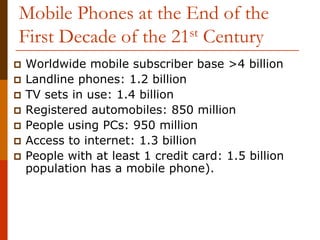
Mobile Phones at the End of the
First Decade of the 21st Century
Worldwide mobile subscriber base >4 billion
Landline phones: 1.2 billion
TV sets in use: 1.4 billion
Registered automobiles: 850 million
People using PCs: 950 million
Access to internet: 1.3 billion
People with at least 1 credit card: 1.5 billion
population has a mobile phone).
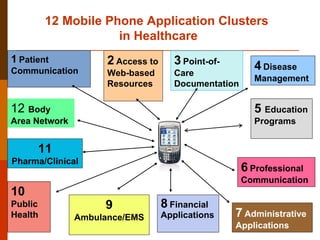
12 Mobile Phone Application Clusters
                     in Healthcare
1 Patient            2 Access to      3 Point-of-
Communication        Web-based        Care
                                                        4 Disease
                                                        Management
                     Resources        Documentation

12 Body                                                 5 Education
Area Network                                            Programs


      11
Pharma/Clinical
                                                      6 Professional
                                                      Communication
10
Public              9              8 Financial
Health         Ambulance/EMS       Applications     7 Administrative
                                                    Applications
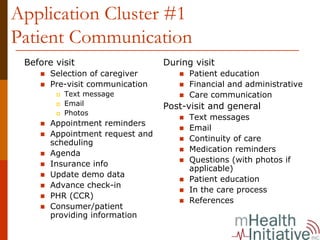
Application Cluster #1
Patient Communication
 Before visit                    During visit
       Selection of caregiver          Patient education
       Pre-visit communication         Financial and administrative
          Text message                 Care communication
          Email                  Post-visit and general
          Photos
                                       Text messages
       Appointment reminders
                                       Email
       Appointment request and
                                       Continuity of care
       scheduling
                                       Medication reminders
       Agenda
                                       Questions (with photos if
       Insurance info
                                       applicable)
       Update demo data
                                       Patient education
       Advance check-in
                                       In the care process
       PHR (CCR)
                                       References
       Consumer/patient
       providing information
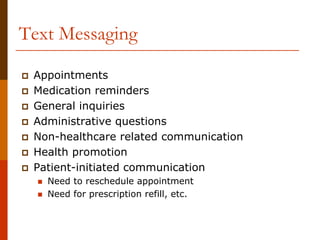
Text Messaging

 Appointments
 Medication reminders
 General inquiries
 Administrative questions
 Non-healthcare related communication
 Health promotion
 Patient-initiated communication
   Need to reschedule appointment
   Need for prescription refill, etc.
Preferred Communication: The Phone
            as Identification

Programs like the airlines’ “Remember Me”
  provide
   A direct path to information about you when
   calling from a phone number pre-registered with
   your provider.
   The system recognizes your phone number,
   instantaneously pulls up your information and
   even greets you by name.
   All of this information is available within a few
   seconds at the beginning of the call
Benefits of mHealth Patient
Communication Systems
 More communication between clinician and
 patient leads to
   Better quality of care
   Greater continuity of care
   Greater efficiency
   Fewer visits
   Lower costs
Considerations

 All communication must be clear and
 customizable (usability)
 Reason for visit
 Both parties need acknowledgement This may
 even be more important for the provider because it will allow them to
 be better prepared and confirm that tests required for the visit have
 been done.
 Requires new workflow, parameters and
 protocols
 ID Systems: Photo and “Remember me”
Considerations
 Requires new reimbursement system
   Do all communications have equal value? If nine
   communications are required in one instance and five in
   another, are they paid the same?
   How do you measure the amount of work required by the
   physicians behind the scenes for each communication?
   Would compensation paradigms that include a frequency
   component invite abuse?
   Can the evaluation of the value/compensation be
   automated or does it need a new bureaucracy?
   Is this another good reason to move to capitated
   compensation structures so that providers are free to
   focus on the optimal way to arrive at best case
   outcomes?
Considerations
 Providers must have an auto responder function
 about emergencies
 What is the difference between text messaging
 and telephone messages in terms of impact and
 liability?
 Perhaps the terminology should be “emailing or
 text messaging” since text messages are limited
 to 160 characters, which may be too limiting.
 All communication should be logged and saved
 for a minimum period.
 Everything that isn’t easily and automatically
 identifiable as unnecessary (such as appointment
 reminders) should be saved in an EMR, otherwise
 time/money is wasted deciding on what’s worthy.
Standards Needed
 Patient ID
 Structured communication
 Security/confidentiality
 Provider workflow issues
Application Cluster #2:
Access to Web-based Resources
  Formularies
  Guidelines and protocols
  Decision support
  Telemedicine guidelines
  Accessing specific CCR information
  Patient’s comments re Web
  Patient directives
  PHR
        For providers and patients
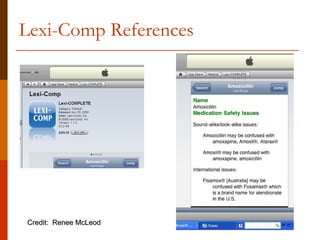
Lexi-Comp References


Credit: Renee McLeod
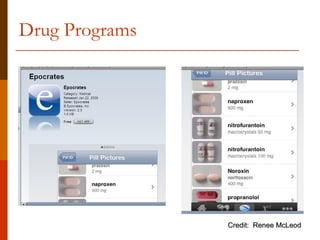
Drug Programs


                Credit: Renee McLeod
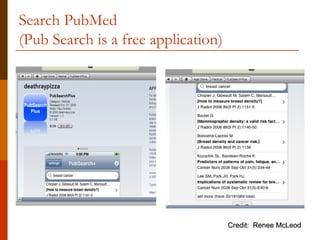
Search PubMed
(Pub Search is a free application)


                                     Credit: Renee McLeod
Application Cluster #3:
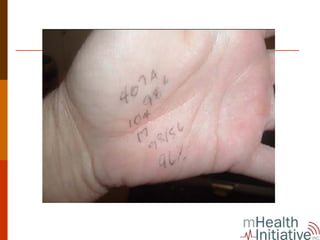
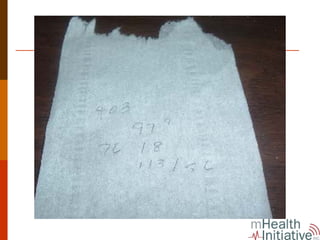
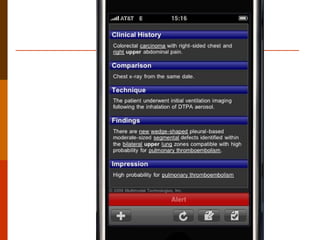
Point-of-care, Real-time Documentation

   The promise of EMRs at your
   fingertips anywhere, anytime
    Access patient history in real-time
    Document (capture patient information
    capture and generate report) in real-time
    Transmit patient information in real-time
    Navigate patient information in real-time
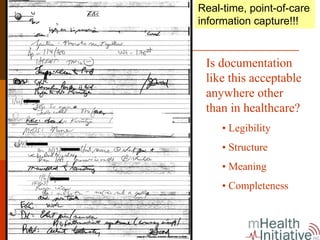
Real-time, point-of-care
information capture!!!


 Is documentation
 like this acceptable
 anywhere other
 than in healthcare?
     • Legibility
     • Structure
     • Meaning
     • Completeness
Issues
 Accuracy
 Authentication
 Interoperability
   mDevices to HIS and EMR
   Medical devices wireless communication
     EMC
     Data integrity
Accessing Patient Information
 Interoperability
 From internal system
 From a Website
 From the phone card
Application Cluster #4:
Disease Management

    Currently focused on
      Diabetes
      Asthma
      Dermatology
      Preventive care in pregnancy
      Smoking cessation
      Hypertension
Diabetes
 Several companies
 Applications
   Parents to monitor their children
   Patients to monitor and report their health
   data
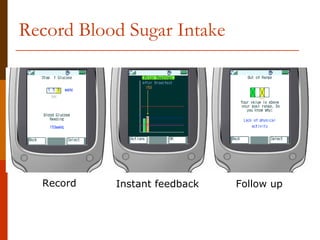
Record Blood Sugar Intake


  Record   Instant feedback   Follow up
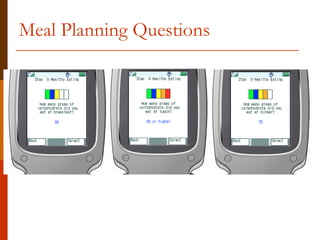
Meal Planning Questions
Disease Management Issues
 FDA approval
 Proof of ROI
 Collection of projects/experiences
   Aggregation of data
Application Cluster #5:
Education Programs
 Teaching, monitoring, coaching…
 New applications in nursing and other
 areas
 Teaching patients self-care, monitoring,
 expectations
 Need standards
Application Cluster #6:
Professional Communication
 Preferred communication channels for lab,
 pharmacy, etc.
 Colleagues
   Specialty-specific communities
   Disease-specific experiences
   Ask the expert!
Application Cluster #7:
Administrative Applications
  Provider-patient         Asset tracking
  applications               Surgical instruments
       Financial data        Medical records
       Demographic data      Equipment
       Non-clinical data
       Appointments
                           Patient flow
       Self check-in
                           management
       Reminder              Scheduling
                             Admissions/discharges
  Staff communication
       Internal
                             Bed management
       External
  Third parties
       Payers
       Labs
       Other providers
Application Cluster #8:
Financial Applications
 Charge capture
 Providers accessing eligibility info
 Providers sending bills
 Patients accessing coverage and co-pay
 information
 Payers in active communication with
 patients and providers
 Online real-time adjudication
Application Cluster #9:
Emergency Care
 Not starting with a “blank sheet”
 Potential need for record locator system
 Substantial cost reductions expected
 San Diego experience
Application Cluster #10
Public Health
 Reporting of disease outbreaks
   Swine flu, for example
 Alerting providers
 Instructing patients
 Bioterrorism
 Surveillance
 Population notifications
 Increasing adoption in developing countries
 Other
Application Cluster #11
Pharma/Clinical Trials
Clinical trials
  Automatic, scheduled and ad hoc information
  transmission
  Rely on instrument rather than patient for
  routine data collection
  Patient feedback systems
Application Cluster #12:
Body-area Networks (BAN)
  Mobile wearable or implanted sensors that
  monitor vital body parameters and
  movements and wirelessly transmit data from
  the body to provider or elsewhere via a home
  base
  Examples
    Heart monitor could alert pending heart attack
    Auto-inject insulin for patient whose blood sugar
    drops
    Sports activity monitoring: speed, distance, heart
    rate, blood pressure
    Fantasy? - Exchange business cards (or patient
    demographic data) with a handshake?
  Big issue: Security
mHealth Initiative Plans
 Develop online resource to record and
 access information about mApps
   By application cluster
   By device
   By disease
   Information from vendors
   Information and feedback from users
Thank you!


        www.mhealthinitiative.org
     c.tessier@mhealthinitiative.org
              617-816-7513

mHealth Application Clusters

  • 1.
    The 12 mHealth Application Clusters mHealth Initiative Seminar San Francisco September 18, 2009 Claudia Tessier RHIA CEO and President Copyright 2009 mHealth Initiative Inc., Boston MA. All rights reserved.
  • 2.
    Mobile Phones atthe End of the First Decade of the 21st Century Worldwide mobile subscriber base >4 billion Landline phones: 1.2 billion TV sets in use: 1.4 billion Registered automobiles: 850 million People using PCs: 950 million Access to internet: 1.3 billion People with at least 1 credit card: 1.5 billion population has a mobile phone).
  • 3.
    12 Mobile PhoneApplication Clusters in Healthcare 1 Patient 2 Access to 3 Point-of- Communication Web-based Care 4 Disease Management Resources Documentation 12 Body 5 Education Area Network Programs 11 Pharma/Clinical 6 Professional Communication 10 Public 9 8 Financial Health Ambulance/EMS Applications 7 Administrative Applications
  • 4.
    Application Cluster #1 PatientCommunication Before visit During visit Selection of caregiver Patient education Pre-visit communication Financial and administrative Text message Care communication Email Post-visit and general Photos Text messages Appointment reminders Email Appointment request and Continuity of care scheduling Medication reminders Agenda Questions (with photos if Insurance info applicable) Update demo data Patient education Advance check-in In the care process PHR (CCR) References Consumer/patient providing information
  • 5.
    Text Messaging Appointments Medication reminders General inquiries Administrative questions Non-healthcare related communication Health promotion Patient-initiated communication Need to reschedule appointment Need for prescription refill, etc.
  • 6.
    Preferred Communication: ThePhone as Identification Programs like the airlines’ “Remember Me” provide A direct path to information about you when calling from a phone number pre-registered with your provider. The system recognizes your phone number, instantaneously pulls up your information and even greets you by name. All of this information is available within a few seconds at the beginning of the call
  • 7.
    Benefits of mHealthPatient Communication Systems More communication between clinician and patient leads to Better quality of care Greater continuity of care Greater efficiency Fewer visits Lower costs
  • 8.
    Considerations All communicationmust be clear and customizable (usability) Reason for visit Both parties need acknowledgement This may even be more important for the provider because it will allow them to be better prepared and confirm that tests required for the visit have been done. Requires new workflow, parameters and protocols ID Systems: Photo and “Remember me”
  • 9.
    Considerations Requires newreimbursement system Do all communications have equal value? If nine communications are required in one instance and five in another, are they paid the same? How do you measure the amount of work required by the physicians behind the scenes for each communication? Would compensation paradigms that include a frequency component invite abuse? Can the evaluation of the value/compensation be automated or does it need a new bureaucracy? Is this another good reason to move to capitated compensation structures so that providers are free to focus on the optimal way to arrive at best case outcomes?
  • 10.
    Considerations Providers musthave an auto responder function about emergencies What is the difference between text messaging and telephone messages in terms of impact and liability? Perhaps the terminology should be “emailing or text messaging” since text messages are limited to 160 characters, which may be too limiting. All communication should be logged and saved for a minimum period. Everything that isn’t easily and automatically identifiable as unnecessary (such as appointment reminders) should be saved in an EMR, otherwise time/money is wasted deciding on what’s worthy.
  • 11.
    Standards Needed PatientID Structured communication Security/confidentiality Provider workflow issues
  • 12.
    Application Cluster #2: Accessto Web-based Resources Formularies Guidelines and protocols Decision support Telemedicine guidelines Accessing specific CCR information Patient’s comments re Web Patient directives PHR For providers and patients
  • 13.
  • 14.
    Drug Programs Credit: Renee McLeod
  • 15.
    Search PubMed (Pub Searchis a free application) Credit: Renee McLeod
  • 16.
    Application Cluster #3: Point-of-care,Real-time Documentation The promise of EMRs at your fingertips anywhere, anytime Access patient history in real-time Document (capture patient information capture and generate report) in real-time Transmit patient information in real-time Navigate patient information in real-time
  • 17.
    Real-time, point-of-care information capture!!! Is documentation like this acceptable anywhere other than in healthcare? • Legibility • Structure • Meaning • Completeness
  • 21.
    Issues Accuracy Authentication Interoperability mDevices to HIS and EMR Medical devices wireless communication EMC Data integrity
  • 22.
    Accessing Patient Information Interoperability From internal system From a Website From the phone card
  • 23.
    Application Cluster #4: DiseaseManagement Currently focused on Diabetes Asthma Dermatology Preventive care in pregnancy Smoking cessation Hypertension
  • 24.
    Diabetes Several companies Applications Parents to monitor their children Patients to monitor and report their health data
  • 25.
    Record Blood SugarIntake Record Instant feedback Follow up
  • 26.
  • 27.
    Disease Management Issues FDA approval Proof of ROI Collection of projects/experiences Aggregation of data
  • 28.
    Application Cluster #5: EducationPrograms Teaching, monitoring, coaching… New applications in nursing and other areas Teaching patients self-care, monitoring, expectations Need standards
  • 29.
    Application Cluster #6: ProfessionalCommunication Preferred communication channels for lab, pharmacy, etc. Colleagues Specialty-specific communities Disease-specific experiences Ask the expert!
  • 30.
    Application Cluster #7: AdministrativeApplications Provider-patient Asset tracking applications Surgical instruments Financial data Medical records Demographic data Equipment Non-clinical data Appointments Patient flow Self check-in management Reminder Scheduling Admissions/discharges Staff communication Internal Bed management External Third parties Payers Labs Other providers
  • 31.
    Application Cluster #8: FinancialApplications Charge capture Providers accessing eligibility info Providers sending bills Patients accessing coverage and co-pay information Payers in active communication with patients and providers Online real-time adjudication
  • 32.
    Application Cluster #9: EmergencyCare Not starting with a “blank sheet” Potential need for record locator system Substantial cost reductions expected San Diego experience
  • 33.
    Application Cluster #10 PublicHealth Reporting of disease outbreaks Swine flu, for example Alerting providers Instructing patients Bioterrorism Surveillance Population notifications Increasing adoption in developing countries Other
  • 34.
    Application Cluster #11 Pharma/ClinicalTrials Clinical trials Automatic, scheduled and ad hoc information transmission Rely on instrument rather than patient for routine data collection Patient feedback systems
  • 35.
    Application Cluster #12: Body-areaNetworks (BAN) Mobile wearable or implanted sensors that monitor vital body parameters and movements and wirelessly transmit data from the body to provider or elsewhere via a home base Examples Heart monitor could alert pending heart attack Auto-inject insulin for patient whose blood sugar drops Sports activity monitoring: speed, distance, heart rate, blood pressure Fantasy? - Exchange business cards (or patient demographic data) with a handshake? Big issue: Security
  • 36.
    mHealth Initiative Plans Develop online resource to record and access information about mApps By application cluster By device By disease Information from vendors Information and feedback from users
  • 37.
    Thank you! www.mhealthinitiative.org c.tessier@mhealthinitiative.org 617-816-7513