Health and Community Design
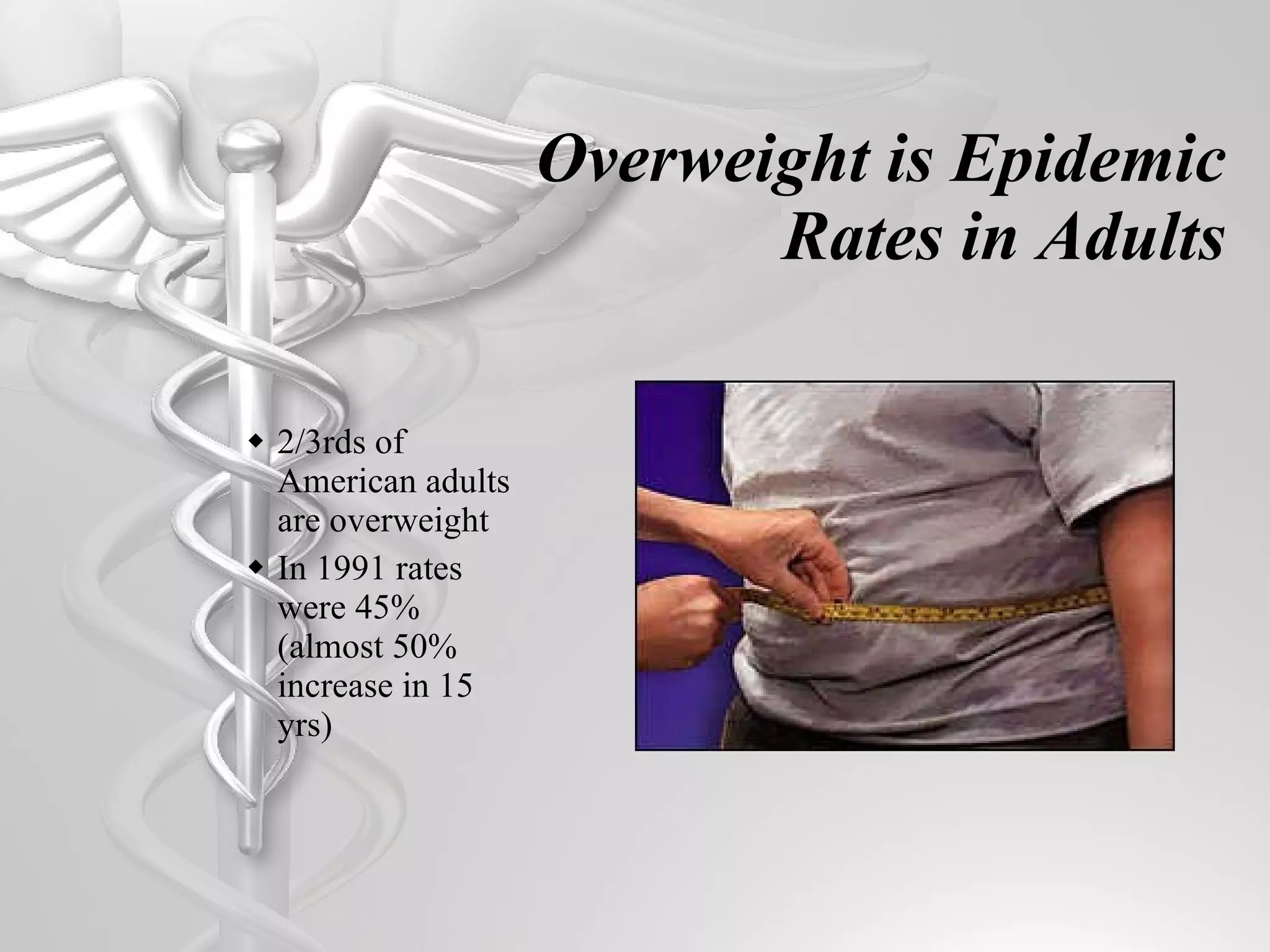
Overweight is Epidemic Rates in Adults 2/3rds of American adults are overweight In 1991 rates were 45% (almost 50% increase in 15 yrs)                                                                             (
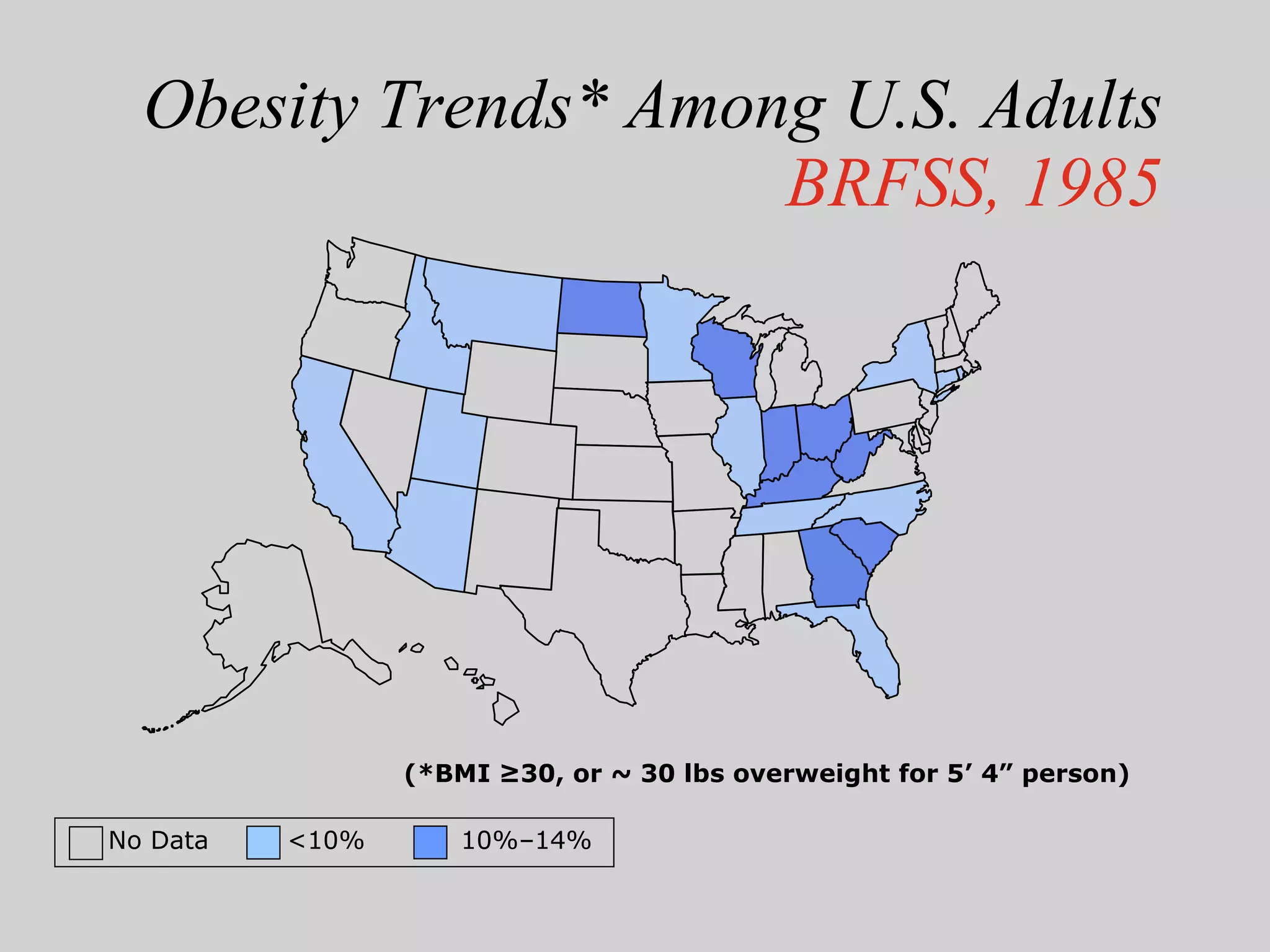
Obesity Trends* Among U.S. Adults BRFSS, 1985 (*BMI ≥30, or ~ 30 lbs overweight for 5’ 4” person) No Data  <10%  10%–14%
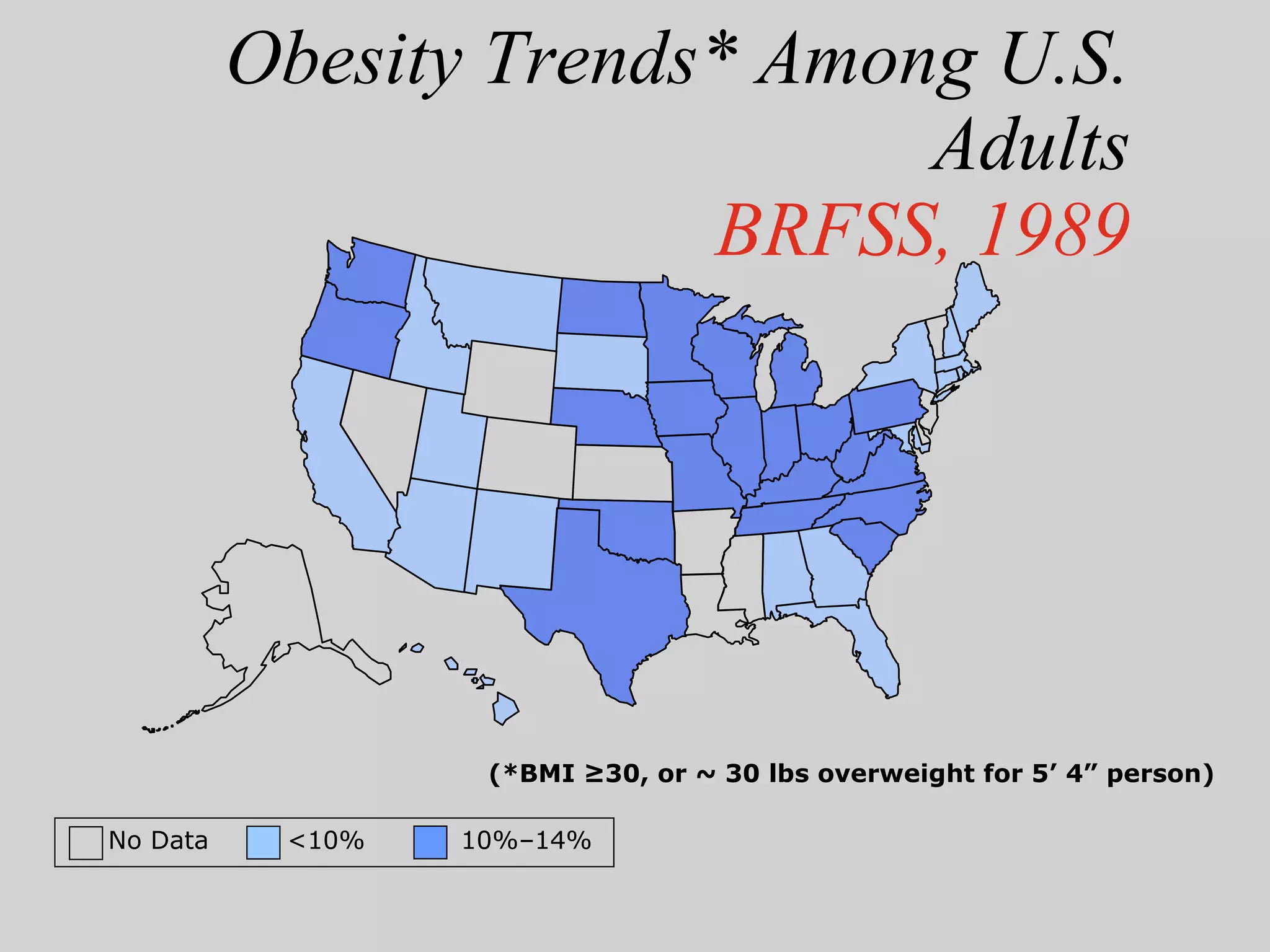
Obesity Trends* Among U.S. Adults BRFSS, 1989 (*BMI ≥30, or ~ 30 lbs overweight for 5’ 4” person) No Data  <10%  10%–14%
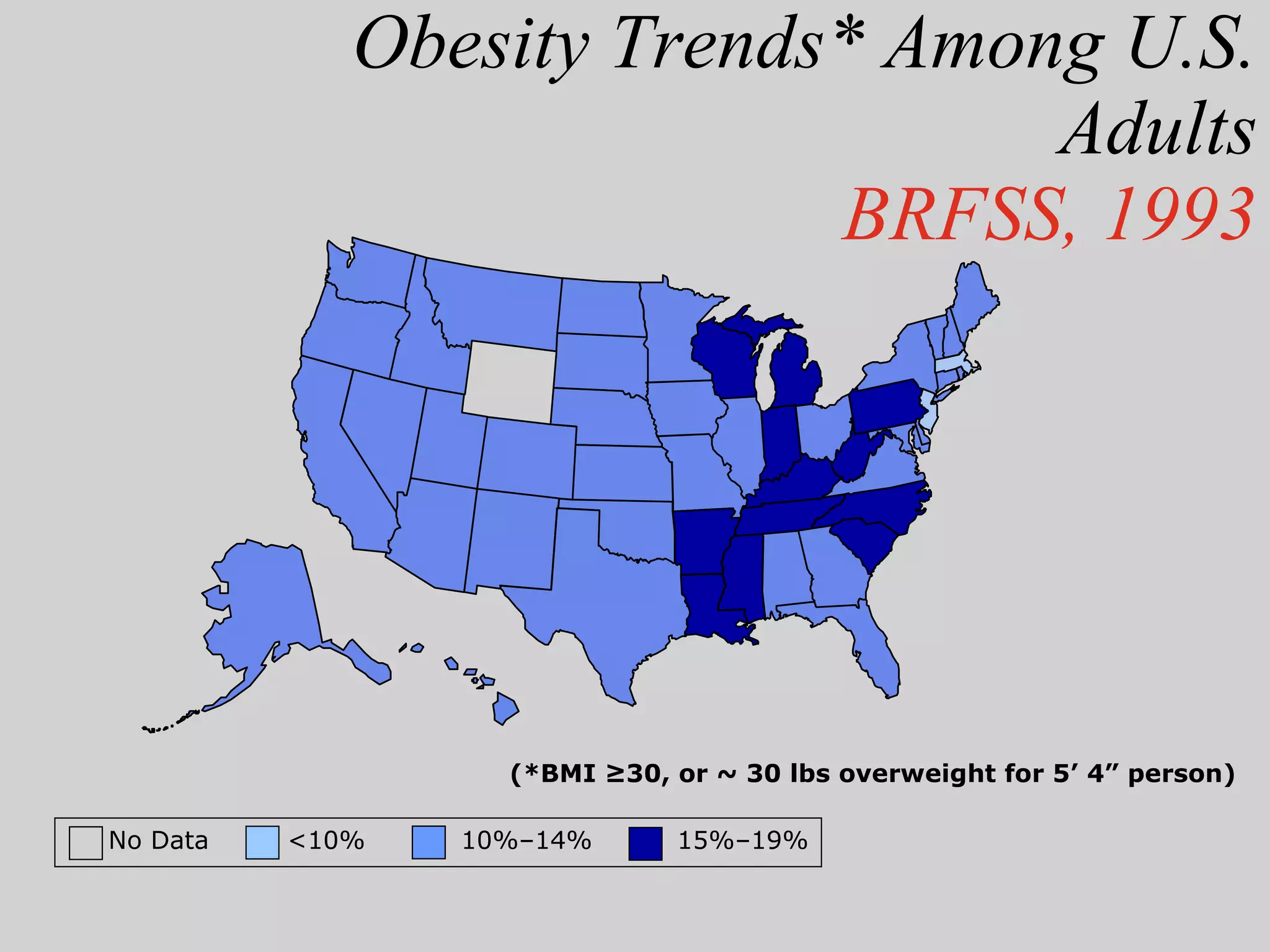
Obesity Trends* Among U.S. Adults BRFSS, 1993 (*BMI ≥30, or ~ 30 lbs overweight for 5’ 4” person) No Data  <10%  10%–14%   15%–19%
Obesity Trends* Among U.S. Adults BRFSS, 1997 (*BMI ≥30, or ~ 30 lbs overweight for 5’ 4” person) No Data  <10%  10%–14%   15%–19%  ≥20
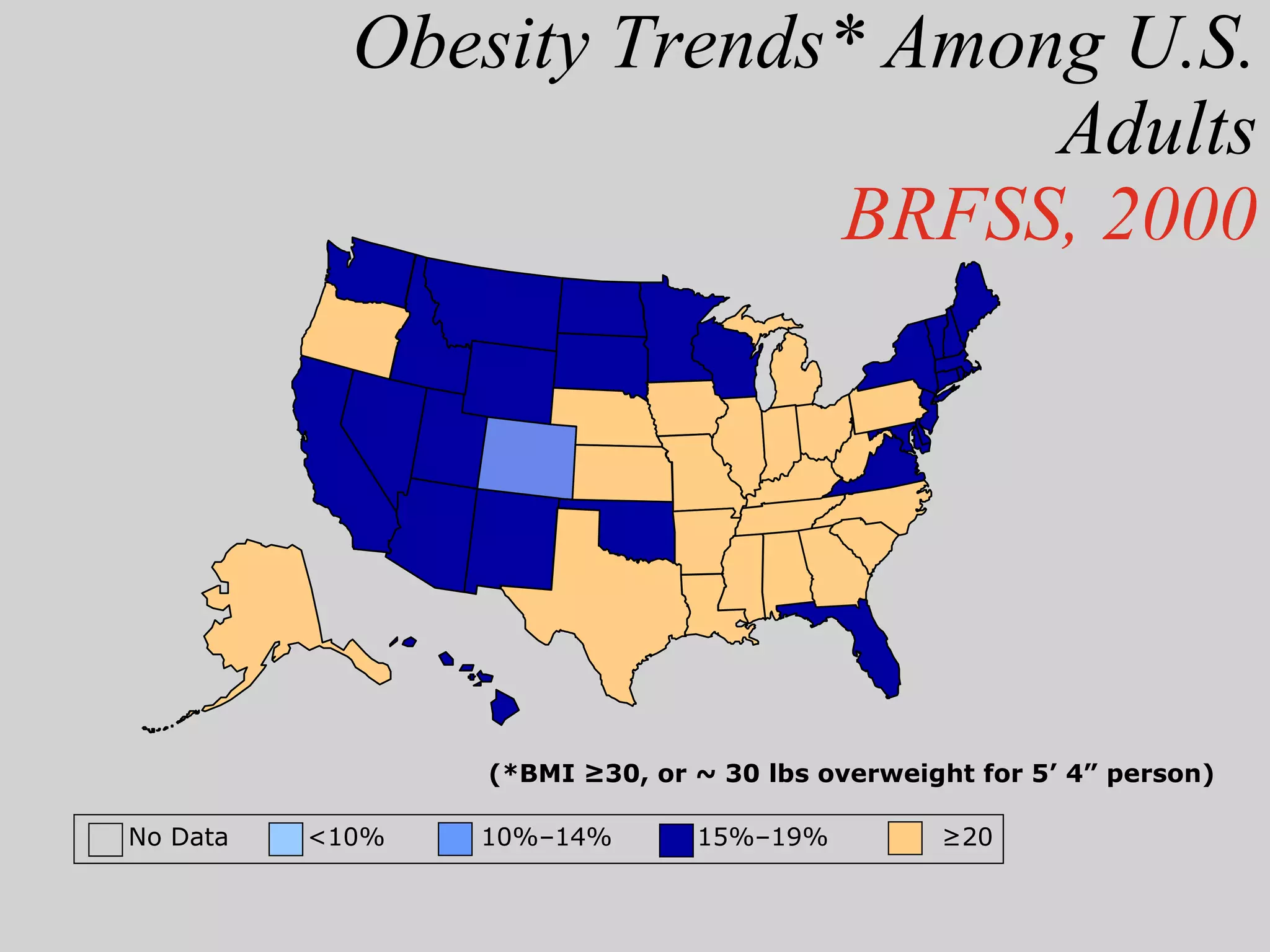
Obesity Trends* Among U.S. Adults BRFSS, 2000 (*BMI ≥30, or ~ 30 lbs overweight for 5’ 4” person) No Data  <10%  10%–14%   15%–19%  ≥20
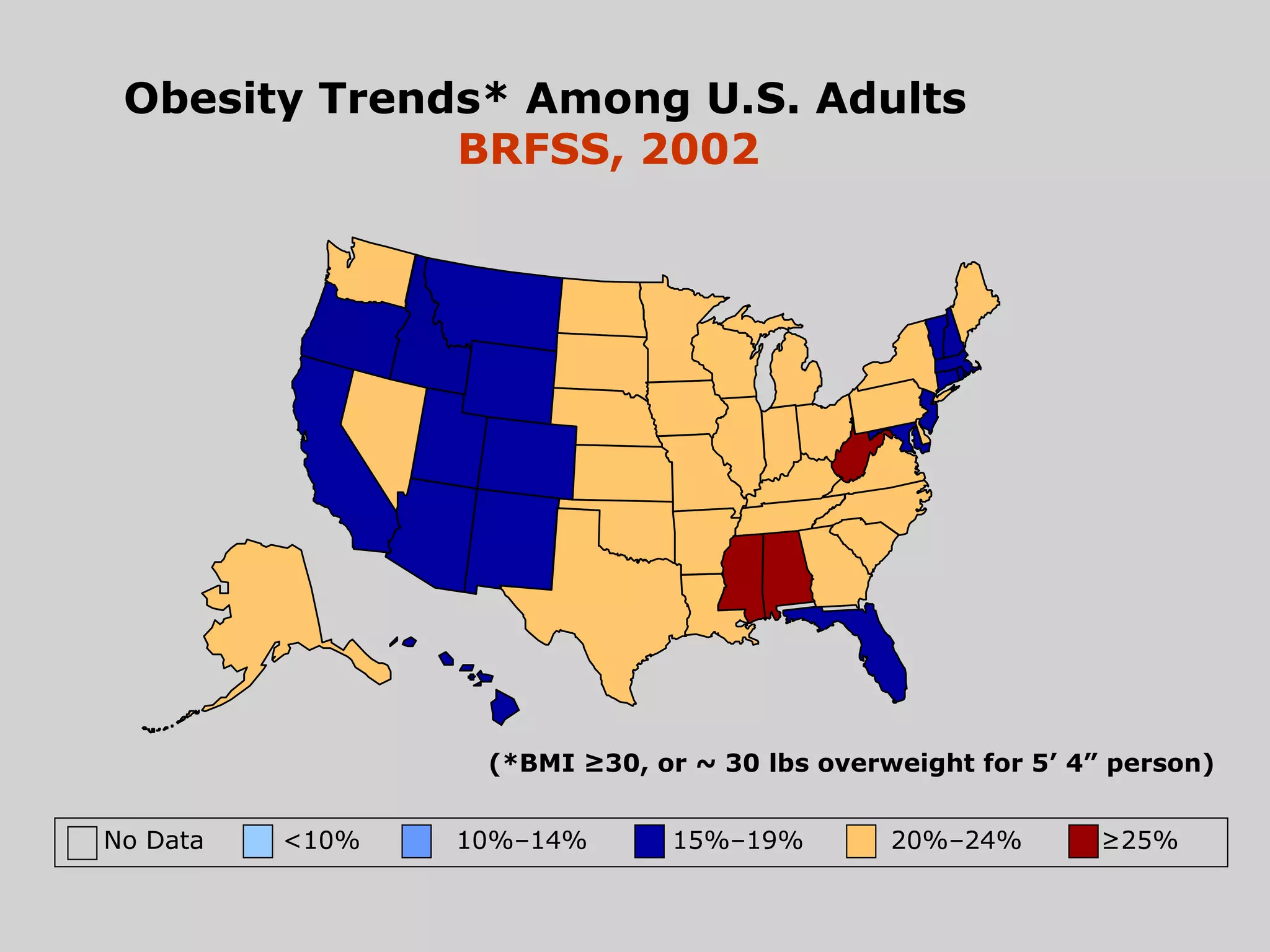
(*BMI   30, or ~ 30 lbs overweight for 5’4” person) No Data  <10%  10%–14%   15%–19%  20%–24%  ≥25% (*BMI ≥30, or ~ 30 lbs overweight for 5’ 4” person) Obesity Trends* Among U.S. Adults BRFSS, 2002
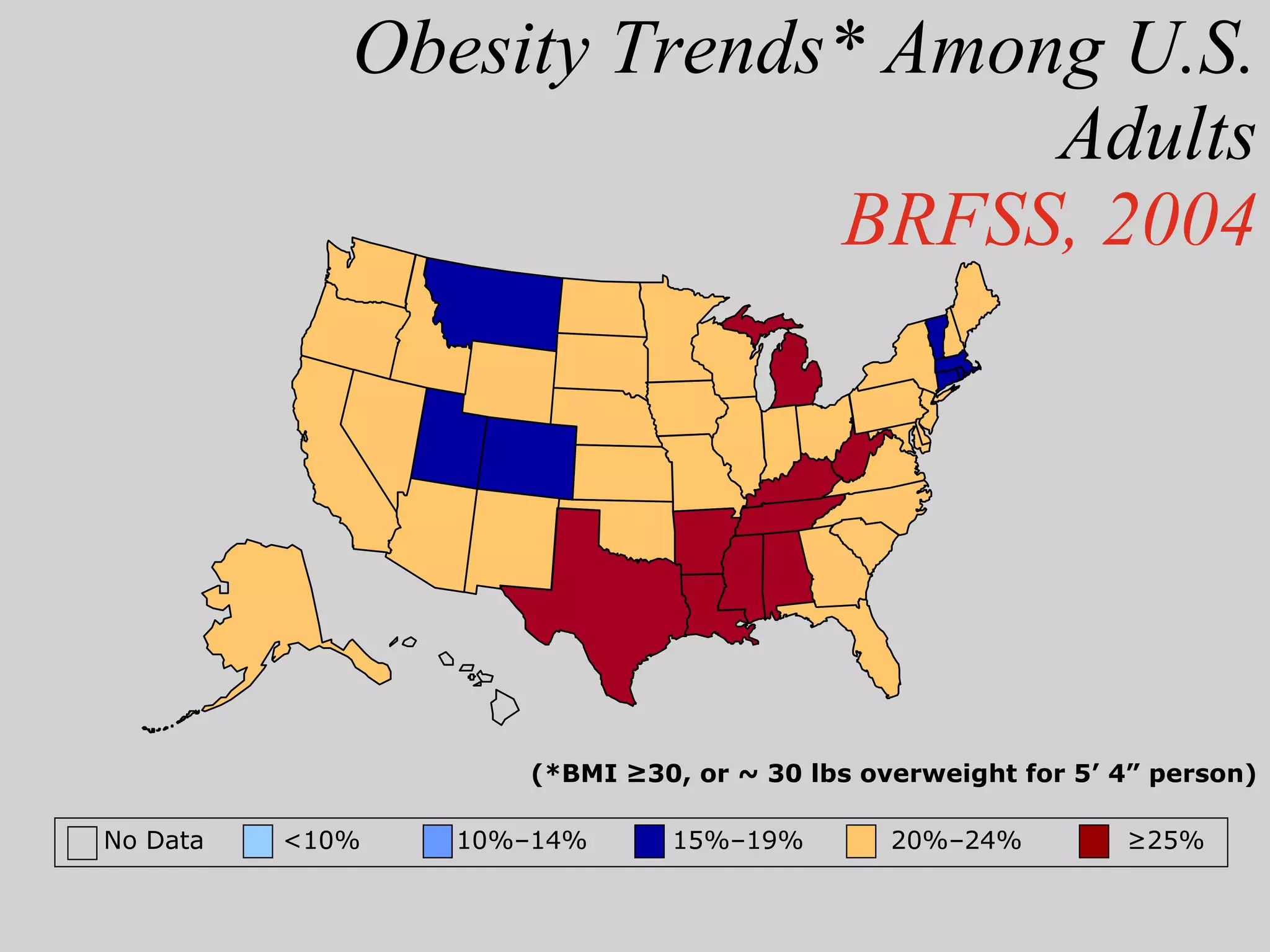
Obesity Trends* Among U.S. Adults BRFSS, 2004 No Data  <10%  10%–14%   15%–19%  20%–24%  ≥25% (*BMI ≥30, or ~ 30 lbs overweight for 5’ 4” person)
OBESITY  Risk Factors for the Chronic Disease Cardiovascular Stroke Endocrine  Orthopedic  Pulmonary Hepatic Psychosocial
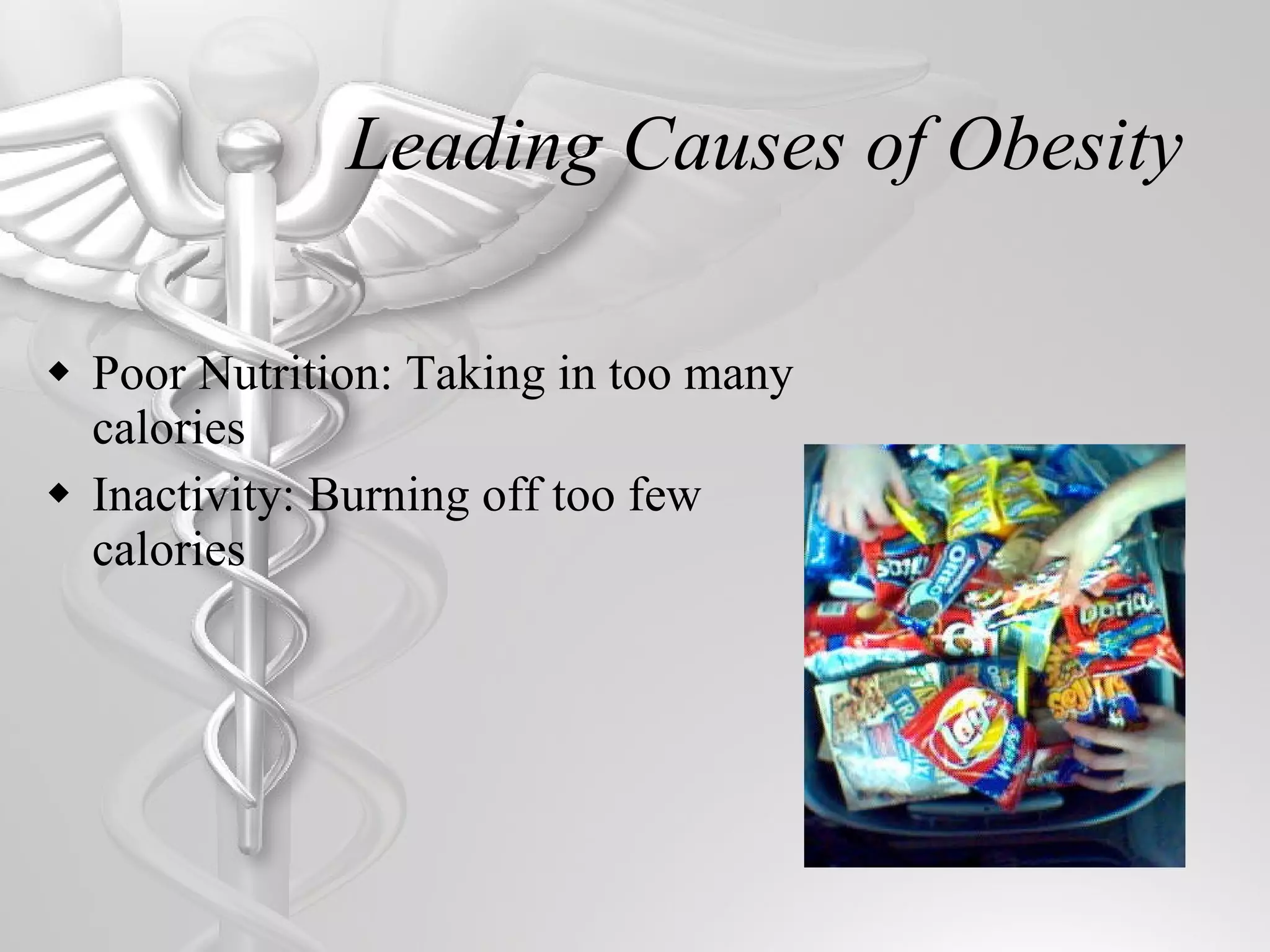
Leading Causes of Obesity Poor Nutrition: Taking in too many calories Inactivity: Burning off too few calories
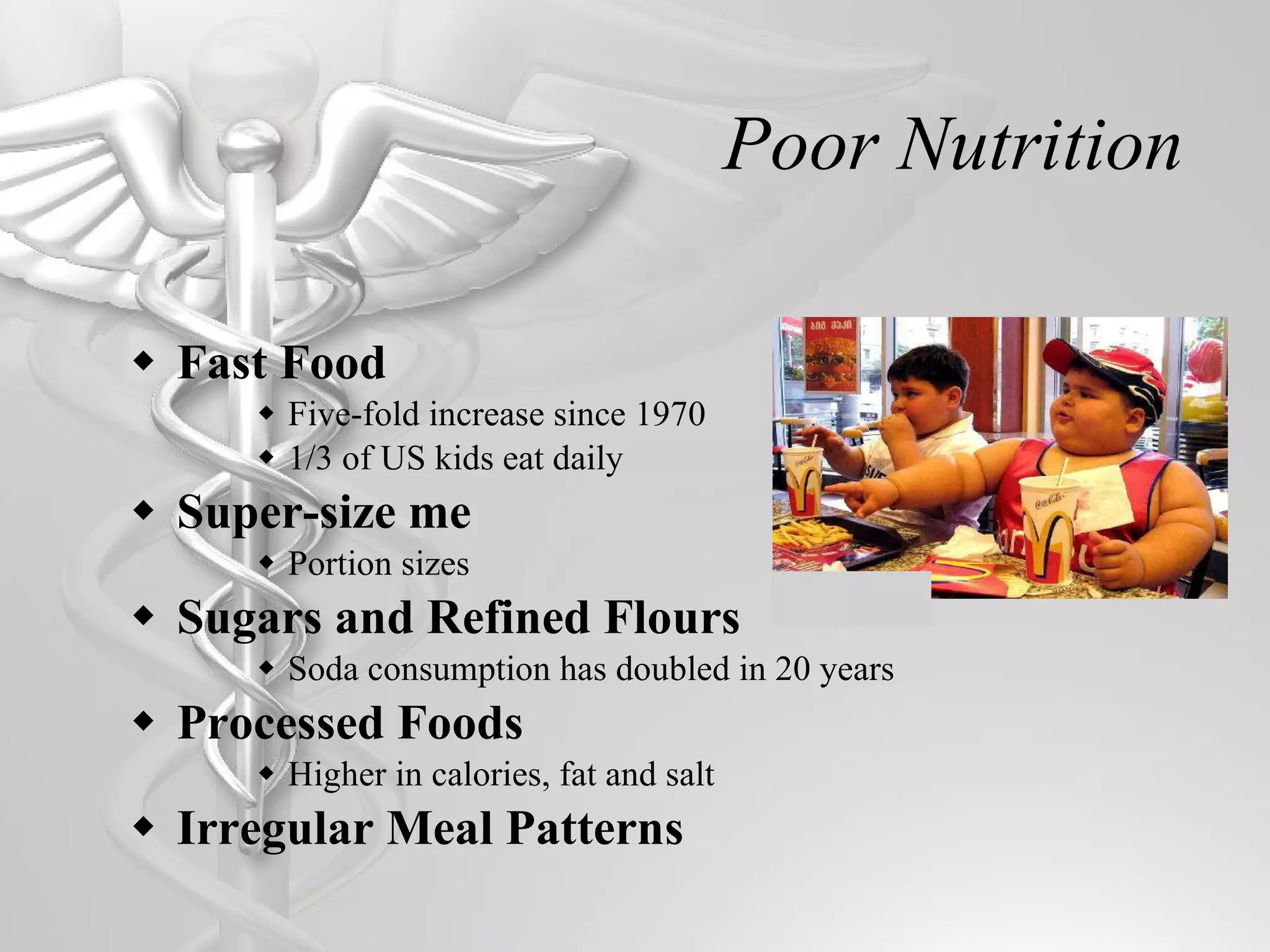
Poor Nutrition Fast Food Five-fold increase since 1970 1/3 of US kids eat daily Super-size me Portion sizes Sugars and Refined Flours Soda consumption has doubled in 20 years Processed Foods Higher in calories, fat and salt Irregular Meal Patterns
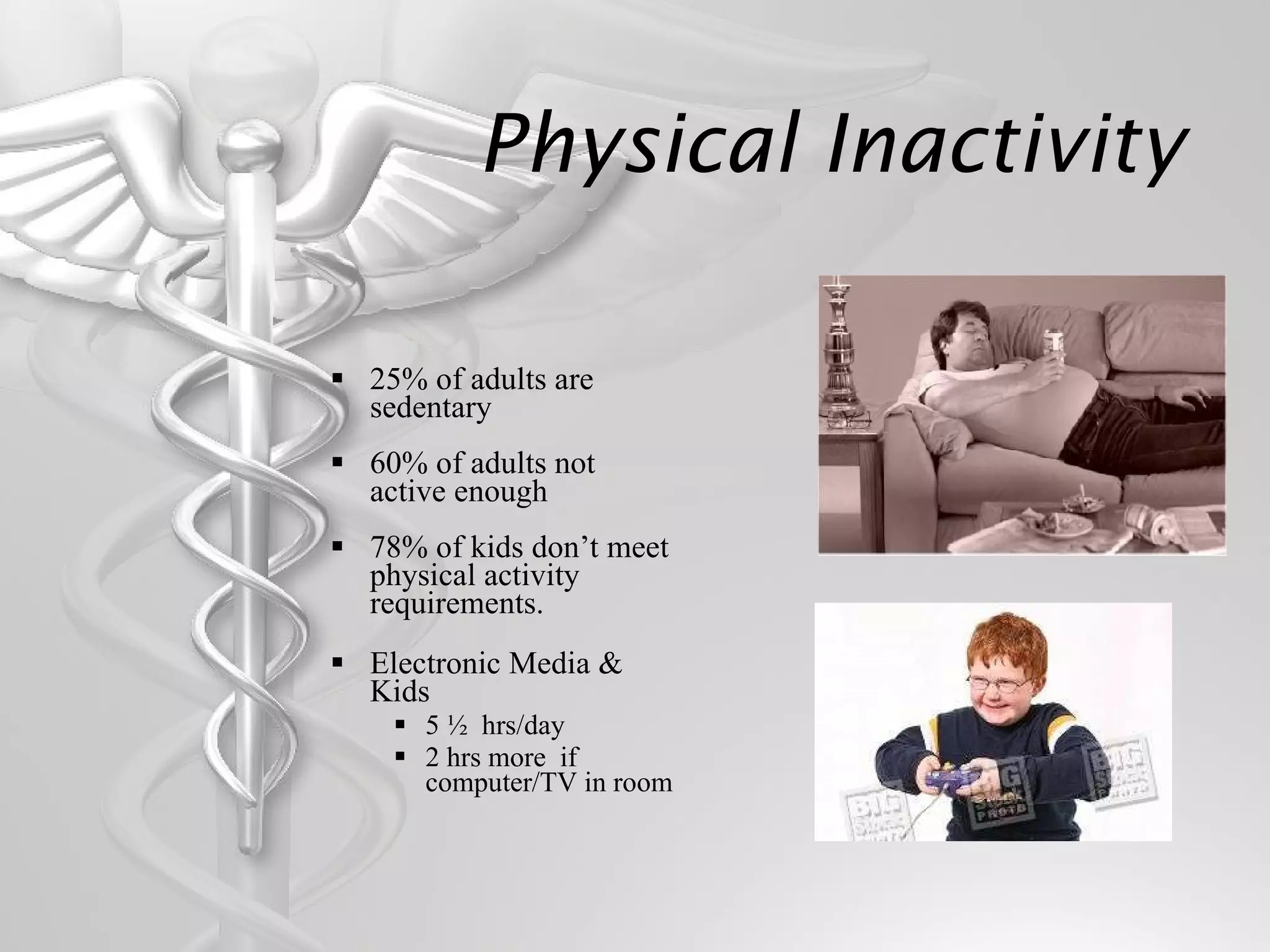
Physical Inactivity 25% of adults are sedentary 60% of adults not active enough 78% of kids don’t meet physical activity requirements. Electronic Media & Kids 5 ½  hrs/day  2 hrs more  if computer/TV in room
Percentage of Trips in Urban Areas Made by Walking and Bicycling: North America and Europe 1995
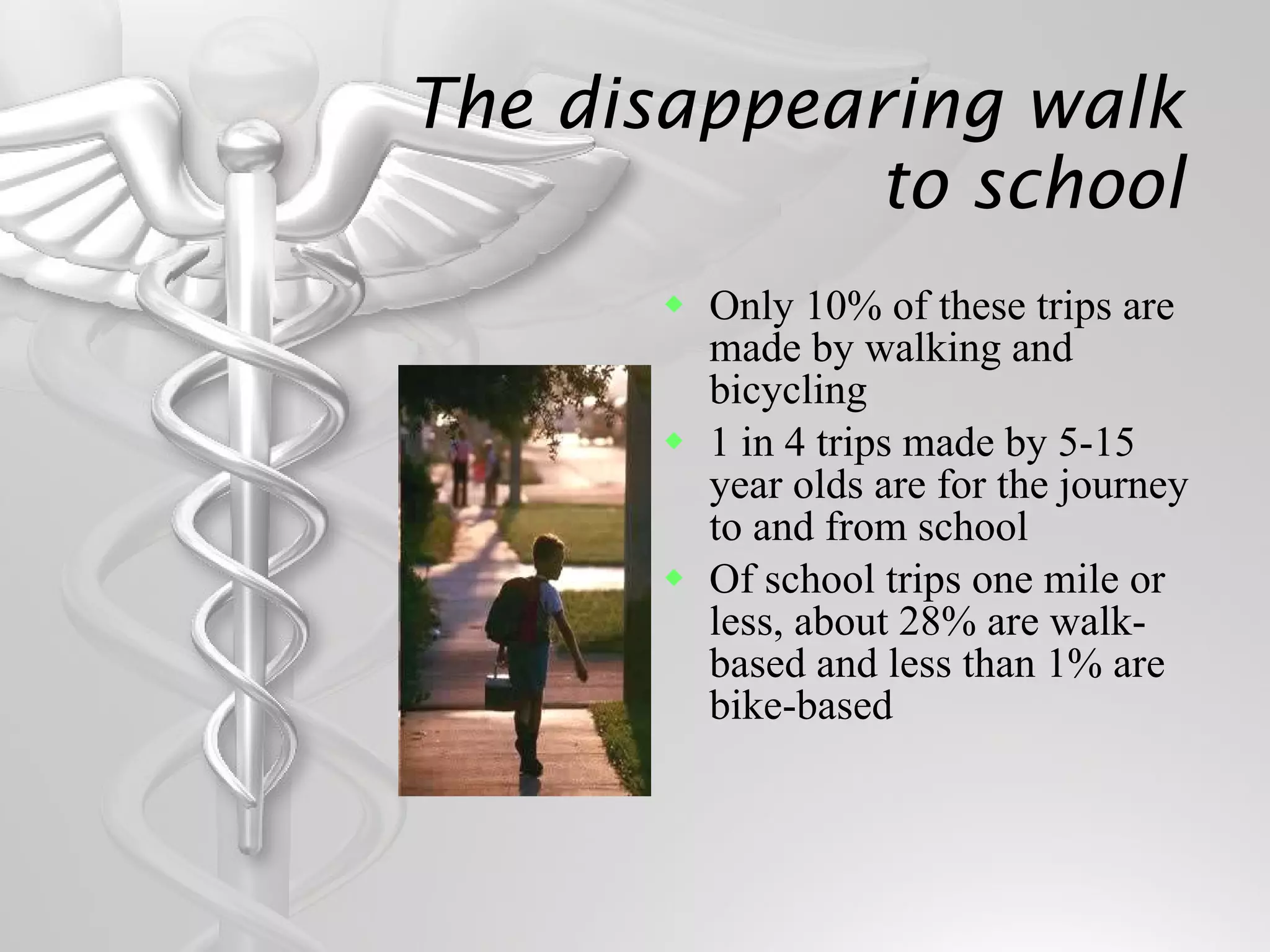
The disappearing walk to school Only 10% of these trips are made by walking and bicycling 1 in 4 trips made by 5-15 year olds are for the journey to and from school Of school trips one mile or less, about 28% are walk-based and less than 1% are bike-based
20% to 30% of morning peak traffic is parents driving kids to school
Increasing Vehicle Travel
Explaining the Epidemic Not genetic or biological changes Lifestyle and environmental changes


Improving Health through Community Design
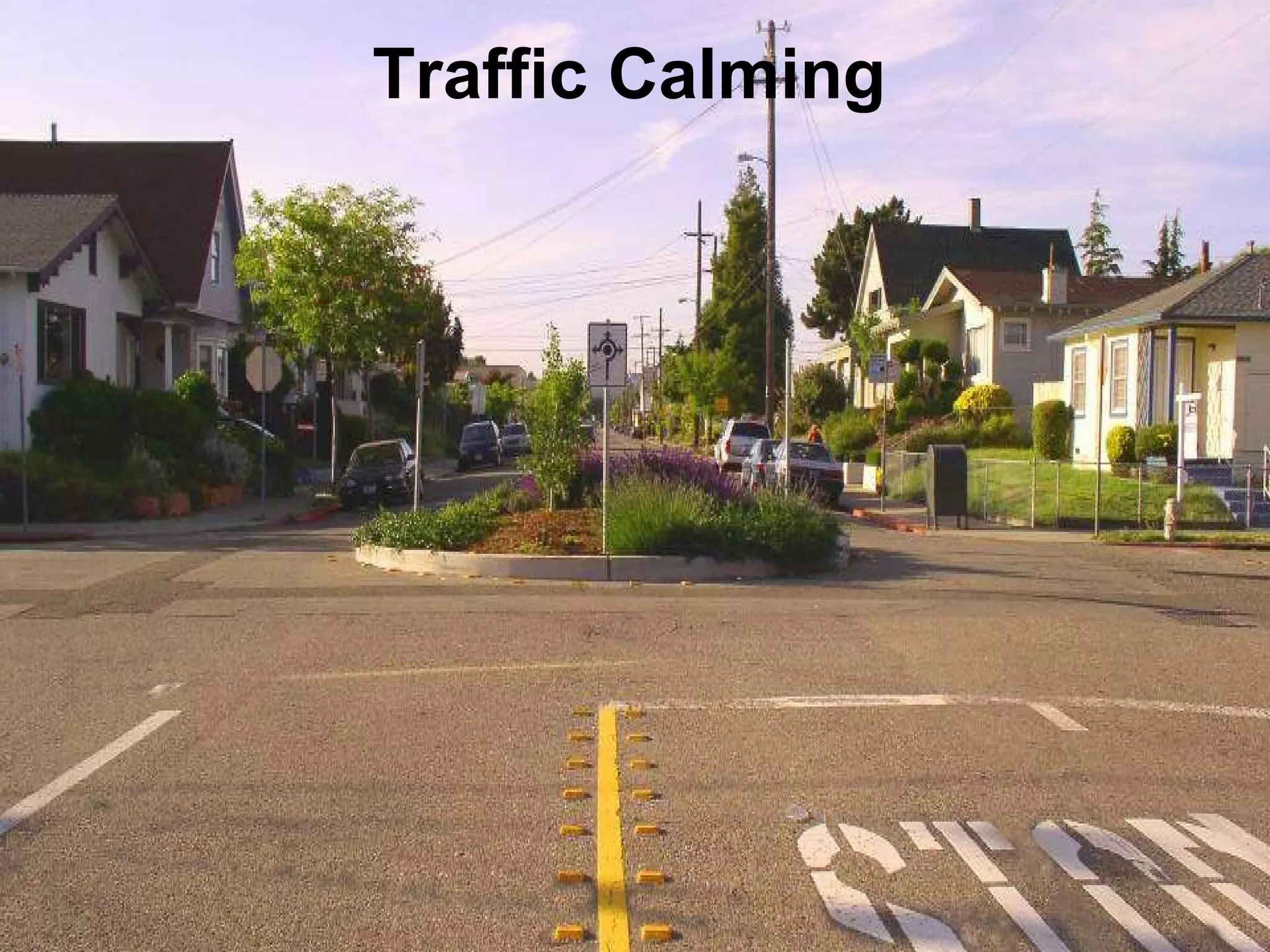
Traffic Calming
Street Lighting
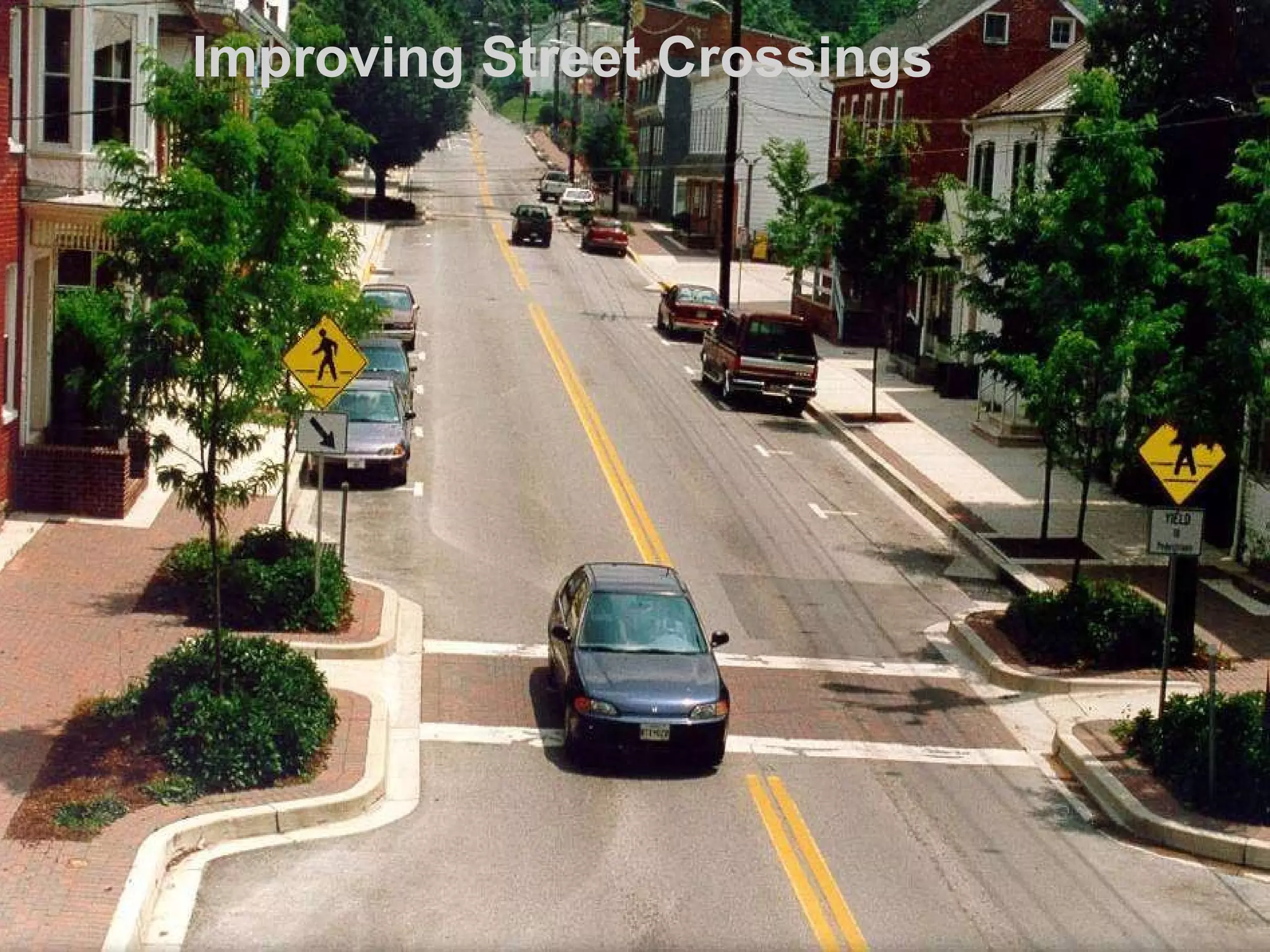
Improving Street Crossings
Compact/ Mixed Use Development
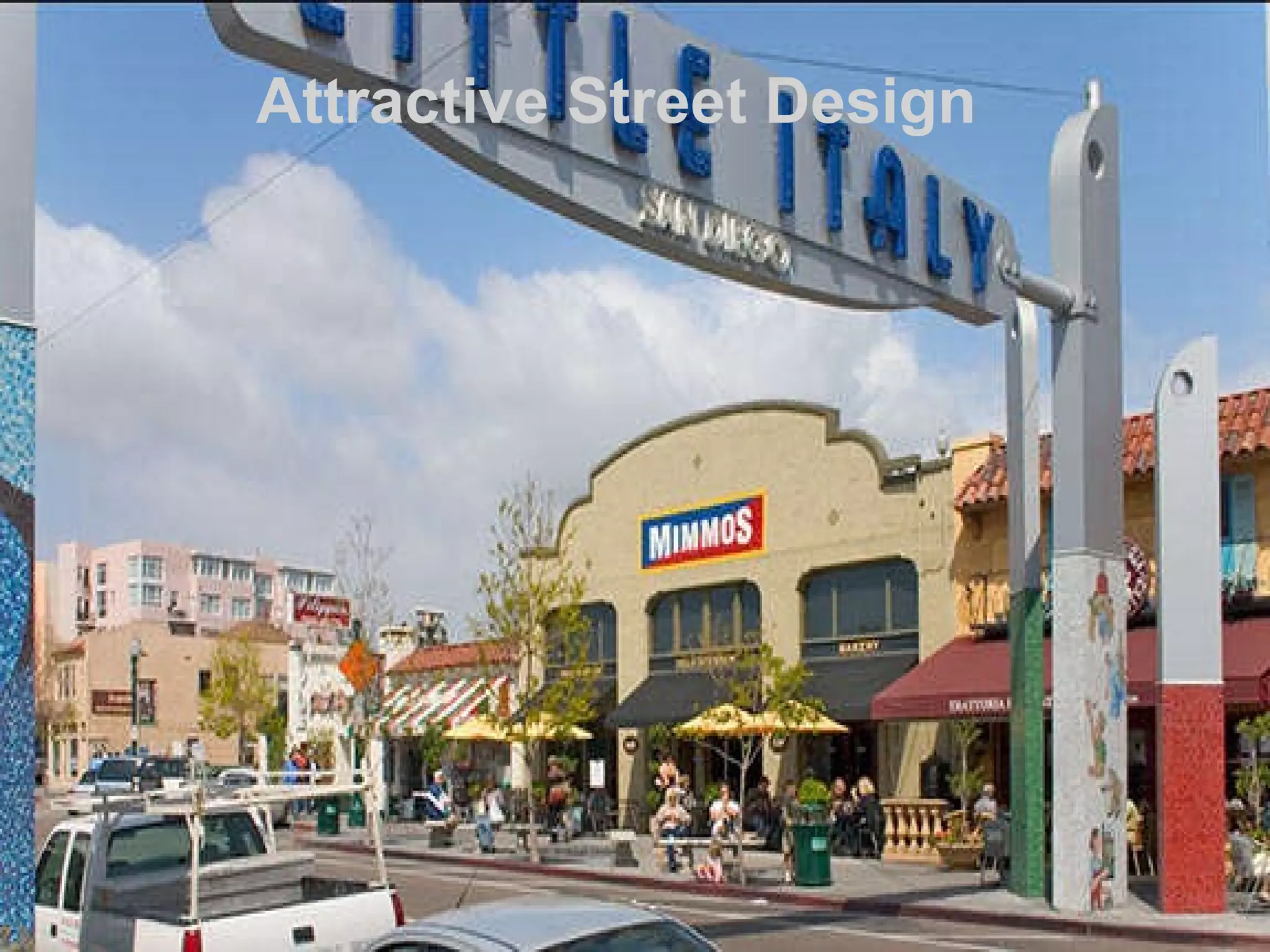
Attractive Street Design
Street Design & Connectivity
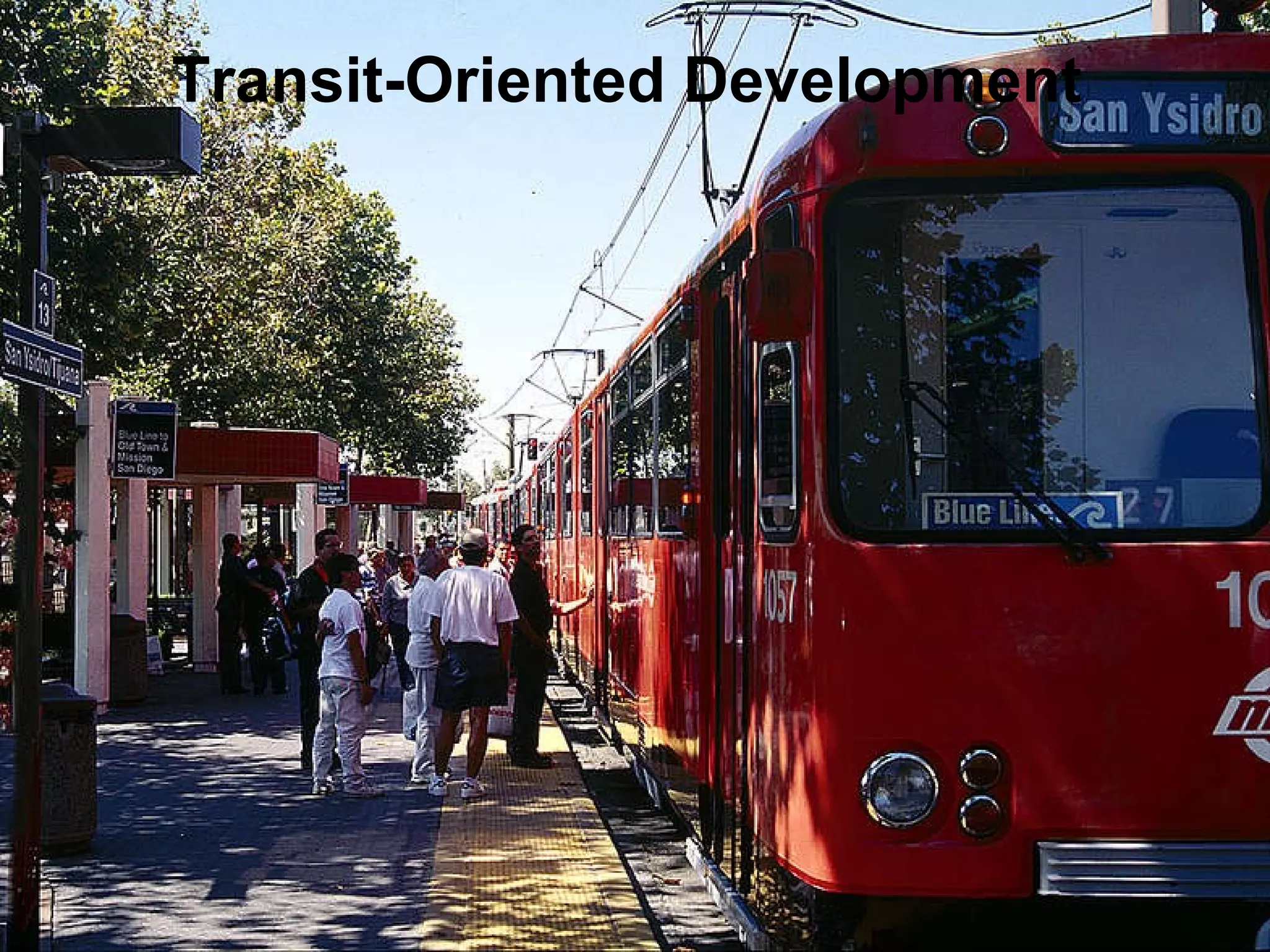
Transit-Oriented Development
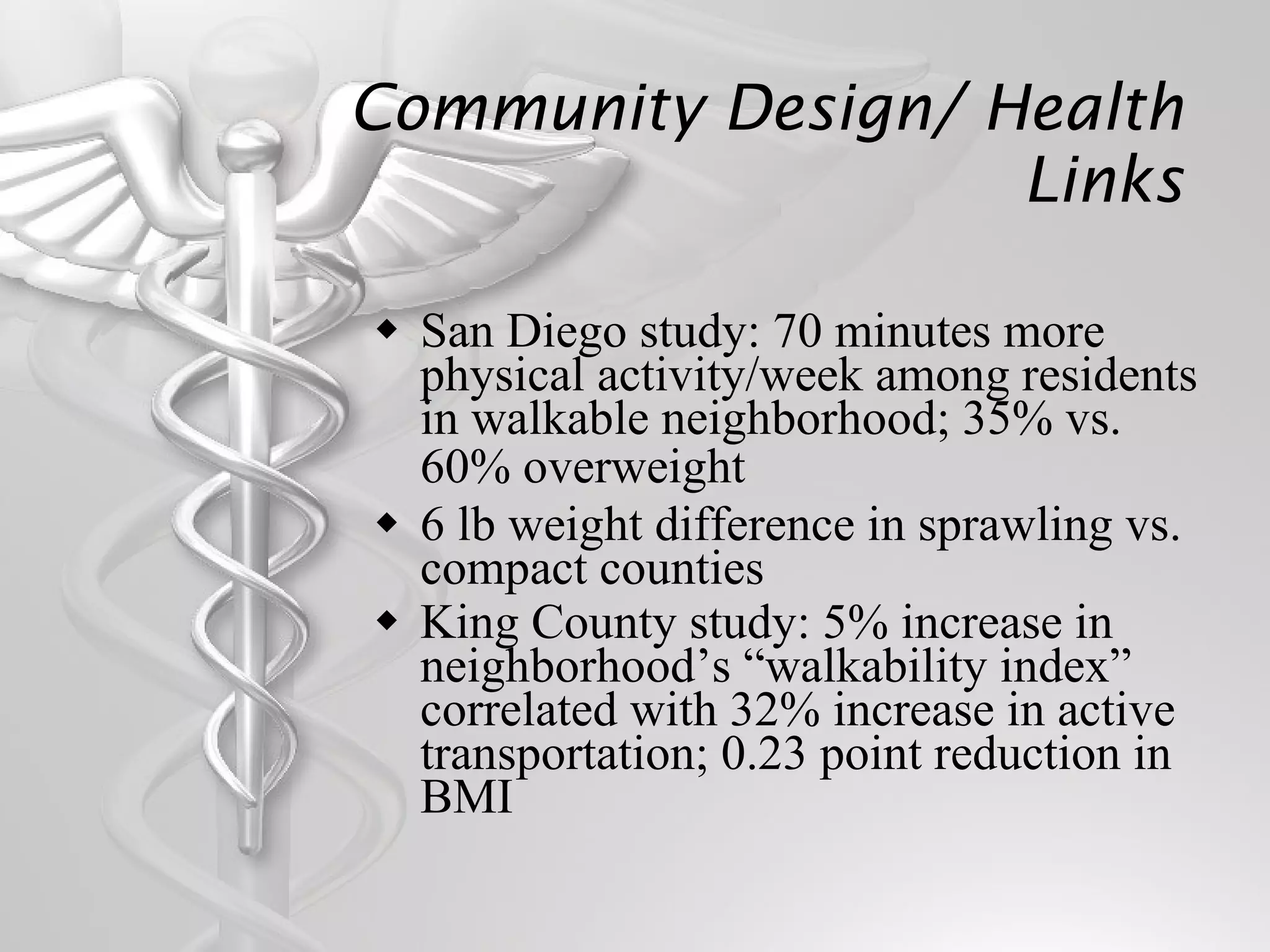
Community Design/ Health Links San Diego study: 70 minutes more physical activity/week among residents in walkable neighborhood; 35% vs. 60% overweight   6 lb weight difference in sprawling vs. compact counties King County study: 5% increase in neighborhood’s “walkability index” correlated with 32% increase in active transportation; 0.23 point reduction in BMI
Expanding our Roles and Vision Urban planners, Transportation Engineers    and Architects:  Have a critical role in public health ************** Public Health needs to appreciate the built  environment influences public health as much as vaccines or water quality .
The Public Health Impacts of the Built Environment Physical activity Obesity  Chronic disease Access to healthy foods Pedestrian injuries/death Crime & violence Senior independence & mobility Water quality & quantity Mental health  Health disparities Asthma & respiratory disease
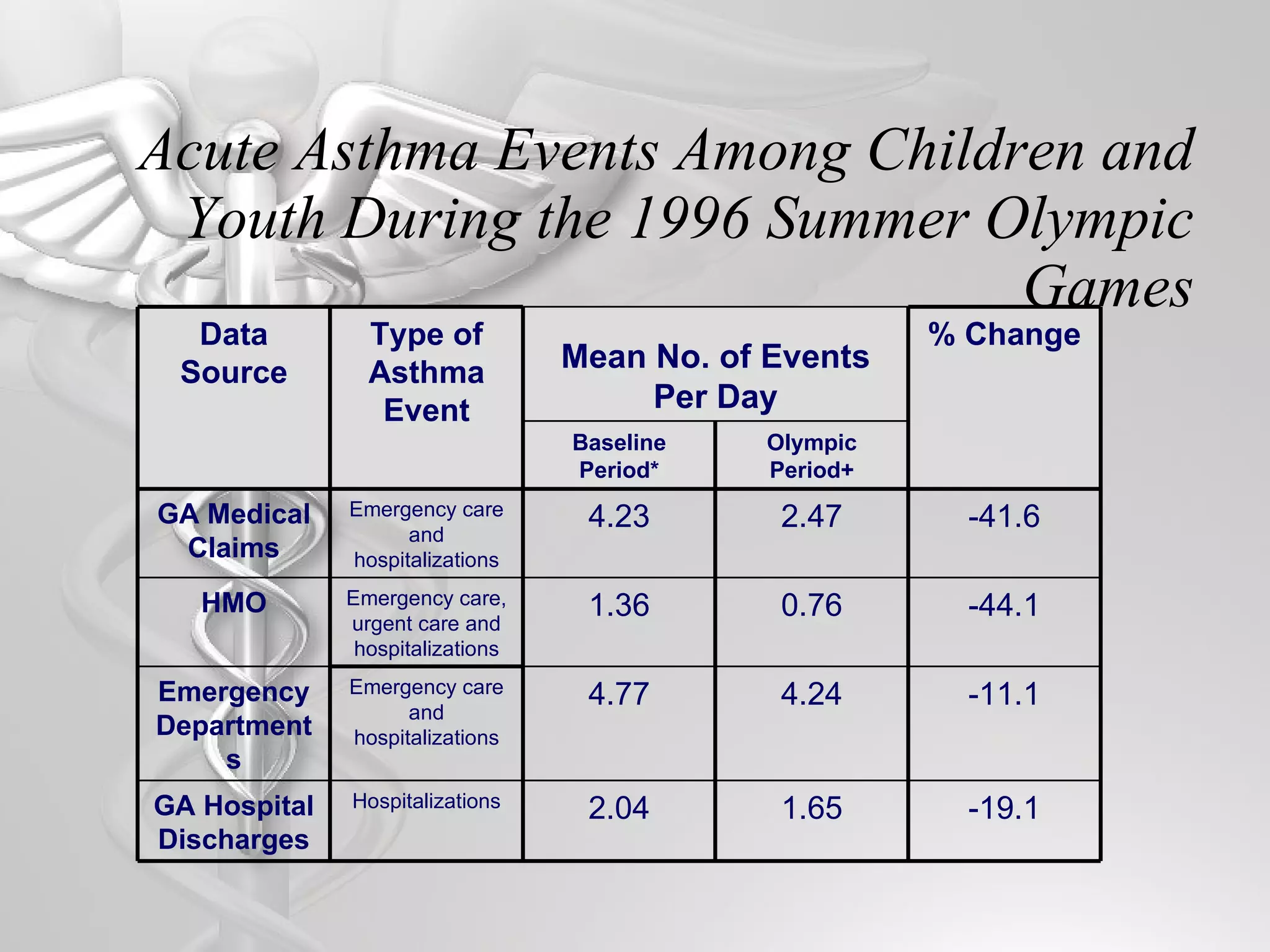
Acute Asthma Events Among Children and Youth During the 1996 Summer Olympic Games Data Source Type of Asthma Event Mean No. of Events Per Day % Change Baseline Period* Olympic Period+ GA Medical Claims Emergency care and hospitalizations 4.23 2.47 -41.6 HMO Emergency care, urgent care and hospitalizations 1.36 0.76 -44.1 Emergency Departments Emergency care and hospitalizations 4.77 4.24 -11.1 GA Hospital Discharges Hospitalizations 2.04 1.65 -19.1

Best Practices
King County, Washington King County pursues aggressive  “ smart growth: strategies: Land Use-  combating sprawl and building healthier communities. Public transportation-  getting more people onto leaner, greener busses. Environmental management-  turning waste into energy Clean energy future-  stimulating climate-friendly fuel and technology markets for a prosperous, sustainable economy. Ron Sims, King County Executive
Health & Transportation departments collaborated Commissioned study on health/transportation links The first Comprehensive Plan with physical activity/health as a goal and policies in the Urban Form and Transportation Elements Health as a General Plan Goal  in King County, WA Seattle, Washington
Los Angeles County LAC Public Health and Regional Planning Directors have agreed to have their staff work collaboratively on General Plan Policies supporting healthy, livable communities have been incorporated into the Draft Preliminary General Plan Review/revise zoning ordinances to ensure they are in support of new general plan Public Health input into proposed new developments at Regional Planning’s subdivision committee meetings and EIR reviews
What Can Cities Do?  Include health objectives in general plans Add a health element to the general plan Get Public Health input projects and updates Update zoning codes to allow compact, mixed use Update street design standards Dedicate/Increase funds for active transportation
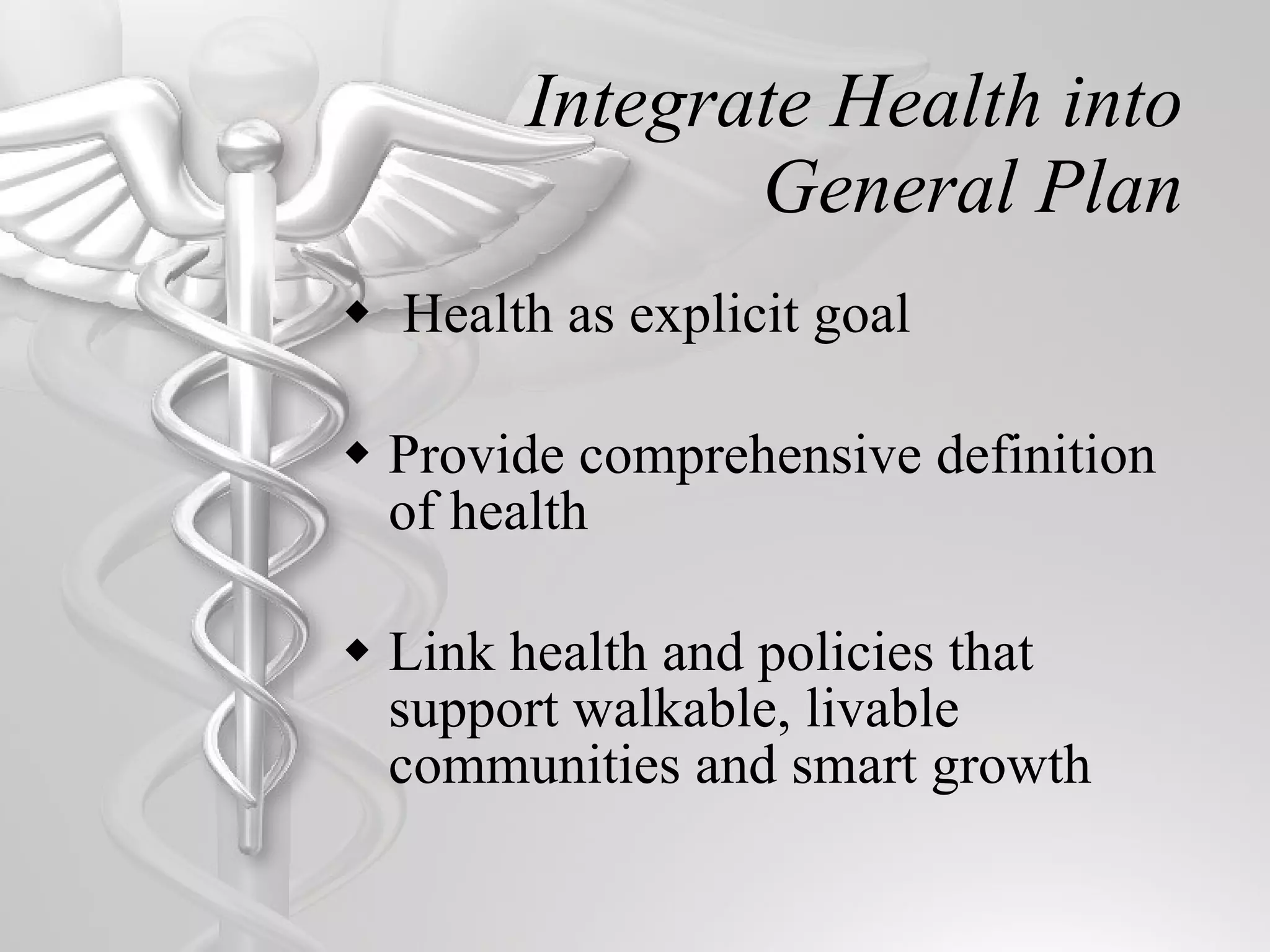
Integrate Health into General Plan Health as explicit goal Provide comprehensive definition of health Link health and policies that support walkable, livable communities and smart growth
Models in California Chula Vista Richmond Chino
Integrate Health into Specific Plans Master Plan Redevelopment Plans Downtown Plans
California  Assembly Bill 437 Authorizes the county health officer to provide assistance to cities and counties with local land use planning and transportation planning processes as they relate to public health.

Health + Community Design

  • 1.
  • 2.
    Overweight is EpidemicRates in Adults 2/3rds of American adults are overweight In 1991 rates were 45% (almost 50% increase in 15 yrs)                                                                             (
  • 3.
    Obesity Trends* AmongU.S. Adults BRFSS, 1985 (*BMI ≥30, or ~ 30 lbs overweight for 5’ 4” person) No Data <10% 10%–14%
  • 4.
    Obesity Trends* AmongU.S. Adults BRFSS, 1989 (*BMI ≥30, or ~ 30 lbs overweight for 5’ 4” person) No Data <10% 10%–14%
  • 5.
    Obesity Trends* AmongU.S. Adults BRFSS, 1993 (*BMI ≥30, or ~ 30 lbs overweight for 5’ 4” person) No Data <10% 10%–14% 15%–19%
  • 6.
    Obesity Trends* AmongU.S. Adults BRFSS, 1997 (*BMI ≥30, or ~ 30 lbs overweight for 5’ 4” person) No Data <10% 10%–14% 15%–19% ≥20
  • 7.
    Obesity Trends* AmongU.S. Adults BRFSS, 2000 (*BMI ≥30, or ~ 30 lbs overweight for 5’ 4” person) No Data <10% 10%–14% 15%–19% ≥20
  • 8.
    (*BMI 30, or ~ 30 lbs overweight for 5’4” person) No Data <10% 10%–14% 15%–19% 20%–24% ≥25% (*BMI ≥30, or ~ 30 lbs overweight for 5’ 4” person) Obesity Trends* Among U.S. Adults BRFSS, 2002
  • 9.
    Obesity Trends* AmongU.S. Adults BRFSS, 2004 No Data <10% 10%–14% 15%–19% 20%–24% ≥25% (*BMI ≥30, or ~ 30 lbs overweight for 5’ 4” person)
  • 10.
    OBESITY RiskFactors for the Chronic Disease Cardiovascular Stroke Endocrine Orthopedic Pulmonary Hepatic Psychosocial

  • 11.
    Leading Causes ofObesity Poor Nutrition: Taking in too many calories Inactivity: Burning off too few calories
  • 12.
    Poor Nutrition FastFood Five-fold increase since 1970 1/3 of US kids eat daily Super-size me Portion sizes Sugars and Refined Flours Soda consumption has doubled in 20 years Processed Foods Higher in calories, fat and salt Irregular Meal Patterns
  • 13.
    Physical Inactivity 25%of adults are sedentary 60% of adults not active enough 78% of kids don’t meet physical activity requirements. Electronic Media & Kids 5 ½ hrs/day 2 hrs more if computer/TV in room
  • 14.
    Percentage of Tripsin Urban Areas Made by Walking and Bicycling: North America and Europe 1995
  • 15.
    The disappearing walkto school Only 10% of these trips are made by walking and bicycling 1 in 4 trips made by 5-15 year olds are for the journey to and from school Of school trips one mile or less, about 28% are walk-based and less than 1% are bike-based

  • 16.
    20% to 30%of morning peak traffic is parents driving kids to school
  • 17.
  • 18.
    Explaining the EpidemicNot genetic or biological changes Lifestyle and environmental changes
  • 19.
  • 20.
  • 21.
  • 22.
  • 23.
    Improving Health throughCommunity Design
  • 24.
  • 25.
  • 26.
  • 27.
    Compact/ Mixed UseDevelopment
  • 28.
  • 29.
    Street Design &Connectivity
  • 30.
  • 31.
    Community Design/ HealthLinks San Diego study: 70 minutes more physical activity/week among residents in walkable neighborhood; 35% vs. 60% overweight 6 lb weight difference in sprawling vs. compact counties King County study: 5% increase in neighborhood’s “walkability index” correlated with 32% increase in active transportation; 0.23 point reduction in BMI
  • 32.
    Expanding our Rolesand Vision Urban planners, Transportation Engineers and Architects: Have a critical role in public health ************** Public Health needs to appreciate the built environment influences public health as much as vaccines or water quality .
  • 33.
    The Public HealthImpacts of the Built Environment Physical activity Obesity Chronic disease Access to healthy foods Pedestrian injuries/death Crime & violence Senior independence & mobility Water quality & quantity Mental health Health disparities Asthma & respiratory disease
  • 34.
    Acute Asthma EventsAmong Children and Youth During the 1996 Summer Olympic Games Data Source Type of Asthma Event Mean No. of Events Per Day % Change Baseline Period* Olympic Period+ GA Medical Claims Emergency care and hospitalizations 4.23 2.47 -41.6 HMO Emergency care, urgent care and hospitalizations 1.36 0.76 -44.1 Emergency Departments Emergency care and hospitalizations 4.77 4.24 -11.1 GA Hospital Discharges Hospitalizations 2.04 1.65 -19.1
  • 35.
  • 36.
    King County, WashingtonKing County pursues aggressive “ smart growth: strategies: Land Use- combating sprawl and building healthier communities. Public transportation- getting more people onto leaner, greener busses. Environmental management- turning waste into energy Clean energy future- stimulating climate-friendly fuel and technology markets for a prosperous, sustainable economy. Ron Sims, King County Executive
  • 37.
    Health & Transportationdepartments collaborated Commissioned study on health/transportation links The first Comprehensive Plan with physical activity/health as a goal and policies in the Urban Form and Transportation Elements Health as a General Plan Goal in King County, WA Seattle, Washington
  • 38.
    Los Angeles CountyLAC Public Health and Regional Planning Directors have agreed to have their staff work collaboratively on General Plan Policies supporting healthy, livable communities have been incorporated into the Draft Preliminary General Plan Review/revise zoning ordinances to ensure they are in support of new general plan Public Health input into proposed new developments at Regional Planning’s subdivision committee meetings and EIR reviews
  • 39.
    What Can CitiesDo? Include health objectives in general plans Add a health element to the general plan Get Public Health input projects and updates Update zoning codes to allow compact, mixed use Update street design standards Dedicate/Increase funds for active transportation
  • 40.
    Integrate Health intoGeneral Plan Health as explicit goal Provide comprehensive definition of health Link health and policies that support walkable, livable communities and smart growth
  • 41.
    Models in CaliforniaChula Vista Richmond Chino
  • 42.
    Integrate Health intoSpecific Plans Master Plan Redevelopment Plans Downtown Plans
  • 43.
    California AssemblyBill 437 Authorizes the county health officer to provide assistance to cities and counties with local land use planning and transportation planning processes as they relate to public health.

Editor's Notes

  • #10 We have never had an epidemic like this that we have been able to track so thoroughly and see. As I told you, this is conservative. About 60 million adults, or 30 percent of the adult population, are now obese, which represents a doubling of the rate since 1980.
  • #32 Marin, Co SR2S evaluation: 64% increase in number of kids walking to school with safety &amp; traffic calming improvements &amp; encouragement. CA SR2S evaluation: 15% of kids walked to school more often after physical improvements (vs. 4% when no improvements).
  • #38 Health Element or “Healthy Commumities” Component or integrated into existing Elements?