The Health Care
Delivery System
Chapter 2
2-2
Copyright 2004 by Delmar Learning, a division of Thomson Learning, Inc.
Health Care Delivery System?
 Mechanism for providing services that
meet the health-related needs of
individuals.
 Nursing is a major component of the U.S.
health care delivery system.
2-3
Copyright 2004 by Delmar Learning, a division of Thomson Learning, Inc.
Types of Health Care Services
 Primary: Health promotion and illness
prevention
 Secondary: Diagnosis and treatment
 Tertiary: Rehabilitation
2-4
Copyright 2004 by Delmar Learning, a division of Thomson Learning, Inc.
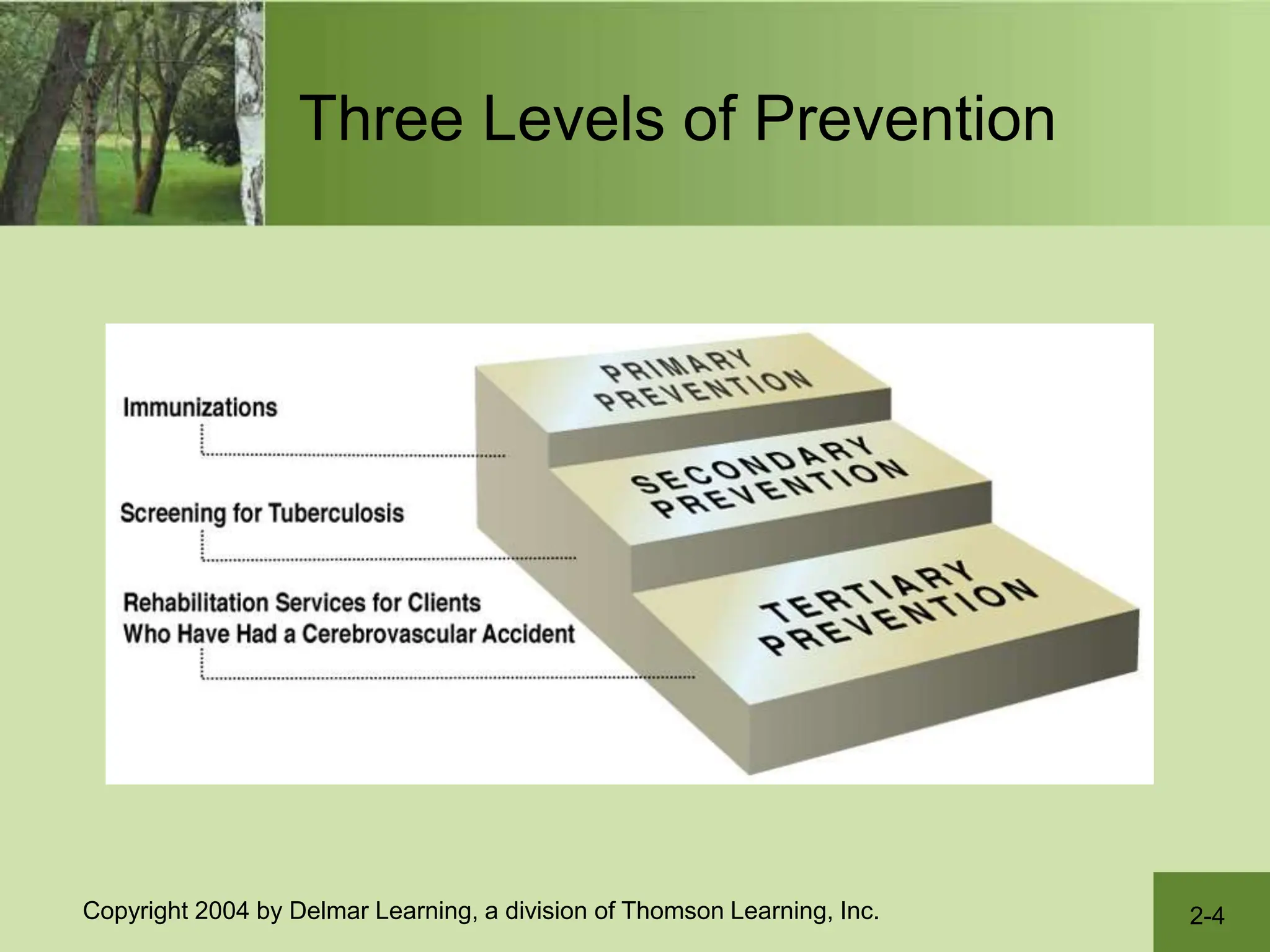
Three Levels of Prevention
2-5
Copyright 2004 by Delmar Learning, a division of Thomson Learning, Inc.
Health Care Settings
Public Sector
 Federal Level
• U.S. Department of Health and Human
Services (DHHS)
 State Level
• Department of Health
2-6
Copyright 2004 by Delmar Learning, a division of Thomson Learning, Inc.
Health Care Settings
Public Sector
 Local Level Health Units
• Communicable disease control
• Health records maintenance
• Individual health services
• Environmental health and safety
• Public health education
2-7
Copyright 2004 by Delmar Learning, a division of Thomson Learning, Inc.
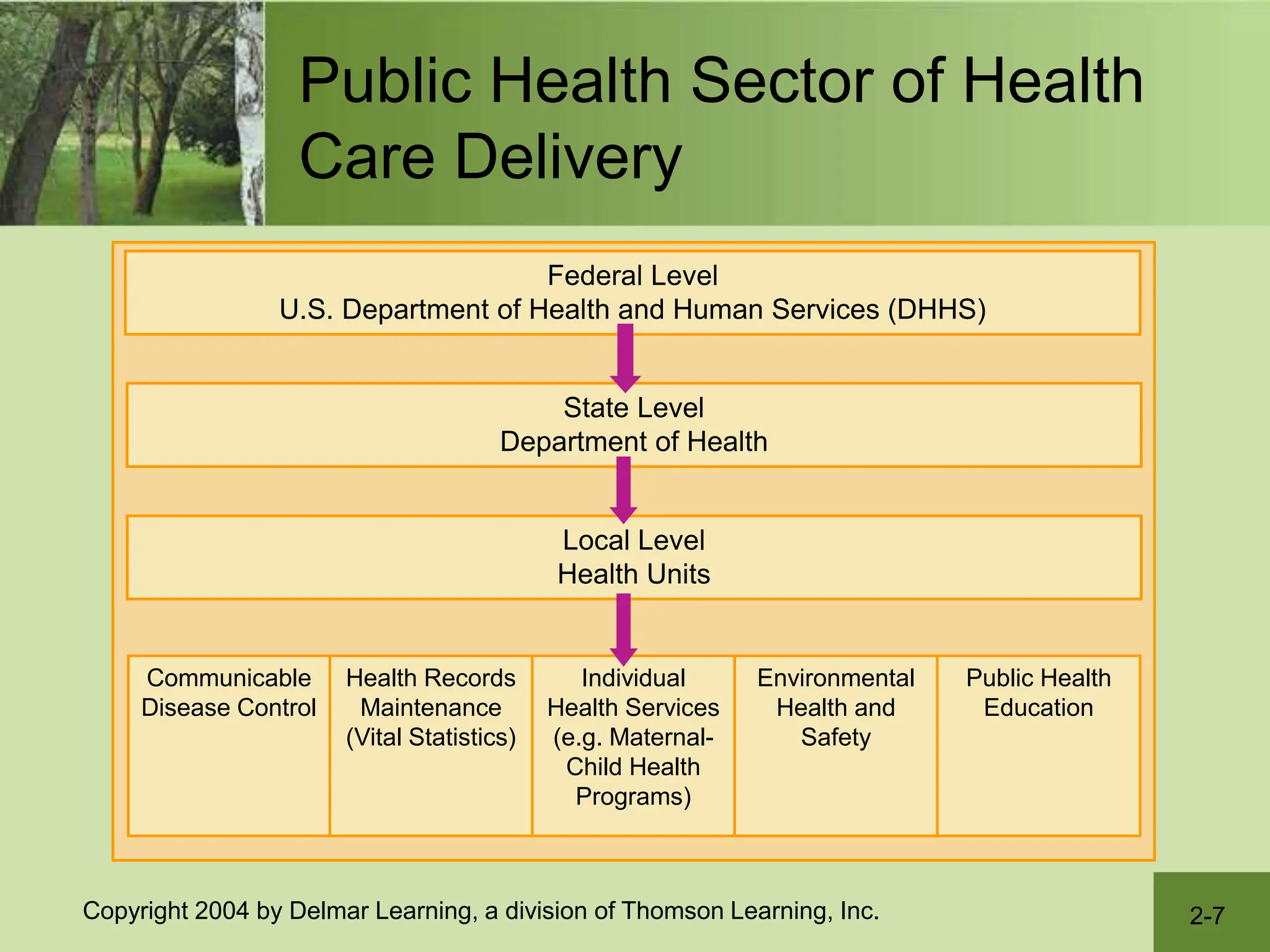
Public Health Sector of Health
Care Delivery
Communicable
Disease Control
Health Records
Maintenance
(Vital Statistics)
Individual
Health Services
(e.g. Maternal-
Child Health
Programs)
Environmental
Health and
Safety
Public Health
Education
Federal Level
U.S. Department of Health and Human Services (DHHS)
State Level
Department of Health
Local Level
Health Units
2-8
Copyright 2004 by Delmar Learning, a division of Thomson Learning, Inc.
Health Care Settings
Private Sector
 Hospitals
 Extended care facilities
 Home health agencies
 Hospices
 Outpatient settings
2-9
Copyright 2004 by Delmar Learning, a division of Thomson Learning, Inc.
Health Care Settings
Private Sector
 Schools
 Industrial clinics
 Managed care organizations
 Community nursing centers
 Rural primary care hospitals
2-10
Copyright 2004 by Delmar Learning, a division of Thomson Learning, Inc.
Health Care Team
 Nurse (RN)
 Physician (MD)
 Physician Assistant (PA)
 Pharmacist (RPh)
 Dentist (DDS)
 Dietitian (RD)
 Social Worker (SW)
2-11
Copyright 2004 by Delmar Learning, a division of Thomson Learning, Inc.
Health Care Team
 Respiratory Therapist (RT)
 Physical therapist (PT)
 Occupational Therapist (OT)
 Chaplain
 Unlicensed Assistive Personnel (UAP)
 Dental Hygienist
2-12
Copyright 2004 by Delmar Learning, a division of Thomson Learning, Inc.
Advanced Practice Registered
Nurse
 Diagnoses and manages common health
problems.
 Performs medical procedures (e.g.,
suturing, casting).
2-13
Copyright 2004 by Delmar Learning, a division of Thomson Learning, Inc.
Nursing Roles
 Caregiver
 Teacher
 Advocate
 Manager
 Expert
 Case Manager
 Team Member
2-14
Copyright 2004 by Delmar Learning, a division of Thomson Learning, Inc.
Roles of the Nurse
 Caregiver
 Teacher
 Advocate
 Manager
 Expert
 Case Manager
 Team Member
2-15
Copyright 2004 by Delmar Learning, a division of Thomson Learning, Inc.
Economics of Health Care
 Private Insurance
 Managed Care
• Primary care providers
• Health Maintenance Organizations (HMOs)
• Preferred Provider Organizations (PPOs)
• Exclusive Provider Organizations (EPOs)
2-16
Copyright 2004 by Delmar Learning, a division of Thomson Learning, Inc.
Economics of Health Care
 Federal Government Insurance Plans
• Social Security Act 1965
• Medicare and Medicaid
• Regulated by Centers for Medicare &
Medicaid Services (CMS)
2-17
Copyright 2004 by Delmar Learning, a division of Thomson Learning, Inc.
Federal Government Insurance
Plans
 Medicare
• Individuals over age 65
• Public funding
• Permanently disabled individuals
• Individuals with end-stage renal disease
2-18
Copyright 2004 by Delmar Learning, a division of Thomson Learning, Inc.
Federal Government Insurance
Plans
 Medicaid
• Medically indigent
• Determined by federal and state
governments
• Inpatient and outpatient hospital services
• Physician services
• Laboratory services
• Rural health clinic services
2-19
Copyright 2004 by Delmar Learning, a division of Thomson Learning, Inc.
Economics of Health Care
 Canadian Health Insurance
• National health insurance
• Single-payer model
• Short and long-term care
• Financed with tax dollars
2-20
Copyright 2004 by Delmar Learning, a division of Thomson Learning, Inc.
Factors Influencing the Delivery
of Health Care
 Cost
 Access
 Quality
2-21
Copyright 2004 by Delmar Learning, a division of Thomson Learning, Inc.
Cost
 Four major factors increase the cost of
health care
• An over supply of specialized providers
• A surplus of hospital beds
• The passive role assumed by most
consumers
• Inequitable financing of services
2-22
Copyright 2004 by Delmar Learning, a division of Thomson Learning, Inc.
Access Limiting Factors
 Prohibitive costs for employer to provide
 Inability to obtain individual insurance
 Cultural barriers
 Persons with preexisting conditions
 Shortages of health care providers
 Limited access to ancillary services
2-23
Copyright 2004 by Delmar Learning, a division of Thomson Learning, Inc.
Quality
 Estimated that 30% to 40% of
diagnostic/medical procedures performed
in U.S. are unnecessary
 Inappropriate use of resources
 A 2002 study revealed that 73% of
nurses surveyed stated that the quality of
care at their hospital had declined due to
cost-containment measures.
2-24
Copyright 2004 by Delmar Learning, a division of Thomson Learning, Inc.
Challenges Within the
Health Care System
 Positive Perception of Nurses
• Nurses are persistently seen as having the
highest standards of honesty and ethics.
• The public believes that if nurses were
allowed to use their skills, they would
significantly enhance quality and reduce
costs.
2-25
Copyright 2004 by Delmar Learning, a division of Thomson Learning, Inc.
Challenges Within the
Health Care System
 Nursing shortage
 Loss of control over health care decisions
 Decreased use of hospitals
 Changing practice settings
 Ethical issues
 Vulnerable populations
2-26
Copyright 2004 by Delmar Learning, a division of Thomson Learning, Inc.
Challenges Within the
Health Care System
 Nursing Shortage: By 2020 the workforce
is forecast to be 20% below
requirements.
• Fewer people entering the profession
• Aging of the nursing population
• Other career options offering greater
remuneration
2-27
Copyright 2004 by Delmar Learning, a division of Thomson Learning, Inc.
Challenges Within the
Health Care System
 Loss of Control
• Consumers express a loss of personal
control within the health care system.
• Some feel terrorized by the system.
• Many American workers state that their
greatest concern is the possible loss of
health care coverage.
2-28
Copyright 2004 by Delmar Learning, a division of Thomson Learning, Inc.
Challenges Within the
Health Care System
 Decreased use of hospitals
• Shorter lengths of stay
• Technologic advances
• Greater availability of outpatient facilities
• More services available in outpatient
settings
• Expectations/demands of third-party payers
2-29
Copyright 2004 by Delmar Learning, a division of Thomson Learning, Inc.
Challenges Within the
Health Care System
 Changing Practice Settings
• Most nurses currently practice in hospitals
and will continue to do so in the future.
• There is an ever-increasing need for
expanded services and settings.
• Larger numbers of nurses will be needed for
primary care, public health, extended care
facilities, and the home setting.
2-30
Copyright 2004 by Delmar Learning, a division of Thomson Learning, Inc.
Home Health Nursing
 The percentage of home health nurses is increasing in
numbers, as health care reform places more nurses
(as this home health nurse) outside the acute care
setting.
2-31
Copyright 2004 by Delmar Learning, a division of Thomson Learning, Inc.
Challenges Within the
Health Care System
 Ethical Issues
• At present, citizens’ needs are greater than
available resources.
• The United States is struggling with major
ethical conflicts over allocation of scarce
resources versus compassionate quality
care.
2-32
Copyright 2004 by Delmar Learning, a division of Thomson Learning, Inc.
Challenges Within the
Health Care System
 Nurses continue to advocate for ethical
distribution of resources as health care
reform progresses.
2-33
Copyright 2004 by Delmar Learning, a division of Thomson Learning, Inc.
Challenges Within the
Health Care System
 Vulnerable Populations
• Children
• The elderly
• People with AIDS
• The homeless
• Others living in poverty
2-34
Copyright 2004 by Delmar Learning, a division of Thomson Learning, Inc.
Vulnerable Populations
 Children
• Children are more likely to be insured than
adults.
• One in five children lives in a family with an
income below the poverty level.
• The State Children’s Health Insurance
Program was passed in 1997 to expand
health insurance coverage to uninsured low
income children.
2-35
Copyright 2004 by Delmar Learning, a division of Thomson Learning, Inc.
Vulnerable Populations
 The Elderly
• A large number of elderly people live in rural
areas.
• Many elderly have no health insurance.
• Many hospitals in rural areas have been
closed due to economic pressures.
2-36
Copyright 2004 by Delmar Learning, a division of Thomson Learning, Inc.
Vulnerable Populations
 People with AIDS
• Over 300,000 Americans have been
diagnosed with AIDS.
• Approximately 800,000 Americans are
infected with HIV.
• The most rapid spread of the disease is
occurring among women, children, and IV
drug users and their sexual partners.
2-37
Copyright 2004 by Delmar Learning, a division of Thomson Learning, Inc.
Nursing’s Response to Health
Care Challenges
 Nursing’s Agenda for the Future is a plan
that focuses on strategies to improve
professional conditions for nurses and
quality of health care by 2010.
2-38
Copyright 2004 by Delmar Learning, a division of Thomson Learning, Inc.
Ten Focus Areas of Nursing’s
Agenda for the Future
 Leadership and
planning
 Delivery systems
 Legislation/regulation
policy
 Professional/nursing
culture
 Recruitment/
retention
 Economic value
 Work environment
 Public relations/
communication
 Education
 Diversity
2-39
Copyright 2004 by Delmar Learning, a division of Thomson Learning, Inc.
Nursing’s Response to Health
Care Challenges
 Standards of care
 Advanced practice
 Public versus private programs
 Public health
 Community health
 School nursing
 Long-term care

health care and delivery system .ppt

  • 1.
    The Health Care DeliverySystem Chapter 2
  • 2.
    2-2 Copyright 2004 byDelmar Learning, a division of Thomson Learning, Inc. Health Care Delivery System?  Mechanism for providing services that meet the health-related needs of individuals.  Nursing is a major component of the U.S. health care delivery system.
  • 3.
    2-3 Copyright 2004 byDelmar Learning, a division of Thomson Learning, Inc. Types of Health Care Services  Primary: Health promotion and illness prevention  Secondary: Diagnosis and treatment  Tertiary: Rehabilitation
  • 4.
    2-4 Copyright 2004 byDelmar Learning, a division of Thomson Learning, Inc. Three Levels of Prevention
  • 5.
    2-5 Copyright 2004 byDelmar Learning, a division of Thomson Learning, Inc. Health Care Settings Public Sector  Federal Level • U.S. Department of Health and Human Services (DHHS)  State Level • Department of Health
  • 6.
    2-6 Copyright 2004 byDelmar Learning, a division of Thomson Learning, Inc. Health Care Settings Public Sector  Local Level Health Units • Communicable disease control • Health records maintenance • Individual health services • Environmental health and safety • Public health education
  • 7.
    2-7 Copyright 2004 byDelmar Learning, a division of Thomson Learning, Inc. Public Health Sector of Health Care Delivery Communicable Disease Control Health Records Maintenance (Vital Statistics) Individual Health Services (e.g. Maternal- Child Health Programs) Environmental Health and Safety Public Health Education Federal Level U.S. Department of Health and Human Services (DHHS) State Level Department of Health Local Level Health Units
  • 8.
    2-8 Copyright 2004 byDelmar Learning, a division of Thomson Learning, Inc. Health Care Settings Private Sector  Hospitals  Extended care facilities  Home health agencies  Hospices  Outpatient settings
  • 9.
    2-9 Copyright 2004 byDelmar Learning, a division of Thomson Learning, Inc. Health Care Settings Private Sector  Schools  Industrial clinics  Managed care organizations  Community nursing centers  Rural primary care hospitals
  • 10.
    2-10 Copyright 2004 byDelmar Learning, a division of Thomson Learning, Inc. Health Care Team  Nurse (RN)  Physician (MD)  Physician Assistant (PA)  Pharmacist (RPh)  Dentist (DDS)  Dietitian (RD)  Social Worker (SW)
  • 11.
    2-11 Copyright 2004 byDelmar Learning, a division of Thomson Learning, Inc. Health Care Team  Respiratory Therapist (RT)  Physical therapist (PT)  Occupational Therapist (OT)  Chaplain  Unlicensed Assistive Personnel (UAP)  Dental Hygienist
  • 12.
    2-12 Copyright 2004 byDelmar Learning, a division of Thomson Learning, Inc. Advanced Practice Registered Nurse  Diagnoses and manages common health problems.  Performs medical procedures (e.g., suturing, casting).
  • 13.
    2-13 Copyright 2004 byDelmar Learning, a division of Thomson Learning, Inc. Nursing Roles  Caregiver  Teacher  Advocate  Manager  Expert  Case Manager  Team Member
  • 14.
    2-14 Copyright 2004 byDelmar Learning, a division of Thomson Learning, Inc. Roles of the Nurse  Caregiver  Teacher  Advocate  Manager  Expert  Case Manager  Team Member
  • 15.
    2-15 Copyright 2004 byDelmar Learning, a division of Thomson Learning, Inc. Economics of Health Care  Private Insurance  Managed Care • Primary care providers • Health Maintenance Organizations (HMOs) • Preferred Provider Organizations (PPOs) • Exclusive Provider Organizations (EPOs)
  • 16.
    2-16 Copyright 2004 byDelmar Learning, a division of Thomson Learning, Inc. Economics of Health Care  Federal Government Insurance Plans • Social Security Act 1965 • Medicare and Medicaid • Regulated by Centers for Medicare & Medicaid Services (CMS)
  • 17.
    2-17 Copyright 2004 byDelmar Learning, a division of Thomson Learning, Inc. Federal Government Insurance Plans  Medicare • Individuals over age 65 • Public funding • Permanently disabled individuals • Individuals with end-stage renal disease
  • 18.
    2-18 Copyright 2004 byDelmar Learning, a division of Thomson Learning, Inc. Federal Government Insurance Plans  Medicaid • Medically indigent • Determined by federal and state governments • Inpatient and outpatient hospital services • Physician services • Laboratory services • Rural health clinic services
  • 19.
    2-19 Copyright 2004 byDelmar Learning, a division of Thomson Learning, Inc. Economics of Health Care  Canadian Health Insurance • National health insurance • Single-payer model • Short and long-term care • Financed with tax dollars
  • 20.
    2-20 Copyright 2004 byDelmar Learning, a division of Thomson Learning, Inc. Factors Influencing the Delivery of Health Care  Cost  Access  Quality
  • 21.
    2-21 Copyright 2004 byDelmar Learning, a division of Thomson Learning, Inc. Cost  Four major factors increase the cost of health care • An over supply of specialized providers • A surplus of hospital beds • The passive role assumed by most consumers • Inequitable financing of services
  • 22.
    2-22 Copyright 2004 byDelmar Learning, a division of Thomson Learning, Inc. Access Limiting Factors  Prohibitive costs for employer to provide  Inability to obtain individual insurance  Cultural barriers  Persons with preexisting conditions  Shortages of health care providers  Limited access to ancillary services
  • 23.
    2-23 Copyright 2004 byDelmar Learning, a division of Thomson Learning, Inc. Quality  Estimated that 30% to 40% of diagnostic/medical procedures performed in U.S. are unnecessary  Inappropriate use of resources  A 2002 study revealed that 73% of nurses surveyed stated that the quality of care at their hospital had declined due to cost-containment measures.
  • 24.
    2-24 Copyright 2004 byDelmar Learning, a division of Thomson Learning, Inc. Challenges Within the Health Care System  Positive Perception of Nurses • Nurses are persistently seen as having the highest standards of honesty and ethics. • The public believes that if nurses were allowed to use their skills, they would significantly enhance quality and reduce costs.
  • 25.
    2-25 Copyright 2004 byDelmar Learning, a division of Thomson Learning, Inc. Challenges Within the Health Care System  Nursing shortage  Loss of control over health care decisions  Decreased use of hospitals  Changing practice settings  Ethical issues  Vulnerable populations
  • 26.
    2-26 Copyright 2004 byDelmar Learning, a division of Thomson Learning, Inc. Challenges Within the Health Care System  Nursing Shortage: By 2020 the workforce is forecast to be 20% below requirements. • Fewer people entering the profession • Aging of the nursing population • Other career options offering greater remuneration
  • 27.
    2-27 Copyright 2004 byDelmar Learning, a division of Thomson Learning, Inc. Challenges Within the Health Care System  Loss of Control • Consumers express a loss of personal control within the health care system. • Some feel terrorized by the system. • Many American workers state that their greatest concern is the possible loss of health care coverage.
  • 28.
    2-28 Copyright 2004 byDelmar Learning, a division of Thomson Learning, Inc. Challenges Within the Health Care System  Decreased use of hospitals • Shorter lengths of stay • Technologic advances • Greater availability of outpatient facilities • More services available in outpatient settings • Expectations/demands of third-party payers
  • 29.
    2-29 Copyright 2004 byDelmar Learning, a division of Thomson Learning, Inc. Challenges Within the Health Care System  Changing Practice Settings • Most nurses currently practice in hospitals and will continue to do so in the future. • There is an ever-increasing need for expanded services and settings. • Larger numbers of nurses will be needed for primary care, public health, extended care facilities, and the home setting.
  • 30.
    2-30 Copyright 2004 byDelmar Learning, a division of Thomson Learning, Inc. Home Health Nursing  The percentage of home health nurses is increasing in numbers, as health care reform places more nurses (as this home health nurse) outside the acute care setting.
  • 31.
    2-31 Copyright 2004 byDelmar Learning, a division of Thomson Learning, Inc. Challenges Within the Health Care System  Ethical Issues • At present, citizens’ needs are greater than available resources. • The United States is struggling with major ethical conflicts over allocation of scarce resources versus compassionate quality care.
  • 32.
    2-32 Copyright 2004 byDelmar Learning, a division of Thomson Learning, Inc. Challenges Within the Health Care System  Nurses continue to advocate for ethical distribution of resources as health care reform progresses.
  • 33.
    2-33 Copyright 2004 byDelmar Learning, a division of Thomson Learning, Inc. Challenges Within the Health Care System  Vulnerable Populations • Children • The elderly • People with AIDS • The homeless • Others living in poverty
  • 34.
    2-34 Copyright 2004 byDelmar Learning, a division of Thomson Learning, Inc. Vulnerable Populations  Children • Children are more likely to be insured than adults. • One in five children lives in a family with an income below the poverty level. • The State Children’s Health Insurance Program was passed in 1997 to expand health insurance coverage to uninsured low income children.
  • 35.
    2-35 Copyright 2004 byDelmar Learning, a division of Thomson Learning, Inc. Vulnerable Populations  The Elderly • A large number of elderly people live in rural areas. • Many elderly have no health insurance. • Many hospitals in rural areas have been closed due to economic pressures.
  • 36.
    2-36 Copyright 2004 byDelmar Learning, a division of Thomson Learning, Inc. Vulnerable Populations  People with AIDS • Over 300,000 Americans have been diagnosed with AIDS. • Approximately 800,000 Americans are infected with HIV. • The most rapid spread of the disease is occurring among women, children, and IV drug users and their sexual partners.
  • 37.
    2-37 Copyright 2004 byDelmar Learning, a division of Thomson Learning, Inc. Nursing’s Response to Health Care Challenges  Nursing’s Agenda for the Future is a plan that focuses on strategies to improve professional conditions for nurses and quality of health care by 2010.
  • 38.
    2-38 Copyright 2004 byDelmar Learning, a division of Thomson Learning, Inc. Ten Focus Areas of Nursing’s Agenda for the Future  Leadership and planning  Delivery systems  Legislation/regulation policy  Professional/nursing culture  Recruitment/ retention  Economic value  Work environment  Public relations/ communication  Education  Diversity
  • 39.
    2-39 Copyright 2004 byDelmar Learning, a division of Thomson Learning, Inc. Nursing’s Response to Health Care Challenges  Standards of care  Advanced practice  Public versus private programs  Public health  Community health  School nursing  Long-term care