Chapter 2
The Health Care Delivery
System
Challenges to Health Care
 Reducing health care costs while maintaining

high-quality care for patients
 Improving access and coverage for more people
 Encouraging healthy behaviors
 Earlier hospital discharges result in more patients
needing nursing homes or home care.
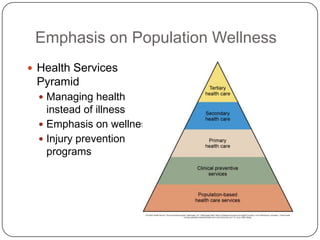
Emphasis on Population Wellness
 Health Services

Pyramid
 Managing health

instead of illness
 Emphasis on wellness
 Injury prevention
programs

{Fig 2-1 here}
National Priorities Partnership
 National Priorities:
 Patient and family engagement
 Population health
 Safety/eliminating errors as possible
 Care coordination

 Palliative care for advanced illnesses
 Overuse/reducing waste
Institute of Medicine (IOM)
 Nurses need to be transformed by:
 Practicing to the full extent of their education and

training
 Achieving higher levels of education and training
through an improved education system that
provides seamless progression
 Becoming full partners, with physicians and other
providers, in redesigning the health care system
 Improving data collection and the information
infrastructure for effective workforce planning and
policy making
Case Study
 Amy Sue Reilly is a 15-year-old white female of Irish

descent. She is a freshman at a Catholic high school.
Although her parents are divorced, Amy Sue reports
that her family (she has two brothers and lives with
her mother) is very close, and that her parents work
together to meet all their children’s needs.
 Amy Sue has had asthma since she was 5 years old.
She has been able to control her asthma by taking
oral medications and by using inhalers when needed.
Health Care Regulation and Competition
 Regulatory and competitive approaches
 Professional standards review organizations

(PSROs)
 Created to review the quality, quantity, and cost of hospital

care provided through Medicare and Medicaid

 Utilization review committees (URs)
 Review admissions, diagnostic testing, and treatments
provided by physicians who cared for patients receiving
Medicare
Health Care Regulation and Competition
(cont’d)


Prospective payment system (PPS)
 Diagnosis-related groups (DRGs)

 Capitation
 Resource utilization groups (RUGs)



Profitability
Managed care
Health Care Regulation and Competition
(cont’d)
 Patient Protection and Affordable Care Act
 Access to health care for all
 Reducing costs
 Improving quality
 Provisions include
 Insurance industry reforms
 Increased funding for community health centers
 Increased primary care services
 Improved coverage for children
Health Care Settings and Services

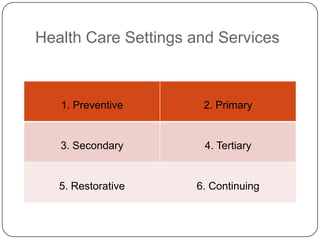
1. Preventive

2. Primary

3. Secondary

4. Tertiary

5. Restorative

6. Continuing
Health Care Accreditation/
Certification
 Reasons:
 To demonstrate quality and safety
 To evaluate performance, identify problems, and

develop solutions
 Accreditation earned by the entire organization
 Specific programs or services within an organization

earn certifications.
 The Joint Commission and others
Preventive and Primary Health Care
Preventive Care
Primary care
Focuses on improved health outcomes for an entire
population
Requires collaboration among health professionals,
health care leaders, and community members
Health promotion lowers overall costs:
Reduces incidence of disease
Minimizes complications
Reduces the need for more expensive resources
Occurs in home, work, and community settings
Secondary and Tertiary Care
 Also called acute care

 Focus: Diagnosis and treatment of disease
 Disease management is the most common and

expensive service of the health care delivery
system.
 20% require 80% of health care spending.
 Fastest growing age group of uninsured?
 Postponement of care by uninsured
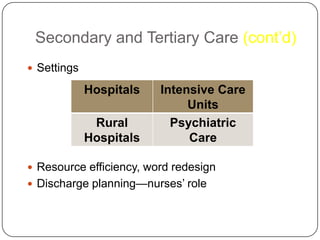
Secondary and Tertiary Care (cont’d)
 Settings

Hospitals
Rural
Hospitals

Intensive Care
Units
Psychiatric
Care

 Resource efficiency, word redesign
 Discharge planning—nurses’ role
Restorative Care
 Serves patients recovering from an acute or





chronic illness/disability
Helps individuals regain maximal function and
enhance quality of life
Promotes patient independence and self-care
abilities
Requires multidisciplinary approach
Settings:

Home Care

Rehabilitation

Extended Care
Restorative Care: Home Care
 Provision of medically related professional and

paraprofessional services and equipment to patients
and families in their homes for health maintenance,
education, illness prevention, diagnosis and treatment
of disease, palliation, and rehabilitation
 Involves coordination of services
 Focuses on patient and family independence
 Usually reimbursed by government (such as
Medicare and Medicaid in the United States), private
insurance, and private pay sources
Restorative Care: Rehabilitation
 Focus: To restore patients to their fullest physical,

mental, social, vocational, and economic potential
 Includes physical, occupational, and speech
therapy, as well as social services
 Occurs in many health care settings, both
inpatient and outpatient
Restorative Care: Extended Care
 Extended care facility
 Provides intermediate medical, nursing, or custodial

care for patients recovering from acute illness or
disabilities
 Skilled nursing facility (intermediate care)
 Provides care for patients until they can return to

their community or residential care location
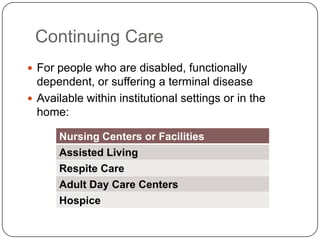
Continuing Care
 For people who are disabled, functionally

dependent, or suffering a terminal disease
 Available within institutional settings or in the
home:
Nursing Centers or Facilities
Assisted Living
Respite Care
Adult Day Care Centers
Hospice
Continuing Care: Nursing Centers or
Facilities
 Provide 24-hour intermediate and custodial care
 Nursing, rehabilitation, diet, social, recreational, and

religious services
 Residents of any age with chronic or debilitating
illness

Omnibus Budget
Reconciliation Act of 1987

 Regulated by standards:

 Interdisciplinary functional assessment is the

focus of clinical practice: MDS, RAIs
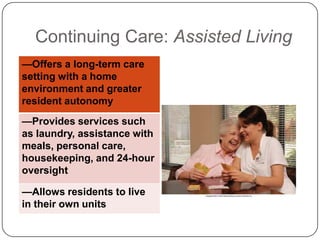
Continuing Care: Assisted Living
—Offers a long-term care
setting with a home
environment and greater
resident autonomy
—Provides services such
as laundry, assistance with
meals, personal care,
housekeeping, and 24-hour
oversight
—Allows residents to live
in their own units
Respite Care
 The service provides short-term relief or “time off”

for persons providing home care to an ill,
disabled, or frail older adult.
 Settings include home, day care, or health care
institution with overnight care.
 Trained volunteers allow family caregivers to
leave the home for errands or social time.
Adult Day Care Centers
 Provide a variety of health and social services to

specific patient populations who live alone or with
family in the community
 May be associated with a hospital or nursing
home or may operate independently
 Offer services to patients such as daily physical
rehabilitation and counseling
Hospice
 Family-centered care that allows patients to live

and remain at home
 Focuses on palliative (not curative) care: comfort,
independence, and dignity
 Provides patient and family support during
terminal illness and time of death
 Many hospice programs provide respite care,
which is important in maintaining the health of the
primary caregiver and family.
Issues in Health Care Delivery
 Nursing shortage

 Competency
 Evidence-based practice
 Quality and safety in health care/ Patient-

centered care
 Health care organizations are being evaluated on
the basis of outcomes such as prevention of
complications, patients’ functional outcomes, and
patient satisfaction.
Issues in Health Care Delivery
(cont’d)
 Magnet Recognition Program
 Nursing-sensitive outcomes

 Nursing informatics and technological

advancements
 Globalization of health care
The Future of Health Care
 Change opens up opportunities for improvement.
 Health care delivery systems need to address the

needs of the uninsured and the underserved.
 Health care organizations are striving to become
better prepared to deal with these and other
challenges in health care.
 The solutions necessary to improve the quality of
health care depend largely on the active
participation of nurses.

caring foundations

  • 1.
    Chapter 2 The HealthCare Delivery System
  • 2.
    Challenges to HealthCare  Reducing health care costs while maintaining high-quality care for patients  Improving access and coverage for more people  Encouraging healthy behaviors  Earlier hospital discharges result in more patients needing nursing homes or home care.
  • 3.
    Emphasis on PopulationWellness  Health Services Pyramid  Managing health instead of illness  Emphasis on wellness  Injury prevention programs {Fig 2-1 here}
  • 4.
    National Priorities Partnership National Priorities:  Patient and family engagement  Population health  Safety/eliminating errors as possible  Care coordination  Palliative care for advanced illnesses  Overuse/reducing waste
  • 5.
    Institute of Medicine(IOM)  Nurses need to be transformed by:  Practicing to the full extent of their education and training  Achieving higher levels of education and training through an improved education system that provides seamless progression  Becoming full partners, with physicians and other providers, in redesigning the health care system  Improving data collection and the information infrastructure for effective workforce planning and policy making
  • 6.
    Case Study  AmySue Reilly is a 15-year-old white female of Irish descent. She is a freshman at a Catholic high school. Although her parents are divorced, Amy Sue reports that her family (she has two brothers and lives with her mother) is very close, and that her parents work together to meet all their children’s needs.  Amy Sue has had asthma since she was 5 years old. She has been able to control her asthma by taking oral medications and by using inhalers when needed.
  • 7.
    Health Care Regulationand Competition  Regulatory and competitive approaches  Professional standards review organizations (PSROs)  Created to review the quality, quantity, and cost of hospital care provided through Medicare and Medicaid  Utilization review committees (URs)  Review admissions, diagnostic testing, and treatments provided by physicians who cared for patients receiving Medicare
  • 8.
    Health Care Regulationand Competition (cont’d)  Prospective payment system (PPS)  Diagnosis-related groups (DRGs)  Capitation  Resource utilization groups (RUGs)   Profitability Managed care
  • 9.
    Health Care Regulationand Competition (cont’d)  Patient Protection and Affordable Care Act  Access to health care for all  Reducing costs  Improving quality  Provisions include  Insurance industry reforms  Increased funding for community health centers  Increased primary care services  Improved coverage for children
  • 10.
    Health Care Settingsand Services 1. Preventive 2. Primary 3. Secondary 4. Tertiary 5. Restorative 6. Continuing
  • 11.
    Health Care Accreditation/ Certification Reasons:  To demonstrate quality and safety  To evaluate performance, identify problems, and develop solutions  Accreditation earned by the entire organization  Specific programs or services within an organization earn certifications.  The Joint Commission and others
  • 12.
    Preventive and PrimaryHealth Care Preventive Care Primary care Focuses on improved health outcomes for an entire population Requires collaboration among health professionals, health care leaders, and community members Health promotion lowers overall costs: Reduces incidence of disease Minimizes complications Reduces the need for more expensive resources Occurs in home, work, and community settings
  • 13.
    Secondary and TertiaryCare  Also called acute care  Focus: Diagnosis and treatment of disease  Disease management is the most common and expensive service of the health care delivery system.  20% require 80% of health care spending.  Fastest growing age group of uninsured?  Postponement of care by uninsured
  • 14.
    Secondary and TertiaryCare (cont’d)  Settings Hospitals Rural Hospitals Intensive Care Units Psychiatric Care  Resource efficiency, word redesign  Discharge planning—nurses’ role
  • 15.
    Restorative Care  Servespatients recovering from an acute or     chronic illness/disability Helps individuals regain maximal function and enhance quality of life Promotes patient independence and self-care abilities Requires multidisciplinary approach Settings: Home Care Rehabilitation Extended Care
  • 16.
    Restorative Care: HomeCare  Provision of medically related professional and paraprofessional services and equipment to patients and families in their homes for health maintenance, education, illness prevention, diagnosis and treatment of disease, palliation, and rehabilitation  Involves coordination of services  Focuses on patient and family independence  Usually reimbursed by government (such as Medicare and Medicaid in the United States), private insurance, and private pay sources
  • 17.
    Restorative Care: Rehabilitation Focus: To restore patients to their fullest physical, mental, social, vocational, and economic potential  Includes physical, occupational, and speech therapy, as well as social services  Occurs in many health care settings, both inpatient and outpatient
  • 18.
    Restorative Care: ExtendedCare  Extended care facility  Provides intermediate medical, nursing, or custodial care for patients recovering from acute illness or disabilities  Skilled nursing facility (intermediate care)  Provides care for patients until they can return to their community or residential care location
  • 19.
    Continuing Care  Forpeople who are disabled, functionally dependent, or suffering a terminal disease  Available within institutional settings or in the home: Nursing Centers or Facilities Assisted Living Respite Care Adult Day Care Centers Hospice
  • 20.
    Continuing Care: NursingCenters or Facilities  Provide 24-hour intermediate and custodial care  Nursing, rehabilitation, diet, social, recreational, and religious services  Residents of any age with chronic or debilitating illness Omnibus Budget Reconciliation Act of 1987  Regulated by standards:  Interdisciplinary functional assessment is the focus of clinical practice: MDS, RAIs
  • 21.
    Continuing Care: AssistedLiving —Offers a long-term care setting with a home environment and greater resident autonomy —Provides services such as laundry, assistance with meals, personal care, housekeeping, and 24-hour oversight —Allows residents to live in their own units
  • 22.
    Respite Care  Theservice provides short-term relief or “time off” for persons providing home care to an ill, disabled, or frail older adult.  Settings include home, day care, or health care institution with overnight care.  Trained volunteers allow family caregivers to leave the home for errands or social time.
  • 23.
    Adult Day CareCenters  Provide a variety of health and social services to specific patient populations who live alone or with family in the community  May be associated with a hospital or nursing home or may operate independently  Offer services to patients such as daily physical rehabilitation and counseling
  • 24.
    Hospice  Family-centered carethat allows patients to live and remain at home  Focuses on palliative (not curative) care: comfort, independence, and dignity  Provides patient and family support during terminal illness and time of death  Many hospice programs provide respite care, which is important in maintaining the health of the primary caregiver and family.
  • 25.
    Issues in HealthCare Delivery  Nursing shortage  Competency  Evidence-based practice  Quality and safety in health care/ Patient- centered care  Health care organizations are being evaluated on the basis of outcomes such as prevention of complications, patients’ functional outcomes, and patient satisfaction.
  • 26.
    Issues in HealthCare Delivery (cont’d)  Magnet Recognition Program  Nursing-sensitive outcomes  Nursing informatics and technological advancements  Globalization of health care
  • 27.
    The Future ofHealth Care  Change opens up opportunities for improvement.  Health care delivery systems need to address the needs of the uninsured and the underserved.  Health care organizations are striving to become better prepared to deal with these and other challenges in health care.  The solutions necessary to improve the quality of health care depend largely on the active participation of nurses.

Editor's Notes

  • #3 To meet these changing conditions, organizations must run as businesses. Technology, new medications, and shortened lengths of stay increase the cost of doing business.The health care system is faced with rising costs, increased access to services, growing populations, improved quality outcomes, and threats of bioterrorism.Nurses face major challenges to prevent gaps in health care across health care settings, so individuals remain healthy and well within their own homes and communities.
  • #4 The Core Functions Project developed the Health Services Pyramid.The shift from managing illness to managing health includes an emphasis on wellness, and the environment has enhanced quality of life.The emphasis has led to improvements in water, sewage, immunizations, and living conditions. Patient teaching has promoted better diet habits, decreased tobacco use, and improved blood pressure control. Injury prevention programs advocating seatbelt use, child seats, restraints, and helmet laws have enhanced quality of life and decreased mortality rates.[See Box 2-1 (on text p. 17) for common health care definitions that should help students begin to integrate terminology.] [Figure is on text p. 17.]
  • #5 How is health care changing? One example can be seen in the National Priorities Partnership, a group of 28 organizations from a variety of health care disciplines that have joined together to work toward transforming health care.They bring an increased focus on wellness and prevention, working through a six-part approach.
  • #6 Nursing is a caring profession with a set of ethics, values, and standards. Nurses will change with the times; however, nurses will always keep patient needs first as they are challenged with new roles and responsibilities.[What are some ways you can see yourself implementing the IOM recommendations?]
  • #7 What concerns would you have if you were Amy Sue’s school nurse about Amy Sue getting the medical care she needs? [Discusstransferring medication to and from school, keeping her inhalers with her when she visits her dad, acclimating to a new routine in high school, etc.]
  • #11 [Lead a discussion on what level or type of care is offered in each of these health care settings.]Larger health care systems have integrated delivery networks (IDNs) that include a set of providers and services organized to deliver a continuum of care to a population of patients at a capitated cost in a particular setting. Nurses are especially important as patient advocates in maintaining continuity of care throughout the levels of care.
  • #12 The Joint Commission (formerly The Joint Commission on Accreditation of Healthcare Organizations) accredits health care organizations across the continuum of care, including hospitals and ambulatory care, long-term care, home care, and behavioral health agencies. Other accrediting agencies have a specific focus, such as the Commission on Accreditation of Rehabilitation Facilities (CARF) and the Community Health Accrediting Program (CHAP).
  • #13 Preventive care focuses on reducing and controlling risk factors for disease through activities such as occupational health programs. [Ask the class for some examples of primary care. Discuss health education, proper nutrition, maternal/child health care, family planning, immunizations, and control of diseases.] Table 2-2 presents examples of preventive and primary care services.
  • #15 Hospital emergency departments, urgent care centers, critical care units, and inpatient medical-surgical units provide secondary and tertiary levels of care. Because of work redesign, more services are available on nursing units, thus minimizing the need to transfer and transport patients across multiple diagnostic and treatment settings.Discharge planning is a centralized, coordinated, multidisciplinary process that ensures that the patient has a plan for continuing care after leaving a health care agency. [What are some ways that nurses help with discharge planning? Discuss.]An ICU is the most expensive health care delivery site because each nurse usually cares for only one or two patients at a time, and because patients in the ICU require complex treatments and procedures.Patients who suffer emotional and behavioral problems such as depression, violent behavior, and eating disorders often require special counseling and treatment in psychiatric facilities. The Balanced Budget Act of 1997 changed the designation for rural hospitals to critical access hospital (CAHs) if certain criteria were met. The CAH provides inpatient care to acutely ill or injured people before transferring them to better-equipped facilities.
  • #22 As one of the fastest growing industries within the United States, assisted living offers privacy, independence, and security.Some facilities provide assistance with medication administration, although nursing care services are not available directly.However, this industry has little regulation, no fee cap. It may not be the most financially sound plan for some individuals.[Photo is on text p. 22.]
  • #27 The American Nurses Credentialing Center (ANCC) established the Magnet Recognition Program to recognize health care organizations that achieve excellence in nursing practice. [See Boxes 2-8, Magnet Model and Forces of Magnetism, and 2-9, Nursing Quality Indicators (both on text p. 26).]Nursing informatics uses information and technology to communicate, manage knowledge, mitigate error, and support decision making.Nurses gain or use information when they organize, structure, or interpret data. Knowledge develops when nurses combine and identify relationships between different pieces of information. Technological advancements influence where and how nurses provide care to patients and can help nurses improve direct care processes, patient outcomes, and work environments. [Ask students what they think of recent technological advancements—do they help or hinder the nurse’s effectiveness?]Globalization, the increasing connectedness of the world’s economy, culture, and technology, is one of the forces reshaping the health care delivery system.Children, women, and older adults are vulnerable populations most threatened by urbanization.