“Commons’ Skills For Assessing
Employability?”
Belinda Child

Criminology Lecturer
UCBC
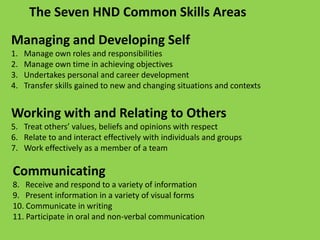
The Seven HND Common Skills Areas
Managing and Developing Self
1.
2.
3.
4.

Manage own roles and responsibilities
Manage own time in achieving objectives
Undertakes personal and career development
Transfer skills gained to new and changing situations and contexts

Working with and Relating to Others
5. Treat others’ values, beliefs and opinions with respect
6. Relate to and interact effectively with individuals and groups
7. Work effectively as a member of a team

Communicating
8. Receive and respond to a variety of information
9. Present information in a variety of visual forms
10. Communicate in writing
11. Participate in oral and non-verbal communication
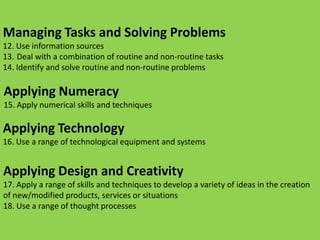
Managing Tasks and Solving Problems
12. Use information sources
13. Deal with a combination of routine and non-routine tasks
14. Identify and solve routine and non-routine problems

Applying Numeracy
15. Apply numerical skills and techniques

Applying Technology
16. Use a range of technological equipment and systems

Applying Design and Creativity
17. Apply a range of skills and techniques to develop a variety of ideas in the creation
of new/modified products, services or situations
18. Use a range of thought processes
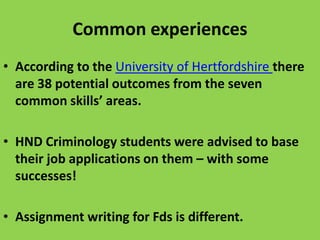
Common experiences
• According to the University of Hertfordshire there
are 38 potential outcomes from the seven
common skills’ areas.

• HND Criminology students were advised to base
their job applications on them – with some
successes!
• Assignment writing for Fds is different.
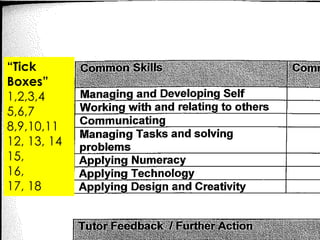
“Tick
Boxes”
1,2,3,4
5,6,7
8,9,10,11
12, 13, 14
15,
16,
17, 18
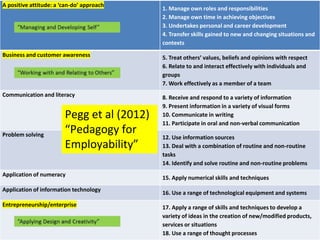
A positive attitude: a ‘can-do’ approach

1. Manage own roles and responsibilities
2. Manage own time in achieving objectives
3. Undertakes personal and career development
4. Transfer skills gained to new and changing situations and
contexts

Business and customer awareness

5. Treat others’ values, beliefs and opinions with respect
6. Relate to and interact effectively with individuals and
groups
7. Work effectively as a member of a team

Communication and literacy

8. Receive and respond to a variety of information
9. Present information in a variety of visual forms
10. Communicate in writing
11. Participate in oral and non-verbal communication

Problem solving

Pegg et al (2012)
“Pedagogy for
Employability”

Application of numeracy
Application of information technology
Entrepreneurship/enterprise

12. Use information sources
13. Deal with a combination of routine and non-routine
tasks
14. Identify and solve routine and non-routine problems
15. Apply numerical skills and techniques
16. Use a range of technological equipment and systems
17. Apply a range of skills and techniques to develop a
variety of ideas in the creation of new/modified products,
services or situations
18. Use a range of thought processes
Y1

CJE

FP

POC

RP

RS

NAC

OM

VIC

RP

RS

A positive attitude: a
‘can-do’ approach

1.1
1.2
1.3
1.4

Business and customer
awareness

2.1
2.2
2.3

Communication and
literacy

3.1
3.2
3.3
3.4

Problem solving

4.1
4.2
4.3

Application of numeracy

5

Application of
information technology

6
7.1
7.2

“The New Grid”

Entrepreneurship
/enterprise
A new assessment choice?
• Not really but was for me and the students.
• Offered in the yr 2 FdA Criminology & Criminal
Justice module ‘Challenging Behaviour’ which
examines criminal justice practices that can be
used for dealing with challenging behaviour.

• They had a choice of either a 2,500 word essay or a
‘video’.
Youtube Assignment Question
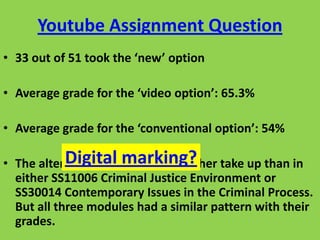
• 33 out of 51 took the ‘new’ option
• Average grade for the ‘video option’: 65.3%
• Average grade for the ‘conventional option’: 54%

Digital marking?
• The alternative method had a higher take up than in
either SS11006 Criminal Justice Environment or
SS30014 Contemporary Issues in the Criminal Process.
But all three modules had a similar pattern with their
grades.
#UCBCFP
#UCBCNAC
#UCBCCB
#UCBCHD
Conclusion?
• Open Educational Practice (OEP) and Open
Educational Resources (OERs) as a means of
change?

• The emphasis on Creative Commons enables the
doing of a “Pedagogy for employability”? (Pegg et
al, 2012)

Commons’ Skills For Assessing Employability

  • 1.
    “Commons’ Skills ForAssessing Employability?” Belinda Child Criminology Lecturer UCBC
  • 2.
    The Seven HNDCommon Skills Areas Managing and Developing Self 1. 2. 3. 4. Manage own roles and responsibilities Manage own time in achieving objectives Undertakes personal and career development Transfer skills gained to new and changing situations and contexts Working with and Relating to Others 5. Treat others’ values, beliefs and opinions with respect 6. Relate to and interact effectively with individuals and groups 7. Work effectively as a member of a team Communicating 8. Receive and respond to a variety of information 9. Present information in a variety of visual forms 10. Communicate in writing 11. Participate in oral and non-verbal communication
  • 3.
    Managing Tasks andSolving Problems 12. Use information sources 13. Deal with a combination of routine and non-routine tasks 14. Identify and solve routine and non-routine problems Applying Numeracy 15. Apply numerical skills and techniques Applying Technology 16. Use a range of technological equipment and systems Applying Design and Creativity 17. Apply a range of skills and techniques to develop a variety of ideas in the creation of new/modified products, services or situations 18. Use a range of thought processes
  • 4.
    Common experiences • Accordingto the University of Hertfordshire there are 38 potential outcomes from the seven common skills’ areas. • HND Criminology students were advised to base their job applications on them – with some successes! • Assignment writing for Fds is different.
  • 5.
  • 6.
    A positive attitude:a ‘can-do’ approach 1. Manage own roles and responsibilities 2. Manage own time in achieving objectives 3. Undertakes personal and career development 4. Transfer skills gained to new and changing situations and contexts Business and customer awareness 5. Treat others’ values, beliefs and opinions with respect 6. Relate to and interact effectively with individuals and groups 7. Work effectively as a member of a team Communication and literacy 8. Receive and respond to a variety of information 9. Present information in a variety of visual forms 10. Communicate in writing 11. Participate in oral and non-verbal communication Problem solving Pegg et al (2012) “Pedagogy for Employability” Application of numeracy Application of information technology Entrepreneurship/enterprise 12. Use information sources 13. Deal with a combination of routine and non-routine tasks 14. Identify and solve routine and non-routine problems 15. Apply numerical skills and techniques 16. Use a range of technological equipment and systems 17. Apply a range of skills and techniques to develop a variety of ideas in the creation of new/modified products, services or situations 18. Use a range of thought processes
  • 7.
    Y1 CJE FP POC RP RS NAC OM VIC RP RS A positive attitude:a ‘can-do’ approach 1.1 1.2 1.3 1.4 Business and customer awareness 2.1 2.2 2.3 Communication and literacy 3.1 3.2 3.3 3.4 Problem solving 4.1 4.2 4.3 Application of numeracy 5 Application of information technology 6 7.1 7.2 “The New Grid” Entrepreneurship /enterprise
  • 8.
    A new assessmentchoice? • Not really but was for me and the students. • Offered in the yr 2 FdA Criminology & Criminal Justice module ‘Challenging Behaviour’ which examines criminal justice practices that can be used for dealing with challenging behaviour. • They had a choice of either a 2,500 word essay or a ‘video’.
  • 9.
    Youtube Assignment Question •33 out of 51 took the ‘new’ option • Average grade for the ‘video option’: 65.3% • Average grade for the ‘conventional option’: 54% Digital marking? • The alternative method had a higher take up than in either SS11006 Criminal Justice Environment or SS30014 Contemporary Issues in the Criminal Process. But all three modules had a similar pattern with their grades.
  • 10.
  • 11.
    Conclusion? • Open EducationalPractice (OEP) and Open Educational Resources (OERs) as a means of change? • The emphasis on Creative Commons enables the doing of a “Pedagogy for employability”? (Pegg et al, 2012)