



Assessing and selecting the right applicantby Fluid March 2010
Page 2Contents3-4 		Introduction to Fluid5-7		Refining the selection process8-10		Filtering job applications11-12	Age discrimination13-14	Exercise A15-17	Selection processes18-19Ability tests20-21Personality tests22-26	Choosing the right assessment tools27-28	Exercise B29-31	Selecting women32-34	Assessing board members35-40	Getting the best from your test41-42Using tests for coaching43-46	Assessment centres47-49	Assessment centres-worth the cost?50-51	Case studies52-53	Exercise C54-55	Conclusion and questions
Page 3Introduction
Page 4Introduction to FluidFluid Consulting Limited (Fluid) is a specialist human resources consultancy headed by Tim Holden MCIPD 10 years in banking10 years in Human Resources consultancyFluid trading since 2006The core services provided by Fluid are:Retention
Selection-  Attraction-  Remuneration & Reward -  Outplacement-  Training & HR consultancy
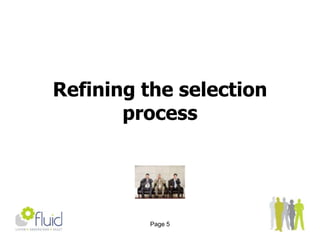
Page 5Refining the selection process
Page 6Refining the selection process 1 of 2To avoid spending hours interviewing unsuitable candidates, start thinking about processes that really test the personality and skills of potential candidates before they reach interview stage
Streamline your paperwork and try to cut administration costs as much as possible
When developing an online questionnaire prior to interview, make sure it is tailor made and specifically matches the requirement for a particular role to filter out applicants who may not have the right aptitudePage 7Refining the selection process 2 of 2Put together a mix of questions so that candidates can’t pre-empt them, and so there are no real right or wrong answers
Try to find out whether there are any potential hidden costs in your recruitment tools. For example, not all candidates have access to a computer so there needs to be a paper version as well
Get to know all the teams or individuals responsible for implementing the new procedure, and co-ordinate team meetings so that everyone is clued up at all timesPage 8Filtering job applications
Page 9Filtering job applications 1 of 2Develop clear job descriptions
Use targeted advertising
Think about the application method
Consider automated selection
Profile the candidate as well as the role
Ensure that interviewers know what to look for
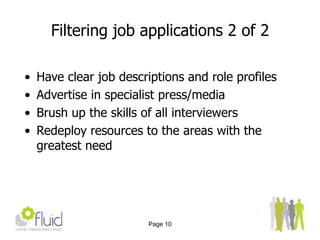
Monitor recruitment activity closelyPage 10Filtering job applications 2 of 2Have clear job descriptions and role profiles
Advertise in specialist press/media
Brush up the skills of all interviewers
Redeploy resources to the areas with the greatest needPage 11Age discrimination
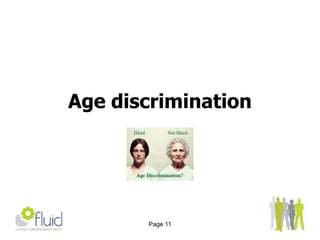
Page 12Age discriminationAge discrimination laws protect both the young and old from discrimination
Discrimination can be justified if it is a proportionate means of achieving a legitimate aim
The test of justification is vague, and difficult to predict
Employers should avoid stereotypical assumptions as to the impact of age and experience on ability
Employers may be driven to labourious assessment processes to avoid the risk of being found to have acted on unjustified assumptionsPage 13Exercise A
Page 14Exercise A
Page 15Selection processes
Page 16Selection processes 1 of 2Pick a role
Obtain selection data
Obtain employee performance data
Carry out a simple analysis
Compute the ROI
Apply the findingsPage 17Selection processes 2 of 2Evaluating the selection process is key to choosing high performers
Evaluation is statistically straightforward and can remove cost from the organisation
Make sure performance data is as accurate and fair as possible by providing guidelines for managers
Take time to understand the findings by placing them in the context of the organisation
Present findings to senior management and propose improvements based on objective data
Squeeze as much as possible out of the findingsPage 18Ability tests
Page 6Ability testsVerbal reasoning
Numerical reasoning
Analytical abilityPage 20Personality tests
Page 21Personality testsKolb Learning Styles inventory
Parent Adult Child
Fundamental Interpersonal Relations OrientationPage 22Choosing the right assessment tools
Page 23Choosing the right assessment tools 1 of 4Have a clear purpose
Identify your needs
Do your research
Consider your resources
Understand the context
Seek advice
Try on for sizePage 24Choosing the right assessment tools 2 of 4JARGON BUSTER
Face validity
Predictive validity
Norm groups

Assessment and Selection March 2010