Download to read offline


![H C I
9
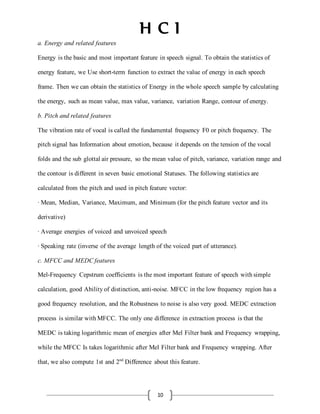
The general architecture for SER system has three steps shown in Fig. 1 [6]:
I. A speech processing system extracts some appropriate quantities from signal, such as pitch
or energy,
ii.These quantities are summarized intoreduced set of features,
iii.A classifier learns in a supervised manner with example data how to associate the features
to the Emotions.
FEATURE EXTRACTION
Feature extraction is based on partitioning speech into small intervals known as frames. To
select suitable Features which are carrying information about emotions from speech signal are
an important step in SER system. There are two types of features: prosodic features including
energy, pitch and spectral features including MFCC,MEDC and LPCC.](https://image.slidesharecdn.com/hciwithemotionalintelligence-180412171916/85/Hci-with-emotional-intelligence-9-320.jpg)


This document discusses a research paper on using emotional intelligence for human-computer interaction. It begins with an introduction describing how emotions play an important role in areas like learning, memory, and decision making. The paper then focuses on current methods for detecting user emotions, including facial expressions, voice analysis, and physiological signals. It presents three test cases analyzing voice parameters like pitch and volume for normal, angry, and panicked emotional states. Features are extracted from speech samples and classifiers are used to associate features with emotions. The goal is to develop systems that can accurately interpret a user's affective feedback through emotional state detection.


