Ya Min Zaw
B.Med.Tech(Final yr)
1.4. 2020
Content
*Definition
*Base
*History
*Moral obligation/duties
*Reasons to take medical ethics
1
 Ethics ; derived from Greek word(ethos-
character/habit),
 Moral principles that govern a person’s behavior.
 A branch of philosophy that defines what is good for
individual or society.
 Professional ethics are considered by members of
profession.
 Medical ethics ; a system of moral principles that apply
to clinical practice and scientific research.
Definition 2
Bases of medical ethics
 Virtue-based ethics (based on good-habit , character, faithfulness
caring)
 Rights-based ethics (emphasize on individuals’ right , individuals’
duties )
 Principle-based ethics (for selecting/defending solutions to ethical
dilemmas)
3
A
Beneficence
(To act in the best interest of
patient ,provide welfare)
Confidentiality
(keeping of patient confidentiality
to built trust and respect)
Justice
(Who get what treatment in the
merit of illness, rescuing from
danger medical conditions)
Non-maleficence
(making sure ; Do no harm,
effective treatment, benefits
outweigh burdens)
Veracity
(Truth telling)
Autonomy
(Patient right to refuse or
choose , consent*psychiatric)
Principle- based medical ethics emphasize on; 4
History of code of medical ethics
1980,2001, 2008 (principle changes by CEJA)
1903, 1949, 1957(language, updated, removed superfluous word)
English physician-philosopher Thomas Percival (1803)
Greek physician Hippocrates, 5th century BCE
5
6
Duties to patients:
- Perform only the procedures
- Advocate the most appropriate care
- Personal prejudices must not affect the professional relationship.
- Practice the principles of justification, optimization and ALARA.
- Respect and maintain patient privacy and confidentiality at all times.
Duties(moral/legal obligation) of Radiographer 7
-Ensure the principle of informed consent.
-Treat with respect and dignity, regardless of race, national or ethnic origin,
color, gender, sexual orientation, religious or political affiliation, age, type of
illness, mental or physical ability.
-Providing information that can be understood.
-Answer patient and family questions fully and honestly within the limits.
-Respect patients’ rights.
8
-Maintain current knowledge of safety standard .
-Intervene in circumstances unsafe, incompetent, or unethical
practice.
Duties to health professionals
-Respect other health professionals.
-Refrain from making unsubstantiated comments about
colleagues and the institution to patients or other persons
9
Duties to the environment:
-Limit unnecessary radiation exposure.
-Correct disposal to protect environment.
- Take steps to minimize the potential risks (for
example, radiation exposure, risk of infection)
10

Duties to one-self( code of ethics byASRT)
-Practice professionally.
-Uphold the professional standing.
-Improve professional standards.
-Engage in lifelong learning.
-Aspire to a high level of professional efficacy at all times.
-Maintain personal well-being and never perform
responsibilities when under the influence of substances or
affected by any condition.
11
-Ensure all oral and written statements are truthful, concise.
-Ensure all professional activities are not a conflict .
- Maintain public trust and confidence.
-Promote a culture of research in the radiographic field .
-Act under the law .
12
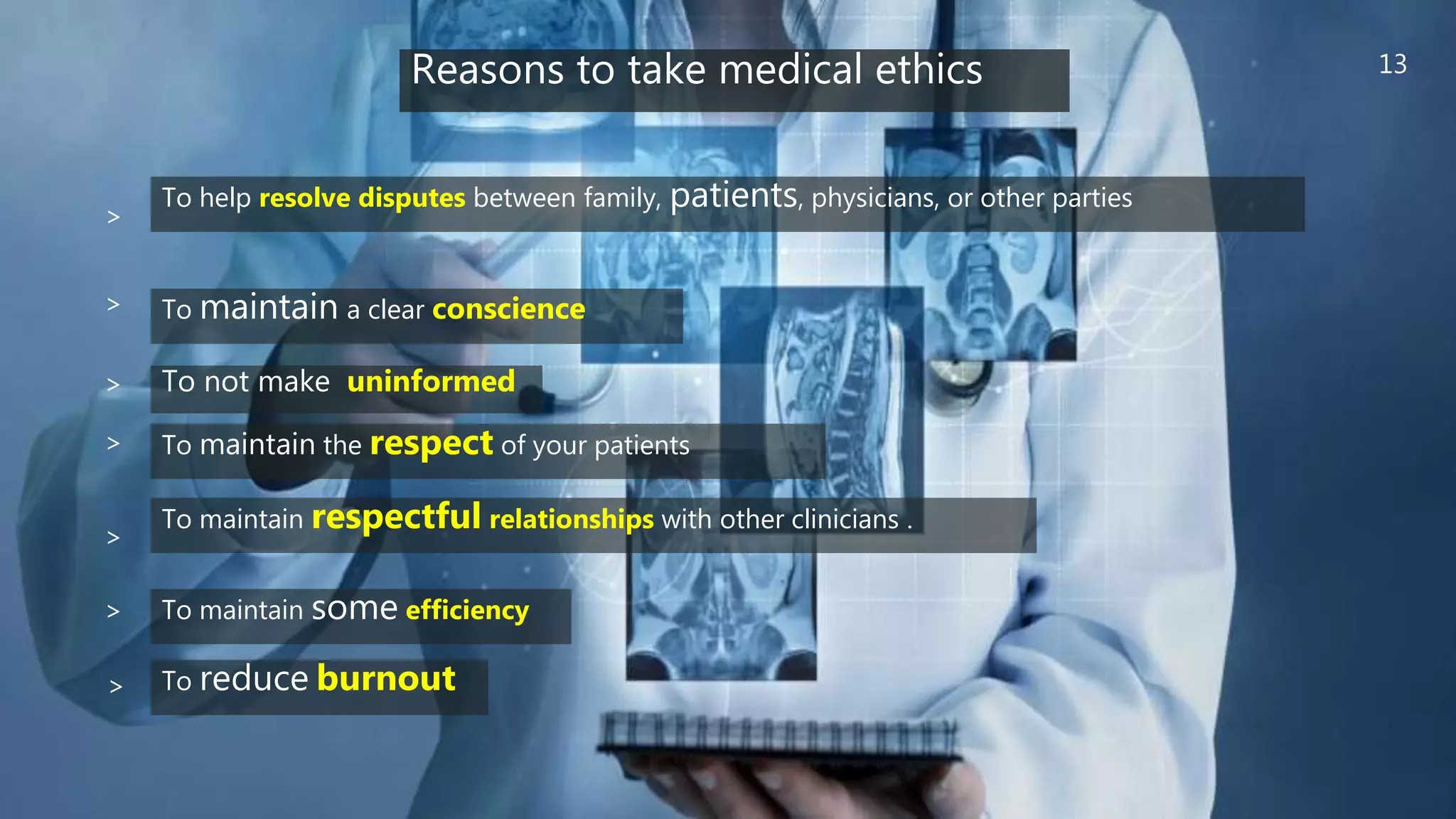
Reasons to take medical ethics
To help resolve disputes between family, patients, physicians, or other parties
To maintain a clear conscience
To not make uninformed
To maintain the respect of your patients
To maintain respectful relationships with other clinicians .
To maintain some efficiency
To reduce burnout
>
>
>
>
>
>
>
13
Breach of ethics;
1. Misconduct(compromise
ethical standards)
2. Malpractice(failure to meet
standard care)
14
“There is no painkiller as effective as
love,
no anti-depressant as soothing as
cheer,
no defibrillator as powerful as
wisdom.”
Abhijit Naskar, Time to Save Medicine
15
Got ethics 16
Medical Ethics in Medical Practice

Medical Ethics in Medical Practice

  • 1.
  • 2.
  • 3.
     Ethics ;derived from Greek word(ethos- character/habit),  Moral principles that govern a person’s behavior.  A branch of philosophy that defines what is good for individual or society.  Professional ethics are considered by members of profession.  Medical ethics ; a system of moral principles that apply to clinical practice and scientific research. Definition 2
  • 4.
    Bases of medicalethics  Virtue-based ethics (based on good-habit , character, faithfulness caring)  Rights-based ethics (emphasize on individuals’ right , individuals’ duties )  Principle-based ethics (for selecting/defending solutions to ethical dilemmas) 3
  • 5.
    A Beneficence (To act inthe best interest of patient ,provide welfare) Confidentiality (keeping of patient confidentiality to built trust and respect) Justice (Who get what treatment in the merit of illness, rescuing from danger medical conditions) Non-maleficence (making sure ; Do no harm, effective treatment, benefits outweigh burdens) Veracity (Truth telling) Autonomy (Patient right to refuse or choose , consent*psychiatric) Principle- based medical ethics emphasize on; 4
  • 6.
    History of codeof medical ethics 1980,2001, 2008 (principle changes by CEJA) 1903, 1949, 1957(language, updated, removed superfluous word) English physician-philosopher Thomas Percival (1803) Greek physician Hippocrates, 5th century BCE 5
  • 7.
  • 8.
    Duties to patients: -Perform only the procedures - Advocate the most appropriate care - Personal prejudices must not affect the professional relationship. - Practice the principles of justification, optimization and ALARA. - Respect and maintain patient privacy and confidentiality at all times. Duties(moral/legal obligation) of Radiographer 7
  • 9.
    -Ensure the principleof informed consent. -Treat with respect and dignity, regardless of race, national or ethnic origin, color, gender, sexual orientation, religious or political affiliation, age, type of illness, mental or physical ability. -Providing information that can be understood. -Answer patient and family questions fully and honestly within the limits. -Respect patients’ rights. 8
  • 10.
    -Maintain current knowledgeof safety standard . -Intervene in circumstances unsafe, incompetent, or unethical practice. Duties to health professionals -Respect other health professionals. -Refrain from making unsubstantiated comments about colleagues and the institution to patients or other persons 9
  • 11.
    Duties to theenvironment: -Limit unnecessary radiation exposure. -Correct disposal to protect environment. - Take steps to minimize the potential risks (for example, radiation exposure, risk of infection) 10
  • 12.
     Duties to one-self(code of ethics byASRT) -Practice professionally. -Uphold the professional standing. -Improve professional standards. -Engage in lifelong learning. -Aspire to a high level of professional efficacy at all times. -Maintain personal well-being and never perform responsibilities when under the influence of substances or affected by any condition. 11
  • 13.
    -Ensure all oraland written statements are truthful, concise. -Ensure all professional activities are not a conflict . - Maintain public trust and confidence. -Promote a culture of research in the radiographic field . -Act under the law . 12
  • 14.
    Reasons to takemedical ethics To help resolve disputes between family, patients, physicians, or other parties To maintain a clear conscience To not make uninformed To maintain the respect of your patients To maintain respectful relationships with other clinicians . To maintain some efficiency To reduce burnout > > > > > > > 13
  • 15.
    Breach of ethics; 1.Misconduct(compromise ethical standards) 2. Malpractice(failure to meet standard care) 14
  • 16.
    “There is nopainkiller as effective as love, no anti-depressant as soothing as cheer, no defibrillator as powerful as wisdom.” Abhijit Naskar, Time to Save Medicine 15
  • 17.