Presented by
Mrs. B.Arulmozhi, M.Sc., B.Ed., M.Phil., SET.,
NET.,
Assistant Professor and Head, Department of
Computer Science and Applications
D.K.M. College for Women, Vellore
HAPTIC TECHNOLOGIES AND
ITS APPLICATIONS
HAPTIC TECHNOLOGY
Introduction – Haptic Technology
 Haptics is the technology of adding the sensation of
touch and feeling to computers.
 “Haptic”, is the term derived from the Greek word,
“haptesthai”, which means ‘sense of touch’.
 It is defined as the “science of applying tactile
sensation to human interaction with computers”.
 It permits users to sense (“feel”) and manipulate three
dimensional virtual objects with respect to such
features as shape, weight, surface textures, and
temperature.
HISTORY
 Haptic- Introduced by 20th century researcher in the
field of experimental psychology to refer to the active
touch of real objects by humans.
 In the late 1980s, the term was redefined to enlarge its
scope to include all aspects of machine touch and
human–machine touch interaction.
 Currently, the term has brought together many
different disciplines, including biomechanics,
psychology, neurophysiology, engineering, and
computer science, as the study of human touch and
force feedback with the external environment.
Generation of Haptic
 First Generation – Use of Electromagnetic
Technologies which produce a limited range of
sensations.
 Second Generation – Touch-Coordinates
specific responses allowing the haptic effects to
be localized to the position on a screen rather
than the whole device.
 Third Generation – Delivers both Touch-
Coordinate specific responses and
customized haptic effects.
 Fourth Generation – Pressure Sensitivity, i.e.
how hard you press on a flat surface can affect
the response.
KEY COMPONENTS
Haptic Interface
Sensors
Control
Software(MCU)
Drivers
Actuators
HOWHAPTICWORKS
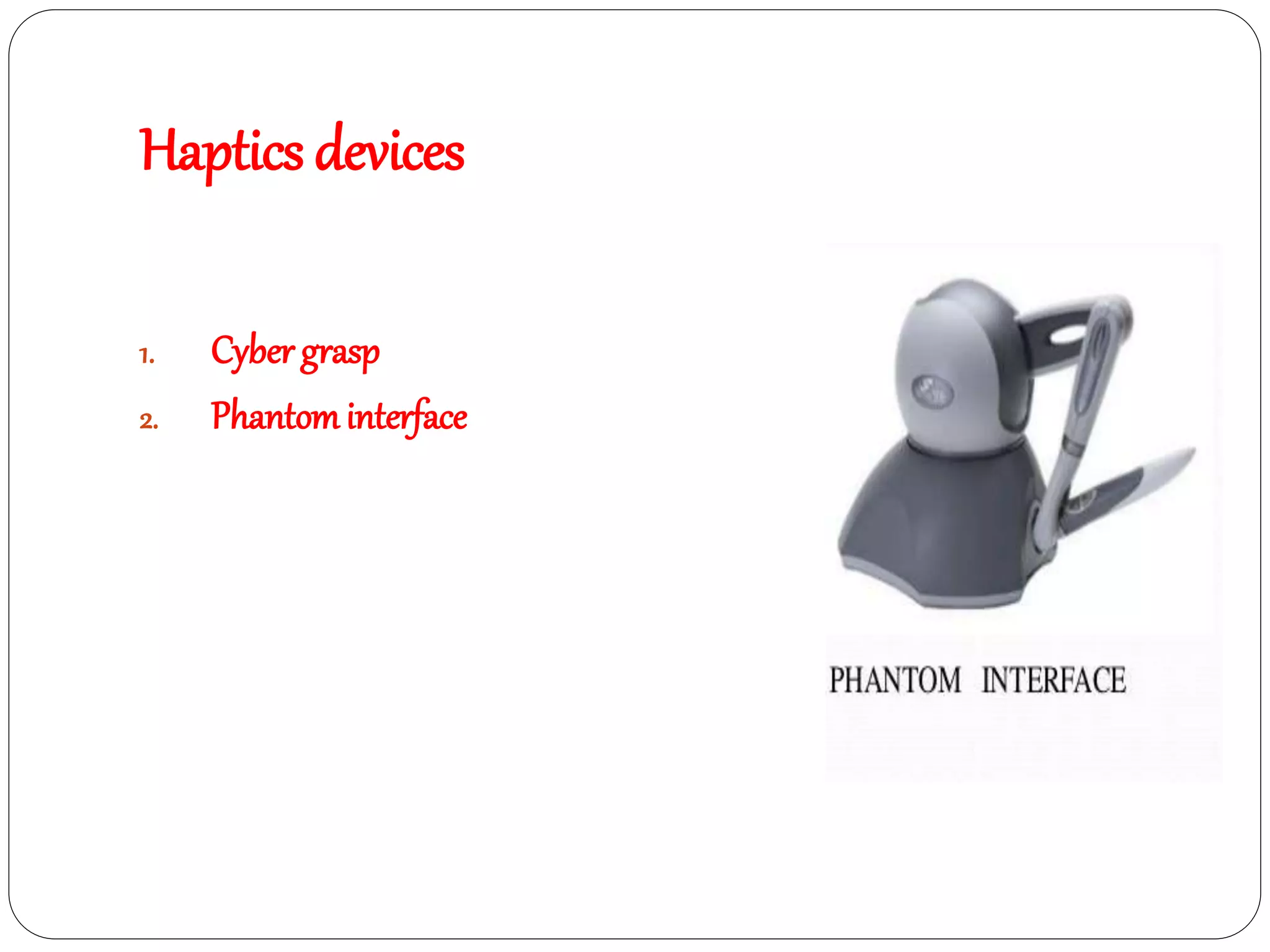
1. Cyber grasp
2. Phantominterface
Haptics devices
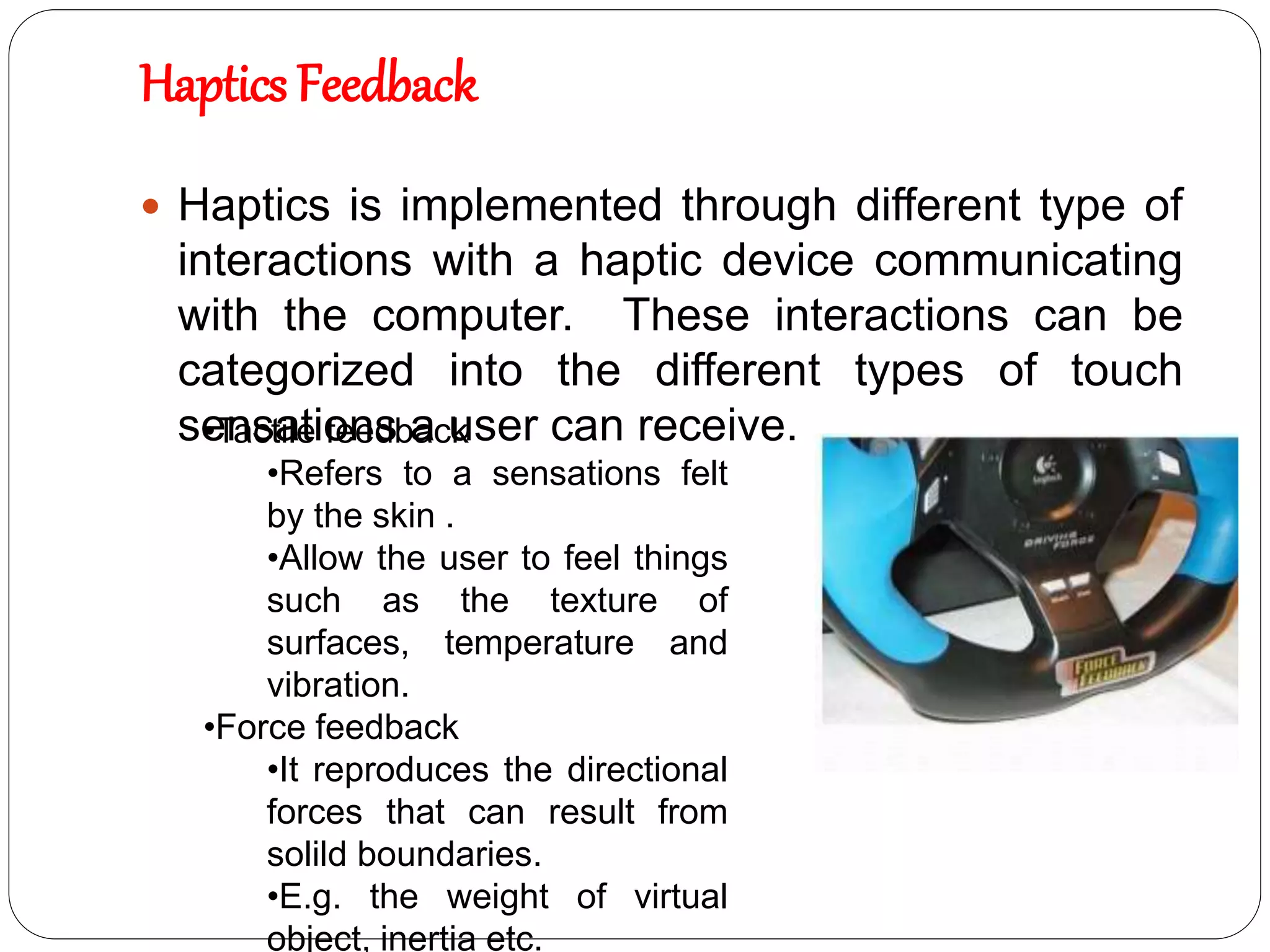
Haptics Feedback
 Haptics is implemented through different type of
interactions with a haptic device communicating
with the computer. These interactions can be
categorized into the different types of touch
sensations a user can receive.
•Tactile feedback
•Refers to a sensations felt
by the skin .
•Allow the user to feel things
such as the texture of
surfaces, temperature and
vibration.
•Force feedback
•It reproduces the directional
forces that can result from
solild boundaries.
•E.g. the weight of virtual
object, inertia etc.
 It is the process of generating and
computing forces in response to the
user interaction with the virtual object.
 The software – controlled haptic
virtual objects(HVO) creation process
is called haptic rendering(HR).
 The control computer(CC) executes
HR events (Collision detection, force
calculation and generation when
necessary) at high rate(one KHz or
more).
Haptic rendering
 It has 3 main blocks
1. Collision detection
algorithms
2. Force-response
algorithms
3. Control algorithms.
Haptic rendering – continue
HAPTIC RENDERING in CONSTRUCTING 3D OBJECT
 Constructive solid geometry
(CSG) has proven to be a
good metaphor for
constructing complex objects.
 These complex objects are
created by applying boolean
operations on simple,
mathematical objects.
 For instance, a box with a hole
can easily be defined as a
cylinder subtracted from a box.
Csg tree
 A CSG model consists of a
series of primitives and
boolean operators, which are
grouped into a tree.
 Most CSG implementations
use the intersection (∩),
subtraction (−) and union (∪)
operators.
 In this CSG tree, the
intersection of a cube and a
sphere is taken, which
results in a rounded cube.
Next a hole is created by
subtracting a cylinder from
HAPTIC RENDERING of CSG TREES
 These algorithms either use special hardware
with 2 depth buffers or the stencil buffer
available on standard OpenGL graphics board.
 Our algorithm for rendering CSG trees
calculates a surface contact point (SCP) for
CSG models. A primitive has to provide two
methods in order to be used in a CSG tree:
1. The primitive has to check if a point
lies inside or outside its surface.
2. The primitive has to calculate the SCP if
the point lies inside its surface.
3. The primitive has to calculate the SCP if
the point lies outside its surface.
INTERSECTION algorithm
 The intersection of two
objects is formed by the
volume that is shared by
these objects.
 As a result, only the
surfaces that are shaded
black in figure have to be
felt. The rendering
algorithm should ignore
the greyed surfaces.
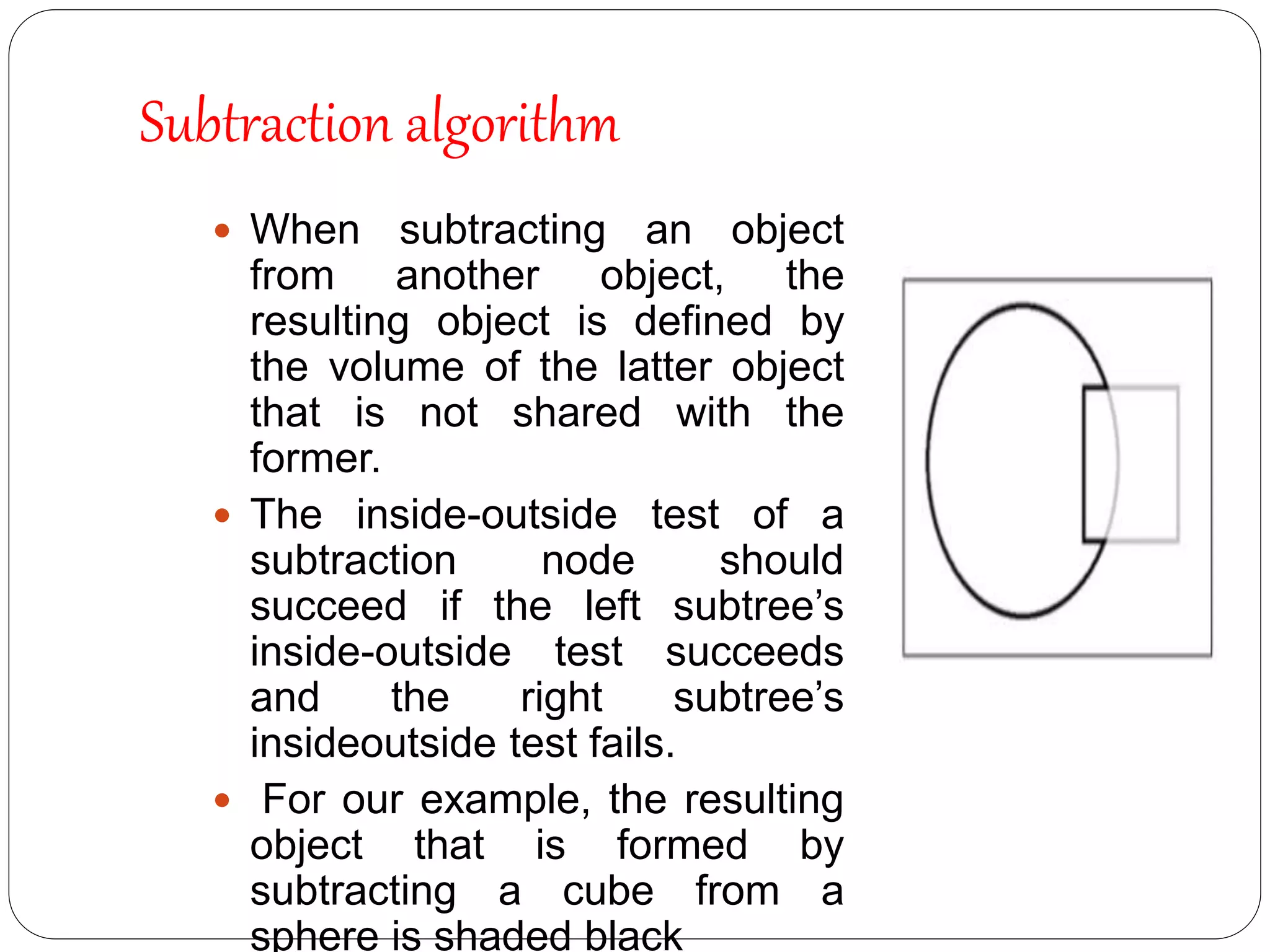
 When subtracting an object
from another object, the
resulting object is defined by
the volume of the latter object
that is not shared with the
former.
 The inside-outside test of a
subtraction node should
succeed if the left subtree’s
inside-outside test succeeds
and the right subtree’s
insideoutside test fails.
 For our example, the resulting
object that is formed by
subtracting a cube from a
sphere is shaded black
Subtraction algorithm
 The union of two objects
is defined as the points
in space that are
enclosed by either of
the objects.
 The grey surfaces in
this figure define the
intersection of the two
objects.
Union algorithm
 A CSG tree can be converted to a normal form by
repeatedly applying the following set of production rules to
the tree. These production rules make use of the
associative and distributive properties of boolean
operations:
 1. X −(Y ∪Z)→(X −Y)−Z
 2. X ∩(Y ∪Z)→(X ∩Y)∪(X ∩Z)
 3. X −(Y ∩Z)→(X −Y)∪(X −Z)
 4. X ∩(Y ∩Z)→(X ∩Y)∩Z
 5. X −(Y −Z)→(X −Y)∪(X ∩Z)
 6. X ∩(Y −Z)→(X ∩Y)−Z
 7. (X −Y)∩Z →(X ∩Z)−Y
 8. (X ∪Y)−Z →(X −Z)∪(Y −Z)
 9. (X ∪Y)∩Z →(X ∩Z)∪(Y ∩Z)
Tree normalization
 The haptic load is defined as the percentage of the
processor time that is needed to perform the haptic
algorithms.
 This haptic load includes (but is not limited to) the time
needed to read the haptic device’s encoders, to
evaluate the haptic scene graph and to sent force
back to the device.
 The PHANToM device drivers, however, include a
utility that visually shows the haptic load. Since this is
the only way to assess the haptic load, this tool is
currently considered a valid means to measure the
performance of haptic algorithms.
analysis of algorithm
 Table 1 compares the
haptic load for empty
scene, object not touched
and object touched by
some pointing device.
 Since an empty scene
requires a haptic load of
±25% and the haptic load
must always be less than
90%, ±65% of the
processor time is still
available for the
calculation of the CSG
Results of algorithm
Applications of haptics technology
 Computer and video games
- Haptics feedback is
commonly used in arcade
games, especially racing
video games.
 Mobile Devices – Tactile
haptics feedback is becoming
common in cellular devices.
 Personal Computers-
Apple’s Macbook and
Macbook pro started
incorporating a “tactile
touch pad” design.
 Virtual Reality – Haptics
are gaining widespread
acceptance as a key part
of virtual reality systems.
Applications of haptics technology
 Medicine – Haptic
interfaces for medical
simulation may prove
especially useful for
training in minimally
invasive procedures such
as laparoscopy and
interventional radiology
as well as for performing
remote surgery.
Applications of haptics technology
 Robotics – Haptic
technology is also
widely used in
teleoperations or
telerobotics.
 Arts and Design –
Haptics is used in
virtual arts, such as
sound syntheisis or
graphic design and
animations.
Applications of haptics technology
 Hologram with haptic
Using this feedback, the user
receives tactile response from
holograph as if it were a real object.
It is based on using ultrasound
waves thereby creating acoustic
radiation pressure. It is through
tactile response that user percieves
the object.
 Haptic in Biometric
The haptic based biometeric
measure the position, velocity
and force. After these
measurements using
algorithms, unique physical
patterns can be developed
which can be used for
identification.
Future Applications
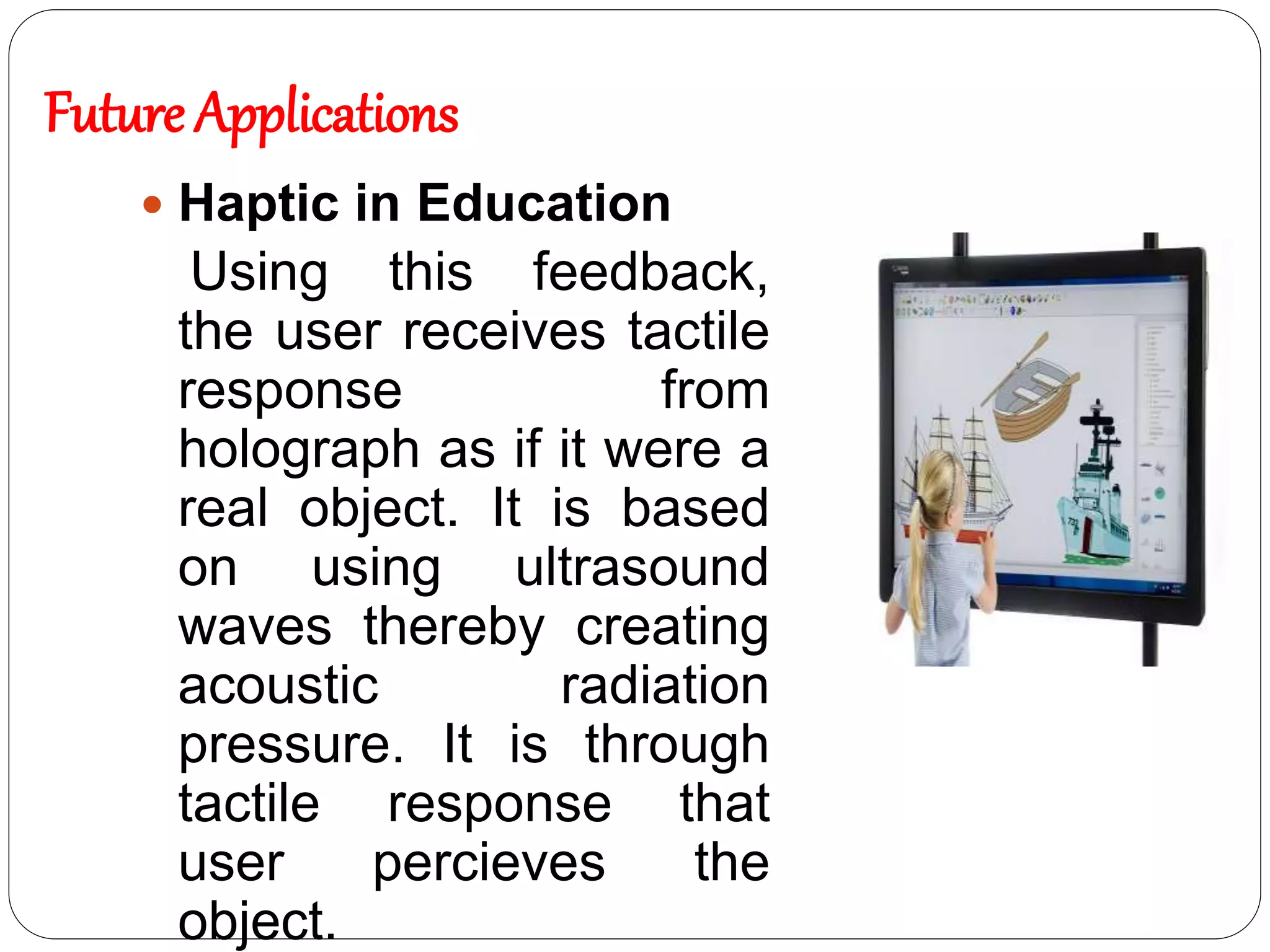
 Haptic in Education
Using this feedback,
the user receives tactile
response from
holograph as if it were a
real object. It is based
on using ultrasound
waves thereby creating
acoustic radiation
pressure. It is through
tactile response that
user percieves the
object.
Future Applications
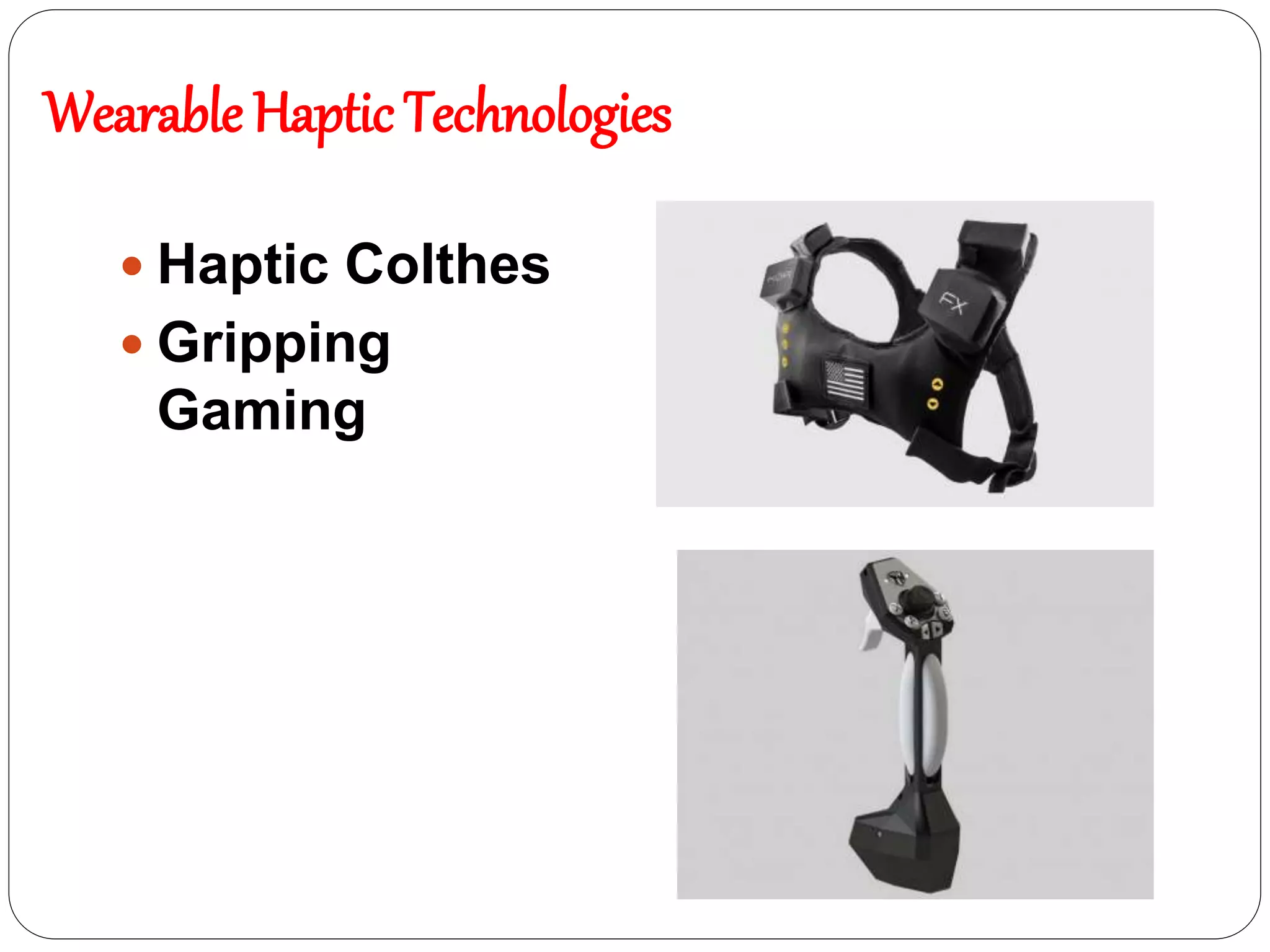
Wearable Haptic Technologies
 Haptic Colthes
 Gripping
Gaming
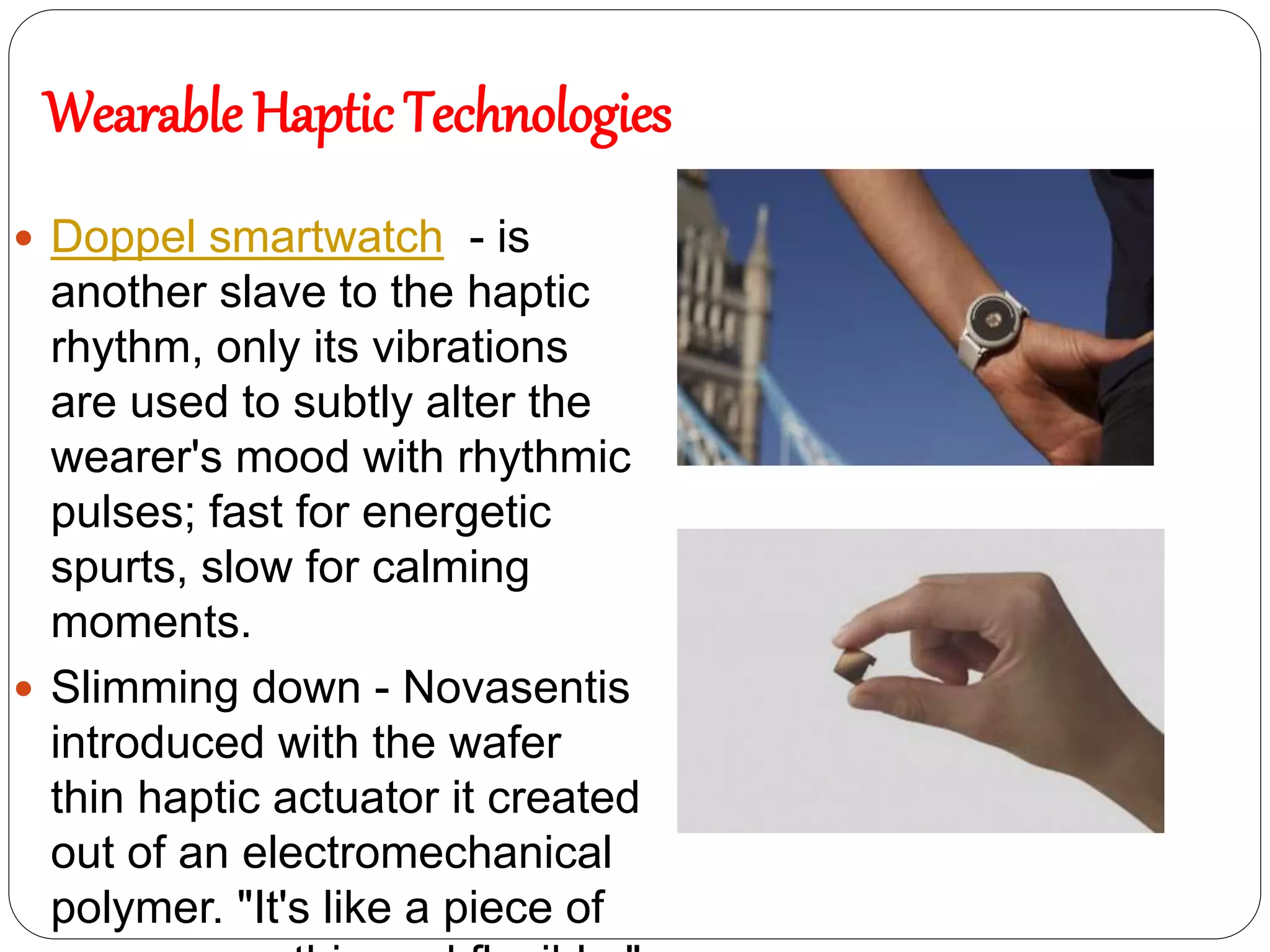
 Doppel smartwatch - is
another slave to the haptic
rhythm, only its vibrations
are used to subtly alter the
wearer's mood with rhythmic
pulses; fast for energetic
spurts, slow for calming
moments.
 Slimming down - Novasentis
introduced with the wafer
thin haptic actuator it created
out of an electromechanical
polymer. "It's like a piece of
Wearable Haptic Technologies
Ultra haptic
. Ultrahaptics has developed a unique
technology that enables users to receive tactile
feedback without needing to wear or touch
anything. The technology uses ultrasound to
project sensations through the air and directly
onto the user. Users can ‘feel’ touch-less
buttons get feedback for mid-air gestures or
interact with virtual objects.
LIMITATIONS
 Hign cost involved
 Large weight and size of haptic
devices(especially wearable one)
 Haptic interfaces can only exert forces with
limited magnitude and not equally well in all
directions.
 Haptic rendering algorithms operate in discrete
time whereas user operate in continuous time.
 Implemented algorithms that are needed for
haptic rendering of a CSG tree.
 These algorithms make use of the same
representation as the graphical rendering
algorithms.
 These algorithms do not make any assumptions
on the primitives, other than that a primitive
renders its surface contact point in a correct
manner.
conclusion

haptic ppt .ppt

  • 1.
    Presented by Mrs. B.Arulmozhi,M.Sc., B.Ed., M.Phil., SET., NET., Assistant Professor and Head, Department of Computer Science and Applications D.K.M. College for Women, Vellore HAPTIC TECHNOLOGIES AND ITS APPLICATIONS
  • 2.
  • 3.
    Introduction – HapticTechnology  Haptics is the technology of adding the sensation of touch and feeling to computers.  “Haptic”, is the term derived from the Greek word, “haptesthai”, which means ‘sense of touch’.  It is defined as the “science of applying tactile sensation to human interaction with computers”.  It permits users to sense (“feel”) and manipulate three dimensional virtual objects with respect to such features as shape, weight, surface textures, and temperature.
  • 4.
    HISTORY  Haptic- Introducedby 20th century researcher in the field of experimental psychology to refer to the active touch of real objects by humans.  In the late 1980s, the term was redefined to enlarge its scope to include all aspects of machine touch and human–machine touch interaction.  Currently, the term has brought together many different disciplines, including biomechanics, psychology, neurophysiology, engineering, and computer science, as the study of human touch and force feedback with the external environment.
  • 5.
    Generation of Haptic First Generation – Use of Electromagnetic Technologies which produce a limited range of sensations.  Second Generation – Touch-Coordinates specific responses allowing the haptic effects to be localized to the position on a screen rather than the whole device.  Third Generation – Delivers both Touch- Coordinate specific responses and customized haptic effects.  Fourth Generation – Pressure Sensitivity, i.e. how hard you press on a flat surface can affect the response.
  • 6.
  • 7.
  • 8.
    1. Cyber grasp 2.Phantominterface Haptics devices
  • 9.
    Haptics Feedback  Hapticsis implemented through different type of interactions with a haptic device communicating with the computer. These interactions can be categorized into the different types of touch sensations a user can receive. •Tactile feedback •Refers to a sensations felt by the skin . •Allow the user to feel things such as the texture of surfaces, temperature and vibration. •Force feedback •It reproduces the directional forces that can result from solild boundaries. •E.g. the weight of virtual object, inertia etc.
  • 10.
     It isthe process of generating and computing forces in response to the user interaction with the virtual object.  The software – controlled haptic virtual objects(HVO) creation process is called haptic rendering(HR).  The control computer(CC) executes HR events (Collision detection, force calculation and generation when necessary) at high rate(one KHz or more). Haptic rendering
  • 11.
     It has3 main blocks 1. Collision detection algorithms 2. Force-response algorithms 3. Control algorithms. Haptic rendering – continue
  • 12.
  • 13.
    HAPTIC RENDERING inCONSTRUCTING 3D OBJECT  Constructive solid geometry (CSG) has proven to be a good metaphor for constructing complex objects.  These complex objects are created by applying boolean operations on simple, mathematical objects.  For instance, a box with a hole can easily be defined as a cylinder subtracted from a box.
  • 14.
    Csg tree  ACSG model consists of a series of primitives and boolean operators, which are grouped into a tree.  Most CSG implementations use the intersection (∩), subtraction (−) and union (∪) operators.  In this CSG tree, the intersection of a cube and a sphere is taken, which results in a rounded cube. Next a hole is created by subtracting a cylinder from
  • 15.
    HAPTIC RENDERING ofCSG TREES  These algorithms either use special hardware with 2 depth buffers or the stencil buffer available on standard OpenGL graphics board.  Our algorithm for rendering CSG trees calculates a surface contact point (SCP) for CSG models. A primitive has to provide two methods in order to be used in a CSG tree: 1. The primitive has to check if a point lies inside or outside its surface. 2. The primitive has to calculate the SCP if the point lies inside its surface. 3. The primitive has to calculate the SCP if the point lies outside its surface.
  • 16.
    INTERSECTION algorithm  Theintersection of two objects is formed by the volume that is shared by these objects.  As a result, only the surfaces that are shaded black in figure have to be felt. The rendering algorithm should ignore the greyed surfaces.
  • 17.
     When subtractingan object from another object, the resulting object is defined by the volume of the latter object that is not shared with the former.  The inside-outside test of a subtraction node should succeed if the left subtree’s inside-outside test succeeds and the right subtree’s insideoutside test fails.  For our example, the resulting object that is formed by subtracting a cube from a sphere is shaded black Subtraction algorithm
  • 18.
     The unionof two objects is defined as the points in space that are enclosed by either of the objects.  The grey surfaces in this figure define the intersection of the two objects. Union algorithm
  • 19.
     A CSGtree can be converted to a normal form by repeatedly applying the following set of production rules to the tree. These production rules make use of the associative and distributive properties of boolean operations:  1. X −(Y ∪Z)→(X −Y)−Z  2. X ∩(Y ∪Z)→(X ∩Y)∪(X ∩Z)  3. X −(Y ∩Z)→(X −Y)∪(X −Z)  4. X ∩(Y ∩Z)→(X ∩Y)∩Z  5. X −(Y −Z)→(X −Y)∪(X ∩Z)  6. X ∩(Y −Z)→(X ∩Y)−Z  7. (X −Y)∩Z →(X ∩Z)−Y  8. (X ∪Y)−Z →(X −Z)∪(Y −Z)  9. (X ∪Y)∩Z →(X ∩Z)∪(Y ∩Z) Tree normalization
  • 20.
     The hapticload is defined as the percentage of the processor time that is needed to perform the haptic algorithms.  This haptic load includes (but is not limited to) the time needed to read the haptic device’s encoders, to evaluate the haptic scene graph and to sent force back to the device.  The PHANToM device drivers, however, include a utility that visually shows the haptic load. Since this is the only way to assess the haptic load, this tool is currently considered a valid means to measure the performance of haptic algorithms. analysis of algorithm
  • 21.
     Table 1compares the haptic load for empty scene, object not touched and object touched by some pointing device.  Since an empty scene requires a haptic load of ±25% and the haptic load must always be less than 90%, ±65% of the processor time is still available for the calculation of the CSG Results of algorithm
  • 22.
    Applications of hapticstechnology  Computer and video games - Haptics feedback is commonly used in arcade games, especially racing video games.  Mobile Devices – Tactile haptics feedback is becoming common in cellular devices.
  • 23.
     Personal Computers- Apple’sMacbook and Macbook pro started incorporating a “tactile touch pad” design.  Virtual Reality – Haptics are gaining widespread acceptance as a key part of virtual reality systems. Applications of haptics technology
  • 24.
     Medicine –Haptic interfaces for medical simulation may prove especially useful for training in minimally invasive procedures such as laparoscopy and interventional radiology as well as for performing remote surgery. Applications of haptics technology
  • 25.
     Robotics –Haptic technology is also widely used in teleoperations or telerobotics.  Arts and Design – Haptics is used in virtual arts, such as sound syntheisis or graphic design and animations. Applications of haptics technology
  • 26.
     Hologram withhaptic Using this feedback, the user receives tactile response from holograph as if it were a real object. It is based on using ultrasound waves thereby creating acoustic radiation pressure. It is through tactile response that user percieves the object.  Haptic in Biometric The haptic based biometeric measure the position, velocity and force. After these measurements using algorithms, unique physical patterns can be developed which can be used for identification. Future Applications
  • 27.
     Haptic inEducation Using this feedback, the user receives tactile response from holograph as if it were a real object. It is based on using ultrasound waves thereby creating acoustic radiation pressure. It is through tactile response that user percieves the object. Future Applications
  • 28.
    Wearable Haptic Technologies Haptic Colthes  Gripping Gaming
  • 29.
     Doppel smartwatch- is another slave to the haptic rhythm, only its vibrations are used to subtly alter the wearer's mood with rhythmic pulses; fast for energetic spurts, slow for calming moments.  Slimming down - Novasentis introduced with the wafer thin haptic actuator it created out of an electromechanical polymer. "It's like a piece of Wearable Haptic Technologies
  • 30.
    Ultra haptic . Ultrahapticshas developed a unique technology that enables users to receive tactile feedback without needing to wear or touch anything. The technology uses ultrasound to project sensations through the air and directly onto the user. Users can ‘feel’ touch-less buttons get feedback for mid-air gestures or interact with virtual objects.
  • 31.
    LIMITATIONS  Hign costinvolved  Large weight and size of haptic devices(especially wearable one)  Haptic interfaces can only exert forces with limited magnitude and not equally well in all directions.  Haptic rendering algorithms operate in discrete time whereas user operate in continuous time.
  • 32.
     Implemented algorithmsthat are needed for haptic rendering of a CSG tree.  These algorithms make use of the same representation as the graphical rendering algorithms.  These algorithms do not make any assumptions on the primitives, other than that a primitive renders its surface contact point in a correct manner. conclusion