Happily Ever After?
Divorce in the Philippine society
◦“The first bond of society
is marriage.”
◦Marcus Tullius Cicero (106-43 B.C.)
Roman statesman and orator
MARRIAGE
◦“socially recognized and
approved union between
individuals, who commit to
one another with the
expectation of a stable and
lasting intimate relationship
(Skolnick, 2005).”
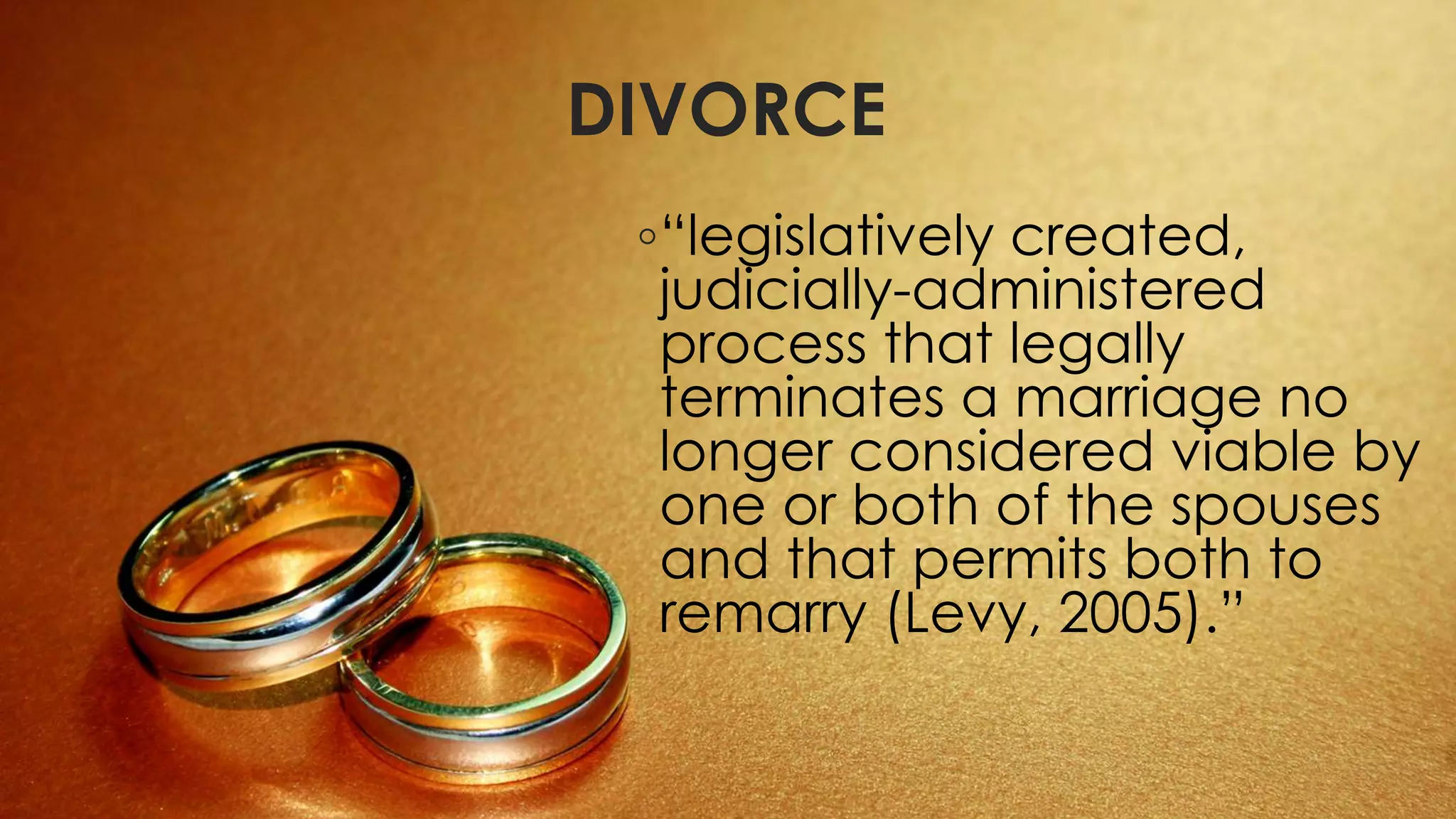
DIVORCE
◦“legislatively created,
judicially-administered
process that legally
terminates a marriage no
longer considered viable by
one or both of the spouses
and that permits both to
remarry (Levy, 2005).”
KEY TERMS
◦ Legal annulment: though rare today, means
the dissolution of marriage in the sense that
the marriage “never happened”.
◦ Children, if any, are considered
legitimate and child support can be
ordered (partners can remarry).
◦ Legal separation: a married couple
separates with a legally recognized
property and custody settlement (but
cannot legally remarry).
◦ Informal separation: a married couple
maintains separate residences (but cannot
legally remarry).
◦ Desertion: one partner leaves without the
other knowing where they live (neither can
remarry).
Divorce: dissolution of
marriage (partners can
remarry).
Divorce, as a legal
concept, rooted from the
history of Britain starting in
1857 as they abolished the
ecclesiastical courts and
rejected the Roman
Catholic origins of English
domestic-relations law
(Levy, 2005).
Blame the British
Filipino Families
today are more
exposed to a growing
number of diverse life
threatening problems
than any other
generation has ever
been.
FILIPINO FAMILY TODAY
DOMESTIC VIOLENCE
PHYSICAL, PSYCHOLOGICAL AND VERBAL ABUSE
INCREASING FRAGILITY OF MARRIAGE.
LEGAL SEPARATION,
DIVORCE, AND ANNULMENT
Differentiating Annulment from Legal Separation
and Divorce
Grounds for Annulment
◦ Minority
◦ Lack of authority of solemnizing officer
◦ Absence of marriage license
◦ Mistake in identity
◦ Incestuous marriages
◦ Void by reason of public policy
◦ Psychological incapacity
Grounds for Legal Separation
◦ Repeated physical violence or grossly abusive conduct
directed against the petitioner, a common child, or a
child of the petitioner;
◦ Physical violence or moral pressure to compel the
petitioner to change religious or political affiliation;
◦ Attempt of respondent to corrupt or induce the
petitioner, a common child, or a child of the petitioner,
to engage in prostitution, or connivance in such
corruption or inducement;
◦ Final judgment sentencing the respondent to
imprisonment of more than six years, even if pardoned;
◦ Drug addiction or habitual alcoholism of the respondent
◦ Lesbianism or homosexuality of the respondent;
◦ Contracting by the respondent of a subsequent
bigamous marriage, whether in or outside the
Philippines;
◦ Sexual infidelity or perversion of the respondent
◦ Attempt on the life of the petitioner by the respondent
◦ Abandonment of petitioner by respondent without
justifiable cause for more than one year
Why the Hiatus?
Status on Divorce Legislation
Why the Hiatus? : Status on
Divorce Legislation
◦ Legislation is the process or act of making law or a set of
laws by the legislative body or governing body in a
country.
◦ Philippines has the Senate and the House of
Representatives. Through this process, all bills are
proposed, ratified and even denied.
◦ One of the most controversial bills to be passed in the
HOR, together with RH bill (passed) and Gay or Same
Sex Marriage and FOI bill.
Why the Hiatus? : Status on
Divorce Legislation
◦ “Divorce” has been present in the Philippines long before the
arrival of the colonist (Spanish, American and Japanese)
◦ After the enactment of Civil Code of the Philippines on June 18,
1949, absolute divorce was prohibited.
◦ Legal separation became the means of separation between
married couples.
◦ Adultery (wife at fault)
◦ Concubinage (husband at fault)
◦ Attempt against the life of the spouse
Why the Hiatus? : Status on
Divorce Legislation
◦ Instances where “Divorces” is ‘allowed’
◦ Revised Family Code
◦ Marriage between Filipino citizen and a foreigner
◦ Divorce can be done abroad by the alien spouse
◦ Code of Muslim and Personal Laws (February 4,
1977) under the Presidential Decree 1083
◦ Allowed divorce or talag but only for MUSLIM
unions between Muslim parties, or when the male
party is a Muslim and the marriage is honored
according to Muslim law and culture
Why the Hiatus? : Status on
Divorce Legislation
◦ Attempts on/against Divorce Bill
◦ 1999-Rep. Manuel C. Ortega’s House Bill No. 6993
◦ 2001- Sen. Rodolfo G. Biazon’s Bill No. 782
◦ - Hon. Bellaflor J. Angara- Castillo’s Bill No. 878
◦ 2005- Rep. Lisa Masa- “the annulment process has been
expensive for most Filipinos and has not been responsive to the
needs of women, particularly the suffering from marital abuse”
◦ 2013- Marikina Rep. Marcelino Teodoro’s “Anti-Divorce and
Unlawful Dissolution of Marriage Act”
Deal or no deal?
The opposing views on the
Divorce Bill
Deal or no deal? The opposing views
on the Divorce Bill
◦ In the Philippines…
◦ There are instances where ‘divorce’ is legal
◦ 80% Catholic
◦ Philippine culture is largely founded on it familial relations
Deal or no deal? The opposing views
on the Divorce Bill
CHURCH
VS.
WOMEN’S RIGHTS ACTIVISTS
Deal or no deal? The opposing views
on the Divorce Bill
◦Church
◦ Why Divorce, when there’s annulment? (Family Code)
◦ Divorce can destroy the very cultural structure of the Philippines
◦ Sabi ni GOD
CBCP for Life
◦ “ensure that absolute divorce remains unacceptable in
the Philippine legal system, and maintains that legal
separation can be availed of by spouses in troubled
marriage, as provided under the Family Code, so they live
independently of each other but without the right to
remarry other persons.” - Anti-Divorce Bill/ HB 37
Deal or no deal? The opposing views
on the Divorce Bill
◦Women’s Rights
◦Psychological, Physical and emotional harm
◦Freedom of marriage and family
Why not Divorce?
The Role of Filipino Cultural Values in the
Society
Close Family Ties
Strong Religious Beliefs
Marital Sacredness
ACCESSIBILITY/VISIBILITY OF PARENTS
STRONG LOYALTY AND FIDELITY
“Ang Pag-aasawa ay Hindi Parang
Susubo ng Mainit na Kanin at
Iluluwa na Lamang Kapag Napaso.”
-Common Filipino Proverb
The End Thank you!

Happily ever after divorce in the philippines

  • 1.
    Happily Ever After? Divorcein the Philippine society
  • 2.
    ◦“The first bondof society is marriage.” ◦Marcus Tullius Cicero (106-43 B.C.) Roman statesman and orator
  • 3.
    MARRIAGE ◦“socially recognized and approvedunion between individuals, who commit to one another with the expectation of a stable and lasting intimate relationship (Skolnick, 2005).”
  • 4.
    DIVORCE ◦“legislatively created, judicially-administered process thatlegally terminates a marriage no longer considered viable by one or both of the spouses and that permits both to remarry (Levy, 2005).”
  • 5.
    KEY TERMS ◦ Legalannulment: though rare today, means the dissolution of marriage in the sense that the marriage “never happened”. ◦ Children, if any, are considered legitimate and child support can be ordered (partners can remarry). ◦ Legal separation: a married couple separates with a legally recognized property and custody settlement (but cannot legally remarry). ◦ Informal separation: a married couple maintains separate residences (but cannot legally remarry). ◦ Desertion: one partner leaves without the other knowing where they live (neither can remarry).
  • 6.
    Divorce: dissolution of marriage(partners can remarry).
  • 7.
    Divorce, as alegal concept, rooted from the history of Britain starting in 1857 as they abolished the ecclesiastical courts and rejected the Roman Catholic origins of English domestic-relations law (Levy, 2005). Blame the British
  • 8.
    Filipino Families today aremore exposed to a growing number of diverse life threatening problems than any other generation has ever been. FILIPINO FAMILY TODAY
  • 9.
  • 10.
  • 11.
  • 12.
    LEGAL SEPARATION, DIVORCE, ANDANNULMENT Differentiating Annulment from Legal Separation and Divorce
  • 13.
    Grounds for Annulment ◦Minority ◦ Lack of authority of solemnizing officer ◦ Absence of marriage license ◦ Mistake in identity ◦ Incestuous marriages ◦ Void by reason of public policy ◦ Psychological incapacity
  • 14.
    Grounds for LegalSeparation ◦ Repeated physical violence or grossly abusive conduct directed against the petitioner, a common child, or a child of the petitioner; ◦ Physical violence or moral pressure to compel the petitioner to change religious or political affiliation; ◦ Attempt of respondent to corrupt or induce the petitioner, a common child, or a child of the petitioner, to engage in prostitution, or connivance in such corruption or inducement;
  • 15.
    ◦ Final judgmentsentencing the respondent to imprisonment of more than six years, even if pardoned; ◦ Drug addiction or habitual alcoholism of the respondent ◦ Lesbianism or homosexuality of the respondent; ◦ Contracting by the respondent of a subsequent bigamous marriage, whether in or outside the Philippines;
  • 16.
    ◦ Sexual infidelityor perversion of the respondent ◦ Attempt on the life of the petitioner by the respondent ◦ Abandonment of petitioner by respondent without justifiable cause for more than one year
  • 17.
    Why the Hiatus? Statuson Divorce Legislation
  • 18.
    Why the Hiatus?: Status on Divorce Legislation ◦ Legislation is the process or act of making law or a set of laws by the legislative body or governing body in a country. ◦ Philippines has the Senate and the House of Representatives. Through this process, all bills are proposed, ratified and even denied. ◦ One of the most controversial bills to be passed in the HOR, together with RH bill (passed) and Gay or Same Sex Marriage and FOI bill.
  • 19.
    Why the Hiatus?: Status on Divorce Legislation ◦ “Divorce” has been present in the Philippines long before the arrival of the colonist (Spanish, American and Japanese) ◦ After the enactment of Civil Code of the Philippines on June 18, 1949, absolute divorce was prohibited. ◦ Legal separation became the means of separation between married couples. ◦ Adultery (wife at fault) ◦ Concubinage (husband at fault) ◦ Attempt against the life of the spouse
  • 20.
    Why the Hiatus?: Status on Divorce Legislation ◦ Instances where “Divorces” is ‘allowed’ ◦ Revised Family Code ◦ Marriage between Filipino citizen and a foreigner ◦ Divorce can be done abroad by the alien spouse ◦ Code of Muslim and Personal Laws (February 4, 1977) under the Presidential Decree 1083 ◦ Allowed divorce or talag but only for MUSLIM unions between Muslim parties, or when the male party is a Muslim and the marriage is honored according to Muslim law and culture
  • 21.
    Why the Hiatus?: Status on Divorce Legislation ◦ Attempts on/against Divorce Bill ◦ 1999-Rep. Manuel C. Ortega’s House Bill No. 6993 ◦ 2001- Sen. Rodolfo G. Biazon’s Bill No. 782 ◦ - Hon. Bellaflor J. Angara- Castillo’s Bill No. 878 ◦ 2005- Rep. Lisa Masa- “the annulment process has been expensive for most Filipinos and has not been responsive to the needs of women, particularly the suffering from marital abuse” ◦ 2013- Marikina Rep. Marcelino Teodoro’s “Anti-Divorce and Unlawful Dissolution of Marriage Act”
  • 22.
    Deal or nodeal? The opposing views on the Divorce Bill
  • 23.
    Deal or nodeal? The opposing views on the Divorce Bill ◦ In the Philippines… ◦ There are instances where ‘divorce’ is legal ◦ 80% Catholic ◦ Philippine culture is largely founded on it familial relations
  • 24.
    Deal or nodeal? The opposing views on the Divorce Bill CHURCH VS. WOMEN’S RIGHTS ACTIVISTS
  • 25.
    Deal or nodeal? The opposing views on the Divorce Bill ◦Church ◦ Why Divorce, when there’s annulment? (Family Code) ◦ Divorce can destroy the very cultural structure of the Philippines ◦ Sabi ni GOD
  • 26.
    CBCP for Life ◦“ensure that absolute divorce remains unacceptable in the Philippine legal system, and maintains that legal separation can be availed of by spouses in troubled marriage, as provided under the Family Code, so they live independently of each other but without the right to remarry other persons.” - Anti-Divorce Bill/ HB 37
  • 27.
    Deal or nodeal? The opposing views on the Divorce Bill ◦Women’s Rights ◦Psychological, Physical and emotional harm ◦Freedom of marriage and family
  • 28.
    Why not Divorce? TheRole of Filipino Cultural Values in the Society
  • 29.
  • 30.
  • 31.
  • 32.
  • 33.
  • 34.
    “Ang Pag-aasawa ayHindi Parang Susubo ng Mainit na Kanin at Iluluwa na Lamang Kapag Napaso.” -Common Filipino Proverb
  • 35.